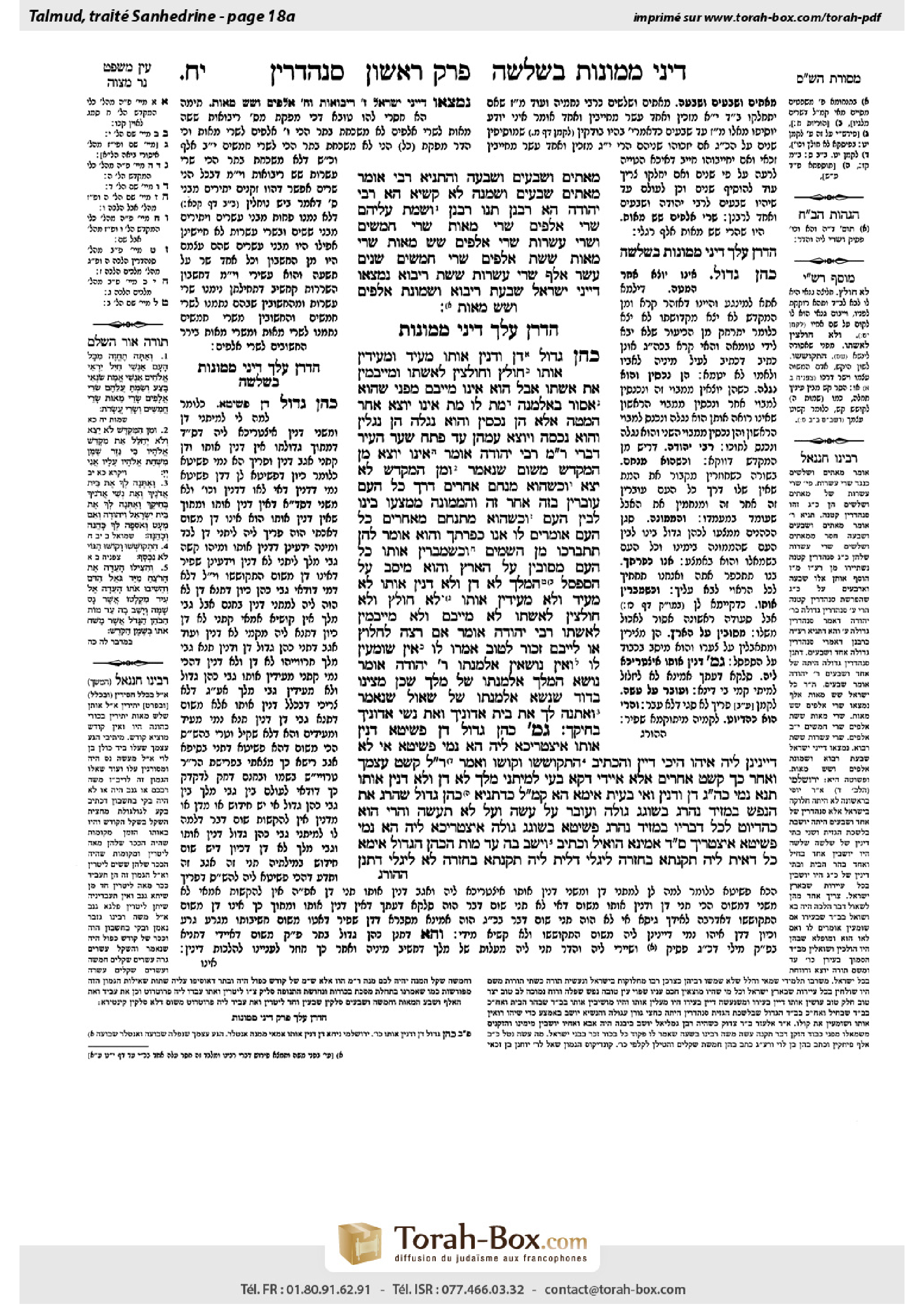
Sanhedrin 18a: Talmud study for Daf Yomi
Daf Yomi is the daily study of one Talmud folio. Explore 37 tractates with scans, Hebrew text, Sefaria English and AI-generated French translations where annotated.
Passage selection and English or AI-generated French translation are available where the scan has annotations. Daf Study is independent of Torah-Box and Sefaria.
Browse Sanhedrin · סנהדרין · All tractatesSanhedrin 18a text and translations
This page of Sanhedrin includes the Aramaic text, an English translation and an AI-generated French translation, alongside the scan above.
סנהדרין י״ח א · Aramaic and Hebrew text
מָאתַיִם וְשִׁבְעִים וְשִׁבְעָה.
וְהָתַנְיָא, רַבִּי אוֹמֵר: מָאתַיִם שִׁבְעִים וּשְׁמֹנָה! לָא קַשְׁיָא: הָא – רַבִּי יְהוּדָה, הָא – רַבָּנַן.
תָּנוּ רַבָּנַן: ״וְשַׂמְתָּ עֲלֵיהֶם שָׂרֵי אֲלָפִים שָׂרֵי מֵאוֹת שָׂרֵי חֲמִשִּׁים וְשָׂרֵי עֲשָׂרֹת״. ״שָׂרֵי אֲלָפִים״ – שֵׁשׁ מֵאוֹת, ״שָׂרֵי מֵאוֹת״ – שֵׁשֶׁת אֲלָפִים, ״שָׂרֵי חֲמִשִּׁים״ – שְׁנֵים עָשָׂר אֶלֶף, ״שָׂרֵי עֲשָׂרוֹת״ – שֵׁשֶׁת רִיבּוֹא. נִמְצְאוּ דַּיָּינֵי יִשְׂרָאֵל שִׁבְעַת רִיבּוֹא וּשְׁמוֹנַת אֲלָפִים וְשֵׁשׁ מֵאוֹת.
הֲדַרַן עֲלָךְ דִּינֵי מָמוֹנוֹת.
מַתְנִי׳ כֹּהֵן גָּדוֹל דָּן וְדָנִין אוֹתוֹ, מֵעִיד וּמְעִידִין אוֹתוֹ, חוֹלֵץ וְחוֹלְצִין לְאִשְׁתּוֹ, וּמְיַיבְּמִין אֶת אִשְׁתּוֹ. אֲבָל הוּא אֵינוֹ מְיַיבֵּם, מִפְּנֵי שֶׁהוּא אָסוּר בָּאַלְמָנָה.
מֵת לוֹ מֵת, אֵינוֹ יוֹצֵא אַחַר הַמִּטָּה, אֶלָּא הֵן נִכְסִין וְהוּא נִגְלֶה, הֵן נִגְלִין וְהוּא נִכְסֶה, וְיוֹצֵא עִמָּהֶן עַד פֶּתַח שַׁעַר הָעִיר, דִּבְרֵי רַבִּי מֵאִיר.
רַבִּי יְהוּדָה אוֹמֵר: אֵינוֹ יוֹצֵא מִן הַמִּקְדָּשׁ, מִשּׁוּם שֶׁנֶּאֱמַר: ״וּמִן הַמִּקְדָּשׁ לֹא יֵצֵא״.
וּכְשֶׁהוּא מְנַחֵם אֲחֵרִים, דֶּרֶךְ כׇּל הָעָם עוֹבְרִין בְּזֶה אַחַר זֶה, וְהַמְמוּנֶּה מְמַצְּעוֹ בֵּינוֹ לְבֵין הָעָם. וּכְשֶׁהוּא מִתְנַחֵם מֵאֲחֵרִים, כׇּל הָעָם אוֹמְרִים לוֹ: אֲנַחְנוּ כַּפָּרָתְךָ, וְהוּא אוֹמֵר לָהֶן: תִּתְבָּרְכוּ מִן הַשָּׁמַיִם. וּכְשֶׁמַּבְרִין אוֹתוֹ, כׇּל הָעָם מְסוּבִּין עַל הָאָרֶץ, וְהוּא מֵיסֵב עַל הַסַּפְסָל.
הַמֶּלֶךְ לֹא דָּן, וְלֹא דָּנִין אוֹתוֹ, לֹא מֵעִיד וְלֹא מְעִידִין אוֹתוֹ, לֹא חוֹלֵץ וְלֹא חוֹלְצִין לְאִשְׁתּוֹ, לֹא מְיַיבֵּם וְלֹא מְיַיבְּמִין לְאִשְׁתּוֹ. רַבִּי יְהוּדָה אוֹמֵר: אִם רָצָה לַחֲלוֹץ אוֹ לְיַיבֵּם – זָכוּר לַטּוֹב. אָמְרוּ לוֹ: אֵין שׁוֹמְעִין לוֹ.
וְאֵין נוֹשְׂאִין אַלְמְנָתוֹ, רַבִּי יְהוּדָה אוֹמֵר: נוֹשֵׂא הַמֶּלֶךְ אַלְמְנָתוֹ שֶׁל מֶלֶךְ, שֶׁכֵּן מָצִינוּ בְּדָוִד שֶׁנָּשָׂא אַלְמְנָתוֹ שֶׁל שָׁאוּל, שֶׁנֶּאֱמַר: ״וָאֶתְּנָה לְךָ אֶת בֵּית אֲדֹנֶיךָ וְאֶת נְשֵׁי אֲדֹנֶיךָ בְּחֵיקֶךָ״.
גְּמָ׳ כֹּהֵן גָּדוֹל דָּן. פְּשִׁיטָא! דָּנִין אוֹתוֹ אִיצְטְרִיכָא לֵיהּ. הָא נָמֵי פְּשִׁיטָא: אִי לָא דָּיְינִינַן לֵיהּ, אִיהוּ הֵיכִי דָּיֵין? וְהָכְתִיב ״הִתְקוֹשְׁשׁוּ וָקוֹשּׁוּ״, וְאָמַר רֵישׁ לָקִישׁ: קְשֹׁט עַצְמְךָ וְאַחַר כָּךְ קְשֹׁט אֲחֵרִים.
אֶלָּא, אַיְּידֵי דְּקָא בָּעֵי לְמִיתְנֵי מֶלֶךְ לֹא דָּן וְלֹא דָּנִין אוֹתוֹ, תְּנָא נָמֵי כֹּהֵן גָּדוֹל דָּן וְדָנִין. וְאִי בָּעֵית אֵימָא, הָא קָא מַשְׁמַע לַן כִּדְתַנְיָא: כֹּהֵן גָּדוֹל שֶׁהָרַג אֶת הַנֶּפֶשׁ בְּמֵזִיד – נֶהֱרָג, בְּשׁוֹגֵג – גּוֹלֶה, וְעוֹבֵר עַל עֲשֵׂה וְעַל לֹא תַעֲשֶׂה, וַהֲרֵי הוּא כְּהֶדְיוֹט לְכׇל דְּבָרָיו.
בְּמֵזִיד נֶהֱרָג – פְּשִׁיטָא! בְּשׁוֹגֵג גּוֹלֶה אִיצְטְרִיכָא לֵיהּ.
הָא נָמֵי פְּשִׁיטָא! אִיצְטְרִיךְ, סָלְקָא דַּעְתָּךְ אָמֵינָא: הוֹאִיל וּכְתִיב ״וְיָשַׁב בָּהּ עַד מוֹת הַכֹּהֵן הַגָּדֹל״, אֵימָא: כֹּל דְּאִית לֵיהּ תַּקַּנְתָּא בַּחֲזָרָה – לִיגְלֵי, דְּלֵית לֵיהּ תַּקַּנְתָּא בַּחֲזָרָה – לָא לִיגְלֵי, דִּתְנַן:
Sanhedrin 18a · English translation
The number of people needed in a city for it to be eligible for a lesser Sanhedrin is 277. This number is based on the opinion of Rabbi Neḥemya, who requires 230 men, but requires an additional 47 men in case it happens that the Sages of the court reach a situation where they are not able to arrive at a verdict, and pairs of judges need to be added, potentially increasing the number of judges on the court from 23 to 70, a maximum of 47 additional judges.
The Gemara asks: But isn’t it taught in a baraita that Rabbi Yehuda HaNasi says: The number of men needed in a city for it to be eligible for a lesser Sanhedrin is 278? The Gemara answers: This is not difficult. This baraita that said Rabbi Yehuda HaNasi requires 277 residents is stated in accordance with the opinion of Rabbi Yehuda, who holds that there are 70 judges on the Great Sanhedrin, and this baraita that quoted the number as 278 is stated in accordance with the opinion of the Rabbis, who hold that there are 71.
Apropos the opinion of Rabbi Neḥemya, which links the issue of the lesser Sanhedrin with the appointment of the ministers in the wilderness, the Gemara relates: The Sages taught: The verse states: “And place over them ministers of thousands, ministers of hundreds, ministers of fifties, and ministers of tens” (Exodus 18:21). The number of ministers of thousands was 600, as there were 600,000 men in total; the number of ministers of hundreds was 6,000; of ministers of fifties, 12,000, and of ministers of tens, 60,000. Therefore, it is found that the total number of judges of the Jewish people was 78,600, and suitable people were found to fill all of these positions.
MISHNA: The High Priest judges others if he is sufficiently wise, and others judge him when he transgresses. He testifies before the court and others testify concerning him. He performs ḥalitza with his brother’s widow and his brother performs ḥalitza with his wife; and his brother consummates levirate marriage with his wife. But he does not consummate levirate marriage with his brother’s widow, because it is prohibited for him to marry a widow (see Leviticus 21:14), and can therefore never fulfill the mitzva of levirate marriage, as a yevama is by definition a widow.
If a relative of the High Priest dies, he does not follow the bier carrying the corpse, since it is prohibited for the High Priest to become ritually impure even for immediate relatives (see Leviticus 21:11). Rather, once the members of the funeral procession are concealed from sight by turning onto another street, he is revealed on the street they departed, and when they are revealed, then he is concealed, and in this way, he goes out with them until the entrance of the gate of the city, from where they would take out the corpse, since the dead were not buried in Jerusalem. This is the statement of Rabbi Meir.
Rabbi Yehuda says: He does not emerge from the Temple at all for the burial of his relatives, as it is stated: “And from the Temple he shall not emerge and will not desecrate the Temple of his God; for the separateness of the oil of the anointment of his God is on him” (Leviticus 21:12).
The mishna continues: And when he consoles others in their mourning when they return from burial, the way of all the people is that they pass by one after another and the mourners stand in a line and are consoled, and the appointed person stands in the middle, between the High Priest and the people. And when he is consoled by others in his mourning, all the people say to him: We are your atonement. And he says to them: May you be blessed from Heaven. And when they comfort him with the first meal after the burial of one of his relatives, all the people recline on the ground as if they are taking his mourning on themselves, and he reclines on the bench out of respect for his status as High Priest.
The mishna continues, enumerating the halakhot pertaining to the king in similar matters: The king does not judge others as a member of a court and others do not judge him, he does not testify and others do not testify concerning him, he does not perform ḥalitza with his brother’s widow and his brother does not perform ḥalitza with his wife, and he does not consummate levirate marriage with his brother’s widow and his brother does not consummate levirate marriage with his wife, as all these actions are not fitting to the honor of his office. Rabbi Yehuda says: These are not restrictions, but his prerogative: If he desired to perform ḥalitza or to consummate levirate marriage, he is remembered for good, as this is to the benefit of his brother’s widow. The Sages said to him: They do not listen to him if he desires to do so, as this affects not only his own honor but that of the kingdom.
And no one may marry a king’s widow, due to his honor. Rabbi Yehuda says: Another king may marry the widow of a king, as we found that King David married the widow of King Saul, as it is stated: “And I have given you the house of your master and the wives of your master in your bosom” (II Samuel 12:8).
GEMARA: The mishna teaches that the High Priest judges others as a member of a court. The Gemara asks: Isn’t that obvious? Why would one think that he would be unfit to serve as a judge? The Gemara answers: It was necessary for the mishna to mention the latter clause: And others judge him, and therefore, it taught the related halakha with it. The Gemara objects: This is also obvious; if others do not judge him, how can he judge others? But isn’t it written: “Gather yourselves together, yea, gather together [hitkosheshu vakoshu]” (Zephaniah 2:1); and Reish Lakish says: This verse teaches a moral principle: Adorn [kashet] yourself first, and then adorn others, i.e., one who is not subject to judgment may not judge others.
Rather, neither halakha concerning the High Priest is a novelty. But since the tanna wants to teach that the king does not judge others and others do not judge him, he also taught that the High Priest judges others and others judge him. And if you wish, say instead that this teaches us the halakha as it is taught in a baraita (Tosefta 4:1): A High Priest who killed a person intentionally is killed; if he killed unintentionally, he is exiled to a city of refuge, and he transgresses a positive mitzva and a prohibition, and he is like an ordinary person concerning all of his halakhot.
The Gemara analyzes the baraita: A High Priest who killed another intentionally is killed. Isn’t that obvious? Why would he be punished differently than other murderers? It was necessary for it to mention the latter clause: If he killed unintentionally, he is exiled, so it taught the related case with it.
The Gemara objects: This is also obvious. The Gemara responds: It was necessary for the baraita to state the latter clause, lest it enter your mind to say: Since it is written about one who kills unintentionally and is exiled to a city of refuge: “And he should dwell in it until the death of the High Priest” (Numbers 35:25), say: Anyone for whom there is a rectification by returning from the city of refuge is exiled, but one for whom there is no rectification by returning is not exiled. The High Priest has no such rectification, as we learned in a mishna (Makkot 11b):
Sanhedrin 18a · Traduction française (IA)
Le nombre d’habitants qu’une ville doit compter pour pouvoir avoir un petit Sanhédrin est de 277. Ce nombre repose sur l’opinion de Rabbi Neḥemya, qui exige 230 hommes, auxquels il faut ajouter 47 hommes au cas où les Sages du tribunal ne pourraient parvenir à un verdict et où il faudrait ajouter des paires de juges, ce qui pourrait faire passer le nombre de juges du tribunal de 23 à 70, soit un maximum de 47 juges supplémentaires.
La Guemara demande : Mais n’enseigne-t-on pas dans une baraïta que Rabbi Yehuda HaNassi dit que le nombre d’hommes qu’une ville doit compter pour pouvoir avoir un petit Sanhédrin est de 278 ? La Guemara répond : Il n’y a pas de contradiction. La baraïta qui attribue à Rabbi Yehuda HaNassi le nombre de 277 habitants suit l’opinion de Rabbi Yehuda, selon laquelle le Grand Sanhédrin compte 70 juges ; la baraïta qui donne le nombre de 278 suit l’opinion des Rabbins, selon laquelle il en compte 71.
À propos de l’opinion de Rabbi Neḥemya, qui rattache la question du petit Sanhédrin à la nomination des chefs dans le désert, la Guemara rapporte : Les Sages ont enseigné : Le verset dit : « Établis sur eux des chefs de milliers, des chefs de centaines, des chefs de cinquantaines et des chefs de dizaines » (Exode 18, 21). Il y avait 600 chefs de milliers, puisqu’il y avait au total 600 000 hommes ; 6 000 chefs de centaines ; 12 000 chefs de cinquantaines ; et 60 000 chefs de dizaines. On trouve donc que le nombre total de juges du peuple juif était de 78 600, et qu’il y avait des hommes aptes à occuper tous ces postes.
MICHNA : Le Grand Prêtre juge les autres s’il est suffisamment sage, et les autres le jugent lorsqu’il transgresse. Il témoigne devant le tribunal et d’autres témoignent à son sujet. Il accomplit la ḥalitsa avec la veuve de son frère, et son frère accomplit la ḥalitsa avec son épouse ; son frère contracte un mariage léviratique avec son épouse. Mais lui ne contracte pas de mariage léviratique avec la veuve de son frère, car il lui est interdit d’épouser une veuve (voir Lévitique 21, 14) et il ne peut donc jamais accomplir la mitsva du mariage léviratique, puisqu’une yevama est, par définition, une veuve.
Si un proche du Grand Prêtre meurt, il ne suit pas le cercueil qui porte le défunt, car il lui est interdit de devenir rituellement impur, même pour ses proches immédiats (voir Lévitique 21, 11). Au lieu de cela, lorsque les membres du cortège funèbre disparaissent de sa vue en tournant dans une autre rue, il apparaît dans la rue qu’ils viennent de quitter ; lorsqu’ils réapparaissent, il se dissimule. De cette manière, il les accompagne jusqu’à l’entrée de la porte de la ville, d’où l’on emportait le défunt, car les morts n’étaient pas enterrés à Jérusalem. Telle est la déclaration de Rabbi Meïr.
Rabbi Yehuda dit : Il ne sort pas du Temple pour l’enterrement de ses proches, comme il est dit : « Il ne sortira pas du sanctuaire et ne profanera pas le sanctuaire de son Dieu, car l’huile de l’onction de son Dieu est sur lui » (Lévitique 21, 12).
La Michna poursuit : Lorsqu’il présente ses condoléances à d’autres endeuillés à leur retour de l’enterrement, la coutume est que tout le peuple passe devant eux l’un après l’autre, tandis que les endeuillés se tiennent en rang et reçoivent les condoléances ; la personne désignée se tient au milieu, entre le Grand Prêtre et le peuple. Et lorsque d’autres le consolent dans son deuil, tout le peuple lui dit : « Nous sommes votre expiation. » Il leur répond : « Que le Ciel vous bénisse. » Et lorsqu’ils le réconfortent au premier repas après l’enterrement de l’un de ses proches, tout le peuple s’assied à même le sol, comme s’il prenait son deuil à sa charge, tandis que lui s’assied sur un banc, par respect pour sa dignité de Grand Prêtre.
La Michna poursuit en énumérant les halakhot relatives au roi dans des cas semblables : Le roi ne juge pas les autres en tant que membre d’un tribunal et les autres ne le jugent pas ; il ne témoigne pas et d’autres ne témoignent pas à son sujet ; il n’accomplit pas la ḥalitsa avec la veuve de son frère et son frère n’accomplit pas la ḥalitsa avec son épouse ; il ne contracte pas de mariage léviratique avec la veuve de son frère et son frère ne contracte pas de mariage léviratique avec son épouse, car tous ces actes ne conviennent pas à la dignité de sa fonction. Rabbi Yehuda dit : Ce ne sont pas des restrictions, mais des prérogatives : s’il souhaite accomplir la ḥalitsa ou contracter un mariage léviratique, on se souviendra de lui en bien, car cela est avantageux pour la veuve de son frère. Les Sages lui répondirent : On ne l’écoute pas s’il souhaite agir ainsi, car cela touche non seulement à sa propre dignité, mais aussi à celle de la royauté.
Nul ne peut épouser la veuve d’un roi, par respect pour sa dignité. Rabbi Yehuda dit : Un autre roi peut épouser la veuve d’un roi, comme nous le voyons dans le cas du roi David, qui épousa la veuve du roi Saül, ainsi qu’il est dit : « Je t’ai donné la maison de ton maître et les femmes de ton maître dans ton sein » (II Samuel 12, 8).
GUEMARA : La Michna enseigne que le Grand Prêtre juge les autres en tant que membre d’un tribunal. La Guemara demande : N’est-ce pas évident ? Pourquoi penserait-on qu’il ne serait pas apte à exercer la fonction de juge ? La Guemara répond : Il était nécessaire que la Michna mentionne la clause suivante : « Et les autres le jugent » ; elle a donc enseigné avec elle la halakha qui s’y rapporte. La Guemara objecte : Cela aussi est évident ; si les autres ne le jugent pas, comment pourrait-il juger les autres ? Mais n’est-il pas écrit : « Rassemblez-vous, oui, rassemblez-vous [hitkosheshu vakoshu] » (Sophonie 2, 1) ? Et Reish Lakish dit que ce verset enseigne un principe moral : « Pare-toi [kashet] d’abord, puis pare les autres », c’est-à-dire que celui qui n’est pas soumis au jugement ne peut pas juger les autres.
En réalité, aucune des deux halakhot concernant le Grand Prêtre n’apporte de nouveauté. Mais puisque le tanna veut enseigner que le roi ne juge pas les autres et que les autres ne le jugent pas, il enseigne également que le Grand Prêtre juge les autres et que les autres le jugent. Et si tu préfères, dis plutôt que cela nous enseigne la halakha énoncée dans une baraïta (Tossefta 4, 1) : Un Grand Prêtre qui a tué intentionnellement est mis à mort ; s’il a tué involontairement, il est exilé dans une ville de refuge ; il transgresse une mitsva positive et une interdiction, et il est considéré comme un homme ordinaire pour toutes ses halakhot.
La Guemara analyse la baraïta : Un Grand Prêtre qui a tué une autre personne intentionnellement est mis à mort. N’est-ce pas évident ? Pourquoi serait-il puni différemment des autres meurtriers ? Il était nécessaire de mentionner la clause suivante : « S’il a tué involontairement, il est exilé » ; la baraïta a donc enseigné avec elle le cas qui s’y rapporte.
La Guemara objecte : Cela aussi est évident. La Guemara répond : Il était nécessaire que la baraïta mentionne la clause suivante, de peur que tu en viennes à penser : Puisqu’il est écrit au sujet de celui qui tue involontairement et est exilé dans une ville de refuge : « Il y demeurera jusqu’à la mort du Grand Prêtre » (Nombres 35, 25), dis-toi : Toute personne pour laquelle le retour de la ville de refuge constitue une réparation est exilée, mais celle pour laquelle ce retour ne constitue pas une réparation n’est pas exilée. Or, le Grand Prêtre ne bénéficie pas d’une telle réparation, comme nous l’avons appris dans une Michna (Makkot 11b) :
Traduction française générée par IA à partir de l’édition anglaise de Sefaria. Vérifie toujours un passage avec le texte source.
Text from Sefaria: William Davidson Edition - Vocalized Aramaic (CC BY NC); William Davidson Edition - English (CC BY NC).