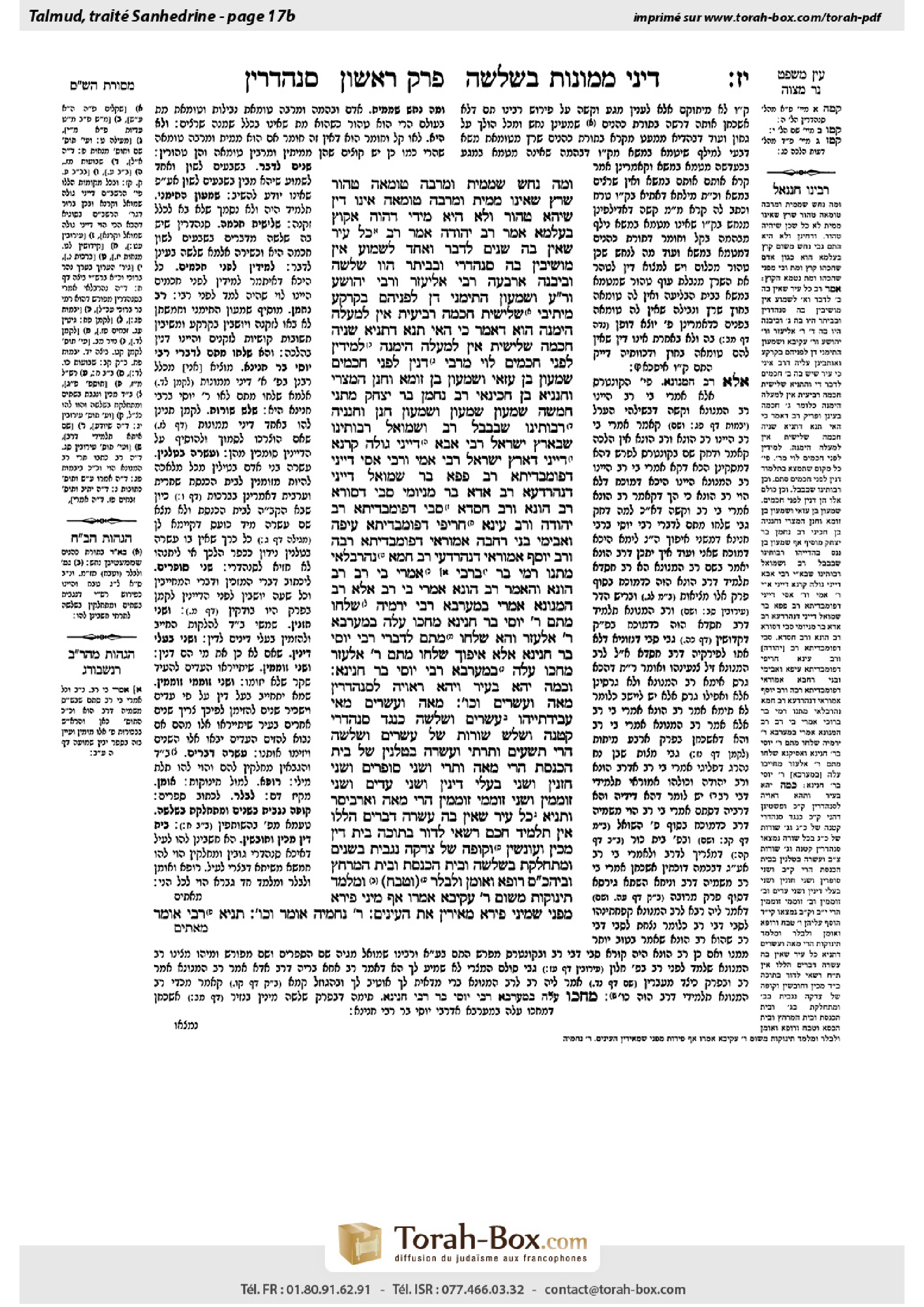
Sanhedrin 17b: Talmud study for Daf Yomi
Daf Yomi is the daily study of one Talmud folio. Explore 37 tractates with scans, Hebrew text, Sefaria English and AI-generated French translations where annotated.
Passage selection and English or AI-generated French translation are available where the scan has annotations. Daf Study is independent of Torah-Box and Sefaria.
Browse Sanhedrin · סנהדרין · All tractatesSanhedrin 17b text and translations
This page of Sanhedrin includes the Aramaic text, an English translation and an AI-generated French translation, alongside the scan above.
סנהדרין י״ז ב · Aramaic and Hebrew text
וּמָה נָחָשׁ שֶׁמֵּמִית וּמַרְבֶּה טוּמְאָה, טָהוֹר; שֶׁרֶץ שֶׁאֵינוֹ מֵמִית וּמַרְבֶּה טוּמְאָה, אֵינוֹ דִּין שֶׁיְּהֵא טָהוֹר? וְלָא הִיא, מִידֵּי דְּהָוֵה אַקּוֹץ בְּעָלְמָא.
אָמַר רַב יְהוּדָה אָמַר רַב: כׇּל עִיר שֶׁאֵין בָּהּ שְׁנַיִם לְדַבֵּר וְאֶחָד לִשְׁמוֹעַ, אֵין מוֹשִׁיבִין בָּהּ סַנְהֶדְרִי. וּבְבֵיתֵּר הֲווֹ שְׁלֹשָׁה, וּבְיַבְנֶה אַרְבָּעָה: רַבִּי אֱלִיעֶזֶר וְרַבִּי יְהוֹשֻׁעַ וְרַבִּי עֲקִיבָא, וְשִׁמְעוֹן הַתִּימְנִי דָּן לִפְנֵיהֶם בַּקַּרְקַע.
מֵיתִיבִי: שְׁלִישִׁית – חֲכָמָה, רְבִיעִית – אֵין לְמַעְלָה הֵימֶנָּה. הוּא דְּאָמַר כִּי הַאי תַּנָּא, דְּתַנְיָא: שְׁנִיָּה – חֲכָמָה, שְׁלִישִׁית – אֵין לְמַעְלָה הֵימֶנָּה.
לְמֵידִין לִפְנֵי חֲכָמִים – לֵוִי מֵרַבִּי. דָּנִין לִפְנֵי חֲכָמִים – שִׁמְעוֹן בֶּן עַזַּאי, וְשִׁמְעוֹן בֶּן זוֹמָא, וְחָנָן הַמִּצְרִי, וַחֲנַנְיָא בֶּן חֲכִינַאי. רַב נַחְמָן בַּר יִצְחָק מַתְנֵי חֲמִשָּׁה: שִׁמְעוֹן, שִׁמְעוֹן, וְשִׁמְעוֹן, חָנָן, וַחֲנַנְיָה.
רַבּוֹתֵינוּ שֶׁבְּבָבֶל – רַב וּשְׁמוּאֵל. רַבּוֹתֵינוּ שֶׁבְּאֶרֶץ יִשְׂרָאֵל – רַבִּי אַבָּא. דַּיָּינֵי גוֹלָה – קַרְנָא. דַּיָּינֵי דְּאֶרֶץ יִשְׂרָאֵל – רַבִּי אַמֵּי וְרַבִּי אַסִּי. דַּיָּינֵי דְּפוּמְבְּדִיתָא – רַב פָּפָּא בַּר שְׁמוּאֵל. דַּיָּינֵי דִּנְהַרְדְּעָא – רַב אַדָּא בַּר מִנְיוֹמֵי. סָבֵי דְּסוּרָא – רַב הוּנָא וְרַב חִסְדָּא. סָבֵי דְּפוּמְבְּדִיתָא – רַב יְהוּדָה וְרַב עֵינָא. חֲרִיפֵי דְּפוּמְבְּדִיתָא – עֵיפָה וַאֲבִימִי בְּנֵי רַחֲבָה. אָמוֹרָאֵי דְּפוּמְבְּדִיתָא – רַבָּה וְרַב יוֹסֵף. אָמוֹרָאֵי דִּנְהַרְדָּעֵי – רַב חָמָא.
נְהַרְבְּלָאֵי מַתְנוּ – רָמֵי בַּר בְּרַבִּי. אָמְרִי בֵּי רַב – רַב הוּנָא. וְהָאָמַר רַב הוּנָא: ״אָמְרִי בֵּי רַב״! אֶלָּא, רַב הַמְנוּנָא. אָמְרִי בְּמַעְרְבָא – רַבִּי יִרְמְיָה. שְׁלַחוּ מִתָּם – רַבִּי יוֹסֵי בַּר חֲנִינָא. מַחֲכוּ עֲלַהּ בְּמַעְרְבָא – רַבִּי אֶלְעָזָר.
וְהָא שְׁלַחוּ מִתָּם: לְדִבְרֵי רַבִּי יוֹסֵי בַּר חֲנִינָא! אֶלָּא אֵיפוֹךְ: שְׁלַחוּ מִתָּם – רַבִּי אֶלְעָזָר; מַחֲכוּ עֲלַהּ בְּמַעְרְבָא – רַבִּי יוֹסֵי בַּר חֲנִינָא.
וְכַמָּה יְהֵא בָּעִיר וִיהֵא רְאוּיָה לְסַנְהֶדְרִין? מֵאָה וְעֶשְׂרִים וְכוּ׳. מֵאָה וְעֶשְׂרִים מַאי עֲבִידְתַּיְיהוּ? עֶשְׂרִים וּשְׁלֹשָׁה כְּנֶגֶד סַנְהֶדְרִי קְטַנָּה, וְשָׁלֹשׁ שׁוּרוֹת שֶׁל עֶשְׂרִים וּשְׁלֹשָׁה – הֲרֵי תִּשְׁעִים וְתַרְתֵּי, וַעֲשָׂרָה בַּטְלָנִין שֶׁל בֵּית הַכְּנֶסֶת – הֲרֵי מְאָה וּתְרֵי.
וּשְׁנֵי סוֹפְרִים, וּשְׁנֵי חַזָּנִין, וּשְׁנֵי בַּעֲלֵי דִינִין, וּשְׁנֵי עֵדִים, וּשְׁנֵי זוֹמְמִין, וּשְׁנֵי זוֹמְמֵי זוֹמְמִין – הֲרֵי מְאָה וְאַרְבֵּיסַר.
וְתַנְיָא: כׇּל עִיר שֶׁאֵין בָּהּ עֲשָׂרָה דְּבָרִים הַלָּלוּ אֵין תַּלְמִיד חָכָם רַשַּׁאי לָדוּר בְּתוֹכָהּ: בֵּית דִּין מַכִּין וְעוֹנְשִׁין, וְקוּפָּה שֶׁל צְדָקָה נִגְבֵּית בִּשְׁנַיִם וּמִתְחַלֶּקֶת בִּשְׁלֹשָׁה, וּבֵית הַכְּנֶסֶת, וּבֵית הַמֶּרְחָץ, וּבֵית הַכִּסֵּא, רוֹפֵא, וְאוּמָּן, וְלַבְלָר, וְטַבָּח, וּמְלַמֵּד תִּינוֹקוֹת. מִשּׁוּם רַבִּי עֲקִיבָא אָמְרוּ: אַף מִינֵי פֵירָא, מִפְּנֵי שֶׁמִּינֵי פֵירָא מְאִירִין אֶת הָעֵינַיִם.
רַבִּי נְחֶמְיָה אוֹמֵר וְכוּ׳. תַּנְיָא, רַבִּי אוֹמֵר:
Sanhedrin 17b · English translation
If a snake, which kills other creatures whose carcasses are impure and thereby increases impurity in the world, is itself nevertheless pure, as it is not included in the list of impure creeping animals, then concerning a creeping animal that does not kill and does not increase impurity, isn’t it logical that it should be pure? This argument is rejected: But it is not so; the logic of the halakha of a creeping animal is just as it is concerning the halakha with regard to an ordinary thorn, which can injure people or animals and can even kill and thereby increase impurity, but is nevertheless pure. It is therefore apparent that this consideration is not relevant to the halakhot of impurity.
§ Rav Yehuda says that Rav says: With regard to any city that does not have among its residents two men who are able to speak all seventy languages and one additional man who is able to listen to and understand statements made in all the languages, even if he cannot speak all of them, they do not place a lesser Sanhedrin there. The members of the Sanhedrin do not all need to know all of the languages, but there must be at least this minimum number. And in Beitar there were three individuals who were able to speak all seventy languages, and in Yavne there were four, and they were: Rabbi Eliezer, and Rabbi Yehoshua, and Rabbi Akiva, and Shimon HaTimni, who was not an ordained Sage, and he would therefore deliberate before the other judges while seated on the ground, not among the rows of Sages.
The Gemara raises an objection to this from a baraita: A third, i.e., a Sanhedrin that has three individuals who can speak all seventy languages, is a wise Sanhedrin, and if it also has a fourth such person, there is no court above it, meaning that there is no need for additional language experts. Apparently the minimum requirement is three people who can speak the languages, not two. The Gemara answers: Rav states his opinion in accordance with the opinion of the following tanna, as it is taught in a baraita: A Sanhedrin that has a second language expert is wise; and if it also has a third, there is no court above it.
§ Since the baraita stated that Shimon HaTimni would deliberate before them on the ground, the Gemara now lists various standard formulations used to introduce the statements of various Sages throughout the generations. If a source says: It was learned from the Sages, the intention is that this was a statement made by the Sage Levi who sat before and learned from Rabbi Yehuda HaNasi. If it says: They deliberated before the Sages, this is referring to Shimon ben Azzai, and Shimon ben Zoma, and Ḥanan the Egyptian, and Ḥananya ben Ḥakhinai. Rav Naḥman bar Yitzḥak would teach five names for this list: Shimon ben Azzai, Shimon ben Zoma, and Shimon HaTimni, Ḥanan the Egyptian, and Ḥananya ben Ḥakhinai.
The expression: Our Rabbis that are in Babylonia, is referring to Rav and Shmuel. The expression: Our Rabbis that are in Eretz Yisrael, is referring to Rabbi Abba. The expression: The judges of the Diaspora, is a reference to the Sage Karna. The phrase: The judges of Eretz Yisrael, is a reference to Rabbi Ami and Rabbi Asi. The phrase: The judges of Pumbedita, is referring to Rav Pappa bar Shmuel, who was the head of the court there, and: The judges of Neharde’a, is a reference to the court headed by Rav Adda bar Minyumi. The term: The Elders of Sura, is referring to Rav Huna and Rav Ḥisda, and: The Elders of Pumbedita, is referring to Rav Yehuda and Rav Eina. The sharp ones of Pumbedita are Eifa and Avimi, the sons of Raḥava. The expression: The amora’im of Pumbedita, is referring to Rabba and Rav Yosef, and the phrase: The amora’im of Neharde’a, is referring to Rav Ḥama.
If it says: The Sages of Neharbela taught, this is referring to Rami bar Berabi, and the statement: They say in the school of Rav, is a reference to Rav Huna. The Gemara asks: But doesn’t Rav Huna sometimes say with regard to a given halakha: They say in the school of Rav? From this, it is apparent that a statement introduced by that formula cannot be made by Rav Huna himself, as Rav Huna quotes someone else with that introduction. The Gemara responds: Rather, the expression: They say in the school of Rav, must be referring to Rav Hamnuna. The formula: They say in the West, i.e., Eretz Yisrael, is referring to Rabbi Yirmeya; the expression: They sent a message from there, meaning from Eretz Yisrael, is referring to Rabbi Yosei bar Ḥanina; and the statement: They laughed at it in the West, means that Rabbi Elazar did not accept a particular opinion.
The Gemara asks: But in one instance it is reported that: They sent a message from there that began: According to the statement of Rabbi Yosei bar Ḥanina. This indicates that the expression: They sent from there, is not itself a reference to a statement of Rabbi Yosei bar Ḥanina. The Gemara answers: Rather, reverse the statements. The phrase: They sent from there, is a reference to Rabbi Elazar, and: They laughed at it in the West, means that Rabbi Yosei bar Ḥanina did not accept a particular opinion.
§ The mishna teaches: And how many men must be in the city for it to be eligible for a lesser Sanhedrin? The opinion of the first tanna is that there must be 120 men. The Gemara asks: What is the relevance of the number 120? The Gemara explains that 23 are needed to correspond to the number of members of the lesser Sanhedrin, and it is necessary for there to be three rows of 23 students who sit before the lesser Sanhedrin to learn and also to advise them; that is a total of 92 people. And since there also need to be 10 idlers of the synagogue, people who are free from urgent work and are always sitting in the synagogue to take care of its repair and the other needs of the public, that would be 102.
And in addition there are two scribes required for the Sanhedrin, and two bailiffs, and two litigants who will come to be judged. And there are two witnesses for one side, and two witnesses who could render those witnesses conspiring witnesses by testifying that they were elsewhere at the time of the alleged incident, and two additional witnesses who could testify against the witnesses who rendered the first witnesses conspiring witnesses, rendering the second pair conspiring witnesses. All of these are necessary in order for a trial to take place, as is described in Deuteronomy 19:15–21. Therefore, there are so far a total of 114 men who must be in the city.
And it is taught in a baraita: A Torah scholar is not permitted to reside in any city that does not have these ten things: A court that has the authority to flog and punish transgressors; and a charity fund for which monies are collected by two people and distributed by three, as required by halakha. This leads to a requirement for another three people in the city. And a synagogue; and a bathhouse; and a public bathroom; a doctor; and a bloodletter; and a scribe [velavlar] to write sacred scrolls and necessary documents; and a ritual slaughterer; and a teacher of young children. With these additional requirements there are a minimum of 120 men who must be residents of the city. They said in the name of Rabbi Akiva: The city must also have varieties of fruit, because varieties of fruit illuminate the eyes.
The mishna teaches that Rabbi Neḥemya says: There must be 230 men in the city in order for it to be eligible for a lesser Sanhedrin, corresponding to the ministers of tens appointed in the wilderness by Moses at the suggestion of his father-in-law, Yitro (see Exodus 18:21). Each member of the Sanhedrin can be viewed as a judge with responsibility for ten men. It is taught in a baraita: Rabbi Yehuda HaNasi says:
Sanhedrin 17b · Traduction française (IA)
Si un serpent, qui tue d’autres créatures dont les carcasses sont impures et accroît ainsi l’impureté dans le monde, est néanmoins pur, puisqu’il ne figure pas dans la liste des animaux rampants impurs, alors, à plus forte raison, un animal rampant qui ne tue pas et n’accroît pas l’impureté n’est-il pas pur ? Cet argument est rejeté : Mais il n’en est pas ainsi. Le raisonnement concernant le statut halakhique d’un animal rampant est le même que celui qui s’applique à une simple épine, qui peut blesser des personnes ou des animaux, voire les tuer, et accroître ainsi l’impureté, tout en étant néanmoins pure. Il apparaît donc que cette considération n’est pas pertinente pour les halakhot relatives à l’impureté.
§ Rav Yehouda dit au nom de Rav : Dans toute ville où ne résident pas deux hommes capables de parler les soixante-dix langues et un homme supplémentaire capable d’écouter et de comprendre des propos exprimés dans toutes ces langues, même s’il ne peut pas toutes les parler, on n’établit pas un petit Sanhédrin. Il n’est pas nécessaire que tous les membres du Sanhédrin connaissent toutes les langues, mais il faut au moins ce nombre minimal. À Beitar, il y avait trois personnes capables de parler les soixante-dix langues, et à Yavné, quatre : Rabbi Eliezer, Rabbi Yehoshoua, Rabbi Akiva et Shimon HaTimni, qui n’était pas un Sage ordonné. Il délibérait donc devant les autres juges, assis par terre et non parmi les rangées de Sages.
La Guemara soulève une objection à partir d’une baraïta : Un Sanhédrin qui compte trois personnes capables de parler les soixante-dix langues est un Sanhédrin sage ; s’il en compte aussi une quatrième, il n’existe pas de tribunal supérieur au sien, c’est-à-dire qu’il n’est pas nécessaire d’y ajouter d’autres experts en langues. Il semble donc que le minimum requis soit de trois personnes capables de parler ces langues, et non de deux. La Guemara répond : Rav exprime son avis conformément à celui du tanna suivant, comme l’enseigne une baraïta : Un Sanhédrin qui compte un deuxième expert en langues est sage ; s’il en compte aussi un troisième, il n’existe pas de tribunal supérieur au sien.
§ Puisque la baraïta a indiqué que Shimon HaTimni délibérait devant eux, assis par terre, la Guemara énumère maintenant diverses formules habituelles servant à introduire les propos de différents Sages au fil des générations. Si une source dit : « Cela a été appris auprès des Sages », il s’agit d’une déclaration du Sage Levi, qui siégeait devant Rabbi Yehouda HaNassi et étudiait auprès de lui. Si elle dit : « Ils délibéraient devant les Sages », cela désigne Shimon ben Azzai, Shimon ben Zoma, Ḥanan l’Égyptien et Ḥananya ben Ḥakhinai. Rav Naḥman bar Yitzḥak donnait cinq noms pour cette liste : Shimon ben Azzai, Shimon ben Zoma, Shimon HaTimni, Ḥanan l’Égyptien et Ḥananya ben Ḥakhinai.
L’expression « nos maîtres qui sont en Babylonie » désigne Rav et Shmouel. L’expression « nos maîtres qui sont en Erets Israël » désigne Rabbi Abba. L’expression « les juges de la Diaspora » fait référence au Sage Karna. L’expression « les juges d’Erets Israël » fait référence à Rabbi Ami et Rabbi Asi. L’expression « les juges de Poumbedita » désigne Rav Pappa bar Shmouel, qui était à la tête du tribunal là-bas, et « les juges de Nehardea » fait référence au tribunal dirigé par Rav Adda bar Minyumi. Le terme « les Anciens de Soura » désigne Rav Houna et Rav Ḥisda, et « les Anciens de Poumbedita » désigne Rav Yehouda et Rav Eina. Les esprits les plus vifs de Poumbedita sont Eifa et Avimi, les fils de Raḥava. L’expression « les amoraïm de Poumbedita » désigne Rabba et Rav Yossef, et « les amoraïm de Nehardea » désigne Rav Ḥama.
Si une source dit : « Les Sages de Neharbela ont enseigné », cela désigne Rami bar Berabi, et l’expression « On dit à l’école de Rav » fait référence à Rav Houna. La Guemara demande : Mais Rav Houna ne dit-il pas parfois, à propos d’une halakha donnée : « On dit à l’école de Rav » ? Il apparaît donc qu’une déclaration introduite par cette formule ne peut pas être de Rav Houna lui-même, puisqu’il cite quelqu’un d’autre en employant cette formule. La Guemara répond : Il faut plutôt comprendre que l’expression « On dit à l’école de Rav » désigne Rav Hamnouna. La formule « On dit en Occident », c’est-à-dire en Erets Israël, désigne Rabbi Yirmeya ; l’expression « On a envoyé un message de là-bas », c’est-à-dire d’Erets Israël, désigne Rabbi Yosei bar Ḥanina ; et la formule « On s’en est moqué en Occident » signifie que Rabbi Elazar n’a pas accepté un avis particulier.
La Guemara demande : Mais, dans un cas, il est rapporté qu’on a envoyé un message de là-bas, qui commençait ainsi : « Selon l’avis de Rabbi Yosei bar Ḥanina ». Cela indique que l’expression « On a envoyé de là-bas » ne fait pas en elle-même référence à une déclaration de Rabbi Yosei bar Ḥanina. La Guemara répond : Il faut plutôt inverser les attributions. L’expression « On a envoyé de là-bas » fait référence à Rabbi Elazar, et « On s’en est moqué en Occident » signifie que Rabbi Yosei bar Ḥanina n’a pas accepté un avis particulier.
§ La Michna enseigne : Combien d’hommes la ville doit-elle compter pour pouvoir accueillir un petit Sanhédrin ? Selon le premier tanna, il faut 120 hommes. La Guemara demande : À quoi correspond le nombre 120 ? La Guemara explique qu’il en faut 23 pour correspondre au nombre de membres du petit Sanhédrin, et qu’il faut également trois rangées de 23 élèves assis devant le petit Sanhédrin pour étudier et aussi le conseiller ; cela fait un total de 92 personnes. Puisqu’il faut également dix personnes disponibles à la synagogue, c’est-à-dire des gens libérés de tout travail urgent, qui sont toujours assis à la synagogue pour veiller à son entretien et aux autres besoins de la collectivité, on arrive à 102.
Il faut en outre deux scribes pour le Sanhédrin, deux huissiers et deux plaideurs qui viendront se faire juger. Il faut aussi deux témoins pour l’une des parties, deux témoins qui pourraient faire de ces premiers témoins des témoins conspirateurs en attestant qu’ils se trouvaient ailleurs au moment de l’incident allégué, ainsi que deux témoins supplémentaires qui pourraient témoigner contre ceux qui ont fait des premiers témoins des témoins conspirateurs, faisant ainsi de cette seconde paire des témoins conspirateurs. Tous ces éléments sont nécessaires pour qu’un procès puisse avoir lieu, comme le décrit Deutéronome 19:15–21. Il faut donc, jusqu’à présent, un total de 114 hommes dans la ville.
Et une baraïta enseigne : Un érudit en Torah n’est pas autorisé à résider dans une ville qui ne compte pas ces dix éléments : un tribunal habilité à flageller et à punir les transgresseurs ; une caisse de charité dont les fonds sont recueillis par deux personnes et distribués par trois, conformément à la halakha. Cela impose la présence de trois personnes supplémentaires dans la ville. Il faut aussi une synagogue, un bain public, des toilettes publiques, un médecin, un saigneur, un scribe [velavlar] chargé d’écrire des rouleaux sacrés et les documents nécessaires, un abatteur rituel et un maître pour les jeunes enfants. Avec ces exigences supplémentaires, la ville doit compter au minimum 120 hommes parmi ses résidents. On a dit au nom de Rabbi Akiva : La ville doit aussi disposer de variétés de fruits, car celles-ci éclairent les yeux.
La Michna enseigne que Rabbi Neḥemya dit : La ville doit compter 230 hommes pour pouvoir accueillir un petit Sanhédrin, en référence aux chefs de dix nommés dans le désert par Moïse, sur la suggestion de son beau-père Yitro (voir Exode 18:21). Chaque membre du Sanhédrin peut être considéré comme un juge ayant la responsabilité de dix hommes. Une baraïta enseigne : Rabbi Yehouda HaNassi dit :
Traduction française générée par IA à partir de l’édition anglaise de Sefaria. Vérifie toujours un passage avec le texte source.
Text from Sefaria: William Davidson Edition - Vocalized Aramaic (CC BY NC); William Davidson Edition - English (CC BY NC).