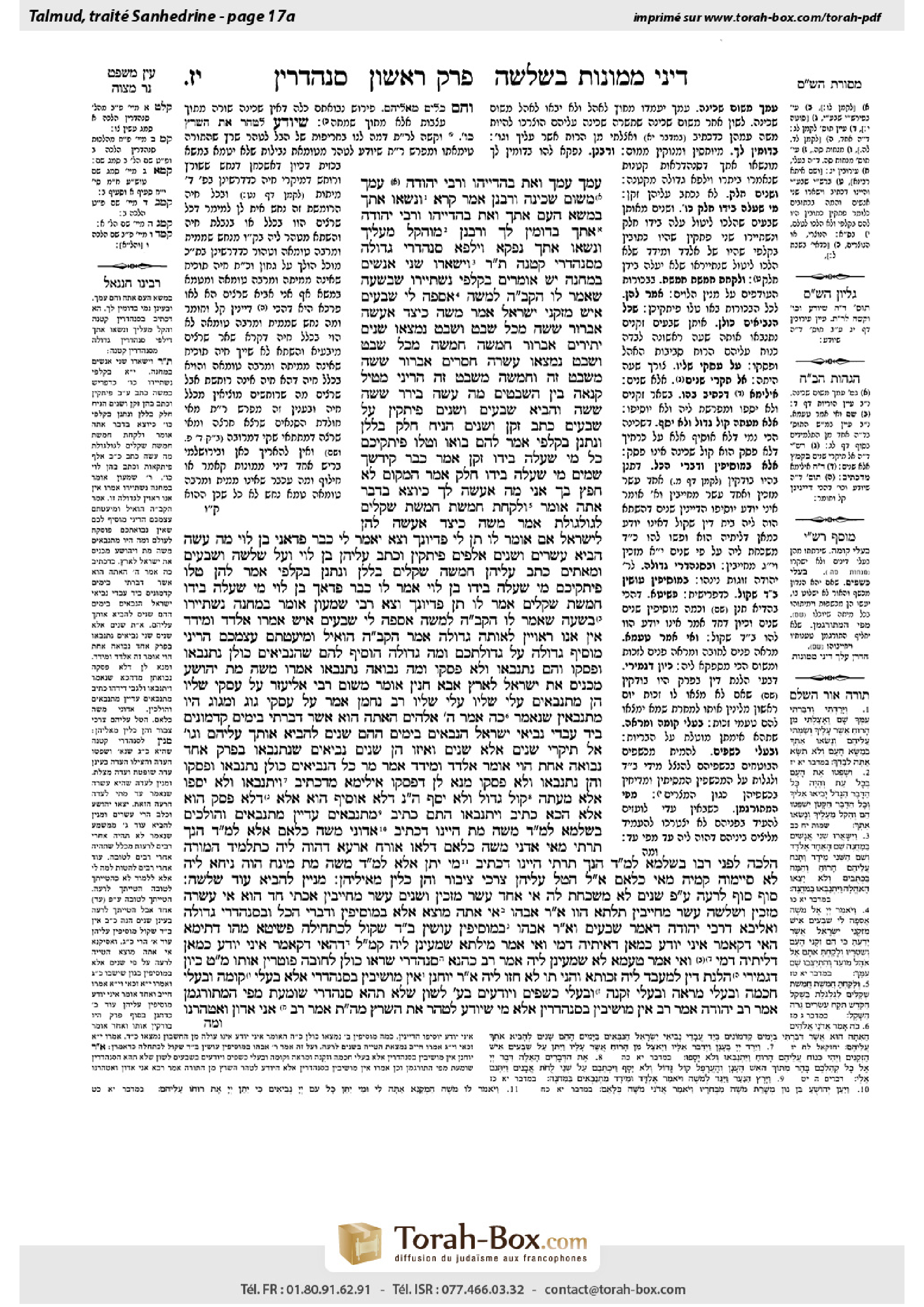
Sanhedrin 17a: Talmud study for Daf Yomi
Daf Yomi is the daily study of one Talmud folio. Explore 37 tractates with scans, Hebrew text, Sefaria English and AI-generated French translations where annotated.
Passage selection and English or AI-generated French translation are available where the scan has annotations. Daf Study is independent of Torah-Box and Sefaria.
Browse Sanhedrin · סנהדרין · All tractatesSanhedrin 17a text and translations
This page of Sanhedrin includes the Aramaic text, an English translation and an AI-generated French translation, alongside the scan above.
סנהדרין י״ז א · Aramaic and Hebrew text
עִמָּךְ״, ״עִמָּךְ״ – וְאַתְּ בַּהֲדַיְיהוּ. וְרַבִּי יְהוּדָה: ״עִמָּךְ״ מִשּׁוּם שְׁכִינָה.
וְרַבָּנַן, אָמַר קְרָא: ״וְנָשְׂאוּ אִתְּךָ בְּמַשָּׂא הָעָם״, ״אִתְּךָ״ – וְאַתְּ בַּהֲדַיְיהוּ. וְרַבִּי יְהוּדָה: ״אִתְּךָ״ – בְּדוֹמִין לָךְ.
וְרַבָּנַן, מִ״וְהָקֵל מֵעָלֶיךָ וְנָשְׂאוּ אִתָּךְ״ נָפְקָא. וְיָלְפָא סַנְהֶדְרִי גְּדוֹלָה מִסַּנְהֶדְרִי קְטַנָּה.
תָּנוּ רַבָּנַן: ״וַיִּשָּׁאֲרוּ שְׁנֵי אֲנָשִׁים בַּמַּחֲנֶה״. יֵשׁ אוֹמְרִים: בַּקַּלְפִּי נִשְׁתַּיְּירוּ.
שֶׁבְּשָׁעָה שֶׁאָמַר לוֹ הַקָּדוֹשׁ בָּרוּךְ הוּא לְמֹשֶׁה: ״אֶסְפָה לִּי שִׁבְעִים אִישׁ מִזִּקְנֵי יִשְׂרָאֵל״, אָמַר מֹשֶׁה: כֵּיצַד אֶעֱשֶׂה? אֶבְרוֹר שִׁשָּׁה מִכׇּל שֵׁבֶט וְשֵׁבֶט – נִמְצְאוּ שְׁנַיִם יְתֵירִים. אֶבְרוֹר חֲמִשָּׁה חֲמִשָּׁה מִכׇּל שֵׁבֶט וְשֵׁבֶט – נִמְצְאוּ עֲשָׂרָה חֲסֵרִים. אֶבְרוֹר שִׁשָּׁה מִשֵּׁבֶט זֶה וַחֲמִשָּׁה מִשֵּׁבֶט זֶה – הֲרֵינִי מֵטִיל קִנְאָה בֵּין הַשְּׁבָטִים.
מָה עָשָׂה? בֵּירַר שִׁשָּׁה שִׁשָּׁה, וְהֵבִיא שִׁבְעִים וּשְׁנַיִם פִּיתְקִין. עַל שִׁבְעִים כָּתַב ״זָקֵן״, וּשְׁנַיִם הִנִּיחַ חָלָק. בְּלָלָן וּנְתָנָן בְּקַלְפִּי. אָמַר לָהֶם: בּוֹאוּ וּטְלוּ פִּיתְקֵיכֶם! כׇּל מִי שֶׁעָלָה בְּיָדוֹ ״זָקֵן״, אָמַר: כְּבָר קִידֶּשְׁךָ שָׁמַיִם. מִי שֶׁעָלָה בְּיָדוֹ חָלָק, אָמַר: הַמָּקוֹם לֹא חָפֵץ בְּךָ, אֲנִי מָה אֶעֱשֶׂה לָךְ?
כְּיוֹצֵא בַּדָּבָר אַתָּה אוֹמֵר: ״וְלָקַחְתָּ חֲמֵשֶׁת חֲמֵשֶׁת שְׁקָלִים לַגֻּלְגֹּלֶת״. אָמַר מֹשֶׁה: כֵּיצַד אֶעֱשֶׂה לָהֶן לְיִשְׂרָאֵל? אִם אוֹמַר לוֹ: תֵּן לִי פִּדְיוֹנְךָ וָצֵא, יֹאמַר לִי: כְּבָר פְּדָאַנִי בֶּן לֵוִי.
מָה עָשָׂה? הֵבִיא עֶשְׂרִים וּשְׁנַיִם אֲלָפִים פִּיתְקִין, וְכָתַב עֲלֵיהֶן ״בֶּן לֵוִי״, וְעַל שְׁלֹשָׁה וְשִׁבְעִים וּמָאתַיִם כָּתַב עֲלֵיהֶן ״חֲמִשָּׁה שְׁקָלִים״. בְּלָלָן וּנְתָנָן בְּקַלְפִּי. אָמַר לָהֶן: טְלוּ פִּיתְקֵיכֶם. מִי שֶׁעָלָה בְּיָדוֹ ״בֶּן לֵוִי״, אָמַר לוֹ: כְּבָר פְּדָאֲךָ בֶּן לֵוִי. מִי שֶׁעָלָה בְּיָדוֹ ״חֲמֵשֶׁת שְׁקָלִים״, אָמַר לוֹ: תֵּן פִּדְיוֹנְךָ וָצֵא.
רַבִּי שִׁמְעוֹן אוֹמֵר: בַּמַּחֲנֶה נִשְׁתַּיְּירוּ. בְּשָׁעָה שֶׁאָמַר לוֹ הַקָּדוֹשׁ בָּרוּךְ הוּא לְמֹשֶׁה ״אֶסְפָה לִּי שִׁבְעִים אִישׁ״, אָמְרוּ אֶלְדָּד וּמֵידָד: אֵין אָנוּ רְאוּיִין לְאוֹתָהּ גְּדוּלָּה. אָמַר הַקָּדוֹשׁ בָּרוּךְ הוּא: הוֹאִיל וּמִיעַטְתֶּם עַצְמְכֶם, הֲרֵינִי מוֹסִיף גְּדוּלָּה עַל גְּדוּלַּתְכֶם. וּמָה גְּדוּלָּה הוֹסִיף לָהֶם? שֶׁהַנְּבִיאִים כּוּלָּן נִתְנַבְּאוּ וּפָסְקוּ, וְהֵם נִתְנַבְּאוּ וְלֹא פָּסְקוּ.
וּמָה נְבוּאָה נִתְנַבְּאוּ? אָמְרוּ: מֹשֶׁה מֵת, יְהוֹשֻׁעַ מַכְנִיס אֶת יִשְׂרָאֵל לָאָרֶץ. אַבָּא חָנִין אוֹמֵר מִשּׁוּם רַבִּי אֱלִיעֶזֶר: עַל עִסְקֵי שְׂלָיו הֵן מִתְנַבְּאִים: עֲלִי שְׂלָיו, עֲלִי שְׂלָיו.
רַב נַחְמָן אָמַר: עַל עִסְקֵי גּוֹג וּמָגוֹג הָיוּ מִתְנַבְּאִין, שֶׁנֶּאֱמַר: ״כֹּה אָמַר ה׳ אֱלֹהִים הַאַתָּה הוּא אֲשֶׁר דִּבַּרְתִּי בְּיָמִים קַדְמוֹנִים בְּיַד עֲבָדַי נְבִיאֵי יִשְׂרָאֵל הַנִּבְּאִים בַּיָּמִים הָהֵם שָׁנִים לְהָבִיא אֹתְךָ עֲלֵיהֶם וְגוֹ׳״. אַל תִּיקְרֵי ״שָׁנִים״ אֶלָּא ״שְׁנַיִם״. אֵילּוּ הֵן שְׁנַיִם נְבִיאִים שֶׁנִּתְנַבְּאוּ בְּפֶרֶק אֶחָד נְבוּאָה אַחַת? הֱוֵי אוֹמֵר: אֶלְדָּד וּמֵידָד.
אָמַר מָר: כׇּל הַנְּבִיאִים כּוּלָּן נִתְנַבְּאוּ וּפָסְקוּ, וְהֵן נִתְנַבְּאוּ וְלֹא פָּסְקוּ. מְנָא לַן דְּפָסְקוּ? אִילֵּימָא מִדִּכְתִיב: ״וַיִּתְנַבְּאוּ וְלֹא יָסָפוּ״? אֶלָּא מֵעַתָּה: ״קוֹל גָּדוֹל וְלֹא יָסָף״ – הָכִי נָמֵי דְּלָא אוֹסֵיף הוּא? אֶלָּא דְּלָא פְּסַק הוּא!
אֶלָּא, הָכָא כְּתִיב: ״וַיִּתְנַבְּאוּ״, הָתָם כְּתִיב: ״מִתְנַבְּאִים״. עֲדַיִין מִתְנַבְּאִים וְהוֹלְכִים.
בִּשְׁלָמָא לְמַאן דְּאָמַר מֹשֶׁה מֵת, הַיְינוּ דִּכְתִיב ״אֲדֹנִי מֹשֶׁה כְּלָאֵם״. אֶלָּא לְמַאן דְּאָמַר הָנָךְ תַּרְתֵּי, מַאי ״אֲדֹנִי מֹשֶׁה כְּלָאֵם״? דְּלָאו אוֹרַח אַרְעָא, דְּהָוֵה לֵיהּ כְּתַלְמִיד הַמּוֹרֶה הֲלָכָה לִפְנֵי רַבּוֹ.
בִּשְׁלָמָא לְמַאן דְּאָמַר הָנָךְ תַּרְתֵּי, הַיְינוּ דִּכְתִיב: ״מִי יִתֵּן״. אֶלָּא לְמַאן דְּאָמַר מֹשֶׁה מֵת, מֵינָח הֲוָה נִיחָא לֵיהּ? לָא סַיְּימוּהָ קַמֵּיהּ.
מַאי ״כְּלָאֵם״? אֲמַר לֵיהּ: הַטֵּל עֲלֵיהֶן צׇרְכֵי צִיבּוּר, וְהֵן כָּלִין מֵאֵילֵיהֶן.
מִנַּיִין לְהָבִיא עוֹד שְׁלֹשָׁה?
סוֹף סוֹף, לְרָעָה עַל פִּי שְׁנַיִם לָא מַשְׁכַּחַתְּ לַהּ. אִי אַחַד עָשָׂר מְזַכִּין וּשְׁנֵים עָשָׂר מְחַיְּיבִין – אַכַּתִּי חַד הוּא. אִי עֲשָׂרָה מְזַכִּין וּשְׁלֹשָׁה עָשָׂר מְחַיְּיבִין – תְּלָתָא הָווּ. אָמַר רַבִּי אֲבָהוּ: אִי אַתָּה מוֹצֵא אֶלָּא בְּמוֹסִיפִין, וְדִבְרֵי הַכֹּל, וּבְסַנְהֶדְרִי גְּדוֹלָה, וְאַלִּיבָּא דְּרַבִּי יְהוּדָה דְּאָמַר שִׁבְעִים.
וְאָמַר רַבִּי אֲבָהוּ: בְּמוֹסִיפִין עוֹשִׂין בֵּית דִּין שָׁקוּל לְכַתְּחִילָּה. פְּשִׁיטָא! מַהוּ דְּתֵימָא: הַאי דְּקָאָמַר ״אֵינִי יוֹדֵעַ״ כְּמַאן דְּאִיתֵיהּ דָּמֵי, וְאִי אָמַר מִילְּתָא – שָׁמְעִינַן לֵיהּ; קָא מַשְׁמַע לַן דְּהַאי דְּקָאָמַר ״אֵינִי יוֹדֵעַ״ כְּמַאן דְּלֵיתֵיהּ דָּמֵי, וְאִי אָמַר טַעְמָא – לָא שָׁמְעִינַן לֵיהּ.
אָמַר רַב כָּהֲנָא: סַנְהֶדְרִי שֶׁרָאוּ כּוּלָּן לְחוֹבָה – פּוֹטְרִין אוֹתוֹ. מַאי טַעְמָא? כֵּיוָן דִּגְמִירִי הֲלָנַת דִּין לְמֶעְבַּד לֵיהּ זְכוּתָא, וְהָנֵי תּוּ לָא חָזוּ לֵיהּ.
אָמַר רַבִּי יוֹחָנָן: אֵין מוֹשִׁיבִין בְּסַנְהֶדְרִי אֶלָּא בַּעֲלֵי קוֹמָה, וּבַעֲלֵי חׇכְמָה, וּבַעֲלֵי מַרְאֶה, וּבַעֲלֵי זִקְנָה, וּבַעֲלֵי כְשָׁפִים, וְיוֹדְעִים בְּשִׁבְעִים לָשׁוֹן – שֶׁלֹּא תְּהֵא סַנְהֶדְרִי שׁוֹמַעַת מִפִּי הַמְתוּרְגְּמָן.
אָמַר רַב יְהוּדָה אָמַר רַב: אֵין מוֹשִׁיבִין בְּסַנְהֶדְרִין אֶלָּא מִי שֶׁיּוֹדֵעַ לְטַהֵר אֶת הַשֶּׁרֶץ מִן הַתּוֹרָה. אָמַר רַב: אֲנִי אָדוּן וַאֲטַהֲרֶנּוּ.
Sanhedrin 17a · English translation
with you” (Numbers 11:16), i.e., they will stand “with you,” and you are to be counted with them, leading to a total number of seventy-one. And Rabbi Yehuda holds that the term “with you” is mentioned due to the Divine Presence that rested on Moses. According to Rabbi Yehuda, Moses was instructed to remain with the seventy Elders in order for the Divine Presence to rest upon them as well. He was not formally part of their court and therefore the number of Sages on the Great Sanhedrin is seventy.
The Gemara asks: And how would the Rabbis respond to this line of reasoning? The Gemara answers: The verse states: “And they shall bear the burden of the people with you” (Numbers 11:17), which indicates: “With you,” and you are to be counted with them. And how would Rabbi Yehuda respond to that? He would explain that the term “with you” means similar to you, meaning, that the Elders appointed to the court had to be of fit lineage and free of blemish, like Moses.
And from where do the Rabbis derive that halakha? They derive it from what was stated with regard to the appointment of the ministers of thousands and the ministers of hundreds: “And they shall make it easier for you, and bear the burden with you” (Exodus 18:22), understanding the term “with you” to mean: Similar to you. And the halakha of the judges of the Great Sanhedrin of seventy is derived from the halakha of the judges of the lesser Sanhedrin, i.e., those ministers, that Moses appointed.
§ Apropos the appointment of the Elders by Moses, the Gemara discusses additional aspects of that event. There were seventy-two candidates for Elder but only seventy were needed. They were chosen by lots with their names put into a box. The Sages taught: The verse states: “And there remained two men in the camp; the name of one was Eldad and the name of the other Medad, and the spirit rested upon them, and they were among those who were written but who did not go out to the tent, and they prophesied in the camp” (Numbers 11:26). Where did they remain? Some say this means they, i.e., their names, remained excluded from those selected from the lots in the box.
The baraita explains: At the time that the Holy One, Blessed be He, said to Moses: “Gather for Me seventy men of the Elders of Israel” (Numbers 11:16), Moses said: How shall I do it? If I select six from each and every tribe, there will be a total of seventy-two, which will be two extra. But if I select five from each and every tribe, there will be a total of sixty, lacking ten. And if I select six from this tribe and five from that tribe, I will bring about envy between the tribes, as those with fewer representatives will resent the others.
What did he do? He selected six from every tribe and he brought seventy-two slips [pitakin]. On seventy of them he wrote: Elder, and he left two of them blank. He mixed them and placed them in the box. He then said to the seventy-two chosen candidates: Come and draw your slips. Everyone whose hand drew up a slip that said: Elder, he said to him: Heaven has already sanctified you. And everyone whose hand drew up a blank slip, he said to him: The Omnipresent does not desire you; what can I do for you?
The Gemara comments: You can say something similar to this to explain the verse about the redemption of the firstborn by the Levites: “Take the Levites in place of all of the firstborn of the children of Israel…and as for the redemption of the 273 of the firstborn of the children of Israel who are in excess over the number of the Levites…you shall take five shekels per head” (Numbers 3:45–47). It can be explained that Moses said: How shall I do this for the Jews? If I say to one of the firstborns: Give me money for your redemption and you may leave, as you are among the 273 extra firstborns, he will say to me: A Levite already redeemed me; what is the reason you think that I am among those who were not redeemed?
What did he do? He brought 22,000 slips (see Numbers 3:39), and he wrote on them: Levite, and on 273 additional ones he wrote: Five shekels. He mixed them up and placed them in a box. He said to them: Draw your slips. Everyone whose hand drew up a slip that said: Levite, he said to him: A Levite already redeemed you. Everyone whose hand drew up a slip that said: Five shekels, he said to him: Pay your redemption money and you may leave.
Rabbi Shimon says: Eldad and Medad remained in the camp, as they did not want to come to the lottery for the Elders. At the time that the Holy One, Blessed be He, said to Moses: Gather for me seventy Elders, Eldad and Medad said: We are not fitting for that level of greatness; we are not worthy of being appointed among the Elders. The Holy One, Blessed be He, said: Since you have made yourselves humble, I will add greatness to your greatness. And what is the greatness that he added to them? It was that all of the prophets, meaning the other Elders, who were given prophecy, prophesied for a time and then stopped prophesying, but they prophesied and did not stop.
Apropos Eldad and Medad being prophets, the Gemara asks: And what prophecy did they prophesy? They said: Moses will die, and Joshua will bring the Jewish people into Eretz Yisrael. Abba Ḥanin says in the name of Rabbi Eliezer: They prophesied about the matter of the quail that came afterward (Numbers 11:31–33), saying: Arise quail, arise quail, and then the quail came.
Rav Naḥman says: They were prophesying about the matter of Gog and Magog, as it is stated with regard to Gog and Magog: “So says the Lord God: Are you the one of whom I spoke in ancient days, through my servants, the prophets of Israel, who prophesied in those days for many years [shanim] that I would bring you against them?” (Ezekiel 38:17). Do not read it as: “Years [shanim]”; rather, read it as: Two [shenayim]. And who are the two prophets who prophesied the same prophecy at the same time? You must say: Eldad and Medad.
The Master says: The baraita said: All of the prophets prophesied and then stopped, but Eldad and Medad prophesied and did not stop. The Gemara asks: From where do we derive that the other prophets stopped prophesying? If we say it is from that which is written about them: “And they prophesied but they did so no more [velo yasafu]” (Numbers 11:25), that is difficult: But if that is so, then concerning that which is stated in relation to the giving of the Torah: “These words the Lord spoke to all your assembly…with a great voice, and it went on no more [velo yasaf]” (Deuteronomy 5:19), so too shall it be understood that the great voice did not continue? Rather, the intention there is that it did not stop, interpreting the word yasafu as related to sof, meaning: End. Consequently, with regard to the seventy Elders as well, the word can be interpreted to mean that they did not stop prophesying.
Rather, the proof is as follows: It is written here with regard to the seventy Elders: “They prophesied” (Numbers 11:25), and it is written there: “Eldad and Medad are prophesying in the camp” (Numbers 11:27), from which it can be derived that they were continuously prophesying.
With regard to the content of Eldad and Medad’s prophecy, the Gemara asks: Granted, according to the one who says their prophecy was that Moses will die, this is the reason for that which is written there: “And Joshua, son of Nun, the servant of Moses from his youth, answered and said: My master Moses, imprison them” (Numbers 11:28), as their prophecy appeared to be a rebellion against Moses. But according to the one who says those other two opinions with regard to the content of the prophecy, according to which their prophecy had no connection to Moses, what is the reason that Joshua said: “My master Moses, imprison them”? The Gemara answers: He said this because it is not proper conduct for them to prophesy publicly in close proximity to Moses, as by doing so they are like a student who teaches a halakha in his teacher’s presence, which is inappropriate.
The Gemara asks: Granted, according to the one who says those other two opinions, this is the reason for that which is written: “And Moses said to him: Are you jealous for my sake? Would that all of the Lord’s people were prophets” (Numbers 11:29). But according to the one who says that Eldad and Medad prophesied that Moses will die and Joshua will bring Israel into the land, would it have been satisfactory to Moses that all of the people of God would utter similar prophecies? The Gemara answers: They did not conclude it before him. Moses was not aware of what they had said, but only that they were prophesying.
The Gemara asks: What is the meaning of: “Imprison them [kela’em]”? The Gemara answers: Joshua said to him: Place responsibility for the needs of the public upon them, so that they will be occupied like the other Elders of Israel and they will cease [kalin] prophesying, on their own. Due to the burden of public responsibility they would not be able to be prophets.
§ The mishna derives the halakha that there are twenty-three judges on a lesser Sanhedrin from the verses: “And the congregation shall judge,” and: “And the congregation shall save” (Numbers 35:24–25). The mishna understands that the term “congregation” is referring to ten judges, so that the two congregations, one in each verse, total twenty judges. The mishna then asks: From where is it derived to bring three more judges to the court? The mishna answers: The implication of the verse: “You shall not follow a multitude to convict” (Exodus 23:2), is that your inclination after a majority to exonerate is not like your inclination after a majority to convict, and a conviction must be by a majority of two.
The Gemara objects: Ultimately, you do not find an occurrence of the inclination for evil according to a majority of two judges. If eleven judges vote to acquit the defendant and twelve vote to convict, this is still only a majority of one, and if ten vote to acquit and thirteen vote to convict, they are a majority of three. With a court of twenty-three judges, there is no possible way to convict with a majority of two. Rabbi Abbahu says: You do not find such a scenario except in a case where they add two additional judges because one of the judges abstained from the deliberation, the other judges are split in their decisions, and the two added judges both vote to convict. And this is a possibility according to all tanna’im, and in a case tried by the Great Sanhedrin according to the opinion of Rabbi Yehuda, who says there are seventy judges on the Great Sanhedrin. With an even number, it is possible to have a majority of two.
And Rabbi Abbahu says: When they add additional judges, they create a court consisting of an even number of judges ab initio. The Gemara asks: Isn’t that obvious? What is the novelty in Rabbi Abbahu’s statement? The Gemara answers: Lest you say: This judge who says: I do not know, is viewed as one who is still there, and if he says something afterward, we listen to him and include him in the count, so there are actually an odd number of judges on the court; therefore, Rabbi Abbahu teaches us that this judge who says: I do not know, is viewed as one who is not still there, and if he says a reason to rule in a certain manner afterward, we do not listen to him. Consequently, the court consists of an even number of judges.
§ Rav Kahana says: In a Sanhedrin where all the judges saw fit to convict the defendant in a case of capital law, they acquit him. The Gemara asks: What is the reasoning for this halakha? It is since it is learned as a tradition that suspension of the trial overnight is necessary in order to create a possibility of acquittal. The halakha is that they may not issue the guilty verdict on the same day the evidence was heard, as perhaps over the course of the night one of the judges will think of a reason to acquit the defendant. And as those judges all saw fit to convict him they will not see any further possibility to acquit him, because there will not be anyone arguing for such a verdict. Consequently, he cannot be convicted.
§ Rabbi Yoḥanan says: They place on the Great Sanhedrin only men of high stature, and of wisdom, and of pleasant appearance, and of suitable age so that they will be respected. And they must also be masters of sorcery, i.e., they know the nature of sorcery, so that they can judge sorcerers, and they must know all seventy languages in order that the Sanhedrin will not need to hear testimony from the mouth of a translator in a case where a witness speaks a different language.
Rav Yehuda says that Rav says: They place on the Sanhedrin only one who knows how to render a carcass of a creeping animal pure by Torah law. The judges on the Sanhedrin must be so skilled at logical reasoning that they could even produce a convincing argument that creeping animals, which the Torah states explicitly are ritually impure, are actually pure. Rav said: I will discuss the halakha of the creeping animal and render it pure, i.e., I am able to demonstrate how it is possible to construct such a proof:
Sanhedrin 17a · Traduction française (IA)
« avec toi » (Nombres 11,16), c’est-à-dire qu’ils se tiendront « avec toi » et que tu seras compté parmi eux, pour atteindre un total de soixante et onze. Rabbi Yehouda, lui, estime que l’expression « avec toi » est mentionnée en raison de la Présence divine qui reposait sur Moïse. Selon Rabbi Yehouda, Moïse devait rester auprès des soixante-dix Anciens afin que la Présence divine repose également sur eux. Il ne faisait pas formellement partie de leur tribunal ; le Grand Sanhédrin compte donc soixante-dix Sages.
La Guemara demande : Et comment les Rabbins répondraient-ils à ce raisonnement ? La Guemara répond : Le verset dit : « Ils porteront avec toi la charge du peuple » (Nombres 11,17), ce qui indique : « avec toi », et tu seras compté parmi eux. Et comment Rabbi Yehouda répondrait-il à cela ? Il expliquerait que l’expression « avec toi » signifie « semblables à toi » : les Anciens nommés au tribunal devaient être de bonne ascendance et exempts de défaut, comme Moïse.
Et d’où les Rabbins tirent-ils cette halakha ? Ils la tirent de ce qui est dit au sujet de la nomination des chefs de milliers et des chefs de centaines : « Ils allégeront ta charge et la porteront avec toi » (Exode 18,22), en comprenant l’expression « avec toi » au sens de « semblables à toi ». La halakha concernant les juges du Grand Sanhédrin de soixante-dix membres est déduite de celle concernant les juges du petit Sanhédrin, c’est-à-dire ces chefs que Moïse avait nommés.
§ À propos de la nomination des Anciens par Moïse, la Guemara examine d’autres aspects de cet événement. Soixante-douze candidats étaient pressentis pour devenir Anciens, mais seuls soixante-dix étaient nécessaires. Ils furent choisis par tirage au sort, leurs noms étant placés dans une boîte. Les Sages ont enseigné : Le verset dit : « Deux hommes étaient restés dans le camp ; l’un s’appelait Eldad et l’autre Medad ; l’esprit reposa sur eux ; ils faisaient partie de ceux qui avaient été inscrits, mais qui n’étaient pas sortis vers la tente, et ils prophétisaient dans le camp » (Nombres 11,26). Où étaient-ils restés ? Certains disent que cela signifie qu’ils étaient restés à l’écart des candidats sélectionnés par tirage au sort dans la boîte, c’est-à-dire que leurs noms n’avaient pas été tirés.
La baraïta explique : Au moment où le Saint, béni soit-Il, dit à Moïse : « Rassemble pour Moi soixante-dix hommes parmi les Anciens d’Israël » (Nombres 11,16), Moïse dit : Comment vais-je procéder ? Si j’en choisis six dans chacune des tribus, il y en aura soixante-douze au total, soit deux de trop. Mais si j’en choisis cinq dans chacune des tribus, il y en aura soixante au total, soit dix de moins. Et si j’en choisis six dans cette tribu et cinq dans une autre, je provoquerai de la jalousie entre les tribus, car celles qui auront moins de représentants en voudront aux autres.
Que fit-il ? Il choisit six hommes dans chaque tribu et prépara soixante-douze billets [pitakin]. Sur soixante-dix d’entre eux, il écrivit : « Ancien », et il en laissa deux vierges. Il les mélangea et les plaça dans la boîte. Puis il dit aux soixante-douze candidats choisis : Venez tirer vos billets. À quiconque tirait un billet portant le mot « Ancien », il disait : Le Ciel t’a déjà sanctifié. Et à quiconque tirait un billet vierge, il disait : Le Tout-Puissant ne te désire pas ; que puis-je faire pour toi ?
La Guemara remarque : On peut donner une explication semblable à propos du verset relatif au rachat des premiers-nés par les Lévites : « Prends les Lévites à la place de tous les premiers-nés des enfants d’Israël […] et, pour le rachat des 273 premiers-nés des enfants d’Israël qui sont en excédent par rapport au nombre des Lévites […], tu prendras cinq sicles par tête » (Nombres 3,45-47). On peut expliquer que Moïse dit : Comment vais-je faire cela pour les Juifs ? Si je dis à l’un des premiers-nés : Donne-moi de l’argent pour ton rachat et tu pourras partir, car tu fais partie des 273 premiers-nés en excédent, il me répondra : Un Lévite m’a déjà racheté ; pourquoi penses-tu que je fais partie de ceux qui n’ont pas été rachetés ?
Que fit-il ? Il prépara 22 000 billets (voir Nombres 3,39), sur lesquels il écrivit : « Lévite », et 273 autres billets, sur lesquels il écrivit : « Cinq sicles ». Il les mélangea et les plaça dans une boîte. Il leur dit : Tirez vos billets. À quiconque tirait un billet portant le mot « Lévite », il disait : Un Lévite t’a déjà racheté. Et à quiconque tirait un billet portant les mots « Cinq sicles », il disait : Paie la somme de ton rachat et tu pourras partir.
Rabbi Shimon dit : Eldad et Medad étaient restés dans le camp, car ils ne voulaient pas participer au tirage au sort des Anciens. Au moment où le Saint, béni soit-Il, dit à Moïse : Rassemble pour Moi soixante-dix Anciens, Eldad et Medad dirent : Nous ne sommes pas aptes à un tel degré de grandeur ; nous ne sommes pas dignes d’être nommés parmi les Anciens. Le Saint, béni soit-Il, dit : Puisque vous vous êtes montrés humbles, j’ajouterai de la grandeur à votre grandeur. Et quelle grandeur leur ajouta-t-Il ? Tous les prophètes — c’est-à-dire les autres Anciens — qui reçurent le don de prophétie prophétisèrent pendant un temps, puis cessèrent de prophétiser ; eux, en revanche, prophétisèrent sans s’arrêter.
À propos d’Eldad et Medad, qui étaient prophètes, la Guemara demande : Quelle prophétie ont-ils prononcée ? Ils dirent : Moïse mourra, et Josué fera entrer le peuple juif en Eretz Israël. Abba Ḥanin dit au nom de Rabbi Eliezer : Ils prophétisèrent au sujet des cailles qui arrivèrent par la suite (Nombres 11,31-33), disant : « Montez, cailles, montez, cailles », puis les cailles arrivèrent.
Rav Naḥman dit : Ils prophétisaient au sujet de Gog et Magog, comme il est dit à leur propos : « Ainsi parle le Seigneur Dieu : Est-ce toi celui dont j’ai parlé dans les temps anciens, par l’intermédiaire de mes serviteurs, les prophètes d’Israël, qui prophétisaient en ces jours pendant de nombreuses années [shanim], annonçant que je t’amènerais contre eux ? » (Ézéchiel 38,17). Ne lis pas « années [shanim] », mais « deux [shenayim] ». Et quels sont les deux prophètes qui ont prononcé la même prophétie au même moment ? Il faut répondre : Eldad et Medad.
Le maître dit : La baraïta a enseigné que tous les prophètes prophétisèrent puis cessèrent, tandis qu’Eldad et Medad prophétisèrent sans s’arrêter. La Guemara demande : D’où déduisons-nous que les autres prophètes cessèrent de prophétiser ? Si nous répondons que cela vient de ce qui est écrit à leur sujet : « Ils prophétisèrent, mais ne recommencèrent pas [velo yasafu] » (Nombres 11,25), cela pose une difficulté. En effet, si tel était le sens, que faudrait-il comprendre de ce qui est dit au sujet du don de la Torah : « Ces paroles, le Seigneur les a adressées à toute votre assemblée […] d’une voix puissante, et elle ne se poursuivit pas [velo yasaf] » (Deutéronome 5,19) ? Faudrait-il aussi comprendre que la voix puissante ne continua pas ? Il faut plutôt comprendre que la voix ne cessa pas, en interprétant le mot yasafu comme apparenté à sof, qui signifie « fin ». Par conséquent, à propos des soixante-dix Anciens également, le mot peut être interprété comme signifiant qu’ils ne cessèrent pas de prophétiser.
La preuve est plutôt la suivante : Il est écrit ici, à propos des soixante-dix Anciens : « Ils prophétisèrent » (Nombres 11,25), et il est écrit là : « Eldad et Medad prophétisent dans le camp » (Nombres 11,27). On peut en déduire qu’ils prophétisaient de façon continue.
Concernant le contenu de la prophétie d’Eldad et Medad, la Guemara demande : Certes, selon celui qui dit que leur prophétie annonçait la mort de Moïse, on comprend pourquoi il est écrit là : « Josué, fils de Noun, serviteur de Moïse depuis sa jeunesse, répondit et dit : Mon maître Moïse, enferme-les » (Nombres 11,28), car leur prophétie semblait se dresser contre Moïse. Mais selon ceux qui avancent les deux autres opinions concernant le contenu de la prophétie, selon lesquelles elle n’avait aucun rapport avec Moïse, pourquoi Josué dit-il : « Mon maître Moïse, enferme-les » ? La Guemara répond : Il dit cela parce qu’il ne convient pas qu’ils prophétisent publiquement à proximité immédiate de Moïse ; ils se comporteraient ainsi comme un élève qui enseigne une halakha en présence de son maître, ce qui est inconvenant.
La Guemara demande : Certes, selon ceux qui avancent les deux autres opinions, on comprend pourquoi il est écrit : « Moïse lui dit : Es-tu jaloux pour moi ? Ah ! Que tout le peuple du Seigneur soit prophète ! » (Nombres 11,29). Mais selon celui qui dit qu’Eldad et Medad prophétisèrent que Moïse mourrait et que Josué ferait entrer Israël dans le pays, Moïse aurait-il été satisfait que tout le peuple de Dieu prononce des prophéties semblables ? La Guemara répond : Ils ne lui avaient pas révélé le contenu de leur prophétie. Moïse ne savait pas ce qu’ils avaient dit ; il savait seulement qu’ils prophétisaient.
La Guemara demande : Que signifie « enferme-les [kela’em] » ? La Guemara répond : Josué lui dit : Confie-leur la responsabilité des besoins de la communauté, afin qu’ils soient occupés comme les autres Anciens d’Israël et qu’ils cessent [kalin] de prophétiser d’eux-mêmes. Accablés par la responsabilité publique, ils ne seraient plus en mesure de prophétiser.
§ La Michna déduit des versets « L’assemblée jugera » et « L’assemblée sauvera » (Nombres 35,24-25) qu’un petit Sanhédrin compte vingt-trois juges. La Michna comprend que le terme « assemblée » désigne dix juges ; les deux assemblées mentionnées dans les deux versets représentent donc au total vingt juges. La Michna demande ensuite : D’où apprend-on qu’il faut ajouter trois juges au tribunal ? La Michna répond : Le sens du verset « Tu ne suivras pas la majorité pour condamner » (Exode 23,2) est que ta tendance à suivre une majorité pour acquitter n’est pas la même que ta tendance à suivre une majorité pour condamner ; une condamnation doit être prononcée à la majorité de deux voix.
La Guemara objecte : En définitive, il est impossible d’obtenir une majorité de deux juges en faveur de la condamnation. Si onze juges votent pour acquitter l’accusé et douze pour le condamner, la majorité n’est que d’une voix ; et si dix votent pour l’acquitter et treize pour le condamner, la majorité est de trois voix. Dans un tribunal de vingt-trois juges, il est donc impossible de condamner à la majorité de deux voix. Rabbi Abbahou dit : Un tel cas ne peut se présenter que si l’on ajoute deux juges parce que l’un des juges s’est abstenu de participer à la délibération, que les autres juges sont partagés dans leurs décisions et que les deux juges ajoutés votent tous deux pour condamner. Cette possibilité existe selon tous les tannaïm, ainsi que dans un procès jugé par le Grand Sanhédrin selon l’opinion de Rabbi Yehouda, qui affirme que le Grand Sanhédrin compte soixante-dix juges. Avec un nombre pair, il est possible d’obtenir une majorité de deux voix.
Et Rabbi Abbahou dit : Lorsqu’on ajoute des juges, on constitue d’emblée un tribunal comprenant un nombre pair de juges. La Guemara demande : N’est-ce pas évident ? Quelle nouveauté Rabbi Abbahou enseigne-t-il ? La Guemara répond : De peur que tu dises que le juge qui déclare : « Je ne sais pas » est considéré comme étant toujours présent et que, s’il avance ensuite un argument, on l’écoute et on l’inclut dans le décompte, de sorte que le tribunal compterait en réalité un nombre impair de juges ; Rabbi Abbahou nous enseigne donc que le juge qui déclare : « Je ne sais pas » est considéré comme n’étant plus présent et que, s’il avance ensuite une raison pour trancher dans un sens donné, on ne l’écoute pas. Le tribunal compte donc un nombre pair de juges.
§ Rav Kahana dit : Dans un Sanhédrin où tous les juges estiment qu’il faut condamner l’accusé dans une affaire passible de la peine capitale, ils l’acquittent. La Guemara demande : Quel est le fondement de cette halakha ? La tradition reçue enseigne qu’il faut suspendre le procès pendant la nuit afin de laisser ouverte la possibilité d’un acquittement. La halakha veut qu’ils ne prononcent pas le verdict de culpabilité le jour même où les éléments de preuve ont été entendus, car il se peut qu’au cours de la nuit l’un des juges trouve une raison d’acquitter l’accusé. Or, puisque tous ces juges ont estimé qu’il fallait le condamner, ils ne verront aucune possibilité supplémentaire de l’acquitter, car personne ne défendra cette conclusion. Par conséquent, il ne peut pas être condamné.
§ Rabbi Yoḥanan dit : On ne nomme au Grand Sanhédrin que des hommes de haute stature, sages, d’apparence agréable et d’âge convenable, afin qu’ils soient respectés. Ils doivent aussi être versés dans la sorcellerie, c’est-à-dire en connaître la nature afin de pouvoir juger les sorciers, et connaître les soixante-dix langues, pour que le Sanhédrin n’ait pas besoin d’entendre le témoignage par l’intermédiaire d’un traducteur lorsqu’un témoin parle une autre langue.
Rav Yehouda dit au nom de Rav : On ne nomme au Sanhédrin que quelqu’un qui sait démontrer, selon la Torah, qu’une carcasse de reptile est pure. Les juges du Sanhédrin doivent être si habiles dans le raisonnement logique qu’ils pourraient même construire un argument convaincant selon lequel les reptiles, que la Torah déclare explicitement impurs, sont en réalité purs. Rav dit : Je vais examiner la halakha relative au reptile et le déclarer pur, c’est-à-dire que je suis capable de montrer comment on peut élaborer une telle démonstration :
Traduction française générée par IA à partir de l’édition anglaise de Sefaria. Vérifie toujours un passage avec le texte source.
Text from Sefaria: William Davidson Edition - Vocalized Aramaic (CC BY NC); William Davidson Edition - English (CC BY NC).