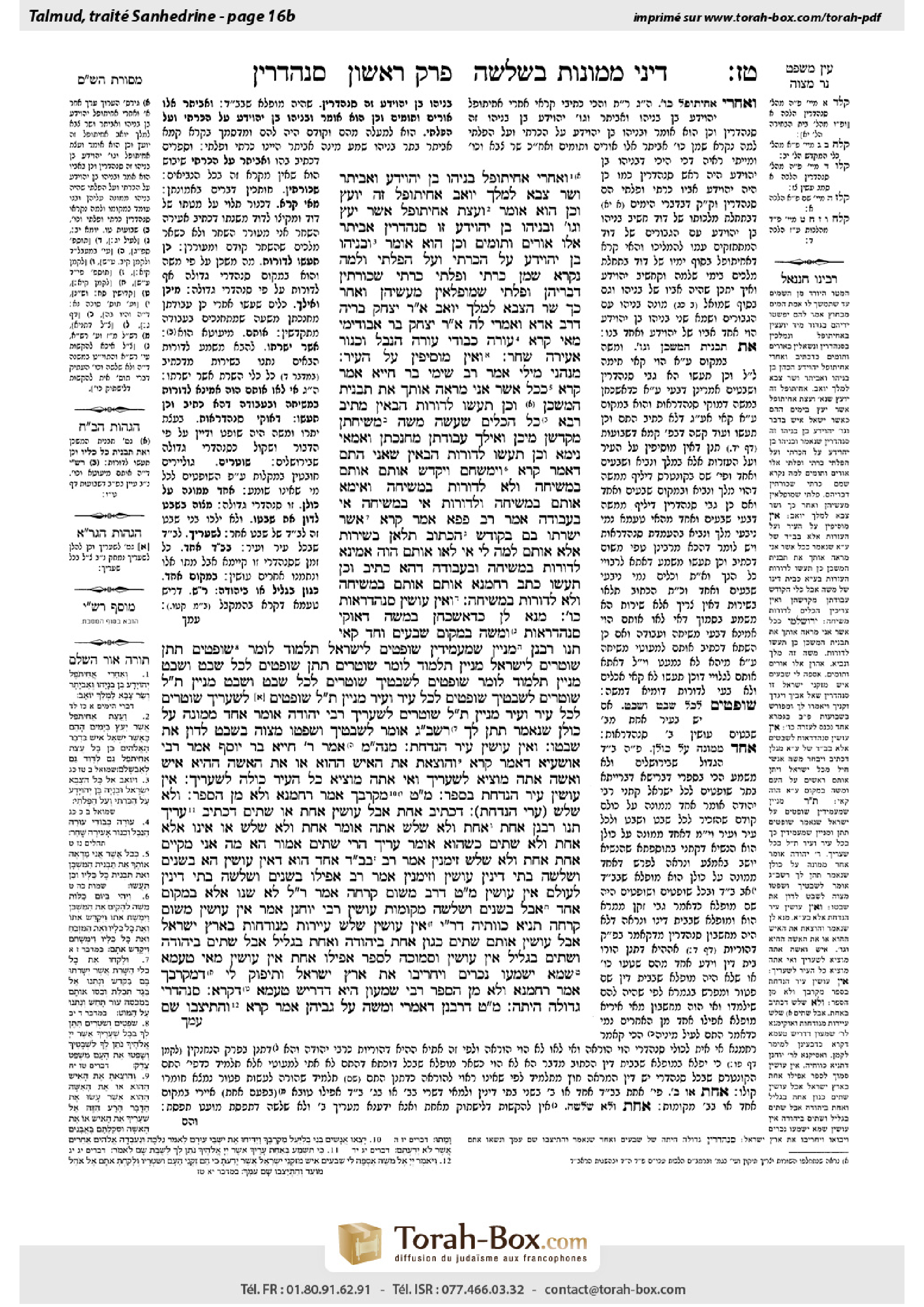
Sanhedrin 16b: Talmud study for Daf Yomi
Daf Yomi is the daily study of one Talmud folio. Explore 37 tractates with scans, Hebrew text, Sefaria English and AI-generated French translations where annotated.
Passage selection and English or AI-generated French translation are available where the scan has annotations. Daf Study is independent of Torah-Box and Sefaria.
Browse Sanhedrin · סנהדרין · All tractatesSanhedrin 16b text and translations
This page of Sanhedrin includes the Aramaic text, an English translation and an AI-generated French translation, alongside the scan above.
סנהדרין י״ו ב · Aramaic and Hebrew text
״וְאַחֲרֵי אֲחִיתֹפֶל בְּנָיָהוּ בֶּן יְהוֹיָדָע וְאֶבְיָתָר וְשַׂר צָבָא לַמֶּלֶךְ יוֹאָב״. ״אֲחִיתוֹפֶל״ – זֶה יוֹעֵץ, וְכֵן הוּא אוֹמֵר: ״וַעֲצַת אֲחִיתֹפֶל אֲשֶׁר יָעַץ וְגוֹ׳״. וּ״בְנָיָהוּ בֶּן יְהוֹיָדָע״ – זוֹ סַנְהֶדְרִין. ״אֶבְיָתָר״ – אֵלּוּ אוּרִים וְתוּמִּים.
וְכֵן הוּא אוֹמֵר: ״וּבְנָיָהוּ בֶּן יְהוֹיָדָע עַל הַכְּרֵתִי וְעַל הַפְּלֵתִי״. וְלָמָּה נִקְרָא שְׁמָן כְּרֵתִי וּפְלֵתִי? כְּרֵתִי – שֶׁכּוֹרְתִין דִּבְרֵיהֶן, וּפְלֵתִי – שֶׁמּוּפְלָאִין מַעֲשֵׂיהֶן. וְאַחַר כָּךְ ״שַׂר הַצָּבָא לַמֶּלֶךְ יוֹאָב״.
אָמַר רַבִּי יִצְחָק בְּרֵיהּ דְּרַב אַדָּא, וְאָמְרִי לַהּ אָמַר רַבִּי יִצְחָק בַּר אֲבוּדִימִי: מַאי קְרָא? ״עוּרָה כְבוֹדִי עוּרָה הַנֵּבֶל וְכִנּוֹר אָעִירָה שָּׁחַר״.
וְאֵין מוֹסִיפִין עַל הָעִיר. מְנָהָנֵי מִילֵּי? אָמַר רַב שִׁימִי בַּר חִיָּיא, אָמַר קְרָא: ״כְּכׇל אֲשֶׁר אֲנִי מַרְאֶה אוֹתְךָ אֵת תַּבְנִית הַמִּשְׁכָּן וְכֵן תַּעֲשׂוּ״ – לְדוֹרוֹת הַבָּאִין.
מֵתִיב רָבָא: כׇּל הַכֵּלִים שֶׁעָשָׂה מֹשֶׁה, מְשִׁיחָתָן מְקַדַּשְׁתָּן. מִיכָּן וְאֵילָךְ, עֲבוֹדָתָן מְחַנַּכְתָּן. וְאַמַּאי? נֵימָא ״וְכֵן תַּעֲשׂוּ״ לְדוֹרוֹת הַבָּאִין!
שָׁאנֵי הָתָם, דְּאָמַר קְרָא: ״וַיִּמְשָׁחֵם וַיְקַדֵּשׁ אֹתָם״ – אוֹתָם בִּמְשִׁיחָה, וְלֹא לְדוֹרוֹת בִּמְשִׁיחָה.
וְאֵימָא: אוֹתָם בִּמְשִׁיחָה, וּלְדוֹרוֹת – אִי בִּמְשִׁיחָה אִי בַּעֲבוֹדָה? אָמַר רַב פָּפָּא: אָמַר קְרָא ״אֲשֶׁר יְשָׁרְתוּ בָם בַּקֹּדֶשׁ״, הַכָּתוּב תְּלָאָן בְּשֵׁירוּת.
אֶלָּא ״אֹתָם״ לְמָה לִי? אִי לָאו ״אֹתָם״, הֲוָה אָמֵינָא: לְדוֹרוֹת בִּמְשִׁיחָה וּבַעֲבוֹדָה, דְּהָא כְּתִיב ״וְכֵן תַּעֲשׂוּ״. כְּתַב רַחֲמָנָא ״אֹתָם״ – אוֹתָם בִּמְשִׁיחָה, וְלֹא לְדוֹרוֹת בִּמְשִׁיחָה.
וְאֵין עוֹשִׂין סַנְהֶדְרָאוֹת כּוּ׳. מְנָא לַן? כִּדְאַשְׁכְּחַן בְּמֹשֶׁה, דְּאוֹקִי סַנְהֶדְרָאוֹת, וּמֹשֶׁה בִּמְקוֹם שִׁבְעִים וְחַד קָאֵי.
תָּנוּ רַבָּנַן: מִנַּיִין שֶׁמַּעֲמִידִין שׁוֹפְטִים לְיִשְׂרָאֵל? תַּלְמוּד לוֹמַר: ״שֹׁפְטִים תִּתֵּן״. שֹׁטְרִים לְיִשְׂרָאֵל מִנַּיִין? תַּלְמוּד לוֹמַר: ״שֹׁטְרִים תִּתֵּן״. שׁוֹפְטִים לְכׇל שֵׁבֶט וְשֵׁבֶט מִנַּיִין? תַּלְמוּד לוֹמַר: ״שֹׁפְטִים לִשְׁבָטֶיךָ״. שׁוֹטְרִים לְכׇל שֵׁבֶט וְשֵׁבֶט מִנַּיִין? תַּלְמוּד לוֹמַר: ״שֹׁטְרִים לִשְׁבָטֶיךָ״.
שׁוֹפְטִים לְכׇל עִיר וָעִיר מִנַּיִין? תַּלְמוּד לוֹמַר: ״שֹׁפְטִים לִשְׁעָרֶיךָ״. שׁוֹטְרִים לְכׇל עִיר וָעִיר מִנַּיִין? תַּלְמוּד לוֹמַר: ״שֹׁטְרִים לִשְׁעָרֶיךָ״. רַבִּי יְהוּדָה אוֹמֵר: אֶחָד מְמוּנֶּה עַל כּוּלָּן, שֶׁנֶּאֱמַר: ״תִּתֶּן לְךָ״. רַבָּן שִׁמְעוֹן בֶּן גַּמְלִיאֵל אוֹמֵר: ״לִשְׁבָטֶיךָ וְשָׁפְטוּ״ – מִצְוָה בַּשֵּׁבֶט לָדוּן אֶת שִׁבְטוֹ.
וְאֵין עוֹשִׂין עִיר הַנִּדַּחַת. מְנָא הָנֵי מִילֵּי? אָמַר רַבִּי חִיָּיא בַּר יוֹסֵף אָמַר רַבִּי אוֹשַׁעְיָא: דְּאָמַר קְרָא ״וְהוֹצֵאתָ אֶת הָאִישׁ הַהוּא אוֹ אֶת הָאִשָּׁה הָהִיא״. אִישׁ וְאִשָּׁה אַתָּה מוֹצִיא לִשְׁעָרֶיךָ, וְאִי אַתָּה מוֹצִיא כָּל הָעִיר כּוּלָּהּ לִשְׁעָרֶיךָ.
אֵין עוֹשִׂין עִיר הַנִּדַּחַת בַּסְּפָר. מַאי טַעְמָא? ״מִקִּרְבֶּךָ״ אָמַר רַחֲמָנָא, וְלֹא מִן הַסְּפָר.
וְלֹא שָׁלֹשׁ עָרֵי הַנִּדַּחַת, דִּכְתִיב: ״אַחַת״, אֲבָל עוֹשִׂין אַחַת אוֹ שְׁתַּיִם, דִּכְתִיב: ״עָרֶיךָ״. תָּנוּ רַבָּנַן: ״אַחַת״ – אַחַת וְלֹא שָׁלֹשׁ. אַתָּה אוֹמֵר: אַחַת וְלֹא שָׁלֹשׁ, אוֹ אֵינוֹ אֶלָּא אַחַת וְלֹא שְׁתַּיִם? כְּשֶׁהוּא אוֹמֵר: ״עָרֶיךָ״, הֲרֵי שְׁתַּיִם אָמוּר. הָא מָה אֲנִי מְקַיֵּים ״אַחַת״? אַחַת וְלֹא שָׁלֹשׁ.
זִימְנִין אָמַר רַב: בְּבֵית דִּין אֶחָד הוּא דְּאֵין עוֹשִׂין, הָא בִּשְׁנַיִם וּשְׁלֹשָׁה בָּתֵּי דִינִין – עוֹשִׂין. וְזִימְנִין אָמַר רַב: אֲפִילּוּ בִּשְׁנַיִם וּשְׁלֹשָׁה בָּתֵּי דִינִין לְעוֹלָם אֵין עוֹשִׂין. מַאי טַעְמָא דְּרַב? מִשּׁוּם קׇרְחָה. אָמַר רֵישׁ לָקִישׁ: לֹא שָׁנוּ אֶלָּא בְּמָקוֹם אֶחָד, אֲבָל בִּשְׁנַיִם וּשְׁלֹשָׁה מְקוֹמוֹת – עוֹשִׂין. רַבִּי יוֹחָנָן אָמַר: אֵין עוֹשִׂין מִשּׁוּם קׇרְחָה.
תַּנְיָא כְּוָותֵיהּ דְּרַבִּי יוֹחָנָן: אֵין עוֹשִׂין שָׁלֹשׁ עֲיָירוֹת מְנוּדָּחוֹת בְּאֶרֶץ יִשְׂרָאֵל, אֲבָל עוֹשִׂין אוֹתָם שְׁתַּיִם, כְּגוֹן אַחַת בִּיהוּדָה וְאַחַת בַּגָּלִיל. אֲבָל שְׁתַּיִם בִּיהוּדָה וּשְׁתַּיִם בַּגָּלִיל – אֵין עוֹשִׂין. וּסְמוּכָה לַסְּפָר – אֲפִילּוּ אַחַת אֵין עוֹשִׂין. מַאי טַעְמָא? שֶׁמָּא יִשְׁמְעוּ גּוֹיִם וְיַחְרִיבוּ אֶת אֶרֶץ יִשְׂרָאֵל.
וְתִיפּוֹק לִי דְּ״מִקִּרְבֶּךָ״ אָמַר רַחֲמָנָא, וְלֹא מִן הַסְּפָר? רַבִּי שִׁמְעוֹן הִיא, דְּדָרֵישׁ טַעְמָא דִּקְרָא.
סַנְהֶדְרִי גְּדוֹלָה הָיְתָה. מַאי טַעְמַיְיהוּ דְּרַבָּנַן דְּאָמְרִי וּמֹשֶׁה עַל גַּבֵּיהֶן? אָמַר קְרָא: ״וְהִתְיַצְּבוּ שָׁם
Sanhedrin 16b · English translation
It is: And after Ahithophel was Benaiah, son of Jehoiada; and Ebiathar; and the general of the king’s army, Yoav (see I Chronicles 27:34). The individuals named in this verse correspond to the roles in the aggada as follows: Ahithophel is the advisor whose counsel they sought first with regard to going to war, and so it says: “Now the advice of Ahithophel, which he counseled in those days, was like that of a man who inquires of the word of God; so was the counsel of Ahithophel both with David and with Absalom” (II Samuel 16:23). And Benaiah, son of Jehoiada corresponds to the Sanhedrin, since he was the head of the Sanhedrin, and Ebiathar corresponds to the Urim VeTummim, as Ebiathar, son of Ahimelech the priest would oversee inquiries directed to the Urim VeTummim (see I Samuel 23:9).
And so it says with regard to the position of Benaiah, son of Jehoiada, as head of the Sanhedrin: “And Benaiah, son of Jehoiada, was over the Kereti and over the Peleti” (II Samuel 20:23). And why was the Sanhedrin called Kereti and Peleti? It was called Kereti because they were decisive [shekoretin] in their pronouncements. It was called Peleti because their actions and wisdom were wondrous [shemufla’in], as Peleti and mufla’in share the same root. According to the order of the verse, upon being instructed by King David to go to war, the Sages first consulted with Ahithophel, then with the Sanhedrin, and then they would ask the Urim VeTummim; and only thereafter was the general of the king’s army, Yoav, given the command to ready the army for battle.
Rabbi Yitzḥak, son of Rav Adda, and some say Rabbi Yitzḥak bar Avudimi, said: What is the verse from which it is derived that David’s lyre would awaken him at midnight? “Awake, my glory; awake, harp and lyre; I will awaken the dawn” (Psalms 57:9). This means that the self-playing lyre has already awoken, and now I must engage in Torah study until dawn.
§ The mishna teaches: They may extend the city of Jerusalem or the courtyards of the Temple only on the basis of a court of seventy-one judges. The Gemara asks: From where is this matter derived? Rav Shimi bar Ḥiyya says: The verse states: “According to all that I show you, the pattern of the Tabernacle and the pattern of all its vessels, and so shall you do” (Exodus 25:9). “And so shall you do” means for future generations; just as the Tabernacle was fashioned in all of its details according to Moses’ instructions, so too later, the Temple is fashioned according to the instructions of the Great Sanhedrin, whose members stand in place of Moses.
Rava raises an objection from a baraita: With regard to all of the utensils that Moses fashioned, their anointment with the sacred oil is what consecrates them, rendering them fit for service in the Tabernacle. From that point forward, i.e., in future generations, there is no need for anointment, but rather their service in and of itself dedicates them, meaning that when they are used for the first time in sacred service they become consecrated. Rava explains the objection: And why is this so? Let us say instead that since the verse states: “And so shall you do,” this teaches that it must be done for future generations as in the Tabernacle, and therefore anointment with sacred oil should be required in the Temple as in the Tabernacle.
The Gemara answers: It is different there, as the verse states: “And it came to pass on the day that Moses completed erecting the Tabernacle that he anointed it and sanctified it and all its vessels, and the altar and all its vessels, and he anointed them and he sanctified them” (Numbers 7:1). The verse emphasizes that he sanctified “them,” and from this it is inferred that only those utensils need sanctification by anointment, but for future generations there is not a requirement of sanctification by anointment.
The Gemara asks: And say instead: Those vessels require sanctification specifically by anointment, but for future generations it could be done either by anointment or by service. Rav Pappa says: The verse states with regard to this: “And they shall take all service vessels with which they shall serve in the sanctuary” (Numbers 4:12). The verse renders it dependent upon service, meaning that the service is what sanctifies them.
The Gemara asks: But if so, why do I need the extra word “them”? This emphasis seems superfluous. The Gemara answers: Had the verse not added the word “them,” I would say: For future generations the sanctification is accomplished by anointment and by service together, as it is written: “And so shall you do.” Therefore, the Merciful One writes “them,” to teach: They alone are consecrated by anointment, but for future generations the vessels are not consecrated by anointment.
§ The mishna teaches that they may appoint a lesser Sanhedrin for the tribes only on the basis of a court of seventy-one judges. The Gemara asks: From where do we derive this matter? The Gemara answers: It is as we find with regard to Moses, who established lesser courts for all of the people (see Exodus 18:25–26), and Moses stands in place of the seventy-one judges on the Great Sanhedrin. Consequently, a lesser Sanhedrin that stands at the head of a tribe is appointed by the Great Sanhedrin.
The Sages taught in a baraita: From where is it derived that society must establish judges for the Jewish people? The verse states: “You shall place judges and officers over you in all of your gates that the Lord your God gives you for your tribes, and they shall judge the people with righteous judgment” (Deuteronomy 16:18). From where is it derived that society must also establish officers for the Jewish people? The same verse states: “You shall place judges and officers.” From where is it derived that society must also establish judges not only for the entire Jewish people but also for each and every tribe? The verse states: “You shall place judges and officers…for your tribes.” From where is it derived that society must also establish officers for each and every tribe? The same verse states: “You shall place judges and officers…for your tribes.”
From where is it derived that society must also establish judges for each and every city? The verse states: You shall place judges and officers…for your gates, as the gate of the city is the seat of the elders of the city and its judges. From where is it derived that society must also establish officers for each and every city? The verse states: You shall place Judges and officers…for your gates. Rabbi Yehuda says: You must also have one court appointed over all of them, as it is stated: “You shall place over you,” meaning that there must be a single institution that is responsible for all of these appointments. Rabban Shimon ben Gamliel says: Another halakha is derived from the verse: “For your tribes, and they shall judge.” This teaches that it is a mitzva for a tribe to judge the sinners from within its tribe, and not to delegate the responsibility to other tribes.
§ The mishna states that a city may be designated as an idolatrous city only in accordance with the ruling of the Great Sanhedrin, consisting of seventy-one judges. The Gemara asks: From where are these matters derived? Rabbi Ḥiyya bar Yosef says that Rabbi Oshaya says: As the verse states with regard to one who engages in idol worship: “And you shall take out that man or that woman who did that evil thing to your gates” (Deuteronomy 17:5), and it is inferred: You take out a man or a woman to your gates for the lesser Sanhedrin to judge them, but you do not take out the entire city to your gates; rather, they are to be judged by the Great Sanhedrin.
§ The mishna teaches that the court may not designate a city as an idolatrous city if it is on the frontier. The Gemara asks: What is the reason for this? The Gemara answers: The verse states: “Certain worthless people have gone out from your midst and have led astray the inhabitants of their city” (Deuteronomy 13:14). The Merciful One states that this halakha applies when they come from your midst, meaning from within your country, but not from the frontier.
§ The mishna teaches: And three adjoining cities may not be designated as idolatrous cities. The source for this ruling is as it is written: “If you shall hear concerning one of your cities that the Lord your God has given you” (Deuteronomy 13:13), and not three cities. The mishna continues: But the court may designate one city, or two adjoining cities as idolatrous cities. The source for this is as it is written: “Your cities,” in the plural. The Sages taught in a baraita: The verse states: “One,” from which it is inferred: One, but not three. Do you say that the meaning is one, but not three, or rather, is this not the meaning of the verse, that it is one, but not two? The baraita explains that this cannot be. When the verse states: “Your cities,” two are stated. How do I realize the meaning of: “One”? One, but not three.
At times Rav said: It is in one court that they may not designate more than two adjoining cities as idolatrous cities, but in two or three courts they may designate them. And at times Rav said: Even in two or three courts they may never designate them. What is the reasoning of Rav? It is due to desolation, to ensure there will not be large swaths of uninhabited land in Eretz Yisrael. Reish Lakish says: They taught only that the court may not designate three adjoining cities as idolatrous cities in one region, but in two or three regions they may designate them. Rabbi Yoḥanan says: They may not designate them, due to desolation.
The Gemara comments: It is taught in a baraita (Tosefta 14:1) in accordance with the opinion of Rabbi Yoḥanan: The court may not designate three adjoining cities as idolatrous cities in Eretz Yisrael, but they may designate two, such as one in Judea and one in the Galilee. But they may not designate two in Judea or two in the Galilee. And if the city is near the frontier, they may not designate even one. What is the reason for this? Perhaps the gentiles will hear that there is a city on the border that is desolate, and they will seize the opportunity to invade and destroy Eretz Yisrael.
The Gemara asks: But let him derive this halakha from the fact that the Merciful One states: “From your midst,” from which it is inferred: But not from the frontier. The Gemara answers: This baraita is in accordance with the opinion of Rabbi Shimon, as he interprets the reason for the mitzva in the verse and draws halakhic conclusions based on that interpretation.
§ The mishna teaches that the Great Sanhedrin was composed of seventy-one judges, and that Rabbi Yehuda holds that it was composed of only seventy, as Moses gathered seventy men of the Elders of the Jewish people, and according to Rabbi Yehuda, Moses himself was not counted as part of the group. The Gemara asks: What is the reasoning of the Rabbis, who say that when Moses gathered seventy men, he was at the head of the court and is therefore counted among them? The verse states: “And the Lord said to Moses: Gather Me seventy men from the Elders of Israel, whom you know to be the Elders of the people and officers over them, and bring them to the Tent of Meeting and they shall stand there
Sanhedrin 16b · Traduction française (IA)
C’est écrit : « Après Ahitophel, il y avait Benaya, fils de Yehoyada ; Ébiathar ; et Yoav, chef de l’armée du roi » (I Chroniques 27:34). Les personnes nommées dans ce verset correspondent aux rôles de l’aggada de la manière suivante : Ahitophel est le conseiller que l’on consultait en premier au sujet d’une guerre, comme il est dit : « Le conseil d’Ahitophel, qu’il donnait en ces jours-là, avait la même autorité que si l’on avait consulté la parole de Dieu ; ainsi en était-il de tout conseil d’Ahitophel, tant auprès de David qu’auprès d’Absalom » (II Samuel 16:23). Benaya, fils de Yehoyada, correspond au Sanhédrin, puisqu’il en était le chef, et Ébiathar correspond aux Ourim véToumim, car Ébiathar, fils d’Ahimélek le prêtre, supervisait les consultations adressées aux Ourim véToumim (voir I Samuel 23:9).
C’est ainsi qu’il est dit au sujet de la fonction de Benaya, fils de Yehoyada, comme chef du Sanhédrin : « Benaya, fils de Yehoyada, était à la tête des Keréthiens et des Péléthiens » (II Samuel 20:23). Et pourquoi le Sanhédrin était-il appelé Keréthiens et Péléthiens ? Keréthiens, parce que leurs décisions étaient tranchées [shekoretin] ; Péléthiens, parce que leurs actes et leur sagesse étaient merveilleux [shemufla’in], les mots Péléthiens et mufla’in ayant la même racine. Selon l’ordre du verset, lorsque le roi David leur ordonnait de partir en guerre, les Sages consultaient d’abord Ahitophel, puis le Sanhédrin, et ensuite les Ourim véToumim ; ce n’est qu’après cela que Yoav, chef de l’armée du roi, recevait l’ordre de préparer l’armée au combat.
Rabbi Yitzḥak, fils de Rav Adda — certains disent Rabbi Yitzḥak bar Avudimi — a dit : Quel verset enseigne que la harpe de David le réveillait à minuit ? « Réveille-toi, ma gloire ; réveille-toi, harpe et lyre ; je réveillerai l’aube » (Psaumes 57:9). Cela signifie que la harpe qui joue d’elle-même s’est déjà réveillée, et que je dois maintenant étudier la Torah jusqu’à l’aube.
§ La Michna enseigne : On ne peut agrandir la ville de Jérusalem ni les cours du Temple qu’en présence d’un tribunal de soixante et onze juges. La Guemara demande : D’où tire-t-on cette règle ? Rav Shimi bar Ḥiyya dit : Le verset énonce : « Selon tout ce que je te montre, le modèle du Tabernacle et le modèle de tous ses ustensiles, ainsi vous ferez » (Exode 25:9). « Ainsi vous ferez » signifie : pour les générations futures. De même que le Tabernacle fut construit dans tous ses détails selon les instructions de Moïse, de même, par la suite, le Temple est construit selon les instructions du Grand Sanhédrin, dont les membres tiennent la place de Moïse.
Rava soulève une objection à partir d’une baraïta : Pour tous les ustensiles que Moïse a fabriqués, c’est leur onction avec l’huile sacrée qui les consacre et les rend aptes au service dans le Tabernacle. À partir de là, c’est-à-dire pour les générations futures, l’onction n’est plus nécessaire ; c’est leur service même qui les consacre, autrement dit, ils deviennent consacrés lorsqu’ils sont utilisés pour la première fois dans le service sacré. Rava explique l’objection : Pourquoi en est-il ainsi ? Disons plutôt que, puisque le verset dit : « Ainsi vous ferez », cela enseigne que, pour les générations futures, il faut procéder comme dans le Tabernacle ; l’onction avec l’huile sacrée devrait donc être requise dans le Temple comme elle l’était dans le Tabernacle.
La Guemara répond : Ce cas est différent, car le verset dit : « Le jour où Moïse acheva de dresser le Tabernacle, il l’oignit et le sanctifia, ainsi que tous ses ustensiles, l’autel et tous ses ustensiles ; il les oignit et les sanctifia » (Nombres 7:1). Le verset insiste sur le fait qu’il les sanctifia, et l’on en déduit que seuls ces ustensiles nécessitent une sanctification par l’onction ; pour les générations futures, la sanctification par l’onction n’est pas requise.
La Guemara demande : Dis plutôt que ces ustensiles doivent être sanctifiés précisément par l’onction, mais que, pour les générations futures, ils peuvent l’être soit par l’onction, soit par le service. Rav Pappa dit : À ce sujet, le verset énonce : « Ils prendront tous les ustensiles du service dont ils se serviront dans le sanctuaire » (Nombres 4:12). Le verset fait dépendre leur consécration du service, ce qui signifie que c’est le service qui les sanctifie.
La Guemara demande : Mais dans ce cas, pourquoi le mot supplémentaire « les » est-il nécessaire ? Cette insistance semble superflue. La Guemara répond : Si le verset n’avait pas ajouté le mot « les », j’aurais dit que, pour les générations futures, la sanctification s’accomplit à la fois par l’onction et par le service, comme il est écrit : « Ainsi vous ferez ». C’est pourquoi le Miséricordieux écrit « les », pour enseigner que ceux-là seuls sont consacrés par l’onction, tandis que, pour les générations futures, les ustensiles ne sont pas consacrés par l’onction.
§ La Michna enseigne qu’on ne peut instituer un petit Sanhédrin pour les tribus qu’en présence d’un tribunal de soixante et onze juges. La Guemara demande : D’où tirons-nous cette règle ? La Guemara répond : Nous l’apprenons du cas de Moïse, qui établit des tribunaux inférieurs pour tout le peuple (voir Exode 18:25-26), et Moïse tient la place des soixante et onze juges du Grand Sanhédrin. Par conséquent, un petit Sanhédrin placé à la tête d’une tribu est institué par le Grand Sanhédrin.
Les Sages ont enseigné dans une baraïta : D’où apprend-on que la société doit établir des juges pour le peuple juif ? Le verset énonce : « Tu établiras des juges et des magistrats dans toutes tes portes que l’Éternel, ton Dieu, te donne pour tes tribus, et ils jugeront le peuple avec justice » (Deutéronome 16:18). D’où apprend-on que la société doit également établir des magistrats pour le peuple juif ? Le même verset dit : « Tu établiras des juges et des magistrats. » D’où apprend-on que la société doit aussi établir des juges, non seulement pour l’ensemble du peuple juif, mais pour chacune des tribus ? Le verset dit : « Tu établiras des juges et des magistrats… pour tes tribus. » D’où apprend-on que la société doit aussi établir des magistrats pour chacune des tribus ? Le même verset dit : « Tu établiras des juges et des magistrats… pour tes tribus. »
D’où apprend-on que la société doit également établir des juges dans chacune des villes ? Le verset dit : « Tu établiras des juges et des magistrats… dans tes portes », car la porte de la ville est le lieu où siègent les anciens de la ville et ses juges. D’où apprend-on que la société doit également établir des magistrats dans chacune des villes ? Le verset dit : « Tu établiras des juges et des magistrats… dans tes portes. » Rabbi Yehuda dit : Il faut aussi instituer un tribunal au-dessus de tous les autres, comme il est dit : « Tu établiras au-dessus de toi », ce qui signifie qu’une institution unique doit être responsable de toutes ces nominations. Rabban Shimon ben Gamliel dit : Le verset « Pour tes tribus, et ils jugeront » permet de déduire une autre halakha. Cela enseigne qu’il est une mitsva pour une tribu de juger les pécheurs issus de sa propre tribu, sans déléguer cette responsabilité aux autres tribus.
§ La Michna stipule qu’une ville ne peut être déclarée ville idolâtre que conformément à la décision du Grand Sanhédrin, composé de soixante et onze juges. La Guemara demande : D’où tire-t-on ces règles ? Rabbi Ḥiyya bar Yosef dit au nom de Rabbi Oshaya : Le verset dit au sujet de celui qui pratique l’idolâtrie : « Tu feras sortir à tes portes cet homme ou cette femme qui a commis cette chose mauvaise » (Deutéronome 17:5). On en déduit que l’on fait sortir un homme ou une femme vers tes portes afin que le petit Sanhédrin les juge, mais qu’on ne fait pas sortir toute la ville vers tes portes ; celle-ci doit plutôt être jugée par le Grand Sanhédrin.
§ La Michna enseigne que le tribunal ne peut pas déclarer ville idolâtre une ville située à la frontière. La Guemara demande : Quelle en est la raison ? La Guemara répond : Le verset dit : « Des gens indignes sont sortis du milieu de toi et ont entraîné les habitants de leur ville dans l’égarement » (Deutéronome 13:14). Le Miséricordieux stipule que cette halakha s’applique lorsqu’ils viennent du milieu de toi, c’est-à-dire de l’intérieur de ton pays, mais non de la frontière.
§ La Michna enseigne : On ne peut pas déclarer villes idolâtres trois villes contiguës. La source de cette règle est le verset : « Si tu entends dire au sujet de l’une de tes villes que l’Éternel, ton Dieu, t’a données » (Deutéronome 13:13), et non au sujet de trois villes. La Michna poursuit : Le tribunal peut toutefois déclarer ville idolâtre une ville, ou deux villes contiguës. La source en est l’expression « tes villes », au pluriel. Les Sages ont enseigné dans une baraïta : Le verset dit « une », d’où l’on déduit : une, mais pas trois. Prétends-tu que le sens est « une, mais pas trois », ou bien le verset ne signifie-t-il pas plutôt « une, mais pas deux » ? La baraïta explique que cela ne peut être le cas : lorsque le verset dit « tes villes », il en mentionne deux. Comment comprendre alors le mot « une » ? Une, mais pas trois.
Parfois Rav disait : Un seul tribunal ne peut pas déclarer plus de deux villes contiguës villes idolâtres, mais deux ou trois tribunaux peuvent le faire. Et parfois Rav disait : Même deux ou trois tribunaux ne peuvent jamais le faire. Quel est le raisonnement de Rav ? C’est pour éviter la désolation, afin que de vastes étendues de terre inhabitées ne se forment pas en Eretz Yisrael. Reish Lakish dit : Les Sages ont enseigné que le tribunal ne peut pas déclarer trois villes contiguës villes idolâtres uniquement si elles se trouvent dans une même région ; mais si elles se trouvent dans deux ou trois régions, il peut le faire. Rabbi Yoḥanan dit : Ils ne peuvent pas le faire, en raison de la désolation.
La Guemara remarque : Une baraïta (Tossefta 14:1) est enseignée conformément à l’opinion de Rabbi Yoḥanan : Le tribunal ne peut pas déclarer villes idolâtres trois villes contiguës en Eretz Yisrael, mais il peut en déclarer deux, par exemple l’une en Judée et l’autre en Galilée. Toutefois, il ne peut pas en déclarer deux en Judée ni deux en Galilée. Et si la ville est proche de la frontière, il ne peut même pas en déclarer une seule. Pour quelle raison ? Les non-Juifs pourraient apprendre qu’une ville située à la frontière est déserte, saisir l’occasion d’envahir le pays et dévaster Eretz Yisrael.
La Guemara demande : Mais ne peut-on pas déduire cette halakha du fait que le Miséricordieux dit « du milieu de toi », ce dont on déduit : pas de la frontière ? La Guemara répond : Cette baraïta suit l’opinion de Rabbi Shimon, car il interprète la raison de la mitsva énoncée dans le verset et en tire des conclusions halakhiques.
§ La Michna enseigne que le Grand Sanhédrin se composait de soixante et onze juges, tandis que Rabbi Yehuda estime qu’il n’en comptait que soixante, car Moïse rassembla soixante-dix hommes parmi les anciens du peuple juif et que, selon Rabbi Yehuda, Moïse lui-même n’était pas compté dans le groupe. La Guemara demande : Quel est le raisonnement des Rabbins, qui disent que, lorsque Moïse rassembla soixante-dix hommes, il était à la tête du tribunal et compte donc parmi eux ? Le verset dit : « L’Éternel dit à Moïse : Rassemble-moi soixante-dix hommes parmi les anciens d’Israël, que tu sais être les anciens du peuple et ses officiers, et amène-les à la Tente de la Rencontre ; qu’ils se tiennent là »
Traduction française générée par IA à partir de l’édition anglaise de Sefaria. Vérifie toujours un passage avec le texte source.
Text from Sefaria: William Davidson Edition - Vocalized Aramaic (CC BY NC); William Davidson Edition - English (CC BY NC).