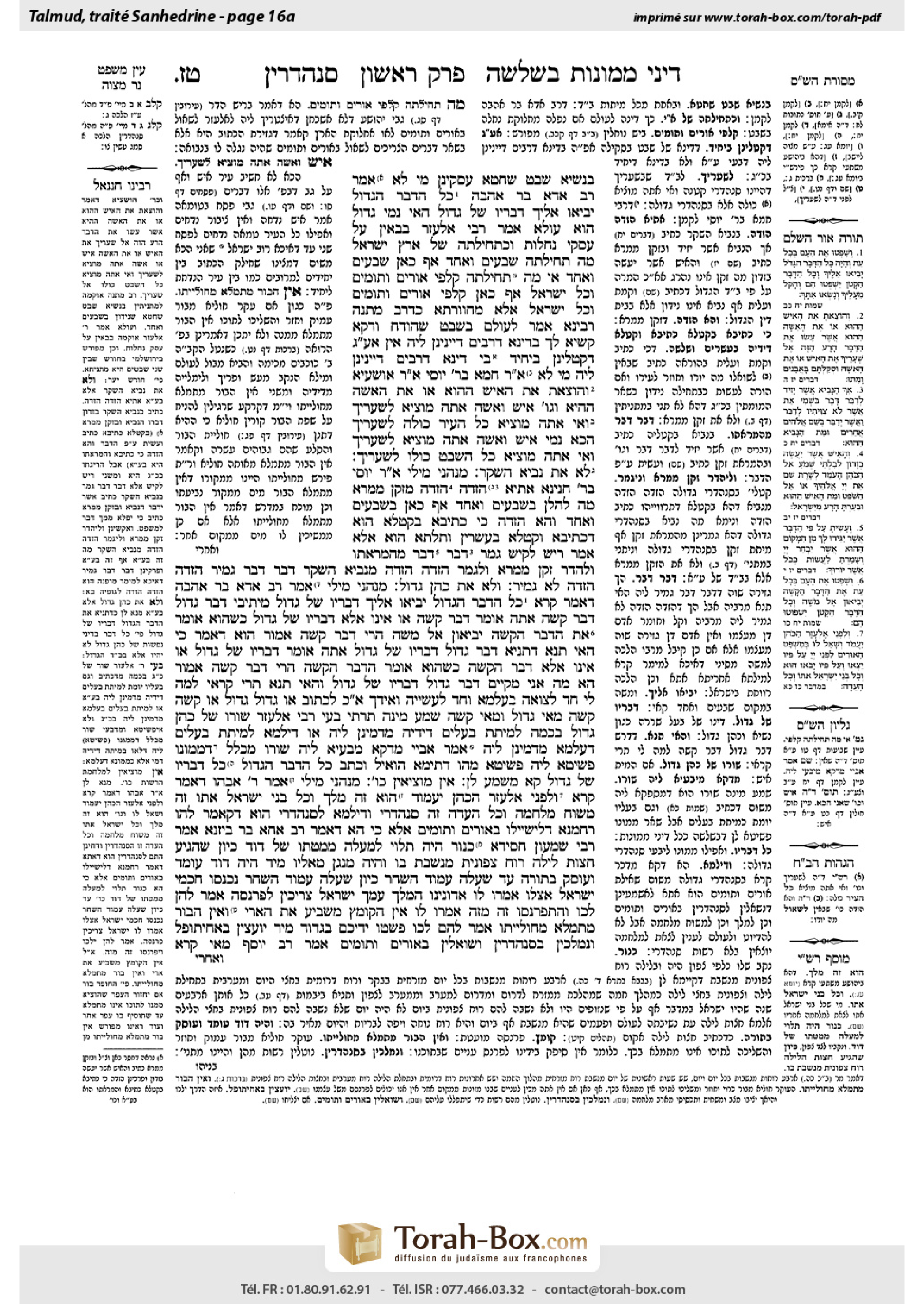
Sanhedrin 16a: Talmud study for Daf Yomi
Daf Yomi is the daily study of one Talmud folio. Explore 37 tractates with scans, Hebrew text, Sefaria English and AI-generated French translations where annotated.
Passage selection and English or AI-generated French translation are available where the scan has annotations. Daf Study is independent of Torah-Box and Sefaria.
Browse Sanhedrin · סנהדרין · All tractatesSanhedrin 16a text and translations
This page of Sanhedrin includes the Aramaic text, an English translation and an AI-generated French translation, alongside the scan above.
סנהדרין י״ו א · Aramaic and Hebrew text
בִּנְשִׂיא שֵׁבֶט שֶׁחָטָא עָסְקִינַן. מִי לָא אָמַר רַב אַדָּא בַּר אַהֲבָה: ״כׇּל הַדָּבָר הַגָּדֹל יָבִיאוּ אֵלֶיךָ״ – דְּבָרָיו שֶׁל גָּדוֹל? הַאי נָמֵי גָּדוֹל הוּא.
עוּלָּא אָמַר רַבִּי אֶלְעָזָר: בְּבָאִין עַל עִסְקֵי נְחָלוֹת, וְכִתְחִילָּתָהּ שֶׁל אֶרֶץ יִשְׂרָאֵל. מָה תְּחִילָּתָהּ שִׁבְעִים וְאֶחָד, אַף כָּאן – שִׁבְעִים וְאֶחָד.
אִי, מָה תְּחִילָּתָהּ קַלְפִּי, אוּרִים וְתוּמִּים, וְכׇל יִשְׂרָאֵל – אַף כָּאן קַלְפִּי, אוּרִים וְתוּמִּים, וְכׇל יִשְׂרָאֵל? אֶלָּא מְחַוַּורְתָּא כִּדְרַב מַתְנָה.
רָבִינָא אָמַר: לְעוֹלָם בְּשֵׁבֶט שֶׁהוּדַּח, וּדְקָא קַשְׁיָא לָךְ – בְּדִינָא דְּרַבִּים דָּיְינִינַן לֵיהּ? אִין, אַף עַל גַּב דְּקָטְלִינַן בְּיָחִיד, בֵּי דִינָא דְּרַבִּים דָּיְינִינַן לֵיהּ.
מִי לָא אָמַר רַבִּי חָמָא בְּרַבִּי יוֹסֵי אָמַר רַבִּי אוֹשַׁעְיָא: ״וְהוֹצֵאתָ אֶת הָאִישׁ הַהוּא אוֹ אֶת הָאִשָּׁה הַהִוא וְגוֹ׳״? אִישׁ וְאִשָּׁה אַתָּה מוֹצִיא לִשְׁעָרֶיךָ, וְאִי אַתָּה מוֹצִיא כָּל הָעִיר כּוּלָּהּ לִשְׁעָרֶיךָ. הָכָא נָמֵי: אִישׁ וְאִשָּׁה אַתָּה מוֹצִיא לִשְׁעָרֶיךָ, וְאִי אַתָּה מוֹצִיא כׇּל הַשֵּׁבֶט כּוּלּוֹ לִשְׁעָרֶיךָ.
לֹא אֶת נְבִיא הַשֶּׁקֶר. מְנָהָנֵי מִילֵּי?
אָמַר רַבִּי יוֹסֵי בְּרַבִּי חֲנִינָא: אַתְיָא ״הֲזָדָה״ ״הֲזָדָה״ מִזָּקֵן מַמְרֵא, מָה לְהַלָּן בְּשִׁבְעִים וְאֶחָד – אַף כָּאן בְּשִׁבְעִים וְאֶחָד.
וְהָא ״הֲזָדָה״ כִּי כְּתִיבָא, בִּקְטָלָא הוּא דִּכְתִיבָא, וּקְטָלָא בְּעֶשְׂרִין וּתְלָתָא הוּא! אֶלָּא, אָמַר רֵישׁ לָקִישׁ: גָּמַר ״דָּבָר״ ״דָּבָר״ מֵהַמְרָאָתוֹ.
וְלֶהְדַּר זָקֵן מַמְרֵא, וְלִגְמַר ״הֲזָדָה״ ״הֲזָדָה״ מִנְּבִיא הַשֶּׁקֶר? ״דָּבָר״ ״דָּבָר״ גְּמִיר, ״הֲזָדָה״ ״הֲזָדָה״ לָא גְּמִיר.
וְלֹא אֶת כֹּהֵן גָּדוֹל. מְנָהָנֵי מִילֵּי? אָמַר רַב אַדָּא בַּר אַהֲבָה: דְּאָמַר קְרָא ״כׇּל הַדָּבָר הַגָּדֹל יָבִיאוּ אֵלֶיךָ״, דְּבָרָיו שֶׁל גָּדוֹל.
מֵיתִיבִי: ״דָּבָר גָּדֹל״ – דָּבָר קָשֶׁה. אַתָּה אוֹמֵר דָּבָר קָשֶׁה, אוֹ אֵינוֹ אֶלָּא דְּבָרָיו שֶׁל גָּדוֹל? כְּשֶׁהוּא אוֹמֵר ״אֶת הַדָּבָר הַקָּשֶׁה יְבִיאוּן אֶל מֹשֶׁה״, הֲרֵי דָּבָר קָשֶׁה אָמוּר.
הוּא דְּאָמַר כִּי הַאי תַּנָּא, דְּתַנְיָא: ״דָּבָר גָּדֹל״ – דְּבָרָיו שֶׁל גָּדוֹל. אַתָּה אוֹמֵר דְּבָרָיו שֶׁל גָּדוֹל, אוֹ אֵינוֹ אֶלָּא דָּבָר הַקָּשֶׁה? כְּשֶׁהוּא אוֹמֵר ״הַדָּבָר הַקָּשֶׁה״, הֲרֵי דָּבָר קָשֶׁה אָמוּר. הָא מָה אֲנִי מְקַיֵּים ״דָּבָר גָּדֹל״? דְּבָרָיו שֶׁל גָּדוֹל.
וְהַאי תַּנָּא, תְּרֵי קְרָאֵי לְמָה לִי? חַד לְצַוָּאָה בְּעָלְמָא, וְחַד לַעֲשִׂיָּיה. וְאִידַּךְ? אִם כֵּן, לִכְתּוֹב אוֹ ״גָּדוֹל״ ״גָּדוֹל״, אוֹ ״קָשֶׁה״ ״קָשֶׁה״. מַאי ״גָּדוֹל״ וּמַאי ״קָשֶׁה״? שְׁמַע מִינַּהּ תַּרְתֵּי.
בָּעֵי רַבִּי אֶלְעָזָר: שׁוֹרוֹ שֶׁל כֹּהֵן גָּדוֹל, בְּכַמָּה? לְמִיתַת בְּעָלִים דִּידֵיהּ מְדַמֵּינַן לֵיהּ, אוֹ דִילְמָא לְמִיתַת בְּעָלִים דְּעָלְמָא מְדַמֵּינַן לֵיהּ? אָמַר אַבָּיֵי: מִדְּקָא מִבַּעְיָא לֵיהּ שׁוֹרוֹ, מִכְלָל דְּמָמוֹנוֹ פְּשִׁיטָא לֵיהּ.
פְּשִׁיטָא! מַהוּ דְּתֵימָא: הוֹאִיל וְכָתַב ״כׇּל הַדָּבָר הַגָּדֹל״, כׇּל דְּבָרָיו שֶׁל גָּדוֹל – קָא מַשְׁמַע לַן.
אֵין מוֹצִיאִין וְכוּ׳. מְנָהָנֵי מִילֵּי? אָמַר רַבִּי אֲבָהוּ: דְּאָמַר קְרָא ״וְלִפְנֵי אֶלְעָזָר הַכֹּהֵן יַעֲמֹד״.
״הוּא״ – זֶה מֶלֶךְ, ״וְכׇל בְּנֵי יִשְׂרָאֵל אִתּוֹ״ – זֶה מְשׁוּחַ מִלְחָמָה, ״וְכׇל הָעֵדָה״ – זֶה סַנְהֶדְרֵי.
וְדִילְמָא לְסַנְהֶדְרֵי הוּא דְּקָאָמַר לְהוּ רַחֲמָנָא, דְּלִישַׁיְּילוּ בְּאוּרִים וְתוּמִּים?
אֶלָּא, כִּי הָא דְּאָמַר רַב אַחָא בַּר בִּיזְנָא אָמַר רַבִּי שִׁמְעוֹן חֲסִידָא: כִּנּוֹר הָיָה תָּלוּי לְמַעְלָה מִמִּטָּתוֹ שֶׁל דָּוִד. כֵּיוָן שֶׁהִגִּיעַ חֲצוֹת לַיְלָה, רוּחַ צְפוֹנִית מְנַשֶּׁבֶת בּוֹ וְהָיָה מְנַגֵּן מֵאֵלָיו. מִיָּד הָיָה דָּוִד עוֹמֵד וְעוֹסֵק בְּתוֹרָה עַד שֶׁעָלָה עַמּוּד הַשַּׁחַר. כֵּיוָן שֶׁעָלָה עַמּוּד הַשַּׁחַר, נִכְנְסוּ חַכְמֵי יִשְׂרָאֵל אֶצְלוֹ.
אָמְרוּ לוֹ: אֲדוֹנֵינוּ הַמֶּלֶךְ, עַמְּךָ יִשְׂרָאֵל צְרִיכִין לְפַרְנָסָה. אָמַר לָהֶן: לְכוּ וְהִתְפַּרְנְסוּ זֶה מִזֶּה. אָמְרוּ לוֹ: אֵין הַקּוֹמֶץ מַשְׂבִּיעַ אֶת הָאֲרִי, וְאֵין הַבּוֹר מִתְמַלֵּא מֵחוּלְיָיתוֹ. אָמַר לָהֶם: לְכוּ פִּשְׁטוּ יְדֵיכֶם בִּגְדוּד.
מִיָּד יוֹעֲצִין בַּאֲחִיתוֹפֶל, וְנִמְלָכִין בְּסַנְהֶדְרִין, וְשׁוֹאֲלִין בְּאוּרִים וְתוּמִּים. אָמַר רַב יוֹסֵף: מַאי קְרָא?
Sanhedrin 16a · English translation
we are dealing with the Nasi of a tribe who has sinned. Doesn’t Rav Adda bar Ahava say: The verse states: “They shall bring every great matter to you” (Exodus 18:22), meaning: Matters of a great one, i.e., in any case where a great person is accused of a transgression whose punishment is death, he is tried by the Great Sanhedrin of seventy-one judges. And this Nasi of the tribe is also a great one, so his trial is by seventy-one judges.
Ulla said that Rabbi Elazar said a different explanation: The mishna discusses a case where two tribes came to adjudicate a dispute about matters of inheritance, i.e., territory claimed by each tribe on the border between them, and this dispute is handled by the Great Sanhedrin consisting of seventy-one judges, as was done at the beginning of the settlement in Eretz Yisrael during the time of Joshua. Just as the beginning, the initial division, was performed by seventy-one Elders of the congregation, so too here, when there is a dispute about the borders determined by that initial division, the case is adjudicated by the seventy-one judges of the Great Sanhedrin.
The Gemara asks: If this logic is employed, then just as the beginning was performed by casting lots [kalpei], with the Urim VeTummim, and with all of the Jewish people present, so too here, in a dispute between tribes, there should be a need for lots, the Urim VeTummim, and the presence of all of the Jewish people. Since this is not required by halakha, it is apparent that a border dispute between tribes need not be adjudicated using the same procedures as the original division of the inheritances. Consequently, there is no reason to require seventy-one judges. Rather, it is clear that this must be explained in accordance with the explanation of Rav Mattana, who says that the mishna is discussing the Nasi of a tribe who has sinned.
Ravina said: The mishna is actually discussing a tribe that was subverted and which engaged in idol worship, and with regard to that which poses a difficulty for you, the question of whether we judge such a tribe with the halakha of a multitude, it can be answered: Yes, although we execute them as individuals by stoning, and their money is not confiscated, nevertheless we judge them in a court of the multitude, i.e., each one of them is tried by the Great Sanhedrin.
Ravina continues: Doesn’t Rabbi Ḥama, son of Rabbi Yosei, say that Rabbi Oshaya says: The verse that discuses an individual who serves idol worship states: “And you shall take out that man or that woman who did that evil thing to your gates, even the man or the woman, and you shall stone them until they die” (Deuteronomy 17:5), and it is inferred: You take out a man or a woman to your gates to judge them in the court that is located at the gates of the city, which is a lesser Sanhedrin, but you do not take out an entire city to your gates; rather they are to be judged by the large court. Here also with regard to a tribe that has sinned: You take out a man or a woman to your gates, but you do not take out the entire tribe to your gates; rather they are judged by a court of seventy-one.
§ The mishna teaches that a false prophet may be judged only by the Great Sanhedrin, consisting of seventy-one judges. The Gemara asks: From where is this matter derived?
Rabbi Yosei, son of Rabbi Ḥanina, says: It is derived by means of a verbal analogy, with the meaning of presumptuousness stated in the context of a false prophet learned from presumptuousness stated in the context of a rebellious elder. With regard to a false prophet the verse states: “But the prophet who shall speak a word presumptuously in My name, which I have not commanded him to speak, or who shall speak in the name of other gods, that prophet shall die” (Deuteronomy 18:20), and with regard to a rebellious elder it states: “And the man that acts presumptuously, by not listening to the priest that stands to minister there before the Lord your God, or to the judge, that man shall die” (Deuteronomy 17:12). Just as there, with regard to a rebellious elder, he is presumptuous against a court of seventy-one judges, so too here, with regard to a false prophet, he is judged by a court of seventy-one judges.
The Gemara challenges: But when presumptuousness is written with regard to a rebellious elder, it is written with regard to the death penalty, and a death sentence may be issued by a court of twenty-three judges. Rather, Reish Lakish said: It is derived by means of a verbal analogy, with the meaning of the term word stated in the context of a false prophet learned from the term word, used when describing the rebellious elder’s rebellion. The rebellious elder transgresses by violating the mitzva: “And you shall do according to the word that they will tell you” (Deuteronomy 17:10), and with regard to the false prophet the verse states: “Who shall speak a word presumptuously in My name” (Deuteronomy 18:20). Just as the rebellious elder rebels against a court of seventy-one judges, so too, a false prophet who speaks a word that is not in the name of God is sentenced to death by a court of seventy-one judges.
The Gemara asks: And let the halakha of a rebellious elder return, and let it be derived by means of a verbal analogy, with the meaning of presumptuousness stated in the context of a rebellious elder learned from presumptuousness stated in the context of a false prophet, to indicate that a rebellious elder is also sentenced by a court of seventy-one judges. The Gemara answers: This tanna derives halakhot through the verbal analogy comparing the terms word and word, but he does not derive halakhot through a verbal analogy between the terms presumptuousness and presumptuousness, as he did not receive it as an authentic tradition.
§ The mishna teaches that the High Priest may be judged only by the Great Sanhedrin, consisting of seventy-one judges. The Gemara asks: From where is this matter derived? Rav Adda bar Ahava says that the verse states: “They shall bring every great matter to you” (Exodus 18:22). This means that Moses, or the Great Sanhedrin with seventy-one judges, which served the parallel role to that of Moses, adjudicates all matters relating to a great one, i.e., the High Priest.
The Gemara raises an objection to this from a baraita: The verse states: “They shall bring every great matter to you,” which is interpreted to mean that a difficult matter is judged by the Great Sanhedrin. The baraita asks: Do you say that the verse is actually referring to a difficult matter, or is it only referring to the matters relating to a great one? The baraita answers: When it states in a different verse that Moses implemented Yitro’s advice: “They brought the difficult matter to Moses” (Exodus 18:26), a difficult matter is stated explicitly. As Moses was following the directive of Yitro, it is therefore apparent that the term “great matter” is referring to a difficult matter.
The Gemara answers: Rav Adda bar Ahava states his opinion in accordance with the opinion of that other tanna, as it is taught in a different baraita: The meaning of “great matter” in the verse is matters relating to a great one. The baraita asks: Do you say that it is referring to matters relating to a great one, or is it only referring to a difficult matter? The baraita explains: When it says further on: “They brought the difficult matter to Moses,” a difficult matter is stated, so how do I realize the meaning of “great matter”? It is referring to matters relating to a great one.
The Gemara asks: And as for this tanna in the first baraita who maintains that “great matter” and “difficult matter” are referring to the same halakha, why do I need two verses to express the same idea? The Gemara answers: One is for the command in general, and one is to state that the execution of the matter was carried out correctly. And why does the other tanna not accept this explanation? The Gemara explains: He would claim that if so, if both verses were actually referring to the same thing, let it write either “great” in one verse and “great” in the other, or “difficult” in one verse and “difficult” in the other. What is the significance of writing “great” in one verse and what is the significance of writing “difficult” in the other? Conclude two conclusions from it; one verse is referring to difficult matters and the other to matters relating to a great one.
Rabbi Elazar asked: If the ox of a High Priest killed a person, by how many judges is it sentenced? Do we compare it to a trial that could result in the death of its owner, the High Priest, which would have to be judged by seventy-one judges, or perhaps we compare it to a trial that could result in the death of owners in general, which could be judged by twenty-three judges? Abaye said: Since he asked the question only with regard to the High Priest’s ox, where there is a specific reason to say that its judicial proceedings should have the same halakhot as those concerning its owner, by inference it can be derived that it was obvious to him that court hearings related to the High Priest’s other property may be deliberated by an ordinary court.
The Gemara asks: Isn’t that obvious? Why should it not be so? The Gemara answers: Abaye needed to clarify this, lest you say that since it writes: “Every great matter,” one might have thought that the verse is referring to all matters relating to a great one, meaning that any case involving the High Priest is adjudicated by the Great Sanhedrin. Therefore, Abaye teaches us that this is not the halakha.
§ The mishna teaches that the king may bring the nation out to an optional war only on the basis of a court of seventy-one judges, i.e., the Great Sanhedrin. The Gemara asks: From where is this matter derived? Rabbi Abbahu says: It is as the verse states with regard to the appointment of Joshua: “And he shall stand before Elazar the priest, and he shall ask counsel of the Urim before the Lord; by his word they shall go out, and by his word they shall come in, he and all of the children of Israel with him and all of the congregation” (Numbers 27:21).
Rabbi Abbahu analyzes the end of the verse. With regard to the word “he,” this is the king, referring to Joshua and to any other leader who brings the nation out to war. With regard to the word “him” in the verse “And all of the children of Israel with him,” this is the priest anointed for war, who was anointed specially to stand and instruct the people before the war (see Deuteronomy 20:2). “And all of the congregation”; this is the Sanhedrin. Consequently, the king can embark on an optional war only if the Great Sanhedrin is present and grants authority to him.
The Gemara challenges: But perhaps this mention of the Sanhedrin simply means that the Merciful One says that the Sanhedrin may ask a question of the Urim VeTummim, as may the king or the priest anointed for war, as opposed to an ordinary person; but with regard to the decision to go to war, perhaps the king may do so without the agreement of the Sanhedrin.
Rather, the proof is like that which Rav Aḥa bar Bizna says that Rabbi Shimon Ḥasida says: A lyre hung above David’s bed, and once midnight arrived, the northern midnight wind would blow on it and cause the lyre to play on its own. David would immediately rise from his bed and study Torah until the dawn arrived. Once dawn arrived, the Sages of Israel would enter to advise him with regard to the various concerns of the nation and the economy.
One time they said to him: Our master the king, your nation, Israel, requires sustenance. King David said to them: Go and sustain one another, i.e., provide each other with whatever is lacking. The Sages said to him in response, citing a parable: A single handful [hakometz] of food does not satisfy a lion, and a cistern will not be filled merely from the rain that falls directly into its mouth, but other water must be channeled in. So too, the nation cannot sustain itself using its own resources. King David then told them: Go and take up arms with the troops in battle in order to expand our borders and provide our people with the opportunity to earn a livelihood.
The Sages immediately sought advice from Ahithophel to determine whether or not it was appropriate to go to war at that time and how they should conduct themselves; and they consulted the Sanhedrin in order to receive the requisite permission to wage a war under those circumstances; and they asked the Urim VeTummim whether or not they should go to war, and whether or not they would be successful. Rav Yosef says: What is the verse from which this aggada is derived?
Sanhedrin 16a · Traduction française (IA)
Nous parlons du nassi d’une tribu qui a péché. Rav Adda bar Ahava ne dit-il pas que le verset énonce : « Ils te soumettront toute grande affaire » (Exode 18,22), c’est-à-dire les affaires concernant un grand personnage ? Ainsi, chaque fois qu’un grand personnage est accusé d’une transgression passible de la peine de mort, il est jugé par le Grand Sanhédrin, composé de soixante et onze juges. Or, le nassi de cette tribu est lui aussi un grand personnage ; son procès doit donc être jugé par soixante et onze juges.
Oulla dit au nom de Rabbi Elazar une autre explication : la Michna traite du cas de deux tribus venues faire trancher un différend portant sur des questions d’héritage, c’est-à-dire sur un territoire revendiqué par chacune à la frontière qui les sépare. Ce différend est jugé par le Grand Sanhédrin, composé de soixante et onze juges, comme cela fut fait au début de l’installation en Eretz Israël, à l’époque de Josué. De même que la répartition initiale fut effectuée par soixante et onze anciens de l’assemblée, de même, ici, lorsqu’un différend porte sur les frontières fixées lors de cette répartition, l’affaire est jugée par les soixante et onze juges du Grand Sanhédrin.
La Guemara demande : Si l’on applique ce raisonnement, de même que la répartition initiale fut effectuée par tirage au sort [kalpei], avec l’Ourim et le Toummim et en présence de tout le peuple juif, de même, ici, dans un différend entre tribus, faudrait-il procéder par tirage au sort, consulter l’Ourim et le Toummim et réunir tout le peuple juif ? Puisque la halakha n’exige pas cela, il est évident qu’un différend frontalier entre tribus n’a pas à être jugé selon les mêmes procédures que celles de la répartition initiale des héritages. Il n’y a donc aucune raison d’exiger soixante et onze juges. Il est plutôt clair qu’il faut expliquer la Michna conformément à l’explication de Rav Mattana, selon laquelle elle traite du nassi d’une tribu qui a péché.
Ravina dit : En réalité, la Michna traite d’une tribu qui a été entraînée à l’idolâtrie et qui s’y est livrée. Quant à la difficulté que cela vous pose — à savoir si une telle tribu est jugée selon la halakha applicable à une multitude —, on peut répondre : oui. Même si ses membres sont exécutés individuellement par lapidation et que leurs biens ne sont pas confisqués, ils sont néanmoins jugés par un tribunal de la multitude, c’est-à-dire que chacun d’eux est jugé par le Grand Sanhédrin.
Ravina poursuit : Rabbi Ḥama, fils de Rabbi Yosei, ne dit-il pas au nom de Rabbi Oshaya que le verset relatif à un individu qui pratique l’idolâtrie énonce : « Tu feras sortir vers tes portes cet homme ou cette femme qui aura commis cette mauvaise action, l’homme ou la femme, et tu les lapideras jusqu’à ce qu’ils meurent » (Deutéronome 17,5). On en déduit que tu fais sortir un homme ou une femme vers tes portes pour les juger devant le tribunal situé aux portes de la ville, qui est un petit Sanhédrin, mais que tu ne fais pas sortir toute une ville vers tes portes ; elle doit plutôt être jugée par le grand tribunal. De même ici, au sujet d’une tribu qui a péché : tu fais sortir un homme ou une femme vers tes portes, mais tu ne fais pas sortir toute la tribu vers tes portes ; celle-ci est plutôt jugée par un tribunal de soixante et onze juges.
§ La Michna enseigne qu’un faux prophète ne peut être jugé que par le Grand Sanhédrin, composé de soixante et onze juges. La Guemara demande : De quelle source déduit-on cette règle ?
Rabbi Yosei, fils de Rabbi Ḥanina, dit : On la déduit au moyen d’une analogie verbale, en rapprochant le terme « présomptueusement », employé à propos d’un faux prophète, du même terme employé à propos d’un ancien rebelle. Au sujet du faux prophète, le verset énonce : « Mais le prophète qui parlera présomptueusement en Mon nom une parole que Je ne lui ai pas ordonné de dire, ou qui parlera au nom d’autres dieux, ce prophète mourra » (Deutéronome 18,20). Et au sujet de l’ancien rebelle, il énonce : « L’homme qui agira présomptueusement, sans écouter le prêtre qui se tient là pour servir l’Éternel, ton Dieu, ou le juge, cet homme mourra » (Deutéronome 17,12). De même que, dans le cas de l’ancien rebelle, il agit avec présomption contre un tribunal de soixante et onze juges, de même, dans le cas du faux prophète, celui-ci est jugé par un tribunal de soixante et onze juges.
La Guemara objecte : Mais lorsque le terme « présomptueusement » est employé au sujet de l’ancien rebelle, il l’est à propos de la peine de mort, et une condamnation à mort peut être prononcée par un tribunal de vingt-trois juges. Reish Lakish dit plutôt : On la déduit au moyen d’une analogie verbale, en rapprochant le terme « parole », employé à propos du faux prophète, du terme « parole » utilisé pour décrire la rébellion de l’ancien rebelle. L’ancien rebelle transgresse en enfreignant la mitsva : « Tu agiras selon la parole qu’ils te diront » (Deutéronome 17,10). Et au sujet du faux prophète, le verset énonce : « Qui parlera présomptueusement une parole en Mon nom » (Deutéronome 18,20). De même que l’ancien rebelle se révolte contre un tribunal de soixante et onze juges, de même, le faux prophète qui prononce une parole qui ne vient pas de Dieu est condamné à mort par un tribunal de soixante et onze juges.
La Guemara demande : Ne pourrait-on pas reprendre la règle concernant l’ancien rebelle et la déduire au moyen d’une analogie verbale, en rapprochant le terme « présomptueusement » employé à son sujet de celui employé à propos du faux prophète, afin d’indiquer qu’un ancien rebelle est lui aussi condamné par un tribunal de soixante et onze juges ? La Guemara répond : Ce tanna déduit des halakhot au moyen de l’analogie verbale qui rapproche les termes « parole » et « parole », mais il ne déduit pas de halakhot au moyen d’une analogie verbale rapprochant les termes « présomptueusement » et « présomptueusement », car il n’a pas reçu cette tradition comme faisant autorité.
§ La Michna enseigne que le Grand Prêtre ne peut être jugé que par le Grand Sanhédrin, composé de soixante et onze juges. La Guemara demande : De quelle source déduit-on cette règle ? Rav Adda bar Ahava dit que le verset énonce : « Ils te soumettront toute grande affaire » (Exode 18,22). Cela signifie que Moïse — ou le Grand Sanhédrin de soixante et onze juges, qui remplissait un rôle équivalent au sien — juge toutes les affaires concernant un grand personnage, c’est-à-dire le Grand Prêtre.
La Guemara soulève une objection à partir d’une baraïta : le verset énonce : « Ils te soumettront toute grande affaire », ce qui est interprété comme signifiant qu’une affaire difficile est jugée par le Grand Sanhédrin. La baraïta demande : Affirmez-vous que le verset parle en réalité d’une affaire difficile, ou ne parle-t-il que des affaires concernant un grand personnage ? La baraïta répond : Puisqu’un autre verset dit, au sujet de Moïse qui met en œuvre le conseil de Yitro : « Ils apportèrent l’affaire difficile à Moïse » (Exode 18,26), une affaire difficile est explicitement mentionnée. Comme Moïse suivait la directive de Yitro, il apparaît donc que l’expression « grande affaire » désigne une affaire difficile.
La Guemara répond : Rav Adda bar Ahava expose son opinion conformément à celle de cet autre tanna, car il est enseigné dans une autre baraïta : dans le verset, l’expression « grande affaire » désigne les affaires concernant un grand personnage. La baraïta demande : Affirmez-vous qu’elle désigne les affaires concernant un grand personnage, ou ne désigne-t-elle qu’une affaire difficile ? La baraïta explique : Puisque la suite dit : « Ils apportèrent l’affaire difficile à Moïse », une affaire difficile est déjà mentionnée ; comment comprendre alors l’expression « grande affaire » ? Elle désigne les affaires concernant un grand personnage.
La Guemara demande : Et pour ce tanna de la première baraïta, qui soutient que « grande affaire » et « affaire difficile » renvoient à la même halakha, pourquoi faut-il deux versets pour exprimer la même idée ? La Guemara répond : L’un énonce la règle générale et l’autre indique que l’affaire a été exécutée correctement. Pourquoi l’autre tanna n’accepte-t-il pas cette explication ? La Guemara explique : Il soutiendrait que, dans ce cas, si les deux versets se rapportaient réellement à la même chose, le texte aurait dû écrire soit « grande » dans les deux versets, soit « difficile » dans les deux. Quelle est donc la signification du mot « grande » dans un verset et du mot « difficile » dans l’autre ? Il faut en tirer deux conclusions : l’un des versets concerne les affaires difficiles et l’autre les affaires concernant un grand personnage.
Rabbi Elazar demanda : Si le bœuf d’un Grand Prêtre a tué une personne, par combien de juges est-il condamné ? Faut-il l’assimiler à un procès qui pourrait entraîner la mort de son propriétaire, le Grand Prêtre, et qui devrait être jugé par soixante et onze juges, ou peut-être faut-il l’assimiler à un procès qui pourrait entraîner la mort d’un propriétaire en général, et qui pourrait être jugé par vingt-trois juges ? Abaye dit : Puisqu’il n’a posé sa question qu’au sujet du bœuf du Grand Prêtre, cas où il y a une raison particulière de dire que sa procédure judiciaire doit suivre les mêmes halakhot que celles applicables à son propriétaire, on peut en déduire qu’il lui semblait évident que les procès concernant les autres biens du Grand Prêtre peuvent être jugés par un tribunal ordinaire.
La Guemara demande : N’est-ce pas évident ? Pourquoi n’en serait-il pas ainsi ? La Guemara répond : Abaye devait préciser ce point, de peur que l’on ne dise que, puisque le verset emploie l’expression « toute grande affaire », on aurait pu penser qu’il vise toutes les affaires concernant un grand personnage, c’est-à-dire que toute affaire impliquant le Grand Prêtre est jugée par le Grand Sanhédrin. Abaye nous enseigne donc que telle n’est pas la halakha.
§ La Michna enseigne que le roi ne peut entraîner le peuple dans une guerre facultative qu’avec l’accord d’un tribunal de soixante et onze juges, c’est-à-dire du Grand Sanhédrin. La Guemara demande : De quelle source déduit-on cette règle ? Rabbi Abbahou dit : C’est ce qu’indique le verset relatif à la nomination de Josué : « Il se tiendra devant le prêtre Elazar, qui consultera pour lui l’Ourim devant l’Éternel ; sur sa parole, ils sortiront et sur sa parole, ils rentreront, lui, tous les enfants d’Israël avec lui et toute l’assemblée » (Nombres 27,21).
Rabbi Abbahou analyse la fin du verset. Le mot « lui » désigne le roi, c’est-à-dire Josué et tout autre dirigeant qui entraîne le peuple à la guerre. Le mot « avec lui », dans l’expression « tous les enfants d’Israël avec lui », désigne le prêtre oint pour la guerre, oint spécialement pour se tenir devant le peuple et lui donner des instructions avant la guerre (voir Deutéronome 20,2). « Toute l’assemblée » désigne le Sanhédrin. Par conséquent, le roi ne peut entreprendre une guerre facultative que si le Grand Sanhédrin est présent et l’y autorise.
La Guemara objecte : Mais peut-être cette mention du Sanhédrin signifie-t-elle simplement que le Miséricordieux a enseigné que le Sanhédrin peut consulter l’Ourim et le Toummim, tout comme le roi ou le prêtre oint pour la guerre, contrairement à une personne ordinaire ; mais, pour décider de partir en guerre, le roi peut peut-être le faire sans l’accord du Sanhédrin.
La preuve est plutôt celle que rapporte Rav Aḥa bar Bizna au nom de Rabbi Shimon Ḥasida : une lyre était suspendue au-dessus du lit de David. À minuit, le vent du nord soufflait dessus et faisait jouer la lyre toute seule. David se levait aussitôt de son lit et étudiait la Torah jusqu’à l’aube. À l’aube, les Sages d’Israël entraient pour le conseiller sur les différentes questions concernant le peuple et l’économie.
Une fois, ils lui dirent : « Notre maître le roi, ton peuple, Israël, a besoin de subsistance. » Le roi David leur répondit : « Allez, pourvoyez les uns aux besoins des autres », c’est-à-dire donnez-vous mutuellement ce qui vous manque. Les Sages lui répondirent en citant une parabole : « Une seule poignée [hakometz] de nourriture ne rassasie pas un lion, et une citerne ne se remplit pas seulement grâce à l’eau de pluie qui tombe directement dans son ouverture ; il faut y acheminer de l’eau d’ailleurs. » De même, le peuple ne peut subvenir à ses besoins avec ses seules ressources. Le roi David leur dit alors : « Allez prendre les armes et combattez avec les troupes afin d’étendre nos frontières et de donner à notre peuple la possibilité de gagner sa vie. »
Les Sages consultèrent aussitôt Ahitophel afin de déterminer s’il convenait ou non de partir en guerre à ce moment-là et quelle conduite adopter ; ils consultèrent le Sanhédrin afin d’obtenir l’autorisation requise pour faire la guerre dans ces circonstances ; et ils interrogèrent l’Ourim et le Toummim pour savoir s’ils devaient partir en guerre et s’ils l’emporteraient. Rav Yosef dit : De quel verset cette aggada est-elle déduite ?
Traduction française générée par IA à partir de l’édition anglaise de Sefaria. Vérifie toujours un passage avec le texte source.
Text from Sefaria: William Davidson Edition - Vocalized Aramaic (CC BY NC); William Davidson Edition - English (CC BY NC).