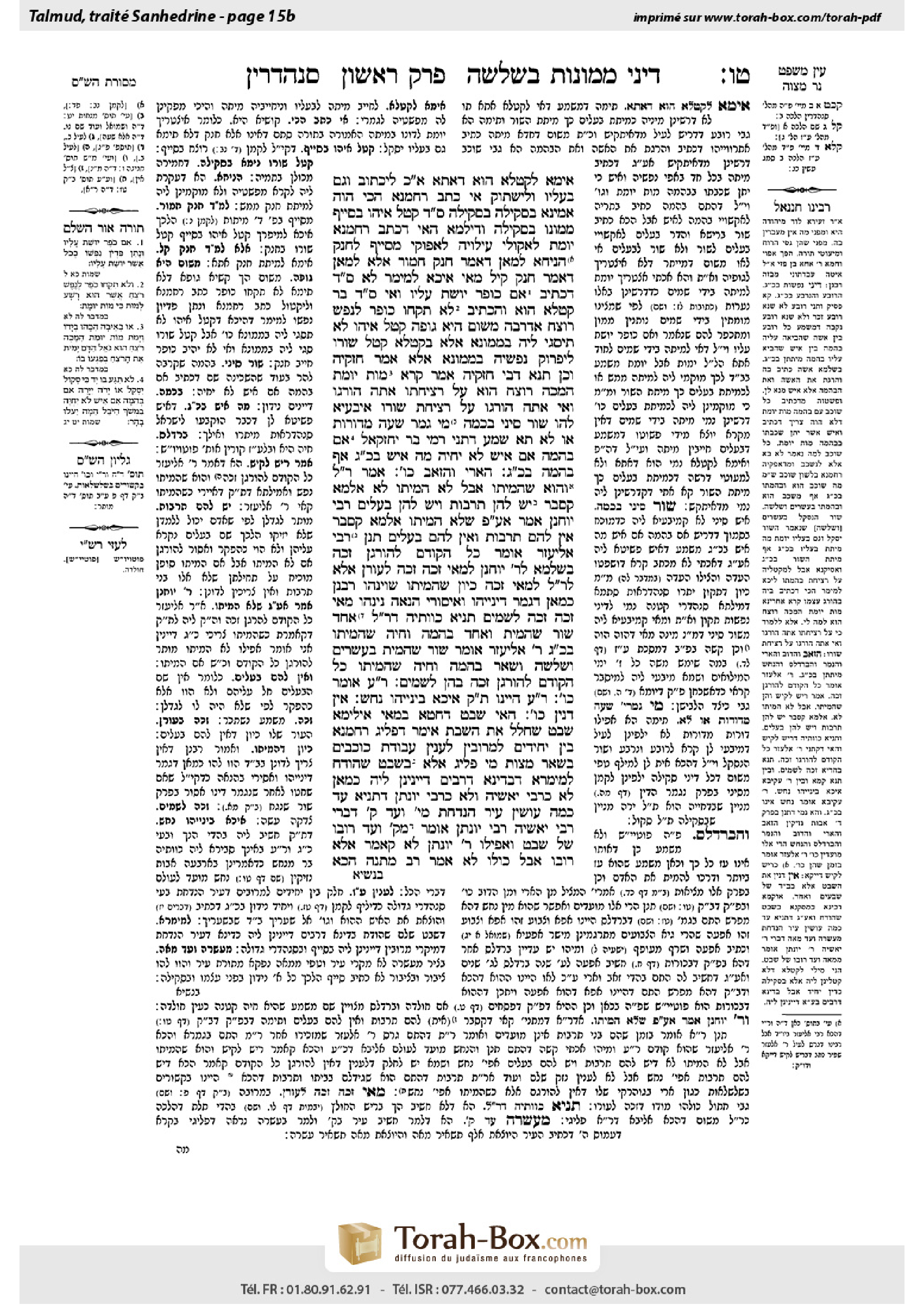
Sanhedrin 15b: Talmud study for Daf Yomi
Daf Yomi is the daily study of one Talmud folio. Explore 37 tractates with scans, Hebrew text, Sefaria English and AI-generated French translations where annotated.
Passage selection and English or AI-generated French translation are available where the scan has annotations. Daf Study is independent of Torah-Box and Sefaria.
Browse Sanhedrin · סנהדרין · All tractatesSanhedrin 15b text and translations
This page of Sanhedrin includes the Aramaic text, an English translation and an AI-generated French translation, alongside the scan above.
סנהדרין י״ה ב · Aramaic and Hebrew text
אֵימָא לִקְטָלָא הוּא דַּאֲתָא! אִם כֵּן, לִיכְתּוֹב ״וְגַם בְּעָלָיו״, וְלִישְׁתּוֹק!
אִי כְּתַב רַחֲמָנָא הָכִי, הֲוָה אָמֵינָא בִּסְקִילָה. בִּסְקִילָה סָלְקָא דַּעְתָּךְ? קְטַל אִיהוּ – בְּסַיִיף, מָמוֹנוֹ – בִּסְקִילָה?
וְדִילְמָא הַאי דִּכְתַב רַחֲמָנָא ״יוּמָת״ לְאַקּוֹלֵי עִילָּוֵיהּ, לְאַפּוֹקֵי מִסַּיִיף לְחֶנֶק? הָנִיחָא לְמַאן דְּאָמַר חֶנֶק חָמוּר, אֶלָּא לְמַאן דְּאָמַר חֶנֶק קִיל, מַאי אִיכָּא לְמֵימַר?
לָא סָלְקָא דַּעְתָּךְ, דִּכְתִיב: ״אִם כֹּפֶר יוּשַׁת עָלָיו״. וְאִי סָלְקָא דַעְתָּךְ בַּר קְטָלָא הוּא, וְהָכְתִיב: ״לֹא תִקְחוּ כֹפֶר לְנֶפֶשׁ רֹצֵחַ״!
אַדְּרַבָּה, מִשּׁוּם הִיא גּוּפַהּ: קְטַל אִיהוּ – לָא תִּיסְגֵּי לֵיהּ בְּמָמוֹנָא אֶלָּא בִּקְטָלָא. קְטַל שׁוֹרוֹ – לִיפְרוֹק נַפְשֵׁיהּ בְּמָמוֹנָא. אֶלָּא, אָמַר חִזְקִיָּה וְכֵן תָּנָא דְּבֵי חִזְקִיָּה: אָמַר קְרָא ״מוֹת יוּמַת הַמַּכֶּה רֹצֵחַ הוּא״ – עַל רְצִיחָתוֹ אַתָּה הוֹרְגוֹ, וְאִי אַתָּה הוֹרְגוֹ עַל רְצִיחַת שׁוֹרוֹ.
אִיבַּעְיָא לְהוּ: שׁוֹר סִינַי בְּכַמָּה? מִי גָּמַר שָׁעָה מִדּוֹרוֹת, אוֹ לָא? תָּא שְׁמַע, דְּתָנֵי רָמֵי בַּר יְחֶזְקֵאל: ״אִם בְּהֵמָה אִם אִישׁ לֹא יִחְיֶה״ – מָה אִישׁ בְּעֶשְׂרִים וּשְׁלֹשָׁה, אַף בְּהֵמָה בְּעֶשְׂרִים וּשְׁלֹשָׁה.
הָאֲרִי וְהַזְּאֵב כּוּ׳. אָמַר רֵישׁ לָקִישׁ: וְהוּא שֶׁהֵמִיתוּ, אֲבָל לֹא הֵמִיתוּ – לָא. אַלְמָא קָסָבַר: יֵשׁ לָהֶן תַּרְבּוּת וְיֵשׁ לָהֶן בְּעָלִים. רַבִּי יוֹחָנָן אָמַר: אַף עַל פִּי שֶׁלֹּא הֵמִיתוּ. אַלְמָא קָסָבַר: אֵין לָהֶם תַּרְבּוּת וְאֵין לָהֶם בְּעָלִים.
תְּנַן, רַבִּי אֱלִיעֶזֶר אוֹמֵר: כׇּל הַקּוֹדֵם לְהוֹרְגָן זָכָה. בִּשְׁלָמָא לְרַבִּי יוֹחָנָן, לְמַאי זָכָה? זָכָה לְעוֹרָן. אֶלָּא לְרֵישׁ לָקִישׁ, לְמַאי זָכָה? כֵּיוָן שֶׁהֵמִיתוּ, שַׁוִּינְהוּ רַבָּנַן כְּמַאן דִּגְמַר דִּינַיְיהוּ, וְאִיסּוּרֵי הֲנָאָה נִינְהוּ.
מַאי ״זָכָה״? זָכָה לַשָּׁמַיִם. תַּנְיָא כְּוָותֵיהּ דְּרֵישׁ לָקִישׁ: אֶחָד שׁוֹר שֶׁהֵמִית וְאֶחָד בְּהֵמָה וְחַיָּה שֶׁהֵמִיתוּ – בְּעֶשְׂרִים וּשְׁלֹשָׁה. רַבִּי אֱלִיעֶזֶר אוֹמֵר: שׁוֹר שֶׁהֵמִית – בְּעֶשְׂרִים וּשְׁלֹשָׁה, וּשְׁאָר בְּהֵמָה וְחַיָּה שֶׁהֵמִיתוּ – כׇּל הַקּוֹדֵם לְהוֹרְגָן זָכָה בָּהֶן לַשָּׁמַיִם.
רַבִּי עֲקִיבָא אוֹמֵר וְכוּ׳. רַבִּי עֲקִיבָא הַיְינוּ תַּנָּא קַמָּא? אִיכָּא בֵּינַיְיהוּ נָחָשׁ.
אֵין דָּנִין כּוּ׳. הַאי שֵׁבֶט דַּחֲטָא בְּמַאי? אִילֵימָא שֵׁבֶט שֶׁחִלֵּל אֶת הַשַּׁבָּת, אֵימַר דְּפַלֵּיג רַחֲמָנָא בֵּין יְחִידִים לִמְרוּבִּין לְעִנְיַן עֲבוֹדַת כּוֹכָבִים, בִּשְׁאָר מִצְוֹת מִי פְּלִיג? אֶלָּא בְּשֵׁבֶט שֶׁהוּדַּח.
לְמֵימְרָא דִּבְדִינָא דְּרַבִּים דָּיְינִינַן לֵיהּ? כְּמַאן: לָא כְּרַבִּי יֹאשִׁיָּה וְלָא כְּרַבִּי יוֹנָתָן! דְּתַנְיָא: עַד כַּמָּה עוֹשִׂין עִיר הַנִּדַּחַת? מֵעֲשָׂרָה וְעַד מֵאָה, דִּבְרֵי רַבִּי יֹאשִׁיָּה. רַבִּי יוֹנָתָן אוֹמֵר: מִמֵּאָה וְעַד רוּבּוֹ שֶׁל שֵׁבֶט.
וַאֲפִילּוּ רַבִּי יוֹנָתָן לָא קָאָמַר אֶלָּא רוּבּוֹ, אֲבָל כּוּלּוֹ לָא. אָמַר רַב מַתְנָה: הָכָא
Sanhedrin 15b · English translation
Why not say instead that it comes to teach that the owner of the ox is liable to receive the death penalty? Rava responded: If so, let it write in the same verse only: “The ox shall be stoned and also its owner,” and let it be silent and not add more. It would be clear that the owner is also to be put to death. Since the verse added the explicit term: “Shall be put to death,” it is clear that the intention is to teach that just as the manner of the death of the owner, so is the manner of the death of the ox.
Abaye said: Had the Merciful One written the verse in this manner, I would say that the owner is executed by stoning. The Gemara rejects this: Would it enter your mind to say he should be executed by stoning? If he killed the person himself he would be executed by the sword, which is deemed a lighter punishment; if his property killed the victim, could he be given the more severe execution by stoning?
The Gemara asks: But perhaps this term that the Merciful One wrote: “Shall be put to death,” is to be lenient with him, to remove his sentence from the category of execution by the sword and instead to sentence him to death by strangulation. This works out well according to the one who says that strangulation is more severe than the sword. According to that opinion there is no place for such a claim, as the punishment is certainly not more severe than that of an actual murderer. But according to the one who says that strangulation is a lighter punishment, what is there to say?
The Gemara responds: It would not enter your mind to think this, as it is written: “If a ransom be placed upon him, then he shall give for the redemption of his life whatever is placed upon him” (Exodus 21:30), and if it enters your mind to say that he is liable to receive the death penalty, that verse would not be understood, for the following reason: But isn’t it written: “You shall take no ransom for the life of a murderer who was convicted to die, for he shall be put to death” (Numbers 35:31)? Since in this case there is a ransom payment, it is clear that there is no actual death penalty involved.
This line of reasoning is rejected: On the contrary, the additional phrase in the verse is necessary due to this argument itself. If one killed a person himself, it would not be enough for him to make a payment of money; he must be punished only with actual execution. But if his ox killed someone, I would say he should redeem himself with money, but that if he does not pay money, he would receive the death penalty. Rather, the matter cannot be decided on the basis of these verses, and it must be proven by what Ḥizkiyya says, and so the school of Ḥizkiyya taught this baraita: The verse states: “He that struck him shall be put to death; he is a murderer” (Numbers 35:21), from which it is inferred: You execute him for his act of murder, but you do not execute him for his ox’s act of murder.
A dilemma was raised before the Sages: By how many judges would an ox at Mount Sinai have been judged? At the time of the giving of the Torah it was forbidden to ascend onto Mount Sinai, as it is written: “No hand shall touch him, but he shall be stoned or shot through; whether animal or man, it shall not live” (Exodus 19:13). If an ox did ascend the mountain, how many judges would be necessary to sentence it to execution by stoning? The Gemara explains the question: Do we derive a halakha that applies only to a specific time from a halakha that applies for all generations, and accordingly any animal that is to be stoned is judged by twenty-three judges; or not? The Gemara answers: Come and hear a solution from that which Rami bar Yeḥezkel taught: The verse states: “Whether animal or man it shall not live.” The comparison serves to teach that just as a person is judged by twenty-three judges, so too an animal is judged by twenty-three judges.
§ The mishna records a dispute with regard to the judgment of a lion or a wolf: Does this judgment require twenty-three judges? Reish Lakish says: And that dispute concerns a lion or wolf that has killed a person. But if they have not killed, then no, they may not be executed. Apparently, Reish Lakish holds that they have the capability of being tamed and domesticated, and consequently they might have owners, so it is not permitted to kill them without due cause. And Rabbi Yoḥanan says: The dispute applies even if they have not killed. Apparently, Rabbi Yoḥanan holds that they do not have the capability of being tamed, and therefore they do not have owners.
We learned in the mishna: Rabbi Eliezer says: Anyone who kills them first merits. Granted, according to the opinion of Rabbi Yoḥanan, what does he merit? It can be explained that he merits, i.e., acquires, their hides; since these animals are by definition ownerless, whoever kills them first may take the hide for himself. But according to the opinion of Reish Lakish, what does he merit? Since according to Reish Lakish the mishna is discussing a case where they have already killed, the Sages made their status equivalent to those whose verdicts have been issued in court, and oxen that are stoned are items from which deriving benefit is prohibited.
The Gemara answers: What is the meaning of: Merits, according to Reish Lakish? It means that he merits according to Heaven, meaning that he has performed a mitzva by destroying a harmful animal. The Gemara relates: It is taught in a baraita in accordance with the opinion of Reish Lakish (Tosefta 3:1): Both an ox that killed and a different domesticated animal or undomesticated animal that killed are sentenced by twenty-three judges. Rabbi Eliezer says: An ox that killed is sentenced by twenty-three judges, but with regard to other domesticated animals and undomesticated animals that killed, anyone who kills them first merits, with that act, according to Heaven. It is therefore apparent that the disagreement concerns only animals that have killed, and that, as Reish Lakish explained, the term: Merits, indicates only a moral achievement but not a financial acquisition.
§ The mishna states that with regard to these dangerous animals, Rabbi Akiva says: Their death is decreed by twenty-three judges. The Gemara asks: The opinion of Rabbi Akiva is identical to the opinion of the first tanna; what is the novelty of his statement? The Gemara answers: The difference between them relates to the halakha concerning a snake. According to the first tanna, a snake is also sentenced by twenty-three judges, whereas Rabbi Akiva holds that all domesticated and undomesticated animals other than snakes are included in this requirement.
§ The mishna teaches that the court judges cases involving an entire tribe that sinned only in the Great Sanhedrin, consisting of seventy-one judges. The Gemara asks: With regard to this tribe that sinned, in what way did it sin? If we say that it was a tribe that transgressed most prohibitions, e.g., they desecrated Shabbat, this is difficult. There is a source to say that the Merciful One distinguishes between individuals and multitudes with regard to idol worship, as there is a special halakha with regard to an idolatrous city. But with regard to other mitzvot, does He distinguish between individuals and multitudes? Rather, it must be that the mishna is discussing a tribe that was subverted and which engaged in idol worship.
The Gemara asks: Is this to say that we judge such a tribe with the halakha of a multitude, meaning that an entire idolatrous tribe is subject to the same treatment as an idolatrous city? If so, in accordance with whose opinion is the mishna? It is not in accordance with the opinion of Rabbi Yoshiya, and not in accordance with the opinion of Rabbi Yonatan. As it is taught in a baraita: How many people in a city must engage in idol worship for it to be designated as an idolatrous city? From ten until one hundred people; this is the statement of Rabbi Yoshiya. Rabbi Yonatan says: From one hundred people until a majority of a tribe.
And it is therefore apparent that even Rabbi Yonatan, who allows a larger community to be declared an idolatrous city, said this only with regard to a majority of the tribe at most, but if it was all of the tribe that was idolatrous, then the halakha of an idolatrous city does not apply. Rav Mattana said: Here, in the mishna,
Sanhedrin 15b · Traduction française (IA)
Pourquoi ne pas dire plutôt que cela vient enseigner que le propriétaire du bœuf est passible de la peine de mort ? Rava répondit : Si tel était le cas, le verset pourrait écrire seulement : « Le bœuf sera lapidé, et son propriétaire aussi », puis s’arrêter là, sans rien ajouter. Il serait alors clair que le propriétaire doit lui aussi être mis à mort. Puisque le verset a ajouté l’expression explicite « sera mis à mort », il est clair que son intention est d’enseigner que la manière dont le propriétaire est mis à mort est aussi celle dont le bœuf est mis à mort.
Abayé dit : Si le Miséricordieux avait écrit le verset de cette manière, j’aurais dit que le propriétaire est exécuté par lapidation. La Guemara objecte : Te viendrait-il à l’esprit de dire qu’il doit être exécuté par lapidation ? S’il avait tué lui-même la personne, il serait exécuté par l’épée, peine considérée comme plus légère ; si c’est son bien qui a tué la victime, pourrait-il recevoir la peine plus sévère de la lapidation ?
La Guemara demande : Mais peut-être l’expression « sera mis à mort », écrite par le Miséricordieux, vise-t-elle à l’indulgence envers lui, en écartant la peine de l’épée pour le condamner plutôt à la strangulation. Cela convient selon celui qui dit que la strangulation est plus sévère que l’épée. Selon cette opinion, une telle affirmation n’a pas lieu d’être, car la peine n’est certainement pas plus sévère que celle infligée à un meurtrier qui a tué de sa propre main. Mais que peut-on répondre selon celui qui dit que la strangulation est une peine plus légère ?
La Guemara répond : Il ne te viendrait pas à l’esprit de penser cela, car il est écrit : « Si une rançon lui est imposée, il donnera pour le rachat de sa vie tout ce qui lui sera imposé » (Exode 21:30). Or, si l’on pouvait penser qu’il est passible de la peine de mort, ce verset ne pourrait pas s’expliquer, pour la raison suivante : N’est-il pas écrit : « Vous ne recevrez aucune rançon pour la vie d’un meurtrier condamné à mort, car il sera mis à mort » (Nombres 35:31) ? Puisqu’en l’occurrence une rançon est prévue, il est clair qu’il ne s’agit pas d’une véritable peine de mort.
Ce raisonnement est rejeté : Au contraire, l’expression supplémentaire du verset est nécessaire précisément en raison de cet argument. Si quelqu’un tuait lui-même une personne, il ne suffirait pas qu’il verse une somme d’argent ; il devrait être puni par une véritable exécution. Mais si son bœuf tuait quelqu’un, j’aurais dit qu’il pouvait se racheter par de l’argent, mais que, s’il ne payait pas, il subirait la peine de mort. La question ne peut donc pas être tranchée à partir de ces versets ; il faut la démontrer à partir de ce que dit Ḥizkiyya. C’est ainsi que l’école de Ḥizkiyya enseigna cette baraïta : le verset dit : « Celui qui l’a frappé sera mis à mort ; c’est un meurtrier » (Nombres 35:21). On en déduit qu’on l’exécute pour son propre meurtre, mais non pour le meurtre commis par son bœuf.
Une question fut posée aux Sages : Par combien de juges aurait été jugé un bœuf sur le mont Sinaï ? Au moment du don de la Torah, il était interdit de gravir le mont Sinaï, comme il est écrit : « Aucune main ne le touchera ; il sera lapidé ou transpercé ; bête ou homme, il ne vivra pas » (Exode 19:13). Si un bœuf était monté sur la montagne, combien de juges auraient été nécessaires pour le condamner à la lapidation ? La Guemara précise la question : Déduit-on une halakha qui ne s’applique qu’à une époque donnée d’une halakha valable pour toutes les générations — auquel cas tout animal destiné à être lapidé serait jugé par vingt-trois juges — ou non ? La Guemara répond : Viens entendre la solution de l’enseignement de Rami bar Yeḥezkel : le verset dit : « Bête ou homme, il ne vivra pas. » Cette comparaison enseigne que, de même qu’un homme est jugé par vingt-trois juges, un animal l’est aussi par vingt-trois juges.
§ La Michna rapporte une controverse concernant le jugement d’un lion ou d’un loup : cette affaire requiert-elle vingt-trois juges ? Reish Lakish dit : Cette controverse concerne un lion ou un loup qui a tué une personne. Mais s’ils n’ont pas tué, ils ne peuvent pas être exécutés. Il ressort que, selon Reish Lakish, ils peuvent être apprivoisés et domestiqués et, par conséquent, avoir des propriétaires ; il n’est donc pas permis de les tuer sans motif valable. Rabbi Yoḥanan dit : La controverse s’applique même s’ils n’ont pas tué. Il ressort que, selon Rabbi Yoḥanan, ils ne peuvent pas être apprivoisés et n’ont donc pas de propriétaires.
Nous avons appris dans la Michna : Rabbi Eliezer dit : Quiconque les tue le premier en tire un mérite. Certes, selon l’opinion de Rabbi Yoḥanan, quel mérite en tire-t-il ? On peut expliquer qu’il acquiert leurs peaux ; ces animaux étant par définition sans propriétaire, celui qui les tue le premier peut garder leur peau. Mais selon l’opinion de Reish Lakish, quel mérite en tire-t-il ? Puisque, selon Reish Lakish, la Michna traite d’un cas où ils ont déjà tué, les Sages leur ont donné le statut de ceux dont le verdict a été prononcé par le tribunal ; or, les bœufs lapidés sont des biens dont il est interdit de tirer profit.
La Guemara répond : Que signifie « en tire un mérite », selon Reish Lakish ? Cela signifie qu’il mérite une récompense du Ciel, c’est-à-dire qu’il a accompli une mitsva en éliminant un animal dangereux. La Guemara rapporte qu’une baraïta est enseignée conformément à l’opinion de Reish Lakish (Tossefta 3:1) : un bœuf qui a tué, tout comme un autre animal domestique ou sauvage qui a tué, est jugé par vingt-trois juges. Rabbi Eliezer dit : Un bœuf qui a tué est jugé par vingt-trois juges ; mais, pour les autres animaux domestiques et sauvages qui ont tué, quiconque les tue le premier mérite, par cet acte, une récompense du Ciel. Il apparaît donc que le désaccord ne concerne que les animaux qui ont tué et que, comme l’a expliqué Reish Lakish, l’expression « en tire un mérite » désigne uniquement un mérite moral, et non une acquisition financière.
§ La Michna dit que, concernant ces animaux dangereux, Rabbi Akiva affirme que leur mise à mort est décidée par vingt-trois juges. La Guemara demande : L’opinion de Rabbi Akiva est identique à celle du premier tanna ; quelle est donc la nouveauté de sa déclaration ? La Guemara répond : La différence entre eux concerne la halakha relative au serpent. Selon le premier tanna, un serpent aussi est jugé par vingt-trois juges, tandis que Rabbi Akiva considère que cette exigence s’applique à tous les animaux domestiques et sauvages, à l’exception des serpents.
§ La Michna enseigne que les affaires concernant une tribu entière qui a péché ne sont jugées que par le Grand Sanhédrin, composé de soixante et onze juges. La Guemara demande : En quoi cette tribu a-t-elle péché ? Si l’on dit qu’il s’agissait d’une tribu ayant transgressé plusieurs interdits, par exemple en profanant le Chabbat, cela pose une difficulté. Il existe une source selon laquelle le Miséricordieux établit une distinction entre les individus et la multitude en matière d’idolâtrie, puisqu’il existe une halakha particulière concernant une ville idolâtre. Mais, pour les autres mitsvot, distingue-t-Il les individus de la multitude ? Il faut donc plutôt dire que la Michna traite d’une tribu qui a été détournée et s’est adonnée à l’idolâtrie.
La Guemara demande : Cela signifie-t-il que nous jugeons cette tribu selon la halakha applicable à une multitude, c’est-à-dire qu’une tribu entière qui pratique l’idolâtrie est soumise au même traitement qu’une ville idolâtre ? Si oui, selon l’opinion de qui la Michna est-elle conforme ? Elle n’est conforme ni à l’opinion de Rabbi Yoshiya ni à celle de Rabbi Yonatan. Car il est enseigné dans une baraïta : Combien de personnes dans une ville doivent pratiquer l’idolâtrie pour que celle-ci soit désignée comme ville idolâtre ? De dix à cent personnes ; telle est la déclaration de Rabbi Yoshiya. Rabbi Yonatan dit : De cent personnes jusqu’à la majorité d’une tribu.
Il apparaît donc que même Rabbi Yonatan, qui permet de désigner une communauté plus importante comme ville idolâtre, ne l’a dit que dans le cas où le nombre atteint au plus la majorité de la tribu ; mais si toute la tribu pratique l’idolâtrie, la halakha de la ville idolâtre ne s’applique pas. Rav Mattana dit : Ici, dans la Michna,
Traduction française générée par IA à partir de l’édition anglaise de Sefaria. Vérifie toujours un passage avec le texte source.
Text from Sefaria: William Davidson Edition - Vocalized Aramaic (CC BY NC); William Davidson Edition - English (CC BY NC).