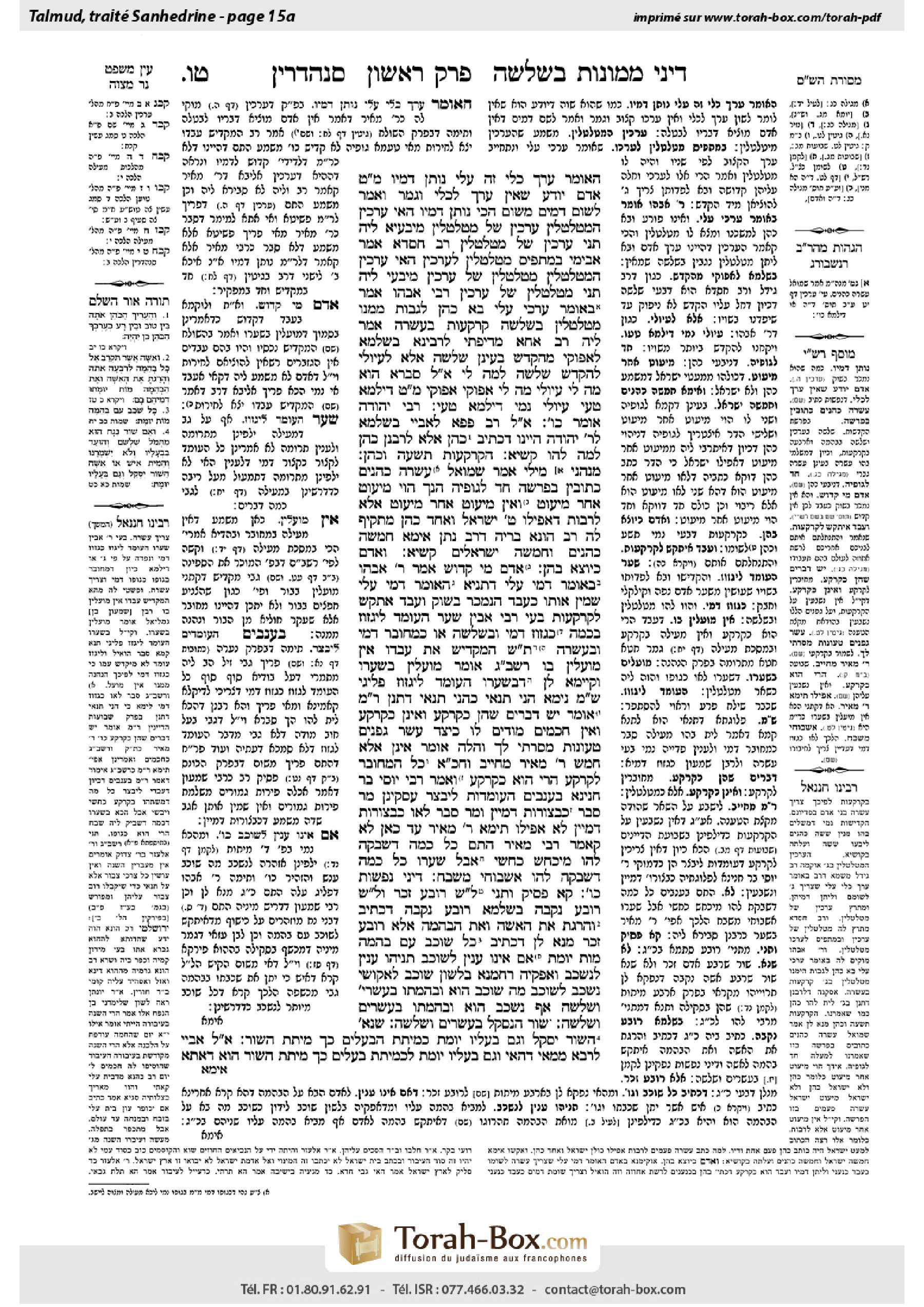
Sanhedrin 15a: Talmud study for Daf Yomi
Daf Yomi is the daily study of one Talmud folio. Explore 37 tractates with scans, Hebrew text, Sefaria English and AI-generated French translations where annotated.
Passage selection and English or AI-generated French translation are available where the scan has annotations. Daf Study is independent of Torah-Box and Sefaria.
Browse Sanhedrin · סנהדרין · All tractatesSanhedrin 15a text and translations
This page of Sanhedrin includes the Aramaic text, an English translation and an AI-generated French translation, alongside the scan above.
סנהדרין י״ה א · Aramaic and Hebrew text
הָאוֹמֵר: ״עֵרֶךְ כְּלִי זֶה עָלַי״ – נוֹתֵן דָּמָיו. מַאי טַעְמָא? אָדָם יוֹדֵעַ שֶׁאֵין עֵרֶךְ לִכְלִי, וְגָמַר וְאָמַר לְשׁוּם דָּמִים. מִשּׁוּם הָכִי נוֹתֵן דָּמָיו. הַאי ״עֲרָכִין הַמִּטַּלְטְלִין״? ״עֲרָכִין שֶׁל מִטַּלְטְלִין״ מִבַּעְיָא לֵיהּ! תְּנִי: עֲרָכִין שֶׁל מִטַּלְטְלִין.
רַב חִסְדָּא אָמַר אֲבִימִי: בְּמַתְפִּיס מִטַּלְטְלִין לַעֲרָכִין. הַאי ״עֲרָכִין הַמִּטַּלְטְלִין״? ״מִטַּלְטְלִין שֶׁל עֲרָכִין״ מִיבְּעֵי לֵיהּ! תְּנִי: מִטַּלְטְלִין שֶׁל עֲרָכִין.
רַבִּי אֲבָהוּ אָמַר: בְּאוֹמֵר ״עֶרְכִּי עָלַי״, בָּא כֹּהֵן לִגְבּוֹת מִמֶּנּוּ מִטַּלְטְלִין – בִּשְׁלֹשָׁה, קַרְקָעוֹת – בַּעֲשָׂרָה. אֲמַר לֵיהּ רַב אַחָא מִדִּיפְתִּי לְרָבִינָא: בִּשְׁלָמָא לְאַפּוֹקֵי מֵהֶקְדֵּשׁ בָּעֵינַן שְׁלֹשָׁה, אֶלָּא לְעַיּוֹלֵי לְהֶקְדֵּשׁ שְׁלֹשָׁה לְמָה לִי?
אֲמַר לֵיהּ: סְבָרָא הוּא, מָה לִי עַיּוֹלֵי, מָה לִי אַפּוֹקֵי? אַפּוֹקֵי מַאי טַעְמָא: דִילְמָא טָעֵי. עַיּוֹלֵי נָמֵי דִּילְמָא טָעֵי.
רַבִּי יְהוּדָה אוֹמֵר כּוּ׳. אָמַר לֵיהּ רַב פָּפָּא לְאַבָּיֵי: בִּשְׁלָמָא לְרַבִּי יְהוּדָה, הַיְינוּ דִּכְתִיב ״כֹּהֵן״. אֶלָּא לְרַבָּנַן, ״כֹּהֵן״ לְמָה לְהוּ? קַשְׁיָא.
הַקַּרְקָעוֹת תִּשְׁעָה וְכֹהֵן. מְנָהָנֵי מִילֵּי? אָמַר שְׁמוּאֵל: עֲשָׂרָה כֹּהֲנִים כְּתוּבִין בַּפָּרָשָׁה, חַד לְגוּפֵיהּ, הָנָךְ הָוֵי מִיעוּט אַחַר מִיעוּט, וְאֵין מִיעוּט אַחַר מִיעוּט אֶלָּא לְרַבּוֹת, דַּאֲפִילּוּ תִּשְׁעָה יִשְׂרָאֵל וְאֶחָד כֹּהֵן.
מַתְקֵיף לַהּ רַב הוּנָא בְּרֵיהּ דְּרַב נָתָן: אֵימָא, חֲמִשָּׁה כֹּהֲנִים וַחֲמִשָּׁה יִשְׂרְאֵלִים? קַשְׁיָא!
וְאָדָם כְּיוֹצֵא בָּהֶן. אָדָם מִי קָדוֹשׁ? אָמַר רַבִּי אֲבָהוּ: בְּאוֹמֵר ״דָּמַי עָלַי״. דְּתַנְיָא: הָאוֹמֵר ״דָּמַי עָלַי״ – שָׁמִין אוֹתוֹ כְּעֶבֶד הַנִּמְכָּר בַּשּׁוּק. וְעֶבֶד אִתַּקַּשׁ לְקַרְקָעוֹת.
בָּעֵי רַבִּי אָבִין: שֵׂעָר הָעוֹמֵד לְיִגָּזֵז, בְּכַמָּה? כְּגָזוּז דָּמֵי, וּבִשְׁלֹשָׁה? אוֹ כִּמְחוּבָּר דָּמֵי, וּבַעֲשָׂרָה?
תָּא שְׁמַע: הַמַּקְדִּישׁ אֶת עַבְדּוֹ – אֵין מוֹעֲלִין בּוֹ. רַבָּן שִׁמְעוֹן בֶּן גַּמְלִיאֵל אוֹמֵר: מוֹעֲלִין בִּשְׂעָרוֹ. וְקַיְימָא לַן דְּבִשְׂעָרוֹ הָעוֹמֵד לִיגָּזֵז פְּלִיגִי. שְׁמַע מִינַּהּ.
נֵימָא: הָנֵי תַּנָּאֵי כְּהָנֵי תַּנָּאֵי. דִּתְנַן, רַבִּי מֵאִיר אוֹמֵר: יֵשׁ דְּבָרִים שֶׁהֵן כַּקַּרְקַע וְאֵינָן כַּקַּרְקַע, וְאֵין חֲכָמִים מוֹדִים לוֹ. כֵּיצַד? עֶשֶׂר גְּפָנִים טְעוּנוֹת מָסַרְתִּי לָךְ, וְהַלָּה אוֹמֵר: אֵינָן אֶלָּא חָמֵשׁ – רַבִּי מֵאִיר מְחַיֵּיב, וַחֲכָמִים אוֹמְרִים: כׇּל הַמְחוּבָּר לַקַּרְקַע הֲרֵי הוּא כַּקַּרְקַע.
וְאָמַר רַבִּי יוֹסֵי בַּר חֲנִינָא: בַּעֲנָבִים הָעוֹמְדוֹת לִיבָּצֵר עָסְקִינַן. מָר סָבַר: כִּבְצוּרוֹת דָּמְיָין, וּמָר סָבַר: לָאו כִּבְצוּרוֹת דָּמְיָין. לָא, אֲפִילּוּ תֵּימָא רַבִּי מֵאִיר. עַד כָּאן לָא קָאָמַר רַבִּי מֵאִיר הָתָם, (כֹּל) כַּמָּה דְּשָׁבְקַתְּ לְהוּ מִיכְחָשׁ כָּחֲשִׁי. אֲבָל שְׂעָרוֹ, (כֹּל) כַּמָּה דְּשָׁבְקַתְּ לְהוּ אַשְׁבּוֹחֵי מַשְׁבַּח.
דִּינֵי נְפָשׁוֹת כּוּ׳. קָא פָּסֵיק וְתָנֵי, לָא שְׁנָא רוֹבֵעַ זָכָר וְלָא שְׁנָא רוֹבֵעַ נְקֵבָה. בִּשְׁלָמָא רוֹבֵעַ נְקֵבָה, דִּכְתִיב: ״וְהָרַגְתָּ אֶת הָאִשָּׁה וְאֶת הַבְּהֵמָה״. אֶלָּא רוֹבֵעַ זָכָר, מְנָא לַן?
דִּכְתִיב: ״כׇּל שֹׁכֵב עִם בְּהֵמָה מוֹת יוּמָת״. אִם אֵינוֹ עִנְיָן לְשׁוֹכֵב, תְּנֵיהוּ עִנְיָן לְנִשְׁכָּב. וְאַפְּקֵיהּ רַחֲמָנָא בִּלְשׁוֹן שׁוֹכֵב, לְאַקּוֹשֵׁי נִשְׁכָּב לְשׁוֹכֵב: מָה שׁוֹכֵב – הוּא וּבְהֶמְתּוֹ בְּעֶשְׂרִים וּשְׁלֹשָׁה, אַף נִשְׁכָּב – הוּא וּבְהֶמְתּוֹ בְּעֶשְׂרִים וּשְׁלֹשָׁה.
שׁוֹר הַנִּסְקָל בְּעֶשְׂרִים וּשְׁלֹשָׁה, שֶׁנֶּאֱמַר: ״הַשּׁוֹר יִסָּקֵל וְגַם בְּעָלָיו יוּמָת״. כְּמִיתַת הַבְּעָלִים כָּךְ מִיתַת הַשּׁוֹר. אֲמַר לֵיהּ אַבָּיֵי לְרָבָא: מִמַּאי דְּהַאי ״וְגַם בְּעָלָיו יוּמָת״ לִכְמִיתַת בְּעָלִים כָּךְ מִיתַת הַשּׁוֹר הוּא דַּאֲתָא?
Sanhedrin 15a · English translation
With regard to one who says: The valuation of this utensil is incumbent upon me to donate, he must give the monetary value of the utensil to the Temple treasury. What is the reason for this halakha? A person knows that a utensil has no valuation, i.e., that the term valuation is not relevant to a utensil, and therefore it must be that he decided to donate money and says this expression as a reference to its monetary value, using the term imprecisely. Due to that reason, he gives its monetary value. The Gemara challenges: According to this explanation, this term: Valuations that are movable property, is not precise; the tanna should have used the term: Valuations of movable property. The Gemara answers: Emend the statement and teach: Valuations of movable property.
Rav Ḥisda says that Avimi says a different explanation: Rav’s statement is discussing one who associates the object of his vow with movable property for the valuation. In other words, he took a vow to pay a valuation, and did not have actual money to pay the vow, so he consecrates movable property for this purpose. This property is then appraised by three experts. The Gemara challenges: According to this explanation, this term: Valuations that are movable property, is not precise; the tanna should have used the term: Movable property of valuations. The Gemara answers: Emend the statement and teach: Movable property of valuations.
Rabbi Abbahu says: Rav’s statement is discussing a case of one who says: My monetary valuation is incumbent upon me to donate. If the priest came to collect movable property from him to pay the vow, it must be evaluated by three experts, and if he came to collect land it must be evaluated by ten. Rav Aḥa of Difti said to Ravina: Granted, to take out property from consecration by redeeming it we require a panel of three experts, because if an error is made in the calculation, this will lead to the sin of misuse of consecrated property. But to elevate property to the status of consecration, why do I need three judges?
Ravina said to him: This is based on logical reasoning: What difference is it to me if he is elevating the property to consecration, and what difference is it to me if he is removing it? If he is removing it, what is the reason a court is needed? It is because perhaps he will err and set a price that is too low. When he is elevating it to consecration there is also a concern that perhaps he will err and cause a loss for the Temple treasury.
§ The mishna teaches that Rabbi Yehuda says that when calculating the valuation of consecrated property, one of the people consulted must be a priest. Rav Pappa said to Abaye: Granted, according to the opinion of Rabbi Yehuda, this is understandable, as it is written in the Torah portion about redeeming consecrated property: “Priest” (see, e.g., Leviticus 27:14). But according to the opinion of the Rabbis, who say that any person is fit for this, why do they need the word “priest”? The Gemara concludes: Indeed, the matter is difficult.
§ The mishna teaches that valuations of consecrated land are to be made by nine judges and one priest. The Gemara asks: From where is this matter derived? Shmuel says: Priests are written in this Torah portion ten times (Leviticus, chapter 27). One instance of the word “priest” is for the matter itself, i.e., to teach that there is a need for a priest. These other instances of the word are a restrictive expression following a restrictive expression, as every additional instance of “priest” is a restrictive term. And there is a hermeneutical principle that a restrictive expression following a restrictive expression serves only to amplify and include other matters, in this case teaching that even nine Israelites and one priest may perform the valuation.
Rav Huna, son of Rav Natan, objects to this explanation: According to the principle that a restrictive expression following a restrictive expression serves only to amplify, say that the procedure should require five priests and five Israelites, as the first incidence of the word “priest” indicates an actual priest, the second time the term serves to amplify and teach that even an Israelite is fitting, and then the third time it again indicates specifically a priest. According to this analysis, the final result would require five priests and five Israelites. The Gemara concludes: Indeed, it poses a difficulty.
§ The mishna teaches that just as the valuation of consecrated land is performed by nine judges and one priest, the valuation of a person for the purpose of a vow is performed in a similar manner. The Gemara asks: Can a person be consecrated? It is not possible to consecrate a person, and therefore it is unclear what sort of valuation would be necessary. Rabbi Abbahu says: The mishna is referring to one who says: My monetary value is incumbent upon me to donate to the Temple treasury. As it is taught in a baraita: With regard to one who says: My monetary value is incumbent upon me, the court appraises him as a slave who is sold in the market, and the price that would be paid for him as a slave is the amount he must give to the Temple treasury. And as a slave is compared to land with regard to halakhot of transactions, the valuation is performed by a panel of nine experts and a priest, as is done when land is appraised.
Rabbi Avin raises a dilemma: With regard to a person’s hair that was consecrated and which is ready to be shorn, by how many judges is the appraisal made? Is such hair deemed similar to hair that has already been shorn, and accordingly it is appraised like other movable property, i.e., by three judges, or is it considered as hair still attached to the body and accordingly appraised by ten judges?
The Gemara suggests: Come and hear a resolution of the dilemma from a baraita: Concerning one who consecrates his slave, a person who derives benefit from the slave is not liable for misuse of consecrated property, since the slave’s body does not become consecrated. Rabban Shimon ben Gamliel says: One who derives benefit from the slave’s hair is liable for misuse of consecrated property. And we maintain that it is with regard to hair that is ready to be shorn that they disagree. The Gemara concludes: Learn from here that the question of whether such hair is viewed as already shorn is a dispute between tanna’im.
The Gemara suggests: Let us say that the opinion of these tanna’im is like the opinion of those tanna’im. As we learned in a mishna (Shevuot 42b): Rabbi Meir says: There are entities that are like land in one aspect, and are not like land in other aspects; and the Rabbis do not concede to him. How so? If one said to another: I gave you ten vines laden with grapes and I want to receive their value, and the other says: There were only five, Rabbi Meir deems the defendant liable to take an oath, in accordance with the halakha concerning one who admits to part of a claim. And the Rabbis say: Any item that is attached to the land is viewed as the land itself, and the halakha is that there is no oath in cases of claims with regard to land.
And Rabbi Yosei bar Ḥanina says: In this mishna, we are dealing with grapes that are ready to be picked. One Sage, Rabbi Meir, holds they are considered as grapes that have been picked, i.e., movable property, and one Sage, the Rabbis, holds they are not considered as grapes that have been picked. This suggestion is rejected: No, this cannot be proven from here, as you may even say that the opinion of the Rabbis with regard to the hair is similar to the opinion of Rabbi Meir in the mishna. Only there, with regard to the vines, Rabbi Meir says that they are viewed as already picked, because the more he leaves them on the vine, the more they become lean and deteriorate. Consequently, the grapes are viewed as picked. But in the case of his hair, the more he leaves it on his head the more it improves, as longer hair has a greater value. Consequently, it cannot be said that hair that is ready to be shorn is viewed as already shorn.
§ The mishna teaches that cases of capital law are judged by twenty-three judges, and that an animal that copulated with a person is also judged by twenty-three judges. The Gemara comments: The mishna categorically teaches this halakha, indicating that there is no difference if this was an ox that copulated with a male, and there is no difference if it was an ox that copulated with a female. The Gemara asks: Granted, the source for this halakha is clear in the case where it copulated with a female, as it is written explicitly: “And if a woman approaches any animal and lies down with it, you shall kill the woman and the animal” (Leviticus 20:16). But with regard to an ox that copulated with a male, from where do we derive that the animal is to be killed?
The Gemara answers: As it is written: “Whoever lies with an animal shall be put to death” (Exodus 22:18). If this verse is not needed for the matter of the one who actively lies with the animal, i.e., a male who sexually penetrates the animal, apply it to the matter of the one who causes the animal to lie with him, by being penetrated by the animal. There is another verse (Leviticus 20:15) that explicitly addresses a man penetrating the animal sexually; this verse from Exodus is therefore understood to be referring to the case where he causes the animal to penetrate him. And the Merciful One brought this forth using the active term “lies,” to compare one who causes the animal to lie with him to one who actively lies with the animal, in order to teach that just as in a case of one who lies with an animal, he and his animal are to be judged by twenty-three judges, so too, in the case of one who causes an animal to lie with him, he and his animal are to be judged by twenty-three judges.
§ The mishna teaches that an ox that is to be stoned is judged by twenty-three judges, as it is stated: “The ox shall be stoned and also its owner shall be put to death” (Exodus 21:29). From this verse it is derived that just as the manner of the death of the owner, so is the manner of the death of the ox. Consequently, it follows that twenty-three judges are necessary to adjudicate the case of the ox that is to be stoned. Abaye said to Rava: From where do we know that this phrase: “And also its owner shall be put to death,” comes to teach that just as the manner of the death of the owner, so is the manner of the death of the ox?
Sanhedrin 15a · Traduction française (IA)
Concernant celui qui dit : « L'évaluation de cet ustensile m'est imposée à donner », il doit verser la valeur monétaire de l'ustensile au trésor du Temple. Quelle est la raison de cette halakha ? Une personne sait qu'un ustensile n'a pas d'évaluation, c'est-à-dire que le terme « évaluation » ne s'applique pas à un ustensile, et par conséquent, il a dû décider de donner de l'argent et utilise cette expression en référence à sa valeur monétaire, en employant le terme de manière imprécise. Pour cette raison, il en donne la valeur monétaire. La Guemara objecte : Selon cette explication, cette expression : « Évaluations qui sont des biens meubles », n'est pas précise ; le tanna aurait dû utiliser le terme : « Évaluations de biens meubles ». La Guemara répond : Corrigez l'énoncé et enseignez : « Évaluations de biens meubles ».
Rav Ḥisda dit qu'Avimi donne une explication différente : L'énoncé de Rav concerne celui qui associe l'objet de son vœu à des biens meubles pour l'évaluation. En d'autres termes, il a fait un vœu de payer une évaluation, et n'avait pas d'argent réel pour payer le vœu, alors il consacre des biens meubles à cette fin. Ces biens sont ensuite évalués par trois experts. La Guemara objecte : Selon cette explication, cette expression : « Évaluations qui sont des biens meubles », n'est pas précise ; le tanna aurait dû utiliser le terme : « Biens meubles d'évaluations ». La Guemara répond : Corrigez l'énoncé et enseignez : « Biens meubles d'évaluations ».
Rabbi Abbahu dit : L'énoncé de Rav concerne le cas de celui qui dit : « Je suis tenu de consacrer ma valeur monétaire ». Si le prêtre vient recueillir des biens meubles de lui pour payer le vœu, ceux-ci doivent être évalués par trois experts, et s'il vient recueillir des terres, celles-ci doivent être évaluées par dix. Rav Aḥa de Difti dit à Ravina : Admettons que pour retirer des biens de la consécration en les rachetant, nous exigeons un panel de trois experts, car si une erreur est commise dans le calcul, cela entraînera le péché d'usage de biens consacrés. Mais pour élever des biens au statut de consécration, pourquoi ai-je besoin de trois juges ?
Ravina lui dit : Cela se fonde sur un raisonnement logique : Quelle différence cela fait-il pour moi s'il élève les biens à la consécration, et quelle différence cela fait-il pour moi s'il les retire ? S'il les retire, quelle est la raison pour laquelle un tribunal est nécessaire ? C'est parce qu'il pourrait se tromper et fixer un prix trop bas. Lorsqu'il les élève à la consécration, il y a aussi la crainte qu'il se trompe et cause une perte pour le trésor du Temple.
§ La Michna enseigne que Rabbi Yehuda dit que lors du calcul de l'évaluation de biens consacrés, l'une des personnes consultées doit être un prêtre. Rav Pappa dit à Abaye : Admettons que selon l'opinion de Rabbi Yehuda, cela est compréhensible, car il est écrit dans la portion de la Torah concernant le rachat de biens consacrés : « Prêtre » (voir, par exemple, Lévitique 27:14). Mais selon l'opinion des Sages, qui disent que toute personne est apte pour cela, pourquoi ont-ils besoin du mot « prêtre » ? La Guemara conclut : En effet, la question est difficile.
§ La Michna enseigne que les évaluations de terres consacrées doivent être effectuées par neuf juges et un Cohen. La Guemara demande : D'où cette règle est-elle dérivée ? Shmuel dit : Le mot « Cohen » est écrit dix fois dans cette portion de la Torah (Lévitique, chapitre 27). Une occurrence du mot « Cohen » sert à la règle elle-même, c'est-à-dire pour enseigner qu'il y a besoin d'un Cohen. Les autres occurrences du mot constituent une expression restrictive suivant une expression restrictive, car chaque occurrence supplémentaire de « Cohen » est un terme restrictif. Or, il existe un principe herméneutique selon lequel une expression restrictive suivant une expression restrictive sert uniquement à amplifier et à inclure d'autres cas, enseignant ici que même neuf Israélites et un Cohen peuvent effectuer l'évaluation.
Rav Huna, fils de Rav Natan, objecte à cette explication : Selon le principe qu'une expression restrictive suivant une expression restrictive sert uniquement à amplifier, on devrait dire que la procédure exige cinq Cohens et cinq Israélites, car la première occurrence du mot « Cohen » indique un Cohen réel, la deuxième fois le terme sert à amplifier et enseigne que même un Israélite est apte, et la troisième fois il indique à nouveau spécifiquement un Cohen. Selon cette analyse, le résultat final exigerait cinq Cohens et cinq Israélites. La Guemara conclut : En effet, cela pose une difficulté.
§ La Michna enseigne que de même que l'évaluation des terres consacrées est effectuée par neuf juges et un prêtre, l'évaluation d'une personne dans le cadre d'un vœu est effectuée de manière similaire. La Guemara demande : Peut-on consacrer une personne ? Il n'est pas possible de consacrer une personne, et par conséquent, il n'est pas clair quel type d'évaluation serait nécessaire. Rabbi Abbahu dit : La Michna fait référence à celui qui dit : « Ma valeur monétaire m'est imposée à donner au trésor du Temple ». Comme il est enseigné dans une baraïta : Concernant celui qui dit : « Ma valeur monétaire m'est imposée », le tribunal l'évalue comme un esclave qui est vendu sur le marché, et le prix qui serait payé pour lui en tant qu'esclave est le montant qu'il doit donner au trésor du Temple. Et comme un esclave est comparé à la terre en ce qui concerne les halakhot des transactions, l'évaluation est effectuée par un panel de neuf experts et un prêtre, comme c'est le cas lorsque la terre est évaluée.
Rabbi Avin soulève un dilemme : Concernant les cheveux d'une personne qui ont été consacrés et qui sont prêts à être coupés, par combien de juges l'évaluation est-elle faite ? De tels cheveux sont-ils considérés comme similaires à des cheveux qui ont déjà été coupés, et par conséquent sont-ils évalués comme d'autres biens meubles, c'est-à-dire par trois juges, ou sont-ils considérés comme des cheveux encore attachés au corps et par conséquent évalués par dix juges ?
La Guemara propose : Venez écouter une résolution du dilemme à partir d'une baraïta : Concernant celui qui consacre son esclave, une personne qui tire un profit de l'esclave n'est pas tenue responsable de l'usage de biens sacrés, car le corps de l'esclave ne devient pas sacré. Rabban Chimon ben Gamliel dit : Celui qui tire un profit des cheveux de l'esclave est tenu responsable de l'usage de biens sacrés. Et nous maintenons qu'ils sont en désaccord concernant les cheveux qui sont prêts à être coupés. La Guemara conclut : Apprenez d'ici que la question de savoir si de tels cheveux sont considérés comme déjà coupés fait l'objet d'un désaccord entre les tannaïm.
La Guemara suggère : Disons que l'opinion de ces tannaïm est semblable à l'opinion de ces autres tannaïm. Comme nous l'avons appris dans une Michna (Shevuot 42b) : Rabbi Meïr dit : Il existe des entités qui sont semblables au sol sous un aspect, et ne le sont pas sous d'autres aspects ; et les Sages ne lui concèdent pas cela. Comment cela se présente-t-il ? Si l'un a dit à l'autre : Je t'ai donné dix ceps de vigne chargés de raisins et je veux recevoir leur valeur, et l'autre dit : Il n'y en avait que cinq, Rabbi Meïr considère le défendeur comme tenu de prêter serment, conformément à la halakha concernant celui qui admet une partie d'une réclamation. Et les Sages disent : Tout objet qui est attaché au sol est considéré comme le sol lui-même, et la halakha est qu'il n'y a pas de serment dans les cas de réclamations concernant le sol.
Et Rabbi Yosse ben Ḥanina dit : Dans cette Michna, nous avons affaire à des raisins qui sont prêts à être cueillis. Un Sage, Rabbi Meïr, soutient qu'ils sont considérés comme des raisins qui ont été cueillis, c'est-à-dire comme des biens meubles, et un Sage, les Sages, soutient qu'ils ne sont pas considérés comme des raisins qui ont été cueillis. Cette suggestion est rejetée : Non, cela ne peut pas être prouvé d'ici, car vous pouvez même dire que l'opinion des Sages concernant les cheveux est semblable à l'opinion de Rabbi Meïr dans la Michna. Seulement là, concernant les ceps de vigne, Rabbi Meïr dit qu'ils sont considérés comme déjà cueillis, car plus il les laisse sur la vigne, plus ils deviennent maigres et se détériorent. Par conséquent, les raisins sont considérés comme cueillis. Mais dans le cas de ses cheveux, plus il les laisse sur sa tête, plus ils s'améliorent, car les cheveux longs ont une plus grande valeur. Par conséquent, il ne peut pas être dit que les cheveux prêts à être coupés sont considérés comme déjà coupés.
§ La Michna enseigne que les affaires relevant de la peine capitale sont jugées par vingt-trois juges, et qu'un animal qui a eu des rapports sexuels avec une personne est également jugé par vingt-trois juges. La Guemara commente : La Michna enseigne cette halakha de manière catégorique, indiquant qu'il n'y a aucune différence si c'était un taureau qui a eu des rapports sexuels avec un homme, et qu'il n'y a aucune différence si c'était un taureau qui a eu des rapports sexuels avec une femme. La Guemara demande : Admettons que la source de cette halakha est claire dans le cas où l'animal a eu des rapports sexuels avec une femme, car il est écrit explicitement : « Et si une femme s'approche d'un animal quelconque et couche avec lui, tu tueras la femme et l'animal » (Lévitique 20:16). Mais concernant un taureau qui a eu des rapports sexuels avec un homme, d'où déduisons-nous que l'animal doit être tué ?
La Guemara répond : Comme il est écrit : « Quiconque couche avec un animal sera mis à mort » (Exode 22:18). Si ce verset n'est pas nécessaire pour l'affaire de celui qui couche activement avec l'animal, c'est-à-dire un homme qui pénètre sexuellement l'animal, appliquez-le à l'affaire de celui qui laisse l'animal coucher avec lui, en étant pénétré par l'animal. Il y a un autre verset (Lévitique 20:15) qui aborde explicitement un homme pénétrant sexuellement l'animal ; ce verset d'Exode est donc compris comme se référant au cas où il laisse l'animal le pénétrer. Et le Tout-Puissant a exprimé cela en utilisant le terme actif « couche », pour comparer celui qui laisse l'animal coucher avec lui à celui qui couche activement avec l'animal, afin d'enseigner que de même que dans le cas de celui qui couche avec un animal, lui et son animal doivent être jugés par vingt-trois juges, de même, dans le cas de celui qui laisse un animal coucher avec lui, lui et son animal doivent être jugés par vingt-trois juges.
§ La Michna enseigne qu'un taureau destiné à être lapidé est jugé par vingt-trois juges, car il est dit : « Le taureau sera lapidé et son propriétaire sera aussi mis à mort » (Exode 21:29). De ce verset, il est déduit que de même que la manière de la mort du propriétaire, de même est la manière de la mort du taureau. Par conséquent, il s'ensuit que vingt-trois juges sont nécessaires pour statuer sur le cas du taureau destiné à être lapidé. Abaye dit à Rava : D'où savons-nous que cette phrase : « Et son propriétaire sera aussi mis à mort », vient enseigner que de même que la manière de la mort du propriétaire, de même est la manière de la mort du taureau ?
Traduction française générée par IA à partir de l’édition anglaise de Sefaria. Vérifie toujours un passage avec le texte source.
Text from Sefaria: William Davidson Edition - Vocalized Aramaic (CC BY NC); William Davidson Edition - English (CC BY NC).