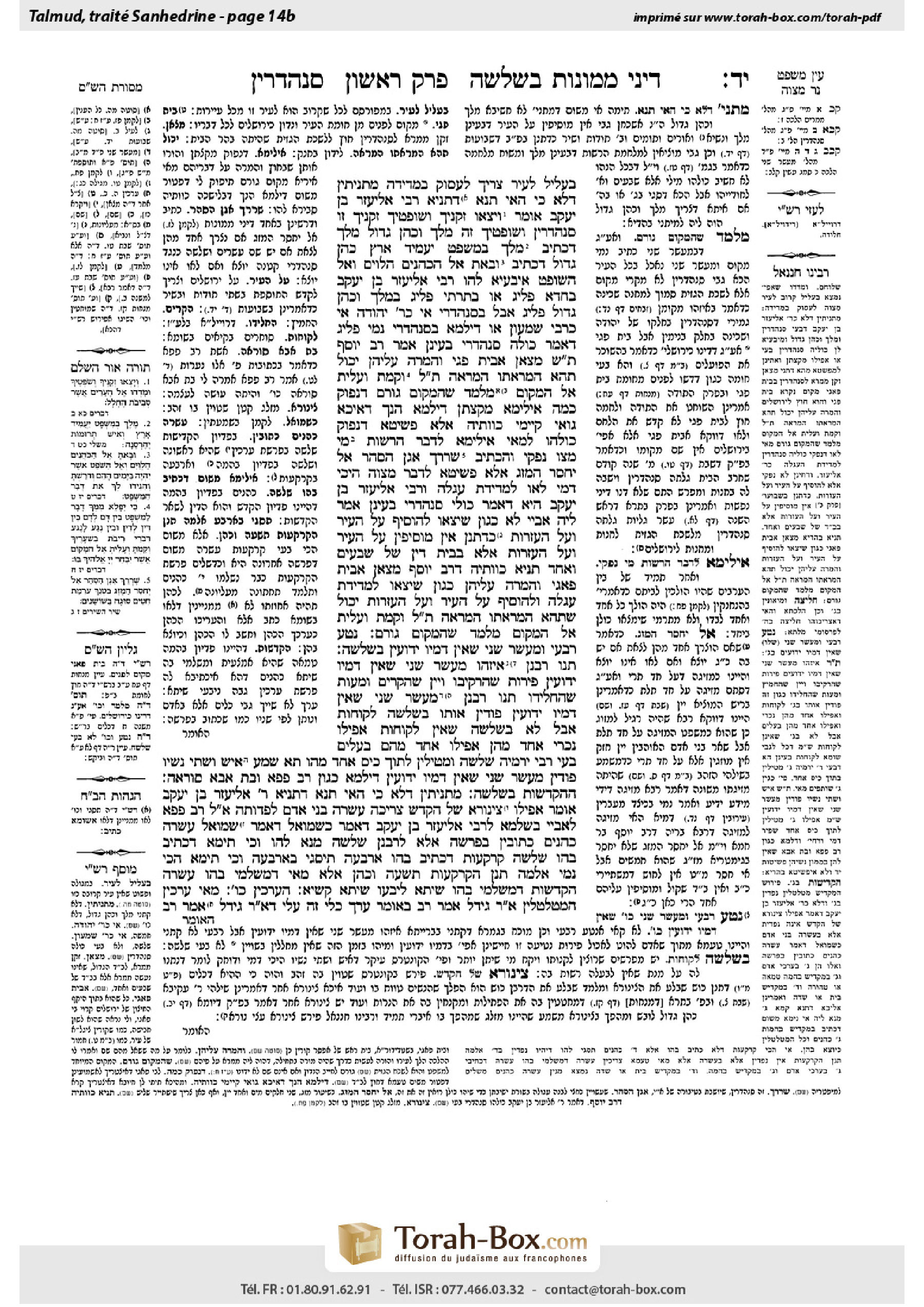
Sanhedrin 14b: Talmud study for Daf Yomi
Daf Yomi is the daily study of one Talmud folio. Explore 37 tractates with scans, Hebrew text, Sefaria English and AI-generated French translations where annotated.
Passage selection and English or AI-generated French translation are available where the scan has annotations. Daf Study is independent of Torah-Box and Sefaria.
Browse Sanhedrin · סנהדרין · All tractatesSanhedrin 14b text and translations
This page of Sanhedrin includes the Aramaic text, an English translation and an AI-generated French translation, alongside the scan above.
סנהדרין י״ד ב · Aramaic and Hebrew text
בַּעֲלִיל לָעִיר, צָרִיךְ לַעֲסוֹק בִּמְדִידָה.
מַתְנִיתִין דְּלָא כִּי הַאי תַּנָּא, דְּתַנְיָא: רַבִּי אֱלִיעֶזֶר בֶּן יַעֲקֹב אוֹמֵר: ״וְיָצְאוּ זְקֵנֶיךָ וְשֹׁפְטֶיךָ״, ״זְקֵנֶיךָ״ – זוֹ סַנְהֶדְרִין, ״וְשֹׁפְטֶיךָ״ – זֶה מֶלֶךְ וְכֹהֵן גָּדוֹל. מֶלֶךְ – דִּכְתִיב: ״מֶלֶךְ בַּמִּשְׁפָּט יַעֲמִיד אָרֶץ״. כֹּהֵן גָּדוֹל – דִּכְתִיב: ״וּבָאתָ אֶל הַכֹּהֲנִים הַלְוִיִּם וְאֶל הַשֹּׁפֵט״.
אִיבַּעְיָא לְהוּ: רַבִּי אֱלִיעֶזֶר בֶּן יַעֲקֹב בַּחֲדָא פְּלִיג אוֹ בְּתַרְתֵּי פְּלִיג? בְּמֶלֶךְ וְכֹהֵן גָּדוֹל פְּלִיג, אֲבָל בְּסַנְהֶדְרֵי – אִי כְּרַבִּי יְהוּדָה אִי כְּרַבִּי שִׁמְעוֹן? אוֹ דִילְמָא בְּסַנְהֶדְרֵי נָמֵי פְּלִיג, דְּאָמַר: כּוּלַּהּ סַנְהֶדְרִי בָּעֵינַן?
אָמַר רַב יוֹסֵף: תָּא שְׁמַע, מְצָאָן אַבֵּית פַּגֵּי וְהִמְרָה עֲלֵיהֶן, יָכוֹל תְּהֵא הַמְרָאָתוֹ הַמְרָאָה? תַּלְמוּד לוֹמַר: ״וְקַמְתָּ וְעָלִיתָ אֶל הַמָּקוֹם״, מְלַמֵּד שֶׁהַמָּקוֹם גּוֹרֵם.
דִּנְפוּק כַּמָּה? אִילֵּימָא מִקְצָתָן, דִּילְמָא הָנָךְ דְּאִיכָּא גַּוַּאי קָיְימִי כְּוָותֵיהּ? אֶלָּא פְּשִׁיטָא דִּנְפוּק כּוּלְּהוּ. לְמַאי? אִילֵימָא לִדְבַר הָרְשׁוּת, מִי מָצוּ נָפְקִי? וְהָכְתִיב: ״שׇׁרְרֵךְ אַגַּן הַסַּהַר אַל יֶחְסַר הַמָּזֶג״! אֶלָּא פְּשִׁיטָא לִדְבַר מִצְוָה.
הֵיכִי דָּמֵי? לָאו לִמְדִידַת עֶגְלָה, וְרַבִּי אֱלִיעֶזֶר בֶּן יַעֲקֹב הִיא, דְּאָמַר: כּוּלֵּי סַנְהֶדְרֵי בָּעֵינַן? אֲמַר לֵיהּ אַבָּיֵי: לָא, כְּגוֹן שֶׁיָּצְאוּ לְהוֹסִיף עַל הָעִיר וְעַל הָעֲזָרוֹת, כְּדִתְנַן: אֵין מוֹסִיפִין עַל הָעִיר וְעַל הָעֲזָרוֹת אֶלָּא בְּבֵית דִּין שֶׁל שִׁבְעִים וְאֶחָד.
תַּנְיָא כְּוָותֵיהּ דְּרַב יוֹסֵף: מְצָאָן אַבֵּית פָּאגֵי וְהִמְרָה עֲלֵיהֶן, כְּגוֹן שֶׁיָּצְאוּ לִמְדִידַת עֶגְלָה וּלְהוֹסִיף עַל הָעִיר וְעַל הָעֲזָרוֹת, יָכוֹל שֶׁתְּהֵא הַמְרָאָתוֹ הַמְרָאָה? תַּלְמוּד לוֹמַר: ״וְקַמְתָּ וְעָלִיתָ אֶל הַמָּקוֹם״, מְלַמֵּד שֶׁהַמָּקוֹם גּוֹרֵם.
נֶטַע רְבָעִי וּמַעֲשֵׂר שֵׁנִי שֶׁאֵין דָּמָיו יְדוּעִין, בִּשְׁלֹשָׁה. תָּנוּ רַבָּנַן: אֵיזֶהוּ מַעֲשֵׂר שֵׁנִי שֶׁאֵין דָּמָיו יְדוּעִין? פֵּירוֹת שֶׁהִרְקִיבוּ, וְיַיִן שֶׁהִקְרִיס, וּמָעוֹת שֶׁהֶחְלִידוּ. תָּנוּ רַבָּנַן: מַעֲשֵׂר שֵׁנִי שֶׁאֵין דָּמָיו יְדוּעִין, פּוֹדִין אוֹתוֹ בִּשְׁלֹשָׁה לָקוֹחוֹת, אֲבָל לֹא בִּשְׁלֹשָׁה שֶׁאֵין לָקוֹחוֹת. אֲפִילּוּ גּוֹי אֶחָד מֵהֶן, אֲפִילּוּ אֶחָד מֵהֶם בְּעָלִים.
בָּעֵי רַבִּי יִרְמְיָה: שְׁלֹשָׁה וּמְטִילִין לְתוֹךְ כִּיס אֶחָד, מַהוּ? תָּא שְׁמַע: אִישׁ וּשְׁתֵּי נָשָׁיו פּוֹדִין מַעֲשֵׂר שֵׁנִי שֶׁאֵין דָּמָיו יְדוּעִין. דִּילְמָא כְּגוֹן רַב פָּפָּא וּבַת אַבָּא סוּרָאָה.
הַהֶקְדֵּשׁוֹת בִּשְׁלֹשָׁה. מַתְנִיתִין דְּלָא כִּי הַאי תַּנָּא, דְּתַנְיָא: רַבִּי אֱלִיעֶזֶר בֶּן יַעֲקֹב אוֹמֵר, אֲפִילּוּ צִינּוֹרָא שֶׁל הֶקְדֵּשׁ צְרִיכָה עֲשָׂרָה בְּנֵי אָדָם לִפְדּוֹתָהּ.
אֲמַר לֵיהּ רַב פָּפָּא לְאַבָּיֵי: בִּשְׁלָמָא לְרַבִּי אֱלִיעֶזֶר בֶּן יַעֲקֹב, דְּאָמַר כִּשְׁמוּאֵל, דְּאָמַר שְׁמוּאֵל: עֲשָׂרָה כֹּהֲנִים כְּתוּבִין בַּפָּרָשָׁה, אֶלָּא לְרַבָּנַן – שְׁלֹשָׁה מְנָא לְהוּ?
וְכִי תֵּימָא דִּכְתִיב בְּהוּ שְׁלֹשָׁה, קַרְקָעוֹת דִּכְתִיב בְּהוּ אַרְבָּעָה תִּיסְגֵּי בְּאַרְבָּעָה? וְכִי תֵּימָא: הָכִי נָמֵי, אַלְּמָה תְּנַן: הַקַּרְקָעוֹת תִּשְׁעָה וְכֹהֵן?
אֶלָּא מַאי, דְּמַשְׁלְמִי בְּהוּ עֲשָׂרָה? הֶקְדֵּשׁוֹת, דְּמַשְׁלְמִי בְּהוּ שִׁיתָּא, לִיבְעוֹ שִׁיתָּא! קַשְׁיָא.
הָעֲרָכִין כּוּ׳. מַאי עֲרָכִין הַמִּטַּלְטְלִין? אָמַר רַב גִּידֵּל אָמַר רַב: בְּאוֹמֵר ״עֵרֶךְ כְּלִי זֶה עָלַי״. דְּאָמַר רַב גִּידֵּל אָמַר רַב:
Sanhedrin 14b · English translation
clearly close to the city, so that there is no need to measure in order to determine the closest city, nevertheless they must involve themselves with the measurement.
§ The Gemara comments: The mishna is not in accordance with the opinion of this tanna, as it is taught in a baraita: Rabbi Eliezer ben Ya’akov says: With regard to the breaking of the neck of the heifer, the verse states: “And your elders and your judges shall go out” (Deuteronomy 21:2). “Your elders,” this is referring to the Sanhedrin; “and your judges,” this is referring to the king and the High Priest. The baraita explains the assertion that the king is called a judge, as it is written: “The king by justice establishes the land” (Proverbs 29:4), and the High Priest is also called a judge, as it is written: “And you shall come to the priests the Levites, and to the judge that will be in those days” (Deuteronomy 17:9), referring to the High Priest.
A dilemma was raised before the Sages: Does Rabbi Eliezer ben Ya’akov disagree with the tanna’im of the mishna only with regard to one matter, or does he disagree with regard to two matters? Does he disagree only with regard to the requirement for the king and the High Priest to participate in the measurement, but with regard to the Sanhedrin he holds either in accordance with the opinion of Rabbi Yehuda or in accordance with the opinion of Rabbi Shimon? Or perhaps he disagrees with regard to the Sanhedrin, too, as he says we require all of the members of the Sanhedrin to participate in the measurement.
Rav Yosef said: Come and hear a solution to this dilemma from a baraita discussing the case of a rebellious elder, a Sage who publicly teaches a halakha against the ruling of the Great Sanhedrin: If the rebellious elder found the members of the Sanhedrin in Beit Pagei outside of Jerusalem and rebelled against them by rejecting their decision, one might have thought that his rebellion is deemed a rebellion and he will be liable to receive the death penalty if he instructs the public to follow his opinion. Therefore, the verse states: “And you shall arise and go up to the place that the Lord your God shall choose” (Deuteronomy 17:8), and this teaches that the location determines the authority of the Sanhedrin; to a certain extent this authority exists only when the Sanhedrin is situated in the Chamber of Hewn Stone, adjacent to the Temple.
The Gemara clarifies: In the case discussed in the baraita, how many members of the Sanhedrin went out to Beit Pagei? If we say that only some of them went out, there is no significance in such a ruling issued by the rebellious elder, as perhaps those who are inside the Chamber of Hewn Stone are the majority and hold in accordance with his opinion; in which case he certainly would not be deemed a rebellious elder. Rather, it is obvious that they all went out. And for what reason did they go out? If we say that they did so for an optional matter, may they go out? But isn’t it written: “Your navel is like a round goblet wherein no blended wine is lacking” (Song of Songs 7:3), from which it is inferred that the Sanhedrin sit in a half-circle, and there must never be more than two-thirds of them lacking, as this is the measure of wine blended in water. Rather, since the Sanhedrin may not leave the chamber unnecessarily, it is obvious that they went out for a matter relating to a mitzva.
What are the circumstances? Is it not that they went out to measure the distance between a murder victim and the nearest city, in order to perform the ritual of the breaking of the neck of the heifer, and it is in accordance with the opinion of Rabbi Eliezer ben Ya’akov, from which it can be deduced that he says: We require all of the Sanhedrin to participate? Abaye said to him: No, that cannot be proven from here, as perhaps it is a case where they went out to extend the city of Jerusalem or the courtyards of the Temple, as we learned in the mishna: They may extend the city or the courtyards of the Temple only in accordance with the ruling of a court of seventy-one judges.
It is taught in a baraita in accordance with the opinion of Rav Yosef: If he found them in Beit Pagei and rebelled against them, such as in a situation where they went out to measure the distance between a murder victim and the nearest city, in order to perform the ceremony of the breaking of the neck of the heifer or to extend the city or the courtyards, one might have thought that his rebellion is deemed a rebellion. Therefore, the verse states: “And you shall arise and go up to the place,” which teaches that the location determines the authority of the Sanhedrin. This proves that there is a tanna who maintains that all of the members of the Sanhedrin must participate in the measurement.
§ The mishna teaches: Valuations of the fruits of a fourth-year sapling or second-tithe produce in cases where their value is not known is performed by three judges. The Sages taught in a baraita: What is the second tithe whose value is not known and requires a special court to assess it? This is fruit that has decomposed, and wine that has developed a film, and coins that have become rusted and cannot be traded at full value. Therefore, there is a need for expert assessment. The Sages taught in another baraita: The second tithe whose value is not known may be redeemed by three purchasers, i.e., experts in trade, but not by three ordinary people who are not purchasers. This may be done even if one of them is a gentile, and even if one of them is the owner.
Rabbi Yirmeya asks: Concerning three people who deposit their funds into one single purse, meaning they are partners in expenses and profits, what is the halakha? With regard to valuations, are they considered as three people or as one? The Gemara answers: Come and hear a solution to the matter from a baraita: A man and his two wives may redeem produce of the second tithe where its value is unknown. It is apparent that three partners are considered a court for this matter. The Gemara rejects this proof: Perhaps this was a case of a marriage with special arrangements, such as that between Rav Pappa and his wife, the daughter of Abba of Sura. Rav Pappa and his wife handled their finances independently; she had her own property and was responsible for her own expenses.
§ The mishna teaches that the valuation of consecrated property is performed by three judges. The Gemara comments: The mishna is not in accordance with the opinion of this tanna, as it is taught in a baraita: Rabbi Eliezer ben Ya’akov says: Even a simple item such as a small fork of consecrated property requires a valuation by ten people in order to redeem it.
Rav Pappa said to Abaye: Granted, the opinion of Rabbi Eliezer ben Ya’akov can be understood, since what he says is in accordance with the opinion of Shmuel. As Shmuel says: Ten priests are written in this Torah portion, meaning the word “priest” appears ten times in the passage discussing consecrated property and redeeming consecrated property (Leviticus, chapter 27). For each time the word “priest” is stated, a judge is added to the court that must endorse the calculation of the redemption, leading to a total of ten judges. But according to the opinion of the Rabbis, from where do they derive a requirement for three judges?
And if you would say that the word “priest” is written with regard to them, i.e., with regard to the specific halakha of redeeming a consecrated animal, which can be generalized to any case of movable property, only three times (Leviticus 27:11–12), then in a case of redeeming land, with regard to which the word “priest,” is written four times (Leviticus 27:14, 18, 23), it should be enough to perform the valuation in a court of four judges. And if you would say: Indeed that is the case, why did we learn in the mishna that the valuation of consecrated land is performed by nine judges and one priest?
Rather, what would you say? That the count of ten instances of the word “priest” written in the section is completed with these, meaning that there is a cumulative calculation of all mentions of the word since the beginning of the passage? If so, concerning consecrated items such as animals, given that a similar cumulative count of six is completed with them, they should require six judges to perform the valuation. The Gemara concludes: Indeed, the matter is difficult.
§ The mishna teaches that the valuations that are movable property are performed by three judges. The Gemara asks: What is the meaning of: Valuations that are movable property? The term: Valuations, generally is referring to a unique type of calculation in which one vows to contribute the value of a person, according to the set amounts explicitly stated in the Torah (see Leviticus 27:1–8). This type of calculation does not apply to property, so to what does the mishna refer? Rav Giddel says that Rav says: The mishna was discussing a case where one says: The valuation of this utensil is incumbent upon me to contribute. As Rav Giddel says that Rav says:
Sanhedrin 14b · Traduction française (IA)
Il est évident que la ville est proche, de sorte qu’il n’est pas nécessaire de mesurer pour déterminer quelle est la ville la plus proche ; pourtant, ils doivent procéder à la mesure.
§ La Guemara fait remarquer que la Michna ne suit pas l’opinion de ce tanna, comme il est enseigné dans une baraïta : Rabbi Eliezer ben Ya’akov dit : « À propos de la cérémonie de la nuque de la génisse que l’on brise, le verset dit : “Tes anciens et tes juges sortiront” (Deutéronome 21,2). “Tes anciens” désigne le Sanhédrin ; “et tes juges” désigne le roi et le grand prêtre. » La baraïta explique pourquoi le roi est appelé juge : il est écrit « Le roi affermit le pays par la justice » (Proverbes 29,4). Le grand prêtre aussi est appelé juge, comme il est écrit : « Tu iras trouver les prêtres lévites et le juge qui sera en fonction en ces jours-là » (Deutéronome 17,9), ce qui fait référence au grand prêtre.
Une question fut posée aux Sages : Rabbi Eliezer ben Ya’akov est-il en désaccord avec les tannaïm de la Michna sur un seul point, ou sur deux points ? Est-il en désaccord uniquement sur l’obligation pour le roi et le grand prêtre de participer à la mesure, tandis que, pour le Sanhédrin, il soutient soit l’opinion de Rabbi Yehuda, soit celle de Rabbi Shimon ? Ou peut-être est-il aussi en désaccord au sujet du Sanhédrin, puisqu’il affirme que tous ses membres doivent participer à la mesure.
Rav Yosef dit : « Viens et entends » une réponse à cette question dans une baraïta qui traite du cas d’un ancien rebelle, un Sage qui enseigne publiquement une halakha contraire à la décision du Grand Sanhédrin : Si l’ancien rebelle a trouvé les membres du Sanhédrin à Beit Pagei, à l’extérieur de Jérusalem, et s’est rebellé contre eux en rejetant leur décision, on aurait pu penser que sa rébellion est considérée comme telle et qu’il sera passible de la peine de mort s’il ordonne au public de suivre son opinion. Le verset dit donc : « Tu te lèveras et tu monteras au lieu que l’Éternel, ton Dieu, choisira » (Deutéronome 17,8). Cela enseigne que l’autorité du Sanhédrin dépend du lieu ; dans une certaine mesure, cette autorité n’existe que lorsque le Sanhédrin siège dans la Chambre de la Pierre taillée, près du Temple.
La Guemara précise : Dans le cas évoqué par la baraïta, combien de membres du Sanhédrin sont sortis à Beit Pagei ? Si l’on dit que seuls certains d’entre eux sont sortis, la décision de l’ancien rebelle n’a aucune portée, car ceux qui sont restés dans la Chambre de la Pierre taillée constituent peut-être la majorité et sont d’accord avec son opinion ; il ne pourrait alors certainement pas être considéré comme un ancien rebelle. Il est donc évident qu’ils sont tous sortis. Et pour quelle raison sont-ils sortis ? Si l’on dit qu’ils l’ont fait pour une affaire facultative, pouvaient-ils sortir ? N’est-il pas écrit : « Ton nombril est comme une coupe arrondie, où le vin mêlé ne manque pas » (Cantique des Cantiques 7,3) ? On en déduit que les membres du Sanhédrin siègent en demi-cercle et qu’il ne doit jamais en manquer plus des deux tiers, cette proportion correspondant au vin mêlé d’eau. Puisque le Sanhédrin ne peut quitter la Chambre sans nécessité, il est donc évident qu’ils sont sortis pour une affaire liée à une mitsva.
Dans quelles circonstances ? N’est-ce pas qu’ils sont sortis pour mesurer la distance entre la victime d’un meurtre et la ville la plus proche, afin d’accomplir la cérémonie de la nuque de la génisse que l’on brise, et que cela suit l’opinion de Rabbi Eliezer ben Ya’akov ? On peut en déduire qu’il dit que tous les membres du Sanhédrin doivent participer. Abaye lui répondit : « Non, on ne peut pas le prouver ainsi, car ils sont peut-être sortis pour agrandir la ville de Jérusalem ou les parvis du Temple. » En effet, nous avons appris dans la Michna qu’on ne peut agrandir la ville ou les parvis du Temple que selon la décision d’un tribunal de soixante et onze juges.
Une baraïta est enseignée conformément à l’opinion de Rav Yosef : S’il les a trouvés à Beit Pagei et s’est rebellé contre eux, par exemple dans le cas où ils étaient sortis pour mesurer la distance entre la victime d’un meurtre et la ville la plus proche, afin d’accomplir la cérémonie de la nuque de la génisse que l’on brise, ou pour agrandir la ville ou les parvis, on aurait pu penser que sa rébellion est considérée comme telle. Le verset dit donc : « Tu te lèveras et tu monteras au lieu », ce qui enseigne que l’autorité du Sanhédrin dépend du lieu. Cela prouve qu’il existe un tanna selon lequel tous les membres du Sanhédrin doivent participer à la mesure.
§ La Michna enseigne que l’évaluation des fruits d’un jeune arbre de quatrième année ou des produits de la seconde dîme, lorsque leur valeur n’est pas connue, est effectuée par trois juges. Les Sages ont enseigné dans une baraïta : Quels sont les produits de la seconde dîme dont la valeur n’est pas connue et qui nécessitent une évaluation par un tribunal spécial ? Il s’agit de fruits qui se sont décomposés, de vin qui a formé une pellicule, et de pièces de monnaie qui se sont oxydées et ne peuvent plus être échangées à leur pleine valeur. Une évaluation par des experts est donc nécessaire. Les Sages ont enseigné dans une autre baraïta : Les produits de la seconde dîme dont la valeur n’est pas connue peuvent être rachetés par trois acheteurs, c’est-à-dire des experts du commerce, mais pas par trois personnes ordinaires qui ne sont pas des acheteurs. Cela peut se faire même si l’un d’eux est un non-Juif et même si l’un d’eux est le propriétaire.
Rabbi Yirmeya demande : Quelle est la halakha concernant trois personnes qui déposent leurs fonds dans une seule bourse, c’est-à-dire qui sont associées pour les dépenses et les bénéfices ? Pour les évaluations, sont-elles considérées comme trois personnes ou comme une seule ? La Guemara répond : « Viens et entends » une réponse à cette question dans une baraïta : un homme et ses deux épouses peuvent racheter des produits de la seconde dîme lorsque leur valeur n’est pas connue. Il ressort de là que trois associés sont considérés comme un tribunal pour cette question. La Guemara rejette cette preuve : il s’agissait peut-être d’un mariage assorti d’arrangements particuliers, comme celui de Rav Pappa et de son épouse, la fille d’Abba de Sura. Rav Pappa et son épouse géraient leurs finances séparément ; elle avait ses propres biens et assumait ses propres dépenses.
§ La Michna enseigne que l’évaluation des biens consacrés est effectuée par trois juges. La Guemara fait remarquer que la Michna ne suit pas l’opinion de ce tanna, comme il est enseigné dans une baraïta : Rabbi Eliezer ben Ya’akov dit : « Même un objet simple, comme une petite fourchette consacrée, doit être évalué par dix personnes avant d’être racheté. »
Rav Pappa dit à Abaye : « Certes, l’opinion de Rabbi Eliezer ben Ya’akov se comprend, puisqu’elle est conforme à celle de Shmuel. En effet, Shmuel dit : “Le mot ‘prêtre’ apparaît dix fois dans cette section de la Torah”, c’est-à-dire dans le passage qui traite des biens consacrés et de leur rachat (Lévitique, chapitre 27). Chaque occurrence du mot “prêtre” ajoute un juge au tribunal qui doit approuver le calcul du rachat, ce qui aboutit à un total de dix juges. Mais, selon l’opinion des Sages, de quel texte déduisent-ils qu’il faut trois juges ? »
Et si tu dis que le mot « prêtre » apparaît à leur propos, c’est-à-dire à propos de la halakha particulière du rachat d’un animal consacré, dont on peut étendre l’application à tous les biens meubles, seulement trois fois (Lévitique 27,11-12), alors, pour le rachat d’un terrain, à propos duquel le mot « prêtre » apparaît quatre fois (Lévitique 27,14, 18, 23), une évaluation par un tribunal de quatre juges devrait suffire. Et si tu dis que c’est effectivement le cas, pourquoi avons-nous appris dans la Michna que l’évaluation d’un terrain consacré est effectuée par neuf juges et un prêtre ?
Que diras-tu plutôt ? Que le compte des dix occurrences du mot « prêtre » dans cette section est complété par celles-ci, c’est-à-dire qu’il s’agit d’un décompte cumulatif de toutes les occurrences du mot depuis le début du passage ? Dans ce cas, pour les biens consacrés tels que les animaux, puisque le décompte cumulatif de six est complété par ces occurrences, il faudrait six juges pour procéder à l’évaluation. La Guemara conclut : En effet, la question reste difficile.
§ La Michna enseigne que l’évaluation des biens meubles est effectuée par trois juges. La Guemara demande : Que signifie « l’évaluation des biens meubles » ? Le terme « évaluations » désigne généralement un type particulier de calcul, dans lequel une personne fait vœu de donner la valeur d’une personne, selon les montants fixés explicitement dans la Torah (voir Lévitique 27,1-8). Ce type de calcul ne s’applique pas aux biens ; à quoi la Michna fait-elle donc référence ? Rav Giddel dit au nom de Rav : La Michna traite du cas où quelqu’un dit : « Je m’engage à donner la valeur de cet ustensile. » Car Rav Giddel dit au nom de Rav :
Traduction française générée par IA à partir de l’édition anglaise de Sefaria. Vérifie toujours un passage avec le texte source.
Text from Sefaria: William Davidson Edition - Vocalized Aramaic (CC BY NC); William Davidson Edition - English (CC BY NC).