Sanhedrin 14a: Talmud study for Daf Yomi
Daf Yomi is the daily study of one Talmud folio. Explore 37 tractates with scans, Hebrew text, Sefaria English and AI-generated French translations where annotated.
Passage selection and English or AI-generated French translation are available where the scan has annotations. Daf Study is independent of Torah-Box and Sefaria.
Browse Sanhedrin · סנהדרין · All tractatesSanhedrin 14a text and translations
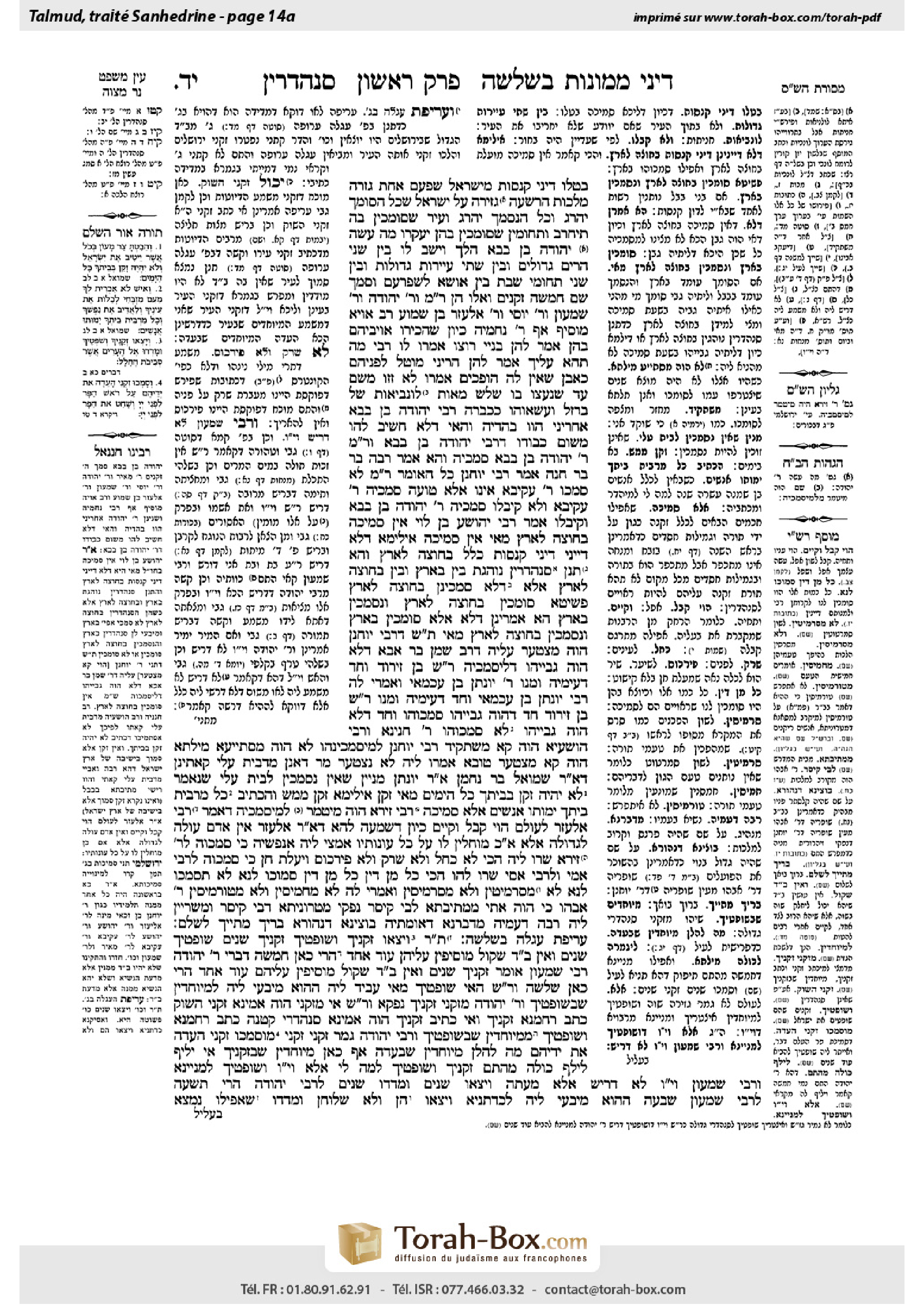
This page of Sanhedrin includes the Aramaic text, an English translation and an AI-generated French translation, alongside the scan above.
סנהדרין י״ד א · Aramaic and Hebrew text
בָּטְלוּ דִּינֵי קְנָסוֹת מִיִּשְׂרָאֵל, שֶׁפַּעַם אַחַת גָּזְרָה מַלְכוּת הָרְשָׁעָה שְׁמָד עַל יִשְׂרָאֵל – שֶׁכׇּל הַסּוֹמֵךְ יֵהָרֵג, וְכׇל הַנִּסְמָךְ יֵהָרֵג, וְעִיר שֶׁסּוֹמְכִין בָּהּ תֵּיחָרֵב, וּתְחוּמִין שֶׁסּוֹמְכִין בָּהֶן יֵעָקְרוּ.
מָה עָשָׂה יְהוּדָה בֶּן בָּבָא? הָלַךְ וְיָשַׁב לוֹ בֵּין שְׁנֵי הָרִים גְּדוֹלִים, וּבֵין שְׁתֵּי עֲיָירוֹת גְּדוֹלוֹת, וּבֵין שְׁנֵי תְּחוּמֵי שַׁבָּת, בֵּין אוּשָׁא לִשְׁפַרְעָם, וְסָמַךְ שָׁם חֲמִשָּׁה זְקֵנִים. וְאֵלּוּ הֵן: רַבִּי מֵאִיר, וְרַבִּי יְהוּדָה, וְרַבִּי שִׁמְעוֹן, וְרַבִּי יוֹסֵי, וְרַבִּי אֶלְעָזָר בֶּן שַׁמּוּעַ. רַב אַוְיָא מוֹסִיף: אַף רַבִּי נְחֶמְיָה.
כֵּיוָן שֶׁהִכִּירוּ אוֹיְבֵיהֶם בָּהֶן, אָמַר לָהֶן: בָּנַיי, רוּצוּ! אָמְרוּ לוֹ: רַבִּי, מָה תְּהֵא עָלֶיךָ? אָמַר לָהֶן: הֲרֵינִי מוּטָל לִפְנֵיהֶם כְּאֶבֶן שֶׁאֵין לָהּ הוֹפְכִים. אָמְרוּ: לֹא זָזוּ מִשָּׁם עַד שֶׁנָּעֲצוּ בּוֹ שְׁלֹשׁ מֵאוֹת לוּנְכִיאוֹת שֶׁל בַּרְזֶל וַעֲשָׂאוּהוּ כִּכְבָרָה.
רַבִּי יְהוּדָה בֶּן בָּבָא אַחֲרִינֵי הֲווֹ בַּהֲדֵיהּ, וְהַאי דְּלָא חָשֵׁיב לְהוּ – מִשּׁוּם כְּבוֹדוֹ דְרַבִּי יְהוּדָה בֶּן בָּבָא. וְרַבִּי מֵאִיר, רַבִּי יְהוּדָה בֶּן בָּבָא סַמְכֵיהּ? וְהָא אָמַר רַבָּה בַּר בַּר חָנָה אָמַר רַבִּי יוֹחָנָן: כׇּל הָאוֹמֵר רַבִּי מֵאִיר לֹא סְמָכוֹ רַבִּי עֲקִיבָא אֵינוֹ אֶלָּא טוֹעֶה! סַמְכֵיהּ רַבִּי עֲקִיבָא וְלֹא קַיבְּלוּהּ, סְמָכֶיהָ רַבִּי יְהוּדָה בֶּן בָּבָא וְקַיבְּלוּהּ.
אָמַר רַבִּי יְהוֹשֻׁעַ בֶּן לֵוִי: אֵין סְמִיכָה בְּחוּצָה לָאָרֶץ. מַאי ״אֵין סְמִיכָה״? אִילֵּימָא דְּלָא דָּיְינִי דִּינֵי קְנָסוֹת כְּלָל בְּחוּצָה לָאָרֶץ, וְהָא תְּנַן: סַנְהֶדְרִין נוֹהֶגֶת בֵּין בָּאָרֶץ וּבֵין בְּחוּצָה לָאָרֶץ! אֶלָּא, דְּלָא סָמְכִינַן בְּחוּצָה לָאָרֶץ.
פְּשִׁיטָא: סוֹמְכִין בְּחוּצָה לָאָרֶץ וְנִסְמָכִין בָּאָרֶץ, הָא אָמְרִינַן דְּלָא. אֶלָּא, סוֹמְכִין בָּאָרֶץ וְנִסְמָכִין בְּחוּצָה לָאָרֶץ – מַאי?
תָּא שְׁמַע: דְּרַבִּי יוֹחָנָן הֲוָה מִצְטַעֵר עֲלֵיהּ דְּרַב שֶׁמֶן בַּר אַבָּא, דְּלָא הֲוָה גַּבַּיְיהוּ דְּלִיסְמְכֵיהּ. רַבִּי שִׁמְעוֹן בֶּן זֵירוּד וְחַד דְּעִימֵּיהּ, וּמַנּוּ? רַבִּי יוֹנָתָן בֶּן עַכְמַאי. וְאָמְרִי לַהּ: רַבִּי יוֹנָתָן בֶּן עַכְמַאי וְחַד דְּעִימֵּיהּ, וּמַנּוּ? רַבִּי שִׁמְעוֹן בֶּן זֵירוּד. חַד דַּהֲוָה גַּבַּיְיהוּ – סַמְכוּהּו, וְחַד דְּלָא הֲוָה גַּבַּיְיהוּ – לָא סַמְכוּהּו.
רַבִּי חֲנִינָא וְרַבִּי הוֹשַׁעְיָא הֲוָה קָא מִשְׁתְּקִיד רַבִּי יוֹחָנָן לְמִיסְמְכִינְהוּ. לָא הֲוָה מִסְתַּיְּיעָא מִילְּתָא, הֲוָה קָא מִצְטַעַר טוּבָא. אֲמַרוּ לֵיהּ: לָא נִצְטַעַר מָר, דַּאֲנַן מִדְּבֵית עֵלִי קָאָתֵינַן.
דְּאָמַר רַבִּי שְׁמוּאֵל בַּר נַחְמָן אָמַר רַבִּי יוֹנָתָן: מִנַּיִין שֶׁאֵין נִסְמָכִין לְבֵית עֵלִי? שֶׁנֶּאֱמַר: ״לֹא יִהְיֶה זָקֵן בְּבֵיתְךָ כׇּל הַיָּמִים״. מַאי זָקֵן? אִילֵּימָא זָקֵן מַמָּשׁ, וְהָכְתִיב: ״כׇּל מַרְבִּית בֵּיתְךָ יָמוּתוּ אֲנָשִׁים״! אֶלָּא סְמִיכָה.
רַבִּי זֵירָא הֲוָה מִיטַּמַּר מִלְּמִיסְמְכֵיהּ, דְּאָמַר רַבִּי אֶלְעָזָר: לְעוֹלָם הֱוֵה קָבֵל וְקַיָּים. כֵּיוָן דְּשַׁמְעַהּ לְהָא דְּאָמַר רַבִּי אֶלְעָזָר, אֵין אָדָם עוֹלֶה לִגְדוּלָּה אֶלָּא אִם כֵּן מוֹחֲלִין לוֹ עַל כׇּל עֲוֹנוֹתָיו, אַמְצִי נַפְשֵׁיהּ.
כִּי סַמְכוּהּ לְרַבִּי זֵירָא, שָׁרוּ לֵיהּ הָכִי: ״לֹא כַּחַל וְלֹא שָׂרָק וְלֹא פִּירְכּוּס, וְיַעֲלַת חֵן״. כִּי סַמְכוּהּ לְרַבִּי אַמֵּי וּלְרַבִּי אַסִּי, שָׁרוּ לְהוּ הָכִי: ״כֹּל מִן דֵּין, כֹּל מִן דֵּין, סְמוּכוּ לַנָא. לָא תִּסְמְכוּ לַנָא לָא מִסַּרְמִיטִין וְלָא מִסַּרְמִיסִין״. וְאָמְרִי לַהּ: ״לָא מֵחֲמִיסִין וְלָא מִטּוּרְמִיסִין״.
רַבִּי אֲבָהוּ, כִּי הֲוָה אָתֵי מִמְּתִיבְתָּא לְבֵי קֵיסָר, נָפְקִי מַטְרוֹנְיָתָא דְּבֵי קֵיסָר וּמְשַׁרְיָין לֵיהּ: ״רַבָּה דְּעַמֵּיהּ, מְדַבְּרָנָא דְּאוּמְּתֵיהּ, בּוּצִינָא דִּנְהוֹרָא, בְּרִיךְ מֵתְיָיךְ לִשְׁלָם״.
עֲרִיפַת עֶגְלָה בִּשְׁלֹשָׁה. תָּנוּ רַבָּנַן: ״וְיָצְאוּ זְקֵנֶיךָ וְשֹׁפְטֶיךָ״. ״זְקֵנֶיךָ״ – שְׁנַיִם, ״שֹׁפְטֶיךָ״ – שְׁנַיִם, וְאֵין בֵּית דִּין שָׁקוּל מוֹסִיפִין עֲלֵיהֶן עוֹד אֶחָד, הֲרֵי כָּאן חֲמִשָּׁה. דִּבְרֵי רַבִּי יְהוּדָה. רַבִּי שִׁמְעוֹן אוֹמֵר: ״זְקֵנֶיךָ״ – שְׁנַיִם, וְאֵין בֵּית דִּין שָׁקוּל מוֹסִיפִין עֲלֵיהֶם עוֹד אֶחָד, הֲרֵי כָּאן שְׁלֹשָׁה.
וְרַבִּי שִׁמְעוֹן, הַאי ״שֹׁפְטֶיךָ״ מַאי עָבֵיד לֵיהּ? הַהוּא מִיבְּעֵי לֵיהּ לִמְיוּחָדִין שֶׁבְּשׁוֹפְטֶיךָ. וְרַבִּי יְהוּדָה? מִ״זִּקְנֵי״ ״זְקֵנֶיךָ״ נָפְקָא.
וְרַבִּי שִׁמְעוֹן: אִי מִ״זִּקְנֵי״ הֲוָה אָמֵינָא זִקְנֵי הַשּׁוּק, כְּתַב רַחֲמָנָא ״זְקֵנֶיךָ״. וְאִי כְּתִיב ״זְקֵנֶיךָ״ – הֲוָה אָמֵינָא סַנְהֶדְרִי קְטַנָּה, כְּתַב רַחֲמָנָא ״וְשֹׁפְטֶיךָ״ – מִמְּיוּחָדִין שֶׁבְּשׁוֹפְטֶיךָ. וְרַבִּי יְהוּדָה גָּמַר ״זִקְנֵי״ ״זִקְנֵי״ מִ״וְסָמְכוּ זִקְנֵי הָעֵדָה אֶת יְדֵיהֶם״ – מָה לְהַלָּן מְיוּחָדִין שֶׁבָּעֵדָה, אַף כָּאן מְיוּחָדִין שֶׁבִּזְקֵנֶיךָ.
אִי יָלֵיף – לֵילַף כּוּלַּהּ מֵהָתָם! ״זְקֵנֶיךָ״ ״וְשֹׁפְטֶיךָ״ לְמָה לִי? אֶלָּא, וָיו ״וְשֹׁפְטֶיךָ״ לְמִנְיָינָא. וְרַבִּי שִׁמְעוֹן – וָיו לָא דָּרֵישׁ.
אֶלָּא מֵעַתָּה, ״וְיָצְאוּ״ – שְׁנַיִם, ״וּמָדְדוּ״ – שְׁנַיִם, לְרַבִּי יְהוּדָה הֲרֵי תִּשְׁעָה, לְרַבִּי שִׁמְעוֹן שִׁבְעָה? הָהוּא מִיבְּעֵי לֵיהּ לְכִדְתַנְיָא: ״וְיָצְאוּ״ – הֵן וְלֹא שְׁלוּחָן, ״וּמָדְדוּ״ – שֶׁאֲפִילּוּ נִמְצָא
Sanhedrin 14a · English translation
the laws of fines would have ceased to be implemented from among the Jewish people, as they would not have been able to adjudicate cases involving these laws due to a lack of ordained judges. This is because at one time the wicked kingdom of Rome issued decrees of religious persecution against the Jewish people with the aim of abolishing the chain of ordination and the authority of the Sages. They said that anyone who ordains judges will be killed, and anyone who is ordained will be killed, and the city in which they ordain the judges will be destroyed, and the signs identifying the boundaries of the city in which they ordain judges will be uprooted. These measures were intended to discourage the Sages from performing or receiving ordination due to fear for the welfare of the local population.
What did Rabbi Yehuda ben Bava do? He went and sat between two large mountains, between two large cities, and between two Shabbat boundaries: Between Usha and Shefaram, i.e., in a desolate place that was not associated with any particular city so that he not endanger anyone not directly involved, and there he ordained five elders. And they were: Rabbi Meir, and Rabbi Yehuda, and Rabbi Shimon, and Rabbi Yosei, and Rabbi Elazar ben Shammua. Rav Avya adds that Rabbi Neḥemya was also among those ordained. This incident indicates that ordination can be performed by a single Sage.
When their enemies discovered them, Rabbi Yehuda ben Bava said to the newly ordained Sages: My sons, run for your lives. They said to him: My teacher, what will be with you? Rabbi Yehuda ben Bava was elderly and unable to run. He said to them: In any case, I am cast before them like a stone that cannot be overturned; even if you attempt to assist me I will not be able to escape due to my frailty, but if you do not escape without me you will also be killed. People say about this incident: The Roman soldiers did not move from there until they had inserted three hundred iron spears [lunkhiyot] into him, making him appear like a sieve pierced with many holes.
This proof is refuted: There may have been other Sages performing the ordination with Rabbi Yehuda ben Bava, who were added in order to reach the quota of three Sages, and this fact that they were not mentioned is due to the honor of Rabbi Yehuda ben Bava, who was the greatest among them. The Gemara asks: And with regard to Rabbi Meir, did Rabbi Yehuda ben Bava actually ordain him? But doesn’t Rabba bar bar Ḥana say that Rabbi Yoḥanan says: Anyone who says that Rabbi Akiva did not ordain Rabbi Meir is nothing other than mistaken. The Gemara answers: Rabbi Akiva in fact ordained Rabbi Meir, but the people did not accept the appointment, as Rabbi Meir was still very young. Therefore, some time later, Rabbi Yehuda ben Bava ordained him a second time, and they accepted it.
§ Rabbi Yehoshua ben Levi says: There is no ordination outside of Eretz Yisrael. The Gemara asks: What is the meaning of: There is no ordination? If we say that they may not adjudicate cases involving laws of fines at all outside of Eretz Yisrael, that is difficult: Didn’t we learn in a mishna (Makkot 7a): The Sanhedrin and its authority functions both in Eretz Yisrael and outside of Eretz Yisrael? Rather, the intention is that we do not ordain judges outside of Eretz Yisrael.
The Gemara comments: It is obvious that if those ordaining the new judges were outside of Eretz Yisrael, and those being ordained were inside Eretz Yisrael, we say that they may not perform the ordination. But if those ordaining the new judges were inside Eretz Yisrael, and those being ordained were outside of Eretz Yisrael, what is the halakha? May ordination be conferred from a distance in this situation?
The Gemara clarifies: Come and hear a resolution to the dilemma from the fact that Rabbi Yoḥanan was distressed concerning Rav Shemen bar Abba, as the latter was not with the other Sages at the time they received the consent of the Nasi so that Rabbi Yoḥanan could ordain him. In addition, concerning Rabbi Shimon ben Zeirud and one who was with him, the Gemara interjects: And who is he? Rabbi Yoḥanan ben Akhmai. And some say that it was Rabbi Yoḥanan ben Akhmai and one who was with him; the Gemara interjects: And who is he? Rabbi Shimon ben Zeirud. The Gemara continues: Although these two Sages were equal in stature, the Sages ordained only the one who was with them in Eretz Yisrael, and they did not ordain the other one, who was not with them. This indicates that ordination can be granted only in Eretz Yisrael.
The Gemara relates several other incidents with regard to ordination. Rabbi Yoḥanan persistently tried to ordain Rabbi Ḥanina and Rabbi Hoshaya, as they were scholars and righteous people. But he was not successful with regard to the matter, as various incidents repeatedly interfered with his plan, and he was very distressed about this. They said to him: Do not be distressed, our Master, as we come from, i.e., are descendants of, the house of the High Priest Eli.
As Rabbi Shmuel bar Naḥman says that Rabbi Yonatan says: From where is it known that there are not to be ordained Sages from the house of Eli? As it is stated with regard to the house of Eli: “And there shall not be an elder in your house forever” (I Samuel 2:32). The Gemara explains: What is the meaning of “elder” in this verse? If we say it means an actual elder, meaning an old person, but isn’t it already written: “And all those raised in your house shall die young men” (I Samuel 2:33)? Rather, the term “elder” is an honorary term for a Sage, and it means that ordination will not be granted to descendants of the House of Eli.
The Gemara relates: Rabbi Zeira would habitually hide himself so that they would not ordain him. He did this due to the fact that Rabbi Elazar said: Always be obscure and remain alive, meaning the more humble and unknown you make yourself, the longer you will live. When he heard that which Rabbi Elazar also said: A person does not rise to greatness unless all his sins are forgiven, he understood that there are also benefits to greatness, and he presented himself to the Nasi in order that he would ordain him.
The Gemara relates: When they ordained Rabbi Zeira the Sages who were present at the ceremony sang to him this paean of praise traditionally sung to a bride at her wedding: She wears no blue eye shadow and no rouge on her face and no hair dye, and nevertheless she radiates grace. The bride is described as so beautiful that she does not need any cosmetics or adornments, and metaphorically Rabbi Zeira is praised as exceptionally and recognizably qualified for his appointment. Similarly, when they ordained Rabbi Ami and Rabbi Asi, they sang to them this paean of praise: Anyone like these, anyone like these, ordain for us, as they epitomized the ideal candidate for ordination. But do not ordain for us those counted among the rags [misarmitin] or among the distorters [misarmisin]. And some say that they said: Do not ordain for us those counted among the robbers [meḥamisin] or among the tramplers [miturmisin].
Since the songs composed for various Sages were mentioned, the Gemara also recounts that when Rabbi Abbahu would come from the yeshiva to the house of the emperor, the ladies from the emperor’s house would go out and sing before him: O great one of his people, leader of his nation, illuminating candle, may your arrival be blessed in peace.
§ The mishna teaches that the breaking of the heifer’s neck is performed in front of a panel of three judges, and that Rabbi Yehuda says there must be five judges. The Sages taught in a baraita: The verse states: “And your elders and your judges shall go out and they shall measure to the cities that are around the corpse” (Deuteronomy 21:2). “Your elders” is in the plural, which indicates a minimum of two, and “your judges” is also plural, indicating another two, and as a court may not be composed of an even number of judges, they add an additional one to them, so there are five judges here; this is the statement of Rabbi Yehuda. Rabbi Shimon says: “Your elders,” indicate two, and as a court may not be composed of an even number of judges, they add an additional one to them, so there are three judges here.
The Gemara asks: But according to Rabbi Shimon, what does he do with this extra expression: “Your judges”? The Gemara answers: He requires it to teach that these judges must be of the unique ones among your judges, meaning that they must be members of the Sanhedrin. The Gemara asks: And how does Rabbi Yehuda derive the halakha that the judges must be members of the Sanhedrin? He derives it from the fact that the verse did not merely state: “Elders,” but rather: “Your elders,” which indicates the elders that are unique to all of the Jewish people, meaning the Sages of the Sanhedrin.
And how does Rabbi Shimon respond to this claim? He holds that had the verse written only: “Elders,” I would say that the verse is referring to any elders in the marketplace who are not members of the Sanhedrin. Therefore, the Merciful One writes: “Your elders.” And if it was written: “Your elders,” I would say that it is referring to members of a lesser Sanhedrin. Therefore, the Merciful One writes: “And your judges,” to indicate that they must be of the unique ones among your judges. And how would Rabbi Yehuda respond to this claim? He learns it by means of a verbal analogy from the word “elders” written in this verse and the word “elders” written in the verse: “And the elders of the congregation shall lay their hands on the head of the bull” (Leviticus 4:15). Just as there it is referring to the unique ones of the congregation, so too here, it is referring to the unique ones among your elders.
The Gemara asks: If he learns this verbal analogy, he should learn all of it, i.e., the entire halakha, including the number of judges as well as their rank, from there, i.e., the verse in Leviticus, and if so why do I need the extra expressions: “Your elders” and: “And your judges”? Rather, certainly he does not accept this verbal analogy. Rather, he holds that the additional letter vav, corresponding to the word “and” in the expression: “And your judges,” is there for the tally, meaning that the expression “your judges” teaches that they must be members of the Great Sanhedrin, and the additional vav serves to add an additional two to the number of judges. And how does Rabbi Shimon respond to that? He does not expound the additional letter vav.
The Gemara asks: If that is so, if the verbs in the plural form are each understood as adding an additional two judges, then the expression: “And they shall go out,” in the continuation of the verse (Deuteronomy 21:2) indicates another two, and the expression: “And they shall measure,” adds another two, meaning that according to Rabbi Yehuda there should be nine judges, and according to Rabbi Shimon, seven. The Gemara answers: He needs this exposition for that which is taught in a baraita: The verse states: “And they shall go out,” to emphasize that they must go out, and not their agents, and the verse states: “And they shall measure,” to teach that this measurement is itself a mitzva, such that even if the corpse is found
Sanhedrin 14a · Traduction française (IA)
Les lois relatives aux amendes auraient cessé d’être appliquées parmi le peuple juif, car il n’aurait plus été possible de juger les affaires relevant de ces lois, faute de juges ordonnés. En effet, à une époque, le royaume impie de Rome décréta des persécutions religieuses contre le peuple juif dans le but d’abolir la chaîne de l’ordination et l’autorité des Sages. Ils déclarèrent que quiconque ordonnerait des juges serait tué, que quiconque serait ordonné serait tué, que la ville où les juges seraient ordonnés serait détruite et que les bornes délimitant cette ville seraient arrachées. Ces mesures visaient à dissuader les Sages de procéder à des ordinations ou de les recevoir, par crainte pour la sécurité de la population locale.
Que fit Rabbi Yehuda ben Bava ? Il alla s’asseoir entre deux grandes montagnes, entre deux grandes villes et entre deux limites de Chabbat, entre Usha et Shefaram, c’est-à-dire dans un lieu désert qui n’était rattaché à aucune ville en particulier, afin de ne mettre en danger personne qui ne fût pas directement impliqué. Là, il ordonna cinq anciens : Rabbi Meïr, Rabbi Yehuda, Rabbi Shimon, Rabbi Yosei et Rabbi Elazar ben Shammua. Rav Avya ajoute que Rabbi Neḥemya figurait également parmi les personnes ordonnées. Cet épisode montre qu’un seul Sage peut procéder à une ordination.
Lorsque leurs ennemis les découvrirent, Rabbi Yehuda ben Bava dit aux Sages qui venaient d’être ordonnés : « Mes fils, fuyez pour sauver votre vie. » Ils lui dirent : « Notre maître, qu’adviendra-t-il de vous ? » Rabbi Yehuda ben Bava était âgé et incapable de courir. Il leur répondit : « De toute façon, je suis étendu devant eux comme une pierre qu’on ne peut renverser ; même si vous essayez de m’aider, ma faiblesse m’empêchera de m’échapper. Mais si vous ne fuyez pas sans moi, vous serez tués vous aussi. » On raconte à propos de cet épisode que les soldats romains ne repartirent pas avant de lui avoir enfoncé trois cents lances de fer [lunkhiyot], le faisant ressembler à un tamis percé de nombreux trous.
Cette preuve est réfutée : d’autres Sages ont peut-être procédé à l’ordination avec Rabbi Yehuda ben Bava afin d’atteindre le nombre requis de trois Sages. S’ils ne sont pas mentionnés, c’est par égard pour Rabbi Yehuda ben Bava, qui était le plus éminent d’entre eux. La Guemara demande : Et Rabbi Yehuda ben Bava a-t-il réellement ordonné Rabbi Meïr ? Pourtant, Rabba bar bar Ḥana dit au nom de Rabbi Yoḥanan : « Quiconque affirme que Rabbi Akiva n’a pas ordonné Rabbi Meïr se trompe. » La Guemara répond : Rabbi Akiva ordonna bel et bien Rabbi Meïr, mais le peuple n’accepta pas cette nomination, car Rabbi Meïr était encore très jeune. C’est pourquoi, quelque temps plus tard, Rabbi Yehuda ben Bava l’ordonna une seconde fois, et cette fois, ils l’acceptèrent.
§ Rabbi Yehoshua ben Levi dit : « Il n’y a pas d’ordination en dehors d’Eretz Israël. » La Guemara demande : Que signifie « il n’y a pas d’ordination » ? Si l’on veut dire qu’on ne peut absolument pas juger les affaires relevant des lois sur les amendes en dehors d’Eretz Israël, cela pose une difficulté : n’avons-nous pas appris dans une Michna (Makot 7a) que le Sanhédrin et son autorité exercent aussi bien en Eretz Israël qu’en dehors d’Eretz Israël ? Il faut donc comprendre qu’on ne procède pas à l’ordination de juges en dehors d’Eretz Israël.
La Guemara fait remarquer : Il est évident que si ceux qui ordonnent les nouveaux juges se trouvent en dehors d’Eretz Israël et que ceux qui sont ordonnés se trouvent en Eretz Israël, ils ne peuvent pas procéder à l’ordination. Mais si ceux qui ordonnent les nouveaux juges se trouvent en Eretz Israël et que ceux qui sont ordonnés se trouvent en dehors d’Eretz Israël, quelle est la halakha ? Dans cette situation, l’ordination peut-elle être conférée à distance ?
La Guemara précise : « Venez et écoutez » une réponse à cette question, tirée du fait que Rabbi Yoḥanan était peiné au sujet de Rav Shemen bar Abba, car celui-ci ne se trouvait pas avec les autres Sages lorsque ceux-ci reçurent l’accord du Nassi permettant à Rabbi Yoḥanan de l’ordonner. Par ailleurs, au sujet de Rabbi Shimon ben Zeirud et de celui qui était avec lui, la Guemara interrompt son propos : « Et qui était-ce ? » Rabbi Yoḥanan ben Akhmai. Certains disent que c’étaient Rabbi Yoḥanan ben Akhmai et celui qui était avec lui ; la Guemara interrompt alors son propos : « Et qui était-ce ? » Rabbi Shimon ben Zeirud. La Guemara poursuit : Bien que ces deux Sages fussent de rang égal, les Sages n’ordonnèrent que celui qui se trouvait avec eux en Eretz Israël, et non l’autre, qui n’était pas avec eux. Cela indique que l’ordination ne peut être conférée qu’en Eretz Israël.
La Guemara rapporte plusieurs autres épisodes concernant l’ordination. Rabbi Yoḥanan s’efforça à plusieurs reprises d’ordonner Rabbi Ḥanina et Rabbi Hoshaya, car ils étaient des érudits et des hommes justes. Mais il n’y parvint pas : divers événements firent sans cesse obstacle à son projet, et il en fut très affligé. Ils lui dirent : « Ne soyez pas peiné, notre maître, car nous sommes issus de la maison du grand prêtre Éli. »
En effet, Rabbi Shmuel bar Naḥman dit au nom de Rabbi Yonatan : « D’où sait-on qu’on ne doit pas ordonner les Sages issus de la maison d’Éli ? » Car il est écrit au sujet de la maison d’Éli : « Il n’y aura jamais de vieillard dans ta maison » (I Samuel 2:32). La Guemara explique : Que signifie ici « vieillard » ? Si l’on dit qu’il s’agit d’un vieillard au sens propre, c’est-à-dire d’un homme âgé, n’est-il pas déjà écrit : « Tous ceux qui auront grandi dans ta maison mourront jeunes » (I Samuel 2:33) ? Le terme « vieillard » est plutôt un titre honorifique désignant un Sage ; cela signifie que l’ordination ne sera pas accordée aux descendants de la maison d’Éli.
La Guemara rapporte : Rabbi Zeira avait coutume de se cacher pour qu’on ne l’ordonne pas. Il agissait ainsi parce que Rabbi Elazar avait dit : « Reste toujours dans l’ombre et tu vivras », c’est-à-dire que plus tu te fais humble et inconnu, plus longtemps tu vivras. Lorsqu’il entendit également Rabbi Elazar dire : « L’homme n’accède à la grandeur que lorsque tous ses péchés lui sont pardonnés », il comprit que la grandeur avait aussi ses avantages et se présenta au Nassi afin que celui-ci l’ordonne.
La Guemara rapporte : Lorsqu’ils ordonnèrent Rabbi Zeira, les Sages présents à la cérémonie lui chantèrent cette louange traditionnellement chantée à une mariée lors de son mariage : « Elle ne porte ni fard bleu sur les yeux, ni rouge sur le visage, ni teinture dans les cheveux, et pourtant elle rayonne de grâce. » La mariée est décrite comme si belle qu’elle n’a besoin ni de cosmétiques ni de parures ; par métaphore, Rabbi Zeira est loué comme étant manifestement et exceptionnellement digne de sa nomination. De même, lorsqu’ils ordonnèrent Rabbi Ami et Rabbi Asi, ils leur chantèrent cette louange : « Des hommes comme ceux-ci, des hommes comme ceux-ci, ordonnez-nous-en ! », car ils incarnaient le candidat idéal à l’ordination. « Mais ne nous ordonnez pas ceux qui sont comptés parmi les loqueteux [misarmitin] ou parmi les faussaires [misarmisin]. » Certains disent qu’ils déclarèrent : « Ne nous ordonnez pas ceux qui sont comptés parmi les voleurs [meḥamisin] ou parmi les piétineurs [miturmisin]. »
Puisqu’il a été question des chants composés pour différents Sages, la Guemara rapporte aussi que, lorsque Rabbi Abbahu revenait de la yeshiva pour se rendre à la maison de l’empereur, les femmes de la maison impériale sortaient et chantaient devant lui : « Ô grand homme de son peuple, chef de sa nation, luminaire éclatant, que ton arrivée soit bénie dans la paix ! »
§ La Michna enseigne que la nuque de la génisse est brisée devant un tribunal de trois juges, et que Rabbi Yehuda exige cinq juges. Les Sages ont enseigné dans une baraïta : Le verset dit : « Tes anciens et tes juges sortiront, et ils mesureront jusqu’aux villes qui entourent le cadavre » (Deutéronome 21:2). « Tes anciens » est au pluriel, ce qui indique un minimum de deux ; « tes juges » est également au pluriel, ce qui en indique deux autres. Or, un tribunal ne peut être composé d’un nombre pair de juges ; on en ajoute donc un, ce qui fait ici cinq juges. Telle est l’opinion de Rabbi Yehuda. Rabbi Shimon dit : « Tes anciens » en indique deux et, comme un tribunal ne peut être composé d’un nombre pair de juges, on en ajoute un, ce qui fait ici trois juges.
La Guemara demande : Mais, selon Rabbi Shimon, que fait-il de cette expression supplémentaire : « Tes juges » ? La Guemara répond : Il en a besoin pour enseigner que ces juges doivent être parmi les plus éminents de tes juges, c’est-à-dire qu’ils doivent être membres du Sanhédrin. La Guemara demande : Et comment Rabbi Yehuda déduit-il la halakha selon laquelle les juges doivent être membres du Sanhédrin ? Il la déduit du fait que le verset ne dit pas simplement « les anciens », mais « tes anciens », ce qui désigne les anciens qui sont particuliers à l’ensemble du peuple juif, c’est-à-dire les Sages du Sanhédrin.
Et comment Rabbi Shimon répond-il à cette affirmation ? Selon lui, si le verset avait seulement dit « les anciens », j’aurais dit qu’il s’agissait de n’importe quels anciens présents sur la place du marché, qui ne sont pas membres du Sanhédrin. Le Miséricordieux écrit donc « tes anciens ». Et s’il avait été écrit « tes anciens », j’aurais dit qu’il s’agissait de membres d’un petit Sanhédrin. Le Miséricordieux écrit donc « et tes juges », pour indiquer qu’ils doivent être parmi les plus éminents de tes juges. Et comment Rabbi Yehuda répond-il à cette affirmation ? Il le déduit par une analogie verbale entre le mot « anciens » écrit dans ce verset et le mot « anciens » écrit dans le verset : « Les anciens de l’assemblée poseront leurs mains sur la tête du taureau » (Lévitique 4:15). De même que là, il s’agit des membres les plus éminents de l’assemblée, de même ici, il s’agit des membres les plus éminents parmi tes anciens.
La Guemara demande : S’il déduit cela par cette analogie verbale, il devrait en déduire toute la halakha, c’est-à-dire l’ensemble des règles, y compris le nombre des juges et leur rang, à partir de là, c’est-à-dire du verset du Lévitique. Dans ce cas, pourquoi faut-il les expressions supplémentaires « tes anciens » et « et tes juges » ? Il est donc certain qu’il n’accepte pas cette analogie verbale. Il considère plutôt que la lettre vav supplémentaire, correspondant au mot « et » dans l’expression « et tes juges », sert au décompte : l’expression « tes juges » enseigne qu’ils doivent être membres du Grand Sanhédrin, et le vav supplémentaire sert à ajouter deux juges au nombre. Et comment Rabbi Shimon répond-il à cela ? Il n’interprète pas la lettre vav supplémentaire.
La Guemara demande : Si c’est ainsi, si l’on comprend que chacun des verbes au pluriel ajoute deux juges, l’expression « ils sortiront », dans la suite du verset (Deutéronome 21:2), en indique deux autres, et l’expression « ils mesureront » en ajoute encore deux. Selon Rabbi Yehuda, il devrait donc y avoir neuf juges, et selon Rabbi Shimon, sept. La Guemara répond : Il a besoin de cette interprétation pour expliquer ce qui est enseigné dans une baraïta : le verset dit « ils sortiront » pour souligner que ce sont eux qui doivent sortir, et non leurs agents ; et le verset dit « ils mesureront » pour enseigner que cette mesure est elle-même une mitsva, de sorte que même si le cadavre est découvert
Traduction française générée par IA à partir de l’édition anglaise de Sefaria. Vérifie toujours un passage avec le texte source.
Text from Sefaria: William Davidson Edition - Vocalized Aramaic (CC BY NC); William Davidson Edition - English (CC BY NC).