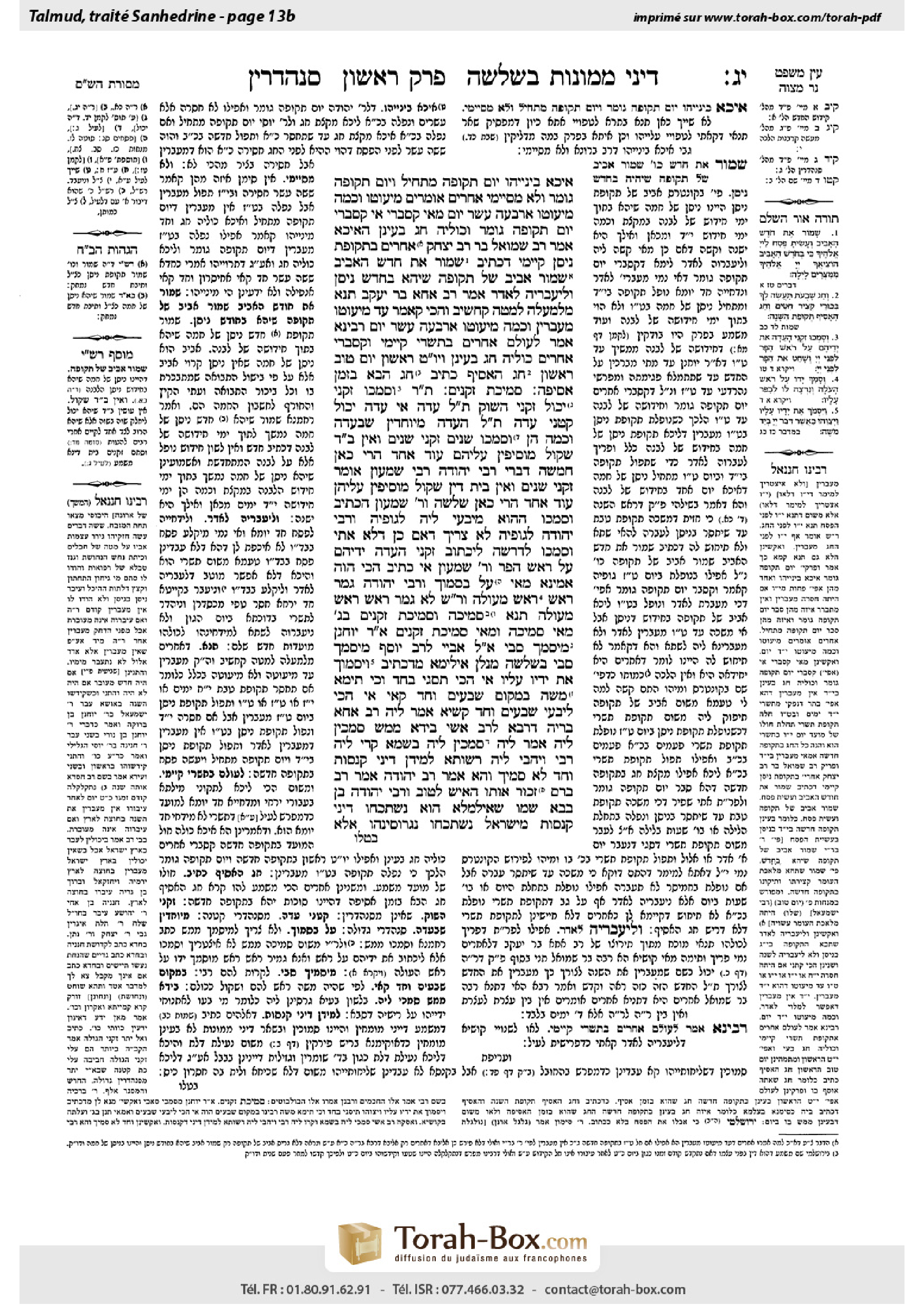
Sanhedrin 13b: Talmud study for Daf Yomi
Daf Yomi is the daily study of one Talmud folio. Explore 37 tractates with scans, Hebrew text, Sefaria English and AI-generated French translations where annotated.
Passage selection and English or AI-generated French translation are available where the scan has annotations. Daf Study is independent of Torah-Box and Sefaria.
Browse Sanhedrin · סנהדרין · All tractatesSanhedrin 13b text and translations
This page of Sanhedrin includes the Aramaic text, an English translation and an AI-generated French translation, alongside the scan above.
סנהדרין י״ג ב · Aramaic and Hebrew text
אִיכָּא בֵּינַיְיהוּ יוֹם תְּקוּפָה מַתְחִיל וְיוֹם תְּקוּפָה גּוֹמֵר. וְלָא מְסַיְּימִי.
אֲחֵרִים אוֹמְרִים: מִיעוּטוֹ, וְכַמָּה מִיעוּטוֹ? אַרְבָּעָה עָשָׂר יוֹם. מַאי קָסָבְרִי? אִי קָסָבְרִי יוֹם תְּקוּפָה גּוֹמֵר, וְכוּלֵּיהּ חַג בָּעֵינַן – הָאִיכָּא! אָמַר רַב שְׁמוּאֵל בַּר רַב יִצְחָק: אֲחֵרִים בִּתְקוּפַת נִיסָן קָיְימִי, דִּכְתִיב: ״שָׁמוֹר אֶת חֹדֶשׁ הָאָבִיב״ – שְׁמוֹר אָבִיב שֶׁל תְּקוּפָה שֶׁיְּהֵא בְּחֹדֶשׁ נִיסָן.
וְלִיעַבְּרֵיהּ לַאֲדָר? אָמַר רַב אַחָא בַּר יַעֲקֹב: תַּנָּא מִלְּמַעְלָה לְמַטָּה קָחָשֵׁיב, וְהָכִי קָאָמַר: עַד מִיעוּטוֹ מְעַבְּרִין. וְכַמָּה מִיעוּטוֹ? אַרְבָּעָה עָשָׂר יוֹם.
רָבִינָא אָמַר: לְעוֹלָם אֲחֵרִים בְּתִשְׁרִי קָיְימִי, וְקָסָבְרִי אֲחֵרִים כּוּלֵּיהּ חַג בָּעֵינַן, וְיוֹם טוֹב רִאשׁוֹן. יוֹם טוֹב רִאשׁוֹן? ״חַג הָאָסִיף״ כְּתִיב! חַג הַבָּא בִּזְמַן אֲסִיפָה.
סְמִיכַת זְקֵנִים. תָּנוּ רַבָּנַן: ״וְסָמְכוּ זִקְנֵי״ – יָכוֹל זִקְנֵי הַשּׁוּק? תַּלְמוּד לוֹמַר ״עֵדָה״.
אִי ״עֵדָה״ – יָכוֹל קְטַנֵּי עֵדָה? תַּלְמוּד לוֹמַר ״הָעֵדָה״ – מְיוּחָדִין שֶׁבָּעֵדָה. וְכַמָּה הֵן? ״וְסָמְכוּ״ – שְׁנַיִם, ״זִקְנֵי״ – שְׁנַיִם, וְאֵין בֵּית דִּין שָׁקוּל מוֹסִיפִין עֲלֵיהֶם עוֹד אֶחָד, הֲרֵי כָּאן חֲמִשָּׁה. דִּבְרֵי רַבִּי יְהוּדָה. רַבִּי שִׁמְעוֹן אוֹמֵר: ״זִקְנֵי״ – שְׁנַיִם, וְאֵין בֵּית דִּין שָׁקוּל מוֹסִיפִין עֲלֵיהֶן עוֹד אֶחָד, הֲרֵי כָּאן שְׁלֹשָׁה.
וְרַבִּי שִׁמְעוֹן, הָכְתִיב ״וְסָמְכוּ״? הָהוּא מִיבְּעֵי לֵיהּ לְגוּפֵיהּ. וְרַבִּי יְהוּדָה? לְגוּפֵיהּ לָא צְרִיךְ, דְּאִם כֵּן דְּלָא אָתֵי ״וְסָמְכוּ״ לִדְרָשָׁה, לִיכְתּוֹב ״זִקְנֵי הָעֵדָה יְדֵיהֶם עַל רֹאשׁ הַפָּר״.
וְרַבִּי שִׁמְעוֹן, אִי כְּתִיב הָכִי, הֲוָה אָמֵינָא: מַאי ״עַל״? בְּסָמוּךְ. וְרַבִּי יְהוּדָה גָּמַר ״רֹאשׁ״ ״רֹאשׁ״ מֵעוֹלָה. וְרַבִּי שִׁמְעוֹן לָא גָּמַר ״רֹאשׁ״ ״רֹאשׁ״ מֵעוֹלָה.
תָּנָא: סְמִיכָה וּסְמִיכַת זְקֵנִים בִּשְׁלֹשָׁה. מַאי סְמִיכָה וּמַאי סְמִיכַת זְקֵנִים? אָמַר רַבִּי יוֹחָנָן: מִיסְמַךְ סָבֵי.
אֲמַר לֵיהּ אַבָּיֵי לְרַב יוֹסֵף: מִיסְמַךְ סָבֵי בִּשְׁלֹשָׁה מְנָלַן? אִילֵּימָא מִדִּכְתִיב ״וַיִּסְמֹךְ אֶת יָדָיו עָלָיו״, אִי הָכִי תִּסְגֵּי בְּחַד! וְכִי תֵּימָא מֹשֶׁה בִּמְקוֹם שִׁבְעִים וְחַד קָאֵי, אִי הָכִי לִיבְעֵי שִׁבְעִים וְחַד! קַשְׁיָא.
אֲמַר לֵיהּ רַב אַחָא בְּרֵיהּ דְּרָבָא לְרַב אָשֵׁי: בִּידָא מַמָּשׁ סָמְכִין לֵיהּ? אֲמַר לֵיהּ: סָמְכִין לֵיהּ בִּשְׁמָא, קָרוּ לֵיהּ ״רַבִּי״, וְיָהֲבִי לֵיהּ רְשׁוּתָא לְמֵידַן דִּינֵי קְנָסוֹת.
וְחַד לָא סָמֵיךְ? וְהָא אָמַר רַב יְהוּדָה אָמַר רַב: בְּרַם, זָכוּר אוֹתוֹ הָאִישׁ לַטּוֹב, וְרַבִּי יְהוּדָה בֶּן בָּבָא שְׁמוֹ, שֶׁאִילְמָלֵא הוּא נִשְׁתַּכְחוּ דִּינֵי קְנָסוֹת מִיִּשְׂרָאֵל. נִשְׁתַּכְחוּ? נִגְרוֹסִינְהוּ! אֶלָּא
Sanhedrin 13b · English translation
The Gemara answers: Also here, the difference between them concerns the question of whether the day of the equinox begins the season or whether the day of the equinox concludes the season, but their opinions are not defined. Although it is apparent from the baraita that these two tanna’im disagree about this issue, it is not clear from their words which tanna ascribes to which of these opinions.
The baraita teaches: The tanna referred to as Aḥerim says: The year is intercalated even on account of a minority of the month, and how much is a minority of the month? Fourteen days. The Gemara asks: What do Aḥerim hold? If they hold that the day of the equinox concludes the season, and also that we require all of the Festival to take place in the new season, this condition is fulfilled even if the season is lacking fifteen days. Rav Shmuel bar Rav Yitzḥak says: Aḥerim are standing in, i.e., discussing, the season of Nisan. As it is written: “Observe the month of spring and keep the Pesaḥ” (Deuteronomy 16:1), from which it is inferred: Preserve the day of the equinox of the spring, to ensure that it will be in the month of Nisan, meaning that the equinox must occur during the first part of the month of Nisan, by the fourteenth, the day the Paschal offering is sacrificed.
The Gemara asks: In a situation like this, why is it necessary to intercalate the year? But let them intercalate the month of Adar by adding a day to it, and this will cause the day of the equinox to occur during the first half of Nisan. Rav Aḥa bar Ya’akov said: The tanna whom the baraita here refers to as Aḥerim calculated from the top, meaning the maximum number of days downward, and this is what he is saying: Up to a minority of the month, meaning, if the equinox would occur during the final days of Nisan, the court would intercalate the year and would also do so if the equinox would occur earlier in the month, unless it would be early enough that only a minority of the month would be in the previous season. And how much is a minority? Fourteen days. But if the equinox would occur on the fourteenth, the year is not to be intercalated, but instead a day should be added to the month of Adar.
Ravina said: Actually, it can be explained that Aḥerim are standing in the season of Tishrei, and were discussing Sukkot as opposed to Passover. Aḥerim hold that we require all of the festival of Sukkot, including the Festival on the first day, to take place in the new season. Since Sukkot begins on the fifteenth of Tishrei, the equinox must fall no later than the fourteenth. The Gemara asks: How is it possible to say that the Festival on the first day must also be in the new season? It is written: “The Festival of Ingathering” (Exodus 23:16), which is referring to the time when the crops are gathered. This can refer only to the intermediate days of Sukkot, since it is prohibited to gather crops on a Festival. The Gemara answers: They interpret the verse to mean: The Festival that comes at the time of ingathering, meaning in the autumn.
§ The mishna teaches: The laying of hands by the Sages is performed by a court of three judges according to Rabbi Shimon and five according to Rabbi Yehuda. The Sages taught in a baraita: The verse states: “And the elders of the congregation shall lay their hands on the head of the bull before the Lord” (Leviticus 4:15). One might have thought that the verse is referring to any elders in the marketplace, meaning people who are not members of the Sanhedrin. Therefore, the verse states: “Elders of the congregation,” meaning from among the leaders and judges of the people.
If it had written only “congregation,” one might have thought they may be the minor ones of the congregation, i.e., members of the lesser Sanhedrin. Therefore, the verse states: “The congregation,” which indicates the unique ones of the congregation, meaning that they must be members of the Great Sanhedrin. And how many must they be? The verse states: “Shall lay” in the plural form, which indicates a minimum of two; “elders” in the plural form, indicating another two; and as a court may not be composed of an even number of judges, they add an additional one to them, so there are five judges here; this is the statement of Rabbi Yehuda. Rabbi Shimon says: The verse states: “Elders,” indicating two, and as a court may not be composed of an even number of judges, they add an additional one to them, so there are three judges here.
The Gemara asks: But according to Rabbi Shimon, isn’t it written: “And the elders of the congregation shall lay”? This word should be included in the derivation. The Gemara answers: That word is necessary for the matter itself, to indicate that the elders of the congregation must lay their hands on the bull, and therefore it is not part of the phrase from which the number of judges is derived. The Gemara asks: And what does Rabbi Yehuda respond to this? The Gemara answers: It is not necessary to use this word for the matter itself, as if this would be so, that the phrase: “And the elders of the congregation shall lay” does not come to be interpreted, let it write: The elders of the congregation, their hands on the head of the bull, and it could be understood that the elders lay their hands on the head of the bull.
And what does Rabbi Shimon respond to this claim? The Gemara answers: If it were written so, I would say: What is the meaning of: “On [al] the head of the bull”? It means adjacent to the head of the bull, as the term al often means next to or nearby. And what does Rabbi Yehuda respond to this claim? He learns that the hands are placed directly on the bull’s head by means of a verbal analogy, from the word “head” in this verse and the word “head” written in the verse discussing a burnt-offering, where the halakha states that the one bringing the offering must lay his hands literally and forcefully on the animal’s head. And what does Rabbi Shimon respond to that? He does not learn this verbal analogy from the word “head” in the verse about the elders and the word “head” in the verse discussing a burnt-offering, as he did not receive this tradition from his teachers.
§ The Sages taught in a baraita (Tosefta 10:15): The laying of hands and the laying of hands by the Sages are performed by three judges. What is the laying of hands, and what is the laying of hands by the Sages? It is clear that one of these terms is referring to the elders laying their hands on the bull offered for an unwitting communal sin, but what is the meaning of the other expression? Rabbi Yoḥanan says: It is referring to the ordination of elders, meaning, to appoint Sages and grant them the title Rabbi.
Abaye said to Rav Yosef: From where do we derive that the ordination of elders is performed by three judges? If we say it is from the fact that it is written with regard to Moses when he appointed Joshua: “And he laid his hands on him and he commanded him” (Numbers 27:23), if so, it should be enough for one man to ordain the new Sage, as Moses ordained Joshua. And if you would say: Moses stood in place of seventy-one, meaning that no Sage in a later generation could fill the place of Moses, and only the Great Sanhedrin can fill that role, if so, then every ordination should require seventy-one judges. The Gemara responds: The matter is difficult; there is no clear source for this halakha.
Rav Aḥa, son of Rava, said to Rav Ashi: Do they ordain him literally with the hand? Rav Ashi said to him: They ordain him by name by announcing it publicly; he is called: Rabbi, and they give him permission to adjudicate cases involving laws of fines.
The Gemara asks: And is it so that one man alone is not able to ordain a rabbi? But doesn’t Rav Yehuda say that Rav says: Indeed [beram], that man will be remembered favorably, and Rabbi Yehuda ben Bava is his name, as had it not been for him the laws of fines would have been forgotten from among the Jewish people. The Gemara challenges that assertion: Would the laws of fines actually have been forgotten? Let them study them, so they will not be forgotten. Rather, his intention was to say that
Sanhedrin 13b · Traduction française (IA)
La Guemara répond : Ici aussi, la divergence porte sur la question de savoir si le jour de l’équinoxe inaugure la saison ou s’il la clôt, mais leurs opinions ne sont pas précisées. Bien que la baraïta montre que ces deux tannaïm sont en désaccord sur cette question, leurs propos ne permettent pas de savoir lequel d’entre eux défend chacune de ces opinions.
La baraïta enseigne : Le tanna appelé Aḥerim dit : On intercala l’année même pour une fraction de mois. Quelle est la durée d’une fraction de mois ? Quatorze jours. La Guemara demande : Quelle est l’opinion d’Aḥerim ? S’ils pensent que le jour de l’équinoxe clôt la saison et qu’il faut aussi que toute la fête ait lieu pendant la nouvelle saison, cette condition est remplie même si la saison compte quinze jours de moins. Rav Shmuel bar Rav Yitzḥak dit : Aḥerim parlent de la saison de Nissan. En effet, il est écrit : « Observe le mois du printemps et célèbre Pessaḥ » (Deutéronome 16:1), d’où l’on déduit : Préserve le jour de l’équinoxe du printemps afin qu’il tombe au mois de Nissan ; autrement dit, l’équinoxe doit avoir lieu pendant la première partie du mois de Nissan, au plus tard le quatorzième jour, celui où l’on offre le sacrifice pascal.
La Guemara demande : Dans une telle situation, pourquoi faut-il intercaler l’année ? Qu’ils intercalent plutôt le mois d’Adar en lui ajoutant un jour ; ainsi, le jour de l’équinoxe tombera pendant la première moitié de Nissan. Rav Aḥa bar Ya’akov dit : Le tanna que la baraïta appelle ici Aḥerim a calculé en partant du haut, c’est-à-dire en comptant à rebours à partir du nombre maximal de jours. Voici ce qu’il dit : Jusqu’à une fraction de mois — autrement dit, si l’équinoxe devait tomber dans les derniers jours de Nissan, le tribunal intercalerait l’année ; il le ferait aussi s’il devait tomber plus tôt dans le mois, à moins qu’il ne tombe assez tôt pour que seule une fraction du mois se situe dans la saison précédente. Quelle est la durée d’une fraction de mois ? Quatorze jours. Mais si l’équinoxe tombait le quatorzième jour, l’année ne serait pas intercalée ; on ajouterait plutôt un jour au mois d’Adar.
Ravina dit : En réalité, on peut expliquer qu’Aḥerim parlent de la saison de Tishrei et traitent de Soukkot, et non de Pessaḥ. Aḥerim pensent que toute la fête de Soukkot, y compris le premier jour de fête, doit avoir lieu pendant la nouvelle saison. Puisque Soukkot commence le quinze Tishrei, l’équinoxe doit tomber au plus tard le quatorze. La Guemara demande : Comment peut-on dire que le premier jour de fête doit lui aussi avoir lieu pendant la nouvelle saison ? Il est écrit : « La fête de la récolte » (Exode 23:16), expression qui désigne le moment où les récoltes sont ramassées. Cela ne peut désigner que les jours intermédiaires de Soukkot, puisqu’il est interdit de ramasser les récoltes pendant un jour de fête. La Guemara répond : Ils interprètent le verset ainsi : la fête qui survient au moment de la récolte, c’est-à-dire en automne.
§ La Michna enseigne : Selon Rabbi Shimon, l’imposition des mains par les Sages est accomplie par un tribunal de trois juges ; selon Rabbi Yehuda, par cinq. Les Sages enseignent dans une baraïta : Le verset dit : « Les anciens de l’assemblée poseront leurs mains sur la tête du taureau devant le Seigneur » (Lévitique 4:15). On aurait pu penser que le verset parle de n’importe quels anciens sur la place du marché, c’est-à-dire de personnes qui ne sont pas membres du Sanhédrin. Le verset précise donc : « Les anciens de l’assemblée », c’est-à-dire des dirigeants et des juges du peuple.
S’il était seulement écrit « assemblée », on aurait pu penser qu’il peut s’agir des membres les moins importants de l’assemblée, c’est-à-dire de membres du Petit Sanhédrin. Le verset précise donc : « l’assemblée », ce qui désigne les membres éminents de l’assemblée, c’est-à-dire des membres du Grand Sanhédrin. Combien doivent-ils être ? Le verset dit « poseront », au pluriel, ce qui indique au minimum deux personnes ; « anciens », au pluriel, en indique deux autres. Comme un tribunal ne peut être composé d’un nombre pair de juges, on en ajoute un, ce qui fait cinq juges ; telle est l’opinion de Rabbi Yehuda. Rabbi Shimon dit : Le verset dit « anciens », ce qui indique deux personnes. Comme un tribunal ne peut être composé d’un nombre pair de juges, on en ajoute un, ce qui fait trois juges.
La Guemara demande : Mais, selon Rabbi Shimon, n’est-il pas écrit : « Les anciens de l’assemblée poseront leurs mains » ? Ce mot devrait être inclus dans la déduction. La Guemara répond : Ce mot est nécessaire au sens même du verset, afin d’indiquer que les anciens de l’assemblée doivent poser leurs mains sur le taureau ; il ne fait donc pas partie de l’expression dont on déduit le nombre de juges. La Guemara demande : Et que répond Rabbi Yehuda ? La Guemara répond : Il n’est pas nécessaire d’utiliser ce mot pour le sens même du verset. En effet, si l’expression « Les anciens de l’assemblée poseront leurs mains » ne devait pas être interprétée, le texte aurait pu écrire : « Les anciens de l’assemblée, leurs mains sur la tête du taureau » ; on aurait alors compris que les anciens posent leurs mains sur la tête du taureau.
Et que répond Rabbi Shimon à cette objection ? La Guemara répond : Si le texte était écrit ainsi, j’aurais dit : Que signifie « sur [al] la tête du taureau » ? Cela signifie à côté de la tête du taureau, car le terme al signifie souvent « à côté de » ou « près de ». Et que répond Rabbi Yehuda à cette objection ? Il déduit que les mains sont posées directement sur la tête du taureau au moyen d’une analogie verbale entre le mot « tête » de ce verset et le mot « tête » du verset qui traite de l’holocauste, où la halakha stipule que celui qui apporte l’offrande doit poser littéralement et fermement ses mains sur la tête de l’animal. Et que répond Rabbi Shimon à cela ? Il ne déduit pas cette analogie verbale du mot « tête » dans le verset concernant les anciens et du mot « tête » dans le verset qui traite de l’holocauste, car il n’a pas reçu cette tradition de ses maîtres.
§ Les Sages enseignent dans une baraïta (Tossefta 10:15) : L’imposition des mains et l’imposition des mains par les Sages sont accomplies par trois juges. Qu’est-ce que l’imposition des mains, et qu’est-ce que l’imposition des mains par les Sages ? Il est clair que l’une de ces expressions désigne les anciens posant leurs mains sur le taureau offert à la suite d’une faute collective commise involontairement ; mais que signifie l’autre expression ? Rabbi Yoḥanan dit : Elle désigne l’ordination des anciens, c’est-à-dire le fait de nommer des Sages et de leur conférer le titre de Rabbi.
Abaye dit à Rav Yosef : D’où déduisons-nous que l’ordination des anciens doit être accomplie par trois juges ? Si nous disons que cela découle du fait qu’il est écrit, à propos de Moïse lorsqu’il nomma Josué : « Il posa ses mains sur lui et lui donna ses ordres » (Nombres 27:23), alors un seul homme devrait suffire pour ordonner le nouveau Sage, puisque Moïse ordonna Josué. Et si tu dis que Moïse tenait lieu de soixante et onze, c’est-à-dire qu’aucun Sage d’une génération ultérieure ne pouvait occuper la place de Moïse, et que seul le Grand Sanhédrin peut remplir ce rôle, alors toute ordination devrait nécessiter soixante et onze juges. La Guemara répond : La question est difficile ; il n’existe pas de source claire pour cette halakha.
Rav Aḥa, fils de Rava, dit à Rav Ashi : L’ordonne-t-on littéralement par la main ? Rav Ashi lui dit : On l’ordonne en le nommant publiquement ; on l’appelle Rabbi et on lui accorde le droit de juger les affaires relevant des lois des amendes.
La Guemara demande : Est-il vrai qu’un seul homme ne peut pas ordonner un rabbin ? Rav Yehuda ne dit-il pas que Rav dit : En vérité [beram], cet homme mérite qu’on se souvienne de lui en bien ; il s’appelait Rabbi Yehuda ben Bava, car si ce n’avait été grâce à lui, les lois des amendes auraient été oubliées par le peuple juif. La Guemara conteste cette affirmation : Les lois des amendes auraient-elles vraiment été oubliées ? Qu’ils les étudient, afin qu’elles ne soient pas oubliées. Il voulait plutôt dire que
Traduction française générée par IA à partir de l’édition anglaise de Sefaria. Vérifie toujours un passage avec le texte source.
Text from Sefaria: William Davidson Edition - Vocalized Aramaic (CC BY NC); William Davidson Edition - English (CC BY NC).