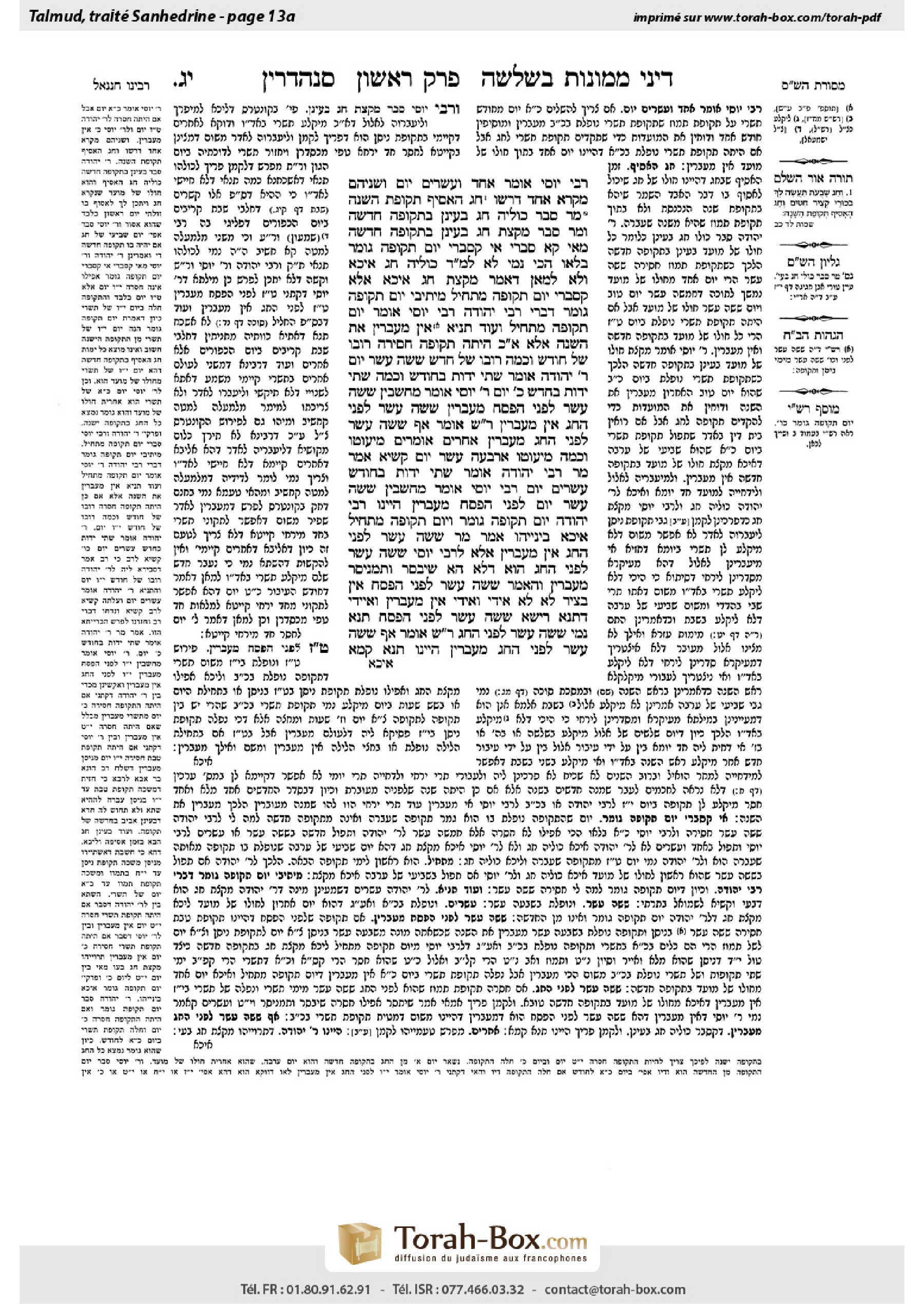
Sanhedrin 13a: Talmud study for Daf Yomi
Daf Yomi is the daily study of one Talmud folio. Explore 37 tractates with scans, Hebrew text, Sefaria English and AI-generated French translations where annotated.
Passage selection and English or AI-generated French translation are available where the scan has annotations. Daf Study is independent of Torah-Box and Sefaria.
Browse Sanhedrin · סנהדרין · All tractatesSanhedrin 13a text and translations
This page of Sanhedrin includes the Aramaic text, an English translation and an AI-generated French translation, alongside the scan above.
סנהדרין י״ג א · Aramaic and Hebrew text
רַבִּי יוֹסֵי אוֹמֵר: אֶחָד וְעֶשְׂרִים יוֹם. וּשְׁנֵיהֶם מִקְרָא אֶחָד דָּרְשׁוּ: ״חַג הָאָסִיף תְּקוּפַת הַשָּׁנָה״. מָר סָבַר: כּוּלֵּיהּ חַג בָּעֵינַן בִּתְקוּפָה חֲדָשָׁה, וּמָר סָבַר: מִקְצָת חַג בָּעֵינַן בִּתְקוּפָה חֲדָשָׁה.
מַאי קָא סָבְרִי? אִי קָסָבְרִי יוֹם תְּקוּפָה גּוֹמֵר, בְּלָאו הָכִי נָמֵי, לָא לְמַאן דְּאָמַר כּוּלֵּיהּ חַג אִיכָּא, וְלָא לְמַאן דְּאָמַר מִקְצָת חַג אִיכָּא. אֶלָּא קָסָבְרִי יוֹם תְּקוּפָה מַתְחִיל.
מֵיתִיבִי: יוֹם תְּקוּפָה גּוֹמֵר, דִּבְרֵי רַבִּי יְהוּדָה. רַבִּי יוֹסֵי אוֹמֵר: יוֹם תְּקוּפָה מַתְחִיל.
וְעוֹד, תַּנְיָא: אֵין מְעַבְּרִין אֶת הַשָּׁנָה אֶלָּא אִם כֵּן הָיְתָה תְּקוּפָה חֲסֵירָה רוּבּוֹ שֶׁל חוֹדֶשׁ. וְכַמָּה רוּבּוֹ שֶׁל חֹדֶשׁ? שִׁשָּׁה עָשָׂר יוֹם. רַבִּי יְהוּדָה אוֹמֵר: שְׁתֵּי יָדוֹת בַּחוֹדֶשׁ. וְכַמָּה שְׁתֵּי יָדוֹת בַּחֹדֶשׁ? עֶשְׂרִים יוֹם.
רַבִּי יוֹסֵי אוֹמֵר: מְחַשְּׁבִין שִׁשָּׁה עָשָׂר לִפְנֵי הַפֶּסַח, מְעַבְּרִין; שִׁשָּׁה עָשָׂר לִפְנֵי הַחַג, אֵין מְעַבְּרִין. רַבִּי שִׁמְעוֹן אוֹמֵר: אַף שִׁשָּׁה עָשָׂר לִפְנֵי הַחַג מְעַבְּרִין. אֲחֵרִים אוֹמְרִים: מִיעוּטוֹ, וְכַמָּה מִיעוּטוֹ? אַרְבָּעָה עָשָׂר יוֹם. קַשְׁיָא!
אָמַר מָר: רַבִּי יְהוּדָה אוֹמֵר: שְׁתֵּי יָדוֹת בַּחוֹדֶשׁ, עֶשְׂרִים יוֹם. רַבִּי יוֹסֵי אוֹמֵר: מְחַשְּׁבִין שִׁשָּׁה עָשָׂר יוֹם לִפְנֵי הַפֶּסַח, מְעַבְּרִין. הַיְינוּ רַבִּי יְהוּדָה!
יוֹם תְּקוּפָה גּוֹמֵר, וְיוֹם תְּקוּפָה מַתְחִיל – אִיכָּא בֵּינַיְיהוּ.
אָמַר מָר: שִׁשָּׁה עָשָׂר לִפְנֵי הַחַג אֵין מְעַבְּרִין. אֶלָּא לְרַבִּי יוֹסֵי, שִׁשָּׁה עָשָׂר לִפְנֵי הַחַג הוּא דְּלָא, הָא שִׁיבְסַר וְתַמְנֵיסַר מְעַבְּרִין?
וְהָאָמַר: שִׁשָּׁה עָשָׂר לִפְנֵי הַפֶּסַח – אִין, בְּצִיר – לָא!
לָא, אִידִי וְאִידִי אֵין מְעַבְּרִין, וְאַיְּידֵי דִּתְנָא רֵישָׁא ״שִׁשָּׁה עָשָׂר לִפְנֵי הַפֶּסַח״, תְּנָא נָמֵי ״שִׁשָּׁה עָשָׂר לִפְנֵי הַחַג״.
רַבִּי שִׁמְעוֹן אוֹמֵר: אַף שִׁשָּׁה עָשָׂר לִפְנֵי הַחַג מְעַבְּרִין. הַיְינוּ תַּנָּא קַמָּא?
Sanhedrin 13a · English translation
Rabbi Yosei says: The year must be intercalated only if twenty-one days of Tishrei will pass before the autumnal equinox. The Gemara explains: And both of them expounded the same verse to arrive at their respective opinions: “And the Festival of the Ingathering at the turn of the year” (Exodus 34:22). They both interpret the verse to mean that the Festival of the Ingathering, which is referring to the intermediate days of Sukkot, must take place during the season of Tishrei, i.e., autumn. One Sage, Rabbi Yehuda, holds that we require all of the Festival to take place in the new season, after the equinox. And one Sage, Rabbi Yosei, holds that we require only some of the Festival, even one day, to take place in the new season, so the year must be intercalated only if the equinox would fall on the twenty-second of Tishrei or later.
The Gemara asks: What do they each hold? If they hold that the day of the equinox concludes the season, meaning that it is counted as part of the preceding season, then even if the season of Tammuz is not lacking more than this number of days until its completion, the year would need to be intercalated. According to the one who says that we require all of the Festival to take place in the new season, this is not sufficient to rectify the problem, as the sixteenth of Tishrei, which is the beginning of the Festival of the Ingathering, is still in the old season. And even according to the one who says we require only some of the Festival to take place in the new season, this is also not sufficient to rectify the problem, since if the equinox occurs on the twenty-first of Tishrei, the new season begins only on the twenty-second, after the Festival of the Ingathering is over. Rather, they certainly both hold that the day of the equinox begins the new season.
The Gemara raises an objection to this conclusion from a different baraita: The day of the equinox concludes the season; this is the statement of Rabbi Yehuda. Rabbi Yosei says: The day of the equinox begins the season. It is therefore clear that they disagree about this issue, and that the previous baraita must be explained differently.
And furthermore, it is taught in a baraita (Tosefta 2:7): The court intercalates the year only if the season of Tammuz was lacking its completion for most of the month of Tishrei. And how much is: Most of the month? Sixteen days. Rabbi Yehuda says: Two parts, meaning two-thirds, of the month. And how much is: Two parts of the month? Twenty days, since in that case the day of the equinox would fall on the twenty-first, and since according to Rabbi Yehuda the day of the equinox concludes the season, the new season would begin on the following day, after the Festival of the Ingathering has ended.
The baraita continues: Rabbi Yosei says: The court calculates the seasons, and if the winter season of Tevet, which is before Passover, is lacking its completion for sixteen days into the month of Nisan, the court intercalates the year, so that Passover will occur within the season of Nisan, i.e., the spring. But if the summer season of Tammuz, which is before the Festival of the Ingathering, is lacking its completion for sixteen days into the month of Tishrei, the court does not intercalate it. Rabbi Shimon says: Even if the season before the Festival of the Ingathering is lacking its completion for sixteen days into the month of Tishrei, the court does intercalate the year. The tanna referred to as Aḥerim says: The year is intercalated even on account of a minority of the month, and how much is a minority of the month? Fourteen days. The Gemara concludes: Comparing the various baraitot poses a difficulty, as they appear to contradict one another.
The Gemara analyzes the baraita: The Master said that Rabbi Yehuda says: The year must be intercalated if the season of Tammuz is lacking its completion for two parts of the month of Tishrei, which is twenty days. Rabbi Yosei says: The court calculates the seasons, and if the season of Tevet, which is before Passover, is lacking its completion for sixteen days into the month of Nisan, the court intercalates the year. The Gemara challenges: That is the same as the opinion of Rabbi Yehuda, since a calculation that shows the winter season of a given year to be lacking its completion for sixteen days of Nisan will also show the summer season of that year will be lacking its completion for twenty days of Tishrei.
The Gemara explains: The difference between them concerns the question of whether the day of the equinox concludes the season, or the day of the equinox begins the season. Rabbi Yehuda holds that the day of the equinox concludes the season, and therefore in the given scenario the year must be intercalated so that some of the Festival of the Ingathering will occur in the season of Tishrei. But according to Rabbi Yosei this is not a concern, as the day of the equinox begins the season. Nevertheless, the year must be intercalated so that Passover will occur in the season of Nisan.
The Master says: In the continuation of his statement, Rabbi Yosei said: If the summer season of Tammuz, which is before the Festival of the Ingathering, is lacking its completion for sixteen days into the month of Tishrei, the court does not intercalate the year. The Gemara challenges: Rather, according to Rabbi Yosei, if the season before the Festival is lacking its completion for sixteen days into the month of Tishrei, this is the situation when the court does not intercalate the year. But can one therefore infer that if it is lacking its completion for seventeen or eighteen days into the month of Tishrei, the court does intercalate the year?
The Gemara explains the difficulty: But doesn’t he say: The court calculates the seasons, and if the winter season of Tevet, which is before Passover, is lacking its completion for sixteen days into the month of Nisan, yes, the court intercalates the year; but if it is lacking its completion for less than that, it should not be intercalated, even if the season before the Festival of the Ingathering will be lacking seventeen or eighteen days? The two elements of Rabbi Yosei’s statement appear to contradict one another.
The Gemara answers: No, those inferences are not correct. Rather, in both this case and that case, the court does not intercalate the year, and since it taught in the first clause: Sixteen days before Passover, it also taught: Sixteen days before the Festival of the Ingathering, but one cannot infer from this that it means sixteen days and no more.
The baraita teaches that Rabbi Shimon says: Even if the season before the Festival of the Ingathering is lacking its completion for sixteen days into the month of Tishrei, the court does intercalate the year. The Gemara asks: If so, this is apparently the same as the opinion of the first tanna; what is the difference between Rabbi Shimon’s opinion and that of the first tanna?
Sanhedrin 13a · Traduction française (IA)
Rabbi Yosei dit : L’année doit être embolismique seulement si vingt et un jours de Tishrei s’écoulent avant l’équinoxe d’automne. La Guemara explique : Tous deux ont interprété le même verset pour parvenir à leurs opinions respectives : « Et la fête de la Récolte, au tournant de l’année » (Exode 34:22). Tous deux comprennent que la fête de la Récolte, qui désigne les jours intermédiaires de Souccot, doit avoir lieu pendant la saison de Tishrei, c’est-à-dire en automne. Un Sage, Rabbi Yehuda, estime que toute la fête doit avoir lieu dans la nouvelle saison, après l’équinoxe. L’autre Sage, Rabbi Yosei, estime qu’il suffit qu’une partie de la fête, même un seul jour, ait lieu dans la nouvelle saison ; l’année doit donc être embolismique seulement si l’équinoxe tombe le vingt-deuxième jour de Tishrei ou plus tard.
La Guemara demande : Quelle est l’opinion de chacun d’eux ? S’ils estiment que le jour de l’équinoxe clôt la saison, c’est-à-dire qu’il est compté comme faisant partie de la saison précédente, alors, même si la saison de Tammuz n’est pas achevée et qu’il lui manque ce nombre de jours, l’année devrait être embolismique. Selon celui qui dit que toute la fête doit avoir lieu dans la nouvelle saison, cela ne suffit pas à résoudre le problème, car le seize Tishrei, qui marque le début de la fête de la Récolte, appartient encore à l’ancienne saison. Et même selon celui qui dit qu’il suffit qu’une partie de la fête ait lieu dans la nouvelle saison, cela ne suffit pas non plus à résoudre le problème, car si l’équinoxe tombe le vingt et un Tishrei, la nouvelle saison ne commence que le vingt-deux, après la fin de la fête de la Récolte. Il faut donc nécessairement qu’ils estiment tous deux que le jour de l’équinoxe inaugure la nouvelle saison.
La Guemara soulève une objection à cette conclusion à partir d’une autre baraïta : Le jour de l’équinoxe clôt la saison ; telle est l’opinion de Rabbi Yehuda. Rabbi Yosei dit : Le jour de l’équinoxe inaugure la saison. Il est donc clair qu’ils sont en désaccord sur cette question et qu’il faut expliquer autrement la baraïta précédente.
De plus, il est enseigné dans une baraïta (Tosefta 2:7) : Le tribunal rend l’année embolismique seulement si la saison de Tammuz n’est pas achevée pendant la majeure partie du mois de Tishrei. Et combien représente la majeure partie du mois ? Seize jours. Rabbi Yehuda dit : Deux tiers du mois. Et combien représentent deux tiers du mois ? Vingt jours, car dans ce cas l’équinoxe tomberait le vingt et un ; et puisque, selon Rabbi Yehuda, le jour de l’équinoxe clôt la saison, la nouvelle saison commencerait le lendemain, après la fin de la fête de la Récolte.
La baraïta poursuit : Rabbi Yosei dit : Le tribunal calcule les saisons ; si la saison d’hiver de Tevet, qui précède Pessa’h, n’est pas achevée pendant les seize premiers jours du mois de Nisan, le tribunal rend l’année embolismique, afin que Pessa’h ait lieu pendant la saison de Nisan, c’est-à-dire au printemps. Mais si la saison d’été de Tammuz, qui précède la fête de la Récolte, n’est pas achevée pendant les seize premiers jours de Tishrei, le tribunal ne rend pas l’année embolismique. Rabbi Shimon dit : Même si la saison qui précède la fête de la Récolte n’est pas achevée pendant les seize premiers jours de Tishrei, le tribunal rend l’année embolismique. Le tanna appelé Aḥerim dit : L’année est rendue embolismique même si la saison n’est pas achevée pendant une minorité du mois. Et combien représente une minorité du mois ? Quatorze jours. La Guemara conclut : La comparaison des différentes baraïtot pose une difficulté, car elles semblent se contredire.
La Guemara analyse la baraïta : Le Maître a dit que Rabbi Yehuda affirme que l’année doit être rendue embolismique si la saison de Tammuz n’est pas achevée pendant les deux tiers du mois de Tishrei, soit vingt jours. Rabbi Yosei dit : Le tribunal calcule les saisons ; si la saison de Tevet, qui précède Pessa’h, n’est pas achevée pendant les seize premiers jours de Nisan, le tribunal rend l’année embolismique. La Guemara objecte : C’est la même opinion que celle de Rabbi Yehuda, car un calcul qui montre que la saison d’hiver d’une année donnée n’est pas achevée pendant les seize premiers jours de Nisan montrera aussi que la saison d’été de cette année-là ne sera pas achevée pendant vingt jours de Tishrei.
La Guemara explique : La différence entre eux concerne la question de savoir si le jour de l’équinoxe clôt la saison ou s’il l’inaugure. Rabbi Yehuda estime que le jour de l’équinoxe clôt la saison ; dans le cas envisagé, l’année doit donc être rendue embolismique afin qu’une partie de la fête de la Récolte ait lieu pendant la saison de Tishrei. Selon Rabbi Yosei, cela ne pose pas de problème, car le jour de l’équinoxe inaugure la saison. Néanmoins, l’année doit être rendue embolismique afin que Pessa’h ait lieu pendant la saison de Nisan.
Le Maître dit : Dans la suite de sa déclaration, Rabbi Yosei a dit : Si la saison d’été de Tammuz, qui précède la fête de la Récolte, n’est pas achevée pendant les seize premiers jours de Tishrei, le tribunal ne rend pas l’année embolismique. La Guemara objecte : Ainsi, selon Rabbi Yosei, si la saison qui précède la fête n’est pas achevée pendant les seize premiers jours de Tishrei, c’est dans cette situation que le tribunal ne rend pas l’année embolismique. Peut-on alors en déduire que si elle n’est pas achevée pendant dix-sept ou dix-huit jours de Tishrei, le tribunal rend l’année embolismique ?
La Guemara explicite la difficulté : Pourtant, ne dit-il pas : Le tribunal calcule les saisons ; si la saison d’hiver de Tevet, qui précède Pessa’h, n’est pas achevée pendant les seize premiers jours de Nisan, alors le tribunal rend l’année embolismique ; mais si elle n’est pas achevée pendant moins de jours, l’année ne doit pas être rendue embolismique, même si la saison qui précède la fête de la Récolte n’est pas achevée pendant dix-sept ou dix-huit jours ? Les deux éléments de la déclaration de Rabbi Yosei semblent se contredire.
La Guemara répond : Non, ces déductions ne sont pas justifiées. Au contraire, dans les deux cas, le tribunal ne rend pas l’année embolismique ; et puisque la première clause enseigne : Seize jours avant Pessa’h, elle enseigne aussi : Seize jours avant la fête de la Récolte, mais on ne peut pas en déduire qu’il s’agit de seize jours exactement, et pas davantage.
La baraïta enseigne que Rabbi Shimon dit : Même si la saison qui précède la fête de la Récolte n’est pas achevée pendant les seize premiers jours de Tishrei, le tribunal rend l’année embolismique. La Guemara demande : Dans ce cas, cela semble être la même opinion que celle du premier tanna ; quelle est la différence entre l’opinion de Rabbi Shimon et celle du premier tanna ?
Traduction française générée par IA à partir de l’édition anglaise de Sefaria. Vérifie toujours un passage avec le texte source.
Text from Sefaria: William Davidson Edition - Vocalized Aramaic (CC BY NC); William Davidson Edition - English (CC BY NC).