Sanhedrin 12b: Talmud study for Daf Yomi
Daf Yomi is the daily study of one Talmud folio. Explore 37 tractates with scans, Hebrew text, Sefaria English and AI-generated French translations where annotated.
Passage selection and English or AI-generated French translation are available where the scan has annotations. Daf Study is independent of Torah-Box and Sefaria.
Browse Sanhedrin · סנהדרין · All tractatesSanhedrin 12b text and translations
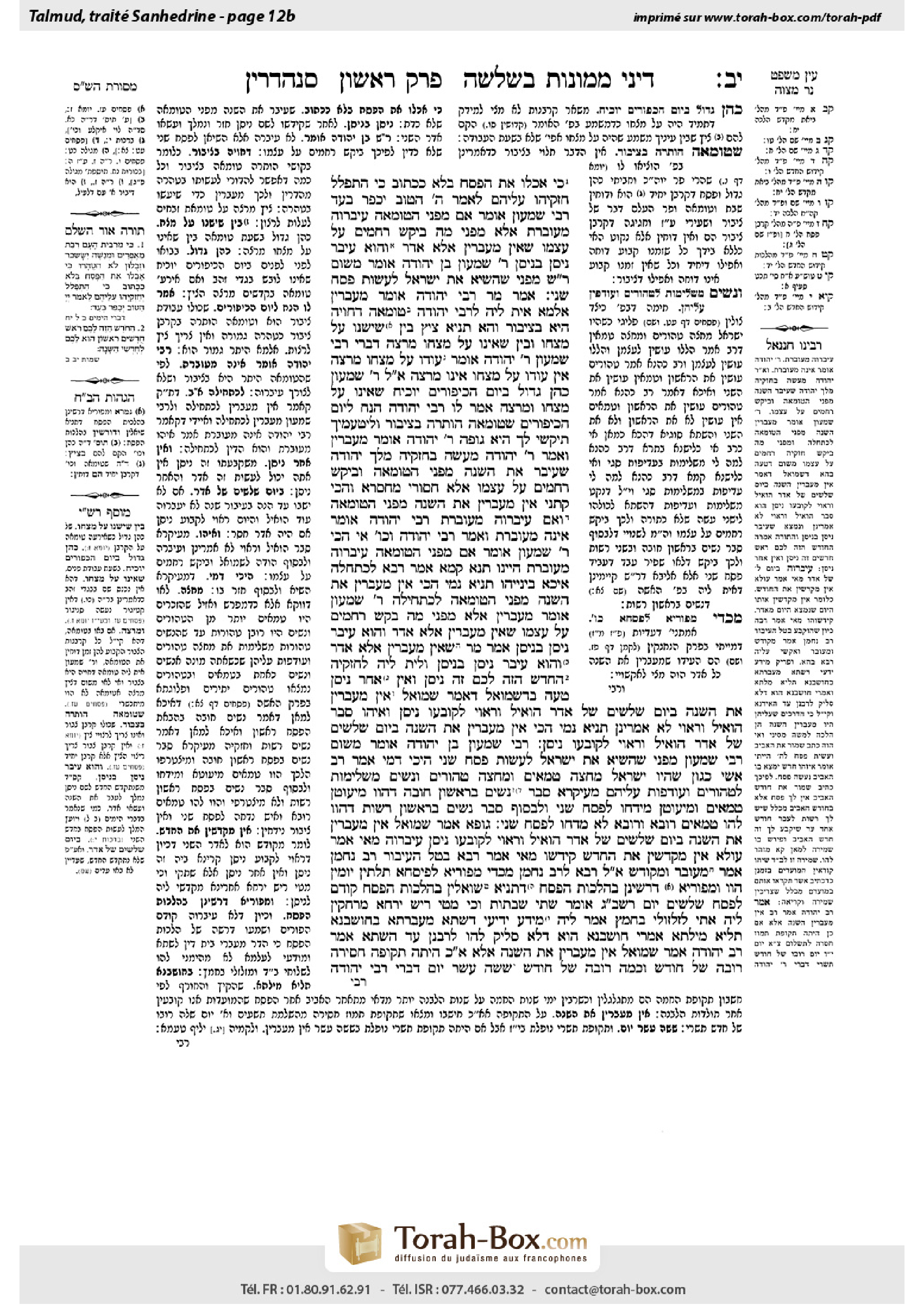
This page of Sanhedrin includes the Aramaic text, an English translation and an AI-generated French translation, alongside the scan above.
סנהדרין י״ב ב · Aramaic and Hebrew text
כִּי אָכְלוּ אֶת הַפֶּסַח בְּלֹא כַכָּתוּב כִּי הִתְפַּלֵּל חִזְקִיָּהוּ עֲלֵיהֶם לֵאמֹר ה׳ הַטּוֹב יְכַפֵּר בְּעַד״.
רַבִּי שִׁמְעוֹן אוֹמֵר: אִם מִפְּנֵי הַטּוּמְאָה עִיבְּרוּהָ, מְעוּבֶּרֶת. אֶלָּא מִפְּנֵי מָה בִּיקֵּשׁ רַחֲמִים עַל עַצְמוֹ? שֶׁאֵין מְעַבְּרִין אֶלָּא אֲדָר, וְהוּא עִיבֵּר נִיסָן בְּנִיסָן. רַבִּי שִׁמְעוֹן בֶּן יְהוּדָה אוֹמֵר מִשּׁוּם רַבִּי שִׁמְעוֹן: מִפְּנֵי שֶׁהִשִּׂיא אֶת יִשְׂרָאֵל לַעֲשׂוֹת פֶּסַח שֵׁנִי.
אָמַר מָר: רַבִּי יְהוּדָה אוֹמֵר: מְעַבְּרִין. אַלְמָא, אִית לֵיהּ לְרַבִּי יְהוּדָה: טוּמְאָה דְּחוּיָה הִיא בְּצִיבּוּר.
וְהָא תַּנְיָא: צִיץ, בֵּין שֶׁיֶּשְׁנוֹ עַל מִצְחוֹ וּבֵין שֶׁאֵינוֹ עַל מִצְחוֹ – מְרַצֶּה, דִּבְרֵי רַבִּי שִׁמְעוֹן. רַבִּי יְהוּדָה אוֹמֵר: עוֹדוֹ עַל מִצְחוֹ – מְרַצֶּה, אֵין עוֹדוֹ עַל מִצְחוֹ – אֵינוֹ מְרַצֶּה.
אָמַר לוֹ רַבִּי שִׁמְעוֹן: כֹּהֵן גָּדוֹל בְּיוֹם הַכִּיפּוּרִים יוֹכִיחַ, שֶׁאֵינוֹ עַל מִצְחוֹ וּמְרַצֶּה. אָמַר לוֹ רַבִּי יְהוּדָה: הַנַּח לְיוֹם הַכִּיפּוּרִים, שֶׁטּוּמְאָה הוּתְּרָה בְּצִיבּוּר.
וְלִיטַעְמָיךְ, תִּיקְשֵׁי לָךְ הִיא גּוּפַהּ: רַבִּי יְהוּדָה אוֹמֵר מְעַבְּרִין, וְאָמַר רַבִּי יְהוּדָה: מַעֲשֶׂה בְּחִזְקִיָּה מֶלֶךְ יְהוּדָה שֶׁעִיבֵּר אֶת הַשָּׁנָה מִפְּנֵי הַטּוּמְאָה, וּבִיקֵּשׁ רַחֲמִים עַל עַצְמוֹ? אֶלָּא, חַסּוֹרֵי מְחַסְּרָא וְהָכִי קָתָנֵי: אֵין מְעַבְּרִין אֶת הַשָּׁנָה מִפְּנֵי הַטּוּמְאָה, וְאִם עִיבְּרוּהָ – מְעוּבֶּרֶת. רַבִּי יְהוּדָה אוֹמֵר: אֵינָהּ מְעוּבֶּרֶת. וְאָמַר רַבִּי יְהוּדָה וְכוּ׳.
אִי הָכִי, רַבִּי שִׁמְעוֹן אוֹמֵר: אִם מִפְּנֵי הַטּוּמְאָה עִיבְּרוּהָ – מְעוּבֶּרֶת. הַיְינוּ תַּנָּא קַמָּא? אָמַר רָבָא: לְכַתְּחִלָּה אִיכָּא בֵּינַיְיהוּ. תַּנְיָא נָמֵי הָכִי: אֵין מְעַבְּרִין אֶת הַשָּׁנָה מִפְּנֵי הַטּוּמְאָה לְכַתְּחִילָּה. רַבִּי שִׁמְעוֹן אוֹמֵר: מְעַבְּרִין. אֶלָּא מִפְּנֵי מָה בִּקֵּשׁ רַחֲמִים עַל עַצְמוֹ? שֶׁאֵין מְעַבְּרִין אֶלָּא אֲדָר, וְהוּא עִיבֵּר נִיסָן בְּנִיסָן.
אָמַר מָר: שֶׁאֵין מְעַבְּרִין אֶלָּא אֲדָר, וְהוּא עִיבֵּר נִיסָן בְּנִיסָן. וְלֵית לֵיהּ לְחִזְקִיָּה ״הַחֹדֶשׁ הַזֶּה לָכֶם״ – זֶה נִיסָן, וְאֵין אַחֵר נִיסָן! טְעָה בְּדִשְׁמוּאֵל, דְּאָמַר שְׁמוּאֵל: אֵין מְעַבְּרִין אֶת הַשָּׁנָה בְּיוֹם שְׁלֹשִׁים שֶׁל אֲדָר, הוֹאִיל וְרָאוּי לְקוֹבְעוֹ נִיסָן.
וְאִיהוּ סָבַר: ״הוֹאִיל וְרָאוּי״ לָא אָמְרִינַן. תַּנְיָא נָמֵי הָכִי: אֵין מְעַבְּרִין אֶת הַשָּׁנָה בְּיוֹם שְׁלֹשִׁים שֶׁל אֲדָר, הוֹאִיל וְרָאוּי לְקוֹבְעוֹ נִיסָן.
רַבִּי שִׁמְעוֹן בֶּן יְהוּדָה אוֹמֵר מִשּׁוּם רַבִּי שִׁמְעוֹן: מִפְּנֵי שֶׁהִשִּׂיא אֶת יִשְׂרָאֵל לַעֲשׂוֹת פֶּסַח שֵׁנִי. הֵיכִי דָּמֵי? אָמַר רַב אָשֵׁי: כְּגוֹן שֶׁהָיוּ יִשְׂרָאֵל מֶחֱצָה טְמֵאִים, מֶחֱצָה טְהוֹרִים, וְנָשִׁים מַשְׁלִימוֹת לַטְּהוֹרִים וְעוֹדְפוֹת עֲלֵיהֶם.
מֵעִיקָּרָא סְבַר: נָשִׁים בָּרִאשׁוֹן חוֹבָה, דְּהָווּ מִיעוּטָן טְמֵאִים, וּמִיעוּטָן מִידְּחוּ לְפֶסַח שֵׁנִי. וּלְבַסּוֹף סְבַר: נָשִׁים בָּרִאשׁוֹן רְשׁוּת, דְּהָווּ לְהוּ טְמֵאִים רוּבָּא, וְרוּבָּא לָא מִדְּחוּ לְפֶסַח שֵׁנִי.
גּוּפָא, אָמַר שְׁמוּאֵל: אֵין מְעַבְּרִין אֶת הַשָּׁנָה בְּיוֹם שְׁלֹשִׁים שֶׁל אֲדָר, הוֹאִיל וְרָאוּי לְקוֹבְעוֹ נִיסָן. עִיבְּרוּהָ, מַאי? אָמַר עוּלָּא: אֵין מְקַדְּשִׁין אֶת הַחֹדֶשׁ. קִידְּשׁוּ, מַאי? אָמַר רָבָא: בָּטֵל הָעִיבּוּר. רַב נַחְמָן אָמַר: מְעוּבָּר וּמְקוּדָּשׁ.
אֲמַר לֵיהּ רָבָא לְרַב נַחְמָן: מִכְּדֵי מִפּוּרַיָּא לְפִיסְחָא תְּלָתִין יוֹמִין הֲווֹ, וּמִפּוּרַיָּא דָּרְשִׁינַן בְּהִלְכוֹת הַפֶּסַח, דְּתַנְיָא: שׁוֹאֲלִין בְּהִלְכוֹת הַפֶּסַח קוֹדֶם לְפֶסַח שְׁלֹשִׁים יוֹם. רַבָּן שִׁמְעוֹן בֶּן גַּמְלִיאֵל אוֹמֵר: שְׁתֵּי שַׁבָּתוֹת. וְכִי מָטֵי רֵישׁ יַרְחָא מְרַחֲקִין לֵיהּ? אָתֵי לְזַלְזוֹלֵי בְּחָמֵץ!
אֲמַר לֵיהּ: מִידָּע יָדְיעִי דְּשַׁתָּא מְעַבַּרְתָּא בְּחוּשְׁבָּנָא תַּלְיָא מִילְּתָא. אָמְרִי: חוּשְׁבָּנָא הוּא דְּלָא סְלֵיק לְהוּ לְרַבָּנַן עַד הַשְׁתָּא.
אָמַר רַב יְהוּדָה אָמַר שְׁמוּאֵל: אֵין מְעַבְּרִין אֶת הַשָּׁנָה אֶלָּא אִם כֵּן הָיְתָה תְּקוּפָה חֲסֵירָה רוּבֹּה שֶׁל חוֹדֶשׁ. וְכַמָּה רוּבֹּה שֶׁל חוֹדֶשׁ? שִׁשָּׁה עָשָׂר יוֹם; דִּבְרֵי רַבִּי יְהוּדָה.
Sanhedrin 12b · English translation
yet they ate the Paschal lamb not as is written. For Hezekiah had prayed for them, saying: May the good Lord pardon everyone who sets his heart to seek God…though he not be cleansed according to the purification that pertains to sacred items” (II Chronicles 30:18–19).
Rabbi Shimon says: If the court intercalated the year due to ritual impurity, it is indeed intercalated. But if ritual impurity is ultimately a legitimate reason for intercalating the year, for what reason did Hezekiah request compassion for himself? Because the court may intercalate only the month of Adar, and he intercalated the month of Nisan during the month of Nisan itself. Rabbi Shimon ben Yehuda says in the name of Rabbi Shimon: The incident did not involve the intercalation of the year; rather he appealed for mercy because he encouraged the Jewish people to bypass the standard first Pesaḥ and instead to perform the second Pesaḥ.
Having quoted the Tosefta in its entirety, the Gemara now clarifies several of its details. The Master said above: Rabbi Yehuda says: The court may intercalate the year due to ritual impurity, in order to delay the Paschal offerings, so that the people can perform them in a state of purity. Apparently, Rabbi Yehuda holds that the prohibition against performing the Temple service in a state of ritual impurity is merely overridden in cases involving the public. Although the offerings may be brought when most of the public is in a state of impurity, this course of action is not ideally permitted; one must attempt to find another way to perform the offerings in purity.
The Gemara asks: But isn’t it taught in a baraita: The frontplate effects acceptance whether it is on the forehead of the High Priest or whether it is not on the forehead of the High Priest; this is the statement of Rabbi Shimon. Rabbi Yehuda says: As long as it is on his forehead it effects acceptance; if it is no longer on his forehead it does not effect acceptance.
Rabbi Shimon said to Rabbi Yehuda: The case of the High Priest on Yom Kippur can prove that your statement is incorrect, as on Yom Kippur the frontplate is not on the forehead of the High Priest during the time that he wears only linen garments, and it still effects acceptance. Rabbi Yehuda said to him: Leave aside the case of the High Priest on Yom Kippur, as since the Temple service consists wholly of public offerings the atonement of the frontplate is unnecessary. Even without the frontplate, performing the Temple service in a state of impurity is permitted in cases involving the public. If Rabbi Yehuda holds that it is readily permitted to perform Temple service in the instance of public impurity, then why would he sanction intercalating the year in order to give the public more time to become ritually pure?
The Gemara rejects the question concerning the opinion of Rabbi Yehuda: And according to your reasoning, the Tosefta itself should pose a difficulty for you. The Tosefta states: Rabbi Yehuda says: The court may intercalate the year due to impurity. And Rabbi Yehuda said: There was an incident involving Hezekiah, king of Judea, who intercalated the year due to ritual impurity, and afterward he requested compassion for himself. Why would he request compassion after having made a legitimate decision? Rather, it must be concluded that the Tosefta is incomplete and this is what it is teaching: The court does not intercalate the year due to impurity, but if the court intercalated it, it is intercalated. Rabbi Yehuda says: Even if the court intercalated it, it is not intercalated. And to prove his point, Rabbi Yehuda said that there was an incident involving Hezekiah, who intercalated the year due to impurity and subsequently appealed for mercy.
The Gemara asks: If that is so, meaning if this is the correct way to understand the Tosefta, then the next statement in the Tosefta cannot be reconciled: Rabbi Shimon says: If they intercalated the year due to ritual impurity, it is indeed intercalated. According to this explanation, this is identical to the opinion of the first tanna, who also says that the intercalation is effective. Rava said: The difference between these two opinions is whether the year may be intercalated due to impurity ab initio. According to the first tanna, although the intercalation is valid after the fact, impurity is not an appropriate reason to intercalate the year. Rabbi Shimon holds that it is an appropriate reason. This is also taught in a baraita: The court may not intercalate the year due to impurity ab initio. Rabbi Shimon says: The court may intercalate the year due to impurity, even ab initio. Rather, according to this opinion, for what reason did Hezekiah request compassion for himself? Because the court may intercalate only Adar, but he intercalated Nisan during Nisan.
The Master said above: Hezekiah requested compassion because the court, when intercalating the year, may intercalate only Adar, and he intercalated Nisan during Nisan. How could Hezekiah act in this way? But doesn’t Hezekiah accept the following interpretive tradition: The verse states: “This month shall be for you the beginning of months; it shall be the first month of the year for you” (Exodus 12:2). This teaches that this month is Nisan, and another month cannot be Nisan. Therefore, the court cannot add another month of Nisan. The Gemara answers: Hezekiah erred with regard to the halakha that would later be expounded by Shmuel. As Shmuel says: The court may not intercalate the year on the thirtieth day of Adar, since although it is part of Adar, it is fit to establish it as the first day of Nisan. As the day that may be assigned as the New Moon of Nisan, it has the same status as does Nisan, and the year may not be intercalated then.
And Hezekiah held: We do not say the principle: Since it is fit. Since it was technically still Adar, he initially thought it was permitted to intercalate the year on that day. The Gemara notes: This opinion is also taught in a baraita: The court may not intercalate the year on the thirtieth day of Adar, since it is fit to establish it as the first day of Nisan.
The Gemara further analyzes the Tosefta quoted above: Rabbi Shimon ben Yehuda says in the name of Rabbi Shimon: Hezekiah requested compassion because he encouraged the Jewish people to perform the second Pesaḥ. What are the circumstances, such that Hezekiah acted in this unusual manner and later regretted his decision? Rav Ashi said: It was a case where half the Jewish people were impure and half were pure. And the women among them completed the ranks of the pure and the combined total then exceeded the impure ones. A majority of the men were impure, but as most of the women were pure, if they were included in the tally the majority of the public was then pure. Hezekiah was unsure whether the women should be counted, as he was unsure if they are obligated to bring the Paschal offering.
Initially, he thought women have an obligation to participate in the first Pesaḥ on the fourteenth of Nisan, so the minority of Jews are impure and the minority should be deferred to the second Pesaḥ. Therefore, he deferred most of the men, as they were ritually impure, to bypass the first Pesaḥ. In the end, he thought women are permitted but not obligated to participate in the first Pesaḥ. So when counting only the men, the impure were the majority of those obligated to bring the offering, and the majority is not deferred to the second Pesaḥ. Instead, they should have sacrificed the offering on the first Pesaḥ despite their impurity. Consequently, having deferred the majority when they should not have been deferred, he regretted his decision.
§ With regard to the question of intercalating the year on the thirtieth of Adar, the Gemara discusses the matter itself. Shmuel says: The court may not intercalate the year on the thirtieth day of Adar, although it is part of Adar, since it is fit to establish the day as the first of Nisan. If they intercalated the year on that day, after the fact, what is the halakha? Ulla says: The intercalation is effective and the court does not sanctify the month on that day, so that the intercalation will have been performed in Adar. The Gemara asks: If another court sanctified the month, what is the halakha? Rava says: The intercalation is void, as it turns out that the intercalation was performed in Nisan. Rav Naḥman disagrees and says: The year is intercalated and the month is also sanctified, because each court has performed an independently valid function.
Rava said to Rav Naḥman: Now, from Purim to Passover is thirty days, and from the time of Purim, we teach the community the halakhot of Passover. As it is taught in a baraita: The people ask questions with regard to the halakhot of Passover beginning thirty days before Passover. Rabban Shimon ben Gamliel says: They ask two weeks before Passover. If so, even during Adar, people know that Passover is approaching. And when the New Moon comes, if the court will distance the Passover holiday another month by adding another Adar at so late a date, then the people will come to treat the Passover prohibitions of leavened bread lightly, believing that the stated time of Passover is incorrect because the Sages decided the dates capriciously.
Rav Naḥman said to Rava: The masses know that the intercalated year is a matter dependent upon the calculation, which is determined by a complex process. Therefore they say: It is the calculation that did not conclusively emerge for the Sages until now, and they will therefore understand when the true date of Passover is.
§ With regard to intercalation on the basis of the season, Rav Yehuda says that Shmuel says: The court intercalates the year only if the season of Tammuz, i.e., the summer, was lacking its completion for most of the month of Tishrei, meaning that the summer season had begun so late in the calendar that the autumnal equinox would occur only after most of the month of Tishrei has passed. Since the festival of Sukkot, beginning on the fifteenth of Tishrei, must fall after the autumnal equinox, a month is added to the previous year, therefore causing the summer season to end and the autumn to begin at an earlier point on the Jewish calendar. This allows Sukkot to begin after the autumnal equinox, within the season of Tishrei. And how much is: Most of the month? Sixteen days; this is the statement of Rabbi Yehuda.
Sanhedrin 12b · Traduction française (IA)
Pourtant, ils mangèrent l’agneau pascal contrairement à ce qui est prescrit. En effet, Ézéchias avait prié pour eux en disant : « Que le bon Seigneur pardonne à quiconque dispose son cœur à rechercher Dieu… même s’il n’est pas purifié selon les règles de purification applicables aux choses saintes » (II Chroniques 30, 18-19).
Rabbi Shimon dit : Si le tribunal a intercalé l’année en raison de l’impureté rituelle, l’intercalation est bien valide. Mais si l’impureté rituelle constitue effectivement un motif valable pour intercaler l’année, pourquoi Ézéchias a-t-il imploré la compassion pour lui-même ? Parce que le tribunal ne peut intercaler que le mois d’Adar, alors que lui a intercalé le mois de Nissan pendant le mois de Nissan lui-même. Rabbi Shimon ben Yehouda dit au nom de Rabbi Shimon : L’incident ne concernait pas l’intercalation de l’année ; Ézéchias implora plutôt la miséricorde parce qu’il avait incité le peuple juif à omettre le premier Pessa’h habituel et à célébrer à sa place le second Pessa’h.
Après avoir cité intégralement la Tosefta, la Guemara en clarifie plusieurs détails. Le maître a dit plus haut : Rabbi Yehouda dit que le tribunal peut intercaler l’année en raison de l’impureté rituelle, afin de retarder les sacrifices pascals et de permettre au peuple de les offrir en état de pureté. Apparemment, Rabbi Yehouda estime que l’interdiction d’accomplir le service du Temple en état d’impureté rituelle est seulement écartée dans les cas concernant la collectivité. Bien que les sacrifices puissent être offerts lorsque la majorité du peuple est en état d’impureté, cette manière de procéder n’est pas idéale ; il faut chercher un autre moyen de les offrir en état de pureté.
La Guemara demande : Mais n’est-il pas enseigné dans une baraïta que le fronton obtient l’agrément, qu’il soit ou non sur le front du Grand Prêtre ? Telle est l’opinion de Rabbi Shimon. Rabbi Yehouda dit : Tant qu’il est sur son front, il obtient l’agrément ; s’il n’y est plus, il ne l’obtient pas.
Rabbi Shimon dit à Rabbi Yehouda : Le cas du Grand Prêtre à Yom Kippour prouve que ton affirmation est erronée, car, à Yom Kippour, le fronton n’est pas sur le front du Grand Prêtre lorsqu’il ne porte que des vêtements de lin, et pourtant il obtient l’agrément. Rabbi Yehouda lui dit : Écarte le cas du Grand Prêtre à Yom Kippour, car, puisque le service du Temple consiste entièrement en sacrifices collectifs, l’expiation obtenue par le fronton est inutile. Même sans le fronton, il est permis d’accomplir le service du Temple en état d’impureté dans les cas concernant la collectivité. Si Rabbi Yehouda estime qu’il est pleinement permis d’accomplir le service du Temple lorsque la collectivité est impure, pourquoi autoriserait-il l’intercalation de l’année afin de donner au peuple plus de temps pour retrouver la pureté rituelle ?
La Guemara écarte la question concernant l’opinion de Rabbi Yehouda : selon ton raisonnement, la Tosefta elle-même devrait te poser problème. La Tosefta enseigne : Rabbi Yehouda dit que le tribunal peut intercaler l’année en raison de l’impureté. Et Rabbi Yehouda a dit : Il y eut un épisode où Ézéchias, roi de Judée, intercala l’année en raison de l’impureté rituelle, puis implora la compassion pour lui-même. Pourquoi aurait-il imploré la compassion après avoir pris une décision légitime ? Il faut plutôt conclure que la Tosefta est incomplète et qu’elle enseigne ceci : Le tribunal n’intercale pas l’année en raison de l’impureté ; mais si le tribunal l’a intercalée, l’intercalation est valide. Rabbi Yehouda dit : Même si le tribunal l’a intercalée, elle n’est pas valide. Pour étayer son propos, Rabbi Yehouda a dit qu’il y eut un épisode où Ézéchias intercala l’année en raison de l’impureté, puis implora la miséricorde.
La Guemara demande : Si tel est le cas, c’est-à-dire si c’est ainsi qu’il faut comprendre la Tosefta, la déclaration suivante de la Tosefta ne peut alors être conciliée avec cela : Rabbi Shimon dit que si le tribunal a intercalé l’année en raison de l’impureté rituelle, l’intercalation est bien valide. Selon cette explication, cela revient à l’opinion du premier tanna, qui dit lui aussi que l’intercalation est valide. Rava dit : La différence entre ces deux opinions porte sur la question de savoir si l’on peut intercaler l’année en raison de l’impureté a priori. Selon le premier tanna, bien que l’intercalation soit valide après coup, l’impureté ne constitue pas un motif approprié pour intercaler l’année. Rabbi Shimon estime que c’est un motif approprié. Cela est également enseigné dans une baraïta : Le tribunal ne peut pas intercaler l’année en raison de l’impureté a priori. Rabbi Shimon dit : Le tribunal peut intercaler l’année en raison de l’impureté, même a priori. Dès lors, selon cette opinion, pourquoi Ézéchias a-t-il imploré la compassion pour lui-même ? Parce que le tribunal ne peut intercaler que le mois d’Adar, alors que lui a intercalé Nissan pendant Nissan.
Le maître a dit plus haut qu’Ézéchias avait imploré la compassion parce que, lorsqu’il intercale l’année, le tribunal ne peut intercaler que le mois d’Adar, alors que lui avait intercalé Nissan pendant Nissan. Comment Ézéchias a-t-il pu agir ainsi ? Mais Ézéchias n’accepte-t-il pas l’interprétation suivante : le verset dit : « Ce mois-ci sera pour vous le commencement des mois ; il sera pour vous le premier mois de l’année » (Exode 12, 2). Cela enseigne que ce mois est Nissan et qu’un autre mois ne peut être Nissan. Le tribunal ne peut donc pas ajouter un autre mois de Nissan. La Guemara répond : Ézéchias s’est trompé au sujet de la halakha que Shmuel devait exposer plus tard. Car Shmuel dit : Le tribunal ne peut pas intercaler l’année le trentième jour d’Adar, puisque, bien que ce jour fasse partie d’Adar, il peut être fixé comme premier jour de Nissan. Comme ce jour peut être désigné comme la nouvelle lune de Nissan, il a le même statut que Nissan ; on ne peut donc pas intercaler l’année à cette date.
Ézéchias estimait qu’on n’applique pas le principe : « Puisqu’il est susceptible de… » Comme il s’agissait techniquement encore d’Adar, il avait d’abord pensé qu’il était permis d’intercaler l’année ce jour-là. La Guemara relève : Cette opinion est également enseignée dans une baraïta : Le tribunal ne peut pas intercaler l’année le trentième jour d’Adar, puisque ce jour peut être fixé comme premier jour de Nissan.
La Guemara analyse davantage la Tosefta citée plus haut : Rabbi Shimon ben Yehouda dit au nom de Rabbi Shimon qu’Ézéchias avait imploré la compassion parce qu’il avait incité le peuple juif à célébrer le second Pessa’h. Dans quelles circonstances Ézéchias a-t-il agi de cette manière inhabituelle, puis regretté sa décision ? Rav Ashi dit : La moitié du peuple juif était impure et l’autre moitié pure. Les femmes parmi eux complétaient les rangs des personnes pures, et leur nombre total dépassait alors celui des personnes impures. La majorité des hommes était impure, mais comme la plupart des femmes étaient pures, si on les incluait dans le décompte, la majorité de la collectivité était alors pure. Ézéchias ne savait pas s’il fallait compter les femmes, car il ne savait pas si elles avaient l’obligation d’apporter le sacrifice pascal.
Au départ, il pensa que les femmes avaient l’obligation de participer au premier Pessa’h, le quatorze Nissan ; les impurs ne constituaient donc qu’une minorité des Juifs, et cette minorité devait être renvoyée au second Pessa’h. Il renvoya donc la plupart des hommes, qui étaient en état d’impureté rituelle, afin qu’ils omettent le premier Pessa’h. Finalement, il pensa que les femmes étaient autorisées à participer au premier Pessa’h sans en avoir l’obligation. Ainsi, si l’on ne comptait que les hommes, les impurs formaient la majorité de ceux qui étaient tenus d’apporter le sacrifice, et la majorité n’est pas renvoyée au second Pessa’h. Ils auraient plutôt dû offrir le sacrifice lors du premier Pessa’h malgré leur impureté. Par conséquent, après avoir renvoyé la majorité alors qu’elle n’aurait pas dû l’être, il regretta sa décision.
§ À propos de l’intercalation de l’année le trentième jour d’Adar, la Guemara examine la question elle-même. Shmuel dit : Le tribunal ne peut pas intercaler l’année le trentième jour d’Adar, bien que ce jour fasse partie d’Adar, puisqu’il peut être fixé comme premier jour de Nissan. S’ils ont intercalé l’année ce jour-là, quelle est la halakha après coup ? Oula dit : L’intercalation est valide, et le tribunal ne sanctifie pas le mois ce jour-là, de sorte que l’intercalation aura été faite pendant Adar. La Guemara demande : Quelle est la halakha si un autre tribunal a sanctifié le mois ? Rava dit : L’intercalation est nulle, puisqu’il s’avère que l’année a été intercalée pendant Nissan. Rav Naḥman n’est pas d’accord et dit : L’année est intercalée et le mois est également sanctifié, car chaque tribunal a accompli une fonction valide de manière indépendante.
Rava dit à Rav Naḥman : Entre Pourim et Pessa’h, il y a trente jours, et, à partir de Pourim, nous enseignons à la communauté les halakhot de Pessa’h. En effet, une baraïta enseigne : On pose des questions sur les halakhot de Pessa’h à partir des trente jours qui précèdent Pessa’h. Rabban Shimon ben Gamliel dit : On pose des questions deux semaines avant Pessa’h. Si c’est ainsi, même pendant Adar, les gens savent que Pessa’h approche. À la nouvelle lune, si le tribunal repousse la fête de Pessa’h d’un mois supplémentaire en ajoutant un autre mois d’Adar à une date aussi tardive, les gens finiront par prendre à la légère les interdictions relatives au pain levé pendant Pessa’h, pensant que la date annoncée de Pessa’h est erronée, puisque les Sages auraient décidé les dates arbitrairement.
Rav Naḥman dit à Rava : Les masses savent que l’intercalation de l’année dépend d’un calcul, déterminé par un processus complexe. Elles diront donc : « C’est que le calcul n’a été définitivement arrêté par les Sages que maintenant », et comprendront ainsi quelle est la véritable date de Pessa’h.
§ À propos de l’intercalation fondée sur la saison, Rav Yehouda dit au nom de Shmuel : Le tribunal n’intercale l’année que si la saison de Tammouz, c’est-à-dire l’été, n’a pas achevé son cours pendant la majeure partie du mois de Tishri ; autrement dit, la saison estivale a commencé si tard dans le calendrier que l’équinoxe d’automne n’aurait lieu qu’après l’écoulement de la majeure partie du mois de Tishri. Comme la fête de Soukkot, qui commence le quinze Tishri, doit tomber après l’équinoxe d’automne, on ajoute un mois à l’année précédente, ce qui fait s’achever la saison estivale et commencer l’automne plus tôt dans le calendrier juif. Cela permet à Soukkot de commencer après l’équinoxe d’automne, pendant la saison de Tishri. Et que signifie « la majeure partie du mois » ? Seize jours ; telle est l’opinion de Rabbi Yehouda.
Traduction française générée par IA à partir de l’édition anglaise de Sefaria. Vérifie toujours un passage avec le texte source.
Text from Sefaria: William Davidson Edition - Vocalized Aramaic (CC BY NC); William Davidson Edition - English (CC BY NC).