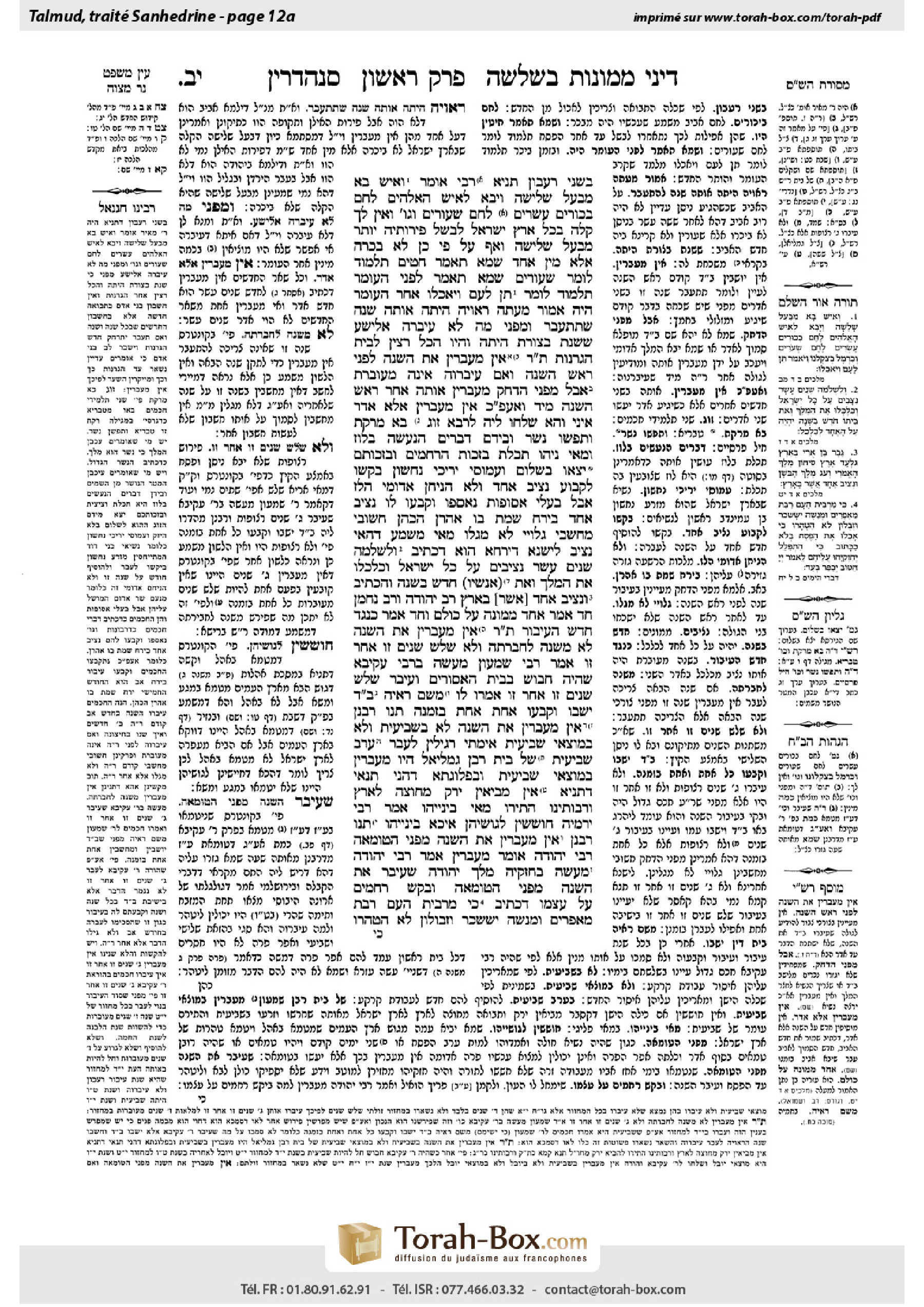
Sanhedrin 12a: Talmud study for Daf Yomi
Daf Yomi is the daily study of one Talmud folio. Explore 37 tractates with scans, Hebrew text, Sefaria English and AI-generated French translations where annotated.
Passage selection and English or AI-generated French translation are available where the scan has annotations. Daf Study is independent of Torah-Box and Sefaria.
Browse Sanhedrin · סנהדרין · All tractatesSanhedrin 12a text and translations
This page of Sanhedrin includes the Aramaic text, an English translation and an AI-generated French translation, alongside the scan above.
סנהדרין י״ב א · Aramaic and Hebrew text
בִּשְׁנֵי רְעָבוֹן.
תַּנְיָא, רַבִּי אוֹמֵר: ״וְאִישׁ בָּא מִבַּעַל שָׁלִישָׁה וַיָּבֵא לְאִישׁ הָאֱלֹהִים לֶחֶם בִּכּוּרִים עֶשְׂרִים לֶחֶם שְׂעֹרִים וְגוֹ׳״.
וְאֵין לְךָ קַלָּה בְּכׇל אֶרֶץ יִשְׂרָאֵל לְבַשֵּׁל פֵּירוֹתֶיהָ יוֹתֵר מִבַּעַל שָׁלִישָׁה, וְאַף עַל פִּי כֵן לֹא בִּכְּרָה אֶלָּא מִין אֶחָד. שֶׁמָּא תֹּאמַר: חִטִּים? תַּלְמוּד לוֹמַר: ״שְׂעוֹרִים״. שֶׁמָּא תֹּאמַר: לִפְנֵי הָעוֹמֶר? תַּלְמוּד לוֹמַר: ״תֵּן לָעָם וְיֹאכֵלוּ״. אַחַר הָעוֹמֶר הָיָה.
אֱמוֹר מֵעַתָּה: רְאוּיָה הָיְתָה אוֹתָהּ שָׁנָה שֶׁתִּתְעַבֵּר, וּמִפְּנֵי מָה לֹא עִיבְּרָהּ אֱלִישָׁע? שֶׁשְּׁנַת בַּצּוֹרֶת הָיְתָה, וְהָיוּ הַכֹּל רָצִין לְבֵית הַגֳּרָנוֹת.
תָּנוּ רַבָּנַן: אֵין מְעַבְּרִין אֶת הַשָּׁנָה לִפְנֵי רֹאשׁ הַשָּׁנָה, וְאִם עִיבְּרוּהָ – אֵינָהּ מְעוּבֶּרֶת. אֲבָל מִפְּנֵי הַדְּחָק מְעַבְּרִין אוֹתָהּ אַחַר רֹאשׁ הַשָּׁנָה מִיָּד, וְאַף עַל פִּי כֵּן אֵין מְעַבְּרִין אֶלָּא אֲדָר.
אִינִי? וְהָא שְׁלַחוּ לֵיהּ לְרָבָא: זוּג בָּא מֵרַקַּת, וּתְפָשׂוֹ נֶשֶׁר, וּבְיָדוֹ דְּבָרִים הַנַּעֲשִׂים בְּלוּז. וּמַאי נִיהוּ? תְּכֵלֶת. בִּזְכוּת הָרַחֲמִים וּבִזְכוּתָם יָצְאוּ בְּשָׁלוֹם.
וַעֲמוּסֵי יְרֵיכֵי נַחְשׁוֹן בִּקְּשׁוּ לִקְבּוֹעַ נְצִיב אֶחָד, וְלֹא הִנִּיחָן אֲדוֹמִי הַלָּז. אֲבָל בַּעֲלֵי אֲסוּפּוֹת נֶאֶסְפוּ וְקָבְעוּ לוֹ נְצִיב אֶחָד בְּיֶרַח שֶׁמֵּת בּוֹ אַהֲרֹן הַכֹּהֵן. חַשּׁוֹבֵי – מְחַשְּׁבִי, גַּלּוֹיֵי – לָא מְגַלּוּ.
מַאי מַשְׁמַע דְּהַאי ״נְצִיב״ לִישָּׁנָא דְּיַרְחָא הוּא? דִּכְתִיב: ״וְלִשְׁלֹמֹה שְׁנֵים עָשָׂר נִצָּבִים עַל כׇּל יִשְׂרָאֵל וְכִלְכְּלוּ אֶת הַמֶּלֶךְ וְאֶת אֲנָשָׁיו חֹדֶשׁ בַּשָּׁנָה״. וְהָכְתִיב: ״וּנְצִיב אֶחָד [אֲשֶׁר] בָּאָרֶץ״? רַב יְהוּדָה וְרַב נַחְמָן, חַד אָמַר: אֶחָד מְמוּנֶּה עַל כּוּלָּם, וְחַד אָמַר: כְּנֶגֶד חֹדֶשׁ הָעִיבּוּר.
תָּנוּ רַבָּנַן: אֵין מְעַבְּרִין אֶת הַשָּׁנָה לֹא מִשָּׁנָה לַחֲבֶרְתָּהּ, וְלֹא שָׁלֹשׁ שָׁנִים זוֹ אַחַר זוֹ. אָמַר רַבִּי שִׁמְעוֹן: מַעֲשֶׂה בְּרַבִּי עֲקִיבָא שֶׁהָיָה חָבוּשׁ בְּבֵית הָאֲסוּרִים, וְעִיבֵּר שָׁלֹשׁ שָׁנִים זוֹ אַחַר זוֹ. אָמְרוּ לוֹ: מִשָּׁם רְאָיָה? בֵּית דִּין יָשְׁבוּ וְקָבְעוּ אַחַת אַחַת בִּזְמַנָּהּ.
תָּנוּ רַבָּנַן: אֵין מְעַבְּרִין אֶת הַשָּׁנָה לֹא בִּשְׁבִיעִית וְלֹא בְּמוֹצָאֵי שְׁבִיעִית. אֵימָתַי רְגִילִין לְעַבֵּר? עֶרֶב שְׁבִיעִית. שֶׁל בֵּית רַבָּן גַּמְלִיאֵל הָיוּ מְעַבְּרִין בְּמוֹצָאֵי שְׁבִיעִית.
וּבִפְלוּגְתָּא דְּהָנֵי תַּנָּאֵי, דְּתַנְיָא: אֵין מְבִיאִין יָרָק מֵחוּצָה לָאָרֶץ, וְרַבּוֹתֵינוּ הִתִּירוּ. מַאי בֵּינַיְיהוּ? אָמַר רַבִּי יִרְמְיָה: חוֹשְׁשִׁין לְגוּשֵׁיהֶן אִיכָּא בֵּינַיְיהוּ.
תָּנוּ רַבָּנַן: אֵין מְעַבְּרִין אֶת הַשָּׁנָה מִפְּנֵי הַטּוּמְאָה.
רַבִּי יְהוּדָה אוֹמֵר: מְעַבְּרִין. אָמַר רַבִּי יְהוּדָה: מַעֲשֶׂה בְּחִזְקִיָּה מֶלֶךְ יְהוּדָה שֶׁעִיבֵּר אֶת הַשָּׁנָה מִפְּנֵי הַטּוּמְאָה, וּבִקֵּשׁ רַחֲמִים עַל עַצְמוֹ, דִּכְתִיב: ״כִּי מַרְבִּית הָעָם רַבַּת מֵאֶפְרַיִם וּמְנַשֶּׁה יִשָּׂשכָר וּזְבֻלוּן לֹא הִטֶּהָרוּ
Sanhedrin 12a · English translation
during years of famine. When grain is scarce, intercalating the year would exacerbate the food shortage by delaying the omer offering, which is brought in Nisan, thereby prolonging the period during which the new crop is forbidden.
It is taught in a baraita: Rabbi Yehuda HaNasi says that this principle can be demonstrated based on an incident related in the Bible. The verse states with regard to the prophet Elisha: “And there came a man from Ba’al Shalisha, and he brought to the man of God bread of the first fruits, twenty loaves of barley, and fresh ears of corn in his sack. And he said: Give to the people, that they may eat” (II Kings 4:42).
The incident is analyzed: You do not have in all of Eretz Yisrael an environment in which fruit ripens more swiftly than in Ba’al Shalisha, and even so, only one of the seven species had ripened at that time, as the verse testifies that he brought him “bread of the first fruits.” Lest you say the verse speaks of wheat, which ripens close to the time of the festival of Shavuot, the verse states “barley.” Lest you say that the incident took place before the omer offering was sacrificed, the verse states: “Give to the people, that they may eat.” As they were permitted to eat, it must be that the incident was after the omer offering was brought.
Based on this, say that even in the place in which fruit ripened the fastest in all of Eretz Yisrael, after the omer had been brought, only the barley had ripened. Evidently, the year was fit to be intercalated, because the spring produce was not sufficiently mature in time. And for what reason did the prophet Elisha not intercalate it? Because it was a year of scarcity, as described in the Bible (see II Kings 4:38), and everyone was running to the granary. Intercalating the year would have made it even more difficult to obtain produce.
§ The Sages taught in a baraita (Tosefta 2:3): The court may not intercalate the year before Rosh HaShana. And if the court intercalated it this early, it is not intercalated. But if there was a need to intercalate it early due to exigent circumstances, e.g., religious persecution, they may intercalate it immediately after Rosh HaShana. Even so, they may intercalate it only by adding a second month of Adar.
The Gemara asks: Is that so, that intercalation may be determined only after Rosh HaShana? But the Sages of Eretz Yisrael sent the following encoded message to Rava during the time of Roman persecution: A pair of Torah scholars came from Rakkath, the biblical name for Tiberias (see Joshua 19:35), which was the seat of the Sanhedrin in Rava’s time. They meant to reach the Diaspora community, but the pair was apprehended by the eagle, i.e., Roman soldiers, whose symbol was the eagle; and in their possession were precious items made in Luz. The Gemara interrupts the story to explain: And what are those items from Luz? Sky-blue dye, which is necessary for ritual fringes. The message continued: In the merit of divine mercy and in their merit, they were spared execution and emerged in peace. Nevertheless, they did not reach their destination.
The message continued: And the offspring of Nahshon, meaning the Sages of the court of the Nasi, who was descended from the prince of Judah, Nahshon ben Amminadab (see Numbers 7:12), sought to establish a pillar, i.e., they sought to add a month to the year. But that Edomite, the local Roman governor, did not allow them to intercalate the year. Nevertheless, the members of the assembly gathered, and they established a pillar, in the month in which Aaron the priest died, i.e., the Sages of Eretz Yisrael convened in the month of Av, which is before Rosh HaShana, and determined that the following year should be intercalated. Evidently, then, in exigent circumstances, intercalation may be done even before Rosh HaShana. The Gemara answers: The court may calculate the need for an extra month even before Rosh HaShana, but they may not reveal and publicize the decision until after Rosh HaShana.
The Gemara asks about the language of the coded message. From where may it be inferred that this word pillar [netziv] is a term for the month? As it is written: “And Solomon had twelve officers [netzivim] over all Israel, and they provided for the king and his household for a month in the year” (I Kings 4:7). This indicates that each netziv was responsible for a particular month. Once this verse was quoted, the Gemara inquires: But isn’t it written afterward: “And one officer that was in the land” (I Kings 4:19), indicating that there were more than twelve netzivim? Rav Yehuda and Rav Naḥman offer answers. One says: One officer was appointed over all of the others. And one says: The extra officer corresponded to the intercalated month. If the year had an additional month, he was responsible for the king’s provisions during that month.
§ The Sages taught in a baraita (Tosefta 2:4): The court may not intercalate the year from one year to another, and it does not intercalate three successive years, one directly after the other. Rabbi Shimon says: There was an incident involving Rabbi Akiva at the time when he was incarcerated in prison, and he intercalated three years, one after the other. The Sages said to Rabbi Shimon: Is there any proof from there? Rabbi Akiva merely made the calculations, but a special court sat and established each one at its time.
The Sages taught in a baraita (Tosefta 2:5): The court may not intercalate the year in the Sabbatical Year, so as not to prolong the prohibitions of the Sabbatical Year, nor in the year after the Sabbatical Year, when there is not much produce available, and delaying the consumption of the new crop would also cause hardship. When is the court accustomed to intercalate? On the eve of the Sabbatical Year, which causes no particular challenges. Nevertheless, the courts of the house of Rabban Gamliel would intercalate the year in the year after the Sabbatical Year.
And they disagree with regard to the issue that is the subject of the dispute between these tanna’im, as it is taught in a baraita: One may not import vegetables in the Sabbatical Year from outside Eretz Yisrael, and our Rabbis permitted importing such produce. According to the opinion that permits importing produce from outside Eretz Yisrael, there is no concern that the food supply will be exhausted. Therefore, the year following the Sabbatical Year may be intercalated. The Gemara asks: What is the reason for the difference between these two opinions concerning importing produce from outside Eretz Yisrael? Rabbi Yirmeya says: The difference between them relates to whether one is concerned for their clods of earth. Although all agree that the earth outside Eretz Yisrael conveys ritual impurity, the tanna’im dispute whether it is therefore forbidden to bring vegetables into Eretz Yisrael due to concern that small clods of earth may cling to them.
§ The Sages taught in a baraita (Tosefta 2:10): The court may not intercalate the year due to ritual impurity, i.e., in the event that most of the Jewish people are in a state of impurity, to give them enough time to become ritually pure before Passover.
Rabbi Yehuda says: The court may intercalate the year due to ritual impurity. Rabbi Yehuda said: There was an incident involving Hezekiah, king of Judea, who intercalated the year due to ritual impurity (II Chronicles 30:2). And after doing so, he requested compassion for himself, as it is written: “For a multitude of the people, even many of Ephraim and Manasseh, Issachar and Zebulun, had not cleansed themselves,
Sanhedrin 12a · Traduction française (IA)
pendant les années de famine. Lorsque les céréales sont rares, intercaler l’année aggraverait la pénurie alimentaire en retardant l’offrande du omer, apportée au mois de nissan, et prolongerait ainsi la période durant laquelle la nouvelle récolte est interdite.
Il est enseigné dans une baraïta : Rabbi Yehouda HaNassi dit que ce principe peut être démontré à partir d’un épisode rapporté dans la Bible. À propos du prophète Élisée, le verset déclare : « Un homme vint de Baal-Chalicha et apporta à l’homme de Dieu du pain des prémices, vingt pains d’orge et des épis frais dans son sac. Il dit : “Donne-les au peuple, qu’ils mangent” » (II Rois 4:42).
L’épisode est analysé : nulle part en Eretz Israël les fruits ne mûrissent plus rapidement qu’à Baal-Chalicha ; pourtant, à cette époque, une seule des sept espèces avait mûri, comme l’atteste le verset en précisant qu’il lui apporta « du pain des prémices ». Si tu prétends que le verset parle de blé, qui mûrit à l’approche de la fête de Chavouot, le verset précise : « de l’orge ». Si tu prétends que l’épisode eut lieu avant que l’offrande du omer ne soit offerte, le verset précise : « Donne-les au peuple, qu’ils mangent. » Puisqu’ils avaient le droit d’en manger, l’épisode a nécessairement eu lieu après que l’offrande du omer eut été apportée.
Sur cette base, dis que même à l’endroit où les fruits mûrissaient le plus rapidement de tout Eretz Israël, seule l’orge avait mûri après que le omer eut été apporté. De toute évidence, l’année se prêtait à être intercalée, car les produits du printemps n’étaient pas suffisamment mûrs à temps. Pour quelle raison le prophète Élisée ne l’a-t-il pas intercalée ? Parce que c’était une année de pénurie, comme le décrit la Bible (voir II Rois 4:38), et que tout le monde se précipitait au grenier. Intercaler l’année aurait rendu les produits encore plus difficiles à obtenir.
§ Les Sages enseignent dans une baraïta (Tossefta 2:3) : Le tribunal ne peut pas intercaler l’année avant Roch Hachana. S’il l’intercale aussi tôt, l’intercalation n’est pas valable. Toutefois, s’il est nécessaire de l’intercaler tôt en raison de circonstances exceptionnelles, par exemple des persécutions religieuses, il peut le faire immédiatement après Roch Hachana. Même dans ce cas, il ne peut intercaler l’année qu’en ajoutant un second mois d’adar.
La Guemara demande : Est-il donc vrai que l’intercalation ne peut être décidée qu’après Roch Hachana ? Pourtant, les Sages d’Eretz Israël envoyèrent à Rava, à l’époque des persécutions romaines, le message codé suivant : « Deux érudits de la Torah vinrent de Rakkath, le nom biblique de Tibériade (voir Josué 19:35), où siégeait le Sanhédrin à l’époque de Rava. Ils voulaient rejoindre la communauté de la Diaspora, mais le couple fut arrêté par l’aigle, c’est-à-dire les soldats romains, dont l’aigle était l’emblème ; ils avaient en leur possession des objets précieux fabriqués à Luz. » La Guemara interrompt le récit pour expliquer : « Et quels étaient ces objets de Luz ? De la teinture bleu ciel, nécessaire aux franges rituelles. » Le message poursuivait : « Grâce à la miséricorde divine et à leur mérite, ils échappèrent à l’exécution et repartirent sains et saufs. Néanmoins, ils n’atteignirent pas leur destination. »
Le message poursuivait : « Les descendants de Nahshon », c’est-à-dire les Sages du tribunal du Nassi, lui-même descendant du prince de Juda, Nahshon ben Amminadab (voir Nombres 7:12), « cherchèrent à ériger un pilier », c’est-à-dire qu’ils voulurent ajouter un mois à l’année. Mais cet Édomite, le gouverneur romain local, ne les autorisa pas à intercaler l’année. Néanmoins, les membres de l’assemblée se réunirent et érigèrent un pilier au mois où Aaron le prêtre mourut : les Sages d’Eretz Israël se réunirent au mois d’av, avant Roch Hachana, et décidèrent que l’année suivante serait intercalée. Il apparaît donc qu’en cas de circonstances exceptionnelles, l’intercalation peut avoir lieu avant Roch Hachana. La Guemara répond : Le tribunal peut calculer la nécessité d’ajouter un mois avant Roch Hachana, mais il ne peut révéler ni rendre publique sa décision avant Roch Hachana.
La Guemara s’interroge sur les termes du message codé. D’où peut-on déduire que le mot « pilier » [netziv] désigne le mois ? Car il est écrit : « Salomon avait douze intendants [netzivim] sur tout Israël, et ils pourvoyaient aux besoins du roi et de sa maison, chacun pendant un mois de l’année » (I Rois 4:7). Cela indique que chaque netziv était chargé d’un mois particulier. Après avoir cité ce verset, la Guemara demande : Pourtant, il est écrit ensuite : « Et un intendant qui était dans le pays » (I Rois 4:19), ce qui indique qu’il y avait plus de douze netzivim. Rav Yehouda et Rav Nahman proposent des réponses. Selon l’un, un intendant était placé au-dessus de tous les autres. Selon l’autre, l’intendant supplémentaire correspondait au mois intercalaire. Si l’année comptait un mois supplémentaire, il était chargé de pourvoir aux besoins du roi pendant ce mois.
§ Les Sages enseignent dans une baraïta (Tossefta 2:4) : Le tribunal ne peut pas intercaler l’année d’une année à l’autre, et il n’intercale pas trois années consécutives, l’une immédiatement après l’autre. Rabbi Shimon dit : Un épisode eut lieu avec Rabbi Akiva, alors qu’il était emprisonné, et il intercala trois années de suite. Les Sages dirent à Rabbi Shimon : Cet épisode constitue-t-il une preuve ? Rabbi Akiva s’est contenté de faire les calculs, mais un tribunal spécial siégea et fixa chacune de ces intercalations en son temps.
Les Sages enseignent dans une baraïta (Tossefta 2:5) : Le tribunal ne peut pas intercaler l’année pendant l’année sabbatique, afin de ne pas prolonger les interdictions de l’année sabbatique, ni l’année qui la suit, où les produits disponibles sont peu abondants et où retarder la consommation de la nouvelle récolte entraînerait également des difficultés. À quel moment le tribunal a-t-il coutume d’intercaler l’année ? À la veille de l’année sabbatique, ce qui ne pose pas de difficulté particulière. Néanmoins, les tribunaux de la maison de Rabban Gamliel intercalaient l’année qui suivait l’année sabbatique.
Ils sont en désaccord sur la question qui fait l’objet de la controverse entre ces tannaïm, comme il est enseigné dans une baraïta : On ne peut pas importer de légumes de l’extérieur d’Eretz Israël pendant l’année sabbatique, mais nos Rabbins ont permis d’importer de tels produits. Selon l’opinion qui autorise l’importation de produits de l’extérieur d’Eretz Israël, il n’y a pas lieu de craindre que les réserves alimentaires s’épuisent. L’année qui suit l’année sabbatique peut donc être intercalée. La Guemara demande : Quelle est la raison de la différence entre ces deux opinions concernant l’importation de produits de l’extérieur d’Eretz Israël ? Rabbi Yirmeya dit : Leur désaccord porte sur la question de savoir s’il faut craindre la présence de mottes de terre. Bien que tous reconnaissent que la terre située hors d’Eretz Israël transmet l’impureté rituelle, les tannaïm divergent sur la question de savoir s’il est donc interdit d’introduire des légumes en Eretz Israël, par crainte que de petites mottes de terre y adhèrent.
§ Les Sages enseignent dans une baraïta (Tossefta 2:10) : Le tribunal ne peut pas intercaler l’année en raison de l’impureté rituelle, c’est-à-dire si la majorité du peuple juif se trouve dans un état d’impureté, afin de lui laisser suffisamment de temps pour retrouver la pureté rituelle avant Pessa’h.
Rabbi Yehouda dit : Le tribunal peut intercaler l’année en raison de l’impureté rituelle. Rabbi Yehouda dit : Un épisode eut lieu avec Ézéchias, roi de Judée, qui intercala l’année en raison de l’impureté rituelle (II Chroniques 30:2). Après l’avoir fait, il implora la compassion pour lui-même, comme il est écrit : « Car une grande partie du peuple, notamment beaucoup d’hommes d’Éphraïm et de Manassé, d’Issachar et de Zabulon, ne s’étaient pas purifiés eux-mêmes,
Traduction française générée par IA à partir de l’édition anglaise de Sefaria. Vérifie toujours un passage avec le texte source.
Text from Sefaria: William Davidson Edition - Vocalized Aramaic (CC BY NC); William Davidson Edition - English (CC BY NC).