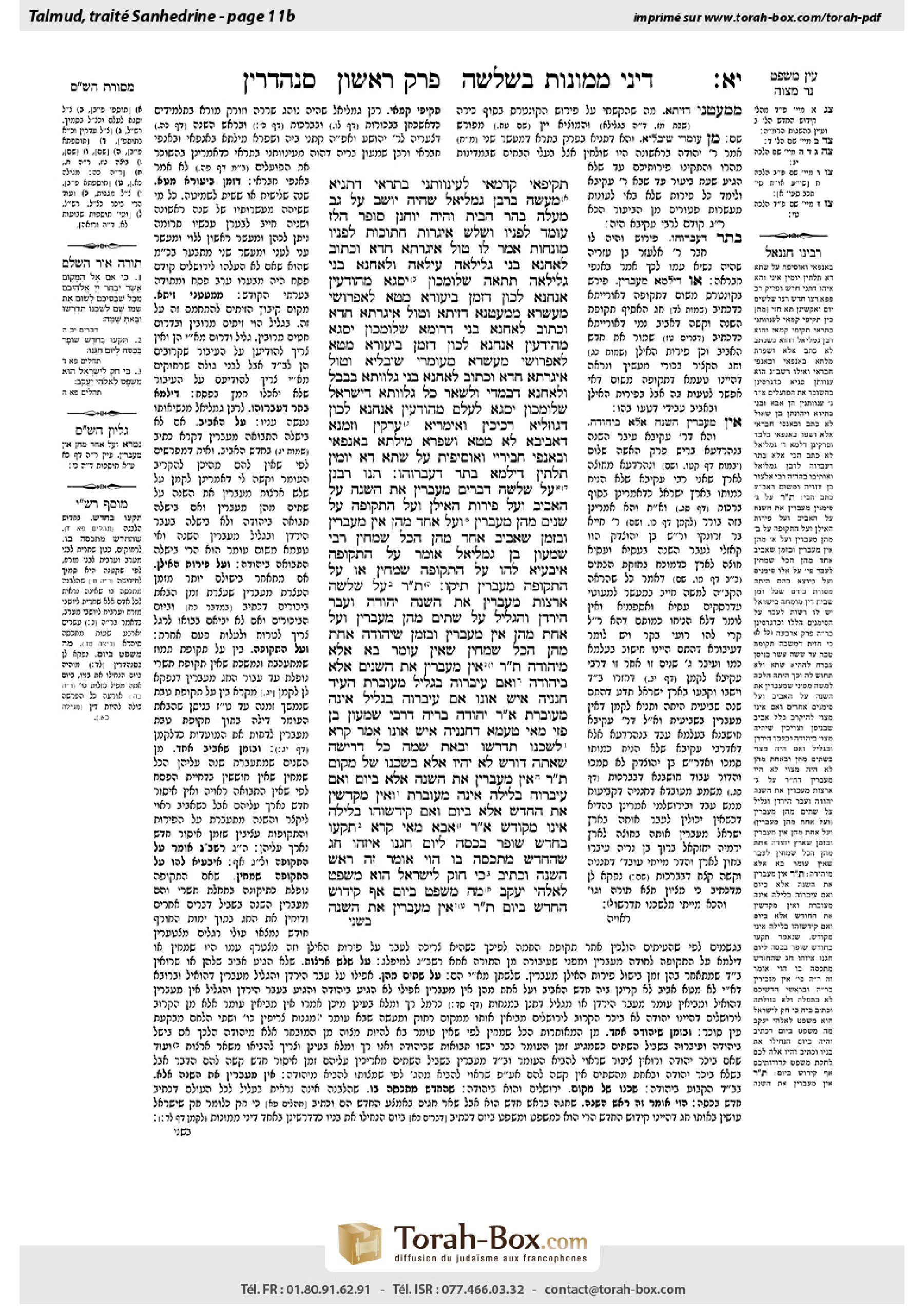
Sanhedrin 11b: Talmud study for Daf Yomi
Daf Yomi is the daily study of one Talmud folio. Explore 37 tractates with scans, Hebrew text, Sefaria English and AI-generated French translations where annotated.
Passage selection and English or AI-generated French translation are available where the scan has annotations. Daf Study is independent of Torah-Box and Sefaria.
Browse Sanhedrin · סנהדרין · All tractatesSanhedrin 11b text and translations
This page of Sanhedrin includes the Aramaic text, an English translation and an AI-generated French translation, alongside the scan above.
סנהדרין י״א ב · Aramaic and Hebrew text
תַּקִּיפֵאי קַדְמָאֵי, לְעִינְוְותָנֵי בָּתְרָאֵי.
דְּתַנְיָא: מַעֲשֶׂה בְּרַבָּן גַּמְלִיאֵל שֶׁהָיָה יוֹשֵׁב עַל גַּב מַעֲלָה בְּהַר הַבַּיִת, וְהָיָה יוֹחָנָן סוֹפֵר הַלָּז עוֹמֵד לְפָנָיו, וְשָׁלֹשׁ אִיגְּרוֹת חֲתוּכוֹת לְפָנָיו מוּנָּחוֹת.
אָמַר לוֹ: טוֹל אִיגַּרְתָּא חֲדָא וּכְתוֹב: לַאֲחַנָא בְּנֵי גָּלִילָאה עִילָּאָה וְלַאֲחַנָא בְּנֵי גָּלִילָאה תַּתָּאָה, שְׁלוֹמְכוֹן יִסְגֵּא. מְהוֹדְעִין אֲנַחְנָא לְכוֹן דִּזְמַן בִּיעוּרָא מְטָא לְאַפְרוֹשֵׁי מַעְשְׂרָא מִמַּעְטָנָא דְזֵיתָא. וְטוֹל אִיגַּרְתָּא חֲדָא וּכְתוֹב: לַאֲחַנָא בְּנֵי דָרוֹמָא, שְׁלוֹמְכוֹן יִסְגֵּא. מְהוֹדְעִין אֲנַחְנָא לְכוֹן דִּזְמַן בִּיעוּרָא מְטָא לְאַפְרוֹשֵׁי מַעְשְׂרָא מֵעוּמְרֵי שׁוּבְלַיָּא.
וְטוֹל אִיגַּרְתָּא חֲדָא וּכְתוֹב: לַאֲחַנָא בְּנֵי גָּלְוָותָא בְּבָבֶל, וְלַאֲחַנָא דִּבְמָדַי, וְלִשְׁאָר כֹּל גָּלְווֹתָא דְּיִשְׂרָאֵל, שְׁלוֹמְכוֹן יִסְגֵּא לְעָלַם. מְהוֹדְעִין אֲנַחְנָא לְכוֹן דְּגוֹזָלַיָּא רַכִּיכִין, וְאִימְּרַיָּא דַּעְדְּקִין, וְזִמְנָא דַאֲבִיבָא לָא מְטָא, וּשְׁפַרָא מִילְּתָא בְּאַנְפַּאי וּבְאַנְפֵּי חֲבֵירַיי, וְאוֹסֵיפִית עַל שַׁתָּא דָּא יוֹמִין תְּלָתִין. דִּילְמָא בָּתַר דְּעַבְּרוּהּוֹ.
תָּנוּ רַבָּנַן: עַל שְׁלֹשָׁה דְּבָרִים מְעַבְּרִין אֶת הַשָּׁנָה – עַל הָאָבִיב, וְעַל פֵּירוֹת הָאִילָן, וְעַל הַתְּקוּפָה. עַל שְׁנַיִם מֵהֶן מְעַבְּרִין, וְעַל אֶחָד מֵהֶן אֵין מְעַבְּרִין.
וּבִזְמַן שֶׁאָבִיב אֶחָד מֵהֶן – הַכֹּל שְׂמֵחִין. רַבָּן שִׁמְעוֹן בֶּן גַּמְלִיאֵל אוֹמֵר: עַל הַתְּקוּפָה. אִיבַּעְיָא לְהוּ: עַל הַתְּקוּפָה שְׂמֵחִין, אוֹ עַל הַתְּקוּפָה מְעַבְּרִין? תֵּיקוּ.
תָּנוּ רַבָּנַן: עַל שְׁלֹשָׁה אֲרָצוֹת מְעַבְּרִין אֶת הַשָּׁנָה – יְהוּדָה, וְעֵבֶר הַיַּרְדֵּן, וְהַגָּלִיל. עַל שְׁתַּיִם מֵהֶן מְעַבְּרִין, וְעַל אַחַת מֵהֶן אֵין מְעַבְּרִין. וּבִזְמַן שֶׁיְּהוּדָה אַחַת מֵהֶן – הַכֹּל שְׂמֵחִין, שֶׁאֵין עוֹמֶר בָּא אֶלָּא מִיהוּדָה.
תָּנוּ רַבָּנַן: אֵין מְעַבְּרִין אֶת הַשָּׁנִים אֶלָּא בִּיהוּדָה, וְאִם עִיבְּרוּהָ בַּגָּלִיל – מְעוּבֶּרֶת. הֵעִיד חֲנַנְיָה אִישׁ אוֹנוֹ: אִם עִיבְּרוּהָ בַּגָּלִיל – אֵינָהּ מְעוּבֶּרֶת. אָמַר רַבִּי יְהוּדָה בְּרֵיהּ דְּרַבִּי שִׁמְעוֹן בֶּן פַּזִּי: מַאי טַעְמָא דַּחֲנַנְיָה אִישׁ אוֹנוֹ? אָמַר קְרָא: ״לְשִׁכְנוֹ תִדְרְשׁוּ וּבָאתָ שָּׁמָּה״, כׇּל דְּרִישׁוֹת שֶׁאַתָּה דּוֹרֵשׁ לֹא יִהְיוּ אֶלָּא בְּשִׁכְנוֹ שֶׁל מָקוֹם.
תָּנוּ רַבָּנַן: אֵין מְעַבְּרִין אֶת הַשָּׁנָה אֶלָּא בְּיוֹם, וְאִם עִיבְּרוּהָ בַּלַּיְלָה – אֵינָהּ מְעוּבֶּרֶת. וְאֵין מְקַדְּשִׁין אֶת הַחֹדֶשׁ אֶלָּא בַּיּוֹם, וְאִם קִידְּשׁוּהוּ בַּלַּיְלָה – אֵינוֹ מְקוּדָּשׁ. אָמַר רַב אַבָּא: מַאי קְרָא: ״תִּקְעוּ בַחֹדֶשׁ שׁוֹפָר בַּכֵּסֶה לְיוֹם חַגֵּנוּ״. אֵיזֶהוּ חַג שֶׁהַחֹדֶשׁ מִתְכַּסֶּה בּוֹ? הֱוֵי אוֹמֵר: זֶה רֹאשׁ הַשָּׁנָה. וּכְתִיב: ״כִּי חֹק לְיִשְׂרָאֵל הוּא מִשְׁפָּט לֵאלֹהֵי יַעֲקֹב״. מָה מִשְׁפָּט בַּיּוֹם – אַף קִידּוּשׁ הַחֹדֶשׁ בְּיוֹם.
תָּנוּ רַבָּנַן: אֵין מְעַבְּרִין אֶת הַשָּׁנָה
Sanhedrin 11b · English translation
the earlier, stern authorities and the later, humble authorities, for although Rabban Shimon ben Gamliel was known as particularly humble, his proclamation was written with less modesty than that of his father, Rabban Gamliel, who was known to be particularly stern.
As it is taught in a baraita (Tosefta 2:6): There was an incident involving Rabban Gamliel, who was sitting on a step on the Temple Mount, and Yoḥanan, that scribe, was standing before him, and three blank documents cut from parchment and ready for writing were set before him.
Rabban Gamliel said to the scribe: Take one document, and write: To our brothers, the people of the Upper Galilee, and to our brothers, the people of the Lower Galilee, may your peace increase. We are informing you that the time has come for eradication of tithes that had been separated from produce but not yet given to their designated recipients, as is to be done in the fourth and seventh years of the Sabbatical-Year cycle, to separate the tithe from the vat of olives, because most of the local olives were grown in the Galilee. Rabban Gamliel continued, instructing the scribe: And take one document, and write: To our brothers, the people of the South, meaning the area of Judea and its environs, may your peace increase. We are informing you that the time has come for eradication, to separate the tithe from the mounds of stalks of grains, because most of the local grain was grown in the Judea region.
Rabban Gamliel continued to instruct the scribe: And take one document, and write: To our brothers, the people of the Diaspora in Babylonia, and to our brothers who are in Media, and to the rest of the entire Jewish Diaspora, may your peace increase forever. We are informing you that the fledglings are tender, and the lambs are thin, and time for the spring has not come. And consequently, the matter is good before me and before my colleagues, i.e., in our estimation, and I have consequently added thirty days to this year. The third letter indicates that evidently Rabban Gamliel included others in his decision. The Gemara rejects this, and explains: Perhaps this incident occurred after they deposed Rabban Gamliel from his position as Nasi. When he was reinstated, he shared his office with Rabbi Elazar ben Azarya. Therefore, he wrote the decision in the name of his colleagues as well.
§ The Sages taught in a baraita (Tosefta 2:2): The court may intercalate the year for three matters: For the ripening of the grain, if it is not yet time for the barley to ripen; for the fruit of the trees, if they have not yet ripened; and for the equinox, i.e., to ensure that the autumnal equinox will precede Sukkot. If two of these concerns apply, the court intercalates the year even if the third factor does not apply; but for only one of them the court does not intercalate the year.
The baraita continues: And when the ripening of the grain is one of the concerns, everyone is happy. Since the grain is not yet ripe, the people do not mind waiting an extra month for Nisan. If the grain is already ripe, however, the extra month would simply prolong the period during which the grain may not be eaten due to the prohibition of the new crop, as the new crop may be harvested and eaten only after the sacrifice of the omer offering on the sixteenth of Nisan (see Leviticus 23:14). Rabban Shimon ben Gamliel says: For the equinox. The Gemara seeks to clarify this statement: A dilemma was raised before the Sages. When he said: For the equinox, did he mean this is the reason that everyone is happy, or did he mean that only for the equinox may the court intercalate the year? The dilemma shall stand unresolved.
The Sages taught in a baraita (Tosefta 2:2): The court may intercalate the year for three regional lands of Eretz Yisrael, meaning that the court considers the agricultural situation in three regions: Judea, and Transjordan, and the Galilee. If there is a concern about two of them, the court intercalates the year even if the third region does not need it, but if there is a concern about only one of them the court does not intercalate the year. And when Judea is one of them, everyone is happy, because the omer offering comes only from Judea. If the court therefore ensures that the crops in Judea ripen just before the omer is brought, the crops will certainly be ripe in the other regions as well, and there will be no complications with the prohibition of the new crop.
§ The Sages taught in a baraita (Tosefta 2:2): The court may intercalate the years only when located in Judea. And if they intercalated it when located in the Galilee, the year is nevertheless intercalated. Ḥananya of Ono testified: Even if the court already formally intercalated the year when located in the Galilee, it is not intercalated. Rabbi Yehuda, son of Rabbi Shimon ben Pazi, says: What is the reasoning of Ḥananya of Ono? The verse states: “But to the place that the Lord your God shall choose out of all your tribes to put His name there, to His abode shall you seek, and there you shall come” (Deuteronomy 12:5). This is interpreted as: Every pursuit that you shall pursue in the area of halakha must be only in the abode of the Omnipresent, in close proximity to Jerusalem, i.e., in Judea.
The Sages taught in a baraita (Tosefta 2:7): The court may intercalate the year only during the day; and if the court intercalated it at night, it is not intercalated. And the court may sanctify the month only during the day; and if the court sanctified it at night, it is not sanctified. Rav Abba says: What is the verse from which this halakha is derived? “Sound the shofar at the New Moon, at the concealed time for our Festival day” (Psalms 81:4). On which Festival is the new moon concealed? You must say it is Rosh HaShana, which occurs on the first of the month, before the moon is visible, whereas the moon is visible during the other Festivals, which occur later in the month. And it is written in the next verse: “For it is a statute for Israel, a judgment of the God of Jacob” (Psalms 81:5). Just as all civil judgment is done during the day, so too is the sanctification of Rosh HaShana, and the sanctification of the month in general, done during the day.
The Sages taught in a baraita (Tosefta 2:5): The court does not intercalate the year
Sanhedrin 11b · Traduction française (IA)
les autorités antérieures, sévères, et les autorités ultérieures, humbles. En effet, bien que Rabban Shimon ben Gamliel fût connu pour son humilité particulière, sa proclamation était rédigée avec moins de modestie que celle de son père, Rabban Gamliel, connu pour sa sévérité particulière.
Comme il est enseigné dans une baraïta (Tossefta 2:6) : Un jour, Rabban Gamliel était assis sur une marche du mont du Temple, et Yoḥanan, le scribe, se tenait devant lui ; trois documents vierges, découpés dans du parchemin et prêts à être écrits, étaient posés devant lui.
Rabban Gamliel dit au scribe : « Prends un document et écris : “À nos frères, les habitants de la Haute Galilée, et à nos frères, les habitants de la Basse Galilée, que votre paix s’accroisse. Nous vous informons que le moment est venu de procéder à l’élimination des dîmes qui ont été prélevées sur les produits, mais pas encore remises à leurs destinataires, comme il convient de le faire les quatrième et septième années du cycle sabbatique, et de prélever la dîme de la cuve d’olives, car la plupart des olives de la région étaient cultivées en Galilée.” » Rabban Gamliel poursuivit ses instructions au scribe : « Prends un document et écris : “À nos frères, les habitants du Sud, c’est-à-dire de la région de Judée et de ses environs, que votre paix s’accroisse. Nous vous informons que le moment est venu de procéder à l’élimination et de prélever la dîme des tas de tiges de céréales, car la plupart des céréales de la région étaient cultivées en Judée.” »
Rabban Gamliel poursuivit ses instructions au scribe : « Prends un document et écris : “À nos frères, les habitants de la diaspora en Babylonie, à nos frères qui se trouvent en Médie et au reste de toute la diaspora juive, que votre paix s’accroisse à jamais. Nous vous informons que les oisillons sont encore tendres, que les agneaux sont maigres et que le printemps n’est pas encore arrivé. Par conséquent, la décision me paraît bonne, ainsi qu’à mes collègues, c’est-à-dire que telle est notre estimation, et j’ai donc ajouté trente jours à cette année.” » Cette troisième lettre semble indiquer que Rabban Gamliel avait inclus d’autres personnes dans sa décision. La Guemara rejette cette interprétation et explique : Peut-être cet épisode eut-il lieu après que Rabban Gamliel eut été destitué de sa fonction de Nassi. Lorsqu’il fut rétabli, il partagea sa fonction avec Rabbi Elazar ben Azarya. Il rédigea donc la décision au nom de ses collègues également.
§ Les Sages enseignent dans une baraïta (Tossefta 2:2) : Le tribunal peut intercaler l’année pour trois raisons : la maturation des céréales, si l’orge n’est pas encore mûre ; les fruits des arbres, s’ils ne sont pas encore mûrs ; et l’équinoxe, c’est-à-dire afin de s’assurer que l’équinoxe d’automne précède Soukkot. Si deux de ces conditions sont réunies, le tribunal intercale l’année même si la troisième ne l’est pas ; mais si une seule de ces conditions est réunie, le tribunal n’intercale pas l’année.
La baraïta poursuit : Et lorsque la maturation des céréales est l’une des raisons, tout le monde est satisfait. Puisque les céréales ne sont pas encore mûres, les gens ne voient pas d’inconvénient à attendre un mois supplémentaire avant Nissan. En revanche, si les céréales sont déjà mûres, le mois supplémentaire ne ferait que prolonger la période durant laquelle il est interdit de manger de la nouvelle récolte, car celle-ci ne peut être moissonnée et consommée qu’après le sacrifice de l’offrande du omer, le 16 Nissan (voir Lévitique 23:14). Rabban Shimon ben Gamliel dit : « À cause de l’équinoxe. » La Guemara cherche à éclaircir cette déclaration : Les Sages ont soulevé un dilemme. Lorsqu’il a dit « à cause de l’équinoxe », voulait-il dire que c’est la raison pour laquelle tout le monde est satisfait, ou voulait-il dire que le tribunal ne peut intercaler l’année qu’à cause de l’équinoxe ? Le dilemme reste sans réponse.
Les Sages enseignent dans une baraïta (Tossefta 2:2) : Le tribunal peut intercaler l’année en fonction de trois régions du pays d’Israël, c’est-à-dire qu’il prend en considération la situation agricole de trois régions : la Judée, la Transjordanie et la Galilée. Si deux d’entre elles posent problème, le tribunal intercale l’année même si la troisième région n’en a pas besoin ; mais si une seule pose problème, le tribunal n’intercale pas l’année. Et lorsque la Judée est l’une de ces régions, tout le monde est satisfait, car l’offrande du omer ne provient que de Judée. Si le tribunal veille donc à ce que les récoltes de Judée mûrissent juste avant que le omer soit offert, elles seront certainement mûres aussi dans les autres régions, et il n’y aura aucune difficulté liée à l’interdiction de consommer la nouvelle récolte.
§ Les Sages enseignent dans une baraïta (Tossefta 2:2) : Le tribunal ne peut intercaler l’année que lorsqu’il siège en Judée. Toutefois, s’il l’intercale alors qu’il siège en Galilée, l’année est néanmoins intercalée. Ḥananya d’Ono a témoigné : Même si le tribunal a déjà officiellement intercalé l’année alors qu’il siégeait en Galilée, elle n’est pas intercalée. Rabbi Yehuda, fils de Rabbi Shimon ben Pazi, dit : Quel est le raisonnement de Ḥananya d’Ono ? Le verset dit : « Mais c’est vers le lieu que l’Éternel votre Dieu choisira parmi toutes vos tribus pour y établir Son nom, vers Sa demeure que vous devrez vous tourner, et c’est là que vous irez » (Deutéronome 12:5). On l’interprète ainsi : Toute démarche que vous entreprendrez dans le domaine de la halakha doit avoir lieu uniquement dans la demeure du Tout-Puissant, à proximité de Jérusalem, c’est-à-dire en Judée.
Les Sages enseignent dans une baraïta (Tossefta 2:7) : Le tribunal ne peut intercaler l’année que pendant la journée ; s’il l’intercale la nuit, elle n’est pas intercalée. De même, le tribunal ne peut sanctifier le mois que pendant la journée ; s’il le sanctifie la nuit, le mois n’est pas sanctifié. Rav Abba dit : De quel verset cette halakha est-elle déduite ? « Sonnez du chofar à la nouvelle lune, au moment caché de notre jour de fête » (Psaumes 81:4). De quelle fête la nouvelle lune est-elle cachée ? Il faut répondre qu’il s’agit de Roch Hachana, qui tombe le premier du mois, alors que la lune n’est pas encore visible, tandis qu’elle est visible lors des autres fêtes, qui tombent plus tard dans le mois. Et le verset suivant dit : « Car c’est une loi pour Israël, un jugement du Dieu de Jacob » (Psaumes 81:5). De même que tout jugement civil se tient pendant la journée, la sanctification de Roch Hachana, et celle du mois en général, se fait elle aussi pendant la journée.
Les Sages enseignent dans une baraïta (Tossefta 2:5) : Le tribunal n’intercale pas l’année
Traduction française générée par IA à partir de l’édition anglaise de Sefaria. Vérifie toujours un passage avec le texte source.
Text from Sefaria: William Davidson Edition - Vocalized Aramaic (CC BY NC); William Davidson Edition - English (CC BY NC).