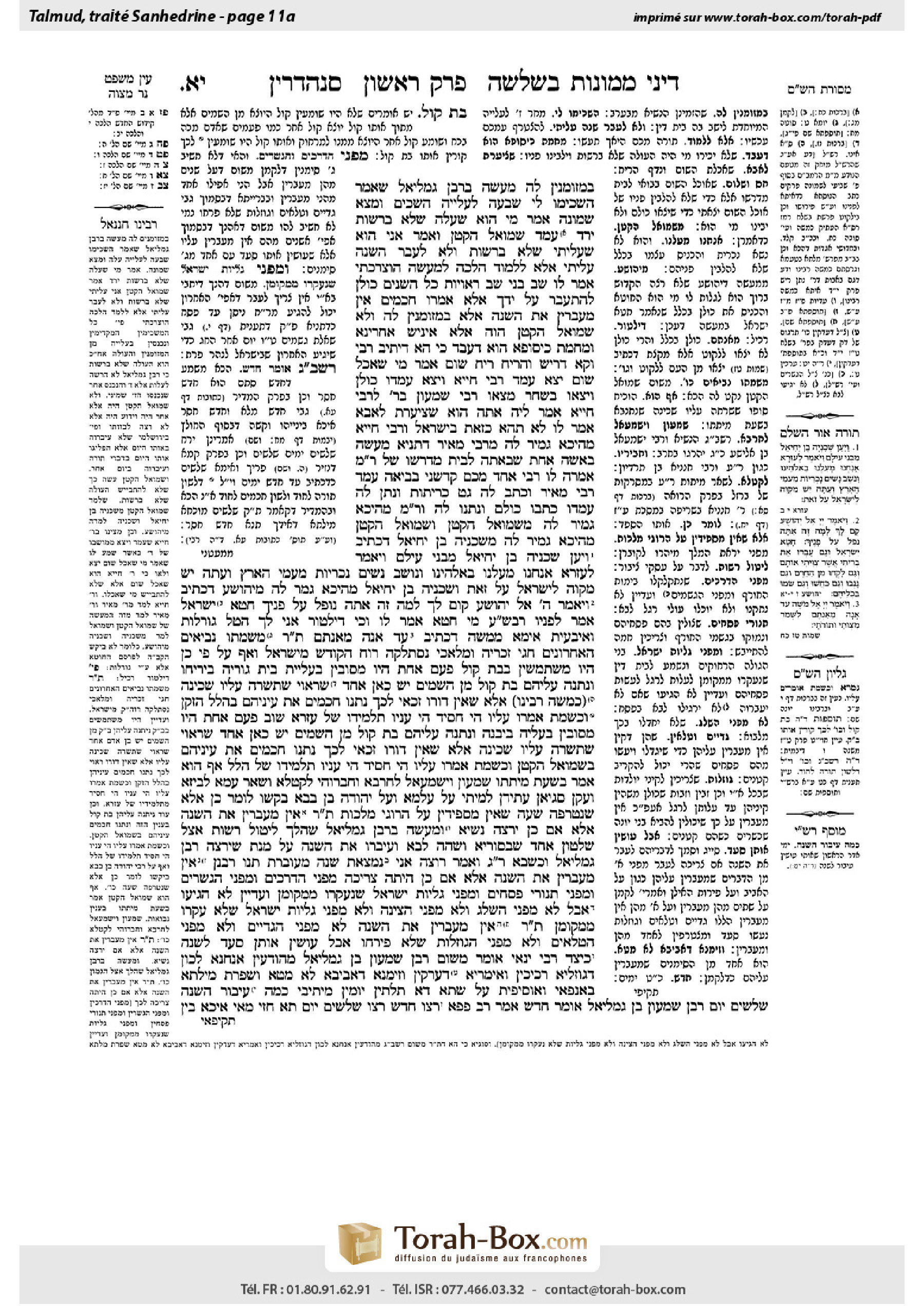
Sanhedrin 11a: Talmud study for Daf Yomi
Daf Yomi is the daily study of one Talmud folio. Explore 37 tractates with scans, Hebrew text, Sefaria English and AI-generated French translations where annotated.
Passage selection and English or AI-generated French translation are available where the scan has annotations. Daf Study is independent of Torah-Box and Sefaria.
Browse Sanhedrin · סנהדרין · All tractatesSanhedrin 11a text and translations
This page of Sanhedrin includes the Aramaic text, an English translation and an AI-generated French translation, alongside the scan above.
סנהדרין י״א א · Aramaic and Hebrew text
בִּמְזוּמָּנִין לָהּ. מַעֲשֵׂה בְּרַבָּן גַּמְלִיאֵל שֶׁאָמַר: הַשְׁכִּימוּ לִי שִׁבְעָה לַעֲלִיָּיה. הִשְׁכִּים וּמָצָא שְׁמוֹנָה. אָמַר: מִי הוּא שֶׁעָלָה שֶׁלֹּא בִּרְשׁוּת? יֵרֵד!
עָמַד שְׁמוּאֵל הַקָּטָן וְאָמַר: אֲנִי הוּא שֶׁעָלִיתִי שֶׁלֹּא בִּרְשׁוּת, וְלֹא לְעַבֵּר הַשָּׁנָה עָלִיתִי אֶלָּא לִלְמוֹד הֲלָכָה לְמַעֲשֶׂה הוּצְרַכְתִּי. אָמַר לוֹ: שֵׁב בְּנִי, שֵׁב. רְאוּיוֹת כׇּל הַשָּׁנִים כּוּלָּן לְהִתְעַבֵּר עַל יָדֶךָ, אֶלָּא אָמְרוּ חֲכָמִים: אֵין מְעַבְּרִין אֶת הַשָּׁנָה אֶלָּא בַּמְזוּמָּנִין לָהּ. וְלָא שְׁמוּאֵל הַקָּטָן הֲוָה, אֶלָּא אִינִישׁ אַחֲרִינָא, וּמֵחֲמַת כִּיסּוּפָא הוּא דַּעֲבַד.
כִּי הָא דְּיָתֵיב רַבִּי וְקָא דָרֵישׁ, וְהֵרִיחַ רֵיחַ שׁוּם. אָמַר: מִי שֶׁאָכַל שׁוּם יֵצֵא. עָמַד רַבִּי חִיָּיא וְיָצָא. עָמְדוּ כּוּלָּן וְיָצְאוּ. בַּשַּׁחַר מְצָאוֹ רַבִּי שִׁמְעוֹן בְּרַבִּי לְרַבִּי חִיָּיא. אֲמַר לֵיהּ: אַתָּה הוּא שֶׁצִּיעַרְתָּ לְאַבָּא? אָמַר לוֹ: לֹא תְּהֵא כְּזֹאת בְּיִשְׂרָאֵל!
וְרַבִּי חִיָּיא מֵהֵיכָא גְּמִיר לַהּ? מֵרַבִּי מֵאִיר, דְּתַנְיָא: מַעֲשֶׂה בְּאִשָּׁה אַחַת שֶׁבָּאתָה לְבֵית מִדְרָשׁוֹ שֶׁל רַבִּי מֵאִיר. אָמְרָה לוֹ: רַבִּי, אֶחָד מִכֶּם קִדְּשַׁנִי בְּבִיאָה. עָמַד רַבִּי מֵאִיר וְכָתַב לָהּ גֵּט כְּרִיתוּת וְנָתַן לָהּ. עָמְדוּ כָּתְבוּ כּוּלָּם וְנָתְנוּ לָהּ.
וְרַבִּי מֵאִיר מֵהֵיכָא גְּמִיר לַהּ? מִשְּׁמוּאֵל הַקָּטָן. וּשְׁמוּאֵל הַקָּטָן מֵהֵיכָא גְּמִיר לַהּ? מִשְּׁכַנְיָה בֶן יְחִיאֵל, דִּכְתִיב: ״וַיַּעַן שְׁכַנְיָה בֶן יְחִיאֵל מִבְּנֵי עֵילָם וַיֹּאמֶר לְעֶזְרָא אֲנַחְנוּ מָעַלְנוּ בֵאלֹהֵינוּ וַנֹּשֶׁב נָשִׁים נׇכְרִיּוֹת מֵעַמֵּי הָאָרֶץ וְעַתָּה יֵשׁ מִקְוֶה לְיִשְׂרָאֵל עַל זֹאת״.
וּשְׁכַנְיָה בֶן יְחִיאֵל מֵהֵיכָא גְּמַר לַהּ? מִיהוֹשֻׁעַ, דִּכְתִיב: ״וַיֹּאמֶר ה׳ אֶל יְהוֹשֻׁעַ קֻם לָךְ לָמָּה זֶּה אַתָּה נֹפֵל עַל פָּנֶיךָ חָטָא יִשְׂרָאֵל״. אָמַר לְפָנָיו: רִבּוֹנוֹ שֶׁל עוֹלָם, מִי חָטָא? אָמַר לוֹ: וְכִי דֵּילָטוֹר אֲנִי? לֵךְ הַטֵּל גּוֹרָלוֹת. וְאִיבָּעֵית אֵימָא: מִמֹּשֶׁה, דִּכְתִיב: ״עַד אָנָה מֵאַנְתֶּם״.
תָּנוּ רַבָּנַן: מִשֶּׁמֵּתוּ נְבִיאִים הָאַחֲרוֹנִים חַגַּי זְכַרְיָה וּמַלְאָכִי, נִסְתַּלְּקָה רוּחַ הַקּוֹדֶשׁ מִיִּשְׂרָאֵל. וְאַף עַל פִּי כֵן הָיוּ מִשְׁתַּמְּשִׁין בְּבַת קוֹל. פַּעַם אַחַת הָיוּ מְסוּבִּין בַּעֲלִיַּית בֵּית גּוּרְיָה בִּירִיחוֹ, וְנִתְּנָה עֲלֵיהֶם בַּת קוֹל מִן הַשָּׁמַיִם: יֵשׁ כָּאן אֶחָד שֶׁרָאוּי שֶׁתִּשְׁרֶה עָלָיו שְׁכִינָה כְּמֹשֶׁה רַבֵּינוּ, אֶלָּא שֶׁאֵין דּוֹרוֹ זַכַּאי לְכָךְ. נָתְנוּ חֲכָמִים אֶת עֵינֵיהֶם בְּהִלֵּל הַזָּקֵן. וּכְשֶׁמֵּת, אָמְרוּ עָלָיו: הִי חָסִיד, הִי עָנָיו, תַּלְמִידוֹ שֶׁל עֶזְרָא.
שׁוּב פַּעַם אַחַת הָיוּ מְסוּבִּין בַּעֲלִיָּה בְּיַבְנֶה, וְנִתְּנָה עֲלֵיהֶם בַּת קוֹל מִן הַשָּׁמַיִם: יֵשׁ כָּאן אֶחָד שֶׁרָאוּי שֶׁתִּשְׁרֶה עָלָיו שְׁכִינָה, אֶלָּא שֶׁאֵין דּוֹרוֹ זַכַּאי לְכָךְ. נָתְנוּ חֲכָמִים אֶת עֵינֵיהֶם בִּשְׁמוּאֵל הַקָּטָן. וּכְשֶׁמֵּת, אָמְרוּ עָלָיו: הִי חָסִיד, הִי עָנָיו, תַּלְמִידוֹ שֶׁל הִלֵּל. אַף הוּא אָמַר בִּשְׁעַת מִיתָתוֹ: שִׁמְעוֹן וְיִשְׁמָעֵאל לְחַרְבָּא, וְחַבְרוֹהִי לִקְטָלָא, וּשְׁאָר עַמָּא לְבִיזָּא, וְעָקָן סַגִּיאָן עֲתִידָן לְמֵיתֵי עַל עָלְמָא.
וְעַל יְהוּדָה בֶּן בָּבָא בִּקְּשׁוּ לוֹמַר כֵּן, אֶלָּא שֶׁנִּטְרְפָה שָׁעָה, שֶׁאֵין מַסְפִּידִין עַל הֲרוּגֵי מַלְכוּת.
תָּנוּ רַבָּנַן: אֵין מְעַבְּרִין אֶת הַשָּׁנָה אֶלָּא אִם כֵּן יִרְצֶה נָשִׂיא. וּמַעֲשֶׂה בְּרַבָּן גַּמְלִיאֵל שֶׁהָלַךְ לִיטּוֹל רְשׁוּת אֵצֶל הֶגְמוֹן אֶחָד שֶׁבְּסוּרְיָא, וְשָׁהָה לָבוֹא, וְעִיבְּרוּ אֶת הַשָּׁנָה עַל מְנָת שֶׁיִּרְצֶה רַבָּן גַּמְלִיאֵל. וּכְשֶׁבָּא רַבָּן גַּמְלִיאֵל וְאָמַר ״רוֹצֶה אֲנִי״, נִמְצֵאת שָׁנָה מְעוּבֶּרֶת.
תָּנוּ רַבָּנַן: אֵין מְעַבְּרִין אֶת הַשָּׁנָה אֶלָּא אִם כֵּן הָיְתָה צְרִיכָה, מִפְּנֵי הַדְּרָכִים, וּמִפְּנֵי הַגְּשָׁרִים, וּמִפְּנֵי תַּנּוּרֵי פְסָחִים, וּמִפְּנֵי גָּלִיּוֹת יִשְׂרָאֵל שֶׁנֶּעֶקְרוּ מִמְּקוֹמָן וַעֲדַיִין לֹא הִגִּיעוּ. אֲבָל לֹא מִפְּנֵי הַשֶּׁלֶג, וְלֹא מִפְּנֵי הַצִּינָּה, וְלֹא מִפְּנֵי גָּלִיּוֹת יִשְׂרָאֵל שֶׁלֹּא עָקְרוּ מִמְּקוֹמָן.
תָּנוּ רַבָּנַן: אֵין מְעַבְּרִין אֶת הַשָּׁנָה לֹא מִפְּנֵי הַגְּדָיִים, וְלֹא מִפְּנֵי הַטְּלָאִים, וְלֹא מִפְּנֵי הַגּוֹזָלוֹת שֶׁלֹּא פֵּירְחוּ, אֲבָל עוֹשִׂין אוֹתָן סַעַד לַשָּׁנָה. כֵּיצַד? רַבִּי יַנַּאי אוֹמֵר מִשּׁוּם רַבָּן שִׁמְעוֹן בֶּן גַּמְלִיאֵל: מְהוֹדְעִין אֲנַחְנָא לְכוֹן דְּגוֹזָלַיָּיא רַכִּיכִין, וְאִימְּרַיָּא דַּעְדְּקִין, וְזִימְנָא דַאֲבִיבָא לָא מְטָא, וּשְׁפַרַת מִילְּתָא בְּאַנְפַּאי, וְאוֹסֵיפִית עַל שַׁתָּא דָּא תְּלָתִין יוֹמִין.
מֵיתִיבִי: כַּמָּה עִיבּוּר הַשָּׁנָה? שְׁלֹשִׁים יוֹם. רַבָּן שִׁמְעוֹן בֶּן גַּמְלִיאֵל אוֹמֵר: חֹדֶשׁ. אָמַר רַב פָּפָּא: רָצוּ – חֹדֶשׁ, רָצוּ – שְׁלֹשִׁים יוֹם.
תָּא חֲזִי מַאי אִיכָּא בֵּין
Sanhedrin 11a · English translation
by those who were invited by the Nasi, the president of the Great Sanhedrin, for that purpose. There was an incident involving Rabban Gamliel, who said to the Sages: Bring me seven of the Sages early tomorrow morning to the loft designated for convening a court to intercalate the year. He went to the loft early the next morning and found eight Sages there. Rabban Gamliel said: Who is it who ascended to the loft without permission? He must descend immediately.
Shmuel HaKatan stood up and said: I am he who ascended without permission; and I did not ascend to participate and be one of those to intercalate the year, but rather I needed to observe in order to learn the practical halakha. Rabban Gamliel said to him: Sit, my son, sit. It would be fitting for all of the years to be intercalated by you, as you are truly worthy. But the Sages said: The year may be intercalated only by those who were invited for that purpose. The Gemara notes: And it was not actually Shmuel HaKatan who had come uninvited, but another person. And due to the embarrassment of the other, Shmuel HaKatan did this, so that no one would know who had come uninvited.
The Gemara relates that the story about Shmuel HaKatan is similar to an incident that occurred when Rabbi Yehuda HaNasi was sitting and teaching, and he smelled the odor of garlic. Rabbi Yehuda HaNasi was very sensitive and could not tolerate this odor. He said: Whoever ate garlic should leave. Rabbi Ḥiyya stood up and left. Out of respect for Rabbi Ḥiyya, all of those in attendance stood up and left. The next day, in the morning, Rabbi Shimon, son of Rabbi Yehuda HaNasi, found Rabbi Ḥiyya, and he said to him: Are you the one who disturbed my father by coming to the lecture with the foul smell of garlic? Rabbi Ḥiyya said to him: There should not be such behavior among the Jewish people. I would not do such a thing, but I assumed the blame and left so that the one who did so would not be embarrassed.
And from where did Rabbi Ḥiyya learn that characteristic of being willing to implicate himself in order to save someone else from being embarrassed? He learned it from Rabbi Meir, as it is taught in a baraita: There was an incident involving a certain woman who came to the study hall of Rabbi Meir. She said to him: My teacher, one of you, i.e., one of the men studying in this study hall, betrothed me through intercourse. The woman came to Rabbi Meir to appeal for help in identifying the man, so that he would either marry her or grant her a divorce. As he himself was also among those who studied in the study hall, Rabbi Meir arose and wrote her a bill of divorce, and he gave it to her. Following his example, all those in the study hall arose and wrote bills of divorce and gave them to her. In this manner, the right man also gave her a divorce, freeing her to marry someone else.
And from where did Rabbi Meir learn that characteristic? From Shmuel HaKatan, in the incident outlined above. And from where did Shmuel HaKatan learn it? From Shecaniah ben Jehiel, as it is written: “And Shecaniah, the son of Jehiel, one of the sons of Elam, answered and said to Ezra: We have broken faith with our God, and have married foreign women of the peoples of the land; yet now there is hope for Israel concerning this” (Ezra 10:2). And although he confessed, Shecaniah is not listed among those who took foreign wives (Ezra 10:18–44). Evidently, he confessed only to spare the others from public embarrassment.
The Gemara continues: And from where did Shecaniah ben Jehiel learn it? From an incident involving Joshua, as it is written: “And the Lord said to Joshua: Get yourself up; why do you fall upon your face? Israel has sinned” (Joshua 7:10–11). Joshua said before Him: Master of the Universe, who sinned? God said to him: And am I your informer? Rather, cast lots to determine who is guilty. In this way, God did not directly disclose the identity of the sinner to Joshua. And if you wish, say instead that Shecaniah ben Jehiel learned this from an incident involving Moses, as it is written: “And the Lord said to Moses: How long do you refuse to keep My mitzvot and My laws?” (Exodus 16:28). Although only a small number of people attempted to collect the manna on Shabbat, God spoke as though the entire nation were guilty, so as not to directly expose the guilty.
§ Since Shmuel HaKatan and his great piety were mentioned, the Gemara now relates several incidents that shed additional light on his personality. The Sages taught: After the last of the prophets, Haggai, Zechariah, and Malachi, died, the Divine Spirit of prophetic revelation departed from the Jewish people. But nevertheless, they were still utilizing a Divine Voice, which they heard as a kind of echo of prophecy. One time, a group of Sages were reclining in the loft of the house of Gurya in Jericho, and a Divine Voice was bestowed upon them from Heaven, saying: There is one here who is fit for the Divine Presence to rest upon him as it rested upon Moses our teacher, but his generation is not deserving of this distinction. The Sages set their eyes upon Hillel the Elder, trusting that he was the one indicated by the Divine Voice. And when he died, the Sages said about him: Alas, the pious man, alas, the humble man, a disciple of Ezra.
The baraita continues: Another time, a group of Sages were reclining in the loft in Yavne, and a Divine Voice was bestowed upon them from Heaven, saying: There is one here who is fit for the Divine Presence to rest upon him in prophecy, but his generation is not deserving of this distinction. The Sages set their eyes upon Shmuel HaKatan. And when he died, the Sages said about him: Alas, the pious man, alas, the humble man, a disciple of Hillel. Additionally, he said at the time of his death, under the influence of the Divine Spirit: Rabban Shimon ben Gamliel, the Nasi of the Great Sanhedrin, and Rabbi Yishmael, the High Priest, will die by the sword, and their friends will die by other executions, and the rest of the nation will be despoiled, and great troubles will ultimately come upon the world.
And they also wished to say thus: Alas, the pious man, alas, the humble man, about Yehuda ben Bava, in their eulogy for him, but the hour was torn, i.e., the opportunity was lost, as one does not eulogize those executed by the government. As will be explained (14a), Yehuda ben Bava was executed by the government.
§ The Gemara returns to the discussion about intercalation of the year. The Sages taught: The year may be intercalated only if the Nasi of the Sanhedrin wants to intercalate it. And there was once an incident involving Rabban Gamliel, who went to ask permission for some communal matter from an officer [hegmon] in Syria, and he tarried in returning until after it was too late to intercalate the year. And because they did not know what his opinion on the matter was, they intercalated the year on the condition that Rabban Gamliel would want to do so. And when Rabban Gamliel came back and said: I want to intercalate the year, the year was found to be retroactively intercalated.
The Sages taught: The year may be intercalated only if it is necessary due to damage to the roads, if the rain has damaged them in such a way that they are inaccessible for those ascending to Jerusalem for Passover; or due to the bridges that are likewise in disrepair; or due to the ovens for the Paschal offerings that are damaged and unfit for roasting the offerings; or due to the Diaspora Jews who have left their homes and still have not arrived due to delays in travel. But the year may not be intercalated due to the snow, and not due to the cold, and not due to the Diaspora Jews who have not yet left from their homes, even if they no longer have enough time to reach Jerusalem for the Festival.
The Sages taught: The year may not be intercalated due to the young goats and not due to the lambs, to allow them to grow larger before they are to be sacrificed as Paschal offerings; and not due to the fledgling doves who have not yet developed sufficiently to fly, so that there won’t be enough of them to supply all those who wish to bring bird offerings at the Festival. But all these considerations may be made supporting factors in the decision to intercalate the year. The Gemara asks: How so? Rabbi Yannai says in the name of Rabban Shimon ben Gamliel, i.e., this is the language Rabban Shimon ben Gamliel used in his declaration of the intercalation: We are notifying you that the fledglings are tender, and that the lambs are thin [de’arkin], and time for the spring has not yet arrived. And consequently, the matter is good in my eyes, and I have therefore added thirty days onto this year.
The Gemara raises an objection to the report that Rabban Shimon ben Gamliel holds the intercalated month is thirty days long. It is taught in a baraita: How long is the additional month in an intercalated leap year? The Rabbis say: Thirty days. Rabban Shimon ben Gamliel says: A standard month, which is twenty-nine days long. What, then, does Rabban Shimon ben Gamliel hold? Rav Pappa said: Rabban Gamliel holds that if the court wants, it may add a standard month, and if it wants, it may add a month of thirty days.
Concerning the declaration of Rabban Shimon ben Gamliel, the Gemara observes: Come and see what difference there is between
Sanhedrin 11a · Traduction française (IA)
par ceux que le Nassi, président du Grand Sanhédrin, avait convoqués à cette fin. Un jour, Rabban Gamliel dit aux Sages : « Faites venir demain matin, de bonne heure, sept Sages dans la salle haute destinée à réunir un tribunal pour intercaler l’année. » Le lendemain matin, il se rendit de bonne heure dans la salle haute et y trouva huit Sages. Rabban Gamliel dit : « Qui est monté dans la salle haute sans permission ? Qu’il descende immédiatement. »
Shmuel HaKatan se leva et dit : « C’est moi qui suis monté sans permission ; je ne suis pas venu pour participer et faire partie de ceux qui intercalent l’année, mais j’avais besoin d’observer afin d’apprendre la halakha en pratique. » Rabban Gamliel lui dit : « Assieds-toi, mon fils, assieds-toi. Il conviendrait que toutes les années soient intercalées par toi, car tu en es tout à fait digne. Mais les Sages ont dit : L’année ne peut être intercalée que par ceux qui ont été convoqués à cette fin. » La Guemara relève qu’en réalité, ce n’était pas Shmuel HaKatan qui était venu sans invitation, mais une autre personne. Shmuel HaKatan agit ainsi par égard pour cette personne, afin que nul ne sache qui était venu sans invitation.
La Guemara rapporte que l’histoire de Shmuel HaKatan ressemble à un épisode survenu alors que Rabbi Yehuda HaNassi enseignait, assis, et qu’il sentit une odeur d’ail. Rabbi Yehuda HaNassi était très sensible et ne pouvait supporter cette odeur. Il dit : « Que celui qui a mangé de l’ail sorte. » Rabbi Ḥiyya se leva et sortit. Par égard pour Rabbi Ḥiyya, tous les assistants se levèrent et sortirent. Le lendemain matin, Rabbi Shimon, fils de Rabbi Yehuda HaNassi, trouva Rabbi Ḥiyya et lui dit : « Est-ce toi qui as dérangé mon père en venant au cours avec cette mauvaise odeur d’ail ? » Rabbi Ḥiyya lui répondit : « Il ne faut pas qu’un tel comportement se produise parmi le peuple juif. Je n’aurais pas fait une telle chose ; j’ai plutôt assumé la faute et je suis sorti afin que celui qui l’avait commise ne soit pas embarrassé. »
Et d’où Rabbi Ḥiyya tenait-il cette qualité, celle d’être prêt à se mettre en cause afin d’éviter à quelqu’un d’autre d’être embarrassé ? Il la tenait de Rabbi Meir, comme l’enseigne une baraïta : Un jour, une certaine femme vint à la maison d’étude de Rabbi Meir. Elle lui dit : « Mon maître, l’un d’entre vous — c’est-à-dire l’un des hommes qui étudient dans cette maison d’étude — m’a fiancée par un rapport sexuel. » Elle était venue auprès de Rabbi Meir pour lui demander de l’aider à identifier cet homme, afin qu’il l’épouse ou lui accorde un divorce. Comme Rabbi Meir lui-même faisait partie de ceux qui étudiaient dans cette maison d’étude, il se leva, rédigea pour elle un acte de divorce et le lui remit. À son exemple, tous ceux qui se trouvaient dans la maison d’étude se levèrent, rédigèrent des actes de divorce et les lui remirent. De cette manière, l’homme concerné lui accorda lui aussi le divorce, la libérant ainsi pour qu’elle puisse épouser quelqu’un d’autre.
Et d’où Rabbi Meir tenait-il cette qualité ? De Shmuel HaKatan, dans l’épisode rapporté plus haut. Et d’où Shmuel HaKatan la tenait-il ? De Shecaniah ben Jehiel, comme il est écrit : « Shecaniah, fils de Jehiel, l’un des fils d’Élam, prit la parole et dit à Ezra : Nous avons été infidèles à notre Dieu en épousant des femmes étrangères parmi les peuples du pays ; mais, malgré cela, il y a maintenant un espoir pour Israël à ce sujet » (Ezra 10:2). Pourtant, Shecaniah ne figure pas parmi ceux qui prirent des femmes étrangères (Ezra 10:18–44). Il est donc évident qu’il ne confessa que pour épargner aux autres une humiliation publique.
La Guemara poursuit : Et d’où Shecaniah ben Jehiel tenait-il cela ? D’un épisode concernant Josué, comme il est écrit : « Le Seigneur dit à Josué : Lève-toi ! Pourquoi te prosterner ainsi le visage contre terre ? Israël a péché » (Josué 7:10–11). Josué lui dit : « Maître de l’Univers, qui a péché ? » Dieu lui répondit : « Suis-je donc ton délateur ? Tire plutôt au sort pour déterminer qui est coupable. » Ainsi, Dieu ne révéla pas directement à Josué l’identité du pécheur. Et si tu le souhaites, dis plutôt que Shecaniah ben Jehiel tenait cela d’un épisode concernant Moïse, comme il est écrit : « Le Seigneur dit à Moïse : Jusques à quand refuserez-vous d’observer mes mitsvot et mes lois ? » (Exode 16:28). Bien qu’un petit nombre seulement de personnes ait tenté de recueillir la manne pendant Chabbat, Dieu parla comme si toute la nation était coupable, afin de ne pas désigner directement les coupables.
§ Puisque Shmuel HaKatan et sa grande piété ont été mentionnés, la Guemara rapporte maintenant plusieurs épisodes qui éclairent davantage sa personnalité. Les Sages enseignent : Après la mort des derniers prophètes, Aggée, Zacharie et Malachie, l’Esprit divin de la révélation prophétique quitta le peuple juif. Cependant, les Sages continuaient à recourir à une Voix céleste, qu’ils entendaient comme une sorte d’écho de la prophétie. Un jour, un groupe de Sages était installé dans la salle haute de la maison de Gurya, à Jéricho, lorsqu’une Voix céleste leur fut accordée depuis le Ciel, disant : « Il y a ici quelqu’un qui est digne que la Présence divine repose sur lui comme elle reposait sur Moïse notre maître, mais sa génération n’est pas digne de cette distinction. » Les Sages tournèrent leur regard vers Hillel l’Ancien, convaincus que la Voix céleste le désignait. À sa mort, les Sages dirent à son sujet : « Hélas pour l’homme pieux, hélas pour l’homme humble, disciple d’Ezra. »
La baraïta poursuit : Une autre fois, un groupe de Sages était installé dans la salle haute de Yavné, lorsqu’une Voix céleste leur fut accordée depuis le Ciel, disant : « Il y a ici quelqu’un qui est digne que la Présence divine repose sur lui par la prophétie, mais sa génération n’est pas digne de cette distinction. » Les Sages tournèrent leur regard vers Shmuel HaKatan. À sa mort, les Sages dirent à son sujet : « Hélas pour l’homme pieux, hélas pour l’homme humble, disciple de Hillel. » En outre, au moment de sa mort, sous l’influence de l’Esprit divin, il dit : « Rabban Shimon ben Gamliel, le Nassi du Grand Sanhédrin, et Rabbi Yishmael, le Grand Prêtre, mourront par l’épée ; leurs compagnons mourront par d’autres supplices ; le reste du peuple sera dépouillé, et de grandes épreuves finiront par s’abattre sur le monde. »
On voulut également dire ces mots : « Hélas pour l’homme pieux, hélas pour l’homme humble », au sujet de Yehuda ben Bava, dans son oraison funèbre ; mais l’occasion s’était envolée, car on ne prononce pas d’oraison funèbre pour ceux qui ont été exécutés par le pouvoir. Comme cela sera expliqué (14a), Yehuda ben Bava fut exécuté par le pouvoir.
§ La Guemara revient à la discussion sur l’intercalation de l’année. Les Sages enseignent : L’année ne peut être intercalée que si le Nassi du Sanhédrin le souhaite. Or, un jour, Rabban Gamliel partit demander à un officier [hegmon] en Syrie l’autorisation nécessaire pour une affaire communautaire, et son retour fut retardé jusqu’à ce qu’il soit trop tard pour intercaler l’année. Comme on ignorait son avis à ce sujet, ils intercalèrent l’année à condition que Rabban Gamliel le souhaite. Lorsque Rabban Gamliel revint et dit : « Je veux intercaler l’année », il s’avéra que l’année avait été intercalée rétroactivement.
Les Sages enseignent : L’année ne peut être intercalée que si cela est nécessaire en raison de routes endommagées, lorsque les pluies les ont détériorées au point qu’elles sont impraticables pour ceux qui montent à Jérusalem pour Pessa’h ; ou en raison de ponts qui sont également en mauvais état ; ou en raison des fours destinés aux sacrifices de Pessa’h, endommagés et impropres à la cuisson des sacrifices ; ou en raison des Juifs de la diaspora qui ont quitté leur domicile mais ne sont toujours pas arrivés à cause des retards de voyage. En revanche, on ne peut pas intercaler l’année à cause de la neige, ni à cause du froid, ni à cause des Juifs de la diaspora qui ne sont pas encore partis de chez eux, même s’ils n’ont désormais plus assez de temps pour atteindre Jérusalem pour la fête.
Les Sages enseignent : On ne peut pas intercaler l’année à cause des chevreaux, ni à cause des agneaux, afin de leur permettre de grandir avant qu’ils soient offerts en sacrifices de Pessa’h ; ni à cause des jeunes colombes qui ne sont pas encore assez développées pour voler, de sorte qu’il n’y en aura pas assez pour tous ceux qui souhaitent apporter des sacrifices d’oiseaux pendant la fête. Toutefois, toutes ces considérations peuvent être prises en compte comme facteurs venant appuyer la décision d’intercaler l’année. La Guemara demande : Comment cela ? Rabbi Yannai dit au nom de Rabban Shimon ben Gamliel — il s’agit de la formule que Rabban Shimon ben Gamliel employait dans sa déclaration d’intercalation : « Nous vous informons que les oisillons sont encore tendres, que les agneaux sont maigres [de’arkin] et que le printemps n’est pas encore arrivé. Par conséquent, cela me paraît approprié, et j’ai donc ajouté trente jours à cette année. »
La Guemara soulève une objection contre le rapport selon lequel Rabban Shimon ben Gamliel estime que le mois intercalaire dure trente jours. Une baraïta enseigne : Quelle est la durée du mois supplémentaire d’une année embolismique ? Les Rabbins disent : Trente jours. Rabban Shimon ben Gamliel dit : Un mois ordinaire, qui compte vingt-neuf jours. Quelle est donc l’opinion de Rabban Shimon ben Gamliel ? Rav Pappa dit : Rabban Gamliel estime que, si le tribunal le souhaite, il peut ajouter un mois ordinaire, et s’il le souhaite, il peut ajouter un mois de trente jours.
À propos de la déclaration de Rabban Shimon ben Gamliel, la Guemara fait remarquer : Viens et vois quelle différence il y a entre
Traduction française générée par IA à partir de l’édition anglaise de Sefaria. Vérifie toujours un passage avec le texte source.
Text from Sefaria: William Davidson Edition - Vocalized Aramaic (CC BY NC); William Davidson Edition - English (CC BY NC).