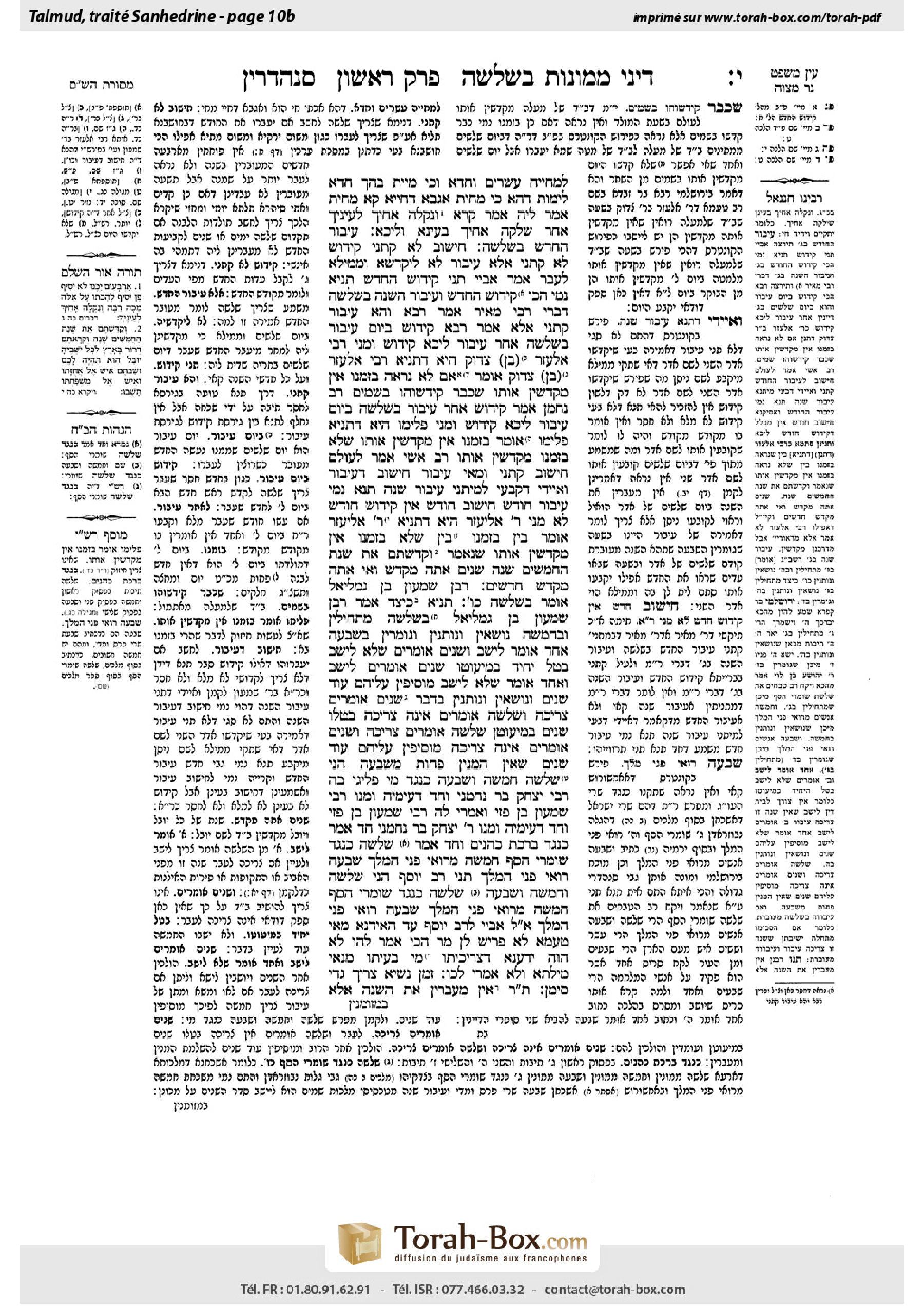
Sanhedrin 10b: Talmud study for Daf Yomi
Daf Yomi is the daily study of one Talmud folio. Explore 37 tractates with scans, Hebrew text, Sefaria English and AI-generated French translations where annotated.
Passage selection and English or AI-generated French translation are available where the scan has annotations. Daf Study is independent of Torah-Box and Sefaria.
Browse Sanhedrin · סנהדרין · All tractatesSanhedrin 10b text and translations
This page of Sanhedrin includes the Aramaic text, an English translation and an AI-generated French translation, alongside the scan above.
סנהדרין י׳ ב · Aramaic and Hebrew text
לִמְחֲיֵיהּ עֶשְׂרִים וַחֲדָא, וְכִי מָיֵית בְּהָךְ חֲדָא – לֵימוּת, דְּהָא כִּי מָחֵי אַגַּבָּא דְּחַיָּיא קָא מָחֵי. אֲמַר לֵיהּ: אָמַר קְרָא ״וְנִקְלָה אָחִיךָ לְעֵינֶיךָ״ – אַחַר שֶׁלָּקָה, ״אָחִיךָ״ בָּעֵינָא, וְלֵיכָּא.
עִיבּוּר הַחֹדֶשׁ בִּשְׁלֹשָׁה. חִישּׁוּב לָא קָתָנֵי, קִידּוּשׁ לָא קָתָנֵי, אֶלָּא עִיבּוּר. לָא לִיקַדְּשֵׁיהּ, וּמִמֵּילָא לִעַבַּר?
אָמַר אַבָּיֵי: תְּנִי קִידּוּשׁ הַחֹדֶשׁ. תַּנְיָא נָמֵי הָכִי: קִידּוּשׁ הַחֹדֶשׁ וְעִיבּוּר הַשָּׁנָה בִּשְׁלֹשָׁה, דִּבְרֵי רַבִּי מֵאִיר. אָמַר רָבָא: וְהָא ״עִיבּוּר״ קָתָנֵי! אֶלָּא אָמַר רָבָא: קִידּוּשׁ בְּיוֹם עִיבּוּר בִּשְׁלֹשָׁה, אַחַר עִיבּוּר לֵיכָּא קִידּוּשׁ.
וּמַנִּי? רַבִּי אֶלְעָזָר בֶּן צָדוֹק הִיא. דְּתַנְיָא, רַבִּי אֶלְעָזָר בֶּן צָדוֹק אוֹמֵר: אִם לֹא נִרְאָה בִּזְמַנּוֹ – אֵין מְקַדְּשִׁין אוֹתוֹ, שֶׁכְּבָר קִידְּשׁוּהוּ בַּשָּׁמַיִם.
רַב נַחְמָן אָמַר: קִידּוּשׁ אַחַר עִיבּוּר – בִּשְׁלֹשָׁה, בְּיוֹם עִיבּוּר – לֵיכָּא קִידּוּשׁ. וּמַנִּי? פְּלֵימוֹ הִיא, דְּתַנְיָא, פְּלֵימוֹ אוֹמֵר: בִּזְמַנּוֹ – אֵין מְקַדְּשִׁין אוֹתוֹ, שֶׁלֹּא בִּזְמַנּוֹ – מְקַדְּשִׁין אוֹתוֹ.
רַב אָשֵׁי אָמַר: לְעוֹלָם חִישּׁוּב קָתָנֵי, וּמַאי עִיבּוּר? חִישּׁוּב דְּעִיבּוּר. וְאַיְּדֵי דְּקָבָעֵי לְמִיתְנֵי עִיבּוּר שָׁנָה, תְּנָא נָמֵי עִיבּוּר חוֹדֶשׁ.
חִישּׁוּב חוֹדֶשׁ – אִין, קִידּוּשׁ חוֹדֶשׁ – לָא. מַנִּי? רַבִּי אֱלִיעֶזֶר הִיא, דְּתַנְיָא: רַבִּי אֱלִיעֶזֶר אוֹמֵר, בֵּין בִּזְמַנּוֹ בֵּין שֶׁלֹּא בִּזְמַנּוֹ אֵין מְקַדְּשִׁין אוֹתוֹ, שֶׁנֶּאֱמַר: ״וְקִדַּשְׁתֶּם אֵת שְׁנַת הַחֲמִשִּׁים שָׁנָה״. שָׁנִים אַתָּה מְקַדֵּשׁ, וְאִי אַתָּה מְקַדֵּשׁ חֳדָשִׁים.
רַבָּן שִׁמְעוֹן בֶּן גַּמְלִיאֵל אוֹמֵר: בִּשְׁלֹשָׁה כּוּ׳. תַּנְיָא: כֵּיצַד אָמַר רַבָּן שִׁמְעוֹן בֶּן גַּמְלִיאֵל? בִּשְׁלֹשָׁה מַתְחִילִין, וּבַחֲמִשָּׁה נוֹשְׂאִין וְנוֹתְנִין, וְגוֹמְרִין בְּשִׁבְעָה. אֶחָד אוֹמֵר לֵישֵׁב, וּשְׁנַיִם אוֹמְרִים שֶׁלֹּא לֵישֵׁב – בָּטֵל יָחִיד בְּמִיעוּטוֹ.
שְׁנַיִם אוֹמְרִים לֵישֵׁב, וְאֶחָד אוֹמֵר שֶׁלֹּא לֵישֵׁב – מוֹסִיפִין עֲלֵיהֶם עוֹד שְׁנַיִם, וְנוֹשְׂאִין וְנוֹתְנִין בַּדָּבָר. שְׁנַיִם אוֹמְרִים צְרִיכָה, וּשְׁלֹשָׁה אוֹמְרִים אֵינָהּ צְרִיכָה – בָּטְלוּ שְׁנַיִם בְּמִיעוּטָן. שְׁלֹשָׁה אוֹמְרִים צְרִיכָה, וּשְׁנַיִם אוֹמְרִים אֵינָהּ צְרִיכָה – מוֹסִיפִין עֲלֵיהֶם עוֹד שְׁנַיִם, שֶׁאֵין הַמִּנְיָן פָּחוֹת מִשִּׁבְעָה.
הָנֵי שְׁלֹשָׁה חֲמִשָּׁה וְשִׁבְעָה, כְּנֶגֶד מִי? פְּלִיגִי בַּהּ רַבִּי יִצְחָק בַּר נַחְמָנִי וְחַד דְּעִימֵּיהּ, וּמַנּוּ? רַבִּי שִׁמְעוֹן בֶּן פַּזִּי. וְאָמְרִי לַהּ: רַבִּי שִׁמְעוֹן בֶּן פַּזִּי וְחַד דְּעִימֵּיהּ, וּמַנּוּ? רַבִּי יִצְחָק בַּר נַחְמָנִי. חַד אָמַר: כְּנֶגֶד בִּרְכַּת כֹּהֲנִים, וְחַד אָמַר: שְׁלֹשָׁה – כְּנֶגֶד שׁוֹמְרֵי הַסַּף, חֲמִשָּׁה – מֵרוֹאֵי פְּנֵי הַמֶּלֶךְ, שִׁבְעָה – רוֹאֵי פְּנֵי הַמֶּלֶךְ.
תָּנֵי רַב יוֹסֵף: הָנֵי שְׁלֹשָׁה וַחֲמִשָּׁה וְשִׁבְעָה, שְׁלֹשָׁה – כְּנֶגֶד שׁוֹמְרֵי הַסַּף, חֲמִשָּׁה – מֵרוֹאֵי פְּנֵי הַמֶּלֶךְ, שִׁבְעָה – רוֹאֵי פְּנֵי הַמֶּלֶךְ. אֲמַר לֵיהּ אַבָּיֵי לְרַב יוֹסֵף: עַד הָאִידָּנָא מַאי טַעְמָא לָא פָּרֵישׁ לַן מָר הָכִי? אֲמַר לְהוּ: לָא הֲוָה יָדַעְנָא דִּצְרִיכִיתוּ. מִי בְּעֵיתוּ מִנַּאי מִילְּתָא וְלָא אֲמַרִי לְכוּ?
זְמַן, נָשִׂיא, צָרִיךְ, גְּדִי – סִימָן. תָּנוּ רַבָּנַן: אֵין מְעַבְּרִין אֶת הַשָּׁנָה אֶלָּא
Sanhedrin 10b · English translation
Let the court strike him with twenty-one lashes, and if he dies with this last one, let him die. According to the medical evaluation, he will still be alive after the twentieth lash. There would be no concern of flogging a dead man, as when the court strikes him with the twenty-first lash, it is upon the back of a living man that the court is striking. If so, why should he not receive the last blow? Rav Ashi said to him: The verse states: “Then your brother will be dishonored before your eyes.” The verse means: Even after he is hit, I need him to remain your brother; and if he dies, he is no longer your brother.
§ The mishna teaches: The intercalation of the month is performed by a panel of three judges. The Gemara extrapolates: The tanna does not teach: The calculation to determine if the month must be extended is performed by three judges, and he does not teach: The sanctification of the new month is performed by three judges; rather, he teaches: The intercalation of the month, referring to the decision to extend the month by an extra day and begin the following month on the thirty-first day instead of the thirtieth, is performed by a panel of three judges. The Gemara asks: Why are judges necessary to extend the month? Simply do not sanctify the new month, and let the previous month be intercalated by itself. When the thirtieth day of any month is not declared the first day of the new month, the earlier month is extended by default. Why, then, does the mishna specify: Intercalation?
Abaye said: Emend the text of the mishna and teach: The sanctification of the new month is performed by three judges. This is also taught in a baraita (Tosefta 2:1): The sanctification of the new month and the intercalation of the year is performed by three judges; this is the statement of Rabbi Meir. Rava said in objection to Abaye’s explanation: But the mishna teaches: Intercalation, not sanctification. Rather, Rava said: Explain the mishna this way: If there will be sanctification of the new month on the thirtieth day of the first month, which is the day that would otherwise be the intercalation, this is done by three judges. But after the day of the intercalation, i.e., if the month is sanctified on the thirty-first day, there is no active sanctification necessary.
And in accordance with whose opinion is this? It is in accordance with the opinion of Rabbi Elazar ben Tzadok, as it is taught in a mishna (Rosh HaShana 24a): Rabbi Elazar ben Tzadok says: If the new moon was not seen at its anticipated time, the court does not formally sanctify the New Moon on the following day, as the celestial court in Heaven has already sanctified it, precluding the need for the additional sanctification by the earthly court.
Taking the opposite opinion, Rav Naḥman says: In the instance of sanctification of the new moon after the intercalation of the month through the addition of a thirtieth day to the previous month, the sanctification is performed by three judges. But if the New Moon is declared on the day of the intercalation, so that the previous month is left with only twenty-nine days, there is no active sanctification. This is the standard time for the New Moon, and no intervention is necessary. And in accordance with whose opinion is this? It is in accordance with the opinion of Peleimu, as it is taught in a baraita: Peleimu says: If the new moon was reported at its anticipated time, the court does not sanctify the New Moon. But if the new moon was reported not at its anticipated time, the court sanctifies the New Moon.
Rav Ashi said: Actually, the mishna teaches that three judges are necessary for the calculation to determine when the New Moon should be declared. And what is the term: Intercalation, that is mentioned in the mishna? It is the calculation of the intercalation. And although the wording of the mishna is imprecise, it is written this way for a reason: Since the mishna needed to teach the number of judges necessary for the intercalation of the year, the mishna also taught: The intercalation of the month, so as to describe the similar processes of adding to the year and adding to the month with the same verb.
The Gemara notes: With regard to the calculation of the month, yes, this requires three judges. But with regard to the sanctification of month, this does not require three judges. In accordance with whose opinion is this? It is in accordance with the opinion of Rabbi Eliezer. As it is taught in a baraita: Rabbi Eliezer says: Whether it was reported in its anticipated time or whether it was reported not in its anticipated time, we do not sanctify the New Moon formally, as it is stated: “And you shall sanctify the fiftieth year” (Leviticus 25:10), which teaches: You must formally sanctify years, but you do not formally sanctify months, as they are sanctified automatically. In any case, calculation, when necessary, is performed by three judges.
§ The mishna teaches: Rabban Shimon ben Gamliel says that intercalation is performed in stages: The deliberations begin with three judges, they debate the matter with five judges, and they conclude the matter with seven judges. The Gemara elaborates: It is taught in a baraita (Tosefta 2:1): How does Rabban Shimon ben Gamliel say the intercalation is to be conducted? The court begins the deliberation with three judges, and they debate the matter with five, and they conclude with seven. At first, three judges convene for a preliminary discussion with regard to the necessity of adding a month to the year. If one says it is necessary to sit and deliberate the question of intercalation and two say that there is not a need to sit and continue, the single opinion in favor of intercalation is negated in its minority, i.e., it is the minority opinion, and the process ends.
The baraita continues: If two say to sit and one says not to sit, the majority decision causes the process to move to the next stage, and the court then adds another two judges to them and all five debate the matter. If two say: The year needs the extra month, and three say: It does not need it, the opinions of the two are negated in their minority. If three say: The year needs it, and two say: It does not need it, the court adds to them another two judges, as the quorum for declaring an intercalation may not be fewer than seven.
The Gemara asks: Corresponding to what was it determined that the intercalation procedure should incorporate these numbers of three, five, and seven judges? Rabbi Yitzḥak bar Naḥmani and one other Sage who was with him disagree about this. And who is that other scholar? Rabbi Shimon ben Pazi. And some say that this was a matter of dispute between Rabbi Shimon ben Pazi and one other scholar who was with him. And who is that other scholar? Rabbi Yitzḥak bar Naḥmani. One said: These numbers correspond to the number of Hebrew words in each of the three verses of the priestly benediction (see Numbers 6:24–26). And one said: Three corresponds to the three guards of the door (see II Kings 25:18), five corresponds to five of the officers who saw the king’s face (see II Kings 25:19), and seven corresponds to seven officers who saw the king’s face (see Jeremiah 52:25). Since these numbers represent appointments of distinction, the Rabbis saw fit to employ them in the composition of the court as well.
Similarly, Rav Yosef taught a baraita: These numbers: Three, five, and seven members of the court for intercalation, are adopted from different numbers of the king’s servants. Three corresponds to: Guards of the door; five corresponds to: Of those officers who saw the king’s face, mentioned in the book of II Kings; and seven corresponds to: Officers who saw the king’s face, mentioned in the book of Jeremiah. When Rav Yosef taught this, Abaye said to Rav Yosef: What is the reason that until now the Master did not explain the matter to us this way, although you have taught this material before? Rav Yosef said to Abaye and the others with him: I did not know that you needed this information, as I thought that you were already familiar with the baraita. Have you ever asked me something and I did not tell you?
§ The Gemara presents a mnemonic device for several other sources cited with regard to the intercalation of the year: Zeman, Nasi, tzarikh, gedi. The Sages taught in a baraita: The year may be intercalated only
Sanhedrin 10b · Traduction française (IA)
Que le tribunal lui inflige vingt et un coups de fouet ; s’il meurt sous le dernier coup, qu’il meure. Selon l’évaluation médicale, il sera encore vivant après le vingtième coup. Il n’y aurait donc pas à craindre de fouetter un mort, car, lorsque le tribunal lui infligera le vingt et unième coup, il frappera le dos d’un homme vivant. Dans ce cas, pourquoi ne recevrait-il pas le dernier coup ? Rav Ashi lui dit : Le verset dit : « Alors ton frère sera déshonoré sous tes yeux. » Le verset signifie : même après avoir été frappé, il faut qu’il reste ton frère ; s’il meurt, il n’est plus ton frère.
§ La Michna enseigne : L’intercalation du mois est effectuée par un tribunal de trois juges. La Guemara en déduit que le tanna n’enseigne ni que le calcul visant à déterminer si le mois doit être prolongé est effectué par trois juges, ni que la sanctification du nouveau mois est effectuée par trois juges. Il enseigne plutôt que l’intercalation du mois — c’est-à-dire la décision de prolonger le mois d’un jour et de faire commencer le mois suivant le trente et unième jour plutôt que le trentième — est effectuée par un tribunal de trois juges. La Guemara demande : Pourquoi faut-il des juges pour prolonger le mois ? Il suffit de ne pas sanctifier le nouveau mois et de laisser le mois précédent s’intercaler de lui-même. Lorsque le trentième jour d’un mois n’est pas déclaré premier jour du nouveau mois, le mois précédent est prolongé automatiquement. Pourquoi, alors, la Michna précise-t-elle : « intercalation » ?
Abayé dit : Corrige le texte de la Michna et enseigne : La sanctification du nouveau mois est effectuée par trois juges. Cela est également enseigné dans une baraïta (Tossefta 2:1) : La sanctification du nouveau mois et l’intercalation de l’année sont effectuées par trois juges ; telle est l’opinion de Rabbi Meïr. Rava objecte à l’explication d’Abayé : Mais la Michna enseigne « intercalation », et non « sanctification ». Rava dit plutôt : Explique la Michna ainsi : si le nouveau mois est sanctifié le trentième jour du mois en cours, qui serait autrement le jour de l’intercalation, cela se fait par trois juges. Mais après le jour de l’intercalation, c’est-à-dire si le nouveau mois est sanctifié le trente et unième jour, aucune sanctification active n’est nécessaire.
Et de qui cette opinion est-elle ? De Rabbi Elazar ben Tsadok, comme il est enseigné dans une Michna (Roch Hachana 24a) : Rabbi Elazar ben Tsadok dit : Si la nouvelle lune n’a pas été aperçue au moment prévu, le tribunal ne sanctifie pas officiellement le nouveau mois le lendemain, car le tribunal céleste, au Ciel, l’a déjà sanctifié, ce qui rend inutile toute sanctification supplémentaire par le tribunal terrestre.
À l’inverse, Rav Naḥman dit : Lorsque le nouveau mois est sanctifié après l’intercalation du mois, par l’ajout d’un trentième jour au mois précédent, la sanctification est effectuée par trois juges. Mais si le nouveau mois est proclamé le jour de l’intercalation, de sorte que le mois précédent ne compte que vingt-neuf jours, aucune sanctification active n’est requise. C’est le moment habituel du nouveau mois, et aucune intervention n’est nécessaire. Et de qui cette opinion est-elle ? De Péléïmou, comme il est enseigné dans une baraïta : Péléïmou dit : Si la nouvelle lune est signalée au moment prévu, le tribunal ne sanctifie pas le nouveau mois. Mais si la nouvelle lune est signalée à un autre moment que celui prévu, le tribunal sanctifie le nouveau mois.
Rav Ashi dit : En réalité, la Michna enseigne que trois juges sont nécessaires pour effectuer le calcul déterminant quand le nouveau mois doit être proclamé. Que signifie donc le terme « intercalation » mentionné dans la Michna ? Il désigne le calcul de l’intercalation. Et si la formulation de la Michna manque de précision, elle est ainsi rédigée pour une raison : puisque la Michna devait enseigner le nombre de juges nécessaires à l’intercalation de l’année, elle enseigne également « l’intercalation du mois », afin de décrire par le même verbe les processus analogues consistant à ajouter à l’année et à ajouter au mois.
La Guemara fait remarquer : le calcul du mois, oui, nécessite trois juges ; mais la sanctification du mois, elle, ne nécessite pas trois juges. Et de qui cette opinion est-elle ? De Rabbi Eliezer, comme il est enseigné dans une baraïta : Rabbi Eliezer dit : Que la nouvelle lune ait été signalée au moment prévu ou à un autre moment, nous ne sanctifions pas officiellement le nouveau mois, car il est dit : « Vous sanctifierez la cinquantième année » (Lévitique 25:10). Cela enseigne qu’il faut sanctifier officiellement les années, mais pas les mois, car ceux-ci sont sanctifiés automatiquement. Quoi qu’il en soit, lorsque le calcul est nécessaire, il est effectué par trois juges.
§ La Michna enseigne que Rabban Shimon ben Gamliel dit que l’intercalation se déroule par étapes : les délibérations commencent avec trois juges, la question est examinée par cinq juges, puis tranchée par sept. La Guemara développe : Il est enseigné dans une baraïta (Tossefta 2:1) : Selon Rabban Shimon ben Gamliel, comment l’intercalation doit-elle se dérouler ? Le tribunal commence les délibérations avec trois juges, examine la question avec cinq, puis la tranche avec sept. Au début, trois juges se réunissent pour une discussion préliminaire sur la nécessité d’ajouter un mois à l’année. Si l’un dit qu’il est nécessaire de siéger et de délibérer sur la question de l’intercalation, tandis que deux disent qu’il n’est pas nécessaire de siéger et de poursuivre les débats, l’avis favorable à l’intercalation est rejeté comme minoritaire, et la procédure s’arrête.
La baraïta poursuit : Si deux disent qu’il faut siéger et qu’un dit qu’il ne le faut pas, la décision majoritaire fait passer la procédure à l’étape suivante ; le tribunal leur adjoint alors deux autres juges, et les cinq examinent la question. Si deux disent que l’année a besoin du mois supplémentaire et que trois disent qu’elle n’en a pas besoin, l’avis des deux est rejeté comme minoritaire. Si trois disent que l’année en a besoin et que deux disent qu’elle n’en a pas besoin, le tribunal leur adjoint deux autres juges, car le quorum requis pour déclarer une intercalation ne peut être inférieur à sept.
La Guemara demande : À quoi correspondent les nombres de trois, cinq et sept juges retenus pour la procédure d’intercalation ? Rabbi Yitzḥak bar Naḥmani et un autre Sage qui était avec lui sont en désaccord à ce sujet. Qui est cet autre Sage ? Rabbi Shimon ben Pazi. Certains disent que le désaccord opposait Rabbi Shimon ben Pazi et un autre Sage qui était avec lui. Qui était cet autre Sage ? Rabbi Yitzḥak bar Naḥmani. Selon l’un, ces nombres correspondent au nombre de mots hébreux de chacun des trois versets de la bénédiction sacerdotale (voir Nombres 6:24–26). Selon l’autre, trois correspond aux trois gardes du seuil (voir II Rois 25:18), cinq aux cinq officiers qui avaient accès au roi (voir II Rois 25:19), et sept aux sept officiers qui avaient accès au roi (voir Jérémie 52:25). Puisque ces nombres représentent des fonctions honorifiques, les Rabbins ont jugé bon de les employer également pour composer le tribunal.
De même, Rav Yossef enseigna une baraïta : Ces nombres — trois, cinq et sept membres du tribunal chargé de l’intercalation — sont empruntés aux différents nombres de serviteurs du roi. Trois correspond aux gardes du seuil ; cinq, aux officiers qui avaient accès au roi, mentionnés dans le livre des II Rois ; et sept, aux officiers qui avaient accès au roi, mentionnés dans le livre de Jérémie. Lorsque Rav Yossef enseigna cela, Abayé lui dit : Pourquoi le Maître ne nous a-t-il pas expliqué la chose ainsi jusqu’à présent, alors que tu nous as déjà enseigné ce passage ? Rav Yossef répondit à Abayé et aux autres qui étaient avec lui : Je ne savais pas que vous aviez besoin de cette information, car je pensais que vous connaissiez déjà la baraïta. Vous est-il déjà arrivé de me poser une question à laquelle je n’ai pas répondu ?
§ La Guemara présente un moyen mnémotechnique pour plusieurs autres sources citées au sujet de l’intercalation de l’année : Zeman, Nasi, tzarikh, gedi. Les Sages ont enseigné dans une baraïta : L’année ne peut être intercalée que
Traduction française générée par IA à partir de l’édition anglaise de Sefaria. Vérifie toujours un passage avec le texte source.
Text from Sefaria: William Davidson Edition - Vocalized Aramaic (CC BY NC); William Davidson Edition - English (CC BY NC).