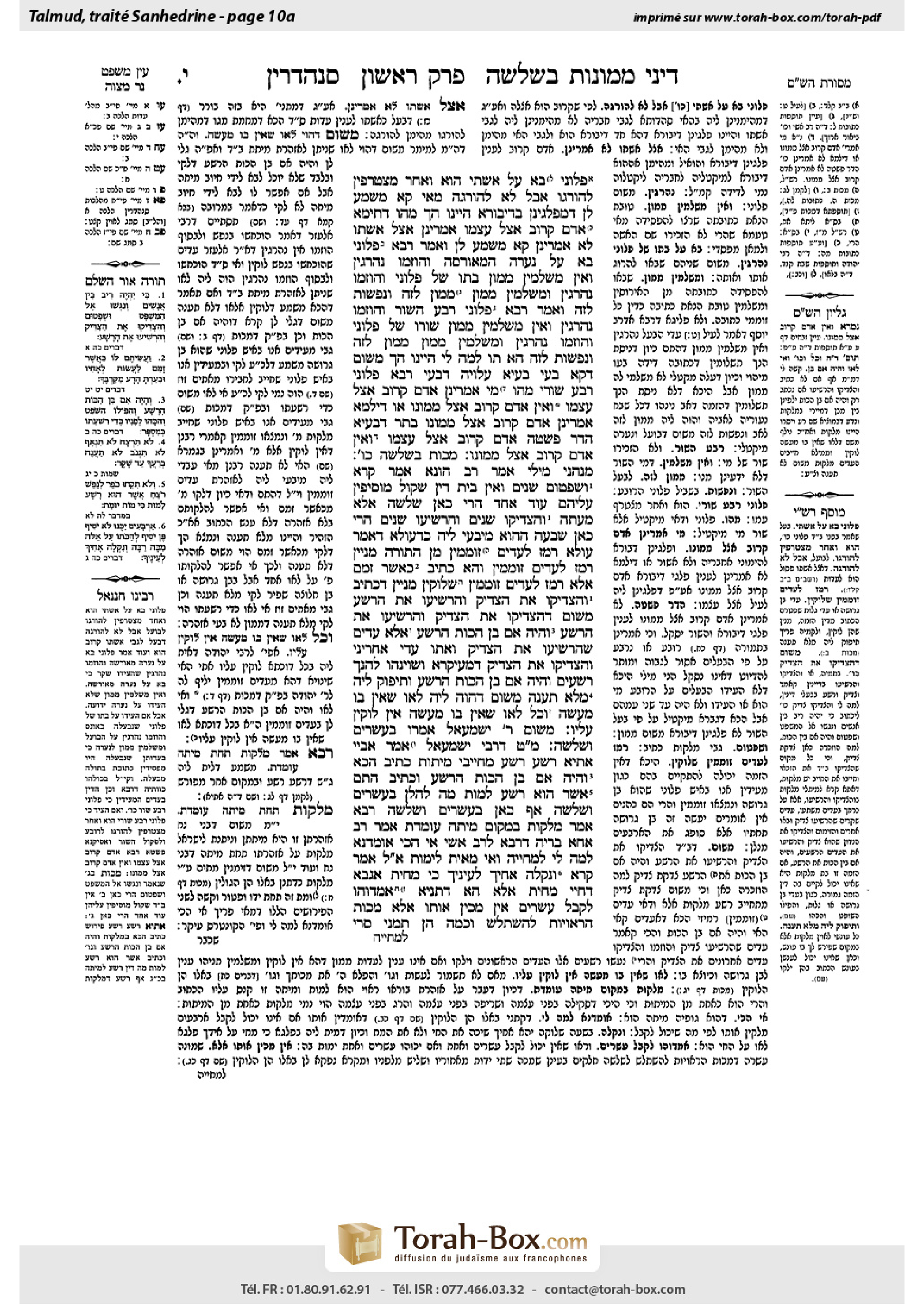
Sanhedrin 10a: Talmud study for Daf Yomi
Daf Yomi is the daily study of one Talmud folio. Explore 37 tractates with scans, Hebrew text, Sefaria English and AI-generated French translations where annotated.
Passage selection and English or AI-generated French translation are available where the scan has annotations. Daf Study is independent of Torah-Box and Sefaria.
Browse Sanhedrin · סנהדרין · All tractatesSanhedrin 10a text and translations
This page of Sanhedrin includes the Aramaic text, an English translation and an AI-generated French translation, alongside the scan above.
סנהדרין י׳ א · Aramaic and Hebrew text
״פְּלוֹנִי בָּא עַל אִשְׁתִּי״, הוּא וְאַחֵר מִצְטָרְפִין לְהוֹרְגוֹ, אֲבָל לֹא לְהוֹרְגָהּ.
מַאי קָא מַשְׁמַע לַן? דִּמְפַלְּגִינַן בְּדִיבּוּרָא? הַיְינוּ הָךְ! מַהוּ דְּתֵימָא: אָדָם קָרוֹב אֵצֶל עַצְמוֹ – אָמְרִינַן, אֵצֶל אִשְׁתּוֹ – לָא אָמְרִינַן. קָא מַשְׁמַע לַן.
וְאָמַר רָבָא: ״פְּלוֹנִי בָּא עַל נַעֲרָה הַמְאוֹרָסָה״, וְהוּזַּמּוּ – נֶהֱרָגִין, וְאֵין מְשַׁלְּמִין מָמוֹן. ״בִּתּוֹ שֶׁל פְּלוֹנִי״, וְהוּזַּמּוּ – נֶהֱרָגִין וּמְשַׁלְּמִין מָמוֹן. מָמוֹן לָזֶה וּנְפָשׁוֹת לָזֶה.
וְאָמַר רָבָא: ״פְּלוֹנִי רָבַע הַשּׁוֹר״ וְהוּזַּמּוּ – נֶהֱרָגִין, וְאֵין מְשַׁלְּמִין מָמוֹן. ״שׁוֹרוֹ שֶׁל פְּלוֹנִי״ וְהוּזַּמּוּ – נֶהֱרָגִין, וּמְשַׁלְּמִין מָמוֹן. מָמוֹן לָזֶה, וּנְפָשׁוֹת לָזֶה.
הָא תּוּ לְמָה לִי? הַיְינוּ הָךְ! מִשּׁוּם דְּקָא בָעֵי בַּעְיָא עִילָּוֵיהּ, דְּבָעֵי רָבָא: ״פְּלוֹנִי רָבַע שׁוֹרִי״, מַהוּ? מִי אָמְרִינַן: אָדָם קָרוֹב אֵצֶל עַצְמוֹ, וְאֵין אָדָם קָרוֹב אֵצֶל מָמוֹנוֹ? אוֹ דִילְמָא אָמְרִינַן: אָדָם קָרוֹב אֵצֶל מָמוֹנוֹ? בָּתַר דְּבַעְיַאּ הֲדַר פַּשְׁטַהּ: אָדָם קָרוֹב אֵצֶל עַצְמוֹ, וְאֵין אָדָם קָרוֹב אֵצֶל מָמוֹנוֹ.
מַכּוֹת בִּשְׁלֹשָׁה כּוּ׳. מְנָהָנֵי מִילֵּי? אָמַר רַב הוּנָא: אָמַר קְרָא ״וּשְׁפָטוּם״ – שְׁנַיִם, וְאֵין בֵּית דִּין שָׁקוּל, מוֹסִיפִין עֲלֵיהֶם עוֹד אֶחָד. הֲרֵי כָּאן שְׁלֹשָׁה.
אֶלָּא מֵעַתָּה, ״וְהִצְדִּיקוּ״ – שְׁנַיִם, ״וְהִרְשִׁיעוּ״ – שְׁנַיִם, הֲרֵי כָּאן שִׁבְעָה? הָהוּא מִיבְּעֵי לֵיהּ כִּדְעוּלָּא, דְּאָמַר עוּלָּא: רֶמֶז לְעֵדִים זוֹמְמִין מִן הַתּוֹרָה מִנַּיִן?
רֶמֶז לְעֵדִים זוֹמְמִין?! וְהָא כְּתִיב: ״כַּאֲשֶׁר זָמַם״! אֶלָּא, רֶמֶז לְעֵדִים זוֹמְמִין שֶׁלּוֹקִין מִנַּיִין? דִּכְתִיב: ״וְהִצְדִּיקוּ אֶת הַצַּדִּיק וְהִרְשִׁיעוּ אֶת הָרָשָׁע״.
מִשּׁוּם דְּ״הִצְדִּיקוּ אֶת הַצַּדִּיק וְהִרְשִׁיעוּ אֶת הָרָשָׁע״, ״וְהָיָה אִם בִּן הַכּוֹת הָרָשָׁע״? אֶלָּא, עֵדִים שֶׁהִרְשִׁיעוּ אֶת הַצַּדִּיק, וַאֲתוֹ עֵדֵי אַחֲרִינֵי וְהִצְדִּיקוּ אֶת הַצַּדִּיק דְּמֵעִיקָּרָא, וְשַׁוִּינְהוּ לְהָנָךְ רְשָׁעִים, ״וְהָיָה אִם בִּן הַכּוֹת הָרָשָׁע״.
וְתִיפּוֹק לֵיהּ מִ״לֹּא תַעֲנֶה״! מִשּׁוּם דְּהָוֵה לֵיהּ לָאו שֶׁאֵין בּוֹ מַעֲשֶׂה, וְכׇל לָאו שֶׁאֵין בּוֹ מַעֲשֶׂה אֵין לוֹקִין עָלָיו.
מִשּׁוּם רַבִּי יִשְׁמָעֵאל אָמְרוּ: בְּעֶשְׂרִים וּשְׁלֹשָׁה. מַאי טַעְמָא דְּרַבִּי יִשְׁמָעֵאל? אָמַר אַבָּיֵי: אָתְיָא ״רָשָׁע״ ״רָשָׁע״ מֵחַיָּיבֵי מִיתוֹת. כְּתִיב הָכָא: ״וְהָיָה אִם בִּן הַכּוֹת הָרָשָׁע״, וּכְתִיב הָתָם: ״אֲשֶׁר הוּא רָשָׁע לָמוּת״. מָה לְהַלָּן בְּעֶשְׂרִים וּשְׁלֹשָׁה, אַף כָּאן בְּעֶשְׂרִים וּשְׁלֹשָׁה.
רָבָא אָמַר: מַלְקוֹת בִּמְקוֹם מִיתָה עוֹמֶדֶת. אָמַר רַב אַחָא בְּרֵיהּ דְּרָבָא לְרַב אָשֵׁי: אִי הָכִי, אוּמְדָּנָא לְמָה לִי? לִמְחֲיֵיהּ, וְאִי מָאֵית – לֵימוּת!
אֲמַר לֵיהּ: אָמַר קְרָא: ״וְנִקְלָה אָחִיךָ לְעֵינֶיךָ״ – כִּי מָחֵית, אַגַּבָּא דְּחָיֵי מָחֵית. אֶלָּא הָא דְּתַנְיָא: אֲמָדוּהוּ לְקַבֵּל עֶשְׂרִים – אֵין מַכִּין אוֹתוֹ אֶלָּא מַכּוֹת הָרְאוּיוֹת לְהִשְׁתַּלֵּשׁ. וְכַמָּה הֵן? תַּמְנֵי סְרֵי,
Sanhedrin 10a · English translation
If someone testifies: So-and-so engaged in intercourse with my wife, he and another may combine to execute him, the accused man, with his testimony, but the woman’s husband is not accepted as a witness to execute her. A person cannot testify concerning his wife or any other close relative.
The Gemara asks: What is this last scenario teaching us? Is it that we divide the statement of the witness in order to accept part of the testimony while rejecting the inadmissible part? This cannot be, as the principle in this case is identical to that case, in which the witness is not accepted to incriminate himself. The Gemara answers: The second case is necessary, lest you say: With regard to his own self, since a person is his own relative, we say that we divide the testimony. But with regard to his wife, one might think we do not say so, and the entire testimony must be either accepted or rejected. Therefore, the second case teaches us that even with regard to one’s wife, the statement is divided, and the testimony concerning his wife is disregarded.
And Rava also says: If witnesses testify: So-and-so engaged in intercourse with a betrothed young woman (see Deuteronomy 22:25), without specifying the young woman in question, and they were rendered conspiring witnesses, they are executed, and they are not liable to pay money. Since they never specified the identity of the young woman, they were never in a position to cause anyone to lose part or all of her marriage contract. But if they specified: The young woman was the daughter of so-and-so, and they are rendered conspiring witnesses, they are executed, and they also pay money. Since in this case, the money is for this victim, i.e., the father of the young woman who stood to lose part or all of her marriage contract, and their lives are for that victim, i.e., the man and woman accused of adultery, they are liable to receive both punishments.
And Rava also says: If they testify: So-and-so engaged in bestiality with an ox (see Leviticus 18:23), which would theoretically result in the execution of both the person and the animal, without specifying which ox, and they were rendered conspiring witnesses, they are executed, as their testimony would have put the accused to death, and yet they are not liable to pay money for the ox, because their testimony did not pertain to any ox in particular. But if they specify: He engaged in bestiality with so-and-so’s ox, and they were rendered conspiring witnesses, they are executed, and they also pay money to the owner of the ox they sought to have killed. Since the money is for this victim, the owner whose ox would have been killed by the court, and their lives are for that victim, the man accused of engaging in bestiality with an animal, they are liable to receive both punishments.
The Gemara asks: It seems that the case of the ox exemplifies the same principle as the case of the betrothed young woman. Why do I also need this case? This is essentially identical to that. The Gemara answers: The second case was necessary to clarify a point, because Rava raised a dilemma about it, as Rava raised a dilemma: If someone testifies: So-and-so engaged in bestiality with my ox, what is the halakha? Do we say: A person is his own relative concerning testimony, but a person does not have the status of a relative with regard to his property, and consequently the ox would also be executed because his testimony about his own animal is admissible? Or perhaps we say: A person has the status of a relative with regard to his property, and therefore his testimony about his ox is inadmissible? The Gemara says: After he raised the dilemma, he then resolved it: A person is his own relative, but a person does not have the status of a relative with regard to his property, so the ox is executed.
§ The mishna teaches: Cases concerning one who is accused of violating a prohibition that would render him liable to receive lashes must be judged by three judges. The Gemara asks: From where is this matter derived? Rav Huna says: The verse states: “If there will be a controversy between men, and they come to judgment, and the judges judge them, and they shall justify the just, and they shall condemn the wicked. Then it shall be, if the wicked man deserves to be beaten, that the judge shall cause him to lie down, and to be beaten before his face” (Deuteronomy 25:1–2). When it states: “And the judges judge them,” in the plural, this indicates a minimum of two judges. And since a court may not be composed of an even number of judges, the court adds to them one more, and there are a total of three judges here.
The Gemara asks: If that is so, that the plural verbs in the verse each indicate two judges, the term: “And they shall justify,” indicates another two, and the term: “And they shall condemn,” indicates another two, so that there are a total of seven here. The Gemara answers: Rav Huna requires that pair of terms in accordance with the opinion of Ulla, as Ulla says: From where in the Torah is there an allusion to the halakha of conspiring witnesses?
The Gemara interrupts with a question: An allusion to the halakha of conspiring witnesses? But it is written explicitly: “Then you shall do to him as he had planned to do to his brother” (Deuteronomy 19:19). Why would there be a need for an allusion? Rather, Ulla meant: From where in the Torah is there an allusion to the halakha that conspiring witnesses are flogged? Ulla answers: As it is written: “And they shall justify the just, and they shall condemn the wicked. Then it shall be, if the wicked man deserves to be beaten, that the judge shall cause him to lie down, and to be beaten before his face.”
The Gemara explains the derivation: Due to the fact that the terms in the verse: “They shall justify the just, and they shall condemn the wicked” indicate a financial dispute in which one party is vindicated and the other is required to pay, does it follow that, as the verse continues: “Then it shall be, if the wicked man deserves to be beaten”? Why would the verdict’s being rendered in the other party’s favor mean that the losing party is flogged? Rather, the verse must be discussing the witnesses and not the litigants. If conspiring witnesses condemned the just one, and other witnesses came and justified the one who was really the just one from the beginning and rendered these conspiring witnesses wicked, then, as the verse continues: “Then it shall be, if the wicked man deserves to be beaten, that the judge shall cause him to lie down, and to be beaten before his face.” This indicates that the witnesses are subject to lashes.
The Gemara asks: Why does this halakha require a specific derivation? But since there is a principle that one is subject to lashes for violating any prohibition, why not derive this punishment from the prohibition: “You shall not testify as a false witness against your neighbor” (Exodus 20:13)? The Gemara answers: That verse is insufficient, because it is a prohibition that does not involve an action, but only speech, and with regard to any prohibition that does not involve an action, one is not flogged for it.
§ The mishna teaches: It was stated in the name of Rabbi Yishmael: Cases concerning lashes must be adjudicated by twenty-three judges. The Gemara asks: What is the reasoning of Rabbi Yishmael? Abaye said: This is derived by means of a verbal analogy between one instance of the term wicked and another instance of the term wicked, from the halakha of those liable to receive death penalties. It is written here, with regard to lashes: “Then it shall be, if the wicked man deserves to be beaten,” and it is written there, with regard to a murderer: “That is a wicked man guilty of death” (Numbers 35:31). Just as there, with regard to the trial of the murderer, the case is tried by twenty-three judges, so too here, the case of lashes must be tried by twenty-three judges.
Rava says: A verbal analogy is unnecessary. Conceptually, lashes stand in place of execution. As corporal punishment is a kind of replacement for capital punishment, it must be judged in the manner of capital punishments, by a court of twenty-three. Rav Aḥa, son of Rava, said to Rav Ashi: If so, that lashes stand in place of execution, why do I need an assessment? Before administering lashes, the court consults with a physician to assess how many lashes the transgressor can withstand and adjusts the number of lashes so that the transgressor’s life will not be threatened. But if Rava is correct, why is this necessary? Let the court strike him, and if the transgressor dies, let him die.
Rav Ashi said to Rav Aḥa, son of Rava: The verse states: “Then your brother will be dishonored before your eyes” (Deuteronomy 25:3). This teaches that when you strike, you strike upon the back of a live person. After he is dead, he is not called: Your brother. Rav Aḥa, son of Rava, continued to ask Rav Ashi: But with regard to that which is taught in a baraita (Tosefta, Makkot 4:6): If they assessed him to be strong enough to absorb twenty lashes, they flog him only with a number of lashes that can be divided into threes, as lashes are administered in sets of three, two behind and one in front. And how many are they? Eighteen.
Sanhedrin 10a · Traduction française (IA)
Si quelqu'un témoigne : Untel a eu des rapports sexuels avec ma femme, lui et un autre peuvent se joindre pour exécuter l'accusé, cet homme, sur la base de son témoignage, mais le mari de la femme n'est pas admis comme témoin pour l'exécuter. Une personne ne peut pas témoigner au sujet de sa femme ou d'un autre proche parent.
La Guemara demande : Que nous enseigne ce dernier scénario ? Est-ce que nous divisons la déclaration du témoin afin d'accepter une partie du témoignage tout en rejetant la partie inadmissible ? Cela ne peut pas être, car le principe dans ce cas est identique à celui de l'autre cas, dans lequel le témoin n'est pas admis pour s'incriminer lui-même. La Guemara répond : Le deuxième cas est nécessaire, de peur que vous ne disiez : S'agissant de sa propre personne, puisque une personne est son propre parent, nous disons que nous divisons le témoignage. Mais s'agissant de sa femme, on pourrait penser que nous ne disons pas cela, et que l'ensemble du témoignage doit être soit accepté, soit rejeté. Par conséquent, le deuxième cas nous enseigne que même s'agissant de sa femme, la déclaration est divisée, et le témoignage concernant sa femme est écarté.
Et Rava dit également : Si des témoins témoignent : Untel a eu des rapports sexuels avec une jeune fille fiancée (voir Deutéronome 22:25), sans préciser la jeune fille en question, et qu'ils sont déclarés témoins conspirateurs, ils sont exécutés, et ils ne sont pas tenus de payer de l'argent. Puisqu'ils n'ont jamais précisé l'identité de la jeune fille, ils n'ont jamais été en mesure de faire perdre à quiconque une partie ou la totalité de son contrat de mariage. Mais s'ils précisent : La jeune fille était la fille d'untel, et qu'ils sont déclarés témoins conspirateurs, ils sont exécutés, et ils paient également de l'argent. Puisque dans ce cas, l'argent est pour cette victime, c'est-à-dire le père de la jeune fille qui était susceptible de perdre une partie ou la totalité de son contrat de mariage, et que leurs vies sont pour cette victime, c'est-à-dire l'homme et la femme accusés d'adultère, ils sont tenus de recevoir les deux peines.
Et Rava dit également : S'ils témoignent : Untel a commis un acte de bestialité avec un bœuf (voir Lévitique 18:23), ce qui entraînerait théoriquement l'exécution de la personne et de l'animal, sans préciser quel bœuf, et qu'ils sont déclarés témoins conspirateurs, ils sont exécutés, car leur témoignage aurait condamné l'accusé à mort, et pourtant ils ne sont pas tenus de payer une indemnité pour le bœuf, car leur témoignage ne concernait aucun bœuf en particulier. Mais s'ils précisent : Il a commis un acte de bestialité avec le bœuf d'untel, et qu'ils sont déclarés témoins conspirateurs, ils sont exécutés, et ils paient également une indemnité au propriétaire du bœuf qu'ils cherchaient à faire tuer. Puisque l'indemnité est due à cette victime, le propriétaire dont le bœuf aurait été tué par le tribunal, et que leurs vies sont dues à cette victime, l'homme accusé d'avoir commis un acte de bestialité avec un animal, ils sont tenus de recevoir les deux peines.
La Guemara demande : Il semble que le cas du bœuf illustre le même principe que le cas de la jeune fille fiancée. Pourquoi ai-je également besoin de ce cas ? C'est essentiellement identique à celui-là. La Guemara répond : Le deuxième cas était nécessaire pour clarifier un point, car Rava a soulevé un dilemme à ce sujet, car Rava a soulevé un dilemme : Si quelqu'un témoigne : Untel a commis un acte de bestialité avec mon bœuf, quelle est la halakha ? Disons-nous : Une personne est son propre parent en matière de témoignage, mais une personne n'a pas le statut de parent s'agissant de ses biens, et par conséquent le bœuf serait également exécuté, car son témoignage sur son propre animal est admissible ? Ou peut-être disons-nous : Une personne a le statut de parent s'agissant de ses biens, et par conséquent son témoignage sur son bœuf est inadmissible ? La Guemara dit : Après avoir soulevé le dilemme, il l'a ensuite résolu : Une personne est son propre parent, mais une personne n'a pas le statut de parent s'agissant de ses biens, donc le bœuf est exécuté.
§ La Michna enseigne : Les affaires concernant une personne accusée d'avoir transgressé une interdiction qui la rendrait passible de coups de fouet doivent être jugées par trois juges. La Guemara demande : D'où cette règle est-elle dérivée ? Rav Huna dit : Le verset énonce : « S'il y a une querelle entre des hommes, et qu'ils viennent au jugement, et que les juges les jugent, et qu'ils justifient le juste, et qu'ils condamnent le méchant. Alors il arrivera, si le méchant mérite d'être battu, que le juge le fera coucher, et qu'il sera battu devant lui » (Deutéronome 25:1-2). Quand il est dit : « Et les juges les jugent », au pluriel, cela indique un minimum de deux juges. Et comme un tribunal ne peut pas être composé d'un nombre pair de juges, le tribunal en ajoute un de plus, et il y a au total trois juges ici.
La Guemara demande : Si c'est ainsi, que les verbes au pluriel dans le verset indiquent chacun deux juges, le terme : « Et ils justifieront », indique deux autres, et le terme : « Et ils condamneront », indique deux autres, de sorte qu'il y a au total sept ici. La Guemara répond : Rav Huna requiert cette paire de termes conformément à l'opinion d'Oula, car Oula dit : D'où dans la Torah y a-t-il une allusion à la halakha des témoins conspirateurs ?
La Guemara interrompt avec une question : Une allusion à la halakha des témoins conspirateurs ? Mais c'est écrit explicitement : « Alors vous lui ferez ce qu'il avait projeté de faire à son frère » (Deutéronome 19:19). Pourquoi y aurait-il besoin d'une allusion ? Plutôt, Oula voulait dire : D'où dans la Torah y a-t-il une allusion à la halakha que les témoins conspirateurs sont fouettés ? Oula répond : Comme il est écrit : « Et ils justifieront le juste, et ils condamneront le méchant. Alors il arrivera, si le méchant mérite d'être battu, que le juge le fera coucher, et qu'il sera battu devant lui. »
La Guemara explique la déduction : Étant donné que les termes du verset : « Ils justifieront le juste, et ils condamneront le méchant » indiquent un litige financier dans lequel une partie est blanchie et l'autre est tenue de payer, s'ensuit-il que, comme le verset continue : « Alors, si le méchant mérite d'être frappé » ? Pourquoi le fait que le verdict soit rendu en faveur de l'autre partie signifierait-il que la partie perdante est fouettée ? Plutôt, le verset doit parler des témoins et non des plaideurs. Si des témoins conspirateurs ont condamné le juste, et que d'autres témoins sont venus justifier celui qui était vraiment le juste dès le début et ont rendu ces témoins conspirateurs méchants, alors, comme le verset continue : « Alors, si le méchant mérite d'être frappé, le juge le fera coucher et le frappera devant lui. » Cela indique que les témoins sont soumis aux coups de fouet.
La Guemara demande : Pourquoi cette halakha nécessite-t-elle une déduction spécifique ? Mais puisque le principe veut qu'on soit soumis aux coups de fouet pour la violation de toute interdiction, pourquoi ne pas déduire cette punition de l'interdiction : « Tu ne témoigneras pas comme faux témoin contre ton prochain » (Exode 20:13) ? La Guemara répond : Ce verset est insuffisant, car c'est une interdiction qui n'implique pas une action, mais seulement la parole, et en ce qui concerne toute interdiction qui n'implique pas une action, on n'est pas fouetté pour cela.
§ La Michna enseigne : Il a été dit au nom de Rabbi Yishmaël : Les affaires concernant les coups de fouet doivent être jugées par vingt-trois juges. La Guemara demande : Quel est le raisonnement de Rabbi Yishmaël ? Abaye a dit : Cela est déduit par le moyen d'une analogie verbale entre une occurrence du terme « méchant » et une autre occurrence du terme « méchant », à partir de la halakha de ceux qui sont passibles de la peine de mort. Il est écrit ici, à propos des coups de fouet : « Alors, si le méchant mérite d'être frappé », et il est écrit là, à propos d'un meurtrier : « C'est un méchant coupable de mort » (Nombres 35:31). De même qu'il y, à propos du procès du meurtrier, l'affaire est jugée par vingt-trois juges, de même ici, l'affaire des coups de fouet doit être jugée par vingt-trois juges.
Rava dit : Une analogie verbale n'est pas nécessaire. Conceptuellement, les coups de fouet tiennent lieu d'exécution. Puisque la punition corporelle est une sorte de remplacement de la peine capitale, elle doit être jugée de la manière des peines capitales, par un tribunal de vingt-trois. Rav Aḥa, fils de Rava, a dit à Rav Ashi : Si c'est ainsi, que les coups de fouet tiennent lieu d'exécution, pourquoi ai-je besoin d'une évaluation ? Avant d'administrer les coups de fouet, le tribunal consulte un médecin pour évaluer combien de coups le transgresseur peut supporter et ajuste le nombre de coups de fouet afin que la vie du transgresseur ne soit pas menacée. Mais si Rava a raison, pourquoi cela est-il nécessaire ? Que le tribunal le frappe, et si le transgresseur meurt, qu'il meure.
Rav Ashi a dit à Rav Aḥa, fils de Rava : Le verset déclare : « Alors ton frère sera déshonoré devant tes yeux » (Deutéronome 25:3). Cela enseigne que lorsque vous frappez, vous frappez sur le dos d'une personne vivante. Une fois qu'il est mort, il n'est plus appelé : Ton frère. Rav Aḥa, fils de Rava, a continué à demander à Rav Ashi : Mais en ce qui concerne ce qui est enseigné dans une baraïta (Tosefta, Makkot 4:6) : S'ils l'ont estimé assez fort pour supporter vingt coups de fouet, ils ne l'infliquent qu'avec un nombre de coups divisible par trois, car les coups de fouet sont administrés par séries de trois, deux derrière et un devant. Et combien sont-ils ? Dix-huit.
Traduction française générée par IA à partir de l’édition anglaise de Sefaria. Vérifie toujours un passage avec le texte source.
Text from Sefaria: William Davidson Edition - Vocalized Aramaic (CC BY NC); William Davidson Edition - English (CC BY NC).