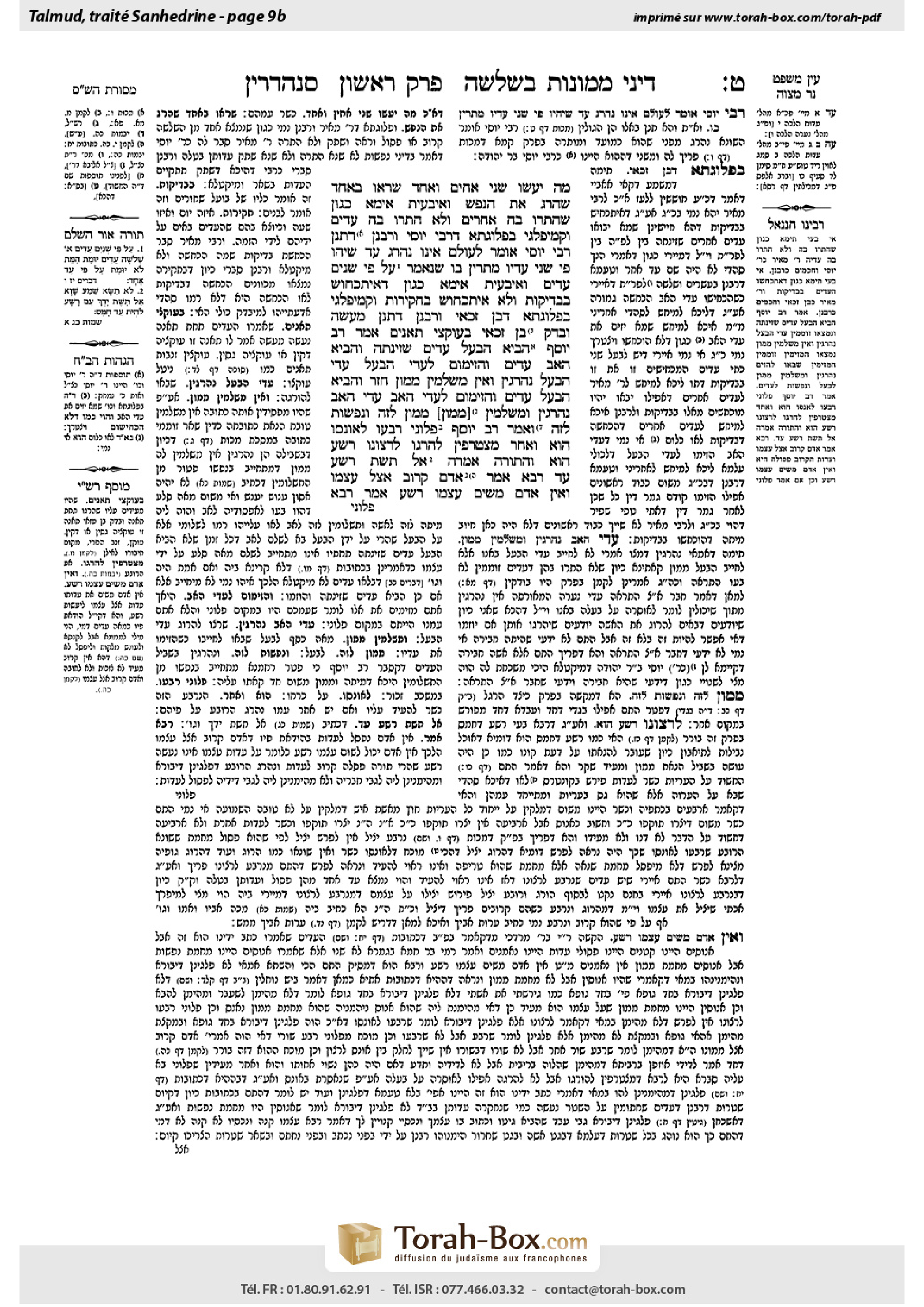
Sanhedrin 9b: Talmud study for Daf Yomi
Daf Yomi is the daily study of one Talmud folio. Explore 37 tractates with scans, Hebrew text, Sefaria English and AI-generated French translations where annotated.
Passage selection and English or AI-generated French translation are available where the scan has annotations. Daf Study is independent of Torah-Box and Sefaria.
Browse Sanhedrin · סנהדרין · All tractatesSanhedrin 9b text and translations
This page of Sanhedrin includes the Aramaic text, an English translation and an AI-generated French translation, alongside the scan above.
סנהדרין ט׳ ב · Aramaic and Hebrew text
מָה יַעֲשׂוּ שְׁנֵי אַחִים וְאֶחָד, שֶׁרָאוּ בְּאֶחָד שֶׁהָרַג אֶת הַנֶּפֶשׁ?
וְאִיבָּעֵית אֵימָא: כְּגוֹן שֶׁהִתְרוּ בָּהּ אֲחֵרִים, וְלֹא הִתְרוּ בָּהּ עֵדִים. וְקָמִיפַּלְגִי בִּפְלוּגְתָּא דְּרַבִּי יוֹסֵי וְרַבָּנַן, דִּתְנַן: רַבִּי יוֹסֵי אוֹמֵר, לְעוֹלָם אֵינוֹ נֶהֱרָג עַד שֶׁיְּהוּ פִּי שְׁנֵי עֵדָיו מַתְרִין בּוֹ, שֶׁנֶּאֱמַר: ״עַל פִּי שְׁנַיִם עֵדִים״.
וְאִיבָּעֵית אֵימָא: כְּגוֹן דְּאִיתַּכְחוּשׁ בִּבְדִיקוֹת, וְלָא אִיתַּכְחוּשׁ בַּחֲקִירוֹת.
וְקָמִיפַּלְגִי בִּפְלוּגְתָּא דְּבֶן זַכַּאי וְרַבָּנַן, דִּתְנַן: מַעֲשֶׂה וּבָדַק בֶּן זַכַּאי בְּעוּקְצֵי תְאֵנִים.
אָמַר רַב יוֹסֵף: הֵבִיא הַבַּעַל עֵדִים שֶׁזִּינְּתָה, וְהֵבִיא הָאָב עֵדִים וֶהֱזִימּוּם לְעֵדֵי הַבַּעַל, עֵדֵי הַבַּעַל נֶהֱרָגִין וְאֵין מְשַׁלְּמִין מָמוֹן.
חָזַר וְהֵבִיא הַבַּעַל עֵדִים, וֶהֱזִימּוּם לְעֵדֵי הָאָב. עֵדֵי הָאָב נֶהֱרָגִין, וּמְשַׁלְּמִין מָמוֹן. מָמוֹן לָזֶה, וּנְפָשׁוֹת לָזֶה.
וְאָמַר רַב יוֹסֵף: ״פְּלוֹנִי רְבָעוֹ לְאוֹנְסוֹ״ – הוּא וְאַחֵר מִצְטָרְפִין לְהׇרְגוֹ.
״לִרְצוֹנוֹ״ – רָשָׁע הוּא, וְהַתּוֹרָה אָמְרָה: ״אַל תָּשֶׁת רָשָׁע עֵד״. רָבָא אָמַר: אָדָם קָרוֹב אֵצֶל עַצְמוֹ, וְאֵין אָדָם מֵשִׂים עַצְמוֹ רָשָׁע.
אָמַר רָבָא:
Sanhedrin 9b · English translation
If this were not to be so, what should two brothers and one other person do, if they saw someone kill another person? If the mere fact that they saw the event invalidates the testimony, then no one can ever be tried for a transgression committed in the presence of relatives. If one may decide whether or not he will be a witness, one of the brothers may join with the third person in warning the potential transgressor and, thereafter, constitute a pair of valid witnesses. Similarly, the mishna is understood as discussing a case in which a betrothed woman committed adultery, and of the three witnesses, two were brothers. If one of the brothers refrained from warning her, the remaining two witnesses may still testify against her, according to Rabbi Yehuda HaNasi. In this situation, the case must be tried by twenty-three judges. According to Rabbi Yosei the case may be tried by three judges, because with regard to capital law, the two brothers invalidate the testimony merely by seeing the event together.
And if you wish, say instead: The mishna discusses a case where others warned her, and the witnesses themselves did not warn her. And Rabbi Meir and the Rabbis disagree with regard to the issue that is the subject of the dispute between Rabbi Yosei and the Rabbis. As we learned in a mishna (Makkot 6b), Rabbi Yosei says: A defendant is never executed unless the mouths of his two witnesses are those who warn him, as it is stated: “At the mouth of two witnesses, or at the mouth of three witnesses, shall he that is to die be put to death” (Deuteronomy 17:6). The verse’s emphasis on the phrase “at the mouth of” teaches that the witnesses must issue the warning themselves. Rabbi Meir may agree with Rabbi Yosei that the woman cannot be executed if others gave the warning. Therefore the trial of the defamer needs only three judges, whereas the Rabbis in the mishna agree with the Rabbis in Makkot who disagree with Rabbi Yosei. Since she may be tried for adultery, the case requires twenty-three judges.
And if you wish, say instead a different explanation: The mishna discusses a case where the testimony about the adultery was found to be contradictory with regard to the examinations concerning minor details of the incident, but the testimony was not found to be contradictory with regard to the interrogations concerning the time and place of the incident, which is the primary substance of the testimony.
And Rabbi Meir and the Rabbis disagree with regard to the issue that is the subject of the dispute between Rabban Yoḥanan ben Zakkai and the Rabbis. As we learned in a mishna (40a): An incident occurred, and Rabban Yoḥanan ben Zakkai examined the witnesses with regard to the stems of figs, as to their color and shape, in order to expose a contradiction between the witnesses. When he found a discrepancy in their reports about the figs, he dismissed the testimony. Rabbi Meir adopts this opinion, and therefore a woman cannot be tried for adultery if the witnesses disagree about details like these. The Rabbis accept such testimony, and consequently, they require a court of twenty-three judges.
§ The Gemara discusses scenarios concerning the testimony about a woman’s committing adultery and allegations that the husband is guilty of defamation. Rav Yosef says: If the husband brought witnesses who testified that his wife committed adultery, and the wife’s father brought witnesses, and they testified that the husband’s witnesses were conspiring witnesses, then the husband’s witnesses are executed, but they or their estates do not pay money. Although their testimony, if accepted, would also have lowered the value of her marriage contract, they do not incur liability, based on the principle that if someone commits a transgression that renders him liable to receive more than one punishment, he receives the greater punishment.
If the husband came back before his witnesses were executed and brought new witnesses, and they testified that the father’s witnesses were conspiring witnesses, the father’s witnesses are executed, and they must also pay money to the husband, as they attempted to make him liable to pay the fine for defamation. They are not exempt from the payment because the money is for this victim, i.e., the husband, and their lives are for that set of witnesses, who would have been killed. Since their liability to receive the death penalty and their financial liability were caused by their offenses against different people, these are deemed separate transgressions, and consequently they receive both punishments.
And Rav Yosef also says, with regard to distinguishing between the different aspects of a single testimony: If a man testifies that so-and-so sodomized him against his will, he and another witness may combine as a valid pair of witnesses to kill the defendant for the sin of homosexual sodomy (see Leviticus 18:22).
But if the one who was sodomized testified that the accused sodomized him with his consent, he is testifying that he himself is wicked, having been complicit in the forbidden act, and the Torah said: “Do not put your hand with a wicked person to be an unrighteous witness” (Exodus 23:1). Therefore, the testimony is rejected. Rava says: A person is his own relative and therefore may not testify about himself. Therefore, a person cannot render himself wicked by his own testimony. As a result, he is deemed credible with regard to the sodomizer, but not with regard to himself. He remains a valid witness to convict the sodomizer in combination with another.
And similarly, Rava says:
Sanhedrin 9b · Traduction française (IA)
S’il n’en était pas ainsi, que devraient faire deux frères et une autre personne s’ils voyaient quelqu’un tuer une autre personne ? Si le simple fait d’avoir vu l’événement invalide leur témoignage, alors personne ne pourrait jamais être jugé pour une transgression commise en présence de membres de sa famille. Si l’on peut choisir de témoigner ou non, l’un des frères peut se joindre au troisième pour avertir le transgresseur potentiel, puis former avec lui une paire de témoins valides. De même, la Michna est comprise comme traitant d’un cas où une femme fiancée a commis un adultère et où, parmi les trois témoins, deux étaient frères. Si l’un des frères s’est abstenu de l’avertir, les deux témoins restants peuvent néanmoins témoigner contre elle, selon Rabbi Yehouda HaNassi. Dans cette situation, l’affaire doit être jugée par vingt-trois juges. Selon Rabbi Yossei, l’affaire peut être jugée par trois juges, car, en matière de droit pénal passible de la peine capitale, les deux frères invalident le témoignage du seul fait d’avoir vu l’événement ensemble.
Et si tu préfères, dis plutôt que la Michna traite d’un cas où d’autres personnes l’ont avertie et où les témoins eux-mêmes ne l’ont pas fait. Rabbi Meïr et les Sages sont en désaccord sur la question qui fait l’objet de la controverse entre Rabbi Yossei et les Sages. En effet, nous avons appris dans une Michna (Makkot 6b) que Rabbi Yossei dit : « Un accusé n’est jamais exécuté à moins que ses deux témoins ne soient ceux qui l’ont averti », comme il est dit : « Par la bouche de deux témoins, ou par la bouche de trois témoins, celui qui doit mourir sera mis à mort » (Deutéronome 17,6). L’expression « par la bouche de » est mise en relief dans le verset pour enseigner que les témoins doivent eux-mêmes donner l’avertissement. Rabbi Meïr peut être d’accord avec Rabbi Yossei pour dire que la femme ne peut pas être exécutée si d’autres ont donné l’avertissement. Par conséquent, le procès du diffamateur ne nécessite que trois juges, tandis que les Sages de la Michna sont d’accord avec les Sages de Makkot, qui sont en désaccord avec Rabbi Yossei. Puisqu’elle peut être jugée pour adultère, l’affaire nécessite vingt-trois juges.
Et si tu préfères, donne une autre explication : la Michna traite d’un cas où le témoignage relatif à l’adultère a été jugé contradictoire lors des vérifications portant sur des détails secondaires de l’incident, mais pas lors des interrogatoires concernant le moment et le lieu de l’incident, qui constituent l’essentiel du témoignage.
Rabbi Meïr et les Sages sont en désaccord sur la question qui fait l’objet de la controverse entre Rabban Yoḥanan ben Zakkaï et les Sages. En effet, nous avons appris dans une Michna (40a) : un incident eut lieu et Rabban Yoḥanan ben Zakkaï interrogea les témoins sur les pédoncules des figues, notamment sur leur couleur et leur forme, afin de mettre au jour une contradiction entre eux. Lorsqu’il constata une divergence dans leurs dépositions au sujet des figues, il rejeta le témoignage. Rabbi Meïr adopte cet avis ; par conséquent, une femme ne peut pas être jugée pour adultère si les témoins ne sont pas d’accord sur des détails de ce genre. Les Sages acceptent un tel témoignage et exigent donc un tribunal de vingt-trois juges.
§ La Guemara examine des situations concernant le témoignage relatif à l’adultère d’une femme et les accusations selon lesquelles son mari serait coupable de diffamation. Rav Yossef dit : si le mari a fait venir des témoins qui ont attesté que sa femme avait commis un adultère, et que le père de celle-ci a fait venir des témoins qui ont attesté que les témoins du mari étaient des témoins comploteurs, les témoins du mari sont exécutés, mais ni eux ni leurs héritiers ne versent d’argent. Bien que leur témoignage, s’il avait été accepté, aurait également diminué la valeur du contrat de mariage de la femme, ils ne sont pas tenus de payer, conformément au principe selon lequel celui qui commet une transgression qui l’expose à plus d’une peine reçoit la peine la plus grave.
Si le mari revient avant l’exécution de ses témoins et fait venir de nouveaux témoins, qui attestent que les témoins du père étaient des témoins comploteurs, les témoins du père sont exécutés et doivent aussi verser de l’argent au mari, puisqu’ils ont tenté de le rendre redevable de l’amende pour diffamation. Ils ne sont pas dispensés du paiement au motif que l’argent est destiné à cette victime, c’est-à-dire le mari, tandis que leur vie est destinée à cet autre groupe de témoins, qui auraient été tués. Puisque leur responsabilité pénale passible de la peine de mort et leur responsabilité financière découlent d’infractions commises à l’encontre de personnes différentes, celles-ci sont considérées comme des transgressions distinctes et ils subissent donc les deux peines.
Rav Yossef dit également, à propos de la distinction entre les différents aspects d’un même témoignage : si un homme témoigne qu’untel l’a sodomisé contre sa volonté, lui-même et un autre témoin peuvent s’associer pour former une paire de témoins valides et faire condamner l’accusé à mort pour sodomie (voir Lévitique 18,22).
Mais si celui qui a été sodomisé témoigne que l’accusé l’a sodomisé avec son consentement, il atteste qu’il est lui-même méchant, puisqu’il a participé à l’acte interdit ; or la Torah dit : « Ne prête pas main-forte au méchant pour être un témoin inique » (Exode 23,1). Son témoignage est donc rejeté. Rava dit : une personne est son propre proche et ne peut donc pas témoigner à son propre sujet. Par conséquent, une personne ne peut pas se déclarer méchante par son propre témoignage. Elle est donc considérée comme crédible au sujet de celui qui l’a sodomisée, mais pas à son propre sujet. Elle reste un témoin valide pour faire condamner celui qui l’a sodomisée, en s’associant à un autre témoin.
Et de même, Rava dit :
Traduction française générée par IA à partir de l’édition anglaise de Sefaria. Vérifie toujours un passage avec le texte source.
Text from Sefaria: William Davidson Edition - Vocalized Aramaic (CC BY NC); William Davidson Edition - English (CC BY NC).