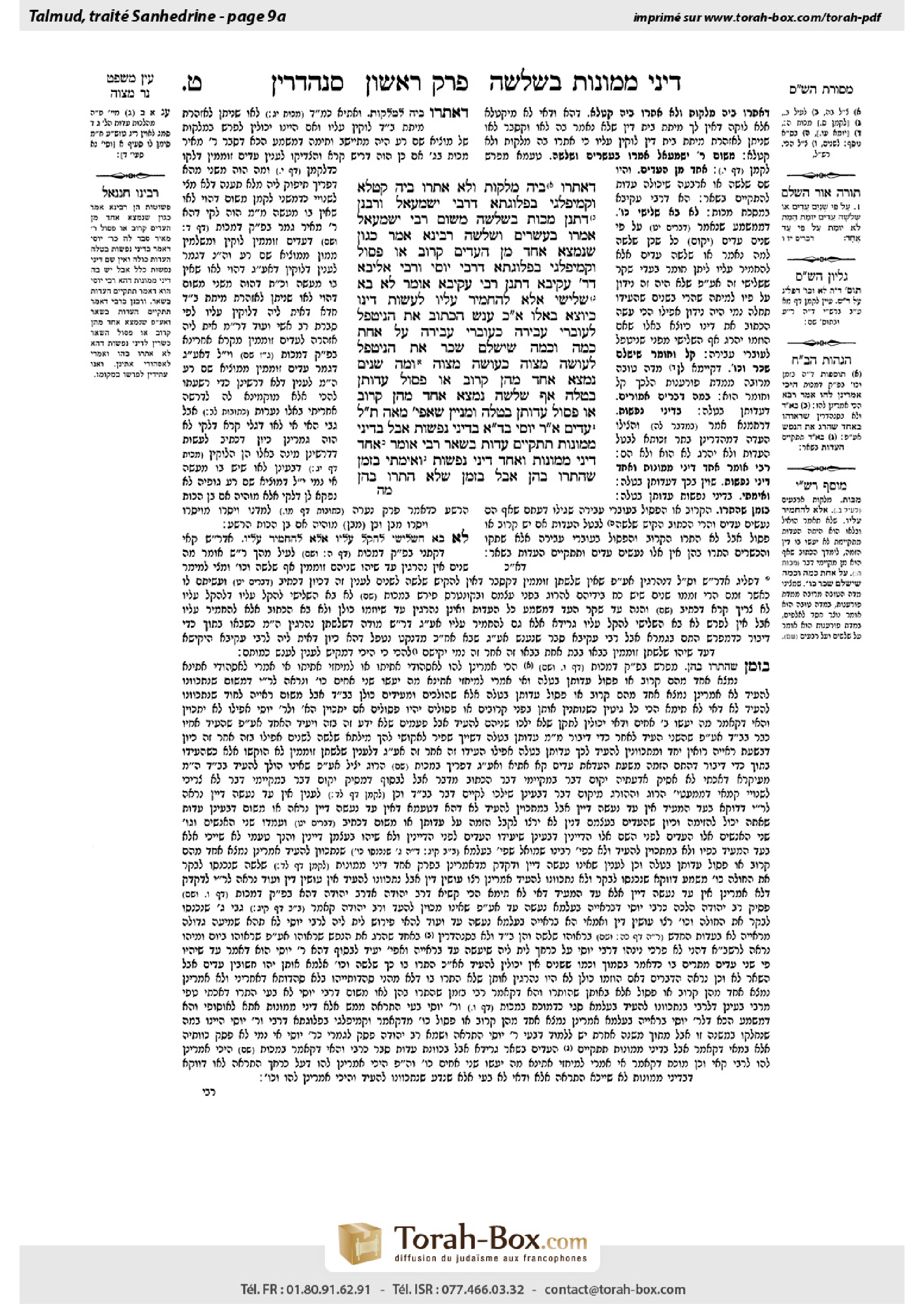
Sanhedrin 9a: Talmud study for Daf Yomi
Daf Yomi is the daily study of one Talmud folio. Explore 37 tractates with scans, Hebrew text, Sefaria English and AI-generated French translations where annotated.
Passage selection and English or AI-generated French translation are available where the scan has annotations. Daf Study is independent of Torah-Box and Sefaria.
Browse Sanhedrin · סנהדרין · All tractatesSanhedrin 9a text and translations
This page of Sanhedrin includes the Aramaic text, an English translation and an AI-generated French translation, alongside the scan above.
סנהדרין ט׳ א · Aramaic and Hebrew text
דְּאַתְרוֹ בַּיהּ מַלְקוֹת, וְלָא אַתְרוֹ בַּיהּ קַטְלָא.
וְקָמִיפַּלְגִי בִּפְלוּגְתָּא דְּרַבִּי יִשְׁמָעֵאל וְרַבָּנַן, דִּתְנַן: מַכּוֹת בִּשְׁלֹשָׁה. מִשּׁוּם רַבִּי יִשְׁמָעֵאל אָמְרוּ: בְּעֶשְׂרִים וּשְׁלֹשָׁה.
רָבִינָא אָמַר: כְּגוֹן שֶׁנִּמְצָא אֶחָד מִן הָעֵדִים קָרוֹב אוֹ פָּסוּל, וְקָמִיפַּלְגִי בִּפְלוּגְתָּא דְּרַבִּי יוֹסֵי וְרַבִּי, אַלִּיבָּא דְּרַבִּי עֲקִיבָא. דִּתְנַן: רַבִּי עֲקִיבָא אוֹמֵר, לֹא בָּא שְׁלִישִׁי אֶלָּא לְהַחְמִיר עָלָיו, לַעֲשׂוֹת דִּינוֹ כַּיּוֹצֵא בָּאֵלּוּ.
אִם כֵּן עָנַשׁ הַכָּתוּב אֶת הַנִּיטְפָּל לְעוֹבְרֵי עֲבֵירָה כְּעוֹבְרֵי עֲבֵירָה – עַל אַחַת כַּמָּה וְכַמָּה שֶׁיְּשַׁלֵּם שָׂכָר לַנִּיטְפָּל לְעוֹשֵׂה מִצְוָה כְּעוֹשֵׂה מִצְוָה.
וּמָה שְׁנַיִם, נִמְצָא אֶחָד מֵהֶן קָרוֹב אוֹ פָּסוּל – עֵדוּתָן בְּטֵלָה, אַף שְׁלֹשָׁה, נִמְצָא אֶחָד מֵהֶן קָרוֹב אוֹ פָּסוּל – עֵדוּתָן בְּטֵלָה. וּמִנַּיִין שֶׁאֲפִילּוּ מֵאָה? תַּלְמוּד לוֹמַר: ״עֵדִים״.
אָמַר רַבִּי יוֹסֵי: בַּמֶּה דְּבָרִים אֲמוּרִים? בְּדִינֵי נְפָשׁוֹת, אֲבָל בְּדִינֵי מָמוֹנוֹת תִּתְקַיֵּים עֵדוּת בַּשְּׁאָר. רַבִּי אוֹמֵר: אֶחָד דִּינֵי מָמוֹנוֹת וְאֶחָד דִּינֵי נְפָשׁוֹת, וְאֵימָתַי? בִּזְמַן שֶׁהִתְרוּ בָּהֶן, אֲבָל בִּזְמַן שֶׁלֹּא הִתְרוּ בָּהֶן,
Sanhedrin 9a · English translation
the witnesses warned her that she would be liable to receive lashes, but they did not warn her that she would be liable to receive the death penalty. In that case, the court would try her for adultery, and if found guilty she would receive lashes and not the death penalty.
And they disagree with regard to the issue that is the subject of the dispute between Rabbi Yishmael and the Rabbis, as we learned in the mishna: One who is accused of violating a prohibition that would render him liable to receive lashes must be judged by three judges. In the name of Rabbi Yishmael it was stated: Cases involving lashes must be adjudicated by twenty-three judges. Therefore, Rabbi Meir holds that the case of the defamer may be adjudicated by three judges, because he holds that a court of three may administer lashes. The dissenting opinion, which holds that lashes may be administered only by twenty-three judges, also holds that this case must be adjudicated by a court of twenty-three.
Ravina says a different explanation: The case in the mishna is discussing a situation where one of the witnesses is found to be a close relative or a disqualified witness, but two valid witnesses still remain. And Rabbi Meir and the Rabbis disagree with regard to the issue that is the subject of the dispute between Rabbi Yosei and Rabbi Yehuda HaNasi with regard to the opinion of Rabbi Akiva. As we learned in a mishna (Makkot 5b) that Rabbi Akiva says: When the verse states: “At the mouth of two witnesses, or at the mouth of three witnesses, shall a matter be established” (Deuteronomy 17:6), the third witness is mentioned only to be stringent with him, to make his status like these other two witnesses. If a group of three witnesses is found to be conspiring witnesses, the third one might claim that his testimony was unnecessary and therefore did no harm. The Torah nevertheless imposes upon him the same strict punishment as his peers.
Rabbi Akiva elaborates upon the implications of this halakha. If so, the Torah punishes the one who acts as an accessory to transgressors with the same punishment as the primary transgressors. All the more so, God will grant the reward to an individual who acts as an accessory to one who performs a mitzva like the primary one who performs a mitzva, for the measure of good is always greater than the measure of suffering (see Sota 11a).
Additionally, this teaches that just as in the case of two witnesses, if one of them is found to be a close relative or a disqualified witness their testimony is nullified, as the single remaining witness is not able to testify alone, so too, in the case of three witnesses, if one of them is found to be a close relative or a disqualified witness their testimony is nullified. And from where is it derived that this applies even to a group of one hundred witnesses? The verse states: “Witnesses.”
The tanna’im discussed how Rabbi Akiva’s opinion is to be understood. Rabbi Yosei says: In what situation is this statement, that if one of them is found to be a close relative or a disqualified witness their testimony is nullified, said? In cases of capital law. But in cases of monetary law, the testimony may be upheld with the other witnesses. Rabbi Yehuda HaNasi says: Rabbi Akiva’s opinion applies to both cases of monetary law and cases of capital law. And when is this so? When the relatives or disqualified witnesses also warned the transgressors and therefore actively included themselves in the group of witnesses; but when they did not warn the transgressors, they are not counted as witnesses at all.
Sanhedrin 9a · Traduction française (IA)
Les témoins l’avaient avertie qu’elle encourrait la flagellation, mais ne l’avaient pas avertie qu’elle encourrait la peine de mort. Dans ce cas, le tribunal la jugerait pour adultère et, si elle était reconnue coupable, elle serait condamnée à la flagellation, mais pas à la peine de mort.
Ils sont en désaccord sur la question qui fait l’objet de la controverse entre Rabbi Yishmael et les Rabbins, comme nous l’avons appris dans la Michna : celui qui est accusé d’avoir enfreint une interdiction passible de flagellation doit être jugé par trois juges. Au nom de Rabbi Yishmael, il a été dit que les affaires passibles de flagellation doivent être jugées par vingt-trois juges. Rabbi Meir estime donc que l’affaire du diffamateur peut être jugée par trois juges, car il considère qu’un tribunal composé de trois juges peut infliger la flagellation. L’opinion divergente, selon laquelle la flagellation ne peut être infligée que par vingt-trois juges, considère elle aussi que cette affaire doit être jugée par un tribunal de vingt-trois juges.
Ravina donne une autre explication : le cas évoqué dans la Michna concerne une situation où l’un des témoins se révèle être un proche parent ou un témoin récusable, mais où il reste deux témoins valides. Rabbi Meir et les Rabbins sont en désaccord sur la question qui fait l’objet de la controverse entre Rabbi Yosei et Rabbi Yehuda HaNasi au sujet de l’opinion de Rabbi Akiva. En effet, nous avons appris dans une Michna (Makkot 5b) que Rabbi Akiva dit : lorsque le verset dit : « Sur la déposition de deux témoins ou sur la déposition de trois témoins, une affaire sera établie » (Deutéronome 17, 6), le troisième témoin n’est mentionné que pour rendre la règle plus stricte à son égard, en lui conférant le même statut qu’aux deux autres témoins. Si un groupe de trois témoins est reconnu coupable de complot, le troisième pourrait prétendre que son témoignage était superflu et qu’il n’a donc causé aucun tort. Pourtant, la Torah lui impose la même peine sévère qu’à ses pairs.
Rabbi Akiva développe les implications de cette halakha. Ainsi, la Torah punit celui qui aide des transgresseurs de la même peine que les transgresseurs principaux. À plus forte raison, Dieu accordera à celui qui aide une personne à accomplir une mitsva la même récompense qu’à celui qui accomplit la mitsva, car la mesure du bien est toujours supérieure à celle de la souffrance (voir Sota 11a).
En outre, cela enseigne que, de même que dans le cas de deux témoins, si l’un d’eux se révèle être un proche parent ou un témoin récusable, leur témoignage est annulé, puisque le seul témoin restant ne peut pas déposer seul, de même, dans le cas de trois témoins, si l’un d’eux se révèle être un proche parent ou un témoin récusable, leur témoignage est annulé. Et d’où déduit-on que cela s’applique même à un groupe de cent témoins ? Le verset dit : « Témoins. »
Les tannaïm ont discuté de la manière dont il faut comprendre l’opinion de Rabbi Akiva. Rabbi Yosei dit : dans quelle situation cette déclaration — selon laquelle, si l’un d’eux se révèle être un proche parent ou un témoin récusable, leur témoignage est annulé — a-t-elle été énoncée ? Dans les affaires de droit pénal. Mais dans les affaires de droit pécuniaire, le témoignage peut être retenu grâce aux autres témoins. Rabbi Yehuda HaNasi dit : l’opinion de Rabbi Akiva s’applique aussi bien aux affaires de droit pécuniaire qu’aux affaires de droit pénal. Et quand en est-il ainsi ? Lorsque les proches parents ou les témoins récusables ont eux aussi averti les transgresseurs et se sont donc activement joints au groupe des témoins ; mais lorsqu’ils ne les ont pas avertis, ils ne sont pas du tout considérés comme témoins.
Traduction française générée par IA à partir de l’édition anglaise de Sefaria. Vérifie toujours un passage avec le texte source.
Text from Sefaria: William Davidson Edition - Vocalized Aramaic (CC BY NC); William Davidson Edition - English (CC BY NC).