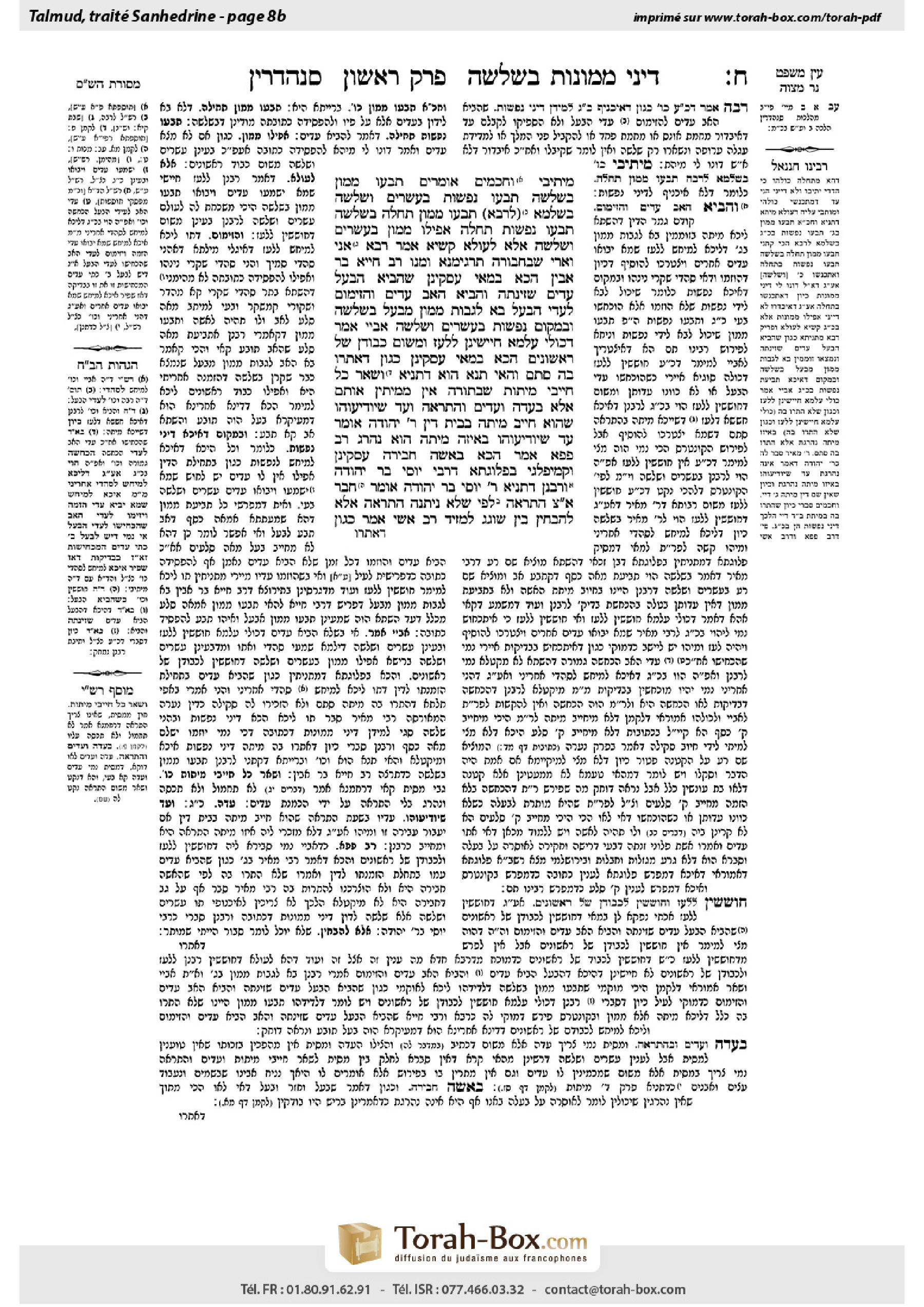
Sanhedrin 8b: Talmud study for Daf Yomi
Daf Yomi is the daily study of one Talmud folio. Explore 37 tractates with scans, Hebrew text, Sefaria English and AI-generated French translations where annotated.
Passage selection and English or AI-generated French translation are available where the scan has annotations. Daf Study is independent of Torah-Box and Sefaria.
Browse Sanhedrin · סנהדרין · All tractatesSanhedrin 8b text and translations
This page of Sanhedrin includes the Aramaic text, an English translation and an AI-generated French translation, alongside the scan above.
סנהדרין ח׳ ב · Aramaic and Hebrew text
מֵיתִיבִי: וַחֲכָמִים אוֹמְרִים, תְּבָעוֹ מָמוֹן – בִּשְׁלֹשָׁה, תְּבָעוֹ נְפָשׁוֹת – בְּעֶשְׂרִים וּשְׁלֹשָׁה. בִּשְׁלָמָא לְרָבָא, תְּבָעוֹ מָמוֹן תְּחִלָּה – בִּשְׁלֹשָׁה, תְּבָעוֹ נְפָשׁוֹת תְּחִלָּה – אֲפִילּוּ מָמוֹן בְּעֶשְׂרִים וּשְׁלֹשָׁה. אֶלָּא לְעוּלָּא קַשְׁיָא!
אָמַר רָבָא: אֲנִי וַאֲרִי שֶׁבַּחֲבוּרָה תַּרְגֵּימְנַהּ. וּמַנּוּ? רַב חִיָּיא בַּר אָבִין. הָכָא בְּמַאי עָסְקִינַן? שֶׁהֵבִיא הַבַּעַל עֵדִים שֶׁזִּינְּתָה, וְהֵבִיא הָאָב עֵדִים וֶהֱזִימּוּם לְעֵדֵי הַבַּעַל. בָּא לִגְבּוֹת מָמוֹן מִבַּעַל – בִּשְׁלֹשָׁה, וּבִמְקוֹם נְפָשׁוֹת – בְּעֶשְׂרִים וּשְׁלֹשָׁה.
אַבָּיֵי אָמַר: דְּכוּלֵּי עָלְמָא חָיְישִׁינַן לְלַעַז, וּמִשּׁוּם כְּבוֹדָן שֶׁל רִאשׁוֹנִים. הָכָא בְּמַאי עָסְקִינַן? כְּגוֹן דְּאַתְרוֹ בַּהּ סְתָם.
וְהַאי תַּנָּא הוּא, דְּתַנְיָא: וּשְׁאָר כׇּל חַיָּיבֵי מִיתוֹת שֶׁבַּתּוֹרָה, אֵין מְמִיתִין אוֹתָם אֶלָּא בְּעֵדָה וְעֵדִים וְהַתְרָאָה, וְעַד שֶׁיּוֹדִיעוּהוּ שֶׁהוּא חַיָּיב מִיתָה בְּבֵית דִּין.
רַבִּי יְהוּדָה אוֹמֵר: עַד שֶׁיּוֹדִיעוּהוּ בְּאֵיזֹה מִיתָה הוּא נֶהֱרָג.
רַב פָּפָּא אָמַר: הָכָא בְּאִשָּׁה חֲבֵירָה עָסְקִינַן, וְקָמִיפַּלְגִי בִּפְלוּגְתָּא דְּרַבִּי יוֹסֵי בַּר יְהוּדָה וְרַבָּנַן. דְּתַנְיָא, רַבִּי יוֹסֵי בַּר יְהוּדָה אוֹמֵר: חָבֵר אֵין צָרִיךְ הַתְרָאָה, לְפִי שֶׁלֹּא נִיתְּנָה הַתְרָאָה אֶלָּא לְהַבְחִין בֵּין שׁוֹגֵג לְמֵזִיד.
רַב אָשֵׁי אָמַר: כְּגוֹן
Sanhedrin 8b · English translation
The Gemara raises an objection from a baraita (Tosefta 1:2): And the Rabbis say: If he took her to court and claimed money, the case is to be adjudicated by three judges. But if he took her to court and claimed that she was liable to receive the death penalty, the case must be judged by twenty-three judges. Granted, according to Rava, the baraita can be read as referring to the terms of the beginning of the trial: If he claimed money at the outset, the case must be judged by three judges. Since the case concerns a financial claim, three are sufficient. But if he initially claimed she should be subject to the death penalty, even if the case becomes transformed into a financial case, it must be judged by twenty-three judges out of concern for their honor. But according to Ulla, who says the requirement for twenty-three judges is based on concern about rumors, it is difficult.
Rava said: I and the lion of the group both explained this. The Gemara asks: And who is the lion of the group? It is Rav Ḥiyya bar Avin. He and Rava explained: With what are we dealing here? We are dealing with a case where the husband brought witnesses to testify that the wife committed adultery, and the wife’s father brought witnesses, and through their testimony that they were with the first witnesses in some other place at the time of the alleged transgression, they classified the husband’s witnesses as conspiring witnesses. In that case, if the father comes to collect monetary restitution from the husband for defamation, the case may be adjudicated by three judges. And in a case of capital punishment, such as the trial of the husband’s witnesses, the case must be judged by twenty-three judges. In this way, Ulla’s interpretation may be reconciled with the Tosefta.
Abaye said: The dispute between Rabbi Meir and the Rabbis can be explained in another manner. According to everyone, one need be concerned for rumors, and also for the honor of the first judges. And with regard to the dispute between Rabbi Meir and the Rabbis, here we are dealing with a case where the witnesses to the adultery warned her that adultery is a capital transgression without specification as to the exact manner of death penalty she would receive.
And the matter is in accordance with this tanna, whose statement follows: As it is taught in a baraita: With regard to all the others, those who are liable for the various death penalties stated in the Torah other than the inciter to idol worship, the court executes them only when the following elements are present: The congregation, represented by the court; and witnesses; and forewarning just before the defendant commits the transgression. And the court does not execute him unless the witnesses had informed the defendant that he is liable to receive the death penalty from the court.
Rabbi Yehuda says: The defendant is not executed unless the witnesses had informed the defendant by which form of the death penalty he is to be killed. According to the opinion of Abaye, the dispute in the mishna involves a case in which it was known that the witnesses forewarned the woman, but they did not specify the specific death penalty she would be liable to receive. In this case, in accordance with the opinion of Rabbi Yehuda, Rabbi Meir holds there can be no death penalty, and therefore the case may be tried by three judges.
Rav Pappa said a similar explanation: Here we are dealing with a woman who is a ḥaveira, meaning that she is knowledgeable with regard to Torah matters. And they disagree with regard to the issue that is the subject of the dispute between Rabbi Yosei bar Yehuda and the Rabbis. As it is taught in a baraita: Rabbi Yosei bar Yehuda says: A ḥaver, as he is knowledgeable in Torah, does not need to be issued a forewarning by the witnesses, because forewarning is given only to distinguish between unintentional sin and intentional sin, and in the case of a ḥaver it is clear that he is aware of the halakha. The Rabbis maintain that even a ḥaver may not be punished unless he has been forewarned. Rav Pappa suggests that Rabbi Meir holds that a ḥaveira must be forewarned, and the mishna discussed a case where this forewarning did not take place, and consequently the trial of her alleged defamer could not lead to capital punishment.
Rav Ashi says a different explanation: The dispute in the mishna concerns a case where
Sanhedrin 8b · Traduction française (IA)
La Guemara soulève une objection à partir d’une baraïta (Tossefta 1:2) : « Et les Sages disent : s’il l’a poursuivie en justice en réclamant de l’argent, l’affaire est jugée par trois juges. Mais s’il l’a poursuivie en justice en affirmant qu’elle est passible de la peine de mort, l’affaire doit être jugée par vingt-trois juges. » Certes, selon Rava, on peut comprendre que la baraïta parle des termes de l’ouverture du procès : s’il a réclamé de l’argent dès le début, l’affaire doit être jugée par trois juges. Puisqu’il s’agit d’une réclamation pécuniaire, trois juges suffisent. Mais s’il a d’abord affirmé qu’elle devait être passible de la peine de mort, même si l’affaire se transforme ensuite en procès pécuniaire, elle doit être jugée par vingt-trois juges, par égard pour leur honneur. Mais selon Oulla, qui dit que l’exigence de vingt-trois juges repose sur la crainte des rumeurs, cela pose difficulté.
Rava dit : « Le lion du groupe et moi avons tous deux expliqué cela. » La Guemara demande : « Et qui est le lion du groupe ? » C’est Rav Ḥiyya bar Avin. Lui et Rava expliquent : de quel cas s’agit-il ici ? D’un cas où le mari a amené des témoins pour attester que sa femme avait commis un adultère, et où le père de la femme a amené des témoins qui, en attestant qu’ils se trouvaient avec les premiers témoins en un autre lieu au moment de la transgression présumée, ont fait reconnaître ces derniers comme des témoins conspirateurs. Dans ce cas, si le père vient réclamer au mari une réparation pécuniaire pour diffamation, l’affaire peut être jugée par trois juges. En revanche, dans une affaire de peine capitale, comme le procès des témoins du mari, l’affaire doit être jugée par vingt-trois juges. Ainsi, l’interprétation d’Oulla peut être conciliée avec la Tossefta.
Abayé dit : Le désaccord entre Rabbi Meïr et les Sages peut s’expliquer autrement. Selon tous, il faut tenir compte des rumeurs, ainsi que de l’honneur des premiers juges. Quant au désaccord entre Rabbi Meïr et les Sages, il porte ici sur un cas où les témoins de l’adultère l’ont avertie que l’adultère était une transgression passible de la peine de mort, sans préciser la forme exacte de cette peine.
Et la question suit l’opinion de ce tanna, dont l’enseignement est le suivant. Comme il est enseigné dans une baraïta : pour tous les autres — ceux qui sont passibles des différentes peines de mort mentionnées dans la Torah, à l’exception de celui qui incite à l’idolâtrie — le tribunal ne les exécute que lorsque les éléments suivants sont réunis : l’assemblée, représentée par le tribunal ; des témoins ; et un avertissement donné juste avant que l’accusé ne commette la transgression. Le tribunal ne l’exécute que si les témoins ont informé l’accusé qu’il est passible de la peine de mort prononcée par le tribunal.
Rabbi Yehouda dit : on n’exécute l’accusé que si les témoins l’ont informé de la forme de la peine de mort à laquelle il sera soumis. Selon l’opinion d’Abayé, le désaccord de la Michna porte sur un cas où l’on savait que les témoins avaient averti la femme, mais sans préciser la peine de mort à laquelle elle était passible. Dans ce cas, conformément à l’opinion de Rabbi Yehouda, Rabbi Meïr considère qu’aucune peine de mort ne peut être prononcée ; l’affaire peut donc être jugée par trois juges.
Rav Pappa donne une explication semblable : il s’agit ici d’une femme qui est une ḥaveira, c’est-à-dire qu’elle connaît les questions de Torah. Leur désaccord porte sur la question qui fait l’objet du désaccord entre Rabbi Yosse bar Yehouda et les Sages. Comme il est enseigné dans une baraïta : Rabbi Yosse bar Yehouda dit : « Un ḥaver, puisqu’il connaît la Torah, n’a pas besoin que les témoins lui donnent un avertissement, car l’avertissement ne sert qu’à distinguer la faute involontaire de la faute intentionnelle et, dans le cas d’un ḥaver, il est évident qu’il connaît la halakha. » Les Sages soutiennent que même un ḥaver ne peut être puni s’il n’a pas été averti. Rav Pappa propose que Rabbi Meïr estime qu’une ḥaveira doit être avertie, et que la Michna traite d’un cas où cet avertissement n’a pas eu lieu ; par conséquent, le procès de celui qui l’a prétendument diffamée ne pouvait pas aboutir à une peine capitale.
Rav Ashi donne une autre explication : le désaccord de la Michna porte sur un cas où
Traduction française générée par IA à partir de l’édition anglaise de Sefaria. Vérifie toujours un passage avec le texte source.
Text from Sefaria: William Davidson Edition - Vocalized Aramaic (CC BY NC); William Davidson Edition - English (CC BY NC).