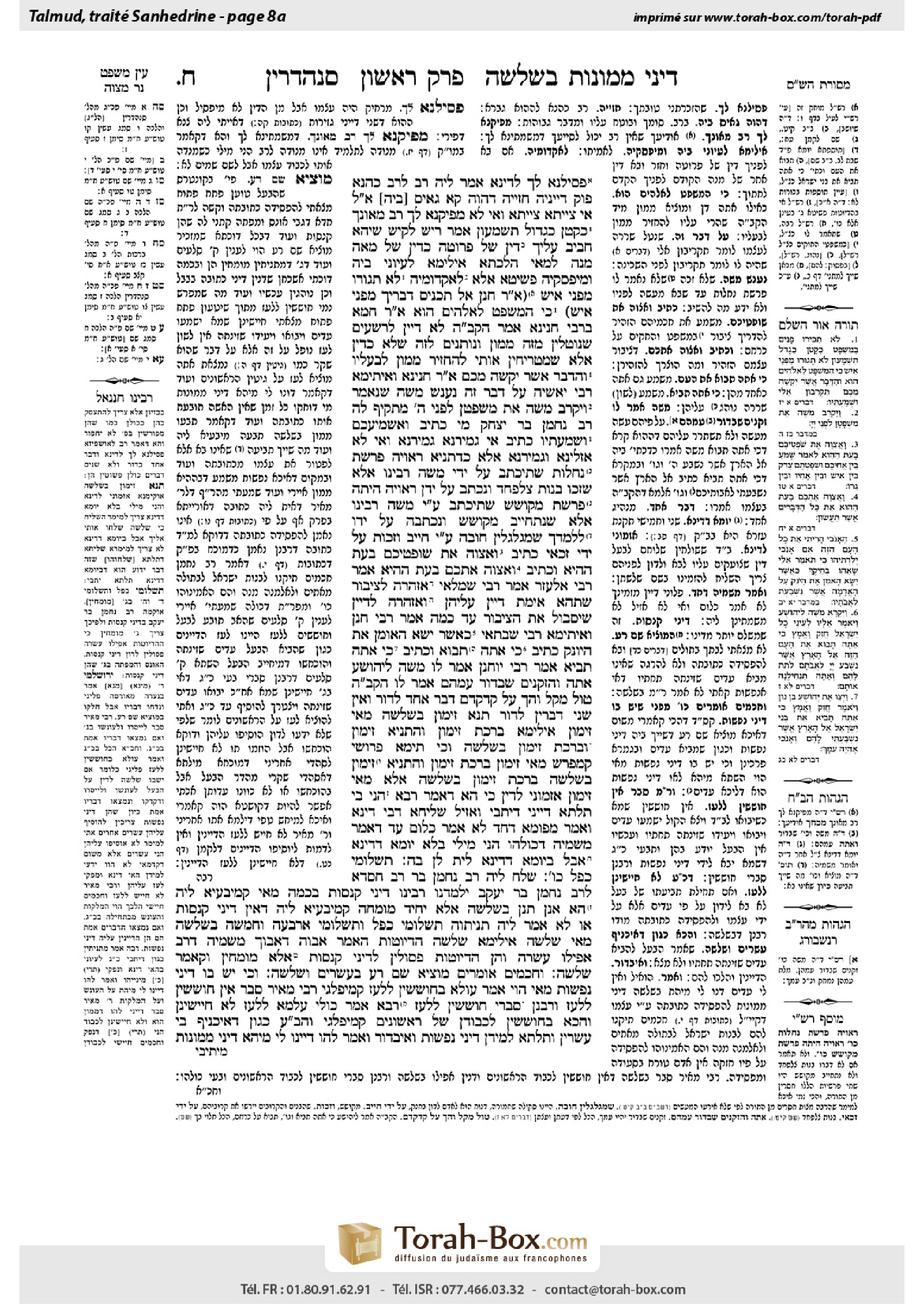
Sanhedrin 8a: Talmud study for Daf Yomi
Daf Yomi is the daily study of one Talmud folio. Explore 37 tractates with scans, Hebrew text, Sefaria English and AI-generated French translations where annotated.
Passage selection and English or AI-generated French translation are available where the scan has annotations. Daf Study is independent of Torah-Box and Sefaria.
Browse Sanhedrin · סנהדרין · All tractatesSanhedrin 8a text and translations
This page of Sanhedrin includes the Aramaic text, an English translation and an AI-generated French translation, alongside the scan above.
סנהדרין ח׳ א · Aramaic and Hebrew text
פְּסִילְנָא לָךְ לְדִינָא. אֲמַר לֵיהּ רַב לְרַב כָּהֲנָא: פּוֹק דַּיְּינֵיהּ. חַזְיֵיהּ דַּהֲוָה קָא גָּאֵיס בֵּיהּ. אֲמַר לֵיהּ: אִי צָיְיתַתְּ – צָיְיתַתְּ, וְאִי לָא – מַפֵּיקְנָא לָךְ רַב מֵאוּנָּךְ.
״כַּקָּטֹן כַּגָּדֹל תִּשְׁמָעוּן״. אָמַר רֵישׁ לָקִישׁ: שֶׁיְּהֵא חָבִיב עָלֶיךָ דִּין שֶׁל פְּרוּטָה כְּדִין שֶׁל מֵאָה מָנֶה. לְמַאי הִלְכְתָא? אִילֵּימָא לְעַיּוֹנֵי בֵּיהּ וּמִיפְסְקֵיהּ – פְּשִׁיטָא! אֶלָּא לְאַקְדּוֹמֵיהּ.
״לֹא תָגוּרוּ מִפְּנֵי אִישׁ״. אָמַר רַבִּי חָנָן: אַל תַּכְנִיס דְּבָרֶיךָ מִפְּנֵי אִישׁ. ״כִּי הַמִּשְׁפָּט לֵאלֹהִים הוּא״. אָמַר רַבִּי חָמָא בְּרַבִּי חֲנִינָא: אָמַר הַקָּדוֹשׁ בָּרוּךְ הוּא, לֹא דַּיָּין לָרְשָׁעִים שֶׁנּוֹטְלִין מִזֶּה מָמוֹן וְנוֹתְנִים לָזֶה שֶׁלֹּא כַּדִּין, אֶלָּא שֶׁמַּטְרִיחִין אוֹתִי לְהַחֲזִיר מָמוֹן לִבְעָלָיו.
״וְהַדָּבָר אֲשֶׁר יִקְשֶׁה מִכֶּם״. אָמַר רַבִּי חֲנִינָא וְאִיתֵּימָא רַבִּי יֹאשִׁיָּה: עַל דָּבָר זֶה נֶעֱנַשׁ מֹשֶׁה, שֶׁנֶּאֱמַר ״וַיַּקְרֵב מֹשֶׁה אֶת מִשְׁפָּטָן לִפְנֵי ה׳״. מַתְקֵיף לַהּ רַב נַחְמָן בַּר יִצְחָק: מִי כְּתִיב ״וְאַשְׁמִיעֲכֶם״? ״וּשְׁמַעְתִּיו״ כְּתִיב! אִי גְּמִירְנָא – גְּמִירְנָא, וְאִי לָא – אָזֵילְנָא וּגְמִירְנָא.
אֶלָּא, כִּדְתַנְיָא: רְאוּיָה פָּרָשַׁת נַחֲלוֹת שֶׁתִּיכָּתֵב עַל יְדֵי מֹשֶׁה רַבֵּינוּ, אֶלָּא שֶׁזָּכוּ בְּנוֹת צְלָפְחָד וְנִכְתְּבָה עַל יָדָן. רְאוּיָה הָיְתָה פָּרָשַׁת מְקוֹשֵׁשׁ שֶׁתִּיכָּתֵב עַל יְדֵי מֹשֶׁה רַבֵּינוּ, אֶלָּא שֶׁנִּתְחַיֵּיב מְקוֹשֵׁשׁ וְנִכְתְּבָה עַל יָדוֹ. לְלַמֶּדְךָ שֶׁמְגַלְגְּלִין חוֹבָה עַל יְדֵי חַיָּיב, וּזְכוּת עַל יְדֵי זַכַּאי.
כְּתִיב: ״וָאֲצַוֶּה אֶת שֹׁפְטֵיכֶם בָּעֵת הַהִיא״, וּכְתִיב: ״וָאֲצַוֶּה אֶתְכֶם בָּעֵת הַהִיא״. אָמַר רַבִּי אֶלְעָזָר אָמַר רַבִּי שִׂמְלַאי: אַזְהָרָה לַצִּיבּוּר שֶׁתְּהֵא אֵימַת דַּיָּין עֲלֵיהֶן, וְאַזְהָרָה לַדַּיָּין שֶׁיִּסְבּוֹל אֶת הַצִּיבּוּר. עַד כַּמָּה? אָמַר רַבִּי חָנָן, וְאִיתֵּימָא רַבִּי שַׁבְּתַאי: ״כַּאֲשֶׁר יִשָּׂא הָאֹמֵן אֶת הַיֹּנֵק״.
כְּתִיב: ״כִּי אַתָּה תָּבוֹא״, וּכְתִיב: ״כִּי אַתָּה תָּבִיא״. אָמַר רַבִּי יוֹחָנָן: אָמַר לוֹ מֹשֶׁה לִיהוֹשֻׁעַ: אַתָּה וְהַזְּקֵנִים שֶׁבַּדּוֹר עִמָּהֶם. אָמַר לוֹ הַקָּדוֹשׁ בָּרוּךְ הוּא: טוֹל מַקֵּל וְהַךְ עַל קׇדְקֳדָם. דַּבָּר אֶחָד לַדּוֹר, וְאֵין שְׁנֵי דַּבָּרִין לַדּוֹר.
תָּנָא: זִימּוּן בִּשְׁלֹשָׁה. מַאי זִימּוּן? אִילֵּימָא בִּרְכַּת זִימּוּן, וְהָתַנְיָא: זִימּוּן וּבִרְכַּת זִימּוּן בִּשְׁלֹשָׁה! וְכִי תֵּימָא פָּרוֹשֵׁי קָמְפָרֵשׁ: מַאי זִימּוּן? בִּרְכַּת זִימּוּן. וְהָתַנְיָא: זִימּוּן בִּשְׁלֹשָׁה, בִּרְכַּת זִימּוּן בִּשְׁלֹשָׁה!
אֶלָּא מַאי זִימּוּן? אַזְמוֹנֵי לְדִין. כִּי הָא דְּאָמַר רָבָא: הָנֵי בֵּי תְלָתָא דַּיָּינֵי דְּיָתְבִי, וְאָזֵיל שְׁלִיחָא דְּבֵי דִּינָא וְאָמַר מִפּוּמָּא דְּחַד – לֹא אָמַר כְּלוּם, עַד דְּאָמַר מִשְּׁמֵיהּ דְּכוּלְּהוּ. הָנֵי מִילֵּי בְּלָא יוֹמָא דְּדִינָא, אֲבָל בְּיוֹמָא דְּדִינָא – לֵית לַן בַּהּ.
תַּשְׁלוּמֵי כֶּפֶל כּוּ׳. שְׁלַח לֵיהּ רַב נַחְמָן בַּר רַב חִסְדָּא לְרַב נַחְמָן בַּר יַעֲקֹב: יְלַמְּדֵנוּ רַבֵּינוּ, דִּינֵי קְנָסוֹת בְּכַמָּה? מַאי קָמִיבַּעְיָא לֵיהּ? הָא אֲנַן תְּנַן בִּשְׁלֹשָׁה! אֶלָּא יָחִיד מוּמְחֶה קָמִיבַּעְיָא לֵיהּ, דְּאֵין דִּינֵי קְנָסוֹת אוֹ לָא?
אֲמַר לֵיהּ: תְּנֵיתוּהָ, תַּשְׁלוּמֵי כֶּפֶל וְתַשְׁלוּמֵי אַרְבָּעָה וַחֲמִשָּׁה בִּשְׁלֹשָׁה. מַאי שְׁלֹשָׁה? אִילֵּימָא שְׁלֹשָׁה הֶדְיוֹטוֹת, הָאָמַר אֲבוּהּ דַּאֲבוּךְ מִשְּׁמֵיהּ דְּרַב: אֲפִילּוּ עֲשָׂרָה וְהֵן הֶדְיוֹטוֹת פְּסוּלִין לְדִינֵי קְנָסוֹת! אֶלָּא מוּמְחִין, וְקָאָמַר שְׁלֹשָׁה.
וַחֲכָמִים אוֹמְרִים: מוֹצִיא שֵׁם רַע בְּעֶשְׂרִים וּשְׁלֹשָׁה.
וְכִי יֵשׁ בּוֹ דִּינֵי נְפָשׁוֹת, מַאי הָוֵי?
אָמַר עוּלָּא: בְּחוֹשְׁשִׁין לְלַעַז קָמִיפַּלְגִי. רַבִּי מֵאִיר סָבַר: אֵין חוֹשְׁשִׁין לְלַעַז, וְרַבָּנַן סָבְרִי: חוֹשְׁשִׁין לְלַעַז.
רָבָא אָמַר: כּוּלֵּי עָלְמָא לְלַעַז לָא חָיְישִׁינַן, וְהָכָא בְּחוֹשְׁשִׁין לִכְבוֹדָן שֶׁל רִאשׁוֹנִים קָמִיפַּלְגִי. וְהָכָא בְּמַאי עָסְקִינַן? כְּגוֹן דְּאִיכְּנִיף בֵּי עֶשְׂרִין וּתְלָתָא לְמֵידַן דִּינֵי נְפָשׁוֹת, וְאִיבַּדּוּר, וַאֲמַר לְהוּ: דַּיְּינוּ לִי מִיהָא דִּינֵי מָמוֹנוֹת.
Sanhedrin 8a · English translation
I am disqualified to judge for you, because I may be partial to you due to what you’ve done for me. Rav said to Rav Kahana: Go out and judge the case. Rav Kahana saw that Rav’s host was acting haughtily due to his relationship with Rav, as he presumed that Rav Kahana was predisposed to favor him. Rav Kahana said to the host: If you are prepared to listen, then listen to me and follow my instructions. And if not, I will take Rav out of your ears. I will treat you harshly, and you will understand that your relationship with Rav will not help you at all.
§ The Gemara continues to interpret clauses from the verse cited above. “You shall hear the small and the great alike” (Deuteronomy 1:17). Reish Lakish says: This teaches that the judgment of one peruta should be as dear, i.e., important, to you as the judgment of one hundred maneh, i.e., ten thousand dinars. The Gemara asks: With regard to what halakha is this said? If we say it is with regard to the need to study it carefully and to decide the case justly, it is obvious that even cases relating to small sums must be judged thoroughly. Rather, Reish Lakish was speaking with regard to giving it precedence: The small claims case may not be deferred in favor of the larger claim merely because the disputed sum is smaller.
The Gemara continues the interpretation of the verse: “You shall not be afraid before any man.” Rabbi Ḥanan says: Do not suppress your statement of opinion due to any person. The verse continues: “For the judgment is God’s.” Rabbi Ḥama, son of Rabbi Ḥanina, says: The Holy One, Blessed be He, says: It is not enough for the wicked judges, that they take money from this person and they give it to that person unlawfully, but they even trouble Me to return the money to its rightful owners. As proper justice is ultimately in the hands of God, He takes responsibility to bring about the rectification of the errors of unfit judges.
The verse continues: “And the cause that is too hard for you, you shall bring to me, and I will hear it.” Rabbi Ḥanina, and some say Rabbi Yoshiya, says: On account of this matter, which displayed a degree of presumptuousness, Moses was punished, as it is stated: “And Moses brought their cause before the Lord” (Numbers 27:5). In this instance, when Zelophehad’s daughters presented their case to Moses, he did not know the answer himself and was compelled to ask God. Rav Naḥman bar Yitzḥak objects to this critique of Moses: Is it written: “And I will tell you,” which would indicate that Moses assumed the authority for himself? No, it is written: “And I will hear it,” meaning: If I have learned the halakha, I have learned it. And if not, I will go and learn it. Consequently, there was no presumptuousness in Moses’ statement.
Rather, the unusual manner in which the halakha of women’s inheritance (see Numbers, chapter 27) was revealed may be understood as it is taught in a baraita: It would have been fitting for the Torah portion about inheritances to have been written by attributing it to Moses, our teacher, i.e., to introduce the halakha with the standard formulation: And the Lord spoke to Moses, saying. But the daughters of Zelophehad achieved merit as a result of their initiative in pursuing a portion in Eretz Yisrael, and therefore the halakha was written by attributing it to them. Similarly, it would have been fitting for the Torah portion concerning the punishment of the wood gatherer (see Numbers 15:32–36) to have been written by attributing it to Moses, our teacher. But the wood gatherer was found guilty, and the halakha was written by attributing it to him. This serves to teach you that guilt is engendered by means of the guilty and merit by means of the innocent.
The Gemara continues to interpret verses pertaining to judges and judgment. It is written: “And I charged your judges at that time” (Deuteronomy 1:16), and it is written soon thereafter: “And I commanded you at that time all the things that you should do” (Deuteronomy 1:18). There is an apparent contradiction between these verses, as one indicates God commanded the judges and the other indicates He commanded the people. Rabbi Elazar says that Rabbi Simlai says: Moses issued a warning to the community that the awe of the judge must be upon them, and Moses issued a warning to the judge that he must bear the burden of the community. Up to what degree must the judge bear this burden? Rabbi Ḥanan, and some say Rabbi Shabbtai, says: It is as Moses said, that he carried Israel “as a nursing father carries the sucking child” (Numbers 11:12).
Similarly, a distinction is drawn between two verses where Moses commanded Joshua concerning his impending leadership: It is written: “For you shall go with these people into the land” (Deuteronomy 31:7), and it is written: “For you shall bring the children of Israel into the land” (Deuteronomy 31:23). Rabbi Yoḥanan reconciled the difference between these two charges and said: Moses said to Joshua, in the first verse: You and the elders of the generation will enter into Eretz Yisrael together with the people, i.e., the elders will assist you in the leadership. Subsequently, in the second verse, the Holy One, Blessed be He, said to Joshua: You yourself must bring the people: Take a rod and strike the people upon their skulls. There must be one clear and authoritative leader for the generation, and there may not be two or more leaders for the generation.
§ The Gemara returns to the discussion of halakhic matters related to the mishna. The Sages taught in a baraita: A zimmun is to be issued with three people. The Gemara analyzes: What is meant by the term zimmun in the baraita? If we say it is referring to the invitation to recite Grace after Meals jointly, which is called the zimmun blessing, that is difficult. But isn’t it taught in a baraita: Zimmun and the zimmun blessing are to be issued with three people? As the baraita lists these halakhot separately, it indicates that the term zimmun is referring to a different matter. And if you would say that the baraita explains itself, by clarifying: What is meant by the term zimmun? It is the zimmun blessing, another source indicates even more clearly that these terms are referring to two different procedures. But isn’t it taught in a baraita: Zimmun is performed with three people, and the zimmun blessing is performed with three people? Evidently, therefore, zimmun is not referring to the zimmun blessing.
Rather, what is zimmun? It is a summons to appear in court for judgment. The Gemara notes that this is similar to that which Rava said: With regard to this court of three judges who are sitting and waiting to adjudicate a case, and the agent of the court went and said to one of the litigants that he is summoned in the name of only one of the judges, the summons is insufficient. It is as if the agent did not say anything, unless he said it in the name of all of them. That is what is meant when it is taught that zimmun is issued by three. The Gemara clarifies: That statement applies only when it is not the day set for judgment. But on the day set for judgment, when it is understood that a summons in the name of only one judge actually indicates a summons from an assembled court, we have no problem with it. Someone who ignores such a summons is subject to the full censure of the court.
§ The mishna teaches: Cases involving payment of double the principal must be adjudicated by a court of three judges. Rav Naḥman bar Rav Ḥisda sent an inquiry to Rav Naḥman bar Ya’akov: Let our teacher instruct us: With regard to cases involving laws of fines, by how many judges must such cases be adjudicated? The Gemara asks: What is the dilemma he is raising? Didn’t we learn in the mishna that such cases are judged by three judges? Rather, Rav Naḥman bar Rav Ḥisda is raising a dilemma with regard to a single expert judge: May he adjudicate cases involving laws of fines by himself or not?
Rav Naḥman bar Ya’akov said to him: You already learned this in the mishna: Cases involving payment of double the principal and payment of four or five times the principal must be adjudicated by three judges. What is meant by three? If we say it means three non-ordained lay judges, didn’t your father’s father say in the name of Rav: Even if there are ten judges, if they are lay judges they are unfit for adjudicating cases involving laws of fines? Rather, the mishna is discussing expert judges, and it says that three are necessary. Therefore, a single expert judge may not adjudicate such cases.
§ The mishna records a dispute concerning the number of judges required to judge the case of a defamer (see Deuteronomy 22:13–19), which generally involves a man defaming his wife by falsely accusing her of having committed adultery while she was betrothed. Rabbi Meir says the case must be tried by three judges, and the Rabbis say: An accused defamer is judged by a court of twenty-three judges. It is obvious that in a case in which the husband’s accusation has the potential to result in the woman’s execution, Rabbi Meir agrees that as this is a case of capital law, it must be tried by twenty-three judges. Therefore, the dispute in the mishna must involve a lesser claim, such as a case where there are no witnesses to the alleged adultery, but the husband claims she was not a virgin when they married and is suing for monetary compensation.
The Gemara asks: But although the halakha of a defamer contains the potential to qualify as a case of capital law, what of it? As long as this particular case has no such potential, why do the Rabbis require twenty-three judges?
Ulla said: Rabbi Meir and the Rabbis disagree with regard to the question of whether one needs to be concerned with the possibility of rumors, meaning that if the husband raises the claim that his wife committed adultery, although he has no witnesses and there is no potential for a capital conviction, should the court be concerned with the possibility that the publicity generated by the proceedings may lead to the emergence of witnesses, which would make it a capital case? Rabbi Meir holds that one need not be concerned with the possibility of rumors. And the Rabbis hold that one does need to be concerned with the possibility of rumors.
Rava says: Everyone agrees that one need not be concerned with the possibility of rumors. And here they disagree about whether one need be concerned for the honor of the first judges. And with what are we dealing here? We are dealing, for example, with a case where a court of twenty-three judges was convened to judge a case of capital law, because the husband accused his wife of committing adultery. As there were no witnesses to the alleged adultery, the court of twenty-three judges was disbanded, and then the husband said to them: At least adjudicate for me the aspect of monetary law, to reduce the sum in her marriage contract to the amount for a non-virgin. At that point, it became strictly a case of monetary law, which would normally be tried by three judges. Nevertheless, the Rabbis hold that the court of twenty-three judges must be reconvened, out of concern for their honor, since they had already begun to hear the case. Rabbi Meir disagrees, as he does not view this as an affront to the honor of the judges.
Sanhedrin 8a · Traduction française (IA)
« Je ne peux pas vous juger, car je pourrais vous favoriser en raison de ce que vous avez fait pour moi. » Rav dit à Rav Kahana : « Va juger cette affaire. » Rav Kahana vit que l’hôte de Rav se comportait avec arrogance en raison de ses liens avec Rav, présumant que Rav Kahana serait disposé à lui être favorable. Rav Kahana dit à l’hôte : « Si tu es prêt à m’écouter, écoute-moi et suis mes instructions. Sinon, je vais te faire sortir Rav des oreilles. Je te traiterai durement et tu comprendras que tes liens avec Rav ne te seront d’aucune aide. »
§ La Guemara poursuit l’interprétation des clauses du verset cité plus haut. « Vous écouterez le petit comme le grand » (Deutéronome 1:17). Reish Lakish dit : Cela enseigne que le jugement portant sur une perouta doit t’être aussi précieux, c’est-à-dire aussi important, que celui portant sur cent maneh, soit dix mille dinars. La Guemara demande : À propos de quelle halakha cela est-il dit ? Si nous disons que cela concerne la nécessité d’étudier soigneusement l’affaire et de rendre une décision juste, cela va de soi : même les affaires portant sur de petites sommes doivent être jugées avec minutie. Reish Lakish parlait donc plutôt de l’ordre de priorité : une affaire portant sur une petite somme ne peut être ajournée au profit d’une affaire portant sur une somme plus importante au seul motif que la somme litigieuse est moindre.
La Guemara poursuit l’interprétation du verset : « Vous ne craindrez aucun homme. » Rabbi Ḥanan dit : Ne tais pas ton opinion à cause de qui que ce soit. Le verset poursuit : « Car le jugement est à Dieu. » Rabbi Ḥama, fils de Rabbi Ḥanina, dit : Le Saint, béni soit-Il, dit : « Il ne suffit pas aux juges méchants de prendre de l’argent à celui-ci et de le donner illicitement à celui-là ; ils Me causent même des difficultés en M’obligeant à rendre l’argent à ses propriétaires légitimes. » Puisque la justice véritable relève en définitive de Dieu, Il assume la responsabilité de réparer les erreurs des juges indignes.
Le verset poursuit : « Et l’affaire qui est trop difficile pour vous, vous me la présenterez et je l’entendrai. » Rabbi Ḥanina, et certains disent Rabbi Yoshiya, dit : C’est à cause de cette déclaration, qui témoignait d’une certaine présomption, que Moïse fut puni, comme il est dit : « Moïse présenta leur affaire devant le Seigneur » (Nombres 27:5). En l’occurrence, lorsque les filles de Tselofḥad présentèrent leur affaire à Moïse, celui-ci ne connaissait pas la réponse et dut interroger Dieu. Rav Naḥman bar Yitzḥak conteste cette critique de Moïse : Est-il écrit : « Et je vous dirai », ce qui indiquerait que Moïse s’attribuait cette autorité ? Non, il est écrit : « Et je l’entendrai », ce qui signifie : « Si j’ai appris la halakha, je la connais ; sinon, j’irai l’apprendre. » Par conséquent, les paroles de Moïse ne témoignaient d’aucune présomption.
Il faut plutôt comprendre la manière inhabituelle dont fut révélée la halakha relative à l’héritage des femmes (voir Nombres, chapitre 27) à la lumière de ce qui est enseigné dans une baraïta : Il aurait convenu que le passage de la Torah relatif aux héritages soit attribué à Moïse, notre maître, c’est-à-dire que la halakha soit introduite par la formule habituelle : « Et le Seigneur parla à Moïse en disant. » Mais les filles de Tselofḥad obtinrent un mérite grâce à leur initiative visant à recevoir une part en Eretz Yisrael ; la halakha fut donc attribuée à elles. De même, il aurait convenu que le passage de la Torah concernant la punition de celui qui ramassa du bois (voir Nombres 15:32–36) soit attribué à Moïse, notre maître. Mais celui qui ramassa du bois fut reconnu coupable, et la halakha fut attribuée à lui. Cela vient t’enseigner que la culpabilité est engendrée par le coupable et le mérite par l’innocent.
La Guemara poursuit l’interprétation des versets concernant les juges et le jugement. Il est écrit : « Et je chargeai vos juges en ce temps-là » (Deutéronome 1:16), puis, peu après : « Et je vous prescrivis alors tout ce que vous deviez faire » (Deutéronome 1:18). Ces versets semblent contradictoires, car l’un indique que Dieu donna ses instructions aux juges, tandis que l’autre indique qu’Il les donna au peuple. Rabbi Elazar dit au nom de Rabbi Simlai : Moïse avertit la communauté qu’elle devait éprouver de la crainte envers le juge, et il avertit le juge qu’il devait porter le fardeau de la communauté. Jusqu’à quel point le juge doit-il porter ce fardeau ? Rabbi Ḥanan, et certains disent Rabbi Shabbtai, dit : Il doit le porter comme Moïse l’a dit, lui qui portait Israël « comme un père nourricier porte l’enfant qui tète » (Nombres 11:12).
De même, on distingue deux versets dans lesquels Moïse donna à Josué des instructions au sujet de la direction qui allait lui être confiée. Il est écrit : « Car tu entreras avec ce peuple dans le pays » (Deutéronome 31:7), et il est écrit : « Car tu feras entrer les enfants d’Israël dans le pays » (Deutéronome 31:23). Rabbi Yoḥanan concilia ces deux consignes et dit : Dans le premier verset, Moïse dit à Josué : « Toi et les anciens de cette génération entrerez avec le peuple en Eretz Yisrael », c’est-à-dire que les anciens t’assisteront dans la direction. Ensuite, dans le second verset, le Saint, béni soit-Il, dit à Josué : « C’est toi-même qui devras faire entrer le peuple. Prends un bâton et frappe le peuple sur le crâne. » Il doit y avoir un seul dirigeant clair et faisant autorité pour la génération ; il ne peut y avoir deux dirigeants ou davantage.
§ La Guemara revient à la discussion des questions de halakha liées à la Michna. Les Sages enseignèrent dans une baraïta : Un zimmun se fait à trois personnes. La Guemara analyse : Que désigne le terme zimmun dans la baraïta ? Si nous disons qu’il s’agit de l’invitation à réciter ensemble la bénédiction après le repas, appelée bénédiction du zimmun, cela pose difficulté. N’est-il pas enseigné dans une baraïta : Le zimmun et la bénédiction du zimmun se font à trois personnes ? Puisque la baraïta énumère ces halakhot séparément, cela indique que le terme zimmun désigne autre chose. Et si tu dis que la baraïta s’explique elle-même en précisant : « Que désigne le terme zimmun ? Il s’agit de la bénédiction du zimmun », une autre source montre encore plus clairement que ces termes désignent deux procédures différentes. N’est-il pas enseigné dans une baraïta : Le zimmun se fait à trois personnes, et la bénédiction du zimmun se fait à trois personnes ? Il est donc évident que le zimmun ne désigne pas la bénédiction du zimmun.
Que désigne donc le zimmun ? Il s’agit d’une convocation à comparaître en justice. La Guemara relève que cela est semblable à ce que Rava a dit : Si un tribunal de trois juges siège en attendant de statuer sur une affaire et que son agent se rend auprès de l’un des plaideurs pour lui dire qu’il est convoqué au nom d’un seul des juges, la convocation n’est pas valable. C’est comme si l’agent n’avait rien dit, à moins qu’il ne l’ait faite au nom de tous les juges. C’est là le sens de l’enseignement selon lequel le zimmun est prononcé par trois. La Guemara précise : Cela ne s’applique que lorsque ce n’est pas le jour fixé pour le jugement. Mais le jour fixé pour le jugement, puisqu’il est entendu qu’une convocation au nom d’un seul juge signifie en réalité qu’elle émane d’un tribunal réuni, il n’y a pas de difficulté. Celui qui ignore une telle convocation s’expose à toute la réprobation du tribunal.
§ La Michna enseigne que les affaires portant sur le paiement du double du principal doivent être jugées par un tribunal de trois juges. Rav Naḥman bar Rav Ḥisda envoya une question à Rav Naḥman bar Ya’akov : « Que notre maître nous enseigne : combien de juges faut-il pour juger les affaires relevant des lois des amendes ? » La Guemara demande : Quelle difficulté soulève-t-il ? N’avons-nous pas appris dans la Michna que ces affaires sont jugées par trois juges ? Rav Naḥman bar Rav Ḥisda soulève plutôt une question au sujet d’un juge expert unique : peut-il juger seul les affaires relevant des lois des amendes, ou non ?
Rav Naḥman bar Ya’akov lui dit : Tu l’as déjà appris dans la Michna : les affaires portant sur le paiement du double du principal et celles portant sur le paiement de quatre ou cinq fois le principal doivent être jugées par trois juges. Que signifie « trois » ? Si nous disons qu’il s’agit de trois juges laïcs non ordonnés, ton grand-père n’a-t-il pas dit au nom de Rav : même s’il y a dix juges, s’ils sont laïcs, ils ne sont pas aptes à juger les affaires relevant des lois des amendes ? La Michna traite donc de juges experts et précise qu’ils doivent être trois. Par conséquent, un seul juge expert ne peut pas juger de telles affaires.
§ La Michna rapporte une controverse concernant le nombre de juges requis pour juger l’affaire d’un diffamateur (voir Deutéronome 22:13–19), qui concerne généralement un homme accusant faussement sa femme d’avoir commis l’adultère alors qu’elle était fiancée. Rabbi Meir dit que l’affaire doit être jugée par trois juges, tandis que les Sages disent : Un homme accusé de diffamation est jugé par un tribunal de vingt-trois juges. Il est évident que si l’accusation du mari peut entraîner l’exécution de la femme, Rabbi Meir convient que, puisqu’il s’agit d’une affaire de droit pénal, elle doit être jugée par vingt-trois juges. La controverse de la Michna doit donc porter sur une accusation moins grave, par exemple un cas où il n’y a aucun témoin de l’adultère présumé, mais où le mari prétend que sa femme n’était pas vierge lorsqu’ils se sont mariés et réclame une compensation financière.
La Guemara demande : Mais même si l’affaire du diffamateur peut relever du droit pénal, qu’importe ? Tant que cette affaire précise ne présente pas une telle possibilité, pourquoi les Sages exigent-ils vingt-trois juges ?
Ulla dit : Rabbi Meir et les Sages sont en désaccord sur la question de savoir s’il faut tenir compte de la possibilité que des témoins se manifestent à la suite de rumeurs. Autrement dit, si le mari prétend que sa femme a commis l’adultère, alors qu’il n’a pas de témoins et qu’il n’existe aucune possibilité de condamnation à mort, le tribunal doit-il craindre que la publicité donnée à la procédure fasse surgir des témoins, ce qui en ferait une affaire passible de la peine capitale ? Rabbi Meir estime qu’il n’est pas nécessaire de tenir compte de cette possibilité. Les Sages, eux, estiment qu’il faut en tenir compte.
Rava dit : Tout le monde convient qu’il n’est pas nécessaire de tenir compte de la possibilité que des témoins se manifestent à la suite de rumeurs. Leur désaccord porte sur la question de savoir s’il faut se soucier de l’honneur des premiers juges. De quelle situation s’agit-il ici ? Par exemple, un tribunal de vingt-trois juges a été réuni pour juger une affaire passible de la peine capitale, parce que le mari accusait sa femme d’adultère. Comme il n’y avait aucun témoin de l’adultère présumé, le tribunal de vingt-trois juges fut dissous, puis le mari leur dit : « Au moins, jugez l’aspect financier de l’affaire, afin de réduire le montant de son contrat de mariage à celui prévu pour une non-vierge. » À ce stade, il ne s’agissait plus que d’une affaire financière, qui aurait normalement dû être jugée par trois juges. Néanmoins, les Sages estiment qu’il faut réunir de nouveau le tribunal de vingt-trois juges, par souci de leur honneur, puisqu’ils avaient déjà commencé à entendre l’affaire. Rabbi Meir n’est pas d’accord, car il ne considère pas cela comme une atteinte à l’honneur des juges.
Traduction française générée par IA à partir de l’édition anglaise de Sefaria. Vérifie toujours un passage avec le texte source.
Text from Sefaria: William Davidson Edition - Vocalized Aramaic (CC BY NC); William Davidson Edition - English (CC BY NC).