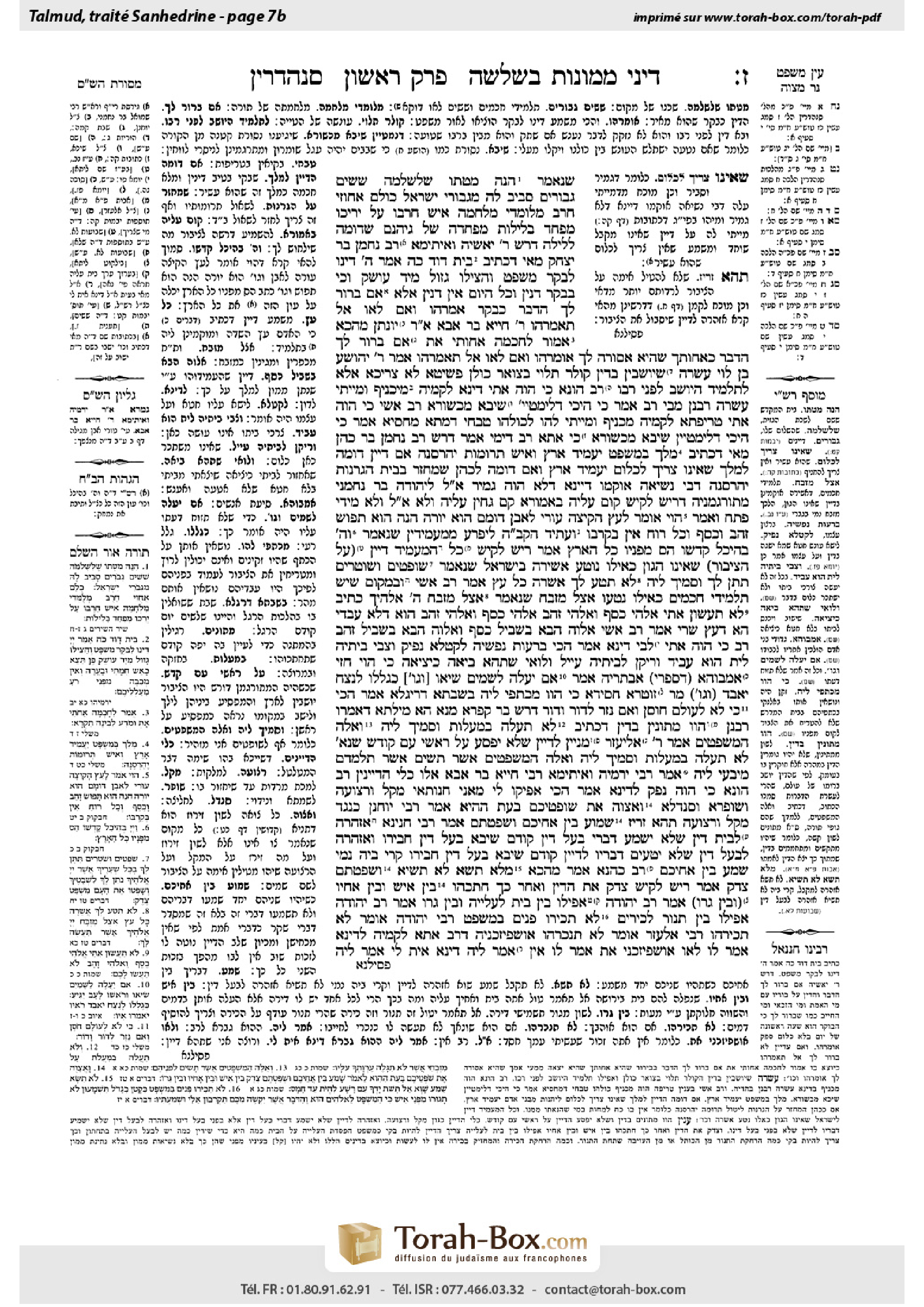
Sanhedrin 7b: Talmud study for Daf Yomi
Daf Yomi is the daily study of one Talmud folio. Explore 37 tractates with scans, Hebrew text, Sefaria English and AI-generated French translations where annotated.
Passage selection and English or AI-generated French translation are available where the scan has annotations. Daf Study is independent of Torah-Box and Sefaria.
Browse Sanhedrin · סנהדרין · All tractatesSanhedrin 7b text and translations
This page of Sanhedrin includes the Aramaic text, an English translation and an AI-generated French translation, alongside the scan above.
סנהדרין ז׳ ב · Aramaic and Hebrew text
שֶׁנֶּאֱמַר: ״הִנֵּה מִטָּתוֹ שֶׁלִּשְׁלֹמֹה שִׁשִּׁים גִּבֹּרִים סָבִיב לָהּ מִגִּבֹּרֵי יִשְׂרָאֵל כֻּלָּם אֲחֻזֵי חֶרֶב מְלֻמְּדֵי מִלְחָמָה אִישׁ חַרְבּוֹ עַל יְרֵכוֹ מִפַּחַד בַּלֵּילוֹת״. מִפַּחְדָּהּ שֶׁל גֵּיהִנָּם, שֶׁדּוֹמָה לְלַיְלָה.
דָּרַשׁ רַבִּי יֹאשִׁיָּה, וְאִיתֵּימָא רַב נַחְמָן בַּר יִצְחָק, מַאי דִּכְתִיב: ״בֵּית דָּוִד כֹּה אָמַר ה׳ דִּינוּ לַבֹּקֶר מִשְׁפָּט וְהַצִּילוּ גָזוּל מִיַּד עוֹשֵׁק״ – וְכִי בַּבֹּקֶר דָּנִין וְכׇל הַיּוֹם אֵין דָּנִין? אֶלָּא אִם בָּרוּר לְךָ הַדָּבָר כַּבֹּקֶר – אׇמְרֵהוּ, וְאִם לָאו – אַל תֹּאמְרֵהוּ. רַבִּי חִיָּיא בַּר אַבָּא אָמַר רַבִּי יוֹנָתָן, מֵהָכָא: ״אֱמֹר לַחׇכְמָה אֲחֹתִי אָתְּ״ – אִם בָּרוּר לְךָ הַדָּבָר כַּאֲחוֹתְךָ שֶׁהִיא אֲסוּרָה לְךָ – אוֹמְרֵהוּ, וְאִם לָאו – אַל תֹּאמְרֵהוּ.
אָמַר רַבִּי יְהוֹשֻׁעַ בֶּן לֵוִי: עֲשָׂרָה שֶׁיּוֹשְׁבִין בַּדִּין, קוֹלָר תָּלוּי בְּצַוַּאר כּוּלָּן. פְּשִׁיטָא! לָא צְרִיכָא אֶלָּא לְתַלְמִיד הַיּוֹשֵׁב לִפְנֵי רַבּוֹ.
רַב הוּנָא, כִּי הֲוָה אָתֵי דִּינָא לְקַמֵּיהּ, מְיכַנֵּיף וּמַיְיתִי עֲשָׂרָה רַבָּנַן מִבֵּי רַב. אָמַר: כִּי הֵיכִי דְּלִימְטְיַין שִׁיבָּא מִכְּשׁוּרָא. רַב אָשֵׁי, כִּי הֲוָה אָתֵי טְרֵיפְתָּא לְקַמֵּיהּ, מְכַנֵּיף וּמַיְיתֵי לְהוּ לְכוּלְּהוּ טַבָּחֵי דְּמָתָא מַחְסֵיָא. אָמַר: כִּי הֵיכִי דְּלִימְטְיַין שִׁיבָּא מִכְּשׁוּרָא.
כִּי אֲתָא רַב דִּימִי אָמַר: דָּרַשׁ רַב נַחְמָן בַּר כֹּהֵן, מַאי דִּכְתִיב: ״מֶלֶךְ בְּמִשְׁפָּט יַעֲמִיד אָרֶץ וְאִישׁ תְּרוּמוֹת יֶהֶרְסֶנָּה״? אִם דַּיָּין דּוֹמֶה לְמֶלֶךְ שֶׁאֵינוֹ צָרִיךְ לִכְלוּם – יַעֲמִיד אָרֶץ, וְאִם דּוֹמֶה לְכֹהֵן שֶׁמְּחַזֵּר בְּבֵית הַגְּרָנוֹת – יֶהֶרְסֶנָּה.
דְּבֵי נְשִׂיאָה אוֹקְמוּ דַּיָּינָא דְּלָא הֲוָה גְּמִיר. אֲמַר לֵיהּ לִיהוּדָה בַּר נַחְמָנִי, מְתוּרְגְּמָנֵיהּ דְּרֵישׁ לָקִישׁ: ״קוּם עֲלֵיהּ בְּאָמוֹרָא״. קָם, גְּחֵין עֲלֵיהּ, וְלָא אֲמַר לֵיהּ וְלָא מִידֵּי.
פָּתַח וְאָמַר: ״הוֹי אוֹמֵר לָעֵץ הָקִיצָה עוּרִי לְאֶבֶן דּוּמָם הוּא יוֹרֶה הִנֵּה הוּא תָּפוּשׂ זָהָב וָכֶסֶף וְכׇל רוּחַ אֵין בְּקִרְבּוֹ״. וְעָתִיד הַקָּדוֹשׁ בָּרוּךְ הוּא לִיפָּרַע מִמַּעֲמִידָן, שֶׁנֶּאֱמַר: ״וַה׳ בְּהֵיכַל קׇדְשׁוֹ הַס מִפָּנָיו כׇּל הָאָרֶץ״.
אָמַר רֵישׁ לָקִישׁ: כׇּל הַמַּעֲמִיד דַּיָּין עַל הַצִּיבּוּר שֶׁאֵינוֹ הָגוּן, כְּאִילּוּ נוֹטֵעַ אֲשֵׁירָה בְּיִשְׂרָאֵל, שֶׁנֶּאֱמַר: ״שֹׁפְטִים וְשֹׁטְרִים תִּתֶּן לְךָ״, וּסְמִיךְ לֵיהּ: ״לֹא תִטַּע לְךָ אֲשֵׁרָה כָּל עֵץ״. אָמַר רַב אָשֵׁי: וּבִמְקוֹם שֶׁיֵּשׁ תַּלְמִידֵי חֲכָמִים, כְּאִילּוּ נְטָעוֹ אֵצֶל מִזְבֵּחַ, שֶׁנֶּאֱמַר: ״אֵצֶל מִזְבַּח ה׳ אֱלֹהֶיךָ״.
כְּתִיב: ״לֹא תַעֲשׂוּן אִתִּי אֱלֹהֵי כֶסֶף וֵאלֹהֵי זָהָב״. אֱלֹהֵי כֶסֶף וֵאלֹהֵי זָהָב הוּא דְּלָא עָבְדִי, הָא דְּעֵץ שְׁרֵי? אָמַר רַב אָשֵׁי: אֱלוֹהַּ הַבָּא בִּשְׁבִיל כֶּסֶף, וֶאֱלוֹהַּ הַבָּא בִּשְׁבִיל זָהָב.
רַב, כִּי הֲוָה אָתֵי לְבֵי דִּינָא, אָמַר הָכִי: בִּרְעוּת נַפְשֵׁיהּ לִקְטָלָא נָפֵיק, וּצְבוּ בֵּיתֵיהּ לֵית הוּא עָבֵיד, וְרֵיקָן לְבֵיתֵיהּ עָיֵיל. וּלְוַאי שֶׁתְּהֵא בִּיאָה כִּיצִיאָה.
כִּי הָוֵי חָזֵי אַמְבּוּהָא דְסָפְרֵי אַבָּתְרֵיהּ, אָמַר: ״אִם יַעֲלֶה לַשָּׁמַיִם שִׂיאוֹ [וְגוֹ׳] כְּגֶלְלוֹ לָנֶצַח יֹאבֵד וְגוֹ׳״. מָר זוּטְרָא חֲסִידָא, כִּי הֲווֹ מְכַתְּפִי לֵיהּ בְּשַׁבְּתָא דְרִיגְלָא, אָמַר הָכִי: ״כִּי לֹא לְעוֹלָם חֹסֶן וְאִם נֵזֶר לְדוֹר וָדוֹר״.
דָּרֵשׁ בַּר קַפָּרָא: מְנָא הָא מִילְּתָא דַּאֲמַרוּ רַבָּנַן, ״הֱווּ מְתוּנִין בַּדִּין״? דִּכְתִיב: ״לֹא תַעֲלֶה בְמַעֲלֹת״, וּסְמִיךְ לֵיהּ ״וְאֵלֶּה הַמִּשְׁפָּטִים״. אָמַר רַבִּי אֱלִיעֶזֶר: מִנַּיִין לְדַיָּין שֶׁלֹּא יְפַסֵּעַ עַל רָאשֵׁי עַם קוֹדֶשׁ? שֶׁנֶּאֱמַר: ״לֹא תַעֲלֶה בְמַעֲלֹת״, וּסְמִיךְ לֵיהּ ״וְאֵלֶּה הַמִּשְׁפָּטִים״.
״אֲשֶׁר תָּשִׂים״? ״אֲשֶׁר תְּלַמְּדֵם״ מִיבְּעֵי לֵיהּ! אָמַר רַבִּי יִרְמְיָה, וְאִיתֵּימָא רַבִּי חִיָּיא בַּר אַבָּא: אֵלּוּ כְּלֵי הַדַּיָּינִין. רַב הוּנָא, כִּי הֲוָה נָפֵק לְדִינָא, אָמַר הָכִי: אַפִּיקוּ לִי מָאנֵי חֲנוּתַאי: מַקֵּל וּרְצוּעָה, וְשׁוֹפָרָא, וְסַנְדָּלָא.
״וָאֲצַוֶּה אֶת שֹׁפְטֵיכֶם בָּעֵת הַהִיא״. אָמַר רַבִּי יוֹחָנָן: כְּנֶגֶד מַקֵּל וּרְצוּעָה תְּהֵא זָרִיז. ״שָׁמֹעַ בֵּין אֲחֵיכֶם וּשְׁפַטְתֶּם״ – אָמַר רַבִּי חֲנִינָא: אַזְהָרָה לַדַּיָּין שֶׁלֹּא יִשְׁמַע דִּבְרֵי בַּעַל דִּין קוֹדֶם שֶׁיָּבֹא בַּעַל דִּין חֲבֵירוֹ, וְאַזְהָרָה לְבַעַל דִּין שֶׁלֹּא יַטְעִים דְּבָרָיו לַדַּיָּין קוֹדֶם שֶׁיָּבֹא בַּעַל דִּין חֲבֵירוֹ. קְרִי בֵּיהּ נָמֵי: ״שַׁמַּע בֵּין אֲחֵיכֶם״.
רַב כָּהֲנָא אָמַר: מֵהָכָא, מִ״לֹּא תִשָּׂא״ – לֹא תַשִּׂיא.
״וּשְׁפַטְתֶּם צֶדֶק״. אָמַר רֵישׁ לָקִישׁ: צַדֵּק אֶת הַדִּין, וְאַחַר כָּךְ חׇתְכֵהוּ. ״בֵּין אִישׁ וּבֵין אָחִיו וּבֵין גֵּרוֹ״. אָמַר רַב יְהוּדָה: אֲפִילּוּ בֵּין בַּיִת לַעֲלִיָּיה.
״וּבֵין גֵּרוֹ״. אָמַר רַב יְהוּדָה: אֲפִילּוּ בֵּין תַּנּוּר לְכִירַיִם.
״לֹא תַכִּירוּ פָנִים בַּמִּשְׁפָּט״. רַבִּי יְהוּדָה אוֹמֵר: לֹא תַּכִּירֵהוּ. רַבִּי אֶלְעָזָר אוֹמֵר: לֹא תְּנַכְּרֵהוּ.
אוּשְׁפִּיזְכָנֵיהּ דְּרַב אֲתָא לְקַמֵּיהּ לְדִינָא. אָמַר לוֹ: לָאו אוּשְׁפִּיזְכָנִי אַתְּ? אָמַר לוֹ: אִין. אֲמַר לֵיהּ: דִּינָא אִית לִי. אֲמַר לֵיהּ:
Sanhedrin 7b · English translation
as it is stated: “Behold, it is the bed of Solomon; sixty mighty men are around it, of the mighty men of Israel. They all handle the sword, and are expert in war; every man has his sword upon his thigh due to dread in the night” (Song of Songs 3:7–8). The words “due to dread in the night” mean due to the dread of Gehenna, which is similar to the night. Rabbi Shmuel bar Naḥmani interprets this verse as referring to judges, who are called: Mighty men of Israel, as they preside in the Temple, which is termed: The bed of God. In this verse, God is referred to as: Solomon [Shlomo], the King to Whom peace [shalom] belongs.
Rabbi Yoshiya, and some say Rav Naḥman bar Yitzḥak, interpreted a verse homiletically. What is the meaning of that which is written: “House of David, so says the Lord: Execute justice in the morning, and deliver the spoiled out of the hand of the oppressor” (Jeremiah 21:12)? And is it so that a court may judge in the morning, and all the rest of the day a court may not judge? Why does the verse specifically relate to judging in the morning? Rather, the meaning is: If the matter is as clear to you as the morning, state the verdict; and if not, do not state it. Rabbi Ḥiyya bar Abba says that Rabbi Yonatan says this principle may be derived from here: “Say to wisdom: You are my sister” (Proverbs 7:4). If the matter is as clear to you as the fact that your sister is forbidden to you, state it, and if not, do not state it.
Rabbi Yehoshua ben Levi says: If ten judges are sitting in judgment, a prisoner’s collar [kolar], referring to responsibility for the consequences of an incorrect verdict, hangs around all of their necks. The Gemara asks: Isn’t it obvious that all of the judges bear joint responsibility for the verdict? The Gemara answers: It is necessary only in order to include a student who is sitting in front of his teacher in the court, and notices that his teacher erred. Although he is not formally part of the court, he nevertheless bears responsibility if he remains silent.
The Gemara relates concerning Rav Huna that when a case would come before him for judgment, he would gather and bring ten rabbis from Rav’s study hall. He would say: I do this so that only a small part of the responsibility, comparable to a splinter from a beam, will reach each of us. The greater the number of judges, the less responsibility each one assumes for the verdict. Similarly, with Rav Ashi, when a person would come before him with meat suspected to be from an animal with a wound that will cause it to die within twelve months [tereifta], he would gather and bring together all the butchers of Mata Meḥasya and consult with them before ruling on the status of the meat. He would say to them: I do this so that only a small part of the responsibility, comparable to a splinter from a beam, will reach each of us.
When Rav Dimi came from Eretz Yisrael, he said: Rav Naḥman bar Kohen interpreted a verse homiletically: What is the meaning of that which is written: “The king by justice establishes the land; but he who exacts gifts [terumot] overthrows it” (Proverbs 29:4)? This teaches that if the judge is like a king in that he does not need anything and is not dependent on anyone, he establishes the land, i.e., he can serve as a judge. But if he is like a priest who seeks out his terumot from various granaries, as he is dependent on others, he overthrows the land.
In the house of the Nasi, they appointed a judge who was not learned. This judge said to Yehuda bar Naḥmani, who was the interpreter of Reish Lakish and whose role was to repeat and explain the Sage’s lectures: Stand over me as an interpreter, and I will lecture. Yehuda bar Naḥmani arose and bent over him in the conventional manner, to hear the judge’s words. And, being ignorant, the judge did not say anything to him.
The interpreter began and said: The verse states: “Woe to him who says to the wood: Awake, to the dumb stone: Arise. Can this teach? Behold, it is overlaid with gold and silver, and there is no breath at all in the midst of it” (Habakkuk 2:19). So is this judge, appointed to teach the public for gold, i.e., for payment, but no more qualified than wood and stone. And in the future, the Holy One, Blessed be He, will punish those who appoint such judges, as it is stated in the next verse: “But the Lord is in His holy Sanctuary; let all the earth be silent before Him” (Habakkuk 2:20). God, Who is above everything, will judge those responsible for such appointments.
Reish Lakish says: With regard to anyone who appoints over the community a judge who is not fit, it is as though he plants a tree used as part of idolatrous rites [ashera] among the Jewish people, as it is stated: “You shall make judges and officers for yourself” (Deuteronomy 16:18), and juxtaposed to it, it is written: “You shall not plant yourself an ashera of any kind of tree” (Deuteronomy 16:21). By implication, appointing unfit judges is akin to planting a tree for idolatry. Rav Ashi says: And in a place where there are Torah scholars, it is as though he planted the tree next to the altar, as it is stated: “You shall not plant yourself an ashera…beside the altar of the Lord your God.”
It is written: “You shall not make with Me gods of [elohei] silver and gods of gold” (Exodus 20:20). The Gemara asks: It is gods of silver and gods of gold that you may not make, but are gods of wood permitted? Rather, Rav Ashi says: This verse discusses a judge, called elohim, who comes, i.e., is appointed, due to payment of silver, and a judge who comes due to payment of gold.
The Gemara relates that Rav, when he would come to court to judge a case, would say this about himself: By his own will he goes out to danger of death, as a judge who misjudges a case is liable to receive the punishment of death at the hand of Heaven; and he does not do what is necessary to provide for the needs of his house, and he enters his home empty-handed, because a judge does not receive a salary. He said: If only it should be so that his entry into his home will be the same as his departure, without sin or transgression.
In a similar demonstration of humility, when Rav would see a convoy [ambuha] of scribes following after him to honor him, he would say: “Though his excellency mount up to the heavens and his head reach the clouds, yet he shall perish forever like his own dung; they who have seen him shall say: Where is he?” (Job 20:6–7). It is said of Mar Zutra the Pious that when the people would carry him to his lectures on their shoulders during Shabbat of the Festival, he would say this to avoid becoming arrogant: “For power is not forever, and does the crown endure for all generations?” (Proverbs 27:24).
Bar Kappara taught, based on a homiletical interpretation of a verse: From where is this matter that the Sages stated derived: Be temperate in judgment (Avot 1:1)? As it is written: “Neither shall you go up by steps onto My altar” (Exodus 20:23), i.e., do not ascend hurriedly, and juxtaposed to it, it is written: “Now these are the ordinances that you shall set before them” (Exodus 21:1). Rabbi Eliezer says: From where is it derived that a judge may not step over the heads of the sacred nation, walking among those assembled for the lecture, who would sit upon the floor, in such a manner that he has the appearance of stepping on them? It is derived from that which is stated: “Neither shall you go up by steps,” and juxtaposed to it is an introduction to civil laws and courtroom regulations: “Now these are the ordinances.” This indicates that the prohibition against ascending upon steps applies to judges.
The Gemara interprets the second part of the verse cited above: “Now these are the ordinances that you shall set before them.” The verse should have stated: That you shall teach them. What is indicated by the phrase: “Set before them”? Rabbi Yirmeya, and some say Rabbi Ḥiyya bar Abba, says: These are the judges’ tools. To illustrate this, the Gemara relates that Rav Huna, when he would go out to a judgment, would say this: Take out for me tools from my shop: A rod and strap, with which to flog transgressors; and a shofar, necessary in the event that someone must be excommunicated; and a sandal, necessary in the event of ḥalitza, the procedure by which a levirate marriage is rejected.
The Gemara interprets other verses related to the topic of adjudicating cases. “And I charged your judges at that time, saying: Hear the causes between your brethren, and judge righteously between a man and his brother, and the stranger who is with him” (Deuteronomy 1:16). Understanding that the word “charged” indicates alacrity, Rabbi Yoḥanan says: Moses urged the judges: With regard to the rod and the strap, be vigilant. With regard to the clause “Hear the causes between your brethren, and judge,” Rabbi Ḥanina says: This is a warning to a court that it may not hear the statement of one litigant before the other litigant comes, and it is a warning to a litigant that he may not explain his statement to the judge before the other litigant comes. Read into the phrase in the verse: “Hear the causes between your brethren,” that it is also concerning the litigant. Although he is not the judge, he is also required to assure that the case is conducted in the presence of both parties.
Rav Kahana says the litigant’s responsibility may be derived from here: From “you shall not bear [tissa] a false report” (Exodus 23:1). Although conjugated in this manner the verb would seem to be addressed to the judges, commanding them not to lend credence to a false report, the term may also be read as: You shall not deliver [tassi] a false report, conjugated so that it addresses the litigants and the witnesses.
The Gemara returns to the verse in Deuteronomy cited above: “And I charged your judges at that time, saying: Hear the causes between your brethren, and judge righteously.” Reish Lakish says: Verify the judgment by meticulously examining the particulars of the case, and only afterward, implement it. The verse continues: “Between a man and his brother, and the stranger who is with him.” Rav Yehuda says: The judge must distinguish even between the merits of a house and the upper story when dividing a two-floor property among inheriting brothers.
With regard to the clause in the verse: “And the stranger who is with him [gero],” the word gero resembles the word: Dwell [gur], and Rav Yehuda says: This word teaches that the judge must distinguish even between the merits of an oven and a stove. The judge must carefully weigh how to divide even these domestic items in a case of inheritance, to ensure that the distribution of property is absolutely equitable.
The next verse states: “You shall not respect [takiru] people in judgment; you shall hear the small and the great alike; you shall not be afraid before any man, for the judgment is God’s; and the cause that is too hard for you, you shall bring to me, and I will hear it” (Deuteronomy 1:17). Rabbi Yehuda says: Do not recognize him [takirehu], i.e., do not acknowledge the litigant as a friend in your role as a judge. Rabbi Elazar says: Even if he is your opponent, do not estrange him [tenakerehu] in such a way as to prejudge him as liable, but treat him as though you do not know him at all.
Rav’s host [ushpizekhaneih], with whom he would stay occasionally, came before him for a judgment. Rav said to the host: Are you not my host? He said to him: Yes, I am. The host then said to him: I have a dispute with another that needs a judgment. Rav said to him:
Sanhedrin 7b · Traduction française (IA)
comme il est dit : « Voici le lit de Salomon ; soixante vaillants l’entourent, parmi les vaillants d’Israël. Tous manient l’épée et sont experts dans l’art de la guerre ; chacun porte son épée sur sa cuisse, à cause des terreurs de la nuit » (Cantique des Cantiques 3, 7-8). Les mots « à cause des terreurs de la nuit » signifient : à cause de la crainte de la Géhenne, qui est semblable à la nuit. Rabbi Shmuel bar Naḥmani interprète ce verset comme faisant référence aux juges, appelés « vaillants d’Israël », puisqu’ils siègent dans le Temple, désigné comme le lit de Dieu. Dans ce verset, Dieu est appelé Salomon [Shlomo], le Roi auquel appartient la paix [shalom].
Rabbi Yoshiya — et certains disent Rav Naḥman bar Yitzḥak — interpréta un verset de manière homilétique. Quel est le sens de ce qui est écrit : « Maison de David, ainsi parle le Seigneur : Rendez la justice dès le matin et délivrez les victimes de l’oppression des mains de l’oppresseur » (Jérémie 21, 12) ? Cela signifie-t-il qu’un tribunal peut juger le matin, mais pas le reste de la journée ? Pourquoi le verset évoque-t-il spécifiquement le jugement rendu le matin ? C’est plutôt que le sens est le suivant : si l’affaire est aussi claire pour toi que le matin, prononce le verdict ; sinon, ne le prononce pas. Rabbi Ḥiyya bar Abba dit au nom de Rabbi Yonatan que ce principe peut être déduit d’ici : « Dis à la sagesse : Tu es ma sœur » (Proverbes 7, 4). Si l’affaire est aussi claire pour toi que le fait que ta sœur t’est interdite, prononce le verdict ; sinon, ne le prononce pas.
Rabbi Yehoshua ben Levi dit : Si dix juges siègent pour rendre un jugement, le collier du prisonnier [kolar], c’est-à-dire la responsabilité des conséquences d’un verdict erroné, pend au cou de chacun d’eux. La Guemara demande : N’est-il pas évident que tous les juges portent conjointement la responsabilité du verdict ? La Guemara répond : Cela est nécessaire uniquement pour inclure un élève qui siège devant son maître au tribunal et remarque que celui-ci s’est trompé. Bien qu’il ne fasse pas officiellement partie du tribunal, il porte néanmoins une part de responsabilité s’il garde le silence.
La Guemara rapporte qu’à chaque fois qu’une affaire était portée devant Rav Huna pour jugement, il faisait venir dix rabbins de la maison d’étude de Rav. Il disait : « Je fais cela pour que seule une petite part de la responsabilité, comparable à une écharde de poutre, retombe sur chacun de nous. » Plus le nombre de juges est élevé, moins chacun assume de responsabilité pour le verdict. De même, lorsqu’une personne se présentait devant Rav Ashi avec de la viande soupçonnée de provenir d’un animal atteint d’une blessure qui le ferait mourir dans les douze mois [tereifta], il réunissait tous les bouchers de Mata Meḥasya et les consultait avant de statuer sur le statut de la viande. Il leur disait : « Je fais cela pour que seule une petite part de la responsabilité, comparable à une écharde de poutre, retombe sur chacun de nous. »
Lorsque Rav Dimi vint d’Eretz Israël, il dit : Rav Naḥman bar Kohen interpréta un verset de manière homilétique. Quel est le sens de ce qui est écrit : « Le roi affermit le pays par la justice, mais celui qui prélève des présents [terumot] le renverse » (Proverbes 29, 4) ? Cela enseigne que si le juge est comme un roi, en ce qu’il n’a besoin de rien et ne dépend de personne, il affermit le pays, c’est-à-dire qu’il peut exercer la fonction de juge. Mais s’il est comme un prêtre qui va chercher ses teroumot dans différents greniers, parce qu’il dépend des autres, il renverse le pays.
Dans la maison du Nassi, on nomma juge un homme qui n’était pas instruit. Ce juge dit à Yehuda bar Naḥmani, qui était l’interprète de Reish Lakish et dont le rôle consistait à répéter et à expliquer les enseignements du Sage : « Tiens-toi devant moi comme interprète, et je donnerai mon enseignement. » Yehuda bar Naḥmani se leva et se pencha vers lui selon l’usage, pour entendre les paroles du juge. Mais, ignorant qu’il était, le juge ne lui dit rien.
L’interprète prit la parole et dit : Le verset déclare : « Malheur à celui qui dit au bois : Réveille-toi ! et à la pierre muette : Lève-toi ! Peut-elle enseigner ? Voici, elle est recouverte d’or et d’argent, mais il n’y a aucun souffle en elle » (Habacuc 2, 19). Il en va ainsi de ce juge, nommé pour enseigner au public contre de l’or, c’est-à-dire contre rémunération, alors qu’il n’est pas plus qualifié que le bois et la pierre. À l’avenir, le Saint, béni soit-Il, punira ceux qui nomment de tels juges, comme le dit le verset suivant : « Mais le Seigneur est dans Son saint Sanctuaire ; que toute la terre fasse silence devant Lui » (Habacuc 2, 20). Dieu, qui est au-dessus de tout, jugera ceux qui sont responsables de telles nominations.
Reish Lakish dit : Quiconque nomme à la tête de la communauté un juge inapte, c’est comme s’il plantait un arbre servant aux rites idolâtres [ashera] au milieu du peuple juif, comme il est dit : « Tu établiras pour toi des juges et des officiers » (Deutéronome 16, 18), et, juste après, il est écrit : « Tu ne planteras pour toi aucune ashera, aucun arbre » (Deutéronome 16, 21). Il en ressort que nommer des juges inaptes équivaut à planter un arbre destiné à l’idolâtrie. Rav Ashi dit : Et là où se trouvent des érudits de la Torah, c’est comme s’il plantait l’arbre à côté de l’autel, comme il est dit : « Tu ne planteras pas pour toi d’ashera… à côté de l’autel du Seigneur ton Dieu. »
Il est écrit : « Tu ne te feras pas avec Moi des dieux [elohei] d’argent ni des dieux d’or » (Exode 20, 20). La Guemara demande : Ainsi, il est interdit de faire des dieux d’argent et des dieux d’or, mais les dieux de bois seraient-ils permis ? Rav Ashi dit plutôt : Ce verset parle d’un juge, appelé elohim, qui vient, c’est-à-dire qui est nommé, grâce à un paiement en argent, et d’un juge qui vient grâce à un paiement en or.
Lorsque Rav se rendait au tribunal pour juger une affaire, il disait à son propre sujet : « De son plein gré, il s’expose au danger de mort, car un juge qui rend un jugement erroné est passible de la peine de mort infligée par le Ciel ; il ne fait pas ce qui est nécessaire pour subvenir aux besoins de sa maison et rentre chez lui les mains vides, puisqu’un juge ne reçoit pas de salaire. » Il disait : « Puisse-t-il seulement rentrer chez lui comme il en est parti, sans péché ni transgression. »
Dans la même manifestation d’humilité, lorsque Rav voyait un cortège [ambuha] de scribes le suivre pour lui rendre hommage, il disait : « Même si sa grandeur s’élève jusqu’aux cieux et que sa tête atteint les nuages, il périra à jamais comme son propre fumier ; ceux qui l’auront vu diront : Où est-il ? » (Job 20, 6-7). On raconte au sujet de Mar Zutra le Pieux que, lorsque les gens le portaient sur leurs épaules jusqu’à ses cours pendant le Chabbat de la fête, il disait ceci afin de ne pas devenir arrogant : « Car la puissance ne dure pas toujours, et la couronne subsiste-t-elle de génération en génération ? » (Proverbes 27, 24).
Bar Kappara enseigna, sur la base d’une interprétation homilétique d’un verset : D’où les Sages tirent-ils cet enseignement : « Sois mesuré dans le jugement » (Avot 1, 1) ? De ce qui est écrit : « Tu ne monteras pas à Mon autel par des marches » (Exode 20, 23), c’est-à-dire : ne monte pas précipitamment ; et, juste après, il est écrit : « Voici les lois que tu leur exposeras » (Exode 21, 1). Rabbi Eliezer dit : D’où apprend-on qu’un juge ne doit pas enjamber la tête du peuple saint, en circulant parmi les personnes réunies pour l’enseignement, assises à même le sol, de manière à donner l’impression de marcher sur elles ? On le déduit de ce qui est dit : « Tu ne monteras pas par des marches », suivi de l’introduction aux lois civiles et aux règles de justice : « Voici les lois. » Cela indique que l’interdiction de monter par des marches s’applique aux juges.
La Guemara interprète la seconde partie du verset cité plus haut : « Voici les lois que tu leur exposeras. » Le verset aurait dû dire : « Que tu leur enseigneras. » Que nous apprend l’expression « tu leur exposeras » ? Rabbi Yirmeya — et certains disent Rabbi Ḥiyya bar Abba — dit : Il s’agit des outils du juge. Pour l’illustrer, la Guemara rapporte que, lorsque Rav Huna se rendait pour juger une affaire, il disait : « Sortez-moi les outils de mon dépôt : un bâton et un fouet, pour flageller les transgresseurs ; un shofar, nécessaire si quelqu’un doit être mis au ḥerem ; et une sandale, nécessaire en cas de ḥalitsa, la procédure par laquelle on renonce au mariage léviratique. »
La Guemara interprète d’autres versets liés au jugement des affaires. « Je donnai alors cet ordre à vos juges : Écoutez les causes entre vos frères et jugez avec équité entre un homme et son frère, ainsi que l’étranger qui est avec lui » (Deutéronome 1, 16). Comprenant que le mot « ordonnai » implique de la promptitude, Rabbi Yoḥanan dit : Moïse exhorta les juges : « En ce qui concerne le bâton et le fouet, soyez vigilants. » À propos de la formule « Écoutez les causes entre vos frères et jugez », Rabbi Ḥanina dit : C’est un avertissement au tribunal, qui ne doit pas entendre la déclaration d’un plaideur avant que l’autre plaideur ne soit présent ; c’est aussi un avertissement au plaideur, qui ne doit pas exposer sa version au juge avant que l’autre plaideur ne soit présent. Il faut comprendre dans l’expression du verset « Écoutez les causes entre vos frères » qu’elle concerne également le plaideur. Bien qu’il ne soit pas juge, il doit lui aussi veiller à ce que l’affaire soit instruite en présence des deux parties.
Rav Kahana dit que la responsabilité du plaideur peut se déduire d’ici : « Tu ne colporteras [tissa] pas de fausse rumeur » (Exode 23, 1). Bien que, sous cette forme grammaticale, le verbe semble s’adresser aux juges et leur ordonner de ne pas accorder foi à une fausse rumeur, le terme peut aussi se lire ainsi : « Tu ne transmettras [tassi] pas de fausse rumeur », sous une forme qui s’adresse aux plaideurs et aux témoins.
La Guemara revient au verset du Deutéronome cité plus haut : « Je donnai alors cet ordre à vos juges : Écoutez les causes entre vos frères et jugez avec équité. » Reish Lakish dit : Vérifiez le jugement en examinant minutieusement les détails de l’affaire, et ne le mettez en œuvre qu’ensuite. Le verset poursuit : « Entre un homme et son frère, ainsi que l’étranger qui est avec lui. » Rav Yehuda dit : Le juge doit distinguer même entre la valeur du rez-de-chaussée et celle de l’étage supérieur lorsqu’il partage une maison à deux niveaux entre des frères héritiers.
À propos de l’expression du verset « et l’étranger qui est avec lui [gero] », le mot gero ressemble au mot « habiter » [gur], et Rav Yehuda dit que ce mot enseigne que le juge doit distinguer même entre la valeur d’un four et celle d’un poêle. Dans une succession, le juge doit évaluer soigneusement la manière de partager même ces objets domestiques, afin que la répartition des biens soit parfaitement équitable.
Le verset suivant dit : « Vous ne ferez pas de différence [takiru] entre les personnes dans le jugement ; vous écouterez le petit comme le grand ; vous ne craindrez aucun homme, car le jugement appartient à Dieu ; et l’affaire trop difficile pour vous, vous me l’apporterez, et je l’entendrai » (Deutéronome 1, 17). Rabbi Yehuda dit : « Ne le reconnais pas [takirehu] », c’est-à-dire ne considère pas le plaideur comme un ami dans ton rôle de juge. Rabbi Elazar dit : Même s’il est ton adversaire, ne le traite pas en étranger [tenakerehu] de manière à le présumer coupable ; traite-le plutôt comme si tu ne le connaissais pas du tout.
L’hôte de Rav [ushpizekhaneih], chez qui il séjournait parfois, se présenta devant lui pour un jugement. Rav dit à son hôte : « N’es-tu pas mon hôte ? » Celui-ci lui répondit : « Oui, je le suis. » Puis l’hôte lui dit : « J’ai un différend avec quelqu’un d’autre qui doit être jugé. » Rav lui dit :
Traduction française générée par IA à partir de l’édition anglaise de Sefaria. Vérifie toujours un passage avec le texte source.
Text from Sefaria: William Davidson Edition - Vocalized Aramaic (CC BY NC); William Davidson Edition - English (CC BY NC).