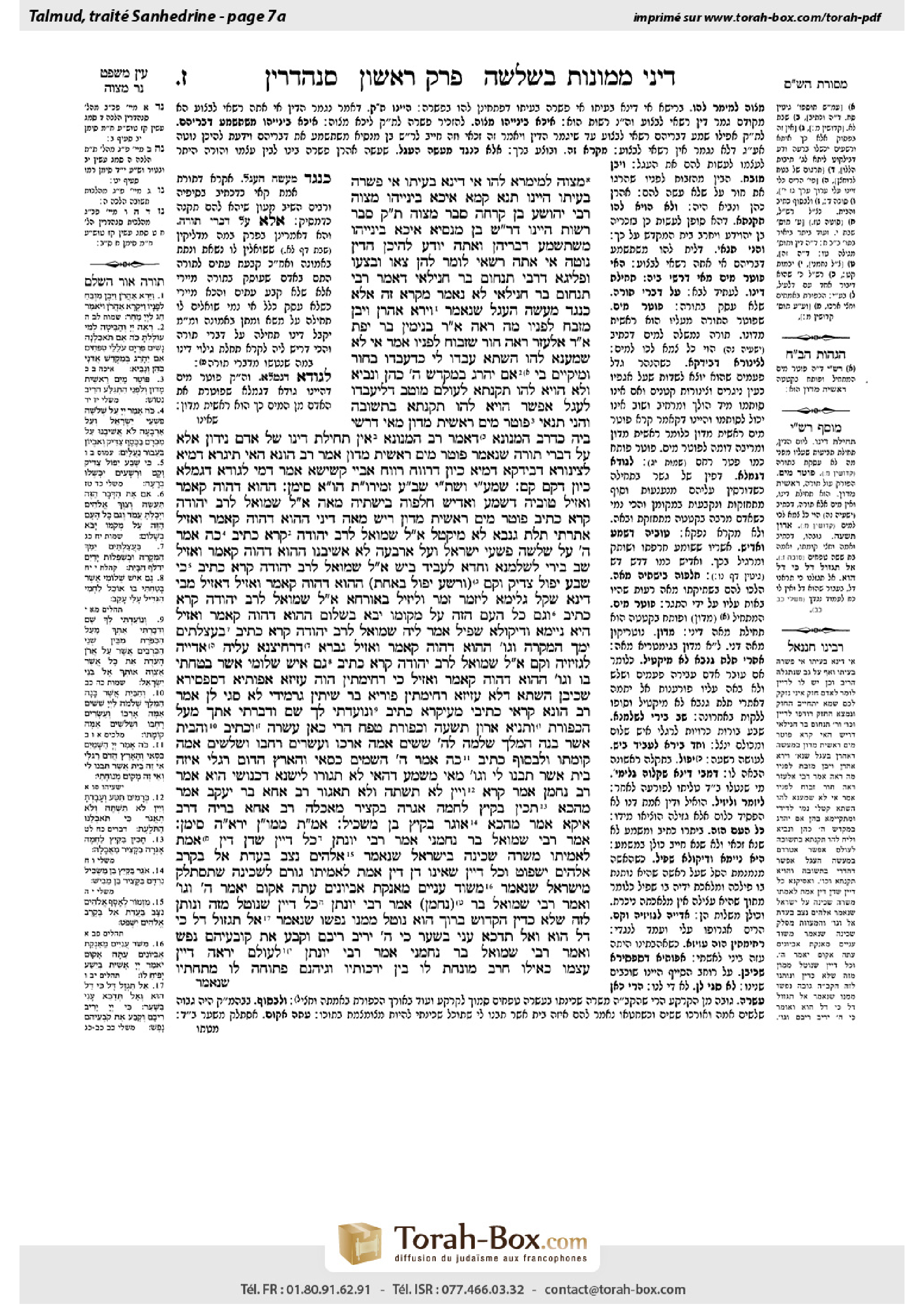
Sanhedrin 7a: Talmud study for Daf Yomi
Daf Yomi is the daily study of one Talmud folio. Explore 37 tractates with scans, Hebrew text, Sefaria English and AI-generated French translations where annotated.
Passage selection and English or AI-generated French translation are available where the scan has annotations. Daf Study is independent of Torah-Box and Sefaria.
Browse Sanhedrin · סנהדרין · All tractatesSanhedrin 7a text and translations
This page of Sanhedrin includes the Aramaic text, an English translation and an AI-generated French translation, alongside the scan above.
סנהדרין ז׳ א · Aramaic and Hebrew text
מִצְוָה לְמֵימְרָא לְהוּ: אִי דִּינָא בָּעֵיתוּ, אִי פְּשָׁרָה בָּעֵיתוּ? הַיְינוּ תַּנָּא קַמָּא! אִיכָּא בֵּינַיְיהוּ מִצְוָה: רַבִּי יְהוֹשֻׁעַ בֶּן קׇרְחָה סָבַר מִצְוָה, תַּנָּא קַמָּא סָבַר רְשׁוּת.
הַיְינוּ דְּרַבִּי שִׁמְעוֹן בֶּן מְנַסְיָא? אִיכָּא בֵּינַיְיהוּ: מִשֶּׁתִּשְׁמַע דִּבְרֵיהֶן וְאַתָּה יוֹדֵעַ לְהֵיכָן הַדִּין נוֹטֶה, אִי אַתָּה רַשַּׁאי לוֹמַר לָהֶן ״צְאוּ וּבִצְעוּ״.
וּפְלִיגָא דְּרַבִּי תַּנְחוּם בַּר חֲנִילַאי, דְּאָמַר רַבִּי תַּנְחוּם בַּר חֲנִילַאי: לֹא נֶאֱמַר מִקְרָא זֶה אֶלָּא כְּנֶגֶד מַעֲשֵׂה הָעֵגֶל, שֶׁנֶּאֱמַר: ״וַיַּרְא אַהֲרֹן וַיִּבֶן מִזְבֵּחַ לְפָנָיו״. מָה רָאָה? אָמַר רַבִּי בִּנְיָמִין בַּר יֶפֶת אָמַר רַבִּי אֶלְעָזָר: רָאָה חוּר שֶׁזָּבוּחַ לְפָנָיו.
אָמַר: אִי לָא שָׁמַעְנָא לְהוּ הַשְׁתָּא, עָבְדוּ לִי כְּדַעֲבַדוּ בְּחוּר, וּמִיקַּיַים בִּי ״אִם יֵהָרֵג בְּמִקְדַּשׁ ה׳ כֹּהֵן וְנָבִיא״, וְלָא הָוְיָא לְהוּ תַּקַּנְתָּא לְעוֹלָם. מוּטָב דְּלִיעְבְּדוּ לְעֵגֶל, אֶפְשָׁר הָוְיָא לְהוּ תַּקַּנְתָּא בִּתְשׁוּבָה.
וְהָנֵי תַּנָּאֵי ״פּוֹטֵר מַיִם רֵאשִׁית מָדוֹן״, מַאי דָּרְשִׁי בֵּיהּ? כִּדְרַב הַמְנוּנָא, דְּאָמַר רַב הַמְנוּנָא: אֵין תְּחִילַּת דִּינוֹ שֶׁל אָדָם נִידּוֹן אֶלָּא עַל דִּבְרֵי תוֹרָה, שֶׁנֶּאֱמַר: ״פּוֹטֵר מַיִם רֵאשִׁית מָדוֹן״. אָמַר רַב הוּנָא: הַאי תִּיגְרָא דָּמְיָא לְצִינּוֹרָא דְּבִידְקָא (דְּמַיָּא), כֵּיוָן דְּרָוַוח – רָוַוח.
אַבָּיֵי קַשִּׁישָׁא אָמַר: דָּמֵי לְגוּדָּא דְּגַמְלָא, כֵּיוָן דְּקָם – קָם.
שִׁמְעִי וּשְׁתֵּי שֶׁבַע זְמִירוֹת הוּא, סִימָן.
הָהוּא דַּהֲוָה קָאָמַר וְאָזֵיל: טוּבֵיהּ דְּשָׁמַע וְאָדֵישׁ, חַלְפוּהּ בִּישָׁתֵיהּ מְאָה. אֲמַר לֵיהּ שְׁמוּאֵל לְרַב יְהוּדָה, קְרָא כְּתִיב: ״פּוֹטֵר מַיִם רֵאשִׁית מָדוֹן״ – רֵישׁ מְאָה דִּינֵי.
הָהוּא דַּהֲוָה קָאָמַר וְאָזֵיל: אַתַּרְתֵּי תְּלָת גַּנָּבָא לָא מִיקְּטַל. אֲמַר לֵיהּ שְׁמוּאֵל לְרַב יְהוּדָה, קְרָא כְּתִיב: ״כֹּה אָמַר ה׳ עַל שְׁלֹשָׁה פִּשְׁעֵי יִשְׂרָאֵל וְעַל אַרְבָּעָה לֹא אֲשִׁיבֶנּוּ״.
הָהוּא דַּהֲוָה קָאָמַר וְאָזֵיל: שַׁב בֵּירֵי לִשְׁלָמָנָא, וַחֲדָא לְעָבֵיד בִּישׁ. אֲמַר לֵיהּ שְׁמוּאֵל לְרַב יְהוּדָה, קְרָא כְּתִיב: ״כִּי שֶׁבַע יִפּוֹל צַדִּיק וָקָם וְרָשָׁע יִפּוֹל בְּאַחַת״.
הָהוּא דַּהֲוָה קָאָמַר וְאָזֵיל: דְּאָזֵיל מִבֵּי דִינָא שְׁקִל גְּלִימָא – לִיזַמַּר זְמָר וְלֵיזִיל בְּאוֹרְחָא. אֲמַר לֵיהּ שְׁמוּאֵל לְרַב יְהוּדָה, קְרָא כְּתִיב: ״וְגַם כׇּל הָעָם הַזֶּה עַל מְקֹמוֹ יָבֹא בְשָׁלוֹם״.
הָהוּא דַּהֲוָה קָאָמַר וְאָזֵיל: הִיא נָיְימָא, וְדִיקּוּלָא שָׁפֵיל. אֲמַר לֵיהּ שְׁמוּאֵל לְרַב יְהוּדָה, קְרָא כְּתִיב: ״בַּעֲצַלְתַּיִם יִמַּךְ הַמְּקָרֶה וְגוֹ׳״.
הָהוּא דַּהֲוָה קָאָמַר וְאָזֵיל: גַּבְרָא דִּרְחִיצְנָא עֲלֵיהּ, אַדְיֵיהּ לִגְזִיזֵיהּ וְקָם. אָמַר לֵיהּ שְׁמוּאֵל לְרַב יְהוּדָה, קְרָא כְּתִיב: ״גַּם אִישׁ שְׁלוֹמִי אֲשֶׁר בָּטַחְתִּי בוֹ וְגוֹ׳״.
הָהוּא דַּהֲוָה קָאָמַר וְאָזֵיל: כִּי רְחִימְתִּין הֲוָה עַזִּיזָא, אַפּוּתְיָא דְּסַפְסֵירָא שְׁכִיבַן. הַשְׁתָּא דְּלָא עַזִּיזָא רְחִימְתִּין, פּוּרְיָא בַּר שִׁיתִּין גַּרְמִידֵי לָא סַגִּי לַן. אָמַר רַב הוּנָא, קְרָאֵי כְּתִיבִי. מֵעִיקָּרָא כְּתִיב: ״וְנוֹעַדְתִּי לְךָ שָׁם וְדִבַּרְתִּי אִתְּךָ מֵעַל הַכַּפֹּרֶת״, וְתַנְיָא: אָרוֹן תִּשְׁעָה וְכַפּוֹרֶת טֶפַח, הֲרֵי כָּאן עֲשָׂרָה.
וּכְתִיב: ״וְהַבַּיִת אֲשֶׁר בָּנָה הַמֶּלֶךְ שְׁלֹמֹה לַה׳ שִׁשִּׁים אַמָּה אׇרְכּוֹ וְעֶשְׂרִים רׇחְבּוֹ וּשְׁלֹשִׁים אַמָּה קוֹמָתוֹ״. וּלְבַסּוֹף כְּתִיב: ״כֹּה אָמַר ה׳ הַשָּׁמַיִם כִּסְאִי וְהָאָרֶץ הֲדֹם רַגְלָי אֵיזֶה בַיִת אֲשֶׁר תִּבְנוּ לִי וְגוֹ׳״.
מַאי מַשְׁמַע דְּהַאי ״לֹא תָגוּרוּ״ לִישָּׁנָא דְּכַנּוֹשֵׁי הוּא? אָמַר רַב נַחְמָן, אָמַר קְרָא: ״וְיַיִן לֹא תִשְׁתֶּה וְלֹא תֶאֱגֹר״. רַב אַחָא בַּר יַעֲקֹב אָמַר מֵהָכָא: ״תָּכִין בַּקַּיִץ לַחְמָהּ אָגְרָה בַקָּצִיר מַאֲכָלָהּ״. רַב אַחָא בְּרֵיהּ דְּרַב אִיקָא אָמַר מֵהָכָא: ״אֹגֵר בַּקַּיִץ בֵּן מַשְׂכִּיל״.
אֱמֶת מָמוֹן יִרְאָה סִימָן. אָמַר רַבִּי שְׁמוּאֵל בַּר נַחְמָנִי אָמַר רַבִּי יוֹנָתָן: כׇּל דַּיָּין שֶׁדָּן דִּין אֱמֶת לַאֲמִיתּוֹ, מַשְׁרֶה שְׁכִינָה בְּיִשְׂרָאֵל, שֶׁנֶּאֱמַר: ״אֱלֹהִים נִצָּב בַּעֲדַת אֵל בְּקֶרֶב אֱלֹהִים יִשְׁפֹּט״. וְכׇל דַּיָּין שֶׁאֵינוֹ דָּן דִּין אֱמֶת לַאֲמִיתּוֹ, גּוֹרֵם לִשְׁכִינָה שֶׁתִּסְתַּלֵּק מִיִּשְׂרָאֵל, שֶׁנֶּאֱמַר: ״מִשֹּׁד עֲנִיִּים מֵאַנְקַת אֶבְיוֹנִים עַתָּה אָקוּם יֹאמַר ה׳ וְגוֹ׳״.
וְאָמַר רַבִּי שְׁמוּאֵל בַּר נַחְמָנִי אָמַר רַבִּי יוֹנָתָן: כׇּל דַּיָּין שֶׁנּוֹטֵל מִזֶּה וְנוֹתֵן לְזֶה שֶׁלֹּא כַּדִּין, הַקָּדוֹשׁ בָּרוּךְ הוּא נוֹטֵל מִמֶּנּוּ נַפְשׁוֹ, שֶׁנֶּאֱמַר: ״אַל תִּגְזׇל דַּל כִּי דַּל הוּא וְאַל תְּדַכֵּא עָנִי בַשָּׁעַר כִּי ה׳ יָרִיב רִיבָם וְקָבַע אֶת קֹבְעֵיהֶם נָפֶשׁ״.
וְאָמַר רַבִּי שְׁמוּאֵל בַּר נַחְמָנִי אָמַר רַבִּי יוֹנָתָן: לְעוֹלָם יִרְאֶה דַּיָּין עַצְמוֹ כְּאִילּוּ חֶרֶב מוּנַּחַת לוֹ בֵּין יַרְכוֹתָיו, וְגֵיהִנָּם פְּתוּחָה לוֹ מִתַּחְתָּיו.
Sanhedrin 7a · English translation
He means that it is a mitzva to say to them: Do you want a strict judgment, or do you want a compromise? The Gemara objects: Since this opinion is the same as that of the first tanna, who also allows compromise, it is redundant to teach it. The Gemara answers: There is a difference between them with regard to the question of whether it is a mitzva to arrange a compromise. Rabbi Yehoshua ben Korḥa holds that it is a mitzva to offer them the option of compromise, and the first tanna holds that it is merely permitted.
The Gemara objects: If so, the opinion of the first tanna is the same as that of Rabbi Shimon ben Menasya. The Gemara answers that there is a difference between them with regard to the principle: After you hear their statements and you know where the judgment is leaning, it is not permitted for you to say to them: Go out and mediate. In that instance, the first tanna holds that it is still not too late to suggest mediation.
§ And the various Sages who offered interpretations of the verse: “And the covetous blesses himself, though he despises the Lord” (Psalms 10:3), disagree with the explanation of Rabbi Tanḥum bar Ḥanilai. As Rabbi Tanḥum bar Ḥanilai says: This verse was stated only with regard to the incident of the Golden Calf, as it is stated: “And Aaron saw this, and he built [vayyiven] an altar [mizbe’aḥ] before it…and said: Tomorrow shall be a feast to the Lord” (Exodus 32:5). What did Aaron see? Rabbi Binyamin bar Yefet says that Rabbi Elazar says: He saw Hur, who had been appointed together with Aaron by Moses to lead the people during Moses’ absence (see Exodus 24:14), slaughtered before him, as he had protested the plan to fashion a calf and had been murdered by the people as a result. The verse is therefore interpreted not as: Aaron built an altar before the calf, but rather: He understood [vayyaven] from the slaughter [mizavuaḥ] before his own eyes; and he then called for a feast.
Aaron said to himself: If I do not listen to them now, they will do to me as they did to Hur, and the verse: “Shall the priest and the prophet be slain in the sanctuary of the Lord?” (Lamentations 2:20), will be fulfilled through me, and they will never have a remedy for such a sin. It is better for them to worship the calf, as it is possible they will have a remedy through repentance. Nevertheless, according to Rabbi Tanḥum bar Ḥanilai, whoever praises Aaron for this compromise is provoking God.
And with regard to those tanna’im who did not interpret the verse: “The beginning of strife is as when one releases water” (Proverbs 17:14), with regard to compromise, what do they derive from this verse? They understand the verse in accordance with the opinion of Rav Hamnuna, as Rav Hamnuna says: The beginning of a person’s judgment after he dies is that he is judged only concerning matters of Torah, as it is stated: “The beginning of strife is as when one releases water.” Based on this verse, Rav Huna says: This quarrel between people is comparable to a split in a hose caused by a burst of water, emptying into a field; once the split in the hose widens, it widens even more and can no longer be repaired. To save the field, the hose must be repaired as soon as it splits. The same is true with regard to a quarrel; it must be stopped as soon as it begins.
Abaye the Elder makes a similar point with a different metaphor, and says: A quarrel is comparable to a board in a wooden bridge. Once it has stood in its place and been stabilized, it continues to stand and becomes ever more rigid and stable. Consequently, the best time to address and end the dispute is at the very beginning.
§ Apropos the previous discussion, the Gemara recounts several incidents in which passersby recited popular proverbs. Shimi ushti, sheva zemirot hu is a mnemonic device for these incidents.
There was a certain man who was saying as he walked: It is good for a person who hears statements said against him and yet remains silent, as a hundred misfortunes pass him by as a result. Upon hearing this, Shmuel said to Rav Yehuda: A verse is written that conveys the message of this aphorism: “The beginning of strife is as when one releases water” (Proverbs 17:14). The words “beginning [poter] of strife [reishit madon]” allude to: The beginning of one hundred litigations [reish me’a dinei]. Troubles are avoided if one overlooks and excuses [poter] an offense.
There was a certain man who was saying as he walked by: For only two or three thefts, the thief is not executed by the heavenly court. Shmuel said to Rav Yehuda: A verse is written that conveys the message of this aphorism: “So says the Lord: For three transgressions of Israel, or for four, I will not repay it” (Amos 2:6). Shmuel interprets the verse rhetorically, as if saying: Will I not repay the fourth offense? Accordingly, before the fourth offense, it is still possible to rectify the sins.
There was a certain man who was saying as he walked: Seven pits are dug for the man of peace, and he escapes all of them, and one pit is dug for the evildoer, and he cannot escape it. Shmuel said to Rav Yehuda: A verse is written that conveys the message of this aphorism: “For a righteous man falls seven times, and rises up again, but the wicked shall fall at once” (see Proverbs 24:16, 28:18).
There was a certain man who was saying as he walked: With regard to one who goes from the court, and his cloak has been taken from him in the course of the proceedings, i.e., he lost all his money due to a ruling against him, let him sing a song and go happily on the way. Although he lost the case, he has benefited from justice being served. Shmuel said to Rav Yehuda: A verse is written with regard to Yitro’s advice for judiciary reforms that conveys the message of this aphorism: “And all these people shall also go to their place in peace” (Exodus 18:23). If justice is served, all the litigants, not only those who emerge victorious, can leave in peace.
There was a certain man who was saying as he walked: If a woman is carrying a basket on her head, when she is dozing the reed basket falls. Shmuel said to Rav Yehuda: A verse is written that conveys the message of this aphorism: “By laziness the rafters sink in; and through idleness of the hands the house leaks” (Ecclesiastes 10:18).
There was a certain man who was saying as he walked: The man upon whom I relied has lifted his fist [ligzizeih] and stood against me. Shmuel said to Rav Yehuda: A verse is written that conveys the message of this aphorism: “Indeed, my own familiar friend, in whom I trusted, who did eat of my bread, has lifted up his heel against me” (Psalms 41:10).
There was a certain man who was saying about his marriage as he walked: When our love was strong, we could have slept on a bed that was the width of a sword. Now that our love is not strong, a bed of sixty cubits is not sufficient for us. Rav Huna said: Verses are written that convey these sentiments. Initially, it was written: “I will meet with you there and I will speak with you from above the Ark Cover” (Exodus 25:22), and it is taught in a baraita: The Ark of the Covenant was itself nine handbreadths high, and the Ark Cover was one handbreadth thick. There is a total height of ten handbreadths here. At first, when God had great affection for Israel, the Divine Presence was revealed within the confines of this limited space.
And it is written: “And the house that King Solomon built for the Lord, its length was sixty cubits, and its breadth twenty cubits, and its height thirty cubits” (I Kings 6:2). And at the end, when Israel sinned, the whole of the space of the Temple was not expansive enough for the Divine Presence to rest within it, as it is written: “Thus says the Lord: The heaven is My throne, and the earth is My footstool; where is the house that you may build for Me? And where is the place that may be My resting place?” (Isaiah 66:1). In times of discord, the Temple is an insufficient resting place for the Divine Presence.
The Gemara returns to analyzing the Tosefta. From where may it be inferred that this expression: “You shall not be afraid [taguru]” (Deuteronomy 1:17), is a term for gathering in, so that the term may be interpreted to mean that a judge may not keep his ruling to himself? Rav Naḥman said: The verse states: “You shalt plant vineyards and dress them, but you shall neither drink of the wine, nor gather [te’egor]” (Deuteronomy 28:39). Rav Aḥa bar Ya’akov says it is derived from here: “She provides her bread in the summer, and gathers [agra] her food in the harvest” (Proverbs 6:8). Rav Aḥa, son of Rav Ika, says it is derived from here: “A wise son gathers [oger] in the summer” (Proverbs 10:5).
§ The Gemara provides a mnemonic device indicating the following series of statements about judges and their functions: Emet mamon yireh. Rabbi Shmuel bar Naḥmani says that Rabbi Yonatan says: Any judge who judges a judgment according to absolute truth [emet] causes the Divine Presence to rest among Israel, as it is stated: “God stands in the congregation of God; in the midst of the judges He judges” (Psalms 82:1), indicating that the Divine Presence is in the midst of the court. And every judge who does not judge a judgment according to absolute truth causes the Divine Presence to withdraw from Israel, as it is stated: “For the oppression of the poor, for the sighing of the needy, now will I arise, says the Lord” (Psalms 12:6). God will arise and leave the people as a result of oppression.
And Rabbi Shmuel bar Naḥmani says that Rabbi Yonatan says: With regard to any judge who takes disputed property or money [mamon] from this litigant and gives it to that other litigant unlawfully, the Holy One, Blessed be He, takes his soul from him as punishment for his corruption, as it is stated: “Rob not the weak, because he is weak, neither crush the poor in the gate; for the Lord will plead their cause and despoil of life those who despoil them” (Proverbs 22:22–23). God cautions that He will take the life of one who steals from the poor at the gate, meaning in the courtroom, as the city gate was the traditional site of the community’s court.
And Rabbi Shmuel bar Naḥmani says that Rabbi Yonatan says: A judge should always view [yireh] himself as if a sword is placed between his thighs, so that if he leans to the right or to the left he will be injured, and as if Gehenna is opened up beneath him,
Sanhedrin 7a · Traduction française (IA)
Il veut dire qu’il est une mitsva de leur dire : « Voulez-vous un jugement strict ou préférez-vous un compromis ? » La Guemara objecte : puisque cette opinion est identique à celle du premier tanna, qui autorise lui aussi le compromis, il est superflu de l’enseigner. La Guemara répond qu’ils diffèrent sur la question de savoir s’il est une mitsva de proposer un compromis. Rabbi Yehoshua ben Korḥa estime qu’il est une mitsva de leur offrir cette possibilité, tandis que, selon le premier tanna, cela est simplement permis.
La Guemara objecte : dans ce cas, l’opinion du premier tanna est identique à celle de Rabbi Shimon ben Menasya. La Guemara répond qu’ils diffèrent sur le principe suivant : après avoir entendu leurs déclarations et compris de quel côté penche le jugement, il ne vous est pas permis de leur dire : « Allez vous mettre d’accord à l’amiable. » Dans ce cas, le premier tanna estime qu’il n’est pas encore trop tard pour proposer une médiation.
§ Les différents Sages qui ont proposé des interprétations du verset : « L’avide se bénit lui-même, tout en méprisant le Seigneur » (Psaumes 10:3), sont en désaccord avec l’explication de Rabbi Tanḥum bar Ḥanilai. Car Rabbi Tanḥum bar Ḥanilai dit : Ce verset ne concerne que l’épisode du Veau d’or, comme il est dit : « Aaron vit cela, et il bâtit [vayyiven] un autel [mizbe’aḥ] devant lui… et dit : Demain, il y aura une fête en l’honneur du Seigneur » (Exode 32:5). Qu’a vu Aaron ? Rabbi Binyamin bar Yefet dit que Rabbi Elazar dit : Il vit Hour, que Moïse avait désigné avec Aaron pour diriger le peuple pendant son absence (voir Exode 24:14), massacré devant lui, parce qu’il avait protesté contre le projet de fabriquer un veau et que le peuple l’avait tué pour cette raison. Le verset ne s’interprète donc pas ainsi : « Aaron bâtit un autel devant le veau », mais plutôt : « Il comprit [vayyiven] à partir du massacre [mizavuaḥ] dont il fut témoin », puis il appela à une fête.
Aaron se dit : « Si je ne les écoute pas maintenant, ils me feront ce qu’ils ont fait à Hour, et le verset : “Le prêtre et le prophète seront-ils tués dans le sanctuaire du Seigneur ?” (Lamentations 2:20) s’accomplira à travers moi ; ils n’auront alors jamais de moyen de réparer un tel péché. Il vaut mieux qu’ils adorent le veau, car ils pourront peut-être réparer leur faute par le repentir. » Néanmoins, selon Rabbi Tanḥum bar Ḥanilai, quiconque loue Aaron pour ce compromis provoque Dieu.
Et que déduisent du verset « Le commencement d’une querelle est comme lorsqu’on libère les eaux » (Proverbes 17:14) les tannaïm qui ne l’interprètent pas à propos du compromis ? Ils comprennent ce verset conformément à l’opinion de Rav Hamnuna. Car Rav Hamnuna dit : Le premier jugement auquel une personne est soumise après sa mort porte uniquement sur les questions de Torah, comme il est dit : « Le commencement d’une querelle est comme lorsqu’on libère les eaux. » À partir de ce verset, Rav Huna dit : Une querelle entre des personnes est comparable à une brèche dans un tuyau, provoquée par un flot d’eau qui se déverse dans un champ ; une fois que la brèche s’élargit, elle s’élargit encore davantage et ne peut plus être réparée. Pour sauver le champ, il faut réparer le tuyau dès qu’il se fend. Il en va de même pour une querelle : il faut y mettre fin dès qu’elle commence.
Abaye l’Ancien exprime une idée similaire au moyen d’une autre métaphore et dit : Une querelle est comparable à une planche d’un pont de bois. Une fois en place et stabilisée, elle continue de tenir et devient toujours plus rigide et solide. Par conséquent, le meilleur moment pour régler le différend et y mettre fin est dès son commencement.
§ À propos de la discussion précédente, la Guemara rapporte plusieurs épisodes où des passants récitent des proverbes populaires. Shimi ushti, sheva zemirot hu est un moyen mnémotechnique pour ces épisodes.
Un homme disait en marchant : « Heureux celui qui entend des propos tenus contre lui et reste pourtant silencieux, car ainsi cent malheurs passent sans l’atteindre. » En entendant cela, Shmuel dit à Rav Yehuda : « Un verset exprime cette idée : “Le commencement d’une querelle est comme lorsqu’on libère les eaux” (Proverbes 17:14). » Les mots « commencement [poter] d’une querelle [reishit madon] » font allusion au commencement de cent procès [reish me’a dinei]. On évite les ennuis en passant outre à une offense et en l’excusant [poter].
Un homme disait en passant : « Pour seulement deux ou trois vols, le voleur n’est pas exécuté par le tribunal céleste. » Shmuel dit à Rav Yehuda : « Un verset exprime cette idée : “Ainsi parle le Seigneur : Pour trois transgressions d’Israël, et pour quatre, je ne révoquerai pas son châtiment” (Amos 2:6). » Shmuel interprète le verset comme une question rhétorique, comme s’il disait : « Ne révoquerai-je pas le châtiment pour la quatrième faute ? » Ainsi, avant la quatrième faute, il est encore possible de réparer les péchés.
Un homme disait en marchant : « Sept fosses sont creusées pour l’homme de paix, et il leur échappe à toutes ; une seule fosse est creusée pour le malfaiteur, et il ne peut lui échapper. » Shmuel dit à Rav Yehuda : « Un verset exprime cette idée : “Le juste tombe sept fois et se relève, mais les méchants tombent d’un seul coup” (voir Proverbes 24:16 ; 28:18). »
Un homme disait en marchant : « Celui qui sort du tribunal, son manteau lui ayant été pris au cours de la procédure », c’est-à-dire celui qui a perdu tout son argent à la suite d’un jugement prononcé contre lui, « qu’il chante et poursuive joyeusement son chemin ». Bien qu’il ait perdu son procès, il a bénéficié du fait que justice a été rendue. Shmuel dit à Rav Yehuda : « Un verset relatif aux conseils de Yitro pour réformer la justice exprime cette idée : “Et tout ce peuple aussi ira à sa place en paix” (Exode 18:23). » Si justice est rendue, tous les plaideurs, et pas seulement ceux qui obtiennent gain de cause, peuvent repartir en paix.
Un homme disait en marchant : « Si une femme porte un panier sur la tête, le panier de roseaux tombe lorsqu’elle somnole. » Shmuel dit à Rav Yehuda : « Un verset exprime cette idée : “Par la paresse, les poutres s’affaissent, et par le relâchement des mains, la maison prend l’eau” (Ecclésiaste 10:18). »
Un homme disait en marchant : « Celui sur qui je comptais a levé le poing [ligzizeih] et s’est dressé contre moi. » Shmuel dit à Rav Yehuda : « Un verset exprime cette idée : “Même mon ami intime, en qui je me confiais, qui mangeait mon pain, a levé son talon contre moi” (Psaumes 41:10). »
Un homme parlait de son mariage en marchant et disait : « Quand notre amour était fort, nous aurions pu dormir sur un lit large comme une épée. Maintenant que notre amour n’est plus fort, un lit de soixante coudées ne nous suffit pas. » Rav Huna dit : Des versets expriment ces sentiments. Au début, il était écrit : « Je te rencontrerai là et je te parlerai du haut du propitiatoire » (Exode 25:22), et une baraïta enseigne : L’Arche d’Alliance elle-même mesurait neuf palmes de hauteur, et le propitiatoire avait une épaisseur d’une palme. Cela fait ici une hauteur totale de dix palmes. Au début, lorsque Dieu avait une grande affection pour Israël, la Présence divine se révélait dans les limites de cet espace restreint.
Et il est écrit : « La maison que le roi Salomon bâtit pour le Seigneur avait soixante coudées de longueur, vingt coudées de largeur et trente coudées de hauteur » (I Rois 6:2). À la fin, lorsque Israël pécha, tout l’espace du Temple ne fut pas assez vaste pour que la Présence divine y réside, comme il est écrit : « Ainsi parle le Seigneur : Le ciel est mon trône et la terre est mon marchepied ; quelle maison pourriez-vous me bâtir, et quel serait le lieu de mon repos ? » (Isaïe 66:1). En temps de discorde, le Temple ne constitue pas un lieu de repos suffisant pour la Présence divine.
La Guemara revient à l’analyse de la Tosefta. D’où déduit-on que l’expression « Vous ne craindrez pas [taguru] » (Deutéronome 1:17) signifie « rassembler », de sorte qu’on puisse l’interpréter comme signifiant qu’un juge ne doit pas garder sa décision pour lui ? Rav Naḥman dit : Le verset dit : « Tu planteras des vignes et tu les cultiveras, mais tu ne boiras pas de leur vin et tu ne le recueilleras pas [te’egor] » (Deutéronome 28:39). Rav Aḥa bar Ya’akov dit que cela se déduit de ce verset : « Elle prépare son pain en été et rassemble [agra] sa nourriture au temps de la moisson » (Proverbes 6:8). Rav Aḥa, fils de Rav Ika, dit que cela se déduit de ce verset : « Un fils sage rassemble [oger] en été » (Proverbes 10:5).
§ La Guemara donne un moyen mnémotechnique pour la série d’enseignements qui suit au sujet des juges et de leurs fonctions : Emet mamon yireh. Rabbi Shmuel bar Naḥmani dit au nom de Rabbi Yonatan : Tout juge qui rend un jugement selon la vérité absolue [emet] fait résider la Présence divine au milieu d’Israël, comme il est dit : « Dieu se tient dans l’assemblée divine ; au milieu des juges, il juge » (Psaumes 82:1), ce qui indique que la Présence divine se trouve au milieu du tribunal. Et tout juge qui ne rend pas un jugement selon la vérité absolue fait se retirer la Présence divine d’Israël, comme il est dit : « À cause de l’oppression des pauvres, à cause des gémissements des nécessiteux, maintenant je me lèverai, dit le Seigneur » (Psaumes 12:6). Dieu se lèvera et quittera le peuple en conséquence de l’oppression.
Et Rabbi Shmuel bar Naḥmani dit au nom de Rabbi Yonatan : Tout juge qui prend illégalement un bien ou de l’argent litigieux [mamon] à un plaideur pour le donner à un autre, le Saint, béni soit-Il, lui retire son âme en punition de sa corruption, comme il est dit : « Ne dépouille pas le faible, parce qu’il est faible, et n’écrase pas le pauvre à la porte ; car le Seigneur défendra leur cause et ravira la vie de ceux qui les dépouillent » (Proverbes 22:22–23). Dieu avertit qu’il prendra la vie de celui qui vole les pauvres à la porte, c’est-à-dire au tribunal, car la porte de la ville était traditionnellement le lieu où siégeait le tribunal de la communauté.
Et Rabbi Shmuel bar Naḥmani dit au nom de Rabbi Yonatan : Un juge doit toujours se voir [yireh] comme si une épée était placée entre ses cuisses, de sorte que s’il penche à droite ou à gauche, il sera blessé, et comme si la Géhenne s’ouvrait sous lui,
Traduction française générée par IA à partir de l’édition anglaise de Sefaria. Vérifie toujours un passage avec le texte source.
Text from Sefaria: William Davidson Edition - Vocalized Aramaic (CC BY NC); William Davidson Edition - English (CC BY NC).