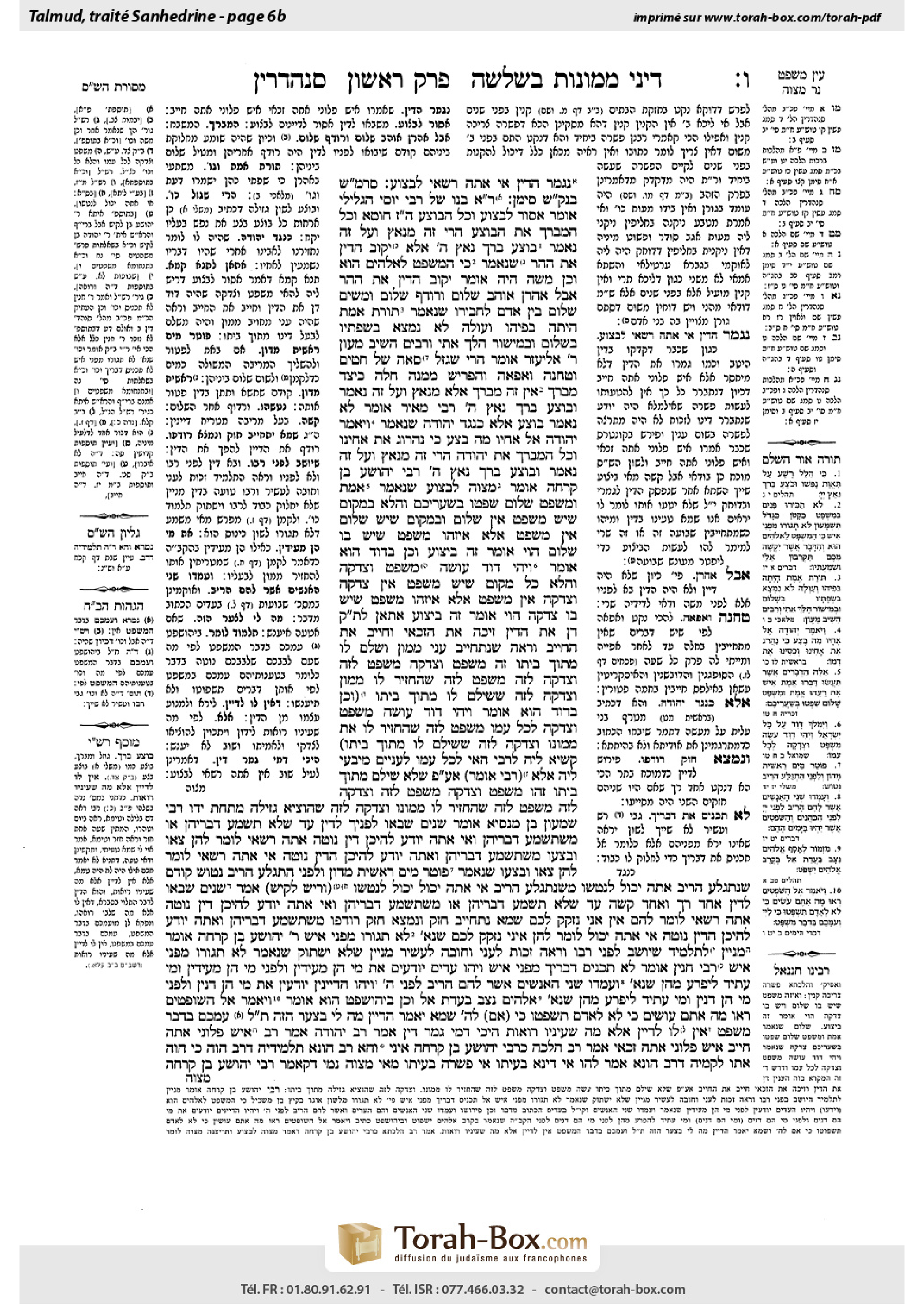
Sanhedrin 6b: Talmud study for Daf Yomi
Daf Yomi is the daily study of one Talmud folio. Explore 37 tractates with scans, Hebrew text, Sefaria English and AI-generated French translations where annotated.
Passage selection and English or AI-generated French translation are available where the scan has annotations. Daf Study is independent of Torah-Box and Sefaria.
Browse Sanhedrin · סנהדרין · All tractatesSanhedrin 6b text and translations
This page of Sanhedrin includes the Aramaic text, an English translation and an AI-generated French translation, alongside the scan above.
סנהדרין ו׳ ב · Aramaic and Hebrew text
נִגְמַר הַדִּין, אִי אַתָּה רַשַּׁאי לִבְצוֹעַ.
סרמ״ש בנק״ש סִימָן. רַבִּי אֱלִיעֶזֶר בְּנוֹ שֶׁל רַבִּי יוֹסֵי הַגְּלִילִי אוֹמֵר: אָסוּר לִבְצוֹעַ, וְכׇל הַבּוֹצֵעַ – הֲרֵי זֶה חוֹטֵא, וְכׇל הַמְבָרֵךְ אֶת הַבּוֹצֵעַ – הֲרֵי זֶה מְנָאֵץ. וְעַל זֶה נֶאֱמַר: ״בֹּצֵעַ בֵּרֵךְ נִאֵץ ה׳״.
אֶלָּא יִקּוֹב הַדִּין אֶת הָהָר, שֶׁנֶּאֱמַר: ״כִּי הַמִּשְׁפָּט לֵאלֹהִים הוּא״. וְכֵן מֹשֶׁה הָיָה אוֹמֵר: יִקּוֹב הַדִּין אֶת הָהָר. אֲבָל אַהֲרֹן אוֹהֵב שָׁלוֹם וְרוֹדֵף שָׁלוֹם, וּמֵשִׂים שָׁלוֹם בֵּין אָדָם לַחֲבֵירוֹ, שֶׁנֶּאֱמַר: ״תּוֹרַת אֱמֶת הָיְתָה בְּפִיהוּ וְעַוְלָה לֹא נִמְצָא בִשְׂפָתָיו בְּשָׁלוֹם וּבְמִישׁוֹר הָלַךְ אִתִּי וְרַבִּים הֵשִׁיב מֵעָוֹן״.
רַבִּי אֱלִיעֶזֶר אוֹמֵר: הֲרֵי שֶׁגָּזַל סְאָה שֶׁל חִטִּים, וּטְחָנָהּ וַאֲפָאָהּ וְהִפְרִישׁ מִמֶּנָּה חַלָּה, כֵּיצַד מְבָרֵךְ? אֵין זֶה מְבָרֵךְ אֶלָּא מְנָאֵץ. וְעַל זֶה נֶאֱמַר: ״וּבֹצֵעַ בֵּרֵךְ נִאֵץ ה׳״.
רַבִּי מֵאִיר אוֹמֵר: לֹא נֶאֱמַר ״בּוֹצֵעַ״ אֶלָּא כְּנֶגֶד יְהוּדָה, שֶׁנֶּאֱמַר: ״וַיֹּאמֶר יְהוּדָה אֶל אֶחָיו מַה בֶּצַע כִּי נַהֲרֹג אֶת אָחִינוּ״. וְכׇל הַמְבָרֵךְ אֶת יְהוּדָה – הֲרֵי זֶה מְנָאֵץ, וְעַל זֶה נֶאֱמַר: ״וּבֹצֵעַ בֵּרֵךְ נִאֵץ ה׳״.
רַבִּי יְהוֹשֻׁעַ בֶּן קׇרְחָה אוֹמֵר: מִצְוָה לִבְצוֹעַ, שֶׁנֶּאֱמַר: ״אֱמֶת וּמִשְׁפַּט שָׁלוֹם שִׁפְטוּ בְּשַׁעֲרֵיכֶם״. וַהֲלֹא בִּמְקוֹם שֶׁיֵּשׁ מִשְׁפָּט – אֵין שָׁלוֹם, וּבִמְקוֹם שֶׁיֵּשׁ שָׁלוֹם – אֵין מִשְׁפָּט? אֶלָּא אֵיזֶהוּ מִשְׁפָּט שֶׁיֵּשׁ בּוֹ שָׁלוֹם? הֱוֵי אוֹמֵר: זֶה בִּיצּוּעַ.
וְכֵן בְּדָוִד הוּא אוֹמֵר: ״וַיְהִי דָוִד עֹשֶׂה מִשְׁפָּט וּצְדָקָה״. וַהֲלֹא כׇּל מָקוֹם שֶׁיֵּשׁ מִשְׁפָּט – אֵין צְדָקָה, וּצְדָקָה – אֵין מִשְׁפָּט? אֶלָּא אֵיזֶהוּ מִשְׁפָּט שֶׁיֵּשׁ בּוֹ צְדָקָה? הֱוֵי אוֹמֵר: זֶה בִּיצּוּעַ.
אֲתָאן לְתַנָּא קַמָּא. דָּן אֶת הַדִּין, זִיכָּה אֶת הַזַּכַּאי וְחִיֵּיב אֶת הַחַיָּיב. וְרָאָה שֶׁנִּתְחַיֵּיב עָנִי מָמוֹן, וְשִׁלֵּם לוֹ מִתּוֹךְ בֵּיתוֹ – זֶה מִשְׁפָּט וּצְדָקָה.
מִשְׁפָּט לָזֶה וּצְדָקָה לָזֶה: מִשְׁפָּט לָזֶה – שֶׁהֶחְזִיר לוֹ מָמוֹן, וּצְדָקָה לָזֶה – שֶׁשִּׁילֵּם לוֹ מִתּוֹךְ בֵּיתוֹ. וְכֵן בְּדָוִד הוּא אוֹמֵר: ״וַיְהִי דָוִד עֹשֶׂה מִשְׁפָּט וּצְדָקָה לְכׇל עַמּוֹ״. מִשְׁפָּט לָזֶה – שֶׁהֶחְזִיר לוֹ אֶת מָמוֹנוֹ, וּצְדָקָה לָזֶה – שֶׁשִּׁילֵּם לוֹ מִתּוֹךְ בֵּיתוֹ.
קַשְׁיָא לֵיהּ לְרַבִּי: הַאי ״לְכׇל עַמּוֹ״ – לַעֲנִיִּים מִיבְּעֵי לֵיהּ! אֶלָּא, רַבִּי אוֹמֵר: אַף עַל פִּי שֶׁלֹּא שִׁילֵּם מִתּוֹךְ בֵּיתוֹ, זֶהוּ מִשְׁפָּט וּצְדָקָה. מִשְׁפָּט לָזֶה וּצְדָקָה לָזֶה: מִשְׁפָּט לָזֶה – שֶׁהֶחְזִיר לוֹ מָמוֹנוֹ, וּצְדָקָה לָזֶה – שֶׁהוֹצִיא גְּזֵילָה מִתַּחַת יָדוֹ.
רַבִּי שִׁמְעוֹן בֶּן מְנַסְיָא אוֹמֵר: שְׁנַיִם שֶׁבָּאוּ לְפָנֶיךָ לַדִּין, עַד שֶׁלֹּא תִּשְׁמַע דִּבְרֵיהֶן, אוֹ מִשֶּׁתִּשְׁמַע דִּבְרֵיהֶן וְאִי אַתָּה יוֹדֵעַ לְהֵיכָן דִּין נוֹטֶה – אַתָּה רַשַּׁאי לוֹמַר לָהֶן: ״צְאוּ וּבִצְעוּ״. מִשֶּׁתִּשְׁמַע דִּבְרֵיהֶן וְאַתָּה יוֹדֵעַ לְהֵיכָן הַדִּין נוֹטֶה – אִי אַתָּה רַשַּׁאי לוֹמַר לָהֶן: ״צְאוּ וּבִצְעוּ״, שֶׁנֶּאֱמַר: ״פּוֹטֵר מַיִם רֵאשִׁית מָדוֹן וְלִפְנֵי הִתְגַּלַּע הָרִיב נְטוֹשׁ״. קוֹדֶם שֶׁנִּתְגַּלַּע הָרִיב – אַתָּה יָכוֹל לְנׇטְשׁוֹ; מִשֶּׁנִּתְגַּלַּע הָרִיב – אִי אַתָּה יָכוֹל לְנׇטְשׁוֹ.
וְרֵישׁ לָקִישׁ אָמַר: שְׁנַיִם שֶׁבָּאוּ לַדִּין, אֶחָד רַךְ וְאֶחָד קָשֶׁה, עַד שֶׁלֹּא תִּשְׁמַע דִּבְרֵיהֶם, אוֹ מִשֶּׁתִּשְׁמַע דִּבְרֵיהֶן וְאֵין אַתָּה יוֹדֵעַ לְהֵיכָן דִּין נוֹטֶה – אַתָּה רַשַּׁאי לוֹמַר לָהֶם: ״אֵין אֲנִי נִזְקָק לָכֶם״, שֶׁמָּא נִתְחַיֵּיב חָזָק וְנִמְצָא חָזָק רוֹדְפוֹ. מִשֶּׁתִּשְׁמַע דִּבְרֵיהֶן וְאַתָּה יוֹדֵעַ לְהֵיכָן הַדִּין נוֹטֶה – אִי אַתָּה יָכוֹל לוֹמַר לָהֶן: ״אֵינִי נִזְקָק לָכֶם״, שֶׁנֶּאֱמַר: ״לֹא תָגוּרוּ מִפְּנֵי אִישׁ״.
רַבִּי יְהוֹשֻׁעַ בֶּן קׇרְחָה אוֹמֵר: מִנַּיִין לְתַלְמִיד שֶׁיּוֹשֵׁב לִפְנֵי רַבּוֹ וְרָאָה זְכוּת לֶעָנִי וְחוֹבָה לֶעָשִׁיר, מִנַּיִין שֶׁלֹּא יִשְׁתּוֹק? שֶׁנֶּאֱמַר: ״לֹא תָגוּרוּ מִפְּנֵי אִישׁ״. רַבִּי חָנִין אוֹמֵר: לֹא תַּכְנִיס דְּבָרֶיךָ מִפְּנֵי אִישׁ. וִיהוּ עֵדִים יוֹדְעִים אֶת מִי הֵן מְעִידִין, וְלִפְנֵי מִי הֵן מְעִידִין, וּמִי עָתִיד לִיפָּרַע מֵהֶן, שֶׁנֶּאֱמַר: ״וְעָמְדוּ שְׁנֵי הָאֲנָשִׁים אֲשֶׁר לָהֶם הָרִיב לִפְנֵי ה׳״.
וִיהוּ הַדַּיָּינִין יוֹדְעִין אֶת מִי הֵן דָּנִין, וְלִפְנֵי מִי הֵן דָּנִין, וּמִי עָתִיד לִיפָּרַע מֵהֶן, שֶׁנֶּאֱמַר: ״אֱלֹהִים נִצָּב בַּעֲדַת אֵל״. וְכֵן בִּיהוֹשָׁפָט הוּא אוֹמֵר: ״וַיֹּאמֶר אֶל הַשֹּׁפְטִים רְאוּ מָה אַתֶּם עֹשִׂים כִּי לֹא לְאָדָם תִּשְׁפְּטוּ כִּי אִם לַה׳״. שֶׁמָּא יֹאמַר הַדַּיָּין: מָה לִי בְּצַעַר הַזֶּה? תַּלְמוּד לוֹמַר: ״עִמָּכֶם בִּדְבַר מִשְׁפָּט״. אֵין לוֹ לַדַּיָּין אֶלָּא מַה שֶּׁעֵינָיו רוֹאוֹת.
הֵיכִי דָּמֵי גְּמַר דִּין? אָמַר רַב יְהוּדָה אָמַר רַב: אִישׁ פְּלוֹנִי אַתָּה חַיָּיב, אִישׁ פְּלוֹנִי אַתָּה זַכַּאי. אָמַר רַב: הֲלָכָה כְּרַבִּי יְהוֹשֻׁעַ בֶּן קׇרְחָה. אִינִי? וְהָא רַב הוּנָא תַּלְמִידֵיהּ דְּרַב הֲוָה! כִּי הֲוָה אָתוּ לְקַמֵּיהּ דְּרַב הוּנָא אָמַר לְהוּ: אִי דִּינָא בָּעֵיתוּ, אִי פְּשָׁרָה בָּעֵיתוּ? מַאי ״מִצְוָה״ נָמֵי דְּקָאָמַר רַבִּי יְהוֹשֻׁעַ בֶּן קׇרְחָה?
Sanhedrin 6b · English translation
Once the verdict of the judgment has been issued, it is not permitted for you to mediate a dispute.
The Gemara presents a mnemonic device alluding to the names of tanna’im in the coming discussion: Samekh, reish, mem, shin; beit, nun, kuf, shin. The Tosefta cites several statements of tanna’im related to compromise and the term botze’a. Rabbi Eliezer, son of Rabbi Yosei HaGelili, says: It is prohibited to mediate a dispute; and anyone who mediates [habotze’a] a dispute is a sinner; and anyone who blesses the mediator is cursing God. And of this, it is stated: “And the covetous [botze’a] blesses himself, though he despises the Lord” (Psalms 10:3).
Rather, the judge must assure that the true judgment will prevail at all costs and metaphorically pierce the mountain, as it is stated: “For the judgment is God’s” (Deuteronomy 1:17). And similarly, Moses would say: Let the judgment pierce the mountain. But by contrast, Aaron, whose role was not that of a judge, was a lover of peace and a pursuer of peace, and he would apply peace between one person and the other, as it is stated: “The law of truth was in his mouth, and unrighteousness was not found in his lips; he walked with Me in peace and uprightness, and turned many away from iniquity” (Malachi 2:6).
The Tosefta cites several other interpretations of the above-mentioned verse from Psalms. Rabbi Eliezer says: If one stole a se’a of wheat and ground it and baked it and separated ḥalla from it, i.e., separated the portion of the dough that must be given to the priests, how can he possibly recite the blessing on the mitzva of ḥalla? He is not blessing; rather, he is cursing God. And of this offense it is stated: “And the covetous [uvotze’a] blesses himself, though he despises the Lord,” interpreted homiletically as: And whoever blesses upon breaking [botze’a] the bread despises the Lord.
Rabbi Meir says: The term botze’a employed in that verse was stated only with regard to Judah, as it is stated: “And Judah said to his brothers: What profit [betza] is it if we slay our brother and conceal his blood? Come, and let us sell him to the Ishmaelites” (Genesis 37:26–27). And consequently, anyone who blesses Judah for this act is cursing God, and of this it is stated: “And the covetous [uvotze’a] blesses himself, though he despises the Lord,” interpreted homiletically as: “And whoever blesses the profiteer [botze’a] despises the Lord.”
Rabbi Yehoshua ben Korḥa says: It is a mitzva to mediate a dispute, as it is stated: “Execute the judgment of truth and peace in your gates” (Zechariah 8:16). Is it not that in the place where there is strict judgment there is no true peace, and in a place where there is true peace, there is no strict judgment? Rather, which is the judgment that has peace within it? You must say: This is mediation, as both sides are satisfied with the result.
And similarly, with regard to David, it says: “And David executed justice and charity to all his people” (II Samuel 8:15). And is it not that wherever there is strict justice, there is no charity, and wherever there is charity, there is no strict justice? Rather, which is the justice that has within it charity? You must say: This is mediation.
The Gemara cites an alternative interpretation of David’s method of judgment, in which we come to the opinion of the first tanna, i.e., Rabbi Eliezer, son of Rabbi Yosei HaGelili, who says that it is prohibited to mediate a dispute: If a judge adjudicated a case of monetary law, and he correctly exonerated the party who was exempt from payment and deemed liable the party who was liable to pay, if he then saw that due to his ruling a poor person became liable to pay an amount of money that is beyond his means and therefore the judge himself paid for him from his own house, this is justice and also charity.
The Gemara continues: It is justice for this one and charity for that one: It is justice for this one, because the judge restored his money to him; and it is charity for that poor person, because the judge paid for him from his own house. And similarly, with regard to David, it says: “And David executed justice and charity to all his people” (II Samuel 8:15). He executed justice for this one, because he restored his money to him, and charity for that one, because he paid for him from his own house.
This interpretation of the verse is difficult for Rabbi Yehuda HaNasi. If the word “charity” is meant to demonstrate that David supported the poor defendants, this term: “To all his people,” is incorrect. If the interpretation is correct, it should have stated: Charity to the poor people. Rather, Rabbi Yehuda HaNasi says: Although he did not pay from his own house, it is still justice and charity. It is justice for this one and charity for that one. It is justice for this one, because the judge restored his money to him, and charity for that one, because the judge removed the stolen item from his possession. By adjudicating the case correctly and compelling the liable party to pay his debt, the judge thereby ensures that the liable party does not illegitimately maintain property to which he is not entitled.
Rabbi Shimon ben Menasya says: If two litigants come before you for a judgment, before you hear their respective statements and claims; or after you hear their statements but you do not yet know where the judgment is leaning, meaning that it is not yet clear to the judge which party is in the right, you are permitted to say to them: Go out and mediate. But after you hear their statements and you know where the judgment is leaning, you are not permitted to say to them: Go out and mediate, as it is stated: “The beginning of strife is as when one releases water; therefore leave off contention before the quarrel breaks out” (Proverbs 17:14). Rabbi Shimon ben Menasya interprets the verse to mean: Before the resolution of the contention is revealed, you can cast it off. Once the resolution of the contention is revealed, you cannot cast it off.
And Reish Lakish says: If two litigants come for a judgment, and one is flexible and agreeable and one is rigid and contentious, before you hear their respective statements, or after you hear their statements but you do not yet know where the judgment is leaning, it is permitted for you to say to them: I will not submit to your request to judge you. The judge may refuse the case out of fear that perhaps the strong and contentious one will be found liable, and it will turn out that the strong one will pursue the judge with intent to harm him. But once you hear their statements and you know where the judgment is leaning, you may not say to them: I will not submit to your request to judge you, as it is stated: “You shall not be afraid before any man” (Deuteronomy 1:17).
Rabbi Yehoshua ben Korḥa says: From where is it derived that a student who is sitting before his teacher and he sees a point of merit for a poor person or liability for a wealthy person, from where is it derived that he should not be silent? As it is stated: “You shall not be afraid before any man”; he should fear neither his teacher nor the wealthy litigant. Rabbi Ḥanin says: The verse intimates: Do not suppress your statement before any man. And the witnesses should know about whom they are testifying, and before Whom they are testifying, and Who will ultimately exact payment from them, as it is stated: “Then both the men, between whom the controversy is, shall stand before the Lord” (Deuteronomy 19:17).
And the judges should know whom they are judging, and before Whom they are judging, and Who will ultimately exact payment from them, as it is stated: “God stands in the congregation of God” (Psalms 82:1). And similarly, with regard to Jehoshaphat it says: “And he said to the judges: Consider what you do; for you judge not for man, but for the Lord” (II Chronicles 19:6). And lest the judge say: What value is there for me with this suffering? Why should I engage in such a burdensome and difficult task? The verse states: “He is with you in giving judgment,” from which it is derived that in rendering his decision, a judge has only that which his eyes see. He is enjoined to render the best judgment possible based on the information he has available, and he is not accountable for anything else.
Earlier, the Tosefta stated that once the verdict has been issued, it is not permitted for the judge to arrange a compromise. The Gemara asks: What are the circumstances of a verdict, i.e., what is the formal action that signifies the conclusion of the case? Rav Yehuda says that Rav says: It is when the judge says: So-and-so, you are liable; so-and-so, you are exonerated. Rav says: The halakha is in accordance with the opinion of Rabbi Yehoshua ben Korḥa, who said it is a mitzva to mediate a dispute. The Gemara asks: Is that so? And was it not that Rav Huna was a student of Rav, and when litigants would come before Rav Huna he would say to them: Do you want a strict judgment, or do you want a compromise? Evidently, Rav’s student Rav Huna did not hold that it is a mitzva to specifically arrange a compromise. The Gemara clarifies: What does Rabbi Yehoshua ben Korḥa mean that he says it is a mitzva?
Sanhedrin 6b · Traduction française (IA)
Une fois le verdict rendu, il ne vous est plus permis de rechercher un compromis dans le différend.
La Guemara présente un moyen mnémotechnique évoquant les noms des tannaïm dans la discussion qui suit : samekh, reish, mem, shin ; beit, noun, kouf, shin. La Tossefta cite plusieurs déclarations de tannaïm relatives au compromis et au terme botze’a. Rabbi Eliezer, fils de Rabbi Yosei HaGelili, dit : Il est interdit de rechercher un compromis dans un différend ; quiconque arbitre [habotze’a] un différend est un pécheur ; et quiconque bénit l’arbitre maudit Dieu. À ce sujet, il est dit : « Et le cupide [botze’a] se bénit lui-même, tout en méprisant le Seigneur » (Psaumes 10, 3).
Au contraire, le juge doit veiller à ce que le jugement véritable prévale à tout prix et, métaphoriquement, fendre la montagne, comme il est dit : « Car le jugement est à Dieu » (Deutéronome 1, 17). De même, Moïse disait : « Que le jugement fende la montagne. » En revanche, Aaron, qui n’était pas juge, aimait la paix et la recherchait ; il faisait régner la paix entre une personne et une autre, comme il est dit : « La Torah de vérité était dans sa bouche, et l’injustice ne se trouvait pas sur ses lèvres ; il marchait avec Moi dans la paix et la droiture, et détournait beaucoup de gens de l’iniquité » (Malachie 2, 6).
La Tossefta cite plusieurs autres interprétations du verset des Psaumes mentionné plus haut. Rabbi Eliezer dit : Si quelqu’un a volé un séa de blé, l’a moulu, en a fait du pain et en a prélevé la ‘hala, c’est-à-dire la portion de pâte qui doit être donnée aux prêtres, comment pourrait-il réciter la bénédiction sur la mitsva de la ‘hala ? Il ne bénit pas Dieu ; il Le maudit. À propos de cette faute, il est dit : « Et le cupide [uvotze’a] se bénit lui-même, tout en méprisant le Seigneur », interprété selon l’exégèse homilétique ainsi : quiconque récite une bénédiction en rompant [botze’a] le pain méprise le Seigneur.
Rabbi Meïr dit : Le terme botze’a employé dans ce verset ne se rapporte qu’à Juda, comme il est dit : « Juda dit à ses frères : Quel profit [betza] y a-t-il à tuer notre frère et à cacher son sang ? Venez, vendons-le aux Ismaélites » (Genèse 37, 26-27). Par conséquent, quiconque bénit Juda pour cet acte maudit Dieu ; à ce sujet, il est dit : « Et le cupide [uvotze’a] se bénit lui-même, tout en méprisant le Seigneur », interprété selon l’exégèse homilétique ainsi : « Quiconque bénit celui qui tire profit [botze’a] méprise le Seigneur. »
Rabbi Yehoshua ben Korḥa dit : C’est une mitsva de rechercher un compromis dans un différend, comme il est dit : « Rendez dans vos portes un jugement de vérité et de paix » (Zacharie 8, 16). N’est-il pas vrai que là où il y a un jugement strict, il n’y a pas de paix véritable, et que là où il y a une paix véritable, il n’y a pas de jugement strict ? Alors, quel jugement comporte la paix ? Il faut dire : c’est le compromis, puisque les deux parties en acceptent le résultat.
De même, à propos de David, il est dit : « David rendait justice et pratiquait la charité envers tout son peuple » (II Samuel 8, 15). N’est-il pas vrai que partout où il y a une justice stricte, il n’y a pas de charité, et que partout où il y a de la charité, il n’y a pas de justice stricte ? Alors, quelle justice comporte de la charité ? Il faut dire : c’est le compromis.
La Guemara rapporte une autre interprétation de la manière dont David rendait la justice, qui rejoint l’avis du premier tanna, c’est-à-dire Rabbi Eliezer, fils de Rabbi Yosei HaGelili, selon lequel il est interdit de rechercher un compromis dans un différend : si un juge a tranché une affaire de droit pécuniaire, disculpant à juste titre la partie qui n’était pas tenue de payer et déclarant responsable la partie qui devait payer, puis qu’il constate qu’en raison de sa décision un pauvre doit payer une somme qu’il n’a pas les moyens de verser, et qu’il la paie alors lui-même de ses propres deniers, cela constitue à la fois un acte de justice et un acte de charité.
La Guemara poursuit : C’est un acte de justice envers l’un et de charité envers l’autre : justice envers l’un, car le juge lui a rendu son argent ; charité envers le pauvre, car le juge a payé à sa place de ses propres deniers. De même, à propos de David, il est dit : « David rendait justice et pratiquait la charité envers tout son peuple » (II Samuel 8, 15). Il rendait justice envers l’un, car il lui rendait son argent, et pratiquait la charité envers l’autre, car il payait à sa place de ses propres deniers.
Cette interprétation du verset pose une difficulté à Rabbi Yehuda HaNasi. Si le mot « charité » vise à montrer que David soutenait les défendeurs pauvres, l’expression « envers tout son peuple » ne convient pas. Si l’interprétation était correcte, le verset aurait dû dire : « Charité envers les pauvres. » Rabbi Yehuda HaNasi dit plutôt : même s’il ne payait pas de ses propres deniers, cela constituait tout de même un acte de justice et de charité : justice envers l’un et charité envers l’autre. Justice envers l’un, car le juge lui a rendu son argent, et charité envers l’autre, car le juge lui a retiré l’objet volé. En tranchant correctement l’affaire et en contraignant la partie responsable à payer sa dette, le juge veille ainsi à ce que celle-ci ne conserve pas illégitimement un bien auquel elle n’a pas droit.
Rabbi Shimon ben Menasya dit : Si deux plaideurs se présentent devant vous pour que vous jugiez leur affaire, avant que vous ayez entendu leurs déclarations et leurs arguments respectifs, ou après les avoir entendus mais sans savoir encore vers qui penche le jugement, c’est-à-dire sans qu’il soit encore clair pour le juge quelle partie a raison, vous pouvez leur dire : « Allez vous mettre d’accord. » Mais après avoir entendu leurs déclarations et su vers qui penche le jugement, vous ne pouvez pas leur dire : « Allez vous mettre d’accord », comme il est dit : « Le commencement d’une querelle est comme lorsqu’on libère les eaux ; renonce donc au conflit avant que la dispute n’éclate » (Proverbes 17, 14). Rabbi Shimon ben Menasya interprète le verset ainsi : tant que l’issue du conflit n’est pas révélée, vous pouvez vous en dégager. Une fois qu’elle est révélée, vous ne pouvez plus vous en dégager.
Et Reish Lakish dit : Si deux plaideurs se présentent pour que vous jugiez leur affaire, l’un étant conciliant et accommodant, l’autre inflexible et querelleur, avant que vous ayez entendu leurs déclarations respectives, ou après les avoir entendues mais sans savoir encore vers qui penche le jugement, vous pouvez leur dire : « Je refuse de juger votre affaire. » Le juge peut refuser l’affaire par crainte que la partie forte et querelleuse soit déclarée responsable et qu’elle poursuive alors le juge dans l’intention de lui faire du mal. Mais après avoir entendu leurs déclarations et su vers qui penche le jugement, vous ne pouvez pas leur dire : « Je refuse de juger votre affaire », comme il est dit : « Vous ne craindrez aucun homme » (Deutéronome 1, 17).
Rabbi Yehoshua ben Korḥa dit : D’où apprend-on qu’un élève assis devant son maître, qui voit un argument en faveur d’un pauvre ou un argument à charge contre un riche, ne doit pas garder le silence ? Comme il est dit : « Vous ne craindrez aucun homme » : il ne doit craindre ni son maître ni le plaideur riche. Rabbi Ḥanin dit : Le verset suggère : « Ne retiens pas ta parole devant qui que ce soit. » Les témoins doivent savoir au sujet de qui ils témoignent, devant Qui ils témoignent et Qui finira par leur demander des comptes, comme il est dit : « Les deux hommes entre lesquels le différend existe se tiendront devant le Seigneur » (Deutéronome 19, 17).
Les juges doivent savoir qui ils jugent, devant Qui ils jugent et Qui finira par leur demander des comptes, comme il est dit : « Dieu se tient dans l’assemblée de Dieu » (Psaumes 82, 1). De même, à propos de Josaphat, il est dit : « Il dit aux juges : Prenez garde à ce que vous faites, car ce n’est pas pour l’homme que vous jugez, mais pour le Seigneur » (II Chroniques 19, 6). Et de peur que le juge ne dise : « Que m’apporte cette souffrance ? Pourquoi m’engager dans une tâche aussi pénible et difficile ? », le verset précise : « Il est avec vous lorsque vous rendez le jugement », ce dont on déduit qu’en rendant sa décision, le juge ne dispose que de ce que ses yeux voient. Il doit rendre le meilleur jugement possible à partir des informations dont il dispose, et il n’est pas tenu responsable d’autre chose.
Plus haut, la Tossefta a déclaré qu’une fois le verdict rendu, le juge n’est plus autorisé à organiser un compromis. La Guemara demande : En quoi consiste un verdict, c’est-à-dire quel acte formel marque la conclusion de l’affaire ? Rav Yehuda rapporte au nom de Rav : c’est lorsque le juge dit : « Untel, tu es responsable ; untel, tu es disculpé. » Rav dit : La halakha suit l’avis de Rabbi Yehoshua ben Korḥa, qui a dit que rechercher un compromis dans un différend est une mitsva. La Guemara demande : Est-ce bien le cas ? Rav Huna n’était-il pas un élève de Rav, et, lorsque des plaideurs se présentaient devant Rav Huna, ne leur disait-il pas : « Voulez-vous un jugement strict, ou un compromis ? » Il semble donc que Rav Huna, l’élève de Rav, ne considérait pas qu’il soit spécifiquement une mitsva d’organiser un compromis. La Guemara précise : Que veut dire Rabbi Yehoshua ben Korḥa lorsqu’il affirme que c’est une mitsva ?
Traduction française générée par IA à partir de l’édition anglaise de Sefaria. Vérifie toujours un passage avec le texte source.
Text from Sefaria: William Davidson Edition - Vocalized Aramaic (CC BY NC); William Davidson Edition - English (CC BY NC).