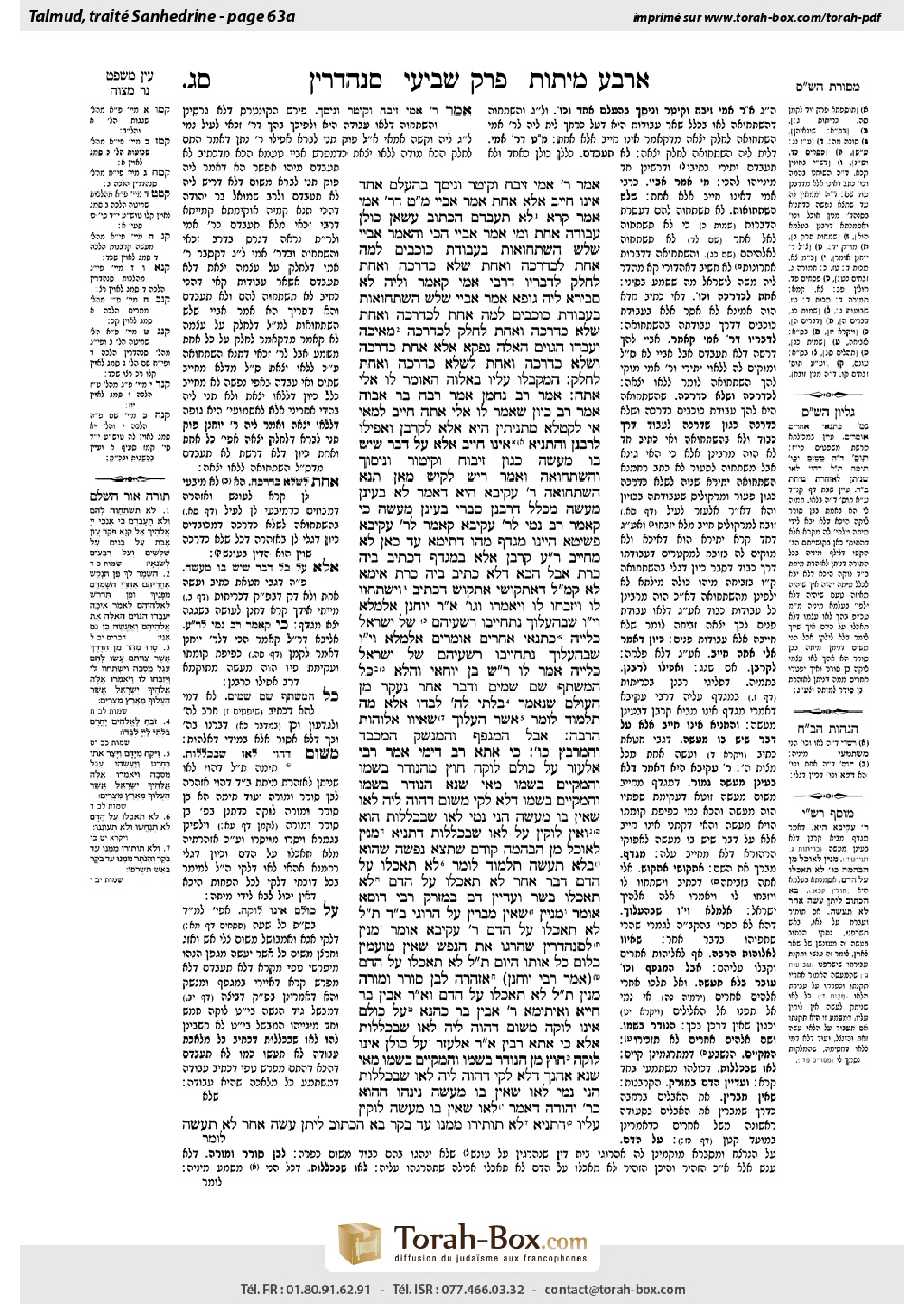
Sanhedrin 63a: Talmud study for Daf Yomi
Daf Yomi is the daily study of one Talmud folio. Explore 37 tractates with scans, Hebrew text, Sefaria English and AI-generated French translations where annotated.
Passage selection and English or AI-generated French translation are available where the scan has annotations. Daf Study is independent of Torah-Box and Sefaria.
Browse Sanhedrin · סנהדרין · All tractatesSanhedrin 63a text and translations
This page of Sanhedrin includes the Aramaic text, an English translation and an AI-generated French translation, alongside the scan above.
סנהדרין ס״ג א · Aramaic and Hebrew text
אָמַר רַבִּי אַמֵּי: זִיבַּח וְקִיטֵּר וְנִיסֵּךְ בְּהֶעְלֵם אֶחָד, אֵינוֹ חַיָּיב אֶלָּא אַחַת. אָמַר אַבָּיֵי: מַאי טַעְמָא דְּרַבִּי אַמֵּי? אָמַר קְרָא ״לֹא תָעׇבְדֵם״, הַכָּתוּב עֲשָׂאָן כּוּלָּן עֲבוֹדָה אַחַת.
וּמִי אָמַר אַבָּיֵי הָכִי? וְהָאָמַר אַבָּיֵי: שָׁלֹשׁ הִשְׁתַּחֲוָאוֹת בַּעֲבוֹדָה זָרָה לָמָּה?
אַחַת לִכְדַרְכָּהּ, וְאַחַת שֶׁלֹּא כְּדַרְכָּהּ, וְאַחַת לְחַלֵּק.
לִדְבָרָיו דְּרַבִּי אַמֵּי קָאָמַר, וְלֵיהּ לָא סְבִירָא לֵיהּ.
גּוּפָא, אָמַר אַבָּיֵי: שָׁלֹשׁ הִשְׁתַּחֲוָאוֹת בַּעֲבוֹדָה זָרָה לָמָּה? אַחַת לִכְדַרְכָּהּ, וְאַחַת שֶׁלֹּא כְּדַרְכָּהּ, וְאַחַת לְחַלֵּק.
לִכְדַרְכָּהּ, מֵ״אֵיכָה יַעַבְדוּ הַגּוֹיִם הָאֵלֶּה״ נָפְקָא.
אֶלָּא, אַחַת כְּדַרְכָּהּ וְשֶׁלֹּא כְּדַרְכָּהּ, וְאַחַת לְשֶׁלֹּא כְּדַרְכָּהּ, וְאַחַת לְחַלֵּק.
הַמְקַבְּלוֹ עָלָיו בֶּאֱלוֹהַּ, הָאוֹמֵר לוֹ ״אֵלִי אַתָּה״. אָמַר רַב נַחְמָן אָמַר רַבָּה בַּר אֲבוּהּ אָמַר רַב: כֵּיוָן שֶׁאָמַר לוֹ ״אֵלִי אַתָּה״ – חַיָּיב.
לְמַאי? אִי לִקְטָלָא, מַתְנִיתִין הִיא! אֶלָּא לְקׇרְבָּן.
וַאֲפִילּוּ לְרַבָּנַן? וְהָתַנְיָא: אֵינוֹ חַיָּיב אֶלָּא עַל דָּבָר שֶׁיֵּשׁ בּוֹ מַעֲשֶׂה, כְּגוֹן זִיבּוּחַ וְקִיטּוּר וְנִיסּוּךְ וְהִשְׁתַּחֲוָאָה. וְאָמַר רֵישׁ לָקִישׁ: מַאן תְּנָא הִשְׁתַּחֲוָאָה? רַבִּי עֲקִיבָא הִיא, דְּאָמַר לָא בָּעֵינַן מַעֲשֶׂה. מִכְּלָל דְּרַבָּנַן סָבְרִי בָּעֵינַן מַעֲשֶׂה.
כִּי קָאָמַר רַב נָמֵי, לְרַבִּי עֲקִיבָא קָאָמַר.
לְרַבִּי עֲקִיבָא, פְּשִׁיטָא! הַיְינוּ מְגַדֵּף.
מַהוּ דְּתֵימָא: עַד כָּאן לָא מְחַיֵּיב רַבִּי עֲקִיבָא קׇרְבָּן אֶלָּא בִּמְגַדֵּף, דִּכְתִיב בֵּיהּ כָּרֵת. אֲבָל הָכָא, דְּלָא כְּתִיב בֵּיהּ כָּרֵת, אֵימָא לָא.
קָא מַשְׁמַע לַן דְּאִתַּקּוֹשֵׁי אִתַּקּוּשׁ, דִּכְתִיב: ״וַיִּשְׁתַּחֲווּ לוֹ וַיִּזְבְּחוּ לוֹ וַיֹּאמְרוּ וְגוֹ׳״.
אָמַר רַבִּי יוֹחָנָן: אִלְמָלֵא וָיו שֶׁבְּ״הֶעֱלוּךָ״, נִתְחַיְּיבוּ שׂוֹנְאֵיהֶם שֶׁל יִשְׂרָאֵל כְּלָיָיה.
כְּתַנָּאֵי: אֲחֵרִים אוֹמְרִים, אִלְמָלֵא וָיו שֶׁבְּ״הֶעֱלוּךָ״, נִתְחַיְּיבוּ שׂוֹנְאֵיהֶם שֶׁל יִשְׂרָאֵל כְּלָיָיה.
אָמַר לוֹ רַבִּי שִׁמְעוֹן בֶּן יוֹחַאי: וַהֲלֹא כׇּל הַמְשַׁתֵּף שֵׁם שָׁמַיִם וְדָבָר אַחֵר נֶעֱקָר מִן הָעוֹלָם, שֶׁנֶּאֱמַר ״בִּלְתִּי לַה׳ לְבַדּוֹ״! אֶלָּא מָה תַּלְמוּד לוֹמַר ״אֲשֶׁר הֶעֱלוּךָ״? שֶׁאִיוּוּ אֱלוֹהוֹת הַרְבֵּה.
אֲבָל הַמְגַפֵּף וְהַמְנַשֵּׁק, הַמְכַבֵּד וְהַמְרַבֵּץ כּוּ׳. כִּי אֲתָא רַב דִּימִי, אָמַר רַבִּי אֶלְעָזָר: עַל כּוּלָּם לוֹקֶה, חוּץ מֵהַנּוֹדֵר בִּשְׁמוֹ וְהַמְקַיֵּים בִּשְׁמוֹ.
מַאי שְׁנָא הַנּוֹדֵר בִּשְׁמוֹ וְהַמְקַיֵּים בִּשְׁמוֹ דְּלָא לָקֵי? מִשּׁוּם דְּהָוֵה לֵיהּ לָאו שֶׁאֵין בּוֹ מַעֲשֶׂה. הָנֵי נָמֵי לָאו שֶׁבִּכְלָלוֹת הוּא, וְאֵין לוֹקִין עַל לָאו שֶׁבִּכְלָלוֹת.
דְּתַנְיָא: מִנַּיִן לְאוֹכֵל מִן הַבְּהֵמָה קוֹדֶם שֶׁתֵּצֵא נַפְשָׁהּ שֶׁהוּא בְּלֹא תַעֲשֶׂה? תַּלְמוּד לוֹמַר: ״לֹא תֹאכְלוּ עַל הַדָּם״.
דָּבָר אַחֵר: ״לֹא תֹאכְלוּ עַל הַדָּם״ – לֹא תֹּאכְלוּ בָּשָׂר, וַעֲדַיִן דָּם בְּמִזְרָק.
רַבִּי דּוֹסָא אוֹמֵר: מִנַּיִין שֶׁאֵין מַבְרִין עַל הֲרוּגֵי בֵּית דִּין? תַּלְמוּד לוֹמַר: ״לֹא תֹאכְלוּ עַל הַדָּם״.
רַבִּי עֲקִיבָא אוֹמֵר: מִנַּיִן לְסַנְהֶדְרִין שֶׁהָרְגוּ אֶת הַנֶּפֶשׁ, שֶׁאֵין טוֹעֲמִין כְּלוּם כׇּל אוֹתוֹ הַיּוֹם? תַּלְמוּד לוֹמַר: ״לֹא תֹאכְלוּ עַל הַדָּם״.
אָמַר רַבִּי יוֹחָנָן: אַזְהָרָה לְבֵן סוֹרֵר וּמוֹרֶה מִנַּיִן? תַּלְמוּד לוֹמַר: ״לֹא תֹאכְלוּ עַל הַדָּם״.
וְאָמַר רַבִּי אָבִין בַּר חִיָּיא, וְאִיתֵּימָא רַבִּי אָבִין בַּר כָּהֲנָא: עַל כּוּלָּם אֵינוֹ לוֹקֶה, מִשּׁוּם דְּהָוֵה לֵיהּ לָאו שֶׁבִּכְלָלוֹת.
אֶלָּא, כִּי אֲתָא רָבִין אָמַר רַבִּי אֶלְעָזָר: עַל כּוּלָּן אֵינוֹ לוֹקֶה, חוּץ מִן הַנּוֹדֵר בִּשְׁמוֹ וְהַמְקַיֵּים בִּשְׁמוֹ.
מַאי שְׁנָא אַהָנָךְ דְּלָא לָקֵי? דְּהָוֵה לֵיהּ לָאו שֶׁבִּכְלָלוֹת. הָנֵי נָמֵי לָאו שֶׁאֵין בּוֹ מַעֲשֶׂה נִינְהוּ.
הָהוּא כְּרַבִּי יְהוּדָה, דְּאָמַר: לָאו שֶׁאֵין בּוֹ מַעֲשֶׂה – לוֹקִין עָלָיו.
דְּתַנְיָא: ״לֹא תוֹתִירוּ מִמֶּנּוּ עַד בֹּקֶר״ – בָּא הַכָּתוּב לִיתֵּן עֲשֵׂה אַחַר לֹא תַעֲשֶׂה,
Sanhedrin 63a · English translation
Rabbi Ami says: If one sacrificed an animal as an idolatrous offering and burned incense and poured a libation, all in the course of one lapse of awareness, he is obligated to bring only one sin-offering. Abaye says: What is the reason for the opinion of Rabbi Ami? The verse states: “Nor worship them” (Exodus 20:5). The verse renders all the various rites of worship as one rite.
The Gemara asks: And does Abaye actually say this? But doesn’t Abaye say: Why are there three mentions in the Torah of the prohibition against bowing to an object of idol worship? The prohibition against bowing to an idol appears three times: “You shall not bow to them nor worship them” (Exodus 20:5), “You shall not bow to their gods nor worship them” (Exodus 23:24), and “For you shall bow to no other god” (Exodus 34:14).
The reason is that one mention is for an idol for which bowing is its standard manner of worship, and one mention is a prohibition against bowing to an idol even if bowing is not its standard manner of worship, and one mention is to divide idol worship into categories, as one is obligated to bring an offering for every type of worship that he performed. Evidently, Abaye’s opinion is not in accordance with Rabbi Ami’s statement that one is obligated to bring one sin-offering for all of his acts of idol worship.
The Gemara answers: Abaye stated his reason in accordance with the statement of Rabbi Ami, but he himself does not hold accordingly.
The Gemara discusses the matter itself that Abaye says: Why are there three mentions of the prohibition against bowing to an object of idol worship? One is for an idol for which bowing is its standard manner of worship, and one is a prohibition against bowing to an idol even if bowing is not its standard manner of worship, and one mention is to divide idol worship into categories.
The Gemara asks: Why is a verse necessary for the prohibition against bowing to an idol for which bowing is its standard manner of worship? That prohibition is already derived from the verse: “Take heed to yourself that you not be ensnared to follow them…saying, how do these nations serve their gods, so I will do likewise” (Deuteronomy 12:30), which indicates that one is liable for worshipping an idol in the manner that the gentiles worship it.
Rather, Abaye’s statement should be understood as follows: One mention of the prohibition is for an idol for which its typical manner of worship is similar to bowing in that the idol is worshipped in an honorable manner, but bowing is not its typical manner of worship, as it is not typically worshipped by bowing. And one mention is a prohibition against bowing to an idol even if it is not similar to its standard manner of worship at all. And one mention is to divide idol worship into categories.
§ The mishna includes among those liable for idol worship one who declares that he accepts an idol upon himself as a god and one who says to an idol: You are my god. Rav Naḥman says that Rabba bar Avuh says that Rav says: Once a person said to an idol: You are my god, he is liable even if he did not worship it.
The Gemara asks: The transgressor is liable to receive what punishment? If he is liable to receive the death penalty, Rav’s statement is superfluous, as this is stated in the mishna. Rather, Rav means that one who does so unwittingly is obligated to bring an offering.
The Gemara asks: And is this statement true even according to the opinion of the Rabbis? But isn’t it taught in a baraita: One is obligated to bring a sin-offering for unwitting idol worship only for a matter, a transgression, that involves an action, e.g., sacrificing an offering, or burning incense, or pouring a libation, or bowing? And Reish Lakish says: Who is the tanna who taught bowing among these examples? It is Rabbi Akiva, who says that we do not require a significant action in order to render one liable to bring a sin-offering; a minimal action is sufficient. By inference, the Rabbis, who disagree with Rabbi Akiva, maintain that we require a significant action. If bowing is not considered a significant action, then all the more so speech alone is not considered a significant action.
The Gemara answers: Rav, too, when he states that one who says to an idol: You are my god, is obligated to bring a sin-offering, he states this according to the opinion of Rabbi Akiva.
The Gemara asks: If Rav states this according to the opinion of Rabbi Akiva, isn’t it obvious that the transgressor is obligated to bring a sin-offering? This is identical to the halakha of a blasphemer, whom Rabbi Akiva obligates to bring an offering despite the lack of an action.
The Gemara answers: Rav states this lest you say that Rabbi Akiva obligates one to bring an offering for a transgression that does not involve an action only in the case of a blasphemer, as it is written explicitly with regard to a blasphemer that he receives karet in the verse: “He blasphemes the Lord, and that soul shall be excised [nikhreta] from among his people” (Numbers 15:30). But here, with regard to one who accepts an idol as his god, where karet is not written explicitly, one might say that he is not obligated to bring an offering.
Therefore, Rav teaches us that he is obligated to bring an offering, as the Torah compares the acceptance of an idol as a god to a case of active idol worship; as it is written: “They have made themselves a molten calf, and have bowed to it, and have sacrificed to it, and said: These are your gods, Israel, which brought you up out of the land of Egypt” (Exodus 32:8).
With regard to the aforementioned verse, Rabbi Yoḥanan says: Were it not for the vav in the term: “Which brought you up [he’elukha],” giving it a plural form, the haters of the Jewish people, a euphemism used to refer to the Jewish people themselves, would have been sentenced to destruction for their idol worship. Since they recognized that God had taken them out of Egypt, and thought that He had merely made the golden calf His partner, the Jewish people were spared.
The Gemara comments: Rabbi Yoḥanan’s opinion is like one side of the following dispute between tanna’im: Others say: Were it not for the vav in the term: “Which brought you up [he’elukha],” the haters of the Jewish people would have been sentenced to destruction.
Rabbi Shimon ben Yoḥai said to him: But isn’t anyone who links the name of Heaven and something else, a euphemism for an idol, uprooted from the world? As it is stated: “He who sacrifices to the gods, save to the Lord only, shall be utterly destroyed” (Exodus 22:19). The fact that the Jewish people included God in their idolatrous statement could not have saved them from destruction. Rather, what is the meaning when the verse states: “Which brought you up” in the plural? The verse teaches that the Jewish people desired many gods; they were not satisfied with the golden calf alone.
§ The mishna teaches: But with regard to one who hugs an idol, or one who kisses it, or one who cleans it, or one who sprays water before it, he transgresses a prohibition but is not liable to receive capital punishment. When Rav Dimi came from Eretz Yisrael to Babylonia, he said that Rabbi Elazar says: For all of these actions one is flogged, with the exception of the cases stated later in the mishna of one who vows in an idol’s name and one who affirms his statement by an oath in its name.
The Gemara asks: What is different about these cases, one who vows in an idol’s name and one who affirms his statement by an oath in its name, that the transgressors are not flogged? It is because they are each an example of a prohibition that does not involve an action. These actions too, namely, hugging or kissing an idol and the like, are not punishable by lashes; one who performs them violates a general prohibition, and one is not flogged for violating a general prohibition, i.e., one that contains several prohibitions.
As this principle is taught in a baraita: From where is it derived that one who eats from an animal before its soul departs is in transgression of a prohibition? The verse states: “You shall not eat with the blood” (Leviticus 19:26), meaning, you shall not eat from the animal while its soul, which is referred to in the Torah as blood, is still within it.
The baraita adds: Another matter is derived from the verse “You shall not eat with the blood”: You shall not eat the meat of an offering while its blood is still in the bowl, as it has not yet been sprinkled on the altar. The meat of an offering may be eaten by the priests only after its blood is sprinkled.
The baraita continues: Rabbi Dosa says: From where is it derived that although in general, after a deceased person is buried, the mourners are provided by others with a meal, others do not provide the mourners with a meal after the burial of those executed by the court? The verse states: “You shall not eat with the blood,” which is interpreted to mean: You shall not eat a mourners’ meal after the burial of one who was executed.
Rabbi Akiva says: From where is it derived with regard to a Sanhedrin that killed a soul, i.e., that sentenced a person to death, that the judges may not taste anything that entire day that they sentenced him? The verse states: “You shall not eat with the blood.”
Rabbi Yoḥanan says: From where is the prohibition against the behavior of a stubborn and rebellious son derived? While the Torah states the punishment given to a stubborn and rebellious son, the prohibition against his actions, namely, stealing money from his parents in order to eat a gluttonous meal of meat and wine in the company of lowly men, is not explicit. The verse states: “You shall not eat with the blood,” which is interpreted to mean that one may not eat in a manner that is punishable by death. This concludes the baraita.
And Rabbi Avin bar Ḥiyya says, and some say it is Rabbi Avin bar Kahana who says this: For all of the prohibitions that the Sages derive from this verse, one is not flogged for transgressing them, as it is a general prohibition that is referring to several different actions. Therefore, since the prohibition against hugging or kissing an idol is also derived from a general prohibition, it should not be punishable by lashes, contrary to the opinion of Rav Dimi.
Rather, when Ravin came from Eretz Yisrael to Babylonia, he related a different version of what Rabbi Elazar says: For all of the transgressions listed in the mishna one is not flogged, with the exception of one who vows in an idol’s name and one who affirms his statement by an oath in its name.
The Gemara asks: What is different about transgressing those prohibitions for which one is not flogged? It is that they are each an example of a general prohibition, as explained previously. These cases too, namely, one who vows or takes an oath in the name of an idol, are included in a prohibition that does not involve an action, and therefore the transgressors are not punishable by lashes.
The Gemara answers: That halakha of Rabbi Eliezer’s is in accordance with the opinion of Rabbi Yehuda, who says with regard to a prohibition that does not involve an action that one is flogged for violating it.
As it is taught in a baraita with regard to the Paschal offering: The verse states: “And you shall not leave any of it until morning; but that which remains of it until morning you shall burn with fire” (Exodus 12:10). The verse comes to provide a positive mitzva to burn the leftover meat after the prohibition against leaving it over was violated,
Sanhedrin 63a · Traduction française (IA)
Rabbi Ami dit : Si quelqu’un sacrifie un animal en offrande idolâtre, brûle de l’encens et verse une libation, le tout au cours d’un seul égarement, il n’est tenu d’apporter qu’un seul sacrifice expiatoire. Abaye dit : Quelle est la raison de l’opinion de Rabbi Ami ? Le verset dit : « Tu ne les adoreras pas » (Exode 20:5). Le verset considère toutes les différentes formes de culte comme un seul rite.
La Guemara demande : Abaye dit-il vraiment cela ? Abaye ne dit-il pas : Pourquoi la Torah mentionne-t-elle à trois reprises l’interdiction de se prosterner devant une idole ? L’interdiction de se prosterner devant une idole apparaît trois fois : « Tu ne te prosterneras pas devant elles et tu ne les adoreras pas » (Exode 20:5), « Tu ne te prosterneras pas devant leurs dieux et tu ne les adoreras pas » (Exode 23:24), et « Car tu ne te prosterneras devant aucun autre dieu » (Exode 34:14).
La raison en est qu’une mention concerne une idole pour laquelle la prosternation est la forme habituelle du culte, une autre interdit de se prosterner devant une idole même lorsque la prosternation n’est pas sa forme habituelle de culte, et une autre sert à répartir le culte idolâtre en catégories, car on est tenu d’apporter une offrande pour chaque forme de culte accomplie. Il apparaît donc que l’opinion d’Abaye ne concorde pas avec la déclaration de Rabbi Ami, selon laquelle on est tenu d’apporter un seul sacrifice expiatoire pour tous ses actes de culte idolâtre.
La Guemara répond : Abaye a exposé sa raison conformément à la déclaration de Rabbi Ami, mais lui-même ne soutient pas cette opinion.
La Guemara examine la question elle-même : Abaye dit : Pourquoi la Torah mentionne-t-elle à trois reprises l’interdiction de se prosterner devant une idole ? Une mention concerne une idole pour laquelle la prosternation est la forme habituelle du culte, une autre interdit de se prosterner devant une idole même lorsque la prosternation n’est pas sa forme habituelle de culte, et une autre sert à répartir le culte idolâtre en catégories.
La Guemara demande : Pourquoi un verset est-il nécessaire pour interdire de se prosterner devant une idole pour laquelle la prosternation est la forme habituelle du culte ? Cette interdiction se déduit déjà du verset : « Prends garde à toi, de peur que tu ne te laisses entraîner à les suivre… en disant : Comment ces nations servent-elles leurs dieux ? Je ferai de même » (Deutéronome 12:30), ce qui indique qu’on est passible d’une peine pour avoir adoré une idole de la manière dont les nations l’adorent.
Il faut plutôt comprendre ainsi la déclaration d’Abaye : une mention de l’interdiction concerne une idole dont la forme habituelle du culte consiste en une pratique honorable, semblable à la prosternation, alors que la prosternation n’est pas sa forme habituelle de culte, puisqu’on ne la sert généralement pas en se prosternant. Une autre mention interdit de se prosterner devant une idole même lorsque la prosternation ne ressemble aucunement à sa forme habituelle de culte. Enfin, une mention sert à répartir le culte idolâtre en catégories.
§ La Michna inclut parmi ceux qui sont passibles d’une peine pour idolâtrie celui qui déclare qu’il accepte une idole comme dieu et celui qui dit à une idole : « Tu es mon dieu. » Rav Naḥman dit au nom de Rabba bar Avouha, qui le dit au nom de Rav : Dès qu’une personne dit à une idole : « Tu es mon dieu », elle est passible d’une peine même si elle ne l’a pas adorée.
La Guemara demande : De quelle peine le transgresseur est-il passible ? S’il est passible de la peine de mort, la déclaration de Rav est superflue, puisque cela est énoncé dans la Michna. Rav veut donc dire que celui qui commet cette faute par inadvertance est tenu d’apporter une offrande.
La Guemara demande : Cette déclaration est-elle vraie même selon l’opinion des Sages ? N’est-il pas enseigné dans une baraïta qu’on est tenu d’apporter un sacrifice expiatoire pour un culte idolâtre commis par inadvertance uniquement lorsque la faute implique un acte, par exemple offrir un sacrifice, brûler de l’encens, verser une libation ou se prosterner ? Et Reish Lakish dit : Qui est le tanna qui a cité la prosternation parmi ces exemples ? C’est Rabbi Akiva, qui estime qu’un acte important n’est pas nécessaire pour rendre quelqu’un passible d’un sacrifice expiatoire ; un acte minime suffit. On en déduit que les Sages, qui sont en désaccord avec Rabbi Akiva, considèrent qu’un acte important est requis. Si la prosternation n’est pas considérée comme un acte important, à plus forte raison la parole seule n’est-elle pas considérée comme un acte important.
La Guemara répond : Rav aussi, lorsqu’il affirme que celui qui dit à une idole : « Tu es mon dieu » est tenu d’apporter un sacrifice expiatoire, parle selon l’opinion de Rabbi Akiva.
La Guemara demande : Si Rav parle selon l’opinion de Rabbi Akiva, n’est-il pas évident que le transgresseur est tenu d’apporter un sacrifice expiatoire ? Cela revient à la halakha concernant le blasphémateur, que Rabbi Akiva oblige à apporter une offrande malgré l’absence d’un acte.
La Guemara répond : Rav précise cela pour éviter qu’on ne dise que Rabbi Akiva oblige à apporter une offrande pour une faute n’impliquant pas d’acte uniquement dans le cas du blasphémateur, car le verset stipule explicitement que le blasphémateur est passible de retranchement [karet] : « Il blasphème l’Éternel, et cette âme sera retranchée [nikhreta] du milieu de son peuple » (Nombres 15:30). Mais ici, concernant celui qui accepte une idole comme dieu, où le retranchement n’est pas explicitement mentionné, on pourrait dire qu’il n’est pas tenu d’apporter une offrande.
Rav nous enseigne donc qu’il est tenu d’apporter une offrande, car la Torah compare le fait d’accepter une idole comme dieu à un cas de culte idolâtre accompagné d’un acte, comme il est écrit : « Ils se sont fait un veau en métal fondu, se sont prosternés devant lui, lui ont offert des sacrifices et ont dit : Voici tes dieux, Israël, qui t’ont fait monter du pays d’Égypte » (Exode 32:8).
À propos du verset précité, Rabbi Yoḥanan dit : Sans le vav dans le terme « qui t’ont fait monter [he’elukha] », qui lui donne une forme plurielle, les ennemis du peuple juif — euphémisme désignant le peuple juif lui-même — auraient été condamnés à la destruction pour leur idolâtrie. Puisqu’ils reconnaissaient que Dieu les avait fait sortir d’Égypte et pensaient qu’Il avait simplement pris le veau d’or pour associé, le peuple juif fut épargné.
La Guemara remarque : L’opinion de Rabbi Yoḥanan correspond à l’un des avis dans la controverse suivante entre tannaïm. D’autres disent : Sans le vav dans le terme « qui t’ont fait monter [he’elukha] », les ennemis du peuple juif auraient été condamnés à la destruction.
Rabbi Shimon ben Yoḥai lui dit : Mais quiconque associe le nom du Ciel à autre chose, euphémisme désignant une idole, n’est-il pas arraché au monde ? Comme il est dit : « Celui qui offre des sacrifices aux dieux, sauf à l’Éternel seul, sera voué à la destruction » (Exode 22:19). Le fait que le peuple juif ait inclus Dieu dans sa déclaration idolâtre n’aurait donc pas pu le sauver de la destruction. Quel est alors le sens des mots « qui t’ont fait monter », au pluriel ? Le verset enseigne que le peuple juif désirait de nombreux dieux ; le veau d’or ne lui suffisait pas.
§ La Michna enseigne : Mais celui qui enlace une idole, l’embrasse, la nettoie ou asperge d’eau le sol devant elle transgresse une interdiction, mais n’est pas passible de la peine capitale. Lorsque Rav Dimi arriva d’Erets Israël en Babylonie, il rapporta que Rabbi Elazar dit : Pour tous ces actes, on reçoit des coups de fouet, à l’exception des cas mentionnés ensuite dans la Michna : celui qui fait un vœu au nom d’une idole et celui qui confirme ses propos par un serment en son nom.
La Guemara demande : En quoi ces cas — faire un vœu au nom d’une idole et confirmer ses propos par un serment en son nom — diffèrent-ils, de sorte que leurs auteurs ne reçoivent pas de coups de fouet ? C’est parce que chacun constitue un exemple d’interdiction n’impliquant pas d’acte. Ces actes aussi, à savoir enlacer ou embrasser une idole et les actes semblables, ne sont pas punis de coups de fouet : celui qui les accomplit transgresse une interdiction générale, et on ne reçoit pas de coups de fouet pour la violation d’une interdiction générale, c’est-à-dire d’une interdiction qui englobe plusieurs prohibitions.
Car ce principe est enseigné dans une baraïta : D’où apprend-on que celui qui mange d’un animal avant que son âme ne l’ait quitté transgresse une interdiction ? Le verset dit : « Tu ne mangeras pas avec le sang » (Lévitique 19:26), c’est-à-dire : tu ne mangeras pas de l’animal tant que son âme, désignée dans la Torah comme le sang, est encore en lui.
La baraïta ajoute : On déduit une autre règle du verset « Tu ne mangeras pas avec le sang » : tu ne mangeras pas la viande d’une offrande tant que son sang se trouve encore dans le bassin, car il n’a pas encore été aspergé sur l’autel. Les prêtres ne peuvent manger la viande d’une offrande qu’après que son sang a été aspergé.
La baraïta poursuit : Rabbi Dosa dit : D’où apprend-on que, bien qu’en règle générale, après l’enterrement d’un défunt, d’autres personnes offrent un repas aux endeuillés, on ne leur offre pas de repas après l’enterrement de ceux qui ont été exécutés par le tribunal ? Le verset dit : « Tu ne mangeras pas avec le sang », interprété ainsi : tu ne prendras pas le repas des endeuillés après l’enterrement d’une personne exécutée.
Rabbi Akiva dit : D’où apprend-on que les membres d’un Sanhédrin qui a donné la mort à une personne, c’est-à-dire qui l’a condamnée à mort, ne peuvent rien goûter pendant toute la journée où ils l’ont condamnée ? Le verset dit : « Tu ne mangeras pas avec le sang. »
Rabbi Yoḥanan dit : D’où tire-t-on l’interdiction du comportement d’un fils rebelle et réfractaire ? Alors que la Torah énonce la peine infligée à un fils rebelle et réfractaire, l’interdiction de ses actes — à savoir voler de l’argent à ses parents afin de manger un repas de viande et de vin en compagnie d’hommes de basse condition — n’est pas explicite. Le verset dit : « Tu ne mangeras pas avec le sang », interprété ainsi : on ne doit pas manger d’une manière passible de la peine de mort. La baraïta s’achève ici.
Rabbi Avin bar Ḥiyya dit — et certains disent que c’est Rabbi Avin bar Kahana qui le dit — que, pour toutes les interdictions que les Sages déduisent de ce verset, on ne reçoit pas de coups de fouet en les transgressant, car il s’agit d’une interdiction générale visant plusieurs actes différents. Par conséquent, puisque l’interdiction d’enlacer ou d’embrasser une idole se déduit elle aussi d’une interdiction générale, elle ne devrait pas être punie de coups de fouet, contrairement à l’opinion de Rav Dimi.
Il faut plutôt dire que lorsque Ravin arriva d’Erets Israël en Babylonie, il rapporta une autre version de la déclaration de Rabbi Elazar : Pour toutes les transgressions énumérées dans la Michna, on ne reçoit pas de coups de fouet, à l’exception de celui qui fait un vœu au nom d’une idole et de celui qui confirme ses propos par un serment en son nom.
La Guemara demande : En quoi les transgressions de ces interdictions, pour lesquelles on ne reçoit pas de coups de fouet, diffèrent-elles ? Elles relèvent chacune d’une interdiction générale, comme cela a été expliqué précédemment. Ces cas aussi, à savoir faire un vœu ou prêter serment au nom d’une idole, relèvent d’une interdiction n’impliquant pas d’acte ; leurs auteurs ne sont donc pas passibles de coups de fouet.
La Guemara répond : Cette halakha de Rabbi Eliezer est conforme à l’opinion de Rabbi Yehuda, qui affirme que l’on reçoit des coups de fouet pour avoir transgressé une interdiction n’impliquant pas d’acte.
Comme il est enseigné dans une baraïta à propos de l’offrande pascale : Le verset dit : « Vous n’en laisserez rien jusqu’au matin ; ce qui en restera jusqu’au matin, vous le brûlerez au feu » (Exode 12:10). Le verset vient prescrire une mitsva positive de brûler la viande restante après que l’interdiction de la laisser jusqu’au matin a été transgressée,
Traduction française générée par IA à partir de l’édition anglaise de Sefaria. Vérifie toujours un passage avec le texte source.
Text from Sefaria: William Davidson Edition - Vocalized Aramaic (CC BY NC); William Davidson Edition - English (CC BY NC).