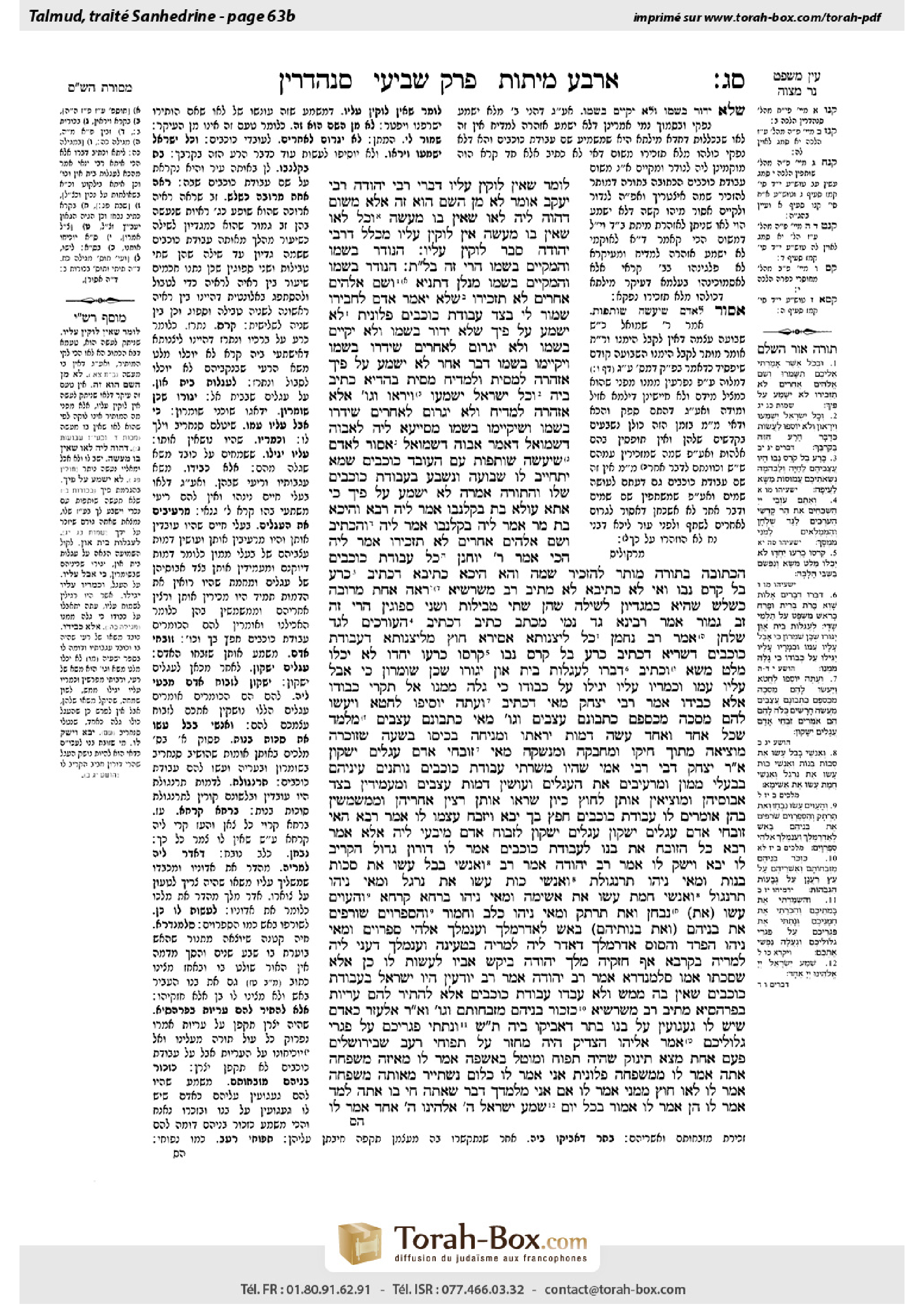
Sanhedrin 63b: Talmud study for Daf Yomi
Daf Yomi is the daily study of one Talmud folio. Explore 37 tractates with scans, Hebrew text, Sefaria English and AI-generated French translations where annotated.
Passage selection and English or AI-generated French translation are available where the scan has annotations. Daf Study is independent of Torah-Box and Sefaria.
Browse Sanhedrin · סנהדרין · All tractatesSanhedrin 63b text and translations
This page of Sanhedrin includes the Aramaic text, an English translation and an AI-generated French translation, alongside the scan above.
סנהדרין ס״ג ב · Aramaic and Hebrew text
לוֹמַר שֶׁאֵין לוֹקִין עָלָיו, דִּבְרֵי רַבִּי יְהוּדָה.
רַבִּי יַעֲקֹב אוֹמֵר: לֹא מִן הַשֵּׁם הוּא זֶה, אֶלָּא מִשּׁוּם דְּהָוֵה לֵיהּ לָאו שֶׁאֵין בּוֹ מַעֲשֶׂה, וְכׇל לָאו שֶׁאֵין בּוֹ מַעֲשֶׂה אֵין לוֹקִין עָלָיו.
מִכְּלָל דְּרַבִּי יְהוּדָה סָבַר: לוֹקִין עָלָיו.
הַנּוֹדֵר בִּשְׁמוֹ וְהַמְקַיֵּים בִּשְׁמוֹ, הֲרֵי זֶה בְּלֹא תַעֲשֶׂה. הַנּוֹדֵר בִּשְׁמוֹ וְהַמְקַיֵּים בִּשְׁמוֹ, מְנָלַן?
דְּתַנְיָא: ״וְשֵׁם אֱלֹהִים אֲחֵרִים לֹא תַזְכִּירוּ״ – שֶׁלֹּא יֹאמַר אָדָם לַחֲבֵירוֹ ״שְׁמוֹר לִי בְּצַד עֲבוֹדָה זָרָה פְּלוֹנִית״. ״לֹא יִשָּׁמַע עַל פִּיךָ״ – שֶׁלֹּא יִדּוֹר בִּשְׁמוֹ וְלֹא יְקַיֵּים בִּשְׁמוֹ, וְלֹא יִגְרוֹם לַאֲחֵרִים שִׁידְּרוּ בִּשְׁמוֹ וְשֶׁיְּקַיְּימוּ בִּשְׁמוֹ.
דָּבָר אַחֵר: ״לֹא יִשָּׁמַע עַל פִּיךָ״ – אַזְהָרָה לַמֵּסִית וְלַמַּדִּיחַ.
מֵסִית, בְּהֶדְיָא כְּתִיב בֵּיהּ: ״וְכׇל יִשְׂרָאֵל יִשְׁמְעוּ וְיִרָאוּ וְגוֹ׳״. אֶלָּא, אַזְהָרָה לַמַּדִּיחַ.
וְלֹא יִגְרוֹם לַאֲחֵרִים שֶׁיִּדְּרוּ בִּשְׁמוֹ וְשֶׁיְּקַיְּימוּ בִּשְׁמוֹ. מְסַיְּיעָא לֵיהּ לַאֲבוּהּ דִּשְׁמוּאֵל, דְּאָמַר אֲבוּהּ דִּשְׁמוּאֵל: אָסוּר לְאָדָם שֶׁיַּעֲשֶׂה שׁוּתָּפוּת עִם הַנׇּכְרִי, שֶׁמָּא יִתְחַיֵּיב לוֹ שְׁבוּעָה וְנִשְׁבָּע בַּעֲבוֹדָה זָרָה שֶׁלּוֹ, וְהַתּוֹרָה אָמְרָה: ״לֹא יִשָּׁמַע עַל פִּיךָ״.
כִּי אֲתָא עוּלָּא, בָּת בְּקַלְנְבוֹ. אֲמַר לֵיהּ רָבָא: וְהֵיכָא בָּת מָר? אֲמַר לֵיהּ: בְּקַלְנְבוֹ. אֲמַר לֵיהּ: וְהָכְתִיב ״וְשֵׁם אֱלֹהִים אֲחֵרִים לֹא תַזְכִּירוּ״? אֲמַר לֵיהּ, הָכִי אָמַר רַבִּי יוֹחָנָן: כׇּל עֲבוֹדָה זָרָה הַכְּתוּבָה בַּתּוֹרָה – מוּתָּר לְהַזְכִּיר שְׁמָהּ. וְהָא הֵיכָא כְּתִיבָא? דִּכְתִיב: ״כָּרַע בֵּל קֹרֵס נְבוֹ״.
וְאִי לָא כְּתִיבָא – לָא? מֵתִיב רַב מְשַׁרְשְׁיָא: רָאָה אַחַת מְרוּבָּה כְּשָׁלֹשׁ, שֶׁהִיא כְּמִגַּדְיוֹן לְשִׁילֹה, שֶׁהֵן שְׁתֵּי טְבִילוֹת וּשְׁנֵי סְפוֹגִין – הֲרֵי זֶה זָב גָּמוּר. אָמַר רָבִינָא: גַּד נָמֵי מִכְתָּב כְּתִיב, דִּכְתִיב ״הָעֹרְכִים לַגַּד שֻׁלְחָן״.
אָמַר רַב נַחְמָן: כֹּל לֵיצָנוּתָא אֲסִירָא, חוּץ מִלֵּיצָנוּתָא דַּעֲבוֹדָה זָרָה דְּשַׁרְיָא, דִּכְתִיב: ״כָּרַע בֵּל קֹרֵס נְבוֹ ... קָרְסוּ כָרְעוּ יַחְדָּו לֹא יָכְלוּ מַלֵּט מַשָּׂא״.
וּכְתִיב: ״דִּבְּרוּ ... לְעֶגְלוֹת בֵּית אָוֶן יָגוּרוּ שְׁכַן שֹׁמְרוֹן כִּי אָבַל עָלָיו עַמּוֹ וּכְמָרָיו עָלָיו יָגִילוּ עַל כְּבוֹדוֹ כִּי גָּלָה מִמֶּנּוּ״. אַל תִּקְרֵי ״כְּבוֹדוֹ״, אֶלָּא ״כְּבֵידוֹ״.
אָמַר רַבִּי יִצְחָק: מַאי דִּכְתִיב ״וְעַתָּה יוֹסִפוּ לַחֲטֹא וַיַּעְשׂוּ לָהֶם מַסֵּכָה מִכַּסְפָּם כִּתְבוּנָם עֲצַבִּים וְגוֹ׳״ – מַאי ״כִּתְבוּנָם עֲצַבִּים״? מְלַמֵּד שֶׁכׇּל אֶחָד וְאֶחָד עֹשֶׂה דְּמוּת יִרְאָתוֹ וּמַנִּיחָהּ בְּכִיסוֹ, בְּשָׁעָה שֶׁזּוֹכְרָהּ מוֹצִיאָהּ מִתּוֹךְ חֵיקוֹ וּמְחַבְּקָהּ וּמְנַשְּׁקָהּ.
מַאי ״זֹבְחֵי אָדָם עֲגָלִים יִשָּׁקוּן״? אָמַר רַבִּי יִצְחָק דְּבֵי רַבִּי אַמֵּי: שֶׁהָיוּ כּוֹמָרִים נוֹתְנִים עֵינֵיהֶם בְּבַעֲלֵי מָמוֹן, וּמַרְעִיבִים אֶת הָעֲגָלִים, וְעוֹשִׂין דְּמוּת עֲצַבִּים, וּמַעֲמִידִין בְּצַד אֲבוּסֵיהֶן, וּמוֹצִיאִין אוֹתָן לַחוּץ. כֵּיוָן שֶׁרָאוּ אוֹתָן רָצִין אַחֲרֵיהֶן וּמְמַשְׁמְשִׁין בָּהֶן, אוֹמְרִים לוֹ: עֲבוֹדָה זָרָה חָפֵץ בְּךָ, יָבֹא וְיִזְבַּח עַצְמוֹ לוֹ.
אָמַר רָבָא: הַאי ״זֹבְחֵי אָדָם עֲגָלִים יִשָּׁקוּן״? ״עֲגָלִים יִשָּׁקוּן לִזְבֹּחַ אָדָם״ מִיבְּעֵי לֵיהּ! אֶלָּא אָמַר רָבָא: כׇּל הַזּוֹבֵחַ אֶת בְּנוֹ לַעֲבוֹדָה זָרָה, אֹמֵר לוֹ: דּוֹרוֹן גָּדוֹל הִקְרִיב לוֹ, יָבֹא וְיִשַּׁק לוֹ.
אָמַר רַב יְהוּדָה אָמַר רַב: ״וְאַנְשֵׁי בָבֶל עָשׂוּ אֶת סֻכּוֹת בְּנוֹת״, וּמַאי נִיהוּ? תַּרְנְגוֹלֶת. ״וְאַנְשֵׁי כוּת עָשׂוּ אֶת נֵרְגַל״, וּמַאי נִיהוּ? תַּרְנְגוֹל. ״וְאַנְשֵׁי חֲמָת עָשׂוּ אֶת אֲשִׁימָא״, וּמַאי נִיהוּ? בַּרְחָא קַרְחָא. ״וְהָעַוִּים עָשׂוּ אֶת נִבְחָן וְאֶת תַּרְתָּק״, וּמַאי נִיהוּ? כֶּלֶב וַחֲמוֹר.
״וְהַסְפַרְוִים שֹׂרְפִים אֶת בְּנֵיהֶם וְאֶת בְּנוֹתֵיהֶם בָּאֵשׁ לְאַדְרַמֶּלֶךְ וַעֲנַמֶּלֶךְ אֱלֹהֵי סְפַרְוָיִם״, וּמַאי נִיהוּ? הַפֶּרֶד וְהַסּוּס. אַדְרַמֶּלֶךְ – דְּאָדַר לֵיהּ לְמָרֵיהּ בִּטְעִינָה, וַעֲנַמֶּלֶךְ – דְּעָנֵי לֵיהּ לְמָרֵיהּ בִּקְרָבָא.
אַף חִזְקִיָּה מֶלֶךְ יְהוּדָה בִּיקֵּשׁ אָבִיו לַעֲשׂוֹת לוֹ כֵּן, אֶלָּא שֶׁסָּכַתּוּ אִמּוֹ סָלָמַנְדְּרָא.
אָמַר רַב יְהוּדָה אָמַר רַב: יוֹדְעִין הָיוּ יִשְׂרָאֵל בַּעֲבוֹדָה זָרָה שֶׁאֵין בָּהּ מַמָּשׁ, וְלֹא עָבְדוּ עֲבוֹדָה זָרָה אֶלָּא לְהַתִּיר לָהֶם עֲרָיוֹת בְּפַרְהֶסְיָא.
מֵתִיב רַב מְשַׁרְשְׁיָא: ״כִּזְכֹּר בְּנֵיהֶם מִזְבְּחוֹתָם וְגוֹ׳״, וְאָמַר רַבִּי אֶלְעָזָר: כְּאָדָם שֶׁיֵּשׁ לוֹ גַּעְגּוּעִין עַל בְּנוֹ?
בָּתַר דַּאֲבִיקוּ בַּיהּ.
תָּא שְׁמַע: ״וְנָתַתִּי פִּגְרֵיכֶם עַל פִּגְרֵי גִּלּוּלֵיכֶם״. אָמַר: אֵלִיָּהוּ הַצַּדִּיק הָיָה מְחַזֵּר עַל תְּפוּחֵי רָעָב שֶׁבִּירוּשָׁלַיִם. פַּעַם אַחַת מָצָא תִּינוֹק שֶׁהָיָה תָּפוּחַ וּמוּטָל בָּאַשְׁפָּה.
אָמַר לוֹ: מֵאֵיזֶה מִשְׁפָּחָה אַתָּה? אָמַר לוֹ: מִמִּשְׁפָּחָה פְּלוֹנִית אֲנִי. אָמַר לוֹ: כְּלוּם נִשְׁתַּיֵּיר מֵאוֹתָהּ מִשְׁפָּחָה? אָמַר לוֹ: לָאו, חוּץ מִמֶּנִּי. אָמַר לוֹ: אִם אֲנִי מְלַמֶּדְךָ דָּבָר שֶׁאַתָּה חַי בּוֹ, אַתָּה לָמֵד? אָמַר לוֹ: הֵן. אָמַר לוֹ: אֱמוֹר בְּכׇל יוֹם ״שְׁמַע יִשְׂרָאֵל ה׳ אֱלֹהֵינוּ ה׳ אֶחָד״. אָמַר לוֹ:
Sanhedrin 63b · English translation
to say that one is not flogged for transgressing the prohibition, as any prohibition that can be rectified by the performance of a positive mitzva does not carry a punishment of lashes. This is the statement of Rabbi Yehuda.
Rabbi Ya’akov says: This is not for that reason. Rather, it is because it is a prohibition that does not involve an action. The transgression is simply the failure to consume all the meat during the allotted time rather than the performance of an action. And one is not flogged for the violation of any prohibition that does not involve an action.
The Gemara concludes: By inference, Rabbi Yehuda holds that in general, one is flogged for the violation of a prohibition that does not involve an action. It can therefore be inferred that one who vows or takes an oath in the name of an idol is liable to be flogged according to Rabbi Yehuda’s opinion, even though no action is involved.
§ The mishna teaches with regard to one who vows in the name of an idol and one who affirms his statement by an oath in its name, that this person is in transgression of a prohibition. The Gemara asks: From where do we derive that one who vows in the name of an idol and one who affirms his statement by an oath in its name transgresses a prohibition?
The Gemara answers: As it is taught in a baraita that the meaning of the verse: “And make no mention of the name of the other gods, neither let it be heard out of your mouth” (Exodus 23:13), is that a person may not say to another: Wait for me next to such and such an object of idol worship. The meaning of the statement “neither let it be heard out of your mouth” is that one may not vow in the name of an idol, nor affirm his statement by an oath in its name, nor cause others, i.e., gentiles, to vow in its name or affirm their statements by an oath in its name.
Alternatively, the statement “neither let it be heard out of your mouth” can be interpreted as a prohibition against one who incites another to worship idols and against one who subverts an entire city to do so. The prohibition against inciting others to engage in idol worship can be derived from this verse.
The Gemara asks: Why must the prohibition against an inciter be derived from here? It is written explicitly in that regard, in the verse concerning the inciter’s punishment: “And all Israel shall hear, and fear, and shall do no more of any such wickedness as this is in your midst” (Deuteronomy 13:12). This is clearly a prohibition against inciting others to worship idols. Rather, the verse “neither let it be heard out of your mouth” is a prohibition against one who subverts an entire city to engage in idol worship; this prohibition is not stated elsewhere.
The baraita teaches: And one may not cause others, i.e., gentiles, to vow in the name of an idol or affirm their statements by an oath in its name. The Gemara comments: The baraita supports the opinion of Shmuel’s father, as Shmuel’s father says: It is prohibited for a person to enter into a partnership with a gentile, lest their joint ventures lead them to quarrel, and his gentile partner will be obligated to take an oath to him, and he will take an oath in the name of his object of idol worship; and the Torah states: “Neither let it be heard out of your mouth,” which includes causing a gentile to take an oath in the name of an idol.
When Ulla came from Eretz Yisrael to Babylonia, he lodged in a place called Kalnevo. Rava said to him: And where did the Master lodge? Ulla said to him: In Kalnevo. Rava said to him: But isn’t it written: “And make no mention of the name of the other gods”? Kalnevo is the name of an idol. Ulla said to him: This is what Rabbi Yoḥanan said: With regard to any object of idol worship that is written in the Torah, it is permitted to mention its name. Since one may mention the idol while reading the Torah, it is permitted to mention it altogether. Rava asked: And where is this idol written? Ulla answered: As it is written: “Bel bows down, Nevo stoops” (Isaiah 46:1).
The Gemara asks: And does this mean that if an idol is not written in the Torah, it is not permitted to mention its name? Rav Mesharshiyya raises an objection to this premise from a mishna in tractate Zavim (1:5): If a man saw, i.e., experienced, one gonorrhea-like discharge that lasted as long as three regular gonorrhea-like discharges, which is like the amount of time it takes to walk from the location of the idol Gadyon to Shiloh, which is the amount of time it takes to perform two immersions and two dryings with a towel, he is ritually impure with the impurity status of a full-fledged zav, even though a man generally becomes a zav only after three separate discharges. In any event, the mishna mentions the idol Gadyon. Ravina says: The idol Gad is also written in the Bible; as it is written: “That prepare a table for Gad” (Isaiah 65:11).
§ Rav Naḥman says: All types of mockery are forbidden, except for mockery of idol worship, which is permitted, as it is written: “Bel crouches down, Nevo stoops…they stoop, they crouch down together, they could not hold back the burden” (Isaiah 46:1–2). The verse is interpreted as meaning that they crouch in order to defecate and cannot retain their excrement.
And it is similarly written: “They speak…the inhabitants of Samaria shall be in dread for the calves of Beth Aven; for its people shall mourn over it, and its priests shall tremble for it, for its glory [kevodo], because it has departed from it” (Hosea 10:4–5). Do not read it as “its glory [kevodo]”; rather, read it as its burden [keveido], meaning that the idol is unable to restrain itself from defecating. These are examples of derogatory statements that are permitted only in reference to idols.
Rav Yitzḥak says: What is the meaning of that which is written: “And now they continue to sin, and have made for themselves molten images of their silver, according to their own understanding, idols, all of them the work of the craftsmen; of them they say: Those who sacrifice men kiss calves” (Hosea 13:2)? What is the meaning of the expression: “According to their own understanding [kitvunam], idols”? The word kitvunam is interpreted as meaning: According to their image [ketavnitam], and the verse teaches that each and every person would make an image of his god and place it in his pocket. When he would remember it, he would remove it from his bosom and embrace it and kiss it.
What is the meaning of the statement: “Those who sacrifice men kiss calves”? Rabbi Yitzḥak of the school of Rabbi Ami says: It means that priests of idol worship would set their eyes on the wealthy, and they would starve the calves that were objects of idol worship, and make statues in the image of those wealthy people, and place those statues next to the troughs of the calves, and they would take those calves outside. When the calves would see those wealthy people, whose image they were used to seeing near their troughs, they would run after them and paw them. At this point the priests would say to that wealthy person: The object of idol worship, the calf, desires you; let the Master come and sacrifice himself to it. The priests would inherit his property.
Rava says: That is not the correct interpretation of the verse, as the wording “those who sacrifice men kiss calves” is unsuitable for that interpretation, since in that case the verse should have stated: They make calves kiss to sacrifice men. Rather, Rava says that the verse is to be understood as follows: Whenever anyone sacrifices his son to an object of idol worship, the priest says to him: The Master has sacrificed a great gift [doron] to the idol; therefore, he has the right to come and kiss it. The verse means that the reward of “those who sacrifice men” is to kiss calves.
Rav Yehuda says that Rav says with regard to the verse describing the peoples that were settled in Samaria by the Assyrians: “And the men of Babylonia made Succoth-Benoth” (II Kings 17:30); and what is this idol? It is the image of a hen. “And the men of Cuth made Nergal” (II Kings 17:30); and what is it? It is the image of a rooster. “And the men of Hamath made Ashima” (II Kings 17:30); and what is it? It is the image of a bald billy goat. “And the Avvites made Nibhaz and Tartak” (II Kings 17:31); and what are they? The image of a dog and a donkey.
“And the Sepharvites burned their sons and their daughters in the fire to Adrammelech and Anammelech, the gods of Sepharvaim” (II Kings 17:31); and what are they? The mule and the horse. And why are they called that? A mule is called Adrammelech because it honors [addar] its master with its load, i.e., because it carries the master’s load, and a horse is called Anammelech because it responds [anei] to its master, assisting him in battle.
The Gemara relates: The father of Hezekiah, king of Judea, also attempted to do so to him, i.e., to burn him as an offering to an idol, but his mother rubbed him with the blood of a salamander [salamandera], a creature created out of fire and immune to the effects of fire, whose blood is fireproof.
§ Rav Yehuda says that Rav says: The Jewish people knew that idol worship is of no substance; they did not actually believe in it. And they worshipped idols only in order to permit themselves to engage in forbidden sexual relations in public, since most rituals of idol worship would include public displays of forbidden sexual intercourse.
Rav Mesharshiyya raises an objection to this statement from the following verse: “Like the memory of their sons are their altars, and their Asherim are by the leafy trees, upon the high hills” (Jeremiah 17:2). And Rabbi Elazar says that this means that the Jewish people would recall their idol worship like a person who misses his child. This interpretation indicates that they were truly attached to idol worship.
The Gemara answers: This was the case after the Jewish people became attached to idol worship, at which point they began to actually believe in it. At first, they were drawn to idol worship only due to their lust.
The Gemara suggests: Come and hear a proof that the Jewish people engaged in idol worship for its own sake and not for the sake of engaging in forbidden sexual relations: In interpretation of the verse: “And I shall cast your carcasses upon the carcasses of your idols” (Leviticus 26:30), the Sages say that Elijah the Righteous, the prophet, would search for those who were swollen with hunger in Jerusalem. He once found a child who was swollen with hunger and lying in the garbage.
Elijah said to the child: From which family are you? The child said to him: I am from such and such family. Elijah said to him: Isn’t there anyone left from that family? The child said to him: No one is left besides me. Elijah said to him: If I teach you something through which you will live, will you learn it? The child said to him: Yes. Elijah said to him: Say every day “Listen Israel, the Lord is our God; the Lord is One” (Deuteronomy 6:4). The child said to him:
Sanhedrin 63b · Traduction française (IA)
pour dire que l’on ne reçoit pas la flagellation pour avoir transgressé cette interdiction, car toute interdiction dont la transgression peut être réparée par l’accomplissement d’une mitsva positive n’entraîne pas la flagellation. Telle est l’opinion de Rabbi Yehuda.
Rabbi Ya’akov dit : Ce n’est pas pour cette raison. C’est plutôt parce qu’il s’agit d’une interdiction qui n’implique pas d’action. La transgression consiste simplement à ne pas consommer toute la viande dans le délai imparti, et non à accomplir un acte. Or, on ne reçoit pas la flagellation pour la violation d’une interdiction qui n’implique pas d’action.
La Guemara conclut : On peut donc déduire que Rabbi Yehuda estime qu’en règle générale, on reçoit la flagellation pour la violation d’une interdiction qui n’implique pas d’action. On peut dès lors en déduire que, selon Rabbi Yehuda, celui qui fait un vœu ou prête serment au nom d’une idole est passible de flagellation, bien qu’aucune action ne soit impliquée.
§ La Michna enseigne, au sujet de celui qui fait un vœu au nom d’une idole et de celui qui confirme ses propos par un serment en son nom, qu’il transgresse une interdiction. La Guemara demande : D’où déduisons-nous que celui qui fait un vœu au nom d’une idole et celui qui confirme ses propos par un serment en son nom transgressent une interdiction ?
La Guemara répond : Comme il est enseigné dans une baraïta, le verset « Ne mentionnez pas le nom des autres dieux et ne le faites pas entendre de votre bouche » (Exode 23:13) signifie qu’une personne ne peut pas dire à une autre : « Attends-moi près de tel ou tel objet d’idolâtrie. » L’expression « ne le faites pas entendre de votre bouche » signifie qu’on ne peut ni faire un vœu au nom d’une idole, ni confirmer ses propos par un serment en son nom, ni amener d’autres personnes, c’est-à-dire des non-Juifs, à faire un vœu en son nom ou à confirmer leurs propos par un serment en son nom.
Autre interprétation : l’expression « ne le faites pas entendre de votre bouche » peut être comprise comme une interdiction visant celui qui incite une autre personne à pratiquer l’idolâtrie, ainsi que celui qui pousse une ville entière à le faire. L’interdiction d’inciter autrui à pratiquer l’idolâtrie peut être déduite de ce verset.
La Guemara demande : Pourquoi faut-il déduire d’ici l’interdiction visant un incitateur ? À ce sujet, il est explicitement écrit, dans le verset relatif à la punition de l’incitateur : « Tout Israël l’apprendra, et craindra, et l’on ne commettra plus une telle méchanceté au milieu de vous » (Deutéronome 13:12). Il s’agit clairement d’une interdiction d’inciter autrui à pratiquer l’idolâtrie. Le verset « ne le faites pas entendre de votre bouche » interdit donc plutôt de pousser une ville entière à pratiquer l’idolâtrie ; cette interdiction n’est énoncée nulle part ailleurs.
La baraïta enseigne : On ne peut pas amener d’autres personnes, c’est-à-dire des non-Juifs, à faire un vœu au nom d’une idole ni à confirmer leurs propos par un serment en son nom. La Guemara fait remarquer : La baraïta vient étayer l’opinion du père de Shmuel, car celui-ci dit : Il est interdit à une personne de s’associer avec un non-Juif, de peur que leurs affaires communes ne les amènent à se quereller et que son associé non juif soit tenu de lui prêter serment, auquel cas il prêtera serment au nom de son objet d’idolâtrie. Or, la Torah dit : « Ne le faites pas entendre de votre bouche », ce qui inclut le fait d’amener un non-Juif à prêter serment au nom d’une idole.
Quand Ulla vint d’Eretz Israël en Babylonie, il logea dans un endroit appelé Kalnevo. Rava lui dit : « Et où le Maître a-t-il logé ? » Ulla lui répondit : « À Kalnevo. » Rava lui dit : « Mais n’est-il pas écrit : “Ne mentionnez pas le nom des autres dieux” ? Kalnevo est le nom d’une idole. » Ulla lui dit : « Voici ce qu’a dit Rabbi Yoḥanan : Pour tout objet d’idolâtrie dont le nom est écrit dans la Torah, il est permis de le mentionner. Puisqu’on peut mentionner l’idole en lisant la Torah, il est permis de la mentionner en général. » Rava demanda : « Et où cette idole est-elle mentionnée ? » Ulla répondit : « Comme il est écrit : “Bel s’incline, Nevo se courbe” (Isaïe 46:1). »
La Guemara demande : Cela signifie-t-il que si le nom d’une idole n’est pas écrit dans la Torah, il est interdit de le mentionner ? Rav Mesharshiyya soulève une objection à cette prémisse à partir d’une Michna du traité Zavim (1:5) : Si un homme a eu un écoulement semblable à la gonorrhée qui a duré aussi longtemps que trois écoulements habituels de ce type — durée correspondant au temps nécessaire pour marcher de l’emplacement de l’idole Gadyon à Shilo, soit le temps nécessaire pour accomplir deux immersions et deux séchages avec une serviette —, il est rituellement impur et possède le statut d’un zav à part entière, même si, en général, un homme ne devient zav qu’après trois écoulements distincts. Quoi qu’il en soit, la Michna mentionne l’idole Gadyon. Ravina dit : L’idole Gad est également mentionnée dans la Bible, comme il est écrit : « Ceux qui dressent une table pour Gad » (Isaïe 65:11).
§ Rav Naḥman dit : Toute forme de moquerie est interdite, à l’exception de la moquerie à l’égard de l’idolâtrie, qui est permise, comme il est écrit : « Bel s’affaisse, Nevo se courbe… ils s’affaissent, ils se courbent tous ensemble, ils ne peuvent pas retenir le fardeau » (Isaïe 46:1–2). Le verset est interprété comme signifiant qu’ils se courbent pour déféquer et ne peuvent retenir leurs excréments.
Il est également écrit : « Ils parlent… les habitants de Samarie seront dans l’effroi à cause des veaux de Beth-Aven ; son peuple sera en deuil à son sujet, et ses prêtres trembleront pour lui, pour sa gloire [kevodo], car elle l’a quittée » (Osée 10:4–5). Ne lis pas « sa gloire [kevodo] », mais plutôt « son fardeau [keveido] », ce qui signifie que l’idole ne peut se retenir de déféquer. Ce sont là des exemples de propos dénigrants qui ne sont permis qu’à l’égard des idoles.
Rav Yitzḥak dit : Que signifie ce qui est écrit : « Et maintenant, ils continuent à pécher ; ils se sont fait des images de métal fondu avec leur argent, des idoles selon leur propre conception, toutes œuvres d’artisans ; ils leur disent : Que ceux qui sacrifient des hommes embrassent des veaux » (Osée 13:2) ? Que signifie l’expression « des idoles selon leur propre conception [kitvunam] » ? Le mot kitvunam est interprété comme signifiant « selon leur image [ketavnitam] », et le verset enseigne que chacun fabriquait l’image de son dieu et la plaçait dans sa poche. Lorsqu’il s’en souvenait, il la sortait de son sein, l’étreignait et l’embrassait.
Que signifie l’expression « Que ceux qui sacrifient des hommes embrassent des veaux » ? Rabbi Yitzḥak, de l’école de Rabbi Ami, dit : Elle signifie que les prêtres de l’idolâtrie jetaient leur dévolu sur les riches, affamaient les veaux qui étaient des objets d’idolâtrie, fabriquaient des statues à l’image de ces riches et les plaçaient à côté des mangeoires des veaux, puis emmenaient les veaux à l’extérieur. Quand les veaux voyaient ces riches, dont l’image leur était familière parce qu’ils la voyaient près de leurs mangeoires, ils couraient après eux et les frappaient de leurs sabots. Alors les prêtres disaient au riche : « L’objet d’idolâtrie, le veau, vous désire ; que le Maître vienne se sacrifier à lui. » Les prêtres héritaient de ses biens.
Rava dit : Ce n’est pas la bonne interprétation du verset, car la formulation « ceux qui sacrifient des hommes embrassent des veaux » ne convient pas à cette interprétation ; dans ce cas, le verset aurait dû dire : « Ils font embrasser des veaux pour sacrifier des hommes. » Rava dit plutôt que le verset doit être compris ainsi : chaque fois qu’une personne sacrifie son fils à un objet d’idolâtrie, le prêtre lui dit : « Le Maître a offert à l’idole un grand présent [doron] ; il a donc le droit de venir l’embrasser. » Le verset signifie que la récompense de « ceux qui sacrifient des hommes » consiste à embrasser des veaux.
Rav Yehuda dit au nom de Rav, à propos des peuples installés en Samarie par les Assyriens : « Les gens de Babylone firent Succoth-Benoth » (II Rois 17:30) ; et quelle était cette idole ? C’était l’image d’une poule. « Les gens de Kout firent Nergal » (II Rois 17:30) ; et qu’était-ce ? C’était l’image d’un coq. « Les gens de Hamath firent Ashima » (II Rois 17:30) ; et qu’était-ce ? C’était l’image d’un bouc sans poils. « Les Avvites firent Nibhaz et Tartak » (II Rois 17:31) ; et que représentaient-ils ? Les images d’un chien et d’un âne.
« Les Sepharvites brûlèrent leurs fils et leurs filles dans le feu en l’honneur d’Adrammelech et d’Anammelech, les dieux de Sepharvaïm » (II Rois 17:31) ; et que représentaient-ils ? Le mulet et le cheval. Et pourquoi les appelait-on ainsi ? On appelait le mulet Adrammelech parce qu’il honore [addar] son maître en portant son chargement, c’est-à-dire qu’il porte la charge de son maître ; et on appelait le cheval Anammelech parce qu’il répond [anei] à son maître et l’assiste au combat.
La Guemara rapporte : Le père d’Ézéchias, roi de Judée, tenta lui aussi de lui faire subir cela, c’est-à-dire de le brûler comme offrande à une idole ; mais sa mère le frotta avec le sang d’une salamandre [salamandera], une créature née du feu et insensible aux effets du feu, dont le sang protège du feu.
§ Rav Yehuda dit au nom de Rav : Le peuple juif savait que l’idolâtrie n’avait aucune réalité ; il n’y croyait pas réellement. Il ne pratiquait l’idolâtrie que pour s’autoriser à avoir publiquement des relations sexuelles interdites, puisque la plupart des rites idolâtres comportaient des manifestations publiques de relations sexuelles interdites.
Rav Mesharshiyya soulève une objection à cette déclaration à partir du verset suivant : « Comme le souvenir de leurs fils sont leurs autels, et leurs asherot près des arbres feuillus, sur les hautes collines » (Jérémie 17:2). Rabbi Elazar dit que cela signifie que le peuple juif se souvenait de son idolâtrie comme une personne regrette l’absence de son enfant. Cette interprétation indique qu’il était véritablement attaché à l’idolâtrie.
La Guemara répond : C’était le cas après que le peuple juif se fut attaché à l’idolâtrie ; à partir de ce moment, il commença à y croire réellement. Au début, il était attiré par l’idolâtrie uniquement par ses désirs.
La Guemara propose : Viens et écoute une preuve que le peuple juif pratiquait l’idolâtrie pour elle-même et non pour pouvoir avoir des relations sexuelles interdites : en commentant le verset « Je jetterai vos cadavres sur les cadavres de vos idoles » (Lévitique 26:30), les Sages disent qu’Élie le Juste, le prophète, recherchait à Jérusalem ceux qui étaient gonflés par la faim. Un jour, il trouva un enfant gonflé par la faim, étendu dans les ordures.
Élie dit à l’enfant : « De quelle famille es-tu ? » L’enfant lui répondit : « Je suis de telle ou telle famille. » Élie lui dit : « Ne reste-t-il personne de cette famille ? » L’enfant lui répondit : « Il ne reste personne d’autre que moi. » Élie lui dit : « Si je t’enseigne quelque chose grâce à quoi tu vivras, l’apprendras-tu ? » L’enfant lui répondit : « Oui. » Élie lui dit : « Dis chaque jour : “Écoute, Israël : l’Éternel est notre Dieu, l’Éternel est Un” (Deutéronome 6:4). » L’enfant lui répondit :
Traduction française générée par IA à partir de l’édition anglaise de Sefaria. Vérifie toujours un passage avec le texte source.
Text from Sefaria: William Davidson Edition - Vocalized Aramaic (CC BY NC); William Davidson Edition - English (CC BY NC).