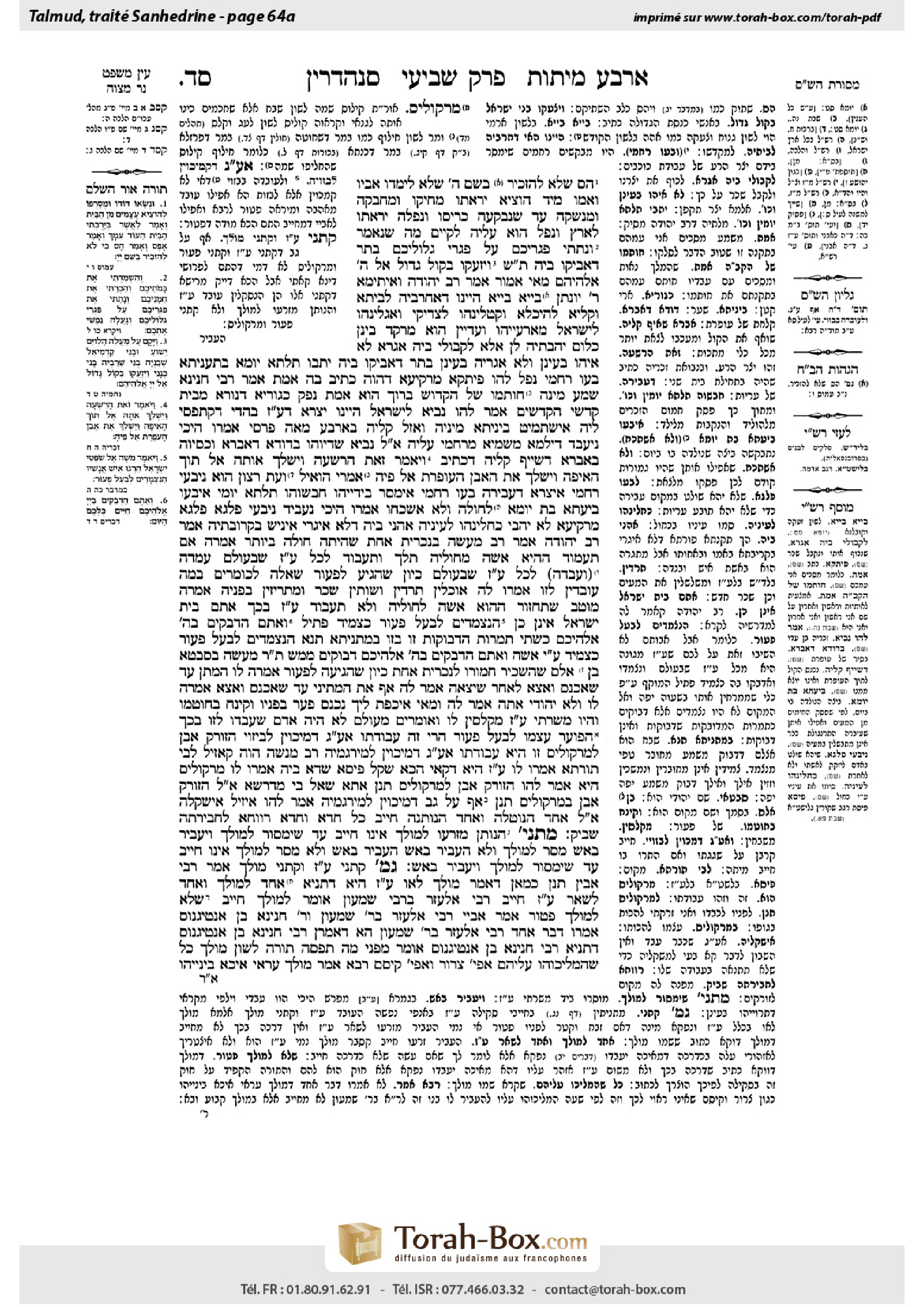
Sanhedrin 64a: Talmud study for Daf Yomi
Daf Yomi is the daily study of one Talmud folio. Explore 37 tractates with scans, Hebrew text, Sefaria English and AI-generated French translations where annotated.
Passage selection and English or AI-generated French translation are available where the scan has annotations. Daf Study is independent of Torah-Box and Sefaria.
Browse Sanhedrin · סנהדרין · All tractatesSanhedrin 64a text and translations
This page of Sanhedrin includes the Aramaic text, an English translation and an AI-generated French translation, alongside the scan above.
סנהדרין ס״ד א · Aramaic and Hebrew text
הַס, שֶׁלֹּא לְהַזְכִּיר בְּשֵׁם ה׳, שֶׁלֹּא לִימְּדוֹ אָבִיו וְאִמּוֹ.
מִיָּד הוֹצִיא יִרְאָתוֹ מֵחֵיקוֹ, וּמְחַבְּקָהּ וּמְנַשְּׁקָהּ, עַד שֶׁנִּבְקְעָה כְּרֵיסוֹ וְנָפְלָה יִרְאָתוֹ לָאָרֶץ, וְנָפַל הוּא עָלֶיהָ, לְקַיֵּים מַה שֶׁנֶּאֱמַר: ״וְנָתַתִּי אֶת פִּגְרֵיכֶם עַל פִּגְרֵי גִּלּוּלֵיכֶם״. בָּתַר דַּאֲבִיקוּ בֵּיהּ.
תָּא שְׁמַע: ״וַיִּזְעֲקוּ בְּקוֹל גָּדוֹל אֶל ה׳ אֱלֹהֵיהֶם״. מַאי אֲמוּר? אָמַר רַב יְהוּדָה, וְאִיתֵּימָא רַב יוֹנָתָן: בִּיָּיא, בִּיָּיא! הַיְינוּ דְּאַחְרְבֵיהּ לְבֵיתָא, וְקַלְיֵאּ לְהֵיכְלָא, וְקַטְלִינְהוּ לְצַדִּיקֵי, וְאַגְלִינְהוּ לְיִשְׂרָאֵל מֵאַרְעַיְיהוּ, וַעֲדַיִין הוּא מְרַקֵּד בֵּינַן. כְּלוּם יְהַבְתֵּיהּ לַן אֶלָּא לְקַבּוֹלֵי בֵּיהּ אַגְרָא? לָא אִיהוּ בָּעֵינַן וְלָא אַגְרֵיהּ בָּעֵינַן! בָּתַר דַּאֲבִיקוּ בֵּיהּ.
יְתַבוּ תְּלָתָא יוֹמֵי בְּתַעֲנִיתָא, בָּעוּ רַחֲמֵי. נְפַל לְהוּ פִּיתְקָא מֵרְקִיעָא דַּהֲוָה כְּתִיב בַּהּ: ״אֱמֶת״.
אָמַר רַבִּי חֲנִינָא: שְׁמַע מִינַּהּ, חוֹתָמוֹ שֶׁל הַקָּדוֹשׁ בָּרוּךְ הוּא ׳אֱמֶת׳.
נְפַק כְּגוּרְיָא דְנוּרָא מִבֵּית קָדְשֵׁי הַקֳּדָשִׁים. אֲמַר לְהוּ נָבִיא לְיִשְׂרָאֵל: הַיְינוּ יִצְרָא דַּעֲבוֹדָה זָרָה. בַּהֲדֵי דְּקָתָפְסִי לֵיהּ, אִישְׁתְּמִיט בִּינִיתָא מִינֵּיהּ, וַאֲזַל קָלֵיהּ בְּאַרְבַּע מְאָה פַּרְסֵי. אָמְרוּ: הֵיכִי נֶיעְבֵּד? דִּילְמָא מִשְּׁמַיָּא מְרַחֲמִי עֲלֵיהּ.
אֲמַר לְהוּ נָבִיא: שַׁדְיוּהּ בְּדוּדָא דַאֲבָרָא, וְכַסְּיוּהּ בַּאֲבָרָא, דְּשָׁיֵיף קָלֵיהּ. דִּכְתִיב: ״וַיֹּאמֶר זֹאת הָרִשְׁעָה וַיַּשְׁלֵךְ אוֹתָהּ אֶל תּוֹךְ הָאֵיפָה וַיַּשְׁלֵךְ אֶת הָאֶבֶן הָעוֹפֶרֶת אֶל פִּיהָ״.
אָמְרִי: הוֹאִיל וְעֵת רָצוֹן הוּא, נִיבְעֵי רַחֲמֵי אַיִּצְרָא דַעֲבֵירָה. בְּעוֹ רַחֲמֵי, אִימְּסַר בִּידַיְיהוּ.
חַבְשׁוּהּ תְּלָתָא יוֹמֵי. בְּעוֹ בֵּיעֲתָא בַּת יוֹמָא לְחוֹלֶה, וְלָא אַשְׁכַּחוּ. אֲמַרוּ: הֵיכִי נַעֲבֵיד? נִיבְעֵי פַּלְגָא? פַּלְגָא מֵרְקִיעָא לָא יָהֲבִי. כַּחְלִינְהוּ לְעֵינֵיהּ. אַהֲנִי בֵּיהּ דְּלָא מִיגָּרֵי אִינִישׁ בְּקָרִיבְתֵּיהּ.
אָמַר רַב יְהוּדָה אָמַר רַב: מַעֲשֶׂה בְּגוֹיָה אַחַת שֶׁהָיְתָה חוֹלָה בְּיוֹתֵר, אָמְרָה: אִם תַּעֲמוֹד הָהִיא אִשָּׁה מֵחוֹלְיָהּ, תֵּלֵךְ וְתַעֲבוֹד לְכׇל עֲבוֹדָה זָרָה שֶׁבָּעוֹלָם. עָמְדָה וְעָבְדָה לְכׇל עֲבוֹדָה זָרָה שֶׁבָּעוֹלָם. כֵּיוָן שֶׁהִגִּיעָה לִפְעוֹר, שָׁאֲלָה לַכּוֹמָרִים: בַּמָּה עוֹבְדִין לָזוֹ? אָמְרוּ לָהּ: אוֹכְלִין תְּרָדִין וְשׁוֹתִין שֵׁכָר וּמַתְרִיזִין בְּפָנֶיהָ. אָמְרָה: מוּטָב שֶׁתַּחֲזוֹר הָהִיא אִשָּׁה לְחוֹלְיָהּ וְלֹא תַּעֲבוֹד עֲבוֹדָה זָרָה בְּכָךְ.
אַתֶּם בֵּית יִשְׂרָאֵל אֵינָן כֵּן, ״הַנִּצְמָדִים לְבַעַל פְּעוֹר״ – כְּצָמִיד פָּתִיל, ״וְאַתֶּם הַדְּבֵקִים בַּה׳ אֱלֹהֵיכֶם״ – כִּשְׁתֵּי תְּמָרוֹת הַדְּבוּקוֹת זוֹ בָּזוֹ.
בְּמַתְנִיתָא תָּנָא: ״הַנִּצְמָדִים לְבַעַל פְּעוֹר״ – כְּצָמִיד עַל יְדֵי אִשָּׁה, ״וְאַתֶּם הַדְּבֵקִים בַּה׳ אֱלֹהֵיכֶם״ – דְּבוּקִים מַמָּשׁ.
תָּנוּ רַבָּנַן: מַעֲשֶׂה בְּסַבְטָא בֶּן אַלָּס, שֶׁהִשְׂכִּיר חֲמוֹרוֹ לְגוֹיָה אַחַת. כֵּיוָן שֶׁהִגִּיעָה לִפְעוֹר, אָמְרָה לוֹ: הַמְתֵּן עַד שֶׁאֶכָּנֵס וְאֵצֵא. לְאַחַר שֶׁיָּצְאָה, אָמַר לָהּ: אַף אַתְּ הַמְתִּינִי עַד שֶׁאֶכָּנֵס וְאֵצֵא. אָמְרָה לוֹ: וְלֹא יְהוּדִי אַתָּה? אָמַר לָהּ: וּמַאי אִיכְפַּת לִיךְ? נִכְנַס, פָּעַר בְּפָנָיו וְקִינַּח בְּחוֹטְמוֹ. וְהָיוּ כּוֹמָרִין מְקַלְּסִין לוֹ וְאוֹמְרִים: מֵעוֹלָם לֹא הָיָה אָדָם שֶׁעֲבָדוֹ לָזֶה בְּכָךְ.
הַפּוֹעֵר עַצְמוֹ לְבַעַל פְּעוֹר – הֲרֵי זֶה עֲבוֹדָתוֹ, אַף עַל גַּב דְּמִיכַּוֵּין לְבִיזּוּי. הַזּוֹרֵק אֶבֶן לְמַרְקוּלִיס – זוֹ הִיא עֲבוֹדָתוֹ, אַף עַל גַּב דְּמִיכַּוֵּין לְמִירְגְּמֵיהּ.
רַב מְנַשֶּׁה הֲוָה קָאָזֵיל לְבֵי תוֹרְתָּא. אֲמַרוּ לֵיהּ: עֲבוֹדָה זָרָה הִיא דְּקָאֵי הָכָא. שְׁקַל פִּיסָּא, שְׁדָא בַּיהּ. אָמְרוּ לוֹ: מַרְקוּלִיס הִיא. אֲמַר לְהוּ: ״הַזּוֹרֵק אֶבֶן לְמַרְקוּלִיס״ תְּנַן.
אֲתָא שְׁאַל בֵּי מִדְרְשָׁא. אָמְרוּ לוֹ: ״הַזּוֹרֵק אֶבֶן בְּמַרְקוּלִיס״ תְּנַן, אַף עַל גַּב דְּמִיכַּוֵּין לְמִירְגְּמֵיהּ. אֲמַר לְהוּ: אֵיזִיל אֶישְׁקְלַהּ. אָמְרוּ לוֹ: אֶחָד הַנּוֹטְלָהּ וְאֶחָד הַנּוֹתְנָהּ חַיָּיב, כֹּל חֲדָא וַחֲדָא רַוְוחָא לַחֲבֶירְתַּהּ שָׁבֵיק.
מַתְנִי׳ הַנּוֹתֵן מִזַּרְעוֹ לַמּוֹלֶךְ, אֵינוֹ חַיָּיב עַד שֶׁיִּמְסוֹר לַמּוֹלֶךְ וְיַעֲבִיר בָּאֵשׁ. מָסַר לַמּוֹלֶךְ וְלֹא הֶעֱבִיר בָּאֵשׁ, הֶעֱבִיר בָּאֵשׁ וְלֹא מָסַר לַמּוֹלֶךְ – אֵינוֹ חַיָּיב עַד שֶׁיִּמְסוֹר לַמּוֹלֶךְ וְיַעֲבִיר בָּאֵשׁ.
גְּמָ׳ קָתָנֵי עֲבוֹדָה זָרָה, וְקָתָנֵי מוֹלֶךְ. אָמַר רַבִּי אָבִין: תְּנַן כְּמַאן דְּאָמַר מוֹלֶךְ לָאו עֲבוֹדָה זָרָה הִיא, דְּתַנְיָא: אֶחָד לַמּוֹלֶךְ וְאֶחָד לִשְׁאָר עֲבוֹדָה זָרָה – חַיָּיב. רַבִּי אֶלְעָזָר בְּרַבִּי שִׁמְעוֹן אוֹמֵר: לַמּוֹלֶךְ – חַיָּיב, שֶׁלֹּא לַמּוֹלֶךְ – פָּטוּר.
אָמַר אַבָּיֵי: רַבִּי אֶלְעָזָר בְּרַבִּי שִׁמְעוֹן וְרַבִּי חֲנִינָא בֶּן אַנְטִיגְנוֹס אָמְרוּ דָּבָר אֶחָד. רַבִּי אֶלְעָזָר בְּרַבִּי שִׁמְעוֹן – הָא דַּאֲמַרַן. רַבִּי חֲנִינָא בֶּן אַנְטִיגְנוֹס – דְּתַנְיָא: רַבִּי חֲנִינָא בֶּן אַנְטִיגְנוֹס אוֹמֵר, מִפְּנֵי מָה תָּפְסָה תּוֹרָה לְשׁוֹן ״מוֹלֶךְ״? כֹּל שֶׁהִמְלִיכוּהוּ עֲלֵיהֶם, אֲפִילּוּ צְרוֹר וַאֲפִילּוּ קֵיסָם.
רָבָא אָמַר: מוֹלֶךְ עֲרַאי אִיכָּא בֵּינַיְיהוּ.
Sanhedrin 64a · English translation
Hush, so as not to mention the name of the Lord (see Amos 6:10). The child did not want to even hear the mention of the name of the Lord, which his father and his mother did not teach him.
Immediately, the child removed his god from his bosom and began hugging it and kissing it, until his stomach burst from hunger, and his god fell to the earth and he fell upon it, in fulfillment of that which is stated: “And I shall cast your carcasses upon the carcasses of your idols” (Leviticus 26:30). This incident demonstrates that the Jewish people engaged in idol worship for its own sake. The Gemara answers: This also occurred after the Jewish people became attached to idol worship.
The Gemara suggests: Come and hear another proof, from the verse: “And they cried in a loud voice to the Lord their God” (Nehemiah 9:4). What did they say in that prayer? Rav Yehuda says, and some say it is Rav Yonatan who says: Woe, woe [baya, baya], this evil inclination for idol worship is what destroyed the Temple, and burned the Sanctuary, and murdered the righteous ones, and caused the Jewish people to be exiled from their land. And it still dances among us, i.e., it still affects us. Didn’t You give it to us solely for the purpose of our receiving reward for overcoming it? We do not want it, nor do we not want its reward. Evidently, the Jewish people were drawn to idol worship itself, and they did not worship idols only in order to engage in forbidden sexual relations. The Gemara answers: This also occurred after the Jewish people became attached to idol worship.
The Gemara continues to relate the story of the prayer in the days of Nehemiah: The people fasted for three days and prayed for mercy. In response to their prayer a note fell for them from the heavens in which was written: Truth, indicating that God accepted their request.
The Gemara makes a parenthetical observation. Rabbi Ḥanina says: Conclude from it that the seal of the Holy One, Blessed be He, is truth.
The form of a fiery lion cub came forth from the chamber of the Holy of Holies. Zechariah, the prophet, said to the Jewish people: This is the evil inclination for idol worship. When they caught hold of it one of its hairs fell out, and it let out a shriek of pain that was heard for four hundred parasangs [parsei]. They said: What should we do to kill it? Perhaps Heaven will have mercy upon it if we attempt to kill it, as it will certainly scream even more.
The prophet said to them: Throw it into a container made of lead and cover it with lead, as lead absorbs sound. As it is written: “And he said: This is the evil one. And he cast it down into the midst of the measure, and he cast a stone of lead upon its opening” (Zechariah 5:8). They followed this advice and were freed of the evil inclination for idol worship.
When they saw that the evil inclination for idol worship was delivered into their hands as they requested, the Sages said: Since it is an auspicious time, let us pray for mercy concerning the evil inclination for sin concerning sexual matters. They prayed for mercy, and it was also delivered into their hands.
The Sages imprisoned it for three days. At that time, people searched for a one-day-old fresh egg for the sick but could not find one. Since the inclination to reproduce was quashed, the chickens stopped laying eggs. They said: What should we do? If we pray for half, i.e., that only half its power be annulled, nothing will be achieved, because Heaven does not grant half gifts, only whole gifts. What did they do? They gouged out its eyes, and this was effective in limiting it to the extent that a person is no longer aroused to commit incest with his close relatives.
§ Rav Yehuda says that Rav says: An incident occurred involving a certain gentile woman who was very ill. She said: If that woman, referring to herself, recovers from her illness, she will go and worship every object of idol worship in the world. She recovered from her illness and subsequently worshipped every object of idol worship in the world. When she arrived at Peor she asked the priests: How does one worship this idol? They said to her: One eats spinach, which causes diarrhea, and drinks beer, which also causes diarrhea, and defecates before it. The woman said: Better for that woman, referring to herself, to return to her illness, and not worship an idol in such a manner.
Rav Yehuda adds: You, the house of Israel, are not like that woman who could not bear the repulsiveness of Ba’al-Peor. It is stated with regard to the attitude of the Jewish people toward idol worship: “That have attached themselves [hanitzmadim] to Ba’al-Peor” (Numbers 25:5), indicating a tight attachment, like a tightly bound cover [ketzamid patil] tied firmly onto a vessel. Yet with regard to the attitude of the Jewish people toward God it is stated: “But you who did cleave [hadevekim] to the Lord your God” (Deuteronomy 4:4), i.e., the connection between the Jewish people and God is like two dates that are lightly attached [hadevukot] to one another but are not tightly pressed together.
This comparison was taught in a baraita but with the opposite conclusion: “That have attached themselves [hanitzmadim] to Ba’al-Peor” indicates a connection that is like a bracelet [ketzamid] on a woman’s arm, which is worn loosely. “But you who did cleave to the Lord your God” means they actually adhered to one another, i.e., there was a tight connection.
The Gemara relates another incident with regard to Ba’al-Peor. The Sages taught: There was an incident involving a Jew named Sabbeta ben Alas, who rented out his donkey and his services to a certain gentile woman. He was driving his donkey behind her, and when she arrived at Peor, she said to him: Wait here until I go in and come out. After she came out, he said to her: You too wait for me until I go in and come out. She said to him: Aren’t you Jewish? Why, then, are you worshipping idols? He said to her: And what do you care? He entered and defecated before the idol, and wiped himself with its nostril, as he wanted to demean the idol as much as possible. But he was unsuccessful, as the priests of Peor were praising him and saying: No person has ever worshipped it before with this excellent form of worship. Although he intended to demean Ba’al-Peor, he actually worshipped it.
The halakha is that one who defecates before Ba’al-Peor is obligated to bring a sin-offering to atone for idol worship, as this is its typical form of worship, even if he intends to demean the idol. Likewise, one who throws a stone at Mercury is obligated to bring a sin-offering to atone for idol worship, as this is its typical form of worship, even if he intends to stone it.
The Gemara relates: Rav Menashe was going to a place called Bei Torta. The people there said to him: There is an object of idol worship situated here in this pile of stones. Rav Menashe picked up a stone and threw it at the idol to demean it. They said to him: It is Mercury, and it is worshipped by throwing stones at it. Rav Menashe said to them: We learned in the mishna that one who throws a stone at Mercury as a manner of worship is liable, whereas I intended to demean it.
Rav Menashe went and asked the Sages in the study hall whether his interpretation of the mishna was correct. They said to him: We learned in the mishna that one who throws a stone at Mercury is liable, which implies that he is liable even if he intends to stone it in order to demean it. Rav Menashe said to the Sages: If so, I will go and take back the stone I threw. They said to him: Both one who removes it and one who places it is liable, as each and every one of the stones taken away from Mercury leaves space for another stone. Taking a stone away from Mercury provides a place for other stones to be thrown at it.
MISHNA: One who gives of his offspring to Molekh, for which one is executed by stoning, is not liable unless he hands over his child to the priests of Molekh and passes the child through the fire. If he handed over the child to the priests of Molekh but did not pass him through the fire, or if he passed him through the fire but did not hand him over to the priests of Molekh, he is not liable, unless he hands the child over to the priests of Molekh and passes him through the fire.
GEMARA: The halakhot of one’s liability for idol worship are taught in the mishna above (60b), and the halakhot of one’s liability for the worship of Molekh are taught separately, in this mishna. Therefore, Rabbi Avin says: We learn this mishna according to the opinion of the one who says that the ritual of Molekh is not idol worship but is a form of witchcraft or superstition, as a dispute over this matter is taught in a baraita: Both one who transfers his child to the priests of Molekh and one who transfers his child for the purpose of worshipping other idols are liable. Molekh is cited merely as an example. Rabbi Elazar, son of Rabbi Shimon, says: One who transfers his child to the priests of Molekh is liable, but if he transfers him to another object of idol worship, not to Molekh, he is exempt.
Abaye says: Rabbi Elazar, son of Rabbi Shimon, and Rabbi Ḥanina ben Antigonus said the same thing, i.e., they share the same halakhic opinion. The statement of Rabbi Elazar, son of Rabbi Shimon, is that which we said. Rabbi Ḥanina ben Antigonus shares the same opinion, as it is taught in a baraita that Rabbi Ḥanina ben Antigonus says: For what reason does the Torah use the term Molekh? It is to indicate that if one passes his child through fire in the worship of any object that people enthroned [shehimlikhuhu] over them as their king, referring to it as Molekh, he is liable, even if it is merely a pebble, or even a toothpick. The baraita indicates that one who passes his child through fire in worship of an item that is not referred to as Molekh is not liable, in accordance with the opinion of Rabbi Elazar, son of Rabbi Shimon.
Rava says: They do not share the same opinion, as there is a practical difference between their opinions in a case of a temporary Molekh. According to Rabbi Elazar, son of Rabbi Shimon, one is liable for passing his child through fire only if it is in worship of a permanent Molekh, whereas according to Rabbi Ḥanina ben Antigonus, one is liable for worshipping even a temporary Molekh.
Sanhedrin 64a · Traduction française (IA)
« Silence, afin de ne pas mentionner le nom du Seigneur » (voir Amos 6:10). L’enfant ne voulait même pas entendre prononcer le nom du Seigneur, que son père et sa mère ne lui avaient pas enseigné.
Aussitôt, l’enfant retira son dieu de son sein et se mit à le serrer dans ses bras et à l’embrasser, jusqu’à ce que son ventre éclate de faim. Son dieu tomba à terre, et lui-même s’effondra sur lui, accomplissant ainsi ce qui est dit : « Je jetterai vos cadavres sur les cadavres de vos idoles » (Lévitique 26:30). Cet épisode montre que le peuple juif pratiquait l’idolâtrie pour elle-même. La Guemara répond : cela aussi eut lieu après que le peuple juif se fut attaché à l’idolâtrie.
La Guemara propose : « Venez et entendez » une autre preuve, tirée du verset : « Ils crièrent d’une voix forte vers le Seigneur, leur Dieu » (Néhémie 9:4). Que dirent-ils dans cette prière ? Rav Yehouda dit — certains disent que c’est Rav Yonatan qui le dit : « Malheur, malheur [baya, baya] ! Ce mauvais penchant pour l’idolâtrie a détruit le Temple, incendié le Sanctuaire, assassiné les justes et provoqué l’exil du peuple juif de son pays. Et il danse encore parmi nous », c’est-à-dire qu’il continue de nous affecter. « Ne nous l’as-Tu pas donné uniquement afin que nous recevions une récompense en le surmontant ? Nous n’en voulons pas, et nous ne voulons pas non plus de sa récompense. » Il apparaît donc que le peuple juif était attiré par l’idolâtrie elle-même et ne pratiquait pas l’idolâtrie uniquement pour se livrer à des relations sexuelles interdites. La Guemara répond : cela aussi eut lieu après que le peuple juif se fut attaché à l’idolâtrie.
La Guemara poursuit le récit de la prière à l’époque de Néhémie : le peuple jeûna pendant trois jours et implora la miséricorde divine. En réponse à sa prière, un billet tomba du ciel, sur lequel était écrit : « Vérité », indiquant que Dieu avait accepté sa demande.
La Guemara fait une remarque incidente. Rabbi Ḥanina dit : On peut en conclure que le sceau du Saint, béni soit-Il, est la vérité.
La forme d’un lionceau de feu sortit de la chambre du Saint des Saints. Zacharie, le prophète, dit au peuple juif : « Voici le mauvais penchant pour l’idolâtrie. » Lorsqu’ils s’en emparèrent, un de ses poils tomba et il poussa un cri de douleur que l’on entendit à quatre cents parasanges [parsei]. Ils dirent : « Que devons-nous faire pour le tuer ? Peut-être le Ciel aura-t-il pitié de lui si nous tentons de le tuer, car il criera certainement encore plus fort. »
Le prophète leur dit : « Jetez-le dans un récipient de plomb et recouvrez-le de plomb, car le plomb absorbe le son. » Comme il est écrit : « Il dit : “C’est le méchant.” Et il le jeta au milieu de l’épha, puis il jeta un bloc de plomb sur son ouverture » (Zacharie 5:8). Ils suivirent ce conseil et furent délivrés du mauvais penchant pour l’idolâtrie.
Voyant que le mauvais penchant pour l’idolâtrie leur avait été remis entre les mains, comme ils l’avaient demandé, les Sages dirent : « Puisque le moment est propice, implorons la miséricorde divine au sujet du mauvais penchant lié aux péchés sexuels. » Ils implorèrent la miséricorde divine, et celui-ci aussi leur fut remis entre les mains.
Les Sages l’emprisonnèrent pendant trois jours. À cette époque, on chercha pour les malades un œuf frais pondu le jour même, mais on n’en trouva pas. Comme le désir de procréer avait été réprimé, les poules avaient cessé de pondre. Ils dirent : « Que devons-nous faire ? Si nous implorons la miséricorde divine pour que seule la moitié de sa puissance soit annulée, cela ne servira à rien, car le Ciel n’accorde pas de demi-dons, mais seulement des dons entiers. » Que firent-ils ? Ils lui crevèrent les yeux, ce qui le limita suffisamment pour qu’une personne ne soit plus excitée à commettre l’inceste avec ses proches parents.
§ Rav Yehouda dit au nom de Rav : Un incident se produisit avec une certaine femme non juive qui était très malade. Elle dit : « Si cette femme », en parlant d’elle-même, « guérit de sa maladie, elle ira rendre un culte à tous les objets idolâtres du monde. » Elle guérit de sa maladie et rendit ensuite un culte à tous les objets idolâtres du monde. Lorsqu’elle arriva à Péor, elle demanda aux prêtres : « Comment rend-on un culte à cette idole ? » Ils lui dirent : « On mange des épinards, qui provoquent la diarrhée, on boit de la bière, qui provoque elle aussi la diarrhée, puis on défèque devant elle. » La femme dit : « Mieux vaut pour cette femme », en parlant d’elle-même, « retourner à sa maladie plutôt que de rendre un culte à une idole de cette manière. »
Rav Yehouda ajoute : « Vous, la maison d’Israël, vous n’êtes pas comme cette femme, qui ne pouvait supporter la répugnance de Ba’al-Peor. » À propos de l’attitude du peuple juif envers l’idolâtrie, il est écrit : « Ceux qui s’étaient attachés [hanitzmadim] à Ba’al-Peor » (Nombres 25:5), ce qui indique un attachement étroit, comme un couvercle bien ajusté [ketzamid patil], solidement fixé à un récipient. Mais, à propos de l’attitude du peuple juif envers Dieu, il est écrit : « Mais vous, qui êtes restés attachés [hadevekim] au Seigneur votre Dieu » (Deutéronome 4:4), c’est-à-dire que le lien entre le peuple juif et Dieu ressemble à celui de deux dattes légèrement collées [hadevukot] l’une à l’autre, sans être fortement pressées ensemble.
Cette comparaison est rapportée dans une baraïta, mais avec la conclusion opposée : « Ceux qui s’étaient attachés [hanitzmadim] à Ba’al-Peor » indique un lien semblable à un bracelet [ketzamid] porté lâchement au bras d’une femme. « Mais vous, qui êtes restés attachés au Seigneur votre Dieu » signifie qu’ils adhéraient véritablement les uns aux autres, c’est-à-dire que leur lien était étroit.
La Guemara rapporte un autre épisode concernant Ba’al-Peor. Les Sages enseignèrent : Il arriva qu’un Juif nommé Sabbeta ben Alas loua son âne et ses services à une certaine femme non juive. Il conduisait son âne derrière elle et, lorsqu’elle arriva à Péor, elle lui dit : « Attends ici jusqu’à ce que j’entre et que je ressorte. » Lorsqu’elle ressortit, il lui dit : « Toi aussi, attends-moi jusqu’à ce que j’entre et que je ressorte. » Elle lui dit : « N’es-tu pas juif ? Pourquoi, alors, rends-tu un culte aux idoles ? » Il lui dit : « En quoi cela te regarde-t-il ? » Il entra et déféqua devant l’idole, puis s’essuya avec sa narine, car il voulait l’humilier autant que possible. Mais il échoua, car les prêtres de Péor le félicitèrent en disant : « Jamais personne ne lui a rendu un culte de cette excellente manière. » Bien qu’il ait voulu humilier Ba’al-Peor, il lui rendit en fait un culte.
La halakha est que celui qui défèque devant Ba’al-Peor est tenu d’apporter un sacrifice expiatoire pour l’idolâtrie, car c’est sa forme habituelle de culte, même s’il entend humilier l’idole. De même, celui qui jette une pierre sur Mercure est tenu d’apporter un sacrifice expiatoire pour l’idolâtrie, car c’est sa forme habituelle de culte, même s’il entend le lapider.
La Guemara rapporte : Rav Menashe se rendait dans un endroit appelé Bei Torta. Les habitants lui dirent : « Il y a ici, dans ce tas de pierres, un objet idolâtre. » Rav Menashe ramassa une pierre et la lança sur l’idole pour l’humilier. Ils lui dirent : « C’est Mercure, et on lui rend un culte en lui lançant des pierres. » Rav Menashe leur dit : « Nous avons appris dans la Michna que celui qui jette une pierre sur Mercure comme manière de lui rendre un culte est passible, alors que mon intention était de l’humilier. »
Rav Menashe alla demander aux Sages de la maison d’étude si son interprétation de la Michna était correcte. Ils lui dirent : « Nous avons appris dans la Michna que celui qui jette une pierre sur Mercure est passible, ce qui implique qu’il l’est même s’il entend le lapider pour l’humilier. » Rav Menashe dit aux Sages : « Dans ce cas, j’irai reprendre la pierre que j’ai lancée. » Ils lui dirent : « Celui qui l’enlève comme celui qui la place est passible, car chacune des pierres retirées à Mercure libère une place pour une autre pierre. En retirer une permet que d’autres pierres soient lancées contre lui. »
MICHNA : Celui qui livre un de ses descendants à Molekh, crime passible de la lapidation, n’est passible que s’il remet son enfant aux prêtres de Molekh et le fait passer par le feu. S’il remet l’enfant aux prêtres de Molekh mais ne le fait pas passer par le feu, ou s’il le fait passer par le feu sans le remettre aux prêtres de Molekh, il n’est pas passible ; il ne l’est que s’il remet l’enfant aux prêtres de Molekh et le fait passer par le feu.
GUEMARA : Les halakhot relatives à la responsabilité en matière d’idolâtrie sont enseignées dans la Michna précédente (60b), tandis que celles concernant la responsabilité liée au culte de Molekh sont enseignées séparément, dans cette Michna. Rabbi Avin dit donc : Nous étudions cette Michna selon l’opinion de celui qui affirme que le rite de Molekh n’est pas de l’idolâtrie, mais relève de la sorcellerie ou de la superstition. Une baraïta enseigne en effet une controverse à ce sujet : celui qui remet son enfant aux prêtres de Molekh et celui qui le remet pour le culte d’autres idoles sont tous deux passibles. Molekh n’est cité qu’à titre d’exemple. Rabbi Elazar, fils de Rabbi Shimon, dit : Celui qui remet son enfant aux prêtres de Molekh est passible, mais s’il le remet à un autre objet d’idolâtrie, et non à Molekh, il est exempt.
Abayé dit : Rabbi Elazar, fils de Rabbi Shimon, et Rabbi Ḥanina ben Antigonus ont exprimé la même opinion, c’est-à-dire qu’ils partagent la même position halakhique. La déclaration de Rabbi Elazar, fils de Rabbi Shimon, est celle que nous avons citée. Rabbi Ḥanina ben Antigonus partage cette opinion, car une baraïta enseigne qu’il dit : « Pourquoi la Torah emploie-t-elle le terme Molekh ? Pour indiquer que celui qui fait passer son enfant par le feu dans le cadre du culte de tout objet que les gens ont intronisé [shehimlikhuhu] comme leur roi, en le désignant comme Molekh, est passible, même s’il ne s’agit que d’un caillou ou d’un cure-dent. » La baraïta indique que celui qui fait passer son enfant par le feu dans le cadre du culte d’un objet qui n’est pas désigné comme Molekh n’est pas passible, conformément à l’opinion de Rabbi Elazar, fils de Rabbi Shimon.
Rava dit : Ils ne partagent pas la même opinion, car leurs positions divergent concrètement dans le cas d’un Molekh temporaire. Selon Rabbi Elazar, fils de Rabbi Shimon, on n’est passible que si l’on fait passer son enfant par le feu dans le cadre du culte d’un Molekh permanent, tandis que, selon Rabbi Ḥanina ben Antigonus, on est passible même pour le culte d’un Molekh temporaire.
Traduction française générée par IA à partir de l’édition anglaise de Sefaria. Vérifie toujours un passage avec le texte source.
Text from Sefaria: William Davidson Edition - Vocalized Aramaic (CC BY NC); William Davidson Edition - English (CC BY NC).