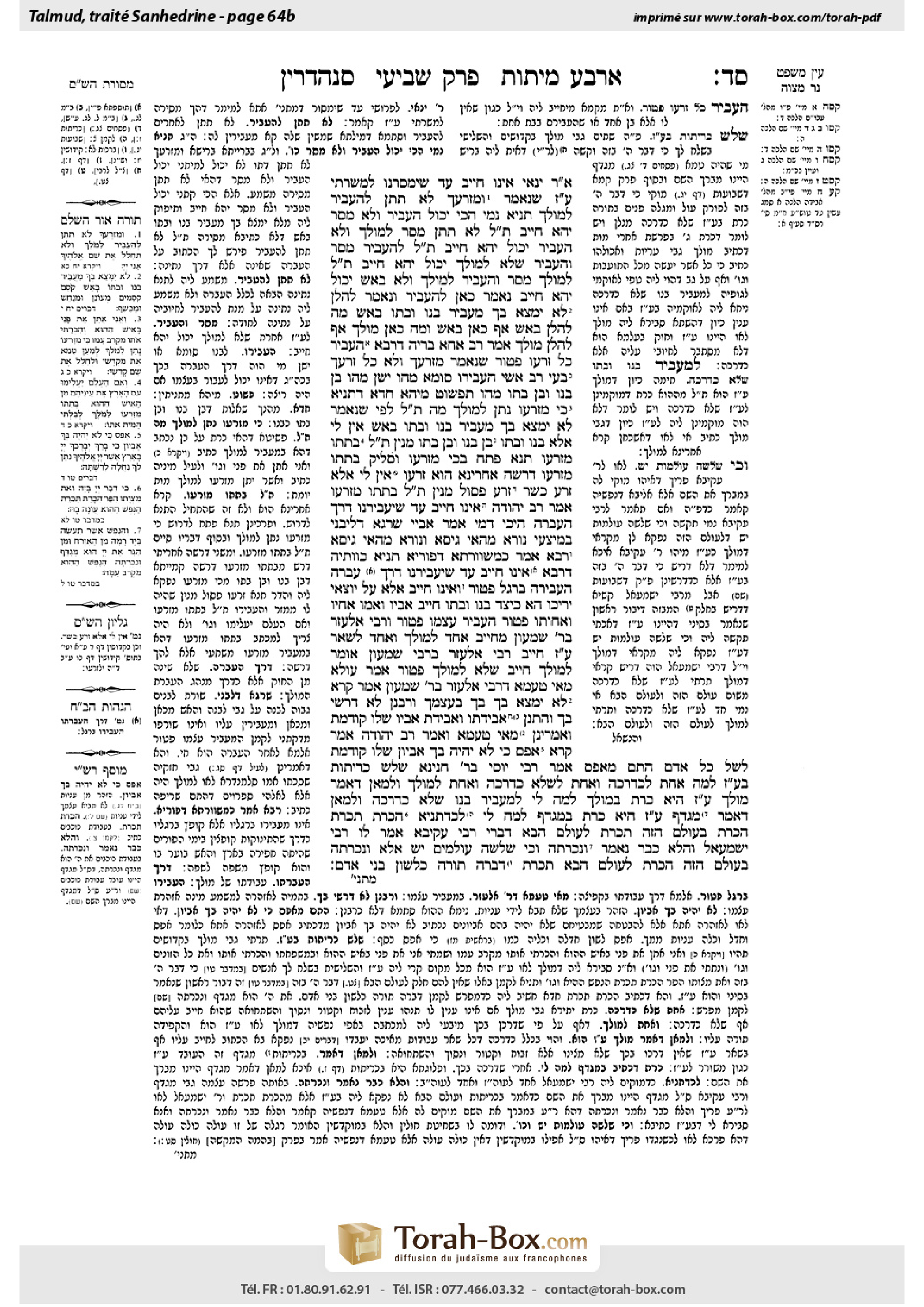
Sanhedrin 64b: Talmud study for Daf Yomi
Daf Yomi is the daily study of one Talmud folio. Explore 37 tractates with scans, Hebrew text, Sefaria English and AI-generated French translations where annotated.
Passage selection and English or AI-generated French translation are available where the scan has annotations. Daf Study is independent of Torah-Box and Sefaria.
Browse Sanhedrin · סנהדרין · All tractatesSanhedrin 64b text and translations
This page of Sanhedrin includes the Aramaic text, an English translation and an AI-generated French translation, alongside the scan above.
סנהדרין ס״ד ב · Aramaic and Hebrew text
אָמַר רַבִּי יַנַּאי: אֵינוֹ חַיָּיב עַד שֶׁיִּמְסְרֶנּוּ לְכוֹמָרִין, שֶׁנֶּאֱמַר: ״וּמִזַּרְעֲךָ לֹא תִתֵּן לְהַעֲבִיר לַמֹּלֶךְ״.
תַּנְיָא נָמֵי הָכִי: יָכוֹל הֶעֱבִיר וְלֹא מָסַר יְהֵא חַיָּיב? תַּלְמוּד לוֹמַר ״לֹא תִתֵּן״. מָסַר לַמּוֹלֶךְ וְלֹא הֶעֱבִיר, יָכוֹל יְהֵא חַיָּיב? תַּלְמוּד לוֹמַר ״לְהַעֲבִיר״. מָסַר וְהֶעֱבִיר שֶׁלֹּא לַמּוֹלֶךְ, יָכוֹל יְהֵא חַיָּיב? תַּלְמוּד לוֹמַר ״לַמֹּלֶךְ״.
מָסַר וְהֶעֱבִיר לַמּוֹלֶךְ, וְלֹא בָּאֵשׁ – יָכוֹל יְהֵא חַיָּיב? נֶאֱמַר כָּאן ״לְהַעֲבִיר״, וְנֶאֱמַר לְהַלָּן ״לֹא יִמָּצֵא בְךָ מַעֲבִיר בְּנוֹ וּבִתּוֹ בָּאֵשׁ״. מָה לְהַלָּן בָּאֵשׁ, אַף כָּאן בָּאֵשׁ. וּמָה כָּאן מוֹלֶךְ, אַף לְהַלָּן מוֹלֶךְ.
אָמַר רַב אַחָא בְּרֵיהּ דְּרָבָא: הֶעֱבִיר כׇּל זַרְעוֹ – פָּטוּר, שֶׁנֶּאֱמַר ״מִזַּרְעֲךָ״ – וְלֹא כׇּל זַרְעֲךָ.
בָּעֵי רַב אָשֵׁי: הֶעֱבִירוֹ סוֹמֵא, מַהוּ? יָשֵׁן, מַהוּ? בֶּן בְּנוֹ וּבֶן בִּתּוֹ, מַהוּ?
תִּפְשׁוֹט מִיהָא חֲדָא, דְּתַנְיָא: ״כִּי מִזַּרְעוֹ נָתַן לַמֹּלֶךְ״ – מָה תַּלְמוּד לוֹמַר? לְפִי שֶׁנֶּאֱמַר ״לֹא יִמָּצֵא בְךָ מַעֲבִיר בְּנוֹ וּבִתּוֹ בָּאֵשׁ״, אֵין לִי אֶלָּא בְּנוֹ וּבִתּוֹ. בֶּן בְּנוֹ וּבֶן בִּתּוֹ מִנַּיִן? תַּלְמוּד לוֹמַר: ״בְּתִתּוֹ מִזַּרְעוֹ״.
תַּנָּא פָּתַח בְּ״כִּי מִזַּרְעוֹ״, וְסָלֵיק בְּ״תִתּוֹ מִזַּרְעוֹ״.
דְּרָשָׁה אַחֲרִינָא הוּא: ״זַרְעוֹ״ – אֵין לִי אֶלָּא זֶרַע כָּשֵׁר, זֶרַע פָּסוּל מִנַּיִן? תַּלְמוּד לוֹמַר ״בְּתִתּוֹ מִזַּרְעוֹ״.
אָמַר רַב יְהוּדָה: אֵינוֹ חַיָּיב עַד שֶׁיַּעֲבִירֶנּוּ דֶּרֶךְ הַעֲבָרָה. הֵיכִי דָּמֵי? אָמַר אַבָּיֵי: שְׁרָגָא דְּלִיבְנֵי בְּמִצְעֵי, נוּרָא מֵהַאי גִּיסָא וְנוּרָא מֵהַאי גִּיסָא.
רָבָא אָמַר: כְּמַשְׁוַורְתָּא דְּפוּרַיָּא.
תַּנְיָא כְּוָותֵיהּ דְּרָבָא: אֵינוֹ חַיָּיב עַד שֶׁיַּעֲבִירֶנּוּ דֶּרֶךְ עֲבָרָהּ. הֶעֱבִירוֹ בָּרֶגֶל – פָּטוּר.
וְאֵינוֹ חַיָּיב אֶלָּא עַל יוֹצְאֵי יְרֵיכוֹ. הָא כֵּיצַד? בְּנוֹ וּבִתּוֹ – חַיָּיב, אָבִיו וְאִמּוֹ אָחִיו וַאֲחוֹתוֹ – פָּטוּר. הֶעֱבִיר עַצְמוֹ – פָּטוּר, וְרַבִּי אֶלְעָזָר בְּרַבִּי שִׁמְעוֹן מְחַיֵּיב.
אֶחָד לַמּוֹלֶךְ, וְאֶחָד לִשְׁאָר עֲבוֹדָה זָרָה – חַיָּיב. רַבִּי אֶלְעָזָר בְּרַבִּי שִׁמְעוֹן אוֹמֵר: לַמּוֹלֶךְ – חַיָּיב, שֶׁלֹּא לַמּוֹלֶךְ – פָּטוּר.
אָמַר עוּלָּא: מַאי טַעְמָא דְּרַבִּי אֶלְעָזָר בְּרַבִּי שִׁמְעוֹן? אָמַר קְרָא: ״לֹא יִמָּצֵא בְךָ״ – בְּךָ בְּעַצְמְךָ.
וְרַבָּנַן לָא דָּרְשִׁי ״בְּךָ״? וְהָתְנַן: אֲבֵידָתוֹ וַאֲבֵידַת אָבִיו – שֶׁלּוֹ קוֹדֶמֶת. וְאָמְרִינַן: מַאי טַעְמָא? וְאָמַר רַב יְהוּדָה: אָמַר קְרָא ״אֶפֶס כִּי לֹא יִהְיֶה בְּךָ אֶבְיוֹן״ – שֶׁלּוֹ קוֹדֶמֶת לְשֶׁל כׇּל אָדָם.
הָתָם מֵ״אֶפֶס״.
אָמַר רַבִּי יוֹסֵי בְּרַבִּי חֲנִינָא: שָׁלֹשׁ כָּרֵיתוֹת בַּעֲבוֹדָה זָרָה לָמָּה?
אַחַת לִכְדַרְכָּהּ, וְאַחַת לְשֶׁלֹּא כְּדַרְכָּהּ, וְאַחַת לַמּוֹלֶךְ.
וּלְמַאן דְּאָמַר מוֹלֶךְ עֲבוֹדָה זָרָה הִיא, כָּרֵת בְּמוֹלֶךְ לְמָה לִי? לְמַעֲבִיר בְּנוֹ שֶׁלֹּא כְּדַרְכָּהּ.
וּלְמַאן דְּאָמַר: מְגַדֵּף עֲבוֹדָה זָרָה הִיא, כָּרֵת בִּמְגַדֵּף לְמָה לִי?
לְכִדְתַנְיָא: ״הִכָּרֵת תִּכָּרֵת״. ״הִכָּרֵת״ – בָּעוֹלָם הַזֶּה, ״תִּכָּרֵת״ – לָעוֹלָם הַבָּא, דִּבְרֵי רַבִּי עֲקִיבָא.
אָמַר לוֹ רַבִּי יִשְׁמָעֵאל: וַהֲלֹא כְּבָר נֶאֱמַר ״וְנִכְרְתָה״! וְכִי שְׁלֹשָׁה עוֹלָמִים יֵשׁ? אֶלָּא ״וְנִכְרְתָה״ – בָּעוֹלָם הַזֶּה, ״הִכָּרֵת״ – לָעוֹלָם הַבָּא, ״תִּכָּרֵת״ – דִּבְּרָה תוֹרָה כִלְשׁוֹן בְּנֵי אָדָם.
Sanhedrin 64b · English translation
§ Rabbi Yannai says: One is not liable for passing his child through fire to Molekh unless he hands him over to the priests of Molekh, as it is stated: “And you shall not give any of your offspring to pass them over to Molekh” (Leviticus 18:21), which indicates that the prohibition is to give, i.e., to hand the child over to the priests.
This is also taught in a baraita: One might have thought that one who passed his child through fire but did not hand him over to the priests of Molekh should be liable. Therefore, the verse states: “You shall not give.” If one handed over his son to the priests of Molekh but did not pass him through fire, one might have thought that he should be liable. Therefore, the verse states: “To pass,” indicating that passing is also necessary. If one handed over the child and passed him through fire, not to priests of Molekh but rather to priests of another object of idol worship, one might have thought that he should be liable. Therefore, the verse states: “To Molekh.”
If one handed over his child and passed him over to the priests of Molekh, but he did not pass him through the fire, one might have thought that he should be liable. It is stated here, in the verse: “To pass,” and it is stated there, in another verse: “There shall not be found among you one who passes his son or his daughter through the fire” (Deuteronomy 18:10). Just as there, the verse is referring to passing one’s child through the fire, so too here, the reference is to passing one’s child through the fire. And just as here, the verse is referring to one who passes his child over to the priests of Molekh, so too there, the reference is to Molekh alone, excluding any other object of idol worship.
Rav Aḥa, son of Rava, says: One who passed all his offspring through fire to the priests of Molekh is exempt, as it is stated: “Of your offspring,” indicating: But not all your offspring.
Rav Ashi raises a dilemma: If one passed through the fire a child of his who is blind, what is the halakha? Furthermore, if one passed his child through the fire while the child was asleep, what is the halakha? Does the child need to be capable of passing through on his own, or is that not necessary? Likewise, if one passed his son’s son or his daughter’s son through the fire, what is the halakha?
The Gemara answers: Resolve at least one of these dilemmas, as it is taught in a baraita: Why must the verse state: “Because he has given of his offspring to Molekh” (Leviticus 20:3)? What is added by this statement? Because it is stated: “There shall not be found among you one who passes his son or his daughter through the fire,” I have derived only that it is prohibited for one to pass his son or daughter. From where do I derive that one who passes his son’s son or his daughter’s son is also liable? The verse states: “When he gives of his offspring” (Leviticus 20:4). The term “offspring” indicates that grandchildren are included. This resolves one of Rav Ashi’s dilemmas.
The Gemara asks: The tanna began his exposition with the phrase in the verse “because he has given of his offspring,” and ended with an interpretation of the phrase in the verse “when he gives of his offspring.” Why did he cite two different verses as proof for his halakhic statement?
The Gemara answers: The second verse is stated in the baraita for a different exposition, which was omitted from the baraita and reads as follows: From the term in the verse “his offspring” I have derived only that one is liable for passing through the fire his offspring of unflawed lineage, i.e., his descendants from a woman whom he was permitted to marry. From where do I derive that one is liable for passing through the fire his offspring of flawed lineage, e.g., a mamzer, as well? The verse states: “When he gives of his offspring,” indicating that one is liable for passing any of his offspring.
§ Rav Yehuda says: One is not liable for passing his child through fire to Molekh unless he passes him in the typical manner of passing. The Gemara asks: What is considered the typical manner of passing? Abaye says: The child is taken by foot along a latticework [sirega] of bricks in the middle, between the fire on this side and the fire on that side.
Rava says: The typical manner of passing is like the leaps of children on Purim. It was customary to light a bonfire on Purim inside a pit, and children would amuse themselves by leaping over the bonfires. Passing one’s child over a fire in such a fashion is the typical manner of passing a child over to Molekh.
The Gemara comments: It is taught in a baraita in accordance with the opinion of Rava: One is not liable unless he passes his child through the fire in the typical manner of passing. If he passed him by foot, he is exempt. Evidently, the passing ritual is performed by leaping and not by walking.
The baraita continues: And one is liable only for passing his descendants. How so? If one passed his son or his daughter through the fire, he is liable. If he passed his father, or his mother, his brother, or his sister, he is exempt. If one passed himself over to Molekh, he is exempt. And Rabbi Elazar, son of Rabbi Shimon, deems him liable.
Both one who passes his child through fire to Molekh and one who passes his child through fire to other objects of idol worship are liable. Rabbi Elazar, son of Rabbi Shimon, says: If he passes him over to Molekh, he is liable, but if he transfers him to another object of idol worship, not to Molekh, he is exempt.
Ulla says: What is the reason for the opinion of Rabbi Elazar, son of Rabbi Shimon, who deems one who passes himself over to Molekh liable? The verse states: “There shall not be found among you one who passes his son or his daughter through the fire” (Deuteronomy 18:10), and the term “among you” is interpreted homiletically to mean: Among yourself.
The Gemara asks: And do the Rabbis not interpret the term “among you” as referring to oneself? But didn’t we learn in a mishna (Bava Metzia 33a): If one finds his lost item and his father’s lost item, taking care of his own lost item takes precedence. And we said in discussion of that mishna: What is the reason for this? And Rav Yehuda said that it is because the verse states: “Only so that there shall be no needy among you” (Deuteronomy 15:4), meaning that one must avoid becoming needy. Therefore, if one lost an item, tending to his lost item takes precedence over tending to the lost item of any other person. Apparently, this interpretation of the verse is based on the understanding that the term “among you” is referring to oneself, i.e., one must take care of himself so that he will not become needy.
The Gemara answers: And there, in that discussion, the halakha is derived from the word “only,” a limiting term, which is interpreted to mean that in preventing destitution one should begin with himself.
§ Rabbi Yosei, son of Rabbi Ḥanina, says: Why is the punishment of excision from the World-to-Come [karet] mentioned three times with regard to idol worship? It is stated twice with regard to the ritual of Molekh, in the verse: “I will also set My face against that man, and I will excise him from among his people” (Leviticus 20:3), and in the verse: “Then I will set My face against that man, and against his family, and I will excise him” (Leviticus 20:5). The third mention of karet is with regard to one who blasphemes: “That person blasphemes the Lord, and that soul shall be excised from among his people” (Numbers 15:30).
One mention is for worshipping an idol in its typical manner of worship, and one mention is for worshipping an idol not in its typical manner of worship, and one mention is for performing the ritual of Molekh.
The Gemara asks: And according to the one who says that Molekh is an object of idol worship, why do I need a special mention of karet with regard to Molekh? The Gemara answers: It is necessary for the case of one who passes his child through fire to an idol other than Molekh, where this is not its typical manner of worship. According to this opinion, one who passes his son through fire to any idol is liable.
The Gemara asks: And according to the one who says that the verse concerning one who blasphemes is referring to one who engages in idol worship and not to one who curses God, why do I need karet to be mentioned with regard to one who blasphemes?
The Gemara answers that it is necessary for that which is taught in a baraita: It is stated with regard to one who blasphemes: “Because he has despised the word of the Lord, and has breached His mitzva, that soul shall be excised [hikkaret tikkaret], his iniquity shall be upon him” (Numbers 15:31). The phrase “hikkaret tikkaret” is interpreted as follows: “Hikkaret”; the sinner is excised in this world, meaning that he will die prematurely. “Tikkaret”; the sinner is excised in the World-to-Come, and he will not merit everlasting life. This is the statement of Rabbi Akiva.
Rabbi Yishmael said to him: But isn’t it already stated in the previous verse: “He blasphemes the Lord; that soul shall be excised [venikhreta]” (Numbers 15:30)? Are there three worlds in which the sinner is excised? Rather, from the term in the verse “venikhreta” it is derived that the sinner is excised in this world, from the term “hikkaret” it is derived that the sinner is excised in the World-to-Come, and nothing is derived from the doubled verb “hikkaret tikkaret,” as the Torah spoke in the language of people.
Sanhedrin 64b · Traduction française (IA)
§ Rabbi Yannai dit : On n’est passible que si l’on remet son enfant aux prêtres de Molekh, afin de le faire passer par le feu, comme il est dit : « Tu ne donneras aucun de tes descendants pour les faire passer à Molekh » (Lévitique 18:21). Cela indique que l’interdit porte sur le fait de donner, c’est-à-dire de remettre l’enfant aux prêtres.
Cela est également enseigné dans une baraïta : On aurait pu penser que celui qui fait passer son enfant par le feu sans le remettre aux prêtres de Molekh est passible. C’est pourquoi le verset dit : « Tu ne donneras pas. » Si quelqu’un remet son fils aux prêtres de Molekh sans le faire passer par le feu, on aurait pu penser qu’il est passible. C’est pourquoi le verset dit : « Pour les faire passer », ce qui indique que le passage par le feu est également nécessaire. Si quelqu’un remet l’enfant et le fait passer par le feu, non pas aux prêtres de Molekh, mais aux prêtres d’un autre objet d’idolâtrie, on aurait pu penser qu’il est passible. C’est pourquoi le verset dit : « À Molekh. »
Si quelqu’un remet son enfant aux prêtres de Molekh et le leur fait passer, mais sans le faire passer par le feu, on aurait pu penser qu’il est passible. Il est dit ici, dans le verset : « Pour les faire passer », et il est dit là, dans un autre verset : « Qu’on ne trouve chez toi personne qui fasse passer son fils ou sa fille par le feu » (Deutéronome 18:10). De même que là, le verset parle de faire passer son enfant par le feu, de même ici, il s’agit de faire passer son enfant par le feu. Et de même qu’ici, le verset parle de celui qui remet son enfant aux prêtres de Molekh, de même là, il s’agit uniquement de Molekh, à l’exclusion de tout autre objet d’idolâtrie.
Rav Aḥa, fils de Rava, dit : Celui qui fait passer tous ses descendants par le feu pour les remettre aux prêtres de Molekh est exempt, comme il est dit : « De tes descendants », ce qui indique : mais pas tous tes descendants.
Rav Ashi soulève une question : Si quelqu’un fait passer par le feu un de ses enfants aveugle, quelle est la halakha ? En outre, si quelqu’un fait passer son enfant par le feu alors que celui-ci dort, quelle est la halakha ? L’enfant doit-il être capable de passer de lui-même, ou cela n’est-il pas nécessaire ? De même, quelle est la halakha si quelqu’un fait passer par le feu le fils de son fils ou le fils de sa fille ?
La Guemara répond : Résolvons au moins l’une de ces questions, car il est enseigné dans une baraïta : Pourquoi le verset doit-il dire : « Parce qu’il a donné de ses descendants à Molekh » (Lévitique 20:3) ? Qu’ajoute cette formule ? Puisqu’il est dit : « Qu’on ne trouve chez toi personne qui fasse passer son fils ou sa fille par le feu », j’ai seulement déduit qu’il est interdit de faire passer son fils ou sa fille. D’où déduis-je que celui qui fait passer le fils de son fils ou le fils de sa fille est également passible ? Le verset dit : « Lorsqu’il donne de ses descendants » (Lévitique 20:4). Le terme « descendants » indique que les petits-enfants sont inclus. Cela résout l’une des questions de Rav Ashi.
La Guemara demande : Le tanna a commencé son exégèse par l’expression du verset « parce qu’il a donné de ses descendants », puis l’a terminée par une interprétation de l’expression « lorsqu’il donne de ses descendants ». Pourquoi a-t-il cité deux versets différents à l’appui de son énoncé halakhique ?
La Guemara répond : Le second verset est cité dans la baraïta à l’appui d’une autre exégèse, omise de la baraïta, qui se lit ainsi : Du terme « ses descendants », dans le verset, j’ai seulement déduit qu’on est passible pour avoir fait passer par le feu ses descendants issus d’une filiation sans défaut, c’est-à-dire ses descendants d’une femme qu’il avait le droit d’épouser. D’où déduis-je qu’on est également passible pour avoir fait passer par le feu ses descendants issus d’une filiation entachée, par exemple un mamzer ? Le verset dit : « Lorsqu’il donne de ses descendants », ce qui indique qu’on est passible pour avoir fait passer n’importe lequel de ses descendants.
§ Rav Yehuda dit : On n’est passible que si l’on fait passer son enfant selon la manière habituelle du rite. La Guemara demande : Qu’est-ce qui est considéré comme la manière habituelle de faire passer l’enfant ? Abaye dit : On fait passer l’enfant à pied sur un treillis [sirega] de briques, au milieu, entre le feu de ce côté et celui de l’autre côté.
Rava dit : La manière habituelle de faire passer l’enfant ressemble aux sauts des enfants à Pourim. Il était d’usage d’allumer un feu de joie à Pourim au fond d’une fosse, et les enfants s’amusaient à sauter par-dessus les feux. Faire passer son enfant par-dessus un feu de cette manière est la façon habituelle de le remettre à Molekh.
La Guemara fait remarquer : Une baraïta est enseignée conformément à l’opinion de Rava : On n’est passible que si l’on fait passer son enfant par le feu selon la manière habituelle du rite. Si on le fait passer à pied, on est exempt. Il ressort de là que le rite consiste à sauter, et non à marcher.
La baraïta poursuit : Et on n’est passible que pour avoir fait passer ses descendants. Comment cela ? Si quelqu’un fait passer son fils ou sa fille par le feu, il est passible. S’il fait passer son père, sa mère, son frère ou sa sœur, il est exempt. Si quelqu’un se remet lui-même à Molekh, il est exempt. Rabbi Elazar, fils de Rabbi Shimon, le déclare passible.
Celui qui fait passer son enfant par le feu pour le remettre à Molekh et celui qui le fait passer par le feu pour le remettre à d’autres objets d’idolâtrie sont tous deux passibles. Rabbi Elazar, fils de Rabbi Shimon, dit : S’il le remet à Molekh, il est passible, mais s’il le remet à un autre objet d’idolâtrie, et non à Molekh, il est exempt.
Ulla dit : Quelle est la raison de l’opinion de Rabbi Elazar, fils de Rabbi Shimon, qui déclare passible celui qui se remet lui-même à Molekh ? Le verset dit : « Qu’on ne trouve chez toi personne qui fasse passer son fils ou sa fille par le feu » (Deutéronome 18:10). L’expression « chez toi » est interprétée homilétiquement comme signifiant : en toi-même.
La Guemara demande : Les rabbins n’interprètent-ils donc pas l’expression « chez toi » comme faisant référence à soi-même ? N’avons-nous pas appris dans une Michna (Bava Metzia 33a) : Si quelqu’un trouve son objet perdu et celui de son père, le soin de son propre objet perdu a priorité. Et nous avons dit, en discutant cette Michna : Quelle en est la raison ? Rav Yehuda a dit que c’est parce que le verset dit : « Il n’y aura ainsi aucun nécessiteux chez toi » (Deutéronome 15:4), c’est-à-dire qu’il faut éviter de devenir nécessiteux. Par conséquent, si quelqu’un a perdu un objet, s’occuper de son objet perdu a priorité sur le fait de s’occuper de l’objet perdu de toute autre personne. Il semble donc que cette interprétation du verset repose sur l’idée que l’expression « chez toi » se rapporte à soi-même, c’est-à-dire qu’on doit prendre soin de soi afin de ne pas devenir nécessiteux.
La Guemara répond : Dans cette discussion, la halakha est déduite du mot « seulement », terme restrictif interprété comme signifiant que, pour éviter la pauvreté, on doit commencer par soi-même.
§ Rabbi Yosei, fils de Rabbi Ḥanina, dit : Pourquoi la peine d’excision du monde à venir [karet] est-elle mentionnée trois fois à propos de l’idolâtrie ? Elle est mentionnée deux fois au sujet du rite de Molekh, dans le verset : « Moi aussi, je tournerai ma face contre cet homme et je l’exciserai du milieu de son peuple » (Lévitique 20:3), et dans le verset : « Alors je tournerai ma face contre cet homme et contre sa famille, et je l’exciserai » (Lévitique 20:5). La troisième mention de karet concerne celui qui blasphème : « Cet homme blasphème le Seigneur, et cette âme sera excisée du milieu de son peuple » (Nombres 15:30).
Une mention concerne le fait de rendre un culte à une idole selon son mode de culte habituel, une autre le fait de rendre un culte à une idole d’une manière qui n’est pas son mode de culte habituel, et une autre encore le rite de Molekh.
La Guemara demande : Et selon celui qui dit que Molekh est un objet d’idolâtrie, pourquoi faut-il une mention particulière de karet à propos de Molekh ? La Guemara répond : Elle est nécessaire pour le cas de celui qui fait passer son enfant par le feu pour le remettre à une idole autre que Molekh, alors que ce n’est pas son mode de culte habituel. Selon cette opinion, celui qui fait passer son fils par le feu pour le remettre à n’importe quelle idole est passible.
La Guemara demande : Et selon celui qui dit que le verset concernant celui qui blasphème parle de celui qui pratique l’idolâtrie, et non de celui qui maudit Dieu, pourquoi faut-il que le karet soit mentionné à propos de celui qui blasphème ?
La Guemara répond que cela est nécessaire en raison de ce qui est enseigné dans une baraïta : Il est dit à propos de celui qui blasphème : « Parce qu’il a méprisé la parole du Seigneur et transgressé sa mitsva, cette âme sera certainement excisée [hikkaret tikkaret], sa faute sera sur lui » (Nombres 15:31). L’expression « hikkaret tikkaret » est interprétée ainsi : « Hikkaret » : le pécheur est retranché dans ce monde, c’est-à-dire qu’il mourra prématurément. « Tikkaret » : le pécheur est retranché du monde à venir et ne méritera pas la vie éternelle. Telle est la déclaration de Rabbi Akiva.
Rabbi Yishmael lui dit : Mais n’est-il pas déjà dit dans le verset précédent : « Il blasphème le Seigneur ; cette âme sera retranchée [venikhreta] » (Nombres 15:30) ? Y aurait-il trois mondes dans lesquels le pécheur serait retranché ? Au contraire, du terme « venikhreta », dans le verset, on déduit que le pécheur est retranché dans ce monde ; du terme « hikkaret », on déduit qu’il est retranché du monde à venir ; et rien n’est déduit du verbe redoublé « hikkaret tikkaret », car la Torah s’est exprimée dans le langage des hommes.
Traduction française générée par IA à partir de l’édition anglaise de Sefaria. Vérifie toujours un passage avec le texte source.
Text from Sefaria: William Davidson Edition - Vocalized Aramaic (CC BY NC); William Davidson Edition - English (CC BY NC).