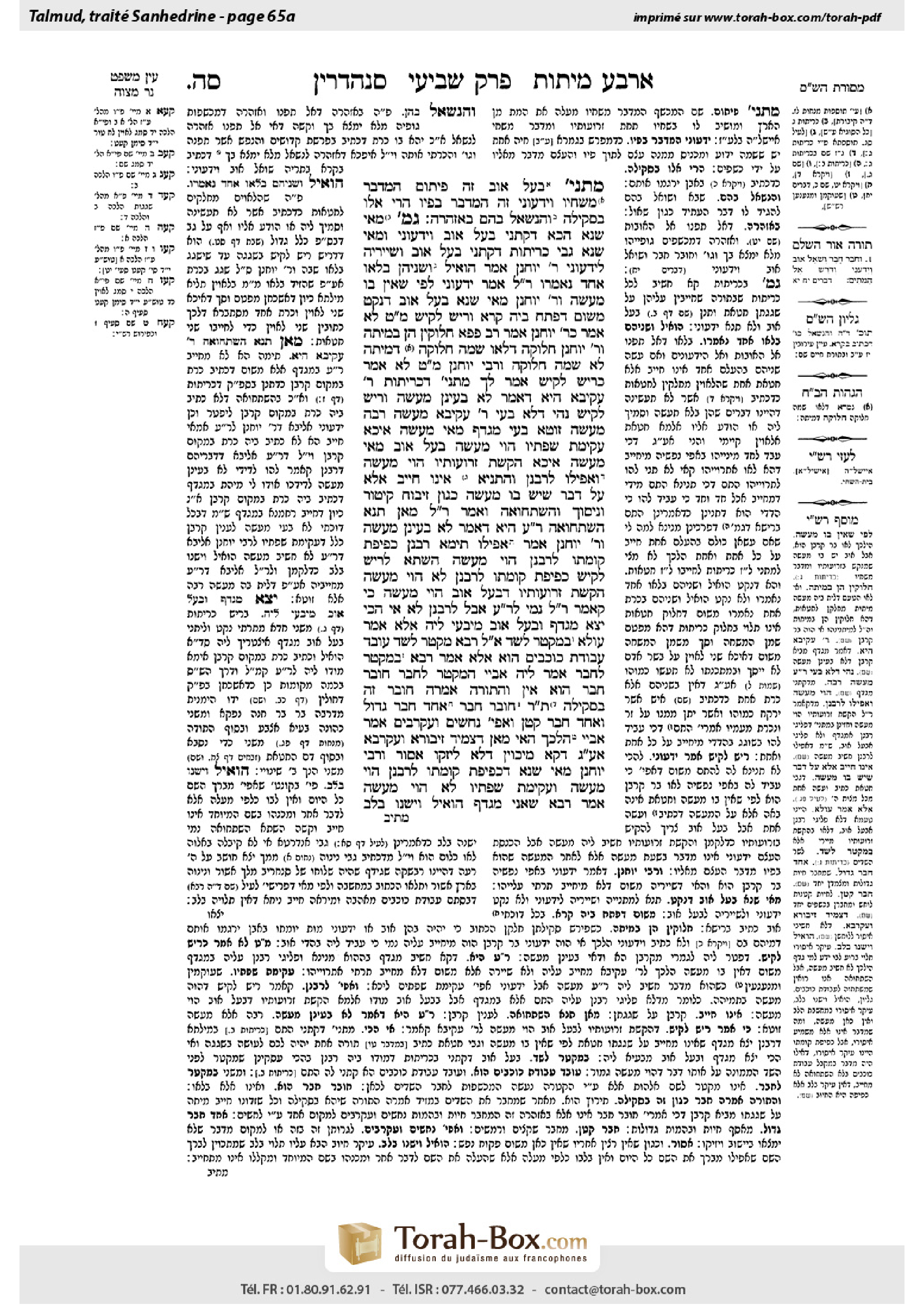
Sanhedrin 65a: Talmud study for Daf Yomi
Daf Yomi is the daily study of one Talmud folio. Explore 37 tractates with scans, Hebrew text, Sefaria English and AI-generated French translations where annotated.
Passage selection and English or AI-generated French translation are available where the scan has annotations. Daf Study is independent of Torah-Box and Sefaria.
Browse Sanhedrin · סנהדרין · All tractatesSanhedrin 65a text and translations
This page of Sanhedrin includes the Aramaic text, an English translation and an AI-generated French translation, alongside the scan above.
סנהדרין ס״ה א · Aramaic and Hebrew text
מַתְנִי׳ בַּעַל אוֹב – זֶה פִּיתוֹם הַמְדַבֵּר מִשֶּׁחְיוֹ, וְיִדְּעוֹנִי – זֶה הַמְדַבֵּר בְּפִיו. הֲרֵי אֵלּוּ בִּסְקִילָה, וְהַנִּשְׁאָל בָּהֶם בְּאַזְהָרָה.
גְּמָ׳ מַאי שְׁנָא הָכָא דְּקָתָנֵי בַּעַל אוֹב וְיִדְּעוֹנִי, וּמַאי שְׁנָא גַּבֵּי כָּרֵיתוֹת דְּקָתָנֵי בַּעַל אוֹב וְשַׁיְּירֵיהּ לְיִדְּעוֹנִי?
רַבִּי יוֹחָנָן אָמַר: הוֹאִיל וּשְׁנֵיהֶן בְּלָאו אֶחָד נֶאֶמְרוּ.
רֵישׁ לָקִישׁ אָמַר: יִדְּעוֹנִי, לְפִי שֶׁאֵין בּוֹ מַעֲשֶׂה.
וְרַבִּי יוֹחָנָן, מַאי שְׁנָא בַּעַל אוֹב דְּנָקֵט? מִשּׁוּם דִּפְתַח בֵּיהּ קְרָא.
וְרֵישׁ לָקִישׁ, מַאי טַעְמָא לָא אָמַר כְּרַבִּי יוֹחָנָן? אָמַר רַב פָּפָּא: חֲלוּקִין הֵן בְּמִיתָה.
וְרַבִּי יוֹחָנָן: חֲלוּקָּה דְּלָאו – שְׁמָהּ חֲלוּקָּה, דְמִיתָה – לֹא שְׁמָהּ חֲלוּקָּה.
וְרַבִּי יוֹחָנָן, מַאי טַעְמָא לָא אָמַר כְּרֵישׁ לָקִישׁ? אָמַר לָךְ: מַתְנִיתִין דְּכָרֵיתוֹת רַבִּי עֲקִיבָא הִיא, דְּאָמַר: לָא בָּעֵינַן מַעֲשֶׂה.
וְרֵישׁ לָקִישׁ: נְהִי דְּלָא בָּעֵי רַבִּי עֲקִיבָא מַעֲשֶׂה רַבָּה, מַעֲשֶׂה זוּטָא בָּעֵי.
מְגַדֵּף, מַאי מַעֲשֶׂה אִיכָּא? עֲקִימַת שְׂפָתָיו הָוֵי מַעֲשֶׂה.
בַּעַל אוֹב, מַאי מַעֲשֶׂה אִיכָּא? הַקָּשַׁת זְרוֹעוֹתָיו הָוֵי מַעֲשֶׂה.
וַאֲפִילּוּ לְרַבָּנַן? וְהָתַנְיָא: אֵינוֹ חַיָּיב אֶלָּא עַל דָּבָר שֶׁיֵּשׁ בּוֹ מַעֲשֶׂה, כְּגוֹן זִיבּוּחַ, קִיטּוּר, וְנִיסּוּךְ, וְהִשְׁתַּחֲוָאָה.
וְאָמַר רֵישׁ לָקִישׁ: מַאן תְּנָא הִשְׁתַּחֲוָאָה? רַבִּי עֲקִיבָא הִיא, דְּאָמַר: לָא בָּעֵינַן מַעֲשֶׂה. וְרַבִּי יוֹחָנָן אָמַר: אֲפִילּוּ תֵּימָא רַבָּנַן, כְּפִיפַת קוֹמָתוֹ לְרַבָּנַן הָוֵי מַעֲשֶׂה.
הַשְׁתָּא לְרֵישׁ לָקִישׁ, כְּפִיפַת קוֹמָתוֹ לְרַבָּנַן לָא הָוֵי מַעֲשֶׂה, הַקָּשַׁת זְרוֹעוֹתָיו דְּבַעַל אוֹב הָוֵי מַעֲשֶׂה?
כִּי קָאָמַר רֵישׁ לָקִישׁ נָמֵי – לְרַבִּי עֲקִיבָא, אֲבָל לְרַבָּנַן – לָא.
אִי הָכִי, יָצָא מְגַדֵּף וּבַעַל אוֹב מִיבְּעֵי לֵיהּ!
אֶלָּא אָמַר עוּלָּא: בִּמְקַטֵּר לַשֵּׁד.
אֲמַר לֵיהּ רָבָא: מְקַטֵּר לַשֵּׁד – עוֹבֵד עֲבוֹדָה זָרָה הוּא! אֶלָּא, אָמַר רָבָא: בִּמְקַטֵּר לְחַבָּר.
אֲמַר לֵיהּ אַבָּיֵי: הַמְקַטֵּר לְחַבָּר – חוֹבֵר חָבֵר הוּא.
אִין, וְהַתּוֹרָה אָמְרָה: חוֹבֵר זֶה בִּסְקִילָה.
תָּנוּ רַבָּנַן: ״חֹבֵר חָבֶר״ – אֶחָד חֶבֶר גָּדוֹל וְאֶחָד חֶבֶר קָטָן, וַאֲפִילּוּ נְחָשִׁים וְעַקְרַבִּים.
אָמַר אַבָּיֵי: הִלְכָּךְ, הַאי מַאן דְּצָמֵיד זִיבּוּרָא וְעַקְרַבָּא, אַף עַל גַּב דְּקָא מִיכַּוֵּין דְּלָא לַיזְּקוּ, אָסוּר.
וְרַבִּי יוֹחָנָן, מַאי שְׁנָא דִּכְפִיפַת קוֹמָתוֹ לְרַבָּנַן הָוֵי מַעֲשֶׂה, וַעֲקִימַת שְׂפָתָיו לָא הָוֵי מַעֲשֶׂה?
אָמַר רָבָא: שָׁאנֵי מְגַדֵּף, הוֹאִיל וְיֶשְׁנוֹ בַּלֵּב.
Sanhedrin 65a · English translation
MISHNA: The list of those liable to be executed by stoning includes those who practice various types of sorcery. The mishna describes them: A necromancer is a pitom from whose armpit the voice of the dead appears to speak. And a sorcerer is one from whose mouth the dead appears to speak. These, the necromancer and the sorcerer, are executed by stoning, and one who inquires about the future through them is in violation of a prohibition.
GEMARA: What is different here, that the mishna teaches the halakhot of both a necromancer and a sorcerer, and what is different in tractate Karetot (2a), that the mishna teaches the halakha of a necromancer but leaves out the halakha of a sorcerer?
Rabbi Yoḥanan says: The mishna in tractate Karetot does not count a sorcerer separately in the list of those liable to receive karet since both a necromancer and a sorcerer are stated in the Torah in one prohibition. Consequently, one who unwittingly serves as both a necromancer and a sorcerer is not obligated to bring two sin-offerings, as would be one who transgressed two prohibitions punishable by karet.
Reish Lakish says: A sorcerer is not included in the list in tractate Karetot because his transgression does not involve an action; it involves only speech, and one does not bring a sin-offering for transgressing a prohibition that does not involve an action.
The Gemara asks: And according to the opinion of Rabbi Yoḥanan, that a sorcerer is not listed because sorcery is included in the same prohibition as that of necromancy, what is different about a necromancer that the mishna uses specifically that example, and not the example of a sorcerer? The Gemara answers: The mishna chooses to mention the example of a necromancer because the verse introduces the prohibition with it; the case of a sorcerer is mentioned in the verse afterward (see Deuteronomy 18:11).
The Gemara asks: And what is the reason that Reish Lakish did not say an explanation in accordance with the explanation of Rabbi Yoḥanan? Rav Pappa says: Reish Lakish disagrees with the opinion of Rabbi Yoḥanan because the cases of a necromancer and a sorcerer are divided in the verse with regard to the issue of the death penalty, i.e., one is liable to receive the death penalty for each transgression. Consequently, one would be obligated to bring a separate sin-offering for sorcery were it not for the fact that this transgression does not involve an action.
And Rabbi Yoḥanan could respond that one cannot infer the number of sin-offerings one is obligated to bring based on capital punishment. With regard to determining the number of sin-offerings, where there is a division of a prohibition, i.e., when two acts are listed as two separate prohibitions, it is considered a division that leads to a separate sin-offering, but where there is a division of a separate death penalty, i.e., when the death penalties are listed separately, it is not considered a division in this regard.
The Gemara asks: And what is the reason that Rabbi Yoḥanan did not say an explanation in accordance with the explanation of Reish Lakish, that a sorcerer is not listed in tractate Karetot because his transgression does not involve an action? The Gemara answers: Rabbi Yoḥanan could have said to you that the mishna of tractate Karetot is in accordance with the opinion of Rabbi Akiva, who says that we do not require an action for one to be obligated to bring a sin-offering.
And Reish Lakish could have responded that although Rabbi Akiva does not require that one perform a significant action to be obligated to bring a sin-offering; nevertheless, he does require that one perform at least a minor action. Sorcery, by contrast, involves no action, and therefore even Rabbi Akiva would not deem one obligated to bring a sin-offering for it.
The Gemara asks: In the case of a blasphemer, i.e., one who curses God, what action is there? He merely speaks, and nevertheless Rabbi Akiva deems him obligated to bring a sin-offering. Clearly, Rabbi Akiva maintains that no action is necessary at all. The Gemara answers: The twisting of his lips while he speaks is considered an action.
The Gemara asks: What action is there in the case of a necromancer? The Gemara answers: The striking of his arms against each other in order to create the sound of a voice is considered an action.
The Gemara asks: And is this considered an action even according to the opinion of the Rabbis, who require a significant action for one to be obligated to bring a sin-offering? But isn’t it taught in a baraita: One is liable for idol worship only for a matter that involves an action, e.g., sacrificing an idolatrous offering, burning incense to an idol, and pouring a libation to an idol, and bowing to an idol.
And Reish Lakish says: Who is the tanna who taught bowing among these examples? It is Rabbi Akiva, who says: We do not require a significant action for one to be liable; any action is sufficient. And Rabbi Yoḥanan says: You may even say that the baraita is in accordance with the opinion of the Rabbis, as the bending of one’s height, according to the opinion of the Rabbis, is considered a significant action.
Now consider, if according to Reish Lakish, the bending of one’s height is not considered a significant action according to the Rabbis, can a less noticeable action such as the striking of the necromancer’s arms be considered a significant action?
The Gemara answers: Reish Lakish concedes that according to the Rabbis, the striking of the necromancer’s arms is not considered a significant action. When Reish Lakish says that it is considered an action, that statement is also in accordance with the opinion of Rabbi Akiva. But according to the Rabbis, it is not considered a significant action.
The Gemara challenges: If so, that the Rabbis hold that the transgression of a necromancer does not involve an action, then when stating in tractate Karetot (2a) that if one unwittingly transgresses a prohibition for which one is liable to receive karet if he transgresses it intentionally he is obligated to bring a sin-offering, excluding a blasphemer, as he does not perform an action, the Rabbis should have stated: Excluding a blasphemer and a necromancer, as they do not perform an action.
Rather, Ulla says: The reason the Rabbis do not state: Excluding a blasphemer and a necromancer, is that when the mishna there lists the case of a necromancer it is referring to one who burns incense to a demon in order to raise the dead, which is a significant action.
Rava said to Ulla: One who burns incense to a demon is an idol worshipper, which is already mentioned in the mishna in Karetot. Rather, Rava says: The mishna there is referring to one who burns incense to the demons not as a form of worship but as a manner of sorcery, in order to gather the demons, i.e., to bring them to one place.
Abaye said to Ulla: One who burns incense to the demons in order to gather them is considered a charmer, whom the Torah relates to with a distinct prohibition (see Deuteronomy 18:11), which is not punishable by karet.
Rava responded: Yes, such a person is also considered a charmer, but the Torah states that this particular charmer, who gathers demons, is included in the category of a necromancer, and therefore he is executed by stoning, and karet applies as well.
The Sages taught with regard to a charmer that the prohibition applies both to a gathering of large animals to one place and to a gathering of small animals to one place, and even to a gathering of snakes and scorpions.
Abaye says: Therefore, with regard to this person, who through sorcery gathers a hornet and a scorpion to harm each other, he is nevertheless prohibited from doing so even if he intends to prevent them from harming him.
The Gemara asks: And as for Rabbi Yoḥanan, who holds that according to the Rabbis one is liable for bowing to an idol but not for blaspheming, what is different between these cases, leading to the conclusion that the bending of one’s height while bowing is considered an action according to the Rabbis, but a blasphemer’s twisting of his lips to speak is not considered an action?
Rava says: The case of a blasphemer is different, since this transgression is in the heart as well. The sin of blasphemy does not apply to speech alone, as the blasphemer’s intention is central to the transgression; if he spoke without intention he is not considered a blasphemer. Consequently, one is not obligated to bring a sin-offering for such an action, as it is essentially a sin of the heart.
Sanhedrin 65a · Traduction française (IA)
MICHNA : La liste de ceux qui sont passibles de la lapidation comprend ceux qui pratiquent diverses formes de sorcellerie. La Michna les décrit ainsi : un nécromancien est un pitom, de l’aisselle duquel semble sortir la voix des morts. Un sorcier est quelqu’un de la bouche duquel semble parler un mort. Le nécromancien et le sorcier sont exécutés par lapidation, et celui qui les consulte pour connaître l’avenir transgresse une interdiction.
GUEMARA : Pourquoi la Michna enseigne-t-elle ici les halakhot du nécromancien et du sorcier, alors que, dans le traité Keritot (2a), elle enseigne la halakha du nécromancien, mais omet celle du sorcier ?
Rabbi Yoḥanan dit : La Michna du traité Keritot ne compte pas le sorcier séparément parmi ceux qui sont passibles du retranchement, car le nécromancien et le sorcier sont mentionnés dans la Torah sous une seule interdiction. Par conséquent, celui qui pratique involontairement à la fois la nécromancie et la sorcellerie n’est pas tenu d’apporter deux sacrifices expiatoires, contrairement à celui qui a transgressé deux interdictions passibles du retranchement.
Reish Lakish dit : Le sorcier ne figure pas dans la liste du traité Keritot parce que sa transgression ne comporte aucun acte ; elle consiste uniquement à parler, et on n’apporte pas de sacrifice expiatoire pour avoir transgressé une interdiction qui ne comporte pas d’acte.
La Guemara demande : Selon l’opinion de Rabbi Yoḥanan, qui dit que le sorcier ne figure pas dans la liste parce que la sorcellerie relève de la même interdiction que la nécromancie, pourquoi la Michna choisit-elle précisément l’exemple du nécromancien, et non celui du sorcier ? La Guemara répond : La Michna mentionne le nécromancien parce que le verset commence par cette interdiction ; le cas du sorcier est mentionné ensuite dans le verset (voir Deutéronome 18,11).
La Guemara demande : Pourquoi Reish Lakish n’a-t-il pas donné une explication conforme à celle de Rabbi Yoḥanan ? Rav Pappa dit : Reish Lakish est en désaccord avec Rabbi Yoḥanan, car le verset distingue le nécromancien du sorcier en ce qui concerne la peine de mort, c’est-à-dire que chacun est passible de la peine de mort pour sa transgression. Par conséquent, on serait tenu d’apporter un sacrifice expiatoire distinct pour la sorcellerie, si ce n’était que cette transgression ne comporte pas d’acte.
Rabbi Yoḥanan pourrait répondre qu’on ne peut pas déduire le nombre de sacrifices expiatoires à apporter de la peine capitale. Pour déterminer le nombre de sacrifices expiatoires, une distinction entre les interdictions — c’est-à-dire lorsque deux actes sont énumérés comme deux interdictions distinctes — entraîne l’obligation d’apporter un sacrifice expiatoire distinct. En revanche, une distinction entre les peines de mort — c’est-à-dire lorsque celles-ci sont énumérées séparément — ne constitue pas une distinction à cet égard.
La Guemara demande : Pourquoi Rabbi Yoḥanan n’a-t-il pas donné une explication conforme à celle de Reish Lakish, selon laquelle le sorcier ne figure pas dans le traité Keritot parce que sa transgression ne comporte pas d’acte ? La Guemara répond : Rabbi Yoḥanan aurait pu te dire que la Michna du traité Keritot suit l’opinion de Rabbi Akiva, qui estime qu’un acte n’est pas nécessaire pour être tenu d’apporter un sacrifice expiatoire.
Reish Lakish aurait pu répondre que, bien que Rabbi Akiva n’exige pas qu’on accomplisse un acte important pour être tenu d’apporter un sacrifice expiatoire, il exige néanmoins qu’on accomplisse au moins un acte mineur. La sorcellerie, en revanche, ne comporte aucun acte ; même Rabbi Akiva ne considérerait donc pas qu’on soit tenu d’apporter un sacrifice expiatoire pour cela.
La Guemara demande : Quel acte accomplit le blasphémateur, c’est-à-dire celui qui maudit Dieu ? Il ne fait que parler, et pourtant Rabbi Akiva considère qu’il est tenu d’apporter un sacrifice expiatoire. Il est donc clair que, selon Rabbi Akiva, aucun acte n’est nécessaire. La Guemara répond : Le mouvement des lèvres lorsqu’il parle est considéré comme un acte.
La Guemara demande : Quel acte accomplit le nécromancien ? La Guemara répond : Le fait de frapper ses bras l’un contre l’autre pour produire le son d’une voix est considéré comme un acte.
La Guemara demande : Cela est-il considéré comme un acte même selon l’opinion des Sages, qui exigent un acte important pour être tenu d’apporter un sacrifice expiatoire ? N’est-il pas enseigné dans une baraïta : On n’est passible d’une peine pour le culte des idoles que pour un acte, par exemple offrir un sacrifice idolâtre, brûler de l’encens à une idole, lui faire une libation ou se prosterner devant elle ?
Et Reish Lakish dit : Quel tanna a inclus la prosternation parmi ces exemples ? Rabbi Akiva, qui dit qu’un acte important n’est pas nécessaire pour être passible d’une peine ; n’importe quel acte suffit. Et Rabbi Yoḥanan dit : On peut même dire que la baraïta suit l’opinion des Sages, car, selon eux, le fait de courber le corps est considéré comme un acte important.
Or, si, selon Reish Lakish, le fait de courber le corps n’est pas considéré comme un acte important par les Sages, comment un acte moins perceptible, tel que le fait pour le nécromancien de frapper ses bras, pourrait-il être considéré comme un acte important ?
La Guemara répond : Reish Lakish reconnaît que, selon les Sages, le fait pour le nécromancien de frapper ses bras n’est pas considéré comme un acte important. Lorsqu’il dit que cela est considéré comme un acte, il parle lui aussi selon l’opinion de Rabbi Akiva. Mais, selon les Sages, cela n’est pas considéré comme un acte important.
La Guemara objecte : Si les Sages estiment que la transgression du nécromancien ne comporte pas d’acte, alors, lorsqu’on enseigne dans le traité Keritot (2a) que celui qui transgresse involontairement une interdiction pour laquelle il serait passible du retranchement s’il la transgressait intentionnellement est tenu d’apporter un sacrifice expiatoire — à l’exception du blasphémateur, puisqu’il n’accomplit pas d’acte —, les Sages auraient dû dire : « À l’exception du blasphémateur et du nécromancien, puisqu’ils n’accomplissent pas d’acte. »
Ulla dit plutôt : Si les Sages ne disent pas « à l’exception du blasphémateur et du nécromancien », c’est parce que, lorsque la Michna mentionne le nécromancien, elle parle de celui qui brûle de l’encens à un démon pour faire apparaître les morts, ce qui constitue un acte important.
Rava dit à Ulla : Celui qui brûle de l’encens à un démon est un idolâtre, et ce cas est déjà mentionné dans la Michna du traité Keritot. Rava dit plutôt : La Michna parle de celui qui brûle de l’encens aux démons non pas pour les adorer, mais dans le cadre d’un procédé de sorcellerie visant à les rassembler, c’est-à-dire à les réunir en un même lieu.
Abayé dit à Ulla : Celui qui brûle de l’encens aux démons pour les rassembler est considéré comme un charmeur, auquel la Torah attribue une interdiction distincte (voir Deutéronome 18,11), qui n’est pas passible du retranchement.
Rava répondit : Oui, une telle personne est également considérée comme un charmeur, mais la Torah enseigne que ce charmeur particulier, qui rassemble des démons, relève de la catégorie du nécromancien ; il est donc exécuté par lapidation et passible également du retranchement.
Les Sages ont enseigné au sujet du charmeur que l’interdiction s’applique aussi bien au rassemblement de grands animaux en un même lieu qu’à celui de petits animaux, et même au rassemblement de serpents et de scorpions.
Abayé dit : Par conséquent, cet homme qui, par sorcellerie, rassemble un frelon et un scorpion pour qu’ils se nuisent mutuellement n’a pas le droit d’agir ainsi, même s’il a l’intention de les empêcher de lui nuire.
La Guemara demande : Et pour Rabbi Yoḥanan, qui estime que, selon les Sages, on est passible d’une peine pour s’être prosterné devant une idole, mais pas pour avoir blasphémé, quelle différence y a-t-il entre ces cas, pour que le fait de courber le corps en se prosternant soit considéré comme un acte selon les Sages, tandis que le mouvement des lèvres du blasphémateur pour parler ne soit pas considéré comme un acte ?
Rava dit : Le cas du blasphémateur est différent, car cette transgression relève aussi du cœur. Le blasphème ne tient pas à la seule parole, puisque l’intention du blasphémateur est essentielle à la transgression ; s’il a parlé sans intention, il n’est pas considéré comme un blasphémateur. Par conséquent, on n’est pas tenu d’apporter un sacrifice expiatoire pour un tel acte, car il s’agit essentiellement d’un péché du cœur.
Traduction française générée par IA à partir de l’édition anglaise de Sefaria. Vérifie toujours un passage avec le texte source.
Text from Sefaria: William Davidson Edition - Vocalized Aramaic (CC BY NC); William Davidson Edition - English (CC BY NC).