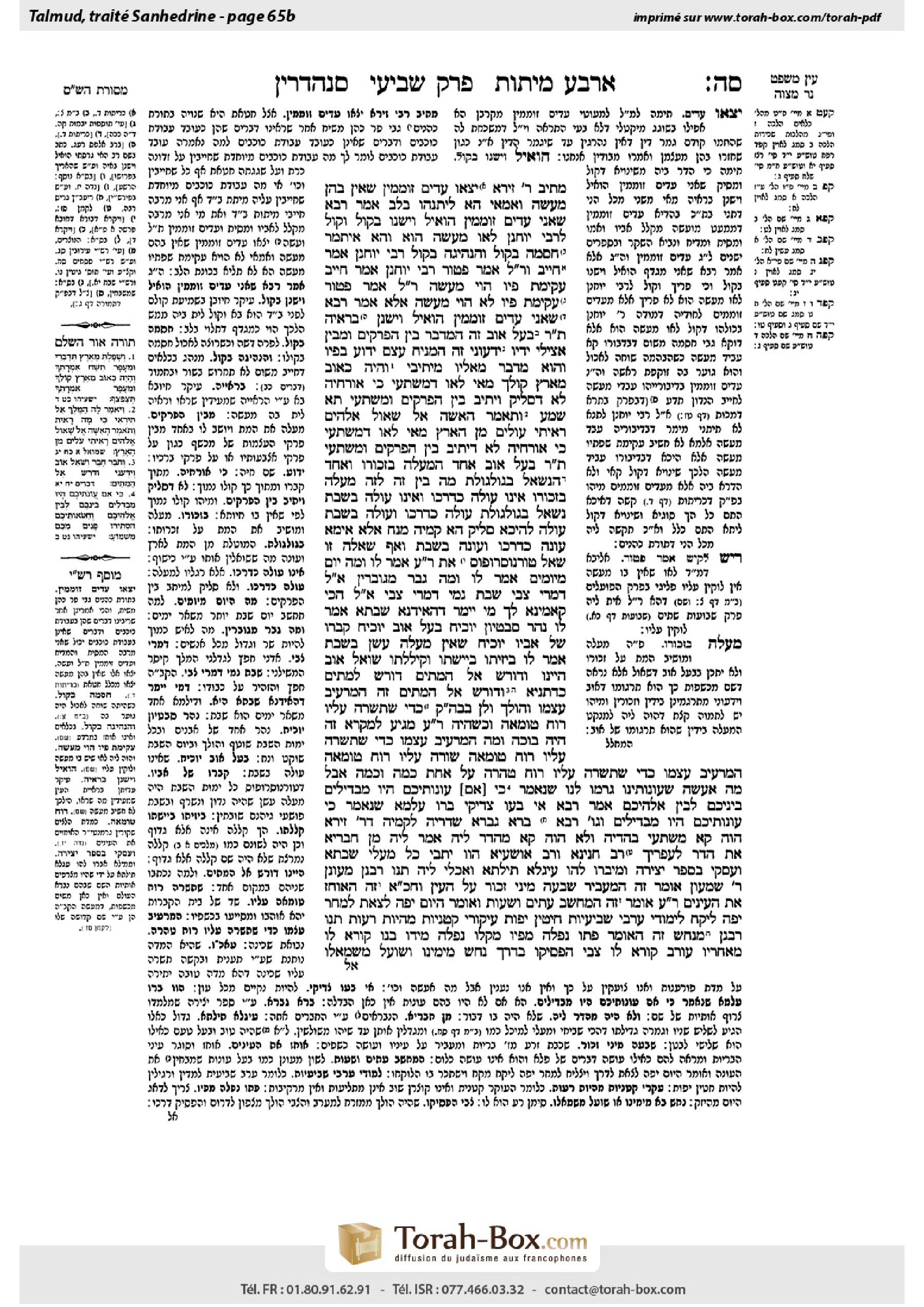
Sanhedrin 65b: Talmud study for Daf Yomi
Daf Yomi is the daily study of one Talmud folio. Explore 37 tractates with scans, Hebrew text, Sefaria English and AI-generated French translations where annotated.
Passage selection and English or AI-generated French translation are available where the scan has annotations. Daf Study is independent of Torah-Box and Sefaria.
Browse Sanhedrin · סנהדרין · All tractatesSanhedrin 65b text and translations
This page of Sanhedrin includes the Aramaic text, an English translation and an AI-generated French translation, alongside the scan above.
סנהדרין ס״ה ב · Aramaic and Hebrew text
מֵתִיב רַבִּי זֵירָא: יָצְאוּ עֵדִים זוֹמְמִין, שֶׁאֵין בָּהֶן מַעֲשֶׂה. וְאַמַּאי? הָא לֵיתַנְהוּ בַּלֵּב!
אָמַר רָבָא: שָׁאנֵי עֵדִים זוֹמְמִין, הוֹאִיל וְיֶשְׁנוֹ בְּקוֹל.
וְקוֹל, לְרַבִּי יוֹחָנָן, לָאו מַעֲשֶׂה הוּא? וְהָא אִיתְּמַר: חֲסָמָהּ בְּקוֹל וְהִנְהִיגָהּ בְּקוֹל, רַבִּי יוֹחָנָן אָמַר: חַיָּיב, וְרֵישׁ לָקִישׁ אָמַר: פָּטוּר.
רַבִּי יוֹחָנָן אָמַר: חַיָּיב, עֲקִימַת פִּיו הָוֵי מַעֲשֶׂה. רֵישׁ לָקִישׁ אָמַר: פָּטוּר, עֲקִימַת פִּיו לָא הָוֵי מַעֲשֶׂה.
אֶלָּא אָמַר רָבָא: שָׁאנֵי עֵדִים זוֹמְמִין, הוֹאִיל וְיֶשְׁנָן בִּרְאִיָּה.
תָּנוּ רַבָּנַן: בַּעַל אוֹב – זֶה הַמְדַבֵּר בֵּין הַפְּרָקִים וּמִבֵּין אַצִּילֵי יָדָיו. יִדְּעוֹנִי – זֶה הַמַּנִּיחַ עֶצֶם יָדוּעַ בְּפִיו, וְהוּא מְדַבֵּר מֵאֵלָיו.
מֵיתִיבִי: ״וְהָיָה כְּאוֹב מֵאֶרֶץ קוֹלֵךְ״. מַאי לָאו, דְּמִשְׁתַּעֵי כִּי אוֹרְחֵיהּ? לָא, דְּסָלֵיק וְיָתֵיב בֵּין הַפְּרָקִים וּמִשְׁתַּעֵי.
תָּא שְׁמַע: ״וַתֹּאמֶר הָאִשָּׁה אֶל שָׁאוּל אֱלֹהִים רָאִיתִי עֹלִים מִן הָאָרֶץ״. מַאי לָאו, דְּמִשְׁתַּעֵי כִּי אוֹרְחֵיהּ? לָא, דְּיָתֵיב בֵּין הַפְּרָקִים וּמִשְׁתַּעֵי.
תָּנוּ רַבָּנַן: בַּעַל אוֹב – אֶחָד הַמַּעֲלֶה בִּזְכוּרוֹ, וְאֶחָד הַנִּשְׁאָל בְּגוּלְגּוֹלֶת. מָה בֵּין זֶה לָזֶה? מַעֲלֶה בִּזְכוּרוֹ – אֵינוֹ עוֹלֶה כְּדַרְכּוֹ, וְאֵינוֹ עוֹלֶה בַּשַּׁבָּת. נִשְׁאָל בְּגוּלְגּוֹלֶת – עוֹלֶה כְּדַרְכּוֹ, וְעוֹלֶה בַּשַּׁבָּת.
עוֹלֶה? לְהֵיכָא סָלֵיק? הָא קַמֵּיהּ מַנַּח! אֶלָּא אֵימָא: עוֹנֶה כְּדַרְכּוֹ, וְעוֹנֶה בַּשַּׁבָּת.
וְאַף שְׁאֵלָה זוֹ שָׁאַל טוֹרָנוּסְרוּפוּס הָרָשָׁע אֶת רַבִּי עֲקִיבָא. אָמַר לוֹ: וּמָה יוֹם מִיָּמִים? אָמַר לוֹ: וּמָה גְּבַר מִגּוּבְרִין? אֲמַר לֵיהּ: דְּמָרִי צָבֵי. שַׁבָּת נָמֵי דְּמָרִי צָבֵי.
אֲמַר לֵיהּ, הָכִי קָאָמֵינָא לָךְ: מִי יֵימַר דְּהָאִידָּנָא שַׁבְּתָא? אָמַר לוֹ: נְהַר סַבַּטְיוֹן יוֹכִיחַ, בַּעַל אוֹב יוֹכִיחַ, קִבְרוֹ שֶׁל אָבִיו יוֹכִיחַ, שֶׁאֵין מַעֲלֶה עָשָׁן בַּשַּׁבָּת. אָמַר לוֹ: בִּיזִּיתוֹ, בִּיַּישְׁתּוֹ, וְקִילַּלְתּוֹ!
שׁוֹאֵל אוֹב, הַיְינוּ ״וְדֹרֵשׁ אֶל הַמֵּתִים״!
דּוֹרֵשׁ לַמֵּתִים, כִּדְתַנְיָא: ״וְדֹרֵשׁ אֶל הַמֵּתִים״ – זֶה הַמַּרְעִיב עַצְמוֹ וְהוֹלֵךְ וְלָן בְּבֵית הַקְּבָרוֹת, כְּדֵי שֶׁתִּשְׁרֶה עָלָיו רוּחַ טוּמְאָה.
וּכְשֶׁהָיָה רַבִּי עֲקִיבָא מַגִּיעַ לְמִקְרָא זֶה הָיָה בּוֹכֶה, וּמָה הַמַּרְעִיב עַצְמוֹ כְּדַי שֶׁתִּשְׁרֶה עָלָיו רוּחַ טוּמְאָה – שׁוֹרָה עָלָיו רוּחַ טוּמְאָה, הַמַּרְעִיב עַצְמוֹ כְּדַי שֶׁתִּשְׁרֶה עָלָיו רוּחַ טׇהֳרָה – עַל אַחַת כַּמָּה וְכַמָּה. אֲבָל מָה אֶעֱשֶׂה שֶׁעֲוֹנוֹתֵינוּ גָּרְמוּ לָנוּ, שֶׁנֶּאֱמַר: ״כִּי [אִם] עֲוֹנוֹתֵיכֶם הָיוּ מַבְדִּלִים בֵּינֵיכֶם לְבֵין אֱלֹהֵיכֶם״.
אָמַר רָבָא: אִי בָּעוּ צַדִּיקֵי, בָּרוּ עָלְמָא, שֶׁנֶּאֱמַר: ״כִּי עֲוֹנוֹתֵיכֶם הָיוּ מַבְדִּלִים וְגוֹ׳״.
רָבָא בְּרָא גַּבְרָא. שַׁדְּרֵיהּ לְקַמֵּיהּ דְּרַבִּי זֵירָא. הֲוָה קָא מִשְׁתַּעֵי בַּהֲדֵיהּ, וְלָא הֲוָה קָא מַהְדַּר לֵיהּ. אֲמַר לֵיהּ: מִן חַבְרַיָּא אַתְּ, הֲדַר לְעַפְרָיךְ.
רַב חֲנִינָא וְרַב אוֹשַׁעְיָא הֲווֹ יָתְבִי כׇּל מַעֲלֵי שַׁבְּתָא, וְעָסְקִי בְּסֵפֶר יְצִירָה, וּמִיבְּרֵי לְהוּ עִיגְלָא תִּילְתָּא, וְאָכְלִי לֵיהּ.
תָּנוּ רַבָּנַן: ״מְעוֹנֵן״ – רַבִּי שִׁמְעוֹן אוֹמֵר: זֶה הַמַּעֲבִיר שִׁבְעָה מִינֵי זְכוּר עַל הָעַיִן. וַחֲכָמִים אוֹמְרִים: זֶה הָאוֹחֵז אֶת הָעֵינַיִם. רַבִּי עֲקִיבָא אוֹמֵר: זֶה הַמְחַשֵּׁב עִתִּים וְשָׁעוֹת וְאוֹמֵר ״הַיּוֹם יָפֶה לָצֵאת״, ״לְמָחָר יָפֶה לִיקַּח״, ״לִמּוּדֵי עַרְבֵי שְׁבִיעִיּוֹת חִטִּין יָפוֹת״, ״עִיקּוּרֵי קִטְנִיּוֹת מֵהֱיוֹת רָעוֹת״.
תָּנוּ רַבָּנַן: ״מְנַחֵשׁ״ – זֶה הָאוֹמֵר: ״פִּתּוֹ נָפְלָה מִפִּיו״, ״מַקְלוֹ נָפְלָה מִידּוֹ״, ״בְּנוֹ קוֹרֵא לוֹ מֵאַחֲרָיו״, ״עוֹרֵב קוֹרֵא לוֹ״, ״צְבִי הִפְסִיקוֹ בַּדֶּרֶךְ״, ״נָחָשׁ מִימִינוֹ״, וְ״שׁוּעָל מִשְּׂמֹאלוֹ״.
Sanhedrin 65b · English translation
Rabbi Zeira raises an objection to Rava’s answer, as it is stated in a baraita that one who unwittingly commits a transgression punishable by death is obligated to bring a sin-offering, excluding conspiring witnesses, who are not obligated to bring a sin-offering, as their transgressions do not involve an action. Rabbi Zeira asks: And why is a false witness’s testimony not considered a transgression that involves an action? The testimony is delivered through speech, which should be considered an action, as this is not a transgression that is committed in the heart; the witnesses are liable for what they said, and not for their intention.
Rava says: Conspiring witnesses are different, since their transgression is committed through their voice. The essence of their transgression is not speech itself but rather making themselves heard by the court. Therefore, since the projection of one’s voice does not involve action, the transgression of conspiring witnesses is considered not to be involving action.
The Gemara asks: And is projecting one’s voice not considered an action according to Rabbi Yoḥanan? But wasn’t it stated that amora’im engaged in a dispute concerning the following case: If one muzzled an animal by projecting his voice, by berating it whenever it tried to eat, has he transgressed the prohibition of: “You shall not muzzle an ox while it treads out the corn” (Deuteronomy 25:4)? And similarly, if one led different species to work together by projecting his voice, without performing any action, has he transgressed the prohibition of: “You shall not plow with an ox and a donkey together” (Deuteronomy 22:10)? Rabbi Yoḥanan says he is liable, and Reish Lakish says he is exempt.
The Gemara explains the reasoning behind their opinions: Rabbi Yoḥanan says he is liable, as he maintains that the twisting of one’s mouth to speak is considered an action, whereas Reish Lakish says he is exempt, because he holds that that the twisting of one’s mouth to speak is not considered an action. Evidently, Rabbi Yoḥanan holds that a transgression one commits by projecting his voice is considered to involve an action.
Rather, Rava says there is a different answer to Rabbi Zeira’s objection: Conspiring witnesses are different, since they are rendered liable mainly through sight, i.e., the important part of their testimony is what they saw, which is not considered an action.
§ The Sages taught: A necromancer is one who causes the voice of the dead to be heard speaking from between his joints or from his armpit. A sorcerer [yideoni] is one who places a bone of an animal called a yadua in his mouth, and the bone speaks on its own.
The Gemara raises an objection from the verse: “And your voice shall be as a ghost out of the ground” (Isaiah 29:4). What, does the dead person not speak from the grave on his own? The Gemara answers: No, this is not so, as the dead person rises by sorcery and sits between the joints of the necromancer and speaks.
The Gemara suggests: Come and hear a proof from the statement of the necromancer to King Saul: “And the woman said to Saul, I see a godlike being coming up out of the earth” (I Samuel 28:13). What, does the verse not mean to say that the dead person spoke on his own? The Gemara refutes this proof: No, this is not so, as the dead person sits between the joints of the necromancer and speaks.
The Sages taught: The category of a necromancer includes both one who raises the dead with his zekhur, which is a form of sorcery, and one who inquires about the future from a skull [begulgolet]. What is the difference between this type of necromancer and that type of necromancer? When one raises the dead with his zekhur, the dead does not rise in its usual manner, but appears upside-down, and it does not rise on Shabbat. By contrast, when one inquires about the future from a skull, the dead rises in its usual manner, and it rises [oleh] even on Shabbat.
The Gemara asks with regard to the wording of the last statement: Rises? To where does it rise? Isn’t the skull lying before him? Rather, say as follows: The dead answers in its usual manner, and it answers [ve’oneh] even on Shabbat.
With regard to the statement that the dead do not rise on Shabbat, the Gemara relates: The wicked Turnus Rufus, the Roman governor of Judea, asked this question of Rabbi Akiva as well. Turnus Rufus said to him: And what makes this day, Shabbat, different from other days? Rabbi Akiva said to him: And what makes this man, referring to his interlocutor, more distinguished than other men? Turnus Rufus said to him: I am more distinguished because my master the emperor wants it that way. Rabbi Akiva said to him: Shabbat too is unique because my Master wants it that way, as he has sanctified that day.
Turnus Rufus said to him: This is what I mean to say to you: Who is to say that now is Shabbat? Perhaps a different day of the week is Shabbat. Rabbi Akiva said to him: The Sabbatyon River can prove that today is Shabbat, as it is calm only on Shabbat. A necromancer can also prove this, as the dead do not rise on Shabbat. The grave of his father, referring to Turnus Rufus’s father, can also prove this, as it does not emit smoke on Shabbat, although smoke rises from it all week, as during the week he is being punished in Gehenna. Turnus Rufus said to him: You have demeaned my father, you have publicly shamed him, and you have cursed him by saying that he is being punished in Gehenna.
§ The Gemara asks: Isn’t one who inquires about the future from a necromancer the same as what is described in the verse: “Or directs inquiries to the dead” (Deuteronomy 18:11)? Why are they mentioned separately in the verse?
The Gemara answers: One who directs inquiries to the dead employs a different method to contact the dead, as it is taught in a baraita: “Or directs inquiries to the dead”; this is one who starves himself and goes and sleeps overnight in a graveyard so that a spirit of impurity should settle upon him, and he can listen to what the dead are saying.
And when Rabbi Akiva would arrive at this verse he would weep and say: If one who starves himself so that a spirit of impurity will settle upon him succeeds in doing so, and a spirit of impurity settles upon him, all the more so one who starves himself so that a spirit of purity will settle upon him should be successful, and a spirit of purity should settle upon him. But what can I do, as our iniquities have caused us not to merit the spirit of sanctity and purity, as it is stated: “But your iniquities have separated between you and your God, and your sins have hid His face from you, that He will not hear” (Isaiah 59:2).
Rava says: If the righteous wish to do so, they can create a world, as it is stated: “But your iniquities have separated between you and your God.” In other words, there is no distinction between God and a righteous person who has no sins, and just as God created the world, so can the righteous.
Indeed, Rava created a man, a golem, using forces of sanctity. Rava sent his creation before Rabbi Zeira. Rabbi Zeira would speak to him but he would not reply. Rabbi Zeira said to him: You were created by one of the members of the group, one of the Sages. Return to your dust.
The Gemara relates another fact substantiating the statement that the righteous could create a world if they so desired: Rav Ḥanina and Rav Oshaya would sit every Shabbat eve and engage in the study of Sefer Yetzira, and a third-born calf [igla tilta] would be created for them, and they would eat it in honor of Shabbat.
§ The Sages taught: What is the definition of the soothsayer mentioned in the verse: “There shall not be found among you…a soothsayer” (Deuteronomy 18:10)? Rabbi Shimon says: This is one who applies seven types of semen [zekhur] to one’s eye in order to perform sorcery. And the Rabbis say: This is one who deceives the eyes, as though he is performing sorcery. Rabbi Akiva says: This is one who calculates the fortune of times and hours, and says, for example: Today is a propitious day for going away on a journey; tomorrow is propitious for purchasing property successfully. Or he says that on the eve of the Sabbatical Years, the wheat harvest is generally good; uprooting legumes rather than cutting them from above the ground prevents them from going bad.
The Sages taught: The enchanter mentioned in the verse (Deuteronomy 18:10) is one who relies on superstitious signs, e.g., one who says: If one’s bread fell from his mouth, that is a bad sign for him; or: If one’s staff fell from his hand, it is a bad sign; or: If one’s son calls him from behind, it is a sign that he should return from his journey; or: If a raven calls to him, or if a deer blocks him on the way, or if a snake is to his right, or if a fox is to his left, all of these are bad signs. An enchanter is one who relies on these as bad signs and consequently changes his course of action.
Sanhedrin 65b · Traduction française (IA)
Rabbi Zeira soulève une objection à la réponse de Rava, car il est enseigné dans une baraïta que celui qui commet par inadvertance une transgression passible de la peine de mort est tenu d’apporter un sacrifice expiatoire. Cela exclut les témoins conspirateurs, qui ne sont pas tenus d’apporter un sacrifice expiatoire, puisque leurs transgressions ne comportent pas d’acte. Rabbi Zeira demande : Pourquoi le faux témoignage n’est-il pas considéré comme une transgression comportant un acte ? Le témoignage est prononcé, ce qui devrait être considéré comme un acte, puisqu’il ne s’agit pas d’une transgression commise dans le cœur ; les témoins sont responsables de ce qu’ils ont dit, et non de leur intention.
Rava répond : Le cas des témoins conspirateurs est différent, car leur transgression est commise au moyen de leur voix. L’essence de leur transgression n’est pas le fait de parler en soi, mais plutôt de se faire entendre par le tribunal. Par conséquent, puisque la projection de la voix ne constitue pas un acte, la transgression des témoins conspirateurs est considérée comme ne comportant pas d’acte.
La Guemara demande : Selon Rabbi Yoḥanan, la projection de la voix n’est-elle donc pas considérée comme un acte ? N’a-t-il pas été enseigné que des amoraïm se sont disputés au sujet du cas suivant : si quelqu’un empêche un animal de manger en projetant sa voix, en le réprimandant chaque fois qu’il tente de manger, transgresse-t-il l’interdiction : « Tu ne muselleras pas un bœuf lorsqu’il foule le grain » (Deutéronome 25, 4) ? De même, si quelqu’un fait travailler ensemble des animaux d’espèces différentes en projetant sa voix, sans accomplir aucun acte, transgresse-t-il l’interdiction : « Tu ne laboureras pas avec un bœuf et un âne ensemble » (Deutéronome 22, 10) ? Rabbi Yoḥanan dit qu’il est passible, tandis que Reish Lakish dit qu’il est exempt.
La Guemara explique le raisonnement qui sous-tend leurs opinions : Rabbi Yoḥanan dit qu’il est passible, car il estime que le mouvement de la bouche nécessaire pour parler est considéré comme un acte, tandis que Reish Lakish dit qu’il est exempt, car il estime que ce mouvement n’est pas considéré comme un acte. Il ressort donc que Rabbi Yoḥanan estime qu’une transgression commise par la projection de la voix comporte un acte.
Rava propose plutôt une autre réponse à l’objection de Rabbi Zeira : le cas des témoins conspirateurs est différent, car leur responsabilité repose principalement sur la vue, c’est-à-dire que l’élément essentiel de leur témoignage est ce qu’ils ont vu, ce qui n’est pas considéré comme un acte.
§ Les Sages ont enseigné : Un nécromancien est quelqu’un qui fait entendre la voix des morts parlant depuis l’espace entre ses articulations ou depuis son aisselle. Un sorcier [yideoni] est quelqu’un qui place dans sa bouche un os d’un animal appelé yadua, et l’os parle de lui-même.
La Guemara soulève une objection à partir du verset : « Et ta voix sortira de la terre comme celle d’un fantôme » (Isaïe 29, 4). Cela ne signifie-t-il pas que le mort parle de lui-même depuis la tombe ? La Guemara répond : Non, il n’en est pas ainsi, car le mort se lève par sorcellerie, s’assied entre les articulations du nécromancien et parle.
La Guemara propose : Viens entendre une preuve tirée des paroles du nécromancien au roi Saül : « La femme dit à Saül : Je vois un être divin qui monte de la terre » (I Samuel 28, 13). Le verset ne veut-il pas dire que le mort parle de lui-même ? La Guemara réfute cette preuve : Non, il n’en est pas ainsi, car le mort s’assied entre les articulations du nécromancien et parle.
Les Sages ont enseigné : La catégorie du nécromancien comprend aussi bien celui qui fait monter les morts par son zekhur, une forme de sorcellerie, que celui qui interroge l’avenir à partir d’un crâne [begulgolet]. Quelle est la différence entre ces deux types de nécromancien ? Lorsque quelqu’un fait monter les morts par son zekhur, le mort ne se lève pas de sa manière habituelle, mais apparaît la tête en bas, et il ne se lève pas le Chabbat. En revanche, lorsqu’on interroge l’avenir à partir d’un crâne, le mort se lève de sa manière habituelle, et il se lève [oleh] même le Chabbat.
La Guemara s’interroge sur la formulation de la dernière déclaration : Il se lève ? Où se lève-t-il ? Le crâne n’est-il pas posé devant lui ? Il faut plutôt dire ceci : Le mort répond de sa manière habituelle, et il répond [ve’oneh] même le Chabbat.
Au sujet de la déclaration selon laquelle les morts ne se lèvent pas le Chabbat, la Guemara rapporte : Le méchant Turnus Rufus, gouverneur romain de Judée, posa également cette question à Rabbi Akiva. Turnus Rufus lui dit : Qu’est-ce qui distingue ce jour, le Chabbat, des autres jours ? Rabbi Akiva lui répondit : Et qu’est-ce qui distingue cet homme, désignant son interlocuteur, des autres hommes ? Turnus Rufus lui dit : Je suis plus distingué parce que mon maître, l’empereur, le veut ainsi. Rabbi Akiva lui répondit : Le Chabbat aussi est unique parce que mon Maître le veut ainsi, puisqu’il a sanctifié ce jour.
Turnus Rufus lui dit : Voici ce que je veux te dire : Qui peut affirmer qu’aujourd’hui, c’est Chabbat ? Peut-être qu’un autre jour de la semaine est le Chabbat. Rabbi Akiva lui répondit : Le fleuve Sabbatyon peut prouver qu’aujourd’hui, c’est Chabbat, car il est calme uniquement le Chabbat. Un nécromancien peut également le prouver, car les morts ne se lèvent pas le Chabbat. La tombe de son père, c’est-à-dire le père de Turnus Rufus, peut aussi le prouver, car elle ne dégage pas de fumée le Chabbat, bien qu’elle en dégage toute la semaine, puisqu’il est puni dans la Géhenne pendant la semaine. Turnus Rufus lui dit : Tu as rabaissé mon père, tu l’as couvert de honte en public et tu l’as maudit en disant qu’il est puni dans la Géhenne.
§ La Guemara demande : Celui qui interroge l’avenir auprès d’un nécromancien n’est-il pas celui qui est décrit dans le verset : « Ou qui interroge les morts » (Deutéronome 18, 11) ? Pourquoi le verset les mentionne-t-il séparément ?
La Guemara répond : Celui qui interroge les morts emploie une autre méthode pour entrer en contact avec eux, comme l’enseigne une baraïta : « Ou qui interroge les morts » désigne celui qui s’affame, puis va passer la nuit dans un cimetière afin qu’un esprit d’impureté se pose sur lui et qu’il puisse écouter ce que disent les morts.
Et lorsque Rabbi Akiva arrivait à ce verset, il pleurait et disait : Si celui qui s’affame afin qu’un esprit d’impureté se pose sur lui réussit à le faire, et qu’un esprit d’impureté se pose sur lui, à plus forte raison celui qui s’affame afin qu’un esprit de pureté se pose sur lui devrait-il réussir, et un esprit de pureté devrait se poser sur lui. Mais que puis-je faire ? Nos fautes nous ont empêchés de mériter l’esprit de sainteté et de pureté, comme il est dit : « Mais vos fautes ont dressé une séparation entre vous et votre Dieu, et vos péchés ont caché sa face, de sorte qu’il n’entendra pas » (Isaïe 59, 2).
Rava dit : Si les justes le souhaitent, ils peuvent créer un monde, comme il est dit : « Mais vos fautes ont dressé une séparation entre vous et votre Dieu. » Autrement dit, il n’y a aucune différence entre Dieu et un juste qui n’a pas de péchés ; de même que Dieu a créé le monde, les justes le peuvent aussi.
En effet, Rava créa un homme, un golem, au moyen de forces de sainteté. Rava envoya sa créature auprès de Rabbi Zeira. Rabbi Zeira lui parlait, mais elle ne répondait pas. Rabbi Zeira lui dit : Tu as été créé par l’un des membres du groupe, l’un des Sages. Retourne à ta poussière.
La Guemara rapporte un autre fait qui confirme l’affirmation selon laquelle les justes pourraient créer un monde s’ils le souhaitaient : Rav Ḥanina et Rav Oshaya s’asseyaient chaque veille de Chabbat et étudiaient le Sefer Yetzira ; un veau de troisième génération [igla tilta] était alors créé pour eux, et ils le mangeaient en l’honneur du Chabbat.
§ Les Sages ont enseigné : Quelle est la définition du devin mentionné dans le verset : « Qu’il ne se trouve parmi vous… aucun devin » (Deutéronome 18, 10) ? Rabbi Shimon dit : Il s’agit de celui qui applique sept sortes de semence [zekhur] sur son œil afin de pratiquer la sorcellerie. Les Rabbis disent : Il s’agit de celui qui trompe les yeux, comme s’il pratiquait la sorcellerie. Rabbi Akiva dit : Il s’agit de celui qui calcule la fortune des moments et des heures et dit, par exemple : Aujourd’hui est un jour favorable pour partir en voyage ; demain est propice à un achat immobilier réussi. Ou bien il dit qu’à la veille des années sabbatiques, la récolte de blé est généralement bonne ; arracher les légumineuses plutôt que de les couper au-dessus du sol les empêche de se gâter.
Les Sages ont enseigné : Le présageur mentionné dans le verset (Deutéronome 18, 10) est celui qui se fie à des signes superstitieux, par exemple celui qui dit : Si le pain tombe de la bouche de quelqu’un, c’est mauvais signe pour lui ; ou : Si son bâton tombe de sa main, c’est mauvais signe ; ou : Si son fils l’appelle par-derrière, c’est signe qu’il doit revenir de son voyage ; ou encore : Si un corbeau l’interpelle, si un cerf lui barre la route, si un serpent se trouve à sa droite ou un renard à sa gauche, tous ces signes sont mauvais. Un présageur est celui qui se fie à ces signes et, les considérant comme de mauvais présages, modifie sa conduite en conséquence.
Traduction française générée par IA à partir de l’édition anglaise de Sefaria. Vérifie toujours un passage avec le texte source.
Text from Sefaria: William Davidson Edition - Vocalized Aramaic (CC BY NC); William Davidson Edition - English (CC BY NC).