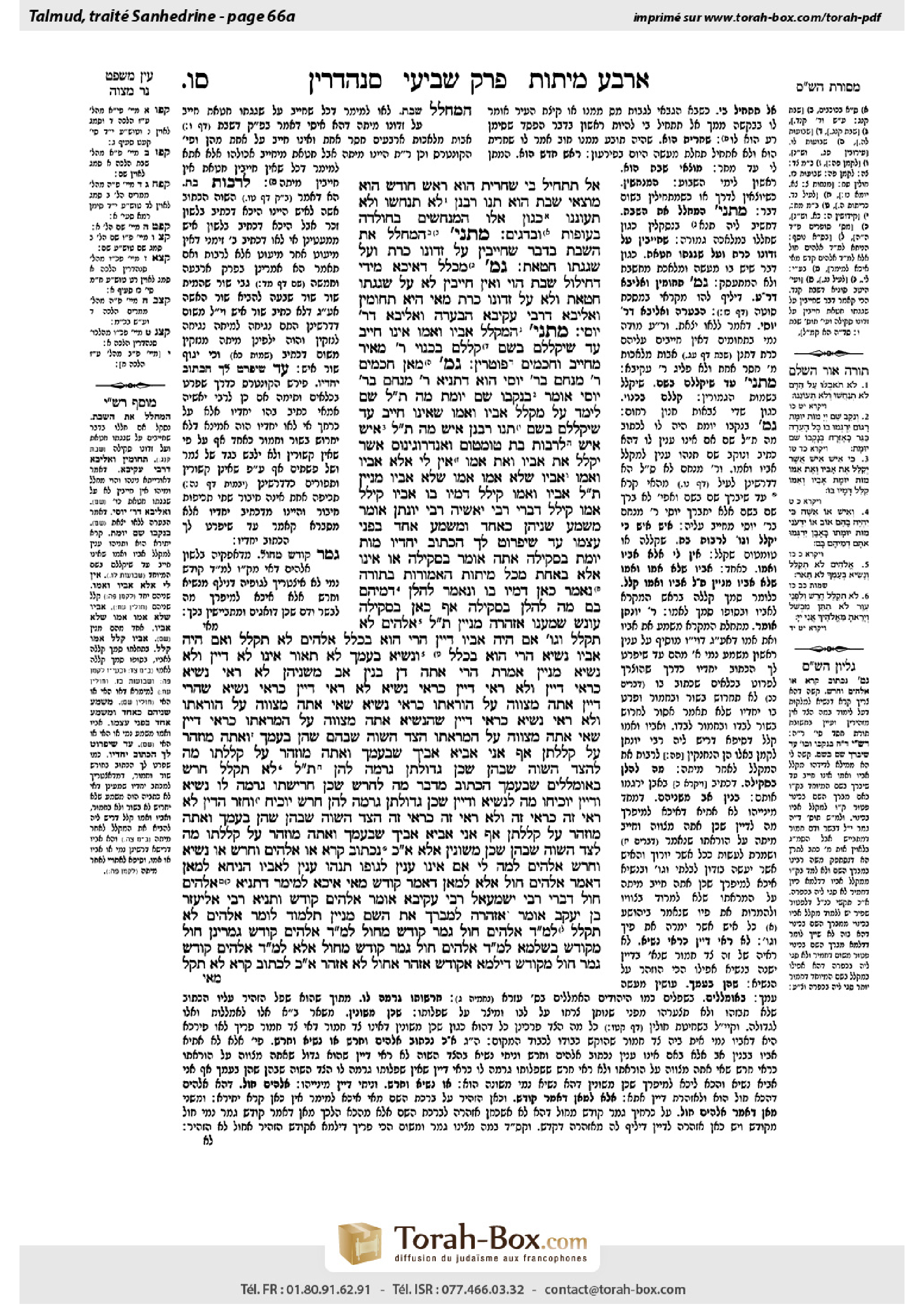
Sanhedrin 66a: Talmud study for Daf Yomi
Daf Yomi is the daily study of one Talmud folio. Explore 37 tractates with scans, Hebrew text, Sefaria English and AI-generated French translations where annotated.
Passage selection and English or AI-generated French translation are available where the scan has annotations. Daf Study is independent of Torah-Box and Sefaria.
Browse Sanhedrin · סנהדרין · All tractatesSanhedrin 66a text and translations
This page of Sanhedrin includes the Aramaic text, an English translation and an AI-generated French translation, alongside the scan above.
סנהדרין ס״ו א · Aramaic and Hebrew text
״אַל תַּתְחִיל בִּי״, ״שַׁחֲרִית הוּא״, ״רֹאשׁ חוֹדֶשׁ הוּא״, ״מוֹצָאֵי שַׁבָּת הוּא״.
תָּנוּ רַבָּנַן: ״לֹא תְנַחֲשׁוּ וְלֹא תְעוֹנֵנוּ״ – כְּגוֹן אֵלּוּ הַמְנַחֲשִׁים בְּחוּלְדָּה, בְּעוֹפוֹת, וּבְדָגִים.
מַתְנִי׳ הַמְחַלֵּל אֶת הַשַּׁבָּת בְּדָבָר שֶׁחַיָּיבִין עַל זְדוֹנוֹ כָּרֵת, וְעַל שִׁגְגָתוֹ חַטָּאת.
גְּמָ׳ מִכְּלָל דְּאִיכָּא מִידֵּי דְּחִילּוּל שַׁבָּת הָוֵי, וְאֵין חַיָּיבִין לֹא עַל שִׁגְגָתוֹ חַטָּאת וְלֹא עַל זְדוֹנוֹ כָּרֵת.
מַאי הִיא? תְּחוּמִין, וְאַלִּיבָּא דְּרַבִּי עֲקִיבָא. הַבְעָרָה, וְאַלִּיבָּא דְּרַבִּי יוֹסֵי.
מַתְנִי׳ הַמְקַלֵּל אָבִיו וְאִמּוֹ אֵינוֹ חַיָּיב עַד שֶׁיְּקַלְּלֵם בַּשֵּׁם. קִלְּלָם בְּכִנּוּי, רַבִּי מֵאִיר מְחַיֵּיב וַחֲכָמִים פּוֹטְרִין.
גְּמָ׳ מַאן חֲכָמִים? רַבִּי מְנַחֵם בְּרַבִּי יוֹסֵי הוּא. דְּתַנְיָא: רַבִּי מְנַחֵם בְּרַבִּי יוֹסֵי אוֹמֵר, ״בְּנׇקְבוֹ שֵׁם יוּמָת״ – מָה תַּלְמוּד לוֹמַר ״שֵׁם״? לִימֵּד עַל מְקַלֵּל אָבִיו וְאִמּוֹ שֶׁאֵינוֹ חַיָּיב עַד שֶׁיְּקַלְּלֵם בַּשֵּׁם.
תָּנוּ רַבָּנַן: ״אִישׁ״ – מָה תַּלְמוּד לוֹמַר ״אִישׁ אִישׁ״? לְרַבּוֹת בַּת, טוּמְטוּם, וְאַנְדְּרוֹגִינוֹס.
״אֲשֶׁר יְקַלֵּל אֶת אָבִיו וְאֶת אִמּוֹ״ – אֵין לִי אֶלָּא אָבִיו וְאִמּוֹ. אָבִיו שֶׁלֹּא אִמּוֹ, אִמּוֹ שֶׁלֹּא אָבִיו – מִנַּיִין? תַּלְמוּד לוֹמַר: ״אָבִיו וְאִמּוֹ קִלֵּל דָּמָיו בּוֹ״ – אָבִיו קִילֵּל, אִמּוֹ קִילֵּל. דִּבְרֵי רַבִּי יֹאשִׁיָּה.
רַבִּי יוֹנָתָן אוֹמֵר: מַשְׁמָע שְׁנֵיהֶן כְּאֶחָד, וּמַשְׁמָע אֶחָד בִּפְנֵי עַצְמוֹ, עַד שֶׁיִּפְרוֹט לְךָ הַכָּתוּב ״יַחְדָּו״.
״מוֹת יוּמָת״ – בִּסְקִילָה. אַתָּה אוֹמֵר בִּסְקִילָה, אוֹ אֵינוֹ אֶלָּא בְּאַחַת מִכׇּל מִיתוֹת הָאֲמוּרוֹת בַּתּוֹרָה? נֶאֱמַר כָּאן ״דָּמָיו בּוֹ״, וְנֶאֱמַר לְהַלָּן ״דְּמֵיהֶם בָּם״. מָה לְהַלָּן בִּסְקִילָה, אַף כָּאן בִּסְקִילָה.
עוֹנֶשׁ שָׁמַעְנוּ, אַזְהָרָה מִנַּיִין? תַּלְמוּד לוֹמַר: ״אֱלֹהִים לֹא תְקַלֵּל וְגוֹ׳״. אִם הָיָה אָבִיו דַּיָּין – הֲרֵי הוּא בִּכְלַל ״אֱלֹהִים לֹא תְקַלֵּל״, וְאִם הָיָה אָבִיו נָשִׂיא – הֲרֵי הוּא בִּכְלַל ״וְנָשִׂיא בְעַמְּךָ לֹא תָאֹר״.
אֵינוֹ לֹא דַּיָּין וְלֹא נָשִׂיא, מִנַּיִין? אָמְרַתְּ: הֲרֵי אַתָּה דָּן בִּנְיַן אָב מִשְּׁנֵיהֶן. לֹא רְאִי נְשִׂיא כִּרְאִי דַּיָּין, וְלֹא רְאִי דַּיָּין כִּרְאִי נָשִׂיא.
לֹא רְאִי דַּיָּין כִּרְאִי נָשִׂיא, שֶׁהֲרֵי דַּיָּין – אַתָּה מְצֻוֶּוה עַל הוֹרָאָתוֹ, כִּרְאִי נָשִׂיא – שֶׁאִי אַתָּה מְצֻוֶּוה עַל הוֹרָאָתוֹ. וְלֹא רְאִי נָשִׂיא כִּרְאִי דַּיָּין, שֶׁהַנָּשִׂיא – אַתָּה מְצֻוֶּוה עַל הַמְרָאָתוֹ, כִּרְאִי דַּיָּין – שֶׁאִי אַתָּה מְצֻוֶּוה עַל הַמְרָאָתוֹ.
הַצַּד הַשָּׁוֶה שֶׁבָּהֶם שֶׁהֵן בְּעַמְּךָ, וְאַתָּה מוּזְהָר עַל קִלְלָתָן. אַף אֲנִי אָבִיא אָבִיךָ, שֶׁבְּעַמְּךָ, וְאַתָּה מוּזְהָר עַל קִלְלָתוֹ.
מָה לְהַצַּד הַשָּׁוֶה שֶׁבָּהֶן, שֶׁכֵּן גְּדוּלָּתָן גָּרְמָה לָהֶן?
תַּלְמוּד לוֹמַר: ״לֹא תְקַלֵּל חֵרֵשׁ״ – בְּאוּמְלָלִים שֶׁבְּעַמְּךָ הַכָּתוּב מְדַבֵּר.
מָה לְחֵרֵשׁ, שֶׁכֵּן חֲרִישָׁתוֹ גָּרְמָה לוֹ?
נָשִׂיא וְדַיָּין יוֹכִיחוּ. מָה לְנָשִׂיא וְדַיָּין שֶׁכֵּן גְּדוּלָּתָן גָּרְמָה לָהֶן? חֵרֵשׁ יוֹכִיחַ.
וְחָזַר הַדִּין. לֹא רְאִי זֶה כִרְאִי זֶה, וְלֹא רְאִי זֶה כִּרְאִי זֶה. הַצַּד הַשָּׁוֶה שֶׁבָּהֶן: שֶׁהֵן בְּעַמְּךָ, וְאַתָּה מוּזְהָר עַל קִלְלָתָן. אַף אֲנִי אָבִיא אָבִיךָ, שֶׁבְּעַמְּךָ וְאַתָּה מוּזְהָר עַל קִלְלָתוֹ.
מָה לְצַד הַשָּׁוֶה שֶׁבָּהֶן, שֶׁכֵּן מְשׁוּנִּין?
אֶלָּא, אִם כֵּן נִכְתּוֹב קְרָא: אוֹ ״אֱלֹהִים וְחֵרֵשׁ״, אוֹ ״נָשִׂיא וְחֵרֵשׁ״. ״אֱלֹהִים״ לְמָה לִי? אִם אֵינוֹ עִנְיָן לְגוּפוֹ, תְּנֵהוּ עִנְיָן לְאָבִיו.
הָנִיחָא לְמַאן דְּאָמַר ״אֱלֹהִים״ חוֹל, אֶלָּא לְמַאן דְּאָמַר קוֹדֶשׁ, מַאי אִיכָּא לְמֵימַר?
דְּתַנְיָא: ״אֱלֹהִים״ – חוֹל, דִּבְרֵי רַבִּי יִשְׁמָעֵאל. רַבִּי עֲקִיבָא אוֹמֵר: ״אֱלֹהִים״ – קוֹדֶשׁ. וְתַנְיָא: רַבִּי אֱלִיעֶזֶר בֶּן יַעֲקֹב אוֹמֵר: אַזְהָרָה לִמְבָרֵךְ אֶת הַשֵּׁם מִנַּיִין? תַּלְמוּד לוֹמַר: ״אֱלֹהִים לֹא תְקַלֵּל״.
לְמַאן דְּאָמַר ״אֱלֹהִים״ חוֹל – גָּמַר קוֹדֶשׁ מֵחוֹל, לְמַאן דְּאָמַר ״אֱלֹהִים״ קוֹדֶשׁ – גָּמְרִינַן חוֹל מִקּוֹדֶשׁ.
בִּשְׁלָמָא לְמַאן דְּאָמַר ״אֱלֹהִים״ חוֹל, גָּמַר קוֹדֶשׁ מֵחוֹל. אֶלָּא לְמַאן דְּאָמַר ״אֱלֹהִים״ קוֹדֶשׁ, גָּמַר חוֹל מִקּוֹדֶשׁ? דִּילְמָא אַקּוֹדֶשׁ אַזְהַר, אַחוֹל לָא אַזְהַר?
אִם כֵּן, לִכְתּוֹב קְרָא: ״לֹא תָקֵל״!
Sanhedrin 66a · English translation
The term is also referring to one who says to a collector of charity: Do not collect from me first, as that is a bad sign for me; or: Do not collect from me now because it is morning, and it is a bad sign to begin the day with a loss; or: Do not collect from me now because it is the New Moon, and it is a bad sign to begin the month with a loss; or: It is the conclusion of Shabbat and I do not want to begin the week with a loss.
The Sages taught that the verse: “Nor shall you practice divination nor soothsaying” (Leviticus 19:26), is referring, for example, to those who divine and receive guidance according to what happens to a weasel, to birds, or to fish.
MISHNA: Also liable to be executed by stoning is one who desecrates Shabbat by performing a matter that for its intentional performance one is liable to receive karet and for its unwitting performance one is obligated to bring a sin-offering.
GEMARA: By inference, there is another matter that is a desecration of Shabbat, and it is prohibited by the Torah, but for its unwitting performance one is not obligated to bring a sin-offering, nor does one receive karet for its intentional performance. Otherwise, the statement in the mishna that one is liable for desecrating Shabbat for performing an act for which one receives karet or is obligated to bring a sin-offering would have been superfluous.
The Gemara asks: What is the labor activity that desecrates Shabbat but whose punishment is not so severe? The Gemara answers: It is the prohibition against going outside the Shabbat boundaries, which are two thousand cubits beyond a person’s location at the beginning of Shabbat, and it is in accordance with the opinion of Rabbi Akiva, who holds that although it is a Torah prohibition one is neither obligated to bring a sin-offering for violating it unwittingly nor liable to be executed for violating it intentionally. Alternatively, it may be referring to the prohibition against kindling a fire on Shabbat in accordance with the opinion of Rabbi Yosei, who holds that contrary to other labors prohibited on Shabbat, this act is not punishable by stoning but by lashes.
MISHNA: One who curses his father or his mother is not liable to be executed by stoning unless he curses them with the name of God. If he cursed them with an appellation of the name of God, Rabbi Meir deems him liable, and the Rabbis deem him exempt.
GEMARA: Who are the Rabbis mentioned here? It is Rabbi Menaḥem, son of Rabbi Yosei. As it is taught in a baraita that Rabbi Menaḥem, son of Rabbi Yosei, says: The verse states: “And he who blasphemes the name of the Lord shall be put to death; all the congregation shall stone him; the convert as well as the homeborn, when he blasphemes the name he shall be put to death” (Leviticus 24:16). Why must the verse state “the name” a second time, which appears to be a superfluous repetition? This term taught concerning one who transgresses other prohibitions of cursing, e.g., one who curses his father or his mother, that he is not liable to be executed by stoning unless he curses them with the name of God. If he merely uses an appellation, he is exempt.
The Sages taught: The verse (Leviticus 20:9) could have stated merely: For a man [ish] that curses his father and his mother shall be put to death; he has cursed his father and his mother; his blood shall be upon him. Why must the verse state: “For any man [ish ish],” repeating the term ish? It is to include not only a son, but also a daughter, one whose sexual organs are indeterminate [tumtum], and a hermaphrodite [ve’androginos].
When the verse states: “That curses his father and his mother,” I have derived only his liability for cursing both his father and his mother. From where do I derive that if one curses his father but not his mother, or his mother but not his father, that he is liable? The continuation of the verse states: “His father and his mother he has cursed; his blood is upon him.” In the first part of the verse, the word “curses” is in proximity to “his father,” and in the last part of the verse, it is in proximity to “his mother.” This teaches that the verse is referring both to a case where he cursed only his father and to a case where he cursed only his mother; this is the statement of Rabbi Yoshiya.
Rabbi Yonatan says: There is no need for this derivation, because the phrase “his father and his mother” teaches that one is liable if he curses both of them together, and it also teaches that he is liable if he curses either one of them on their own, unless the verse specifies that one is liable only when he curses both together, which it does not do in this case.
From the phrase “shall be put to death” it is derived that his punishment is execution by stoning. The baraita asks: Do you say that that they are executed by stoning, or is it rather by one of all the other types of death penalty stated in the Torah? The baraita answers: It is stated here: “His blood shall be upon him,” and it is stated below, with regard to a necromancer and a sorcerer: “They shall be put to death; they shall stone them with stones; their blood shall be upon them” (Leviticus 20:27). Just as there the verse states that a necromancer and a sorcerer are executed by stoning, so too here, with regard to one who curses his father or mother, he is executed by stoning.
The baraita asks: We have learned the punishment of one who curses his parent; from where is the prohibition against doing so derived? The verse states: “You shall not blaspheme judges [elohim], nor curse a king of your people” (Exodus 22:27). If his father was a judge, cursing him is included in the prohibition of: “You shall not blaspheme judges,” as it is prohibited for all people to curse a judge. And if his father was a king, cursing him is included in the prohibition of: “Nor curse a king of your people.”
If he is neither a judge nor a king, from where is it derived that it is prohibited to curse him? One can say: You derive it through a paradigm arrived at from both of them as follows: The defining characteristic of a king is not like the defining characteristic of a judge, and the defining characteristic of a judge is not like the defining characteristic of a king. The two cases are dissimilar.
The baraita elaborates: The defining characteristic of a judge is not like the defining characteristic of a king, as with regard to a judge, you are commanded with regard to obeying his halakhic ruling. This is not like the defining characteristic of a king, with regard to whose halakhic ruling you are not commanded to obey. And the defining characteristic of a king is not like the defining characteristic of a judge, as with regard to the king, you are commanded with regard to rebelling against him, i.e., refusing to obey his order. This is not like the defining characteristic of a judge, as you are not commanded with regard to rebelling against him.
Their common denominator is that they are “of your people,” i.e., they are members of the Jewish people, and you are prohibited from cursing them. I too will include the case of your father, as he is “of your people,” and therefore you are prohibited from cursing him.
This derivation is insufficient, as what is notable about their common denominator, i.e., another element that they share in common? It is notable in that their prominence has caused them to be entitled to an exceptional degree of respect; they are not merely “of your people.” Therefore, perhaps the prohibition against cursing applies only to such prominent figures.
The baraita continues: Consequently, a third case is necessary to arrive at the required paradigm. The verse states: “You shall not curse the deaf, nor put a stumbling block before the blind” (Leviticus 19:14). The verse speaks of the wretched of your people. From the fact that it is prohibited to curse even those people, it can be derived that it is prohibited to curse anyone.
Deriving this halakha from the case of a deaf person is also insufficient, as what is notable about the case of a deaf person? It is notable in that his deafness has caused cursing him to be prohibited. Perhaps the only reason it is prohibited to curse him is that he is deaf, just as it is prohibited to mislead the blind.
One can respond: The prohibition against cursing a king and a judge can prove that it is prohibited to curse anyone, as it is prohibited to curse them even though they are not wretched. And if the proof from these cases is rejected, as one can claim that what is notable about a king and a judge is that their prominence has caused them to be entitled to this respect, then the prohibition against cursing the deaf can prove that prominence is not a determining factor.
And the inference has reverted to its starting point. At this point the halakha is derived from a combination of the three cases: The defining characteristic of this case, i.e., that of a ruler and a judge, is not like the defining characteristic of that case, i.e., that of a deaf person, and the defining characteristic of that case is not like the defining characteristic of this case; their common denominator is that they are “of your people,” and you are prohibited from cursing them. I too will include the case of your father, who is “of your people,” and therefore you are prohibited from cursing him.
The baraita refutes this derivation: What is notable about their common dominator? It is notable in that they are unusual, i.e., they are not common people, but they are in some way different from others. Perhaps there is no prohibition against cursing an ordinary person.
Rather, this proof is insufficient, and the baraita states a different explanation: If it is so that it is prohibited to curse only unusual people, let the verse write either that it is prohibited to curse judges and the deaf, or that it is prohibited to curse a king and the deaf, and it would have been derived from these two cases that the prohibition applies to all unusual people. Why do I need the verse to state a special prohibition with regard to judges? It is superfluous, as judges are also extraordinary people. Rather, if the verse is not needed for its own matter, i.e., the prohibition against cursing judges, apply it to the matter of cursing one’s father.
The Gemara asks: This works out well according to the one who says that in the verse: “You shall not blaspheme elohim” (Exodus 22:27), the word “elohim” is non-sacred, as it is referring to judges. But according to the one who says that the word is sacred, as it is referring to God, what can be said? If the verse is not superfluous, as it is needed to state a special prohibition with regard to God, how is the prohibition against cursing one’s parents derived from it?
As it is taught in a baraita: The word “elohim” in this verse is non-sacred; this is the statement of Rabbi Yishmael. Rabbi Akiva says: The word “Elohim” is sacred. And it is taught in a different baraita that Rabbi Eliezer ben Ya’akov says: From where is the prohibition against one who blesses, i.e., curses, the name of God, derived? The verse states: “You shall not blaspheme God [Elohim].”
The Gemara answers: According to the one who says that “elohim” is non-sacred, he derives the prohibition according to the sacred meaning of the word from the non-sacred meaning, i.e., he derives the prohibition against cursing God from the prohibition against cursing judges. According to the one who says that “Elohim” is sacred, we derive the prohibition according to the non-sacred meaning of the word from the sacred meaning, i.e., he derives the prohibition against cursing judges from the prohibition against cursing God.
The Gemara asks: Granted, according to the one who says that “elohim” is non-sacred, he can derive the prohibition according to the sacred meaning of the word from the non-sacred meaning through an a fortiori inference. But according to the one who says that “Elohim” is sacred, can he derive the prohibition according to the non-sacred meaning from the sacred meaning? Perhaps the Torah renders it prohibited to curse God, in accordance with the sacred meaning of the word, but it does not render it prohibited to curse elohim, judges, in accordance with the non-sacred meaning.
The Gemara answers: If so, if it is prohibited to curse God but not judges, let the verse write: You shall not treat lightly [takel], instead of: “You shall not blaspheme [tekallel]”; it would have been derived from this wording that is prohibited to demean or curse God.
Sanhedrin 66a · Traduction française (IA)
Le terme désigne aussi celui qui dit à un collecteur de dons de charité : « Ne commence pas par me solliciter, car c’est mauvais signe pour moi » ; ou : « Ne me sollicite pas maintenant, car c’est le matin, et commencer la journée par une perte est mauvais signe » ; ou : « Ne me sollicite pas maintenant, car c’est la nouvelle lune, et commencer le mois par une perte est mauvais signe » ; ou encore : « C’est la fin du Chabbat, et je ne veux pas commencer la semaine par une perte. »
Les Sages ont enseigné que le verset « Vous ne pratiquerez ni divination ni augure » (Lévitique 19,26) vise, par exemple, ceux qui tirent des présages et se laissent guider par ce qui arrive à une belette, aux oiseaux ou aux poissons.
Michna : Est également passible de lapidation celui qui profane le Chabbat en accomplissant un acte dont l’exécution intentionnelle entraîne le karet et dont l’exécution involontaire oblige à apporter un sacrifice expiatoire.
Guemara : Il s’ensuit qu’il existe un autre acte qui constitue une profanation du Chabbat et qui est interdit par la Torah, mais dont l’accomplissement involontaire n’oblige pas à apporter un sacrifice expiatoire et dont l’accomplissement intentionnel n’entraîne pas le karet. Sinon, la Michna aurait indiqué inutilement que l’on est passible pour avoir profané le Chabbat en accomplissant un acte qui entraîne le karet ou oblige à apporter un sacrifice expiatoire.
La Guemara demande : Quel est cet acte qui profane le Chabbat, mais dont la sanction est moins sévère ? La Guemara répond : Il s’agit de l’interdiction de sortir des limites du Chabbat, qui s’étendent sur deux mille coudées au-delà de l’endroit où se trouve une personne au début du Chabbat. Cette opinion est conforme à celle de Rabbi Akiva, qui estime que, bien qu’il s’agisse d’une interdiction de la Torah, celui qui la transgresse involontairement n’est pas tenu d’apporter un sacrifice expiatoire et celui qui la transgresse intentionnellement n’est pas passible de mort. Autre possibilité : il s’agit de l’interdiction d’allumer un feu le Chabbat, selon l’opinion de Rabbi Yossei, qui estime que, contrairement aux autres travaux interdits le Chabbat, cet acte n’est pas puni de lapidation, mais de coups de fouet.
Michna : Celui qui maudit son père ou sa mère n’est passible de lapidation que s’il les maudit en employant le nom de Dieu. S’il les a maudits en employant une appellation du nom de Dieu, Rabbi Meïr le déclare passible, tandis que les Sages l’en exemptent.
Guemara : Qui sont les Sages mentionnés ici ? Il s’agit de Rabbi Menaḥem, fils de Rabbi Yosei. En effet, il est enseigné dans une baraïta que Rabbi Menaḥem, fils de Rabbi Yosei, dit : Le verset énonce : « Celui qui blasphème le nom du Seigneur sera mis à mort ; toute l’assemblée le lapidera ; l’étranger comme le citoyen, s’il blasphème le Nom, sera mis à mort » (Lévitique 24,16). Pourquoi le verset répète-t-il une seconde fois « le Nom », ce qui semble superflu ? Cette expression enseigne, au sujet de celui qui transgresse d’autres interdictions de maudire, par exemple celui qui maudit son père ou sa mère, qu’il n’est passible de lapidation que s’il les maudit en employant le nom de Dieu. S’il emploie seulement une appellation, il est exempt.
Les Sages ont enseigné : Le verset (Lévitique 20,9) aurait pu se contenter de dire : « Tout homme [ish] qui maudit son père et sa mère sera mis à mort ; il a maudit son père et sa mère ; son sang est sur lui. » Pourquoi le verset dit-il « tout homme [ish ish] », en répétant le terme ish ? Pour inclure non seulement un fils, mais aussi une fille, une personne dont les organes sexuels sont indéterminés [tumtum] et un hermaphrodite [ve’androginos].
Lorsque le verset dit : « Qui maudit son père et sa mère », je n’ai déduit que sa responsabilité lorsqu’il maudit à la fois son père et sa mère. D’où déduis-je que s’il maudit son père mais pas sa mère, ou sa mère mais pas son père, il est passible ? La suite du verset dit : « Il a maudit son père et sa mère ; son sang est sur lui. » Dans la première partie du verset, le mot « maudit » est placé près de « son père » et, dans la dernière partie, près de « sa mère ». Cela enseigne que le verset vise aussi bien le cas où il n’a maudit que son père que celui où il n’a maudit que sa mère. Telle est l’opinion de Rabbi Yoshiya.
Rabbi Yonatan dit : Cette déduction n’est pas nécessaire, car l’expression « son père et sa mère » enseigne que l’on est passible si l’on maudit les deux ensemble, mais aussi si l’on maudit l’un ou l’autre séparément, à moins que le verset ne précise que l’on n’est passible que si l’on maudit les deux ensemble, ce qu’il ne fait pas ici.
De l’expression « sera mis à mort », on déduit que la peine est la lapidation. La baraïta demande : Faut-il dire qu’ils sont mis à mort par lapidation, ou bien par l’un des autres types de peine capitale mentionnés dans la Torah ? La baraïta répond : Ici, il est dit : « Son sang est sur lui », et plus loin, à propos d’un nécromancien et d’un sorcier, il est dit : « Ils seront mis à mort ; on les lapidera ; leur sang est sur eux » (Lévitique 20,27). De même que le verset indique là qu’un nécromancien et un sorcier sont mis à mort par lapidation, de même, ici, celui qui maudit son père ou sa mère est mis à mort par lapidation.
La baraïta demande : Nous avons appris la peine encourue par celui qui maudit son parent ; d’où déduit-on que cela est interdit ? Le verset dit : « Tu ne blasphémeras pas les juges [elohim], et tu ne maudiras pas un chef de ton peuple » (Exode 22,27). Si son père était juge, le fait de le maudire est compris dans l’interdiction « Tu ne blasphémeras pas les juges », car il est interdit à tous de maudire un juge. Et si son père était roi, le fait de le maudire est compris dans l’interdiction « Tu ne maudiras pas un chef de ton peuple ».
S’il n’est ni juge ni roi, d’où déduit-on qu’il est interdit de le maudire ? On peut le déduire par un raisonnement analogique fondé sur les deux cas : la caractéristique distinctive du roi n’est pas celle du juge, et la caractéristique distinctive du juge n’est pas celle du roi. Les deux cas sont dissemblables.
La baraïta précise : La caractéristique distinctive du juge n’est pas celle du roi, car, en ce qui concerne le juge, vous avez l’obligation de vous conformer à sa décision halakhique. Cela ne correspond pas à la caractéristique distinctive du roi, dont vous n’avez pas l’obligation de suivre la décision halakhique. Et la caractéristique distinctive du roi n’est pas celle du juge, car, en ce qui concerne le roi, vous avez l’obligation de ne pas vous rebeller contre lui, c’est-à-dire de ne pas refuser d’obéir à ses ordres. Cela ne correspond pas à la caractéristique distinctive du juge, contre lequel vous n’avez pas l’obligation de ne pas vous rebeller.
Leur dénominateur commun est qu’ils sont « de ton peuple », c’est-à-dire membres du peuple juif, et qu’il est interdit de les maudire. J’inclus également le cas de ton père, puisqu’il est « de ton peuple » et qu’il est donc interdit de le maudire.
Cette déduction ne suffit pas. Qu’ont-ils d’autre en commun qui soit remarquable ? Leur importance leur vaut un degré exceptionnel de respect ; ils ne sont pas simplement « de ton peuple ». Par conséquent, peut-être l’interdiction de maudire ne s’applique-t-elle qu’à des personnages aussi importants.
La baraïta poursuit : Il faut donc un troisième cas pour parvenir au raisonnement analogique requis. Le verset dit : « Tu ne maudiras pas le sourd et tu ne mettras pas d’obstacle devant l’aveugle » (Lévitique 19,14). Le verset parle des plus misérables de ton peuple. Puisqu’il est interdit de maudire même ces personnes, on peut en déduire qu’il est interdit de maudire quiconque.
Déduire cette halakha du cas du sourd ne suffit pas non plus. Qu’y a-t-il de remarquable dans le cas du sourd ? Sa surdité fait que le maudire est interdit. Peut-être est-il interdit de le maudire uniquement parce qu’il est sourd, tout comme il est interdit d’induire l’aveugle en erreur.
On peut répondre que l’interdiction de maudire un roi et un juge prouve qu’il est interdit de maudire quiconque, puisqu’il est interdit de les maudire alors même qu’ils ne sont pas misérables. Et si l’on rejette cette preuve au motif que ce qui distingue le roi et le juge, c’est que leur importance leur vaut ce respect, l’interdiction de maudire le sourd prouve que l’importance n’est pas un facteur déterminant.
Le raisonnement revient ainsi à son point de départ. À présent, la halakha est déduite de la combinaison des trois cas : la caractéristique distinctive de ce cas, celui du dirigeant et du juge, n’est pas celle de l’autre cas, celui du sourd, et la caractéristique distinctive de l’autre cas n’est pas celle de ce cas. Leur dénominateur commun est qu’ils sont « de ton peuple » et qu’il est interdit de les maudire. J’inclus également le cas de ton père, qui est « de ton peuple » et qu’il est donc interdit de maudire.
La baraïta réfute cette déduction : Qu’y a-t-il de remarquable dans leur dénominateur commun ? Ils sont hors du commun, c’est-à-dire qu’ils ne sont pas des gens ordinaires, mais se distinguent des autres d’une certaine manière. Peut-être n’est-il donc pas interdit de maudire une personne ordinaire.
Cependant, cette preuve ne suffit pas, et la baraïta propose une autre explication : S’il était vrai qu’il est interdit de maudire uniquement les personnes hors du commun, que le verset dise soit qu’il est interdit de maudire les juges et les sourds, soit qu’il est interdit de maudire un roi et les sourds ; de ces deux cas, on aurait déduit que l’interdiction s’applique à toutes les personnes hors du commun. Pourquoi le verset devait-il énoncer une interdiction particulière concernant les juges ? C’est superflu, puisque les juges sont eux aussi des personnes hors du commun. Par conséquent, si le verset n’est pas nécessaire pour son propre sujet, c’est-à-dire l’interdiction de maudire les juges, appliquez-le au sujet de la malédiction de son père.
La Guemara demande : Cela fonctionne bien selon celui qui dit que, dans le verset « Tu ne blasphémeras pas elohim » (Exode 22,27), le mot « elohim » a un sens profane, puisqu’il désigne les juges. Mais selon celui qui dit que le mot a un sens sacré, puisqu’il désigne Dieu, que peut-on répondre ? Si le verset n’est pas superflu, car il est nécessaire pour énoncer une interdiction particulière concernant Dieu, comment en déduit-on l’interdiction de maudire ses parents ?
En effet, il est enseigné dans une baraïta : Dans ce verset, le mot « elohim » a un sens profane ; telle est l’opinion de Rabbi Yishmaël. Rabbi Akiva dit : Le mot « Elohim » a un sens sacré. Et il est enseigné dans une autre baraïta que Rabbi Eliezer ben Ya’akov dit : D’où déduit-on l’interdiction de celui qui bénit, c’est-à-dire maudit, le nom de Dieu ? Le verset dit : « Tu ne blasphémeras pas Dieu [Elohim]. »
La Guemara répond : Selon celui qui dit que « elohim » a un sens profane, il déduit l’interdiction dans le sens sacré du mot à partir de son sens profane, c’est-à-dire qu’il déduit l’interdiction de maudire Dieu de l’interdiction de maudire les juges. Selon celui qui dit que « Elohim » a un sens sacré, nous déduisons l’interdiction dans le sens profane du mot à partir de son sens sacré, c’est-à-dire qu’il déduit l’interdiction de maudire les juges de l’interdiction de maudire Dieu.
La Guemara demande : Admettons que, selon celui qui dit que « elohim » a un sens profane, il puisse déduire l’interdiction dans le sens sacré du mot à partir de son sens profane, par un raisonnement a fortiori. Mais selon celui qui dit que « Elohim » a un sens sacré, peut-il déduire l’interdiction dans le sens profane à partir du sens sacré ? Peut-être la Torah interdit-elle de maudire Dieu, selon le sens sacré du mot, mais n’interdit-elle pas de maudire les elohim, c’est-à-dire les juges, selon son sens profane.
La Guemara répond : Si tel était le cas, si l’on interdisait de maudire Dieu mais pas les juges, que le verset dise « Tu ne traiteras pas à la légère [takel] » au lieu de « Tu ne blasphémeras pas [tekallel] » ; de cette formulation, on aurait déduit qu’il est interdit de dénigrer ou de maudire Dieu.
Traduction française générée par IA à partir de l’édition anglaise de Sefaria. Vérifie toujours un passage avec le texte source.
Text from Sefaria: William Davidson Edition - Vocalized Aramaic (CC BY NC); William Davidson Edition - English (CC BY NC).