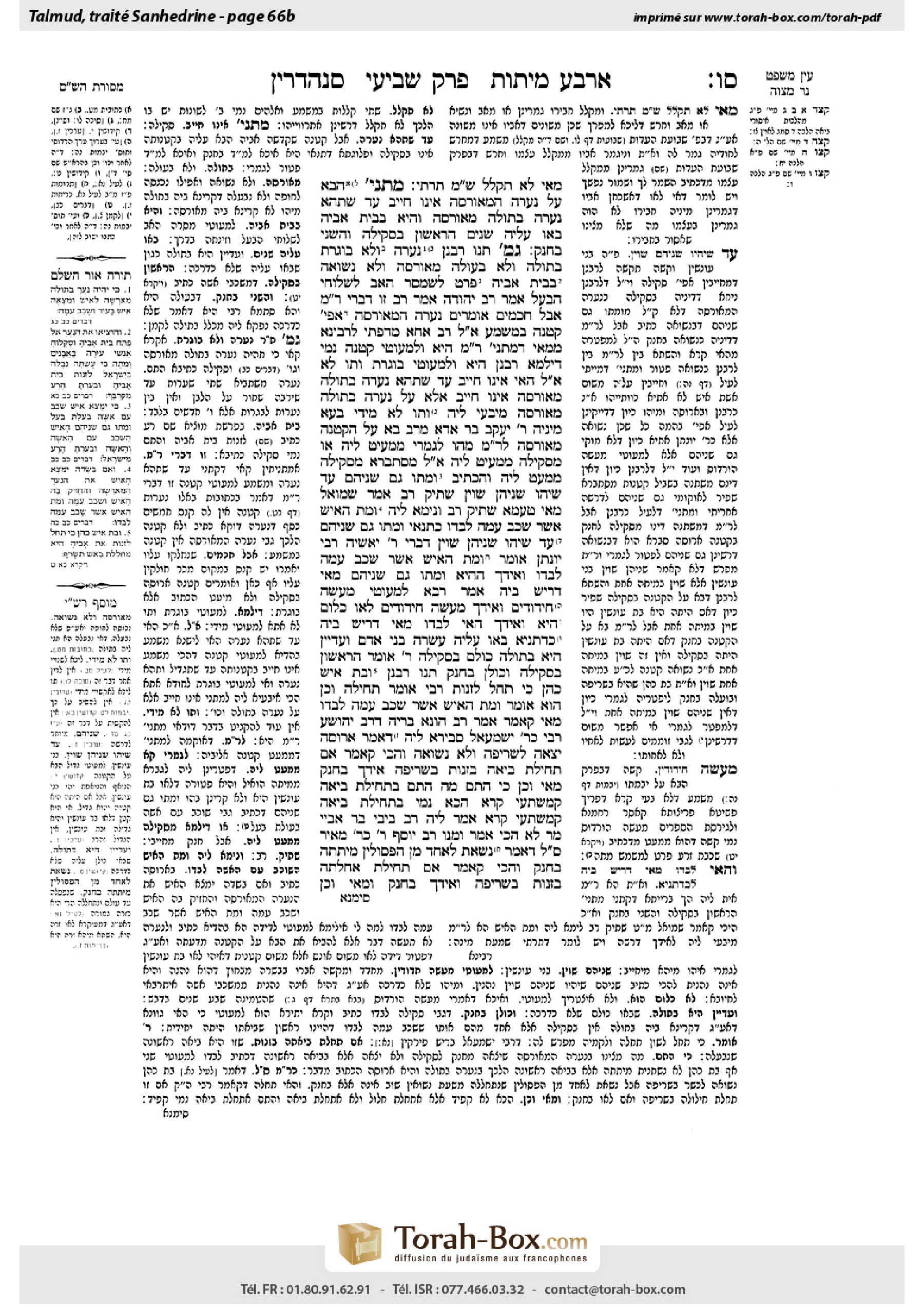
Sanhedrin 66b: Talmud study for Daf Yomi
Daf Yomi is the daily study of one Talmud folio. Explore 37 tractates with scans, Hebrew text, Sefaria English and AI-generated French translations where annotated.
Passage selection and English or AI-generated French translation are available where the scan has annotations. Daf Study is independent of Torah-Box and Sefaria.
Browse Sanhedrin · סנהדרין · All tractatesSanhedrin 66b text and translations
This page of Sanhedrin includes the Aramaic text, an English translation and an AI-generated French translation, alongside the scan above.
סנהדרין ס״ו ב · Aramaic and Hebrew text
מַאי ״לֹא תְקַלֵּל״? שְׁמַע מִינַּהּ תַּרְתֵּי.
מַתְנִי׳ הַבָּא עַל נַעֲרָה הַמְאוֹרָסָה אֵינוֹ חַיָּיב, עַד שֶׁתְּהֵא נַעֲרָה, בְּתוּלָה, מְאוֹרָסָה, וְהִיא בְּבֵית אָבִיהָ. בָּאוּ עָלֶיהָ שְׁנַיִם, הָרִאשׁוֹן בִּסְקִילָה וְהַשֵּׁנִי בְּחֶנֶק.
גְּמָ׳ תָּנוּ רַבָּנַן: ״נַעֲרָה״ – וְלֹא בּוֹגֶרֶת, ״בְּתוּלָה״ – וְלֹא בְּעוּלָה, ״מְאוֹרָסָה״ – וְלֹא נְשׂוּאָה, ״בְּבֵית אָבִיהָ״ – פְּרָט לְשֶׁמָּסַר הָאָב לִשְׁלוּחֵי הַבַּעַל.
אָמַר רַב יְהוּדָה אָמַר רַב: זוֹ דִּבְרֵי רַבִּי מֵאִיר, אֲבָל חֲכָמִים אוֹמְרִים: נַעֲרָה הַמְאוֹרָסָה – אֲפִילּוּ קְטַנָּה בַּמַּשְׁמָע.
אֲמַר לֵיהּ רַב אַחָא מִדִּפְתִּי לְרָבִינָא: מִמַּאי דְּמַתְנִיתִין רַבִּי מֵאִיר הִיא, וּלְמַעוֹטֵי קְטַנָּה נָמֵי? דִּילְמָא רַבָּנַן הִיא, וּלְמַעוֹטֵי בּוֹגֶרֶת וְתוּ לָא?
אֲמַר לֵיהּ: הַאי ״אֵינוֹ חַיָּיב עַד שֶׁתְּהֵא נַעֲרָה בְּתוּלָה מְאוֹרָסָה״ – אֵינוֹ חַיָּיב אֶלָּא עַל נַעֲרָה בְּתוּלָה מְאוֹרָסָה מִיבְּעֵי לֵיהּ! וְתוּ לָא מִידִּי.
בְּעָא מִינֵּיהּ רַבִּי יַעֲקֹב בַּר אַדָּא מֵרַב: בָּא עַל הַקְּטַנָּה מְאוֹרָסָה לְרַבִּי מֵאִיר, מַהוּ? לְגַמְרֵי מְמַעֵיט לֵיהּ, אוֹ מִסְּקִילָה מְמַעֵיט לֵיהּ? אֲמַר לֵיהּ: מִסְתַּבְּרָא מִסְּקִילָה מְמַעֵט לֵיהּ.
וְהָכְתִיב: ״וּמֵתוּ גַּם שְׁנֵיהֶם״, עַד שֶׁיְּהוּ שְׁנֵיהֶן שָׁוִין? שְׁתֵיק רַב.
אָמַר שְׁמוּאֵל: מַאי טַעְמָא שְׁתֵיק רַב? וְנֵימָא לֵיהּ: ״וּמֵת הָאִישׁ אֲשֶׁר שָׁכַב עִמָּהּ לְבַדּוֹ״!
כְּתַנָּאֵי: ״וּמֵתוּ גַּם שְׁנֵיהֶם״ – עַד שֶׁיְּהוּ שְׁנֵיהֶן שָׁוִין, דִּבְרֵי רַבִּי יֹאשִׁיָּה. רַבִּי יוֹנָתָן אוֹמֵר: ״וּמֵת הָאִישׁ אֲשֶׁר שָׁכַב עִמָּהּ לְבַדּוֹ״.
וְאִידָּךְ, הָהִיא ״וּמֵתוּ גַּם שְׁנֵיהֶם״ מַאי דָּרֵישׁ בֵּיהּ? אָמַר רָבָא: לְמַעוֹטֵי מַעֲשֵׂה חִידּוּדִים. וְאִידַּךְ? מַעֲשֵׂה חִידּוּדִים לָאו כְּלוּם הִיא.
וְאִידָּךְ, הַאי ״לְבַדּוֹ״ מַאי דָּרֵישׁ בֵּיהּ?
כִּדְתַנְיָא: בָּאוּ עָלֶיהָ עֲשָׂרָה בְּנֵי אָדָם, וַעֲדַיִין הִיא בְּתוּלָה – כּוּלָּם בִּסְקִילָה. רַבִּי אוֹמֵר: הָרִאשׁוֹן בִּסְקִילָה, וְכוּלָּן בְּחֶנֶק.
תָּנוּ רַבָּנַן: ״וּבַת אִישׁ כֹּהֵן כִּי תֵחֵל לִזְנוֹת״, רַבִּי אוֹמֵר: תְּחִילָּה, וְכֵן הוּא אוֹמֵר: ״וּמֵת הָאִישׁ אֲשֶׁר שָׁכַב עִמָּהּ לְבַדּוֹ״.
מַאי קָאָמַר? אָמַר רַב הוּנָא בְּרֵיהּ דְּרַב יְהוֹשֻׁעַ: רַבִּי כְּרַבִּי יִשְׁמָעֵאל סְבִירָא לֵיהּ, דְּאָמַר אֲרוּסָה יָצְאָה לִשְׂרֵיפָה וְלֹא נְשׂוּאָה. וְהָכִי קָאָמַר: אִם תְּחִילַּת בִּיאָה בִּזְנוּת – בִּשְׂרֵיפָה, אִידַּךְ – בְּחֶנֶק.
מַאי ״וְכֵן״? כִּי הָתָם: מָה הָתָם בִּתְחִילַּת בִּיאָה קָמִשְׁתַּעֵי קְרָא, הָכָא נָמֵי בִּתְחִילַּת בִּיאָה קָמִשְׁתַּעֵי קְרָא.
אֲמַר לֵיהּ רַב בִּיבִי בַּר אַבָּיֵי: מָר לָא הָכִי אֲמַר. וּמַנּוּ? רַב יוֹסֵף.
רַבִּי, כְּרַבִּי מֵאִיר סְבִירָא לֵיהּ, דְּאָמַר: נִשֵּׂאת לְאֶחָד מִן הַפְּסוּלִין – מִיתָתָהּ בְּחֶנֶק.
וְהָכִי קָאָמַר: אִם תְּחִילַּת אַחָלָתָהּ בִּזְנוּת – בִּשְׂרֵיפָה, וְאִידַּךְ – בְּחֶנֶק. וּמַאי ״וְכֵן״?
Sanhedrin 66b · English translation
What halakha can be derived from the seemingly superfluous second letter lamed, which renders the expression: “You shall not curse [tekallel]”? Conclude from it that this expression includes two prohibitions: A prohibition against cursing God and a prohibition against cursing a judge.
MISHNA: One who engages in intercourse with a betrothed young woman is not liable to be executed by stoning unless she is a young woman, i.e., neither a minor nor an adult; a virgin; betrothed but not yet married; and she lives in her father’s home, having yet to move in with her husband. If two men engaged in intercourse with her, the first is liable to be executed by stoning, and the second is liable to be executed by strangulation. The second man is executed in this manner in accordance with the halakha of one who engages in intercourse with a married or non-virgin betrothed woman, as she was no longer a virgin when he engaged in intercourse with her.
GEMARA: The Sages taught with regard to the conditions stated in the mishna: The punishment of stoning applies only if the woman is a young woman, a category that applies until she is approximately twelve-and-a-half years of age, but not a grown woman. She must be a virgin but not a non-virgin. She must be betrothed but not married. She must be living in her father’s home, excluding a case where the father transferred his daughter to the husband’s agents to bring her to her husband’s home for the purpose of marriage; in such a case, even though she has not arrived there yet, she is already considered a married woman according to halakha.
Rav Yehuda says that Rav says: This mishna is the statement of Rabbi Meir, who holds that the halakha of a betrothed young woman applies to a young woman of the intermediate age between minority and adulthood. But the Rabbis say: Even a minor is included in the term: A betrothed young woman; only a grown woman is excluded.
Rav Aḥa of Difti said to Ravina: From where is it indicated that the mishna is in accordance with the opinion of Rabbi Meir, and the specification that she must be a young woman is not only to the exclusion of a grown woman but also to the exclusion of a minor girl? Perhaps the mishna is in accordance with the opinion of the Rabbis, and the condition that she must be a young woman is to the exclusion of a grown woman and nothing more. Accordingly, one who engages in intercourse with an engaged minor girl is liable to be executed by stoning.
Ravina said to him: This expression in the mishna: Is not liable unless she is [ad shetehe] a young woman, a virgin, betrothed, does not suit your suggested explanation. If the mishna is merely excluding a grown woman, it should have stated: Is liable only for engaging in intercourse with a young woman who is a virgin and betrothed. The expression ad shetehe indicates: Until she becomes, i.e., this halakha does not apply until she reaches the age of a young woman. And there is nothing more to be said on the matter, as this is clearly the intention of the mishna.
Rabbi Ya’akov bar Adda asked Rav: In the case of a man who engaged in intercourse with a betrothed minor girl, what is the halakha according to the opinion of Rabbi Meir? Does Rabbi Meir exclude him from punishment entirely, or does he exclude him merely from stoning but he is executed by strangulation, like one who engages in intercourse with any other married woman? Rav said to him: It stands to reason that Rabbi Meir excludes him from stoning alone, but he is liable to be executed by strangulation.
Rabbi Ya’akov bar Adda raised an objection to this answer: But isn’t it written: “If a man is found lying with a woman married to a husband, then they shall both die, the man who lies with the woman, and the woman” (Deuteronomy 22:22), indicating that this punishment does not apply unless they are both equally subject to punishment? If so, one who engages in intercourse with a betrothed minor girl is exempt, as she is not halakhically competent. Rav remained silent and did not answer him.
Shmuel says: What is the reason that Rav remained silent? Why not say to Rabbi Ya’akov that his premise is repudiated by the verse: “But if the man finds the betrothed young woman in the field, and the man takes hold of her, and lies with her, then the man who lay with her alone shall die” (Deuteronomy 22:25)? This verse proves that the punishment of stoning applies to the man even if the woman is exempt. The halakha of a man who engages in intercourse with a betrothed minor should be the same.
The Gemara answers that this matter is subject to a dispute between tanna’im, as is taught in a baraita: The verse states: “Then they shall both die” (Deuteronomy 22:22), indicating that this halakha does not apply unless they are both equally subject to punishment. If one of them cannot be punished, e.g., because he or she is a minor, the other is not executed either. This is the statement of Rabbi Yoshiya. Rabbi Yonatan says that the phrase from the verse “then the man who lay with her alone shall die” indicates that in some cases only one of them is liable to receive the death penalty.
The Gemara asks: And what does the other tanna, Rabbi Yonatan, who holds that this punishment applies even if only one party is subject to punishment, derive from the verse: “Then they shall both die”? Rava says: That verse is stated to exclude an act of sharpening, i.e., engaging in sexual contact with a woman without penetration. Since the man and woman do not equally receive pleasure from such an act, it is not considered sexual intercourse, and they are exempt. And the other tanna, Rabbi Yoshiya, holds that an act of sharpening is nothing; there is clearly no liability for such an act, and it is unnecessary to derive this halakha from the verse.
The Gemara asks: And what does the other tanna, Rabbi Yoshiya, who holds that they must be equally subject to punishment, derive from the verse “Then the man who lay with her alone shall die”?
The Gemara answers: He derives another halakha, as it is taught in a baraita: If ten men engaged in intercourse with a betrothed young woman, and she is still a virgin, as they engaged in anal intercourse with her, they are all liable to be executed by stoning. Rabbi Yehuda HaNasi says: The first of them is executed by stoning, and all the rest of them are executed by strangulation. Rabbi Yehuda HaNasi derives from the phrase in the verse “Then the man who lay with her alone shall die” that although the woman is still a virgin, only one man can be executed by stoning for engaging in intercourse with her. The others are executed by strangulation, in accordance with the halakha of one who engages in intercourse with a married woman or a betrothed non-virgin.
§ The Sages taught: The verse states: “And the daughter of any priest, if she profanes [teḥel] herself by playing the harlot, she profanes her father; she shall be burned with fire” (Leviticus 21:9). Rabbi Yehuda HaNasi says: The word teḥel means first [teḥila]; and likewise it says: “Then the man who lay with her alone shall die” (Deuteronomy 22:25).
The Gemara asks: What is Rabbi Yehuda HaNasi saying? Rav Huna, son of Rav Yehoshua, says: Rabbi Yehuda HaNasi holds in accordance with the opinion of Rabbi Yishmael, who says that only the betrothed daughter of a priest is singled out for execution by burning, but not one who is married; a married daughter of a priest who commits adultery is executed in the same manner as other women who commit adultery. And this is what Rabbi Yehuda HaNasi is saying: If a woman’s first act of sexual intercourse occurs when she commits adultery, as she is still betrothed, she is executed by burning; in another case, i.e., if she is already married and this is not the first time she engages in sexual intercourse, she is executed by strangulation.
The Gemara asks: What is the meaning of the end of Rabbi Yehuda HaNasi’s statement: And likewise it says: “Then the man who lay with her alone shall die”? What is the relevance of that verse to this issue? The Gemara answers: Rabbi Yehuda HaNasi means to say that the halakha here, in the case of a betrothed young woman who is the daughter of a priest, is like there. Just as there, with regard to a betrothed young woman who is not the daughter of a priest, the verse speaks of her first intercourse, here too, the verse speaks of her first intercourse.
Rav Beivai bar Abaye said to Rav Huna, son of Rav Yehoshua: My Master does not say, i.e., does not explain the statement of Rabbi Yehuda HaNasi, like that. The Gemara comments: And who is his Master? Rav Yosef.
Rather, he explains the statement of Rabbi Yehuda HaNasi as follows: Rabbi Yehuda HaNasi holds in accordance with the opinion of Rabbi Meir, who says: In the case of the daughter of a priest who married one of the men unfit for her, e.g., a mamzer, and committed adultery while married to him, her death sentence is administered by strangulation and not by burning.
And this is what Rabbi Yehuda HaNasi is saying: If she first profanes herself, i.e., disqualifies herself from the priesthood, by committing adultery, she is executed by burning, but in another case, where she was already disqualified from the priesthood by marrying a man unfit for her, she is executed by strangulation. And what is the meaning of the end of Rabbi Yehuda HaNasi’s statement: And likewise it says: “Then the man who lay with her alone shall die”?
Sanhedrin 66b · Traduction française (IA)
Quelle halakha peut-on déduire de la seconde lettre lamed, qui semble superflue et qui rend l'expression : « Tu ne maudiras pas [tekallel] » ? On en conclut que cette expression englobe deux interdictions : l'interdiction de maudire Dieu et l'interdiction de maudire un juge.
MICHNA : Celui qui a des relations sexuelles avec une jeune fille fiancée n'est pas condamné à la lapidation, à moins qu'elle ne soit une jeune fille, c'est-à-dire ni une mineure ni une adulte ; qu'elle soit vierge ; qu'elle soit fiancée mais pas encore mariée ; et qu'elle réside dans la maison de son père, n'ayant pas encore emménagé chez son mari. Si deux hommes ont eu des relations sexuelles avec elle, le premier est condamné à la lapidation, et le second est condamné à la strangulation. Le second homme est exécuté de cette manière conformément à la halakha de celui qui a des relations sexuelles avec une femme fiancée mariée ou non vierge, car elle n'était plus vierge lorsqu'il a eu des relations sexuelles avec elle.
GUEMARA : Les Sages ont enseigné au sujet des conditions énoncées dans la mishna : La punition de la lapidation n'applique que si la femme est une jeune fille, une catégorie qui s'applique jusqu'à environ douze ans et demi, mais pas une femme adulte. Elle doit être vierge et non non-vierge. Elle doit être fiancée et non mariée. Elle doit résider dans la maison de son père, excluant le cas où le père a transféré sa fille aux agents du mari pour l'amener dans la maison du mari dans le but du mariage ; dans un tel cas, même si elle n'y est pas encore arrivée, elle est déjà considérée comme une femme mariée selon la halakha.
Rav Yehuda dit que Rav dit : Cette Michna est l'opinion de Rabbi Meïr, qui soutient que la halakha concernant une jeune fille fiancée s'applique à une jeune fille de l'âge intermédiaire entre la minorité et la majorité. Mais les Rabbins disent : Même une mineure est incluse dans le terme : une jeune fille fiancée ; seule une femme adulte est exclue.
Rav Aḥa de Difti dit à Ravina : D'où est-il indiqué que la Michna est conforme à l'opinion de Rabbi Meïr, et que la spécification qu'elle doit être une jeune fille vise non seulement à exclure une femme adulte, mais aussi à exclure une fille mineure ? Peut-être que la Michna est conforme à l'opinion des Rabbins, et que la condition qu'elle doit être une jeune fille vise à exclure une femme adulte et rien de plus. En conséquence, celui qui a des relations sexuelles avec une fille mineure fiancée est condamné à la lapidation.
Ravina lui dit : Cette expression dans la Michna : N'est pas condamné à moins qu'elle ne soit [ad shetehe] une jeune fille, une vierge, fiancée, ne convient pas à votre explication proposée. Si la Michna exclut simplement une femme adulte, elle aurait dû dire : Est condamné uniquement pour avoir eu des relations sexuelles avec une jeune fille qui est vierge et fiancée. L'expression ad shetehe indique : Jusqu'à ce qu'elle devienne, c'est-à-dire que cette halakha ne s'applique pas jusqu'à ce qu'elle atteigne l'âge d'une jeune fille. Et il n'y a rien de plus à dire sur la question, car c'est clairement l'intention de la Michna.
Rabbi Ya’akov bar Adda demanda à Rav : Dans le cas d'un homme qui a eu des relations sexuelles avec une fille mineure fiancée, quelle est la halakha selon l'opinion de Rabbi Meïr ? Rabbi Meïr l'exclut-il entièrement de la punition, ou l'exclut-il uniquement de la lapidation, mais il est condamné à la strangulation, comme celui qui a des relations sexuelles avec toute autre femme mariée ? Rav lui répondit : Il va de soi que Rabbi Meïr l'exclut de la lapidation seule, mais il est condamné à la strangulation.
Rabbi Ya’akov bar Adda souleva une objection à cette réponse : Mais n'est-il pas écrit : « Si un homme est trouvé couchant avec une femme mariée à un mari, alors ils mourront tous deux, l'homme qui couche avec la femme, et la femme » (Deutéronome 22:22), indiquant que cette punition ne s'applique pas à moins qu'ils ne soient tous deux également sujets à la punition ? Si c'est le cas, celui qui a des relations sexuelles avec une fille mineure fiancée est exempt, car elle n'est pas compétente selon la halakha. Rav resta silencieux et ne lui répondit pas.
Shmuel dit : Quelle est la raison pour laquelle Rav est resté silencieux ? Pourquoi ne pas dire à Rabbi Ya’akov que sa prémisse est réfutée par le verset : « Mais si l'homme trouve la jeune fille fiancée dans le champ, et que l'homme la saisisse et couche avec elle, alors l'homme qui a couché avec elle seul mourra » (Deutéronome 22:25) ? Ce verset prouve que la punition de la lapidation s'applique à l'homme même si la femme est exemptée. La halakha d'un homme qui a des relations sexuelles avec une fille mineure fiancée devrait être la même.
La Guemara répond que cette question fait l'objet d'un débat entre les tannaïm, comme l'enseigne une baraïta : Le verset dit : « Alors ils mourront tous deux » (Deutéronome 22:22), indiquant que cette halakha ne s'applique que si tous deux sont également passibles de la peine. Si l'un d'eux ne peut pas être puni, par exemple parce qu'il ou elle est mineur, l'autre n'est pas exécuté non plus. C'est l'opinion de Rabbi Yoshiya. Rabbi Yonatan dit que la phrase du verset « alors l'homme qui a couché avec elle seul mourra » indique que dans certains cas, seul l'un d'eux est condamné à la peine de mort.
La Guemara demande : Et que déduit l'autre tanna, Rabbi Yonatan, qui soutient que cette punition s'applique même si seule une partie est passible de la peine, du verset : « Alors ils mourront tous deux » ? Rava dit : Ce verset est énoncé pour exclure un acte de frottement, c'est-à-dire avoir un contact sexuel avec une femme sans pénétration. Puisque l'homme et la femme ne reçoivent pas également du plaisir d'un tel acte, il n'est pas considéré comme des relations sexuelles, et ils sont exemptés. Et l'autre tanna, Rabbi Yoshiya, soutient qu'un acte de frottement n'est rien ; il n'y a clairement aucune responsabilité pour un tel acte, et il n'est pas nécessaire de déduire cette halakha du verset.
La Guemara demande : Et que déduit l'autre tanna, Rabbi Yoshiya, qui soutient qu'ils doivent être également passibles de la peine, du verset « Alors l'homme qui a couché avec elle seul mourra » ?
La Guemara répond : Il déduit une autre halakha, car il est enseigné dans une baraïta : Si dix hommes ont eu des rapports sexuels avec une jeune femme fiancée, et qu'elle est encore vierge, car ils ont eu des rapports anaux avec elle, ils sont tous passibles de la peine de mort par lapidation. Rabbi Yehuda HaNasi dit : Le premier d'entre eux est exécuté par lapidation, et tous les autres sont exécutés par strangulation. Rabbi Yehuda HaNasi déduit de la phrase du verset « Alors l'homme qui a couché avec elle seul mourra » que, bien que la femme soit encore vierge, un seul homme peut être exécuté par lapidation pour avoir eu des rapports sexuels avec elle. Les autres sont exécutés par strangulation, conformément à la halakha de celui qui a des rapports sexuels avec une femme mariée ou une fiancée non vierge.
§ Les Sages ont enseigné : Le verset dit : « Et la fille de tout sacrificateur, si elle se déshonore [teḥel] en se livrant à la prostitution, elle déshonore son père ; elle sera brûlée au feu » (Lévitique 21:9). Rabbi Yehuda HaNasi dit : Le mot teḥel signifie premièrement [teḥila] ; et de même il est dit : « Alors l'homme qui a couché avec elle seul mourra » (Deutéronome 22:25).
La Guemara demande : Que dit Rabbi Yehuda HaNasi ? Rav Huna, fils de Rav Yehoshua, dit : Rabbi Yehuda HaNasi est d'accord avec l'opinion de Rabbi Yishmaël, qui dit que seule la fille de sacrificateur fiancée est désignée pour l'exécution par le feu, mais pas celle qui est mariée ; une fille de sacrificateur mariée qui commet l'adultère est exécutée de la même manière que les autres femmes qui commettent l'adultère. Et c'est ce que Rabbi Yehuda HaNasi dit : Si le premier acte de rapport sexuel d'une femme a lieu alors qu'elle commet l'adultère, car elle est encore fiancée, elle est exécutée par le feu ; dans un autre cas, c'est-à-dire si elle est déjà mariée et que ce n'est pas la première fois qu'elle a des rapports sexuels, elle est exécutée par strangulation.
La Guemara demande : Quelle est la signification de la fin de la déclaration de Rabbi Yehuda HaNasi : « Et de même il est dit : Alors l'homme qui a couché avec elle seul mourra » ? Quelle est la pertinence de ce verset pour cette question ? La Guemara répond : Rabbi Yehuda HaNasi veut dire que la halakha ici, dans le cas d'une jeune femme fiancée qui est la fille d'un sacrificateur, est comme là-bas. Tout comme là-bas, concernant une jeune femme fiancée qui n'est pas la fille d'un sacrificateur, le verset parle de son premier rapport sexuel, ici aussi, le verset parle de son premier rapport sexuel.
Rav Beivai bar Abaye dit à Rav Huna, fils de Rav Yehoshua : Mon Maître ne dit pas, c'est-à-dire n'explique pas la déclaration de Rabbi Yehuda HaNasi, de cette manière. La Guemara commente : Et qui est son Maître ? Rav Yosef.
Plutôt, il explique la déclaration de Rabbi Yehuda HaNasi comme suit : Rabbi Yehuda HaNasi est d'accord avec l'opinion de Rabbi Meïr, qui dit : Dans le cas de la fille d'un sacrificateur qui a épousé l'un des hommes inaptes pour elle, par exemple un mamzer, et qui a commis l'adultère alors qu'elle était mariée à lui, sa peine de mort est administrée par strangulation et non par le feu.
Et voici ce que Rabbi Yehuda HaNasi enseigne : Si elle se souille d'abord, c'est-à-dire se rend inapte au sacerdoce, en commettant l'adultère, elle est exécutée par le feu ; mais dans un autre cas, où elle était déjà inapte au sacerdoce en ayant épousé un homme inéligible pour elle, elle est exécutée par strangulation. Et quelle est la signification de la fin de l'enseignement de Rabbi Yehuda HaNasi : « Et de même il est dit : Alors l'homme qui a couché avec elle seul mourra » ?
Traduction française générée par IA à partir de l’édition anglaise de Sefaria. Vérifie toujours un passage avec le texte source.
Text from Sefaria: William Davidson Edition - Vocalized Aramaic (CC BY NC); William Davidson Edition - English (CC BY NC).