Sanhedrin 67a: Talmud study for Daf Yomi
Daf Yomi is the daily study of one Talmud folio. Explore 37 tractates with scans, Hebrew text, Sefaria English and AI-generated French translations where annotated.
Passage selection and English or AI-generated French translation are available where the scan has annotations. Daf Study is independent of Torah-Box and Sefaria.
Browse Sanhedrin · סנהדרין · All tractatesSanhedrin 67a text and translations
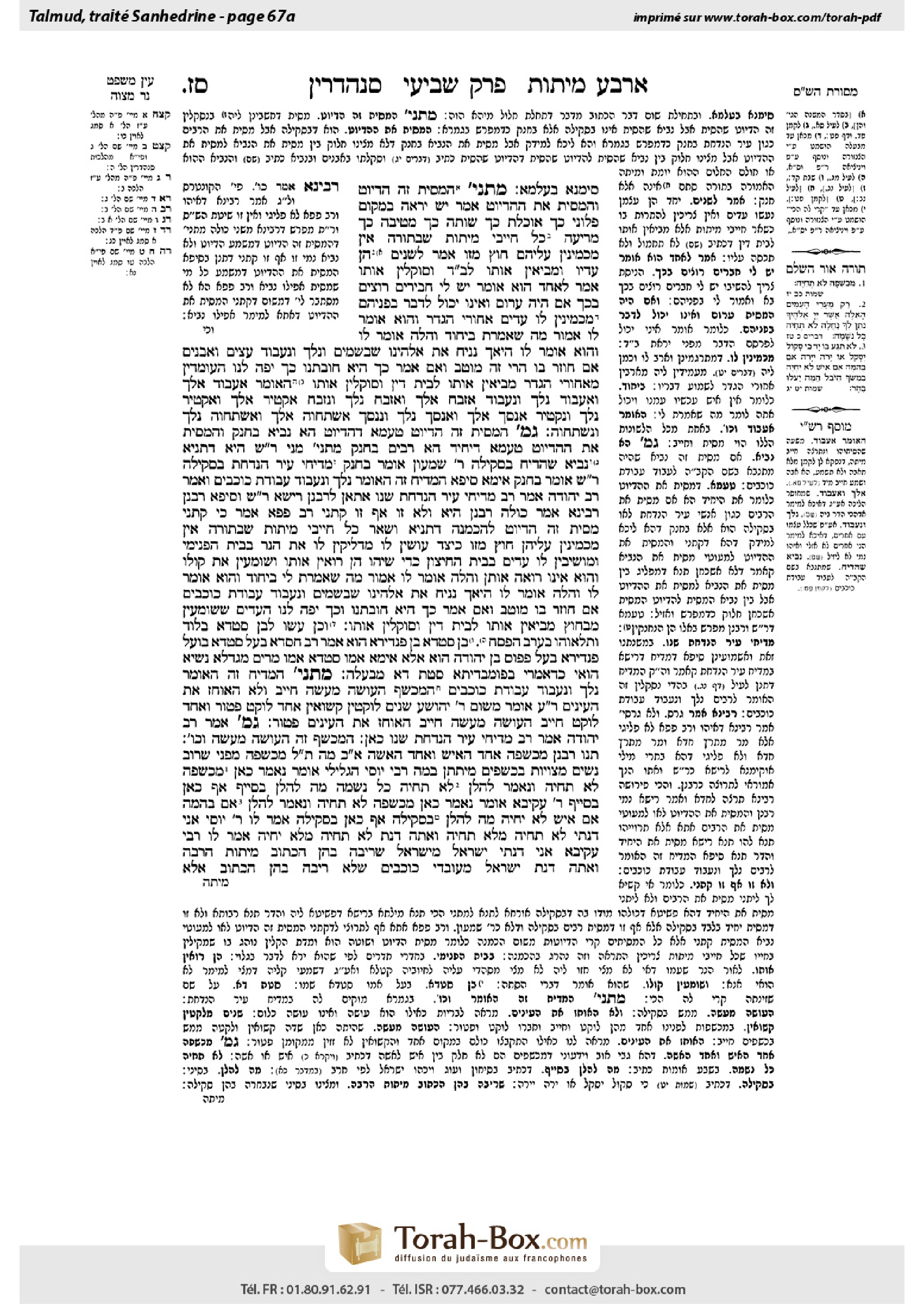
This page of Sanhedrin includes the Aramaic text, an English translation and an AI-generated French translation, alongside the scan above.
סנהדרין ס״ז א · Aramaic and Hebrew text
סִימָנָא בְּעָלְמָא.
מַתְנִי׳ הַמֵּסִית – זֶה הֶדְיוֹט, וְהַמֵּסִית אֶת הַהֶדְיוֹט. אָמַר: יֵשׁ יִרְאָה בְּמָקוֹם פְּלוֹנִי, כָּךְ אוֹכֶלֶת, כָּךְ שׁוֹתֶה, כָּךְ מְטִיבָה, כָּךְ מְרֵיעָה.
כׇּל חַיָּיבֵי מִיתוֹת שֶׁבְּתוֹרָה, אֵין מַכְמִינִין עֲלֵיהֶם, חוּץ מִזּוֹ.
אָמַר לִשְׁנַיִם: הֵן עֵדָיו, וּמְבִיאִין אוֹתוֹ לְבֵית דִּין וְסוֹקְלִין אוֹתוֹ. אָמַר לְאֶחָד: הוּא אוֹמֵר ״יֵשׁ לִי חֲבֵירִים רוֹצִים בְּכָךְ״.
אִם הָיָה עָרוּם וְאֵינוֹ יָכוֹל לְדַבֵּר בִּפְנֵיהֶם, מַכְמִינִין לוֹ עֵדִים אֲחוֹרֵי הַגָּדֵר. וְהוּא אוֹמֵר לוֹ: ״אֱמוֹר מַה שֶּׁאָמַרְתָּ בְּיִחוּד!״ וְהַלָּה אוֹמֵר לוֹ. וְהוּא אוֹמֵר לוֹ: ״הֵיאַךְ נַנִּיחַ אֶת אֱלֹהֵינוּ שֶׁבַּשָּׁמַיִם וְנֵלֵךְ וְנַעֲבוֹד עֵצִים וַאֲבָנִים?״ אִם חוֹזֵר בּוֹ – הֲרֵי זֶה מוּטָב, וְאִם אָמַר: ״כָּךְ הִיא חוֹבָתֵנוּ, כָּךְ יָפֶה לָנוּ״ – הָעוֹמְדִין מֵאֲחוֹרֵי הַגָּדֵר מְבִיאִין אוֹתוֹ לְבֵית דִּין וְסוֹקְלִין אוֹתוֹ.
הָאוֹמֵר: ״אֶעֱבוֹד״, ״אֵלֵךְ וְאֶעֱבוֹד״, ״נֵלֵךְ וְנַעֲבוֹד״; ״אֶזְבַּח״, ״אֵלֵךְ וְאֶזְבַּח״, ״נֵלֵךְ וְנִזְבַּח״; ״אַקְטִיר״, ״אֵלֵךְ וְאַקְטִיר״, ״נֵלֵךְ וְנַקְטִיר״; ״אֲנַסֵּךְ״, ״אֵלֵךְ וַאֲנַסֵּךְ״, ״נֵלֵךְ וּנְנַסֵּךְ״; ״אֶשְׁתַּחֲוֶה״, ״אֵלֵךְ וְאֶשְׁתַּחֲוֶה״, ״נֵלֵךְ וְנִשְׁתַּחֲוֶה״.
גְּמָ׳ הַמֵּסִית זֶה הֶדְיוֹט. טַעְמָא דְּהֶדְיוֹט, הָא נָבִיא בְּחֶנֶק. וְהַמֵּסִית אֶת הַהֶדְיוֹט, טַעְמָא דְּיָחִיד, הָא רַבִּים בְּחֶנֶק.
מַתְנִיתִין מַנִּי? רַבִּי שִׁמְעוֹן הִיא, דְּתַנְיָא: נָבִיא שֶׁהֵדִיחַ – בִּסְקִילָה. רַבִּי שִׁמְעוֹן אוֹמֵר: בְּחֶנֶק. מַדִּיחֵי עִיר הַנִּדַּחַת – בִּסְקִילָה. רַבִּי שִׁמְעוֹן אוֹמֵר: בְּחֶנֶק.
אֵימָא סֵיפָא: הַמַּדִּיחַ זֶה הָאוֹמֵר ״נֵלֵךְ וְנַעֲבוֹד עֲבוֹדָה זָרָה״. וְאָמַר רַב יְהוּדָה אָמַר רַב: מַדִּיחֵי עִיר הַנִּדַּחַת שָׁנוּ. אֲתָאן לְרַבָּנַן. רֵישָׁא רַבִּי שִׁמְעוֹן וְסֵיפָא רַבָּנַן?
רָבִינָא אָמַר: כּוּלָּהּ רַבָּנַן הִיא, וְלָא זוֹ אַף זוֹ קָתָנֵי.
רַב פָּפָּא אָמַר: כִּי קָתָנֵי ״מֵסִית זֶה הֶדְיוֹט״, לְהַכְמָנָה.
דְּתַנְיָא: וּשְׁאָר כׇּל חַיָּיבֵי מִיתוֹת שֶׁבַּתּוֹרָה, אֵין מַכְמִינִין עֲלֵיהֶן, חוּץ מִזּוֹ.
כֵּיצַד עוֹשִׂין לוֹ? מַדְלִיקִין לוֹ אֶת הַנֵּר בַּבַּיִת הַפְּנִימִי, וּמוֹשִׁיבִין לוֹ עֵדִים בַּבַּיִת הַחִיצוֹן, כְּדֵי שֶׁיְּהוּ הֵן רוֹאִין אוֹתוֹ וְשׁוֹמְעִין אֶת קוֹלוֹ, וְהוּא אֵינוֹ רוֹאֶה אוֹתָן. וְהַלָּה אוֹמֵר לוֹ: ״אֱמוֹר מַה שֶּׁאָמַרְתָּ לִי בְּיִחוּד״, וְהוּא אוֹמֵר לוֹ. וְהַלָּה אוֹמֵר לוֹ: ״הֵיאַךְ נַנִּיחַ אֶת אֱלֹהֵינוּ שֶׁבַּשָּׁמַיִם וְנַעֲבוֹד עֲבוֹדָה זָרָה״? אִם חוֹזֵר בּוֹ – מוּטָב, וְאִם אָמַר: ״כָּךְ הִיא חוֹבָתֵנוּ וְכָךְ יָפֶה לָנוּ״ – הָעֵדִים שֶׁשּׁוֹמְעִין מִבַּחוּץ מְבִיאִין אוֹתוֹ לְבֵית דִּין וְסוֹקְלִין אוֹתוֹ.
וְכֵן עָשׂוּ לְבֶן סָטָדָא בְּלוֹד, וּתְלָאוּהוּ בְּעֶרֶב הַפֶּסַח.
בֶּן סָטָדָא? בֶּן פַּנְדִּירָא הוּא! אָמַר רַב חִסְדָּא: בַּעַל סָטָדָא, בּוֹעֵל פַּנְדִּירָא. בַּעַל? פַּפּוּס בֶּן יְהוּדָה הוּא! אֶלָּא, אִמּוֹ סָטָדָא. אִמּוֹ? מִרְיָם מְגַדְּלָא נְשַׁיָּא הֲוַאי! כִּדְאָמְרִי בְּפוּמְבְּדִיתָא: ״סְטָת דָּא מִבַּעְלַהּ״.
מַתְנִי׳ הַמַּדִּיחַ – זֶה הָאוֹמֵר: ״נֵלֵךְ וְנַעֲבוֹד עֲבוֹדָה זָרָה״.
הַמְכַשֵּׁף – הָעוֹשֶׂה מַעֲשֶׂה חַיָּיב, וְלֹא הָאוֹחֵז אֶת הָעֵינַיִם. רַבִּי עֲקִיבָא אוֹמֵר מִשּׁוּם רַבִּי יְהוֹשֻׁעַ: שְׁנַיִם לוֹקְטִין קִשּׁוּאִין, אֶחָד לוֹקֵט פָּטוּר וְאֶחָד לוֹקֵט חַיָּיב. הָעוֹשֶׂה מַעֲשֶׂה חַיָּיב, הָאוֹחֵז אֶת הָעֵינַיִם פָּטוּר.
גְּמָ׳ אָמַר רַב יְהוּדָה אָמַר רַב: מַדִּיחֵי עִיר הַנִּדַּחַת שָׁנוּ כָּאן.
הַמְכַשֵּׁף – זֶה הָעוֹשֶׂה מַעֲשֶׂה וְכוּ׳. תָּנוּ רַבָּנַן: ״מְכַשֵּׁפָה״ – אֶחָד הָאִישׁ וְאֶחָד הָאִשָּׁה. אִם כֵּן, מָה תַּלְמוּד לוֹמַר ״מְכַשֵּׁפָה״? מִפְּנֵי שֶׁרוֹב נָשִׁים מְצוּיוֹת בִּכְשָׁפִים.
מִיתָתָן בַּמֶּה? רַבִּי יוֹסֵי הַגְּלִילִי אוֹמֵר: נֶאֱמַר כָּאן ״מְכַשֵּׁפָה לֹא תְחַיֶּה״, וְנֶאֱמַר לְהַלָּן ״לֹא תְחַיֶּה כׇּל נְשָׁמָה״. מָה לְהַלָּן בְּסַיִיף, אַף כָּאן בְּסַיִיף.
רַבִּי עֲקִיבָא אוֹמֵר: נֶאֱמַר כָּאן ״מְכַשֵּׁפָה לֹא תְחַיֶּה״, וְנֶאֱמַר לְהַלָּן ״אִם בְּהֵמָה אִם אִישׁ לֹא יִחְיֶה״. מָה לְהַלָּן בִּסְקִילָה, אַף כָּאן בִּסְקִילָה.
אָמַר לוֹ רַבִּי יוֹסֵי: אֲנִי דַּנְתִּי ״לֹא תְחַיֶּה״ מִ״לֹּא תְחַיֶּה״, וְאַתָּה דַּנְתָּ ״לֹא תְחַיֶּה״ מִ״לֹּא יִחְיֶה״!
אָמַר לוֹ רַבִּי עֲקִיבָא: אֲנִי דַּנְתִּי יִשְׂרָאֵל מִיִּשְׂרָאֵל, שֶׁרִיבָּה בָּהֶן הַכָּתוּב מִיתוֹת הַרְבֵּה, וְאַתָּה דַּנְתָּ יִשְׂרָאֵל מִגּוֹיִם, שֶׁלֹּא רִיבָּה בָּהֶן הַכָּתוּב אֶלָּא
Sanhedrin 67a · English translation
It is merely a mnemonic. The verse is not relevant to this halakha, and it is cited merely as a sign indicating that just as the halakha of a betrothed young woman pertains to her first act of sexual intercourse, so too, the halakha of the daughter of a priest who committed adultery pertains to a case where it is her first disqualification from the priesthood.
MISHNA: With regard to the case of an inciter, listed among those liable to be executed by stoning, this is an ordinary person, not a prophet. And it is referring to one who incites an ordinary person and not a multitude of people. What does the inciter do? He says: There is an idol in such and such a place, which eats like this, drinks like this, does good for its worshippers like this, and harms those who do not worship it like this.
The mishna states a principle with regard to the halakha of an inciter: With regard to all of those mentioned in the Torah who are liable to receive the death penalty, if there are no witnesses to their transgressions, the court does not hide witnesses in order to ensnare and punish them, except for this case of an inciter.
The mishna elaborates: If the inciter said his words of incitement to two men, they are his witnesses, and he does not need to be warned before the transgression; they bring him to court and stone him. If he said his words of incitement to one man alone, that man’s testimony would not be sufficient to have the inciter executed. Therefore he says to the inciter: I have friends who are interested in this; tell them too. This way there will be more witnesses.
The mishna continues: If the inciter is cunning, and he knows that he cannot speak in front of two men, the court hides witnesses for him behind the fence so that he will not see them, and the man whom the inciter had previously tried to incite says to him: Say what you said to me when we were in seclusion. And the other person, the inciter, says to him again that he should worship the idol. And he says to the inciter: How can we forsake our God in Heaven and go and worship wood and stones? If the inciter retracts his suggestion, that is good. But if he says: This idol worship is our duty; this is what suits us, then those standing behind the fence bring him to court and have him stoned.
The halakha of an inciter includes one who says: I shall worship idols, or one of the following statements: I shall go and worship idols, or: let us go and worship idols, or: I shall sacrifice an idolatrous offering, or: I shall go and sacrifice an idolatrous offering, or: Let us go and sacrifice an idolatrous offering, or: I shall burn incense as an idolatrous offering, or: I shall go and burn incense, or: Let us go and burn incense, or: I shall pour an idolatrous libation, or: I shall go and pour a libation, or: Let us go and pour a libation, or: I shall bow to an idol, or: I shall go and bow, or: Let us go and bow.
GEMARA: The mishna teaches: With regard to the case of an inciter, this is an ordinary person. The Gemara infers: The reason he is executed by stoning is that he is an ordinary person, but if he is a prophet he is executed by strangulation, not by stoning. The mishna states further: And it is referring to one who incites an ordinary person. The Gemara infers: The reason he is executed by stoning is that he incited an individual, but if he subverted a multitude of people, he is executed by strangulation.
Consequently, whose opinion is expressed in the mishna? It is the opinion of Rabbi Shimon, as it is taught in a baraita: A prophet who subverted others to participate in idol worship is executed by stoning. Rabbi Shimon says: He is executed by strangulation. Likewise, the subverters of an idolatrous city are executed by stoning. Rabbi Shimon says: By strangulation.
The Gemara challenges: Say the last clause of the mishna, i.e., say the following mishna: With regard to the case of the subverter listed among those liable to be executed by stoning, this is one who says: Let us go and worship idols. And Rav Yehuda says that Rav says: In this mishna the Sages taught the case of the subverters of an idolatrous city. Here we arrive at the opinion of the Rabbis, who hold that those who incite a multitude of people are also executed by stoning. Is it possible that the first clause of the mishna expresses the opinion of Rabbi Shimon, and the last clause expresses that of the Rabbis?
Ravina says: The entire mishna is in accordance with the opinion of the Rabbis, and the tanna teaches the mishna employing the style of: Not only this but also that. In other words, the mishna should be explained as follows: Not only is one who incites an individual executed by stoning, but even one who subverts an entire city is executed by stoning.
Rav Pappa says: When the mishna teaches with regard to one who incites that this is referring to an ordinary person, it is not indicating that a prophet is not included in this halakha. Rather, it is referring to the hiding of witnesses behind a fence in order to ensnare the inciter, as his life is treated with contempt and derision, as though he were an ordinary person, i.e., a simpleton.
As it is taught in a baraita: And with regard to all the rest of those liable to receive the death penalty by Torah law, the court does not hide witnesses in order to ensnare them and punish them except for this case of an inciter.
How does the court do this to him? The agents of the court light a candle for him in an inner room, and they place witnesses for him in an outer room in the dark, so that they can see him and hear his voice but he cannot see them. And the other person, whom the inciter had previously tried to incite, says to him: Say what you said to me when we were in seclusion. And he says to him again that he should worship the idol. And the other person says to him: How can we forsake our God in Heaven and worship idols? If the inciter retracts his suggestion, that is good. But if he says: This idol worship is our duty, and this is what suits us, the witnesses, who are listening from outside, bring him to court, and they have him stoned.
And the court did the same to an inciter named ben Setada, from the city of Lod, and they hanged him on Passover eve.
The Gemara asks: Why did they call him ben Setada, when he was the son of Pandeira? Rav Ḥisda says: Perhaps his mother’s husband, who acted as his father, was named Setada, but his mother’s paramour, who fathered this mamzer, was named Pandeira. The Gemara challenges: But his mother’s husband was Pappos ben Yehuda, not Setada. Rather, perhaps his mother was named Setada, and he was named ben Setada after her. The Gemara challenges: But his mother was Miriam, who braided women’s hair. The Gemara explains: That is not a contradiction; Setada was merely a nickname, as they say in Pumbedita: This one strayed [setat da] from her husband.
MISHNA: With regard to the case of the subverter listed among those liable to be executed by stoning, this is one who says to a multitude of people: Let us go and worship idols.
The warlock is also liable to be executed by stoning. One who performs a real act of sorcery is liable, but not one who deceives the eyes, making it appear as though he is performing sorcery, as that is not considered sorcery. Rabbi Akiva says in the name of Rabbi Yehoshua: For example, two people can each gather cucumbers by sorcery. One of them gathers cucumbers and he is exempt, and the other one gathers cucumbers and he is liable. How so? The one who performs a real act of sorcery is liable, and the one who deceives the eyes is exempt.
GEMARA: With regard to the case of subverters mentioned in the mishna, Rav Yehuda says that Rav says: The Sages taught here the case of the subverters of an idolatrous city. Accordingly, there is no halakhic difference between one who incites individuals to idolatry and one who subverts an entire city; both are liable to be executed by stoning.
The mishna teaches that the case of the warlock is referring to one who performs a real act of sorcery. The Sages taught in a baraita: The verse: “You shall not allow a witch to live” (Exodus 22:17), does not refer only to a female who practices sorcery; both a man and a woman are included. If so, why does verse state “a witch”? This is because most women are familiar with witchcraft.
In what manner is their death sentence administered? Rabbi Yosei HaGelili says: It is stated here: “You shall not allow a witch to live,” and it is stated there, with regard to the conquest of the Canaanites: “You shall allow nothing that breathes to live” (Deuteronomy 20:16). Just as there, the Canaanites were to be killed by the sword (see Numbers 21:24), so too here, the execution of a witch is administered by the sword.
Rabbi Akiva says: It is stated here: “You shall not allow a witch to live,” and it is stated there, with regard to Mount Sinai: “No hand shall touch it, for he shall be stoned, or thrown down; whether it be animal or man, it shall not live” (Exodus 19:13). Just as there, the verse speaks of stoning, so too here, a witch is executed by stoning.
Rabbi Yosei HaGelili said to him: I derived the meaning of the verse “You shall not allow a witch to live” from the verse “You shall allow nothing that breathes to live” via a verbal analogy between two similar phrases, but you derived the meaning of the verse “You shall not allow a witch to live” from the verse “It shall not live,” which is a less similar phrase.
Rabbi Akiva said to him: I derived a halakha concerning Jews from a halakha concerning Jews, with regard to whom the verse included many types of death penalties. Therefore, the fact that the expression “It shall not live” refers to stoning when stated with regard to Jews is especially significant. But you derived a halakha concerning Jews from a halakha concerning gentiles, with regard to whom the verse included only
Sanhedrin 67a · Traduction française (IA)
Ce n’est qu’un aide-mémoire. Le verset n’a pas de rapport avec cette halakha et il est cité uniquement comme repère : de même que la halakha concernant une jeune fille fiancée s’applique à son premier rapport sexuel, de même celle concernant la fille d’un prêtre qui a commis un adultère s’applique au cas où elle est disqualifiée de la prêtrise pour la première fois.
MICHNA : Dans le cas de l’incitateur, qui figure parmi ceux qui encourent la peine de lapidation, il s’agit d’un homme ordinaire, et non d’un prophète. Il s’agit aussi de quelqu’un qui incite un homme ordinaire, et non une multitude de personnes. Que fait l’incitateur ? Il dit : « Il y a une idole à tel endroit ; elle mange ainsi, elle boit ainsi, elle fait du bien à ceux qui la servent de telle manière et elle nuit ainsi à ceux qui ne la servent pas. »
La Michna énonce un principe concernant la halakha de l’incitateur : parmi tous ceux que la Torah mentionne comme passibles de la peine de mort, si aucun témoin n’a assisté à leur transgression, le tribunal ne dissimule pas de témoins pour les piéger et les punir, sauf dans le cas de l’incitateur.
La Michna précise : si l’incitateur a adressé ses paroles d’incitation à deux hommes, ceux-ci sont ses témoins et il n’est pas nécessaire de l’avertir avant la transgression ; ils le conduisent au tribunal et le font lapider. S’il a adressé ses paroles d’incitation à un seul homme, le témoignage de celui-ci ne suffirait pas à faire exécuter l’incitateur. Cet homme lui dit donc : « J’ai des amis que cela intéresse ; dis-leur aussi. » Ainsi, il y aura davantage de témoins.
La Michna poursuit : si l’incitateur est rusé et sait qu’il ne peut pas parler devant deux hommes, le tribunal dissimule des témoins derrière une clôture, afin qu’il ne les voie pas. L’homme que l’incitateur avait auparavant tenté d’inciter lui dit alors : « Répète ce que tu m’as dit lorsque nous étions seuls. » L’incitateur lui dit de nouveau de servir l’idole. L’homme lui répond : « Comment pourrions-nous abandonner notre Dieu dans les Cieux et aller servir du bois et des pierres ? » Si l’incitateur retire sa proposition, tant mieux. Mais s’il dit : « Ce culte idolâtre est notre devoir ; c’est ce qui nous convient », ceux qui se tiennent derrière la clôture le conduisent au tribunal et le font lapider.
La halakha de l’incitateur s’applique à celui qui dit : « Je servirai des idoles », ainsi qu’à celui qui dit l’une des phrases suivantes : « J’irai servir des idoles » ; « Allons servir des idoles » ; « J’offrirai un sacrifice idolâtre » ; « J’irai offrir un sacrifice idolâtre » ; « Allons offrir un sacrifice idolâtre » ; « Je brûlerai de l’encens en offrande idolâtre » ; « J’irai brûler de l’encens » ; « Allons brûler de l’encens » ; « Je verserai une libation idolâtre » ; « J’irai verser une libation » ; « Allons verser une libation » ; « Je me prosternerai devant une idole » ; « J’irai me prosterner » ; « Allons nous prosterner ».
GUEMARA : La Michna enseigne : dans le cas de l’incitateur, il s’agit d’un homme ordinaire. La Guemara en déduit que s’il est passible de la lapidation, c’est parce qu’il s’agit d’un homme ordinaire ; s’il est prophète, en revanche, il est passible de l’étranglement, et non de la lapidation. La Michna précise ensuite qu’il s’agit de quelqu’un qui incite un homme ordinaire. La Guemara en déduit que s’il est passible de la lapidation, c’est parce qu’il a incité un individu ; mais s’il a subverti une multitude de personnes, il est passible de l’étranglement.
Par conséquent, de qui la Michna exprime-t-elle l’opinion ? De Rabbi Shimon, comme l’enseigne une baraïta : un prophète qui en a subverti d’autres pour les amener à participer au culte idolâtre est passible de la lapidation. Rabbi Shimon dit : il est passible de l’étranglement. De même, ceux qui subvertissent les habitants d’une ville idolâtre sont passibles de la lapidation. Rabbi Shimon dit : ils sont passibles de l’étranglement.
La Guemara objecte : considérons la dernière partie de la Michna, c’est-à-dire l’enseignement suivant : dans le cas du subversif, qui figure parmi ceux qui encourent la peine de lapidation, il s’agit de quelqu’un qui dit à une multitude de personnes : « Allons servir des idoles. » Rav Yehouda dit au nom de Rav : dans cette Michna, les Sages ont enseigné le cas de ceux qui subvertissent les habitants d’une ville idolâtre. Nous en arrivons donc à l’opinion des Rabbins, selon laquelle ceux qui incitent une multitude de personnes sont eux aussi passibles de la lapidation. Est-il possible que la première partie de la Michna exprime l’opinion de Rabbi Shimon, tandis que la dernière partie exprime celle des Rabbins ?
Ravina dit : toute la Michna suit l’opinion des Rabbins, et le tanna l’enseigne selon la formule « non seulement ceci, mais aussi cela ». Autrement dit, la Michna doit être comprise ainsi : non seulement celui qui incite un individu est passible de la lapidation, mais celui qui subvertit une ville entière l’est aussi.
Rav Pappa dit : lorsque la Michna enseigne, à propos de l’incitateur, qu’il s’agit d’un homme ordinaire, cela ne signifie pas qu’un prophète ne relève pas de cette halakha. Il s’agit plutôt des témoins que l’on dissimule derrière une clôture pour piéger l’incitateur : sa vie est traitée avec mépris et dérision, comme s’il était un homme ordinaire, c’est-à-dire un simplet.
Comme l’enseigne une baraïta : parmi tous les autres passibles de la peine de mort selon la loi de la Torah, le tribunal ne dissimule pas de témoins pour les piéger et les punir, sauf dans le cas de l’incitateur.
Comment le tribunal procède-t-il à son égard ? Les agents du tribunal allument une lampe dans une pièce intérieure et placent des témoins dans une pièce extérieure plongée dans l’obscurité, afin qu’ils puissent le voir et entendre sa voix sans qu’il puisse les voir. L’homme que l’incitateur avait auparavant tenté d’inciter lui dit alors : « Répète ce que tu m’as dit lorsque nous étions seuls. » L’incitateur lui dit de nouveau de servir l’idole. L’autre homme lui répond : « Comment pourrions-nous abandonner notre Dieu dans les Cieux et servir des idoles ? » Si l’incitateur retire sa proposition, tant mieux. Mais s’il dit : « Ce culte idolâtre est notre devoir, et c’est ce qui nous convient », les témoins, qui écoutent depuis l’extérieur, le conduisent au tribunal et le font lapider.
Le tribunal fit de même avec un incitateur nommé ben Setada, de la ville de Lod, et le fit pendre la veille de Pessa’h.
La Guemara demande : pourquoi l’appelait-on ben Setada alors qu’il était le fils de Pandeira ? Rav Ḥisda dit : peut-être le mari de sa mère, qui faisait office de père, s’appelait-il Setada, tandis que l’amant de sa mère, qui était le père de ce mamzer, s’appelait Pandeira. La Guemara objecte : mais le mari de sa mère était Pappos ben Yehuda, et non Setada. Peut-être alors sa mère s’appelait-elle Setada, et il était appelé ben Setada d’après elle. La Guemara objecte : mais sa mère était Miriam, qui tressait les cheveux des femmes. La Guemara explique : il n’y a pas de contradiction ; Setada n’était qu’un surnom, car à Pumbedita, on dit : « Celle-ci s’est écartée [setat da] de son mari. »
MICHNA : Dans le cas du subversif, qui figure parmi ceux qui encourent la peine de lapidation, il s’agit de quelqu’un qui dit à une multitude de personnes : « Allons servir des idoles. »
Le sorcier est lui aussi passible de la lapidation. Celui qui accomplit un véritable acte de sorcellerie est passible de cette peine, mais pas celui qui trompe les yeux en donnant l’impression de pratiquer la sorcellerie, car cela n’est pas considéré comme de la sorcellerie. Rabbi Akiva dit au nom de Rabbi Yehoshua : par exemple, deux personnes peuvent chacune faire apparaître des concombres par sorcellerie. L’une fait apparaître des concombres et est exemptée, tandis que l’autre en fait apparaître et est passible de la peine. Comment cela ? Celui qui accomplit un véritable acte de sorcellerie est passible de la peine, tandis que celui qui trompe les yeux en est exempté.
GUEMARA : À propos des subversifs mentionnés dans la Michna, Rav Yehouda dit au nom de Rav : les Sages ont enseigné ici le cas de ceux qui subvertissent les habitants d’une ville idolâtre. Par conséquent, aucune distinction halakhique ne sépare celui qui incite des individus à l’idolâtrie de celui qui subvertit toute une ville : tous deux sont passibles de la lapidation.
La Michna enseigne que le cas du sorcier concerne celui qui accomplit un véritable acte de sorcellerie. Les Sages ont enseigné dans une baraïta : le verset « Tu ne laisseras pas vivre une sorcière » (Exode 22, 17) ne concerne pas uniquement une femme qui pratique la sorcellerie ; il s’applique aussi bien à un homme qu’à une femme. Si tel est le cas, pourquoi le verset dit-il « une sorcière » ? Parce que la plupart des femmes connaissent la sorcellerie.
De quelle manière exécute-t-on leur condamnation à mort ? Rabbi Yosei HaGelili dit : il est écrit ici « Tu ne laisseras pas vivre une sorcière », et il est écrit là, au sujet de la conquête des Cananéens : « Tu ne laisseras vivre rien de ce qui respire » (Deutéronome 20, 16). De même que là, les Cananéens devaient être tués par l’épée (voir Nombres 21, 24), de même ici, la sorcière est exécutée par l’épée.
Rabbi Akiva dit : il est écrit ici « Tu ne laisseras pas vivre une sorcière », et il est écrit là, au sujet du mont Sinaï : « Aucune main ne la touchera, car il sera lapidé ou précipité ; qu’il s’agisse d’un animal ou d’un homme, il ne vivra pas » (Exode 19, 13). De même que là, le verset parle de lapidation, de même ici, la sorcière est exécutée par lapidation.
Rabbi Yosei HaGelili lui dit : j’ai déduit le sens du verset « Tu ne laisseras pas vivre une sorcière » du verset « Tu ne laisseras vivre rien de ce qui respire », au moyen d’une analogie verbale fondée sur deux expressions similaires ; mais toi, tu as déduit le sens du verset « Tu ne laisseras pas vivre une sorcière » du verset « Il ne vivra pas », dont la formulation est moins similaire.
Rabbi Akiva lui dit : j’ai déduit une halakha concernant les Juifs d’une autre halakha concernant les Juifs, à propos desquels le verset mentionne plusieurs types de peines de mort. Par conséquent, le fait que l’expression « Il ne vivra pas », lorsqu’elle est employée à propos des Juifs, désigne la lapidation revêt une importance particulière. Mais toi, tu as déduit une halakha concernant les Juifs d’une halakha concernant les non-Juifs, à propos desquels le verset ne mentionne que
Traduction française générée par IA à partir de l’édition anglaise de Sefaria. Vérifie toujours un passage avec le texte source.
Text from Sefaria: William Davidson Edition - Vocalized Aramaic (CC BY NC); William Davidson Edition - English (CC BY NC).