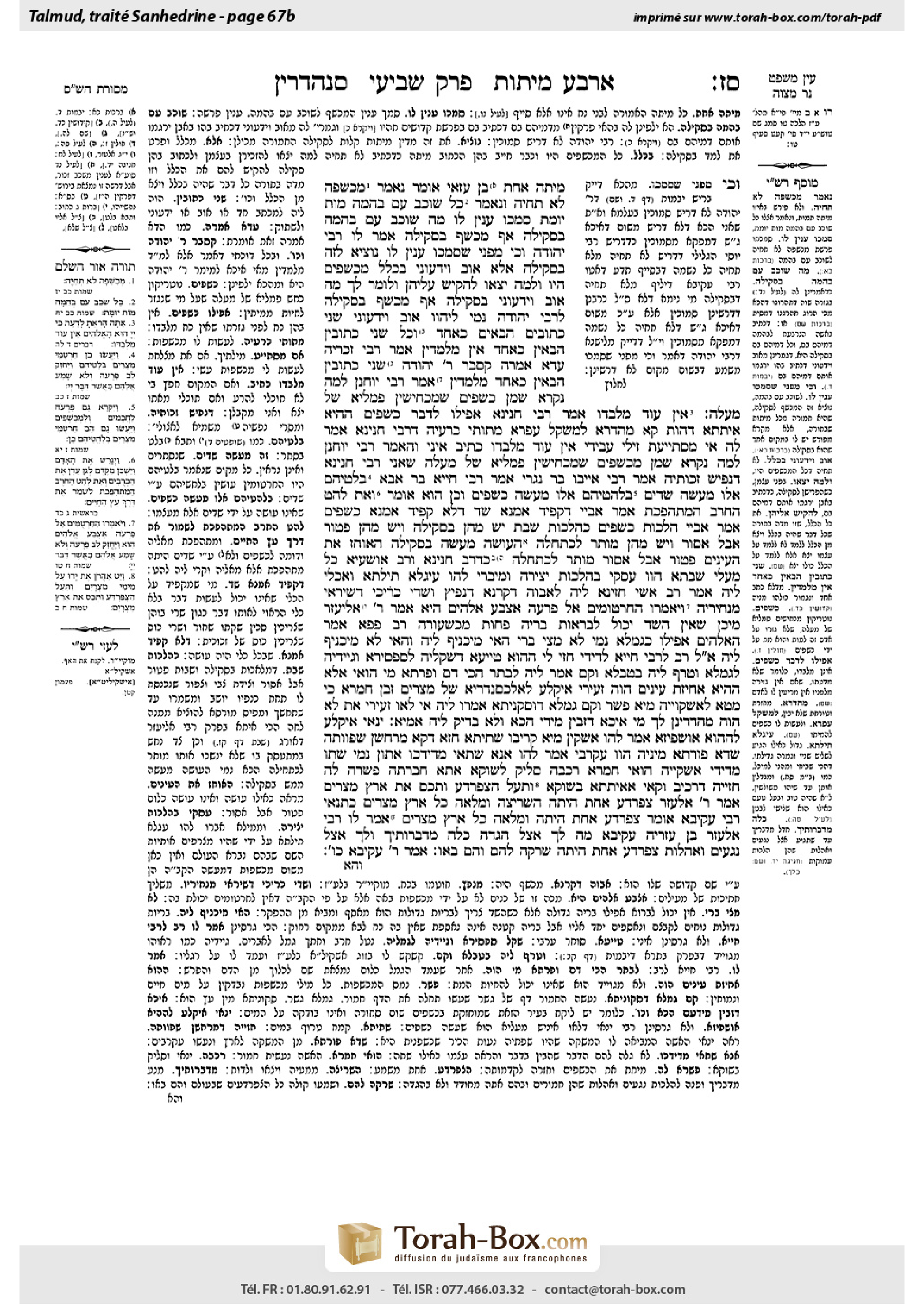
Sanhedrin 67b: Talmud study for Daf Yomi
Daf Yomi is the daily study of one Talmud folio. Explore 37 tractates with scans, Hebrew text, Sefaria English and AI-generated French translations where annotated.
Passage selection and English or AI-generated French translation are available where the scan has annotations. Daf Study is independent of Torah-Box and Sefaria.
Browse Sanhedrin · סנהדרין · All tractatesSanhedrin 67b text and translations
This page of Sanhedrin includes the Aramaic text, an English translation and an AI-generated French translation, alongside the scan above.
סנהדרין ס״ז ב · Aramaic and Hebrew text
מִיתָה אַחַת.
בֶּן עַזַּאי אוֹמֵר: נֶאֱמַר ״מְכַשֵּׁפָה לֹא תְחַיֶּה״, וְנֶאֱמַר ״כׇּל שֹׁכֵב עִם בְּהֵמָה מוֹת יוּמָת״. סְמָכוֹ עִנְיָן לוֹ, מָה שׁוֹכֵב עִם בְּהֵמָה בִּסְקִילָה – אַף מְכַשֵּׁף בִּסְקִילָה.
אָמַר לוֹ רַבִּי יְהוּדָה: וְכִי מִפְּנֵי שֶׁסְּמָכוֹ עִנְיָן לוֹ, נוֹצִיא לָזֶה בִּסְקִילָה? אֶלָּא, אוֹב וְיִדְּעוֹנִי בִּכְלַל מְכַשְּׁפִים הָיוּ, וְלָמָּה יָצְאוּ? לְהַקִּישׁ עֲלֵיהֶן וְלוֹמַר לָךְ: מָה אוֹב וְיִדְּעוֹנִי בִּסְקִילָה – אַף מְכַשֵּׁף בִּסְקִילָה.
לְרַבִּי יְהוּדָה נָמֵי, לִיהְווֹ אוֹב וְיִדְּעוֹנִי שְׁנֵי כְתוּבִים הַבָּאִים כְּאֶחָד, וְכׇל שְׁנֵי כְתוּבִין הַבָּאִין כְּאֶחָד אֵין מְלַמְּדִין!
אָמַר רַבִּי זְכַרְיָה: עֲדָא אָמְרָה, קָסָבַר רַבִּי יְהוּדָה: שְׁנֵי כְתוּבִין הַבָּאִין כְּאֶחָד מְלַמְּדִין.
אָמַר רַבִּי יוֹחָנָן: לָמָּה נִקְרָא שְׁמָן כְּשָׁפִים? שֶׁמַּכְחִישִׁין פָּמַלְיָא שֶׁל מַעְלָה.
״אֵין עוֹד מִלְבַדּוֹ״, אָמַר רַבִּי חֲנִינָא: אֲפִילּוּ לִדְבַר כְּשָׁפִים.
הָהִיא אִיתְּתָא דַּהֲוָת קָא מְהַדְּרָא לְמִשְׁקַל עַפְרָא מִתּוּתֵי כַּרְעֵיהּ דְּרַבִּי חֲנִינָא. אֲמַר לַהּ: אִי מִסְתַּיַּיעְתְּ, זִילִי עֲבִידִי. ״אֵין עוֹד מִלְבַדּוֹ״ כְּתִיב.
אִינִי? וְהָאָמַר רַבִּי יוֹחָנָן: לָמָּה נִקְרָא שְׁמָן מְכַשְּׁפִים? שֶׁמַּכְחִישִׁין פָּמַלְיָא שֶׁל מַעְלָה. שָׁאנֵי רַבִּי חֲנִינָא, דִּנְפִישׁ זְכוּתֵיהּ.
אָמַר רַבִּי אַיְיבוּ בַּר נַגָּרֵי אָמַר רַבִּי חִיָּיא בַּר אַבָּא: ״בְּלָטֵיהֶם״ – אֵלּוּ מַעֲשֵׂה שֵׁדִים, ״בְּלַהֲטֵיהֶם״ – אֵלּוּ מַעֲשֵׂה כְשָׁפִים. וְכֵן הוּא אוֹמֵר: ״וְאֵת לַהַט הַחֶרֶב הַמִּתְהַפֶּכֶת״.
אָמַר אַבָּיֵי: דְּקָפֵיד אַמָּנָא – שֵׁד, דְּלָא קָפֵיד אַמָּנָא – כְּשָׁפִים.
אָמַר אַבָּיֵי: הִלְכוֹת כְּשָׁפִים כְּהִלְכוֹת שַׁבָּת, יֵשׁ מֵהֶן בִּסְקִילָה, וְיֵשׁ מֵהֶן פָּטוּר אֲבָל אָסוּר, וְיֵשׁ מֵהֶן מוּתָּר לְכַתְּחִלָּה.
הָעוֹשֶׂה מַעֲשֶׂה – בִּסְקִילָה, הָאוֹחֵז אֶת הָעֵינַיִם – פָּטוּר אֲבָל אָסוּר. מוּתָּר לְכַתְּחִלָּה – כִּדְרַב חֲנִינָא וְרַב אוֹשַׁעְיָא: כׇּל מַעֲלֵי שַׁבְּתָא הֲווֹ עָסְקִי בְּהִלְכוֹת יְצִירָה, וּמִיבְּרֵי לְהוּ עִיגְלָא תִּילְתָּא, וְאָכְלִי לֵיהּ.
אָמַר רַב אָשֵׁי: חֲזֵינָא לֵיהּ לַאֲבוּהּ דְּקַרְנָא, דְּנָפֵיץ וְשָׁדֵי כְּרִיכֵי דְשִׁירָאֵי מִנְּחִירֵיהּ.
״וַיֹּאמְרוּ הַחַרְטֻמִּם אֶל פַּרְעֹה אֶצְבַּע אֱלֹהִים הִיא״. אָמַר רַבִּי אֱלִיעֶזֶר: מִיכָּן שֶׁאֵין הַשֵּׁד יָכוֹל לִבְראוֹת בְּרִיָּה פָּחוֹת מִכִּשְׂעוֹרָה.
רַב פָּפָּא אָמַר: הָאֱלֹהִים! אֲפִילּוּ כְּגַמְלָא נָמֵי לָא מָצֵי בָּרֵי. הַאי מִיכְּנִיף לֵיהּ, וְהַאי לָא מִיכְּנִיף לֵיהּ.
אֲמַר לֵיהּ רַב לְרַבִּי חִיָּיא: לְדִידִי חֲזֵי לִי הַהוּא טַיָּיעָא, דְּשַׁקְלֵיהּ לְסַפְסִירָא וְגַיְּידֵיהּ לְגַמְלֵאּ, וּטְרַף לֵיהּ בְּטַבְלָא, וְקָם. אֲמַר לֵיהּ: לְבָתַר הָכִי, דָּם וּפַרְתָּא מִי הֲוַאי? אֶלָּא, הַהִיא אֲחִיזַת עֵינַיִם הֲוָה.
זְעֵירִי אִיקְּלַע לַאֲלֶכְּסַנְדְּרִיָּא שֶׁל מִצְרַיִם. זְבַן חַמְרָא. כִּי מְטָא לְאַשְׁקוֹיֵיהּ מַיָּא, פְּשַׁר וְקָם גַּמְלָא דְּאוּסְקָנִיתָא. אֲמַרוּ לֵיהּ: אִי לָאו זְעֵירִי אַתְּ, לָא הֲוָה מַהְדְּרִינַן לָךְ. מִי אִיכָּא דְּזָבֵין מִידֵּי הָכָא וְלָא בָּדֵיק לֵיהּ אַמַּיָּא?
יַנַּאי אִיקְּלַע לְהָהוּא אוּשְׁפִּיזָא. אֲמַר לְהוּ: אַשְׁקְיַן מַיָּא. קָרִיבוּ שְׁתִיתָא. חֲזָא דְּקָא מְרַחֲשָׁן שִׂפְוָותַהּ, שְׁדָא פּוּרְתָּא מִינֵּיהּ. הֲווֹ עַקְרַבֵּי. אֲמַר לְהוּ: אֲנָא שְׁתַאי מִדִּידְכוּ, אַתּוּן נָמֵי שְׁתוֹ מִדִּידִי. אַשְׁקְיַיהּ, הֲוַאי חַמְרָא. רַכְבַהּ, סָלֵיק לְשׁוּקָא. אֲתָא חֲבֶרְתָּהּ, פְּשַׁרָה לַהּ. חַזְיֵיהּ דְּרָכֵיב וְקָאֵי אַאִיתְּתָא בְּשׁוּקָא.
״וַתַּעַל הַצְּפַרְדֵּעַ וַתְּכַס אֶת אֶרֶץ מִצְרָיִם״. אָמַר רַבִּי אֶלְעָזָר: צְפַרְדֵּעַ אַחַת הָיְתָה, הִשְׁרִיצָה וּמִלְּאָה כׇּל אֶרֶץ מִצְרַיִם.
כְּתַנָּאֵי: רַבִּי עֲקִיבָא אוֹמֵר, צְפַרְדֵּעַ אַחַת הָיְתָה וּמִלְּאָה כׇּל אֶרֶץ מִצְרַיִם. אָמַר לוֹ רַבִּי אֶלְעָזָר בֶּן עֲזַרְיָה: עֲקִיבָא, מָה לְךָ אֵצֶל הַגָּדָה? כַּלֵּה מִדַּבְּרוֹתֶיךָ וְלֵךְ אֵצֶל נְגָעִים וְאֹהָלוֹת. צְפַרְדֵּעַ אַחַת הָיְתָה, שָׁרְקָה לָהֶם וְהֵם בָּאוּ.
אָמַר רַבִּי עֲקִיבָא כּוּ׳.
Sanhedrin 67b · English translation
one type of death penalty, namely, decapitation. Since that is the only type of capital punishment that applies to gentiles, it cannot be derived through a verbal analogy that the same type applies to a Jewish sorceror.
The baraita continues: Ben Azzai says that it is stated: “You shall not allow a witch to live” (Exodus 22:17), and it is stated in the following verse: “Whoever lies with an animal shall be put to death” (Exodus 22:18). The fact that the Torah juxtaposes this matter to that matter is to teach that just as one who lies with an animal is executed by stoning (see Leviticus, chapter 20), so too, a warlock is executed by stoning.
With regard to this derivation, Rabbi Yehuda said to him: And because the Torah juxtaposes this matter with that matter, shall we take this person out to be stoned? Should he be sentenced to the most severe type of capital punishment on that basis? Rather, the source is as follows: A necromancer and a sorcerer were included in the general category of warlocks, and why were they singled out from the rest, with their prohibition and punishment stated independently? This was done in order to draw an analogy to them and say to you: Just as a necromancer and a sorcerer are executed by stoning, so too, a warlock is executed by stoning.
The Gemara asks: According to the opinion of Rabbi Yehuda as well, let the punishment with regard to a necromancer and a sorcerer be considered two verses that come as one, i.e., that teach the same matter, and therefore the halakha of other cases cannot be derived from it, according to the principle that any two verses that come as one do not teach about other cases. In other words, if a halakha is taught with regard to two individual cases in the Torah, the understanding is that this halakha applies only to those cases. Had this halakha applied to all other relevant cases as well, it would not have been necessary for the Torah to teach it twice. The fact that two cases are mentioned indicates that they are the exceptions rather than the rule.
Rabbi Zekharya says: This means that Rabbi Yehuda holds that two verses that come as one do teach about other cases.
§ Rabbi Yoḥanan says: Why is sorcery called keshafim? Because it is an acronym for: Contradicts the heavenly entourage [shemakhḥishin pamalia shel mala]. Sorcery appears to contradict the laws of nature established by God.
The verse states: “To you it was shown, so that you should know that the Lord is God; there is none else besides Him” (Deuteronomy 4:35). Rabbi Ḥanina says: This is true even with regard to a matter of sorcery; sorcery is ineffective against a righteous person.
The Gemara relates: There was a certain woman who was attempting to take dust from under the feet of Rabbi Ḥanina in order to perform sorcery on him and harm him. Rabbi Ḥanina said to her: If you succeed, go and do it. I am not concerned about it, as it is written: “There is none else besides Him.”
The Gemara asks: Is that so? But doesn’t Rabbi Yoḥanan say: Why are sorcerers called mekhashefim? Because it is an acronym for: Contradicts the heavenly entourage. This indicates that one should be wary of sorcery. The Gemara answers: Rabbi Ḥanina is different, as his merit is great, and sorcery certainly has no effect on such a righteous person.
Rabbi Aivu bar Nagri says that Rabbi Ḥiyya bar Abba says that in the verse: “And the magicians of Egypt did in that manner with their secret arts [belateihem]” (Exodus 7:22), these words are describing acts of employing demons, which are invisible, and their actions are therefore hidden [balat]. With regard to the similar term “belahateihem” (Exodus 7:11), these are acts of sorcery, which sorcerers perform themselves, without using demons. And likewise it says: “And the flaming [lahat] sword that turned every way” (Genesis 3:24), referring to a sword that revolves by itself.
Abaye says: A sorcerer who is particular about using a certain utensil for his sorcery is employing a demon; one who is not particular about using a certain utensil is performing an act of sorcery.
Abaye says: The halakhot of sorcery are like the halakhot of Shabbat, in that their actions can be divided into three categories: There are some of them for which one is liable to be executed by stoning, and there are some of them for which one is exempt from punishment by Torah law but they are prohibited by rabbinic law, and there are some of them that are permitted ab initio.
Abaye elaborates: One who performs a real act of sorcery is liable to be executed by stoning. One who deceives the eyes is exempt from punishment, but it is prohibited for him to do so. What is permitted ab initio is to act like Rav Ḥanina and Rav Oshaya: Every Shabbat eve they would engage in the study of the halakhot of creation, and a third-born calf would be created for them, and they would eat it in honor of Shabbat.
Rav Ashi said: I saw Karna’s father perform a magic trick in which he would blow his nose and cast rolls of silk from his nostrils by deceiving the eye.
With regard to the verse: “And the magicians said to Pharaoh: This is the finger of God” (Exodus 8:15), Rabbi Eliezer says: It is derived from here that a demon cannot create an entity smaller than the size of a barley grain. Consequently, the magicians were not capable of duplicating the plague of lice, and they realized that this was not an act of sorcery but was performed by God.
Rav Pappa said: By God! They cannot create even an entity as large as a camel. They do not create anything. Rather, they can gather these large animals, leading them from one place to another, but they cannot gather those small animals.
Rav said to Rabbi Ḥiyya: I myself saw a certain Arab who took a sword and sliced a camel and then beat a drum [betavla], and the camel arose from the dead. Rabbi Ḥiyya said to him: Was there blood and excretion afterward in that place, which flowed from the camel when it was sliced? Rather, since there was none, that was clearly a deception of the eyes and not sorcery.
The Gemara relates: Ze’eiri happened to come to Alexandria of Egypt. He bought a donkey. When he was about to give it water to drink the magic thawed when the donkey touched the water and it was revealed that it was not a donkey, and it turned into the plank of a bridge. The ones who sold it to him said to him: If you were not Ze’eiri, a distinguished person, we would not refund you the money for the donkey. Is there anyone who buys an item here and does not examine it first with water? Since sorcery was widespread there, anyone who bought an item examined it in order to find out if it was affected by sorcery, and if one did not examine an acquired item by exposing it to water and it turned out to be under a spell, he suffered the loss.
The Gemara relates: A man named Yannai arrived at a certain inn. He said to the innkeepers: Give me water to drink. They brought him flour mixed with water. He saw that the lips of the innkeeper woman were moving, and he cast a bit of the drink to the ground, and it turned into scorpions, and he understood that the innkeepers performed sorcery on the drink. Yannai said to them: I drank from yours; you too drink from mine, and he also performed sorcery on the drink. He gave it to her to drink and she turned into a donkey. He rode upon her and went to the marketplace. Her friend came and released her from the sorcery, and people saw him riding on a woman in the marketplace.
It is stated with regard to the plagues of Egypt: “And the frog came up and covered the land of Egypt” (Exodus 8:2). Noting that the term “the frog” is written in the singular, Rabbi Elazar says: At first it was one frog; it spawned and filled the entire land of Egypt with frogs.
The Gemara comments: This matter is subject to a dispute between tanna’im: Rabbi Akiva says: It was one frog, and it spawned and filled the entire land of Egypt with frogs. Rabbi Elazar ben Azarya said to him: Akiva, what are you doing occupying yourself with the study of aggada? This is not your field of expertise. Take your statements to the tractates of Nega’im and Oholot. In other words, it is preferable that you teach the halakhot of the impurity of leprosy and the impurity imparted in a tent, which are among the most difficult areas of halakha and are within your field of expertise. Rather, the verse is to be understood as follows: It was one frog; it whistled to the other frogs, and they all came after it.
§ In the mishna, Rabbi Akiva says in the name of Rabbi Yehoshua that two people can each gather cucumbers by sorcery, one of whom is exempt, as he merely deceives the eyes, and one of whom is liable, as he performs real sorcery.
Sanhedrin 67b · Traduction française (IA)
un type de peine capitale, à savoir la décapitation. Puisqu’il s’agit du seul type de peine capitale applicable aux non-Juifs, on ne peut pas déduire par analogie verbale que le même type de peine s’applique à un sorcier juif.
La baraïta poursuit : Ben Azaï dit qu’il est écrit : « Tu ne laisseras pas vivre une sorcière » (Exode 22, 17), puis, au verset suivant : « Quiconque couche avec un animal sera mis à mort » (Exode 22, 18). La Torah juxtapose ces deux sujets pour enseigner que, de même que celui qui couche avec un animal est exécuté par lapidation (voir Lévitique, chapitre 20), de même un sorcier est exécuté par lapidation.
À propos de cette déduction, Rabbi Yehouda lui dit : Parce que la Torah juxtapose ce sujet à cet autre, faut-il faire sortir cet homme pour le lapider ? Faut-il le condamner au type de peine capitale le plus sévère sur cette base ? La source est plutôt la suivante : le nécromancien et le sorcier étaient inclus dans la catégorie générale des sorciers. Pourquoi ont-ils été distingués des autres, leur interdiction et leur peine étant énoncées séparément ? C’était afin d’établir une analogie avec eux et de t’enseigner que, de même que le nécromancien et le sorcier sont exécutés par lapidation, de même un sorcier est exécuté par lapidation.
La Guemara demande : Selon l’opinion de Rabbi Yehouda également, ne faut-il pas considérer que les peines applicables au nécromancien et au sorcier constituent deux versets qui viennent ensemble, c’est-à-dire qui enseignent la même chose, et dont on ne peut donc pas déduire la halakha pour d’autres cas, conformément au principe selon lequel deux versets qui viennent ensemble n’enseignent rien au sujet d’autres cas ? Autrement dit, lorsqu’une halakha est enseignée à propos de deux cas particuliers dans la Torah, on comprend qu’elle ne s’applique qu’à ces cas. Si elle s’appliquait aussi à tous les autres cas pertinents, la Torah n’aurait pas eu besoin de l’enseigner deux fois. Le fait que deux cas soient mentionnés indique qu’ils constituent des exceptions et non la règle.
Rabbi Zekharya dit : Cela signifie que, selon Rabbi Yehouda, deux versets qui viennent ensemble enseignent effectivement quelque chose au sujet d’autres cas.
§ Rabbi Yoḥanan dit : Pourquoi la sorcellerie est-elle appelée keshafim ? Parce que ce mot est l’acronyme de « contredisent la suite céleste » [shemakhḥishin pamalia shel mala]. La sorcellerie semble contredire les lois de la nature établies par Dieu.
Le verset dit : « C’est à toi qu’il a été montré, afin que tu saches que l’Éternel est Dieu ; il n’y en a pas d’autre que Lui » (Deutéronome 4, 35). Rabbi Ḥanina dit : Cela est vrai même en matière de sorcellerie ; celle-ci est sans effet contre un homme juste.
La Guemara rapporte : Une femme tentait de prendre de la poussière sous les pieds de Rabbi Ḥanina afin de pratiquer la sorcellerie contre lui et de lui nuire. Rabbi Ḥanina lui dit : Si tu réussis, va donc le faire. Cela ne m’inquiète pas, car il est écrit : « Il n’y en a pas d’autre que Lui. »
La Guemara demande : Est-ce bien le cas ? Rabbi Yoḥanan ne dit-il pas : Pourquoi les sorciers sont-ils appelés mekhashefim ? Parce que ce mot est l’acronyme de « contredisent la suite céleste ». Cela indique qu’il faut se méfier de la sorcellerie. La Guemara répond : Rabbi Ḥanina est différent, car son mérite est grand et la sorcellerie n’a certainement aucun effet sur un homme juste tel que lui.
Rabbi Aivu bar Nagri dit au nom de Rabbi Ḥiyya bar Abba qu’au sujet du verset : « Les magiciens d’Égypte en firent autant par leurs sortilèges [belateihem] » (Exode 7, 22), ces mots décrivent des actes consistant à employer des démons, qui sont invisibles et dont les actions sont donc cachées [balat]. Quant au terme similaire « belahateihem » (Exode 7, 11), il désigne des actes de sorcellerie que les sorciers accomplissent eux-mêmes, sans recourir à des démons. De même, il est dit : « Et l’épée flamboyante [lahat], qui tournoyait de tous côtés » (Genèse 3, 24), à propos d’une épée qui tourne d’elle-même.
Abayé dit : Un sorcier qui tient à utiliser un ustensile particulier pour sa sorcellerie recourt à un démon ; celui qui ne tient pas à utiliser un ustensile particulier accomplit un acte de sorcellerie.
Abayé dit : Les halakhot de la sorcellerie sont comparables à celles du Chabbat, en ce que ses actes se répartissent en trois catégories : certains entraînent la peine de lapidation ; d’autres sont exempts de peine selon la Torah, mais interdits par la loi rabbinique ; d’autres encore sont permis a priori.
Abayé précise : Celui qui accomplit un véritable acte de sorcellerie est passible de lapidation. Celui qui trompe les yeux est exempt de peine, mais il lui est interdit d’agir ainsi. Ce qui est permis a priori, c’est d’agir comme Rav Ḥanina et Rav Oshaya : chaque veille de Chabbat, ils étudiaient les halakhot de la Création ; un veau né au troisième rang était créé pour eux, et ils le mangeaient en l’honneur du Chabbat.
Rav Ashi dit : J’ai vu le père de Karna exécuter un tour de magie : il se mouchait et faisait sortir de ses narines des rouleaux de soie en trompant les yeux.
À propos du verset : « Les magiciens dirent à Pharaon : “C’est le doigt de Dieu” » (Exode 8, 15), Rabbi Eliezer dit : On en déduit qu’un démon ne peut pas créer un être plus petit qu’un grain d’orge. Par conséquent, les magiciens ne pouvaient pas reproduire la plaie des poux et comprirent qu’il ne s’agissait pas d’un acte de sorcellerie, mais d’une œuvre accomplie par Dieu.
Rav Pappa dit : Par Dieu ! Ils ne peuvent même pas créer un être aussi grand qu’un chameau. Ils ne créent rien du tout. Ils peuvent plutôt rassembler ces grands animaux et les mener d’un endroit à un autre, mais ils ne peuvent pas rassembler ces petits animaux.
Rav dit à Rabbi Ḥiyya : J’ai moi-même vu un certain Arabe prendre une épée, trancher un chameau, puis battre un tambour [betavla], et le chameau se relever d’entre les morts. Rabbi Ḥiyya lui dit : Y avait-il ensuite du sang et des excréments à cet endroit, provenant du chameau lorsqu’il fut tranché ? Comme il n’y en avait pas, il s’agissait clairement d’une illusion des yeux, et non de sorcellerie.
La Guemara rapporte : Ze’eiri arriva par hasard à Alexandrie, en Égypte. Il acheta un âne. Au moment où il s’apprêtait à lui donner de l’eau à boire, le sortilège se dissipa au contact de l’eau ; on découvrit alors que ce n’était pas un âne, et il se transforma en une planche de pont. Ceux qui le lui avaient vendu lui dirent : Si tu n’étais pas Ze’eiri, un personnage éminent, nous ne te rembourserions pas le prix de l’âne. Y a-t-il quelqu’un qui achète un objet ici sans d’abord le vérifier avec de l’eau ? Comme la sorcellerie était répandue là-bas, toute personne qui achetait un objet l’examinait pour savoir s’il était affecté par la sorcellerie ; si quelqu’un n’examinait pas l’objet acheté en l’exposant à l’eau et qu’il s’avérait ensorcelé, il en supportait la perte.
La Guemara rapporte : Un homme nommé Yannai arriva dans une auberge. Il dit aux aubergistes : Donnez-moi de l’eau à boire. Ils lui apportèrent de la farine mélangée à de l’eau. Il vit que les lèvres de l’aubergiste remuaient ; il jeta un peu de la boisson par terre, et elle se transforma en scorpions. Il comprit que les aubergistes avaient ensorcelé la boisson. Yannai leur dit : J’ai bu de la vôtre ; buvez donc vous aussi de la mienne. Il ensorcela à son tour la boisson, la fit boire à la femme, et celle-ci se transforma en ânesse. Il monta sur elle et se rendit au marché. Son amie vint la délivrer du sortilège, et les gens le virent chevaucher une femme au marché.
À propos des plaies d’Égypte, il est dit : « La grenouille monta et couvrit le pays d’Égypte » (Exode 8, 2). Remarquant que le terme « la grenouille » est au singulier, Rabbi Elazar dit : Au début, il n’y avait qu’une grenouille ; elle engendra d’autres grenouilles et remplit tout le pays d’Égypte.
La Guemara commente : Cette question fait l’objet d’un désaccord entre tannaïm. Rabbi Akiva dit : Il n’y avait qu’une grenouille ; elle engendra d’autres grenouilles et remplit tout le pays d’Égypte. Rabbi Elazar ben Azarya lui dit : Akiva, pourquoi t’occupes-tu de l’étude de l’aggada ? Ce n’est pas ton domaine d’expertise. Réserve tes enseignements aux traités de Nega’im et d’Oholot. Autrement dit, il vaut mieux que tu enseignes les halakhot relatives à l’impureté de la lèpre et à l’impureté transmise dans une tente, qui comptent parmi les domaines les plus difficiles de la halakha et relèvent de ton expertise. Le verset doit plutôt se comprendre ainsi : Il n’y avait qu’une grenouille ; elle siffla aux autres grenouilles, qui vinrent toutes à sa suite.
§ Dans la Michna, Rabbi Akiva dit au nom de Rabbi Yehoshua que deux personnes peuvent chacune rassembler des concombres par la sorcellerie : l’une est exempte, car elle ne fait que tromper les yeux, et l’autre est passible de peine, car elle accomplit une véritable sorcellerie.
Traduction française générée par IA à partir de l’édition anglaise de Sefaria. Vérifie toujours un passage avec le texte source.
Text from Sefaria: William Davidson Edition - Vocalized Aramaic (CC BY NC); William Davidson Edition - English (CC BY NC).