Sanhedrin 68a: Talmud study for Daf Yomi
Daf Yomi is the daily study of one Talmud folio. Explore 37 tractates with scans, Hebrew text, Sefaria English and AI-generated French translations where annotated.
Passage selection and English or AI-generated French translation are available where the scan has annotations. Daf Study is independent of Torah-Box and Sefaria.
Browse Sanhedrin · סנהדרין · All tractatesSanhedrin 68a text and translations
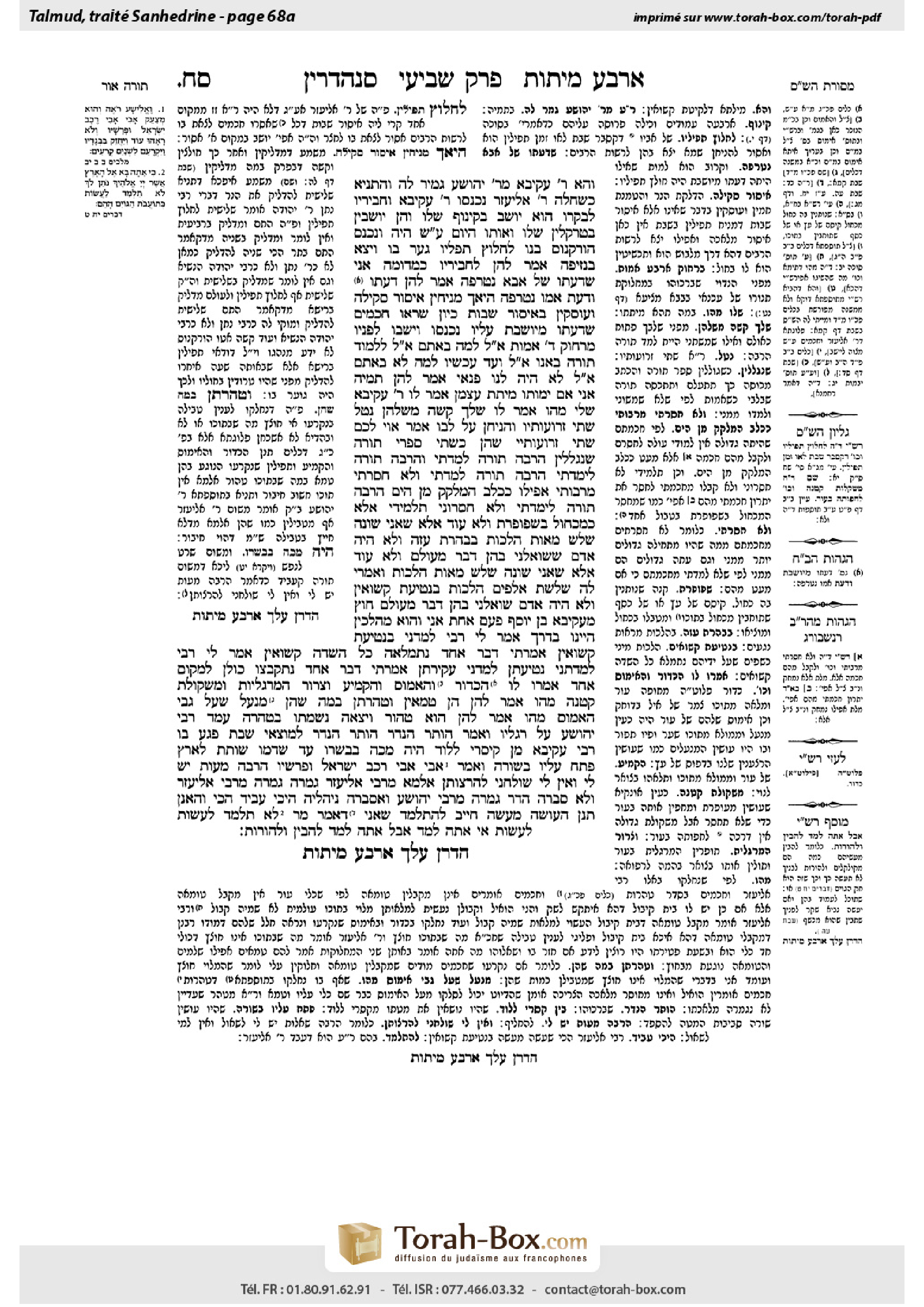
This page of Sanhedrin includes the Aramaic text, an English translation and an AI-generated French translation, alongside the scan above.
סנהדרין ס״ח א · Aramaic and Hebrew text
וְהָא רַבִּי עֲקִיבָא מֵרַבִּי יְהוֹשֻׁעַ גְּמִיר לַהּ? וְהָתַנְיָא: כְּשֶׁחָלָה רַבִּי אֱלִיעֶזֶר, נִכְנְסוּ רַבִּי עֲקִיבָא וַחֲבֵירָיו לְבַקְּרוֹ. הוּא יוֹשֵׁב בְּקִינוֹף שֶׁלּוֹ, וְהֵן יוֹשְׁבִין בִּטְרַקְלִין שֶׁלּוֹ.
וְאוֹתוֹ הַיּוֹם עֶרֶב שַׁבָּת הָיָה, וְנִכְנַס הוּרְקָנוֹס בְּנוֹ לַחְלוֹץ תְּפִלָּיו. גָּעַר בּוֹ וְיָצָא בִּנְזִיפָה. אָמַר לָהֶן לַחֲבֵירָיו: כִּמְדוּמֶּה אֲנִי שֶׁדַּעְתּוֹ שֶׁל אַבָּא נִטְרְפָה. אָמַר לָהֶן: דַּעְתּוֹ וְדַעַת אִמּוֹ נִטְרְפָה! הֵיאַךְ מַנִּיחִין אִיסּוּר סְקִילָה וְעוֹסְקִין בְּאִיסּוּר שְׁבוּת?
כֵּיוָן שֶׁרָאוּ חֲכָמִים שֶׁדַּעְתּוֹ מְיוּשֶּׁבֶת עָלָיו, נִכְנְסוּ וְיָשְׁבוּ לְפָנָיו מֵרָחוֹק אַרְבַּע אַמּוֹת.
אָמַר לָהֶם: לָמָּה בָּאתֶם? אָמְרוּ לוֹ: לִלְמוֹד תּוֹרָה בָּאנוּ. אָמַר לָהֶם: וְעַד עַכְשָׁיו לָמָּה לֹא בָּאתֶם? אָמְרוּ לוֹ: לֹא הָיָה לָנוּ פְּנַאי. אָמַר לָהֶן: תָּמֵיהַּ אֲנִי אִם יָמוּתוּ מִיתַת עַצְמָן. אָמַר לוֹ רַבִּי עֲקִיבָא: שֶׁלִּי מַהוּ? אָמַר לוֹ: שֶׁלְּךָ קָשָׁה מִשֶּׁלָּהֶן.
נָטַל שְׁתֵּי זְרוֹעוֹתָיו וְהִנִּיחָן עַל לִבּוֹ, אָמַר: אוֹי לָכֶם שְׁתֵּי זְרוֹעוֹתַיי, שֶׁהֵן כִּשְׁתֵּי סִפְרֵי תוֹרָה שֶׁנִּגְלָלִין! הַרְבֵּה תּוֹרָה לָמַדְתִּי, וְהַרְבֵּה תּוֹרָה לִימַּדְתִּי. הַרְבֵּה תּוֹרָה לָמַדְתִּי, וְלֹא חִסַּרְתִּי מֵרַבּוֹתַי אֲפִילּוּ כַּכֶּלֶב הַמְּלַקֵּק מִן הַיָּם. הַרְבֵּה תּוֹרָה לִימַּדְתִּי, וְלֹא חִסְּרוּנִי תַּלְמִידַי אֶלָּא כְּמִכְחוֹל בִּשְׁפוֹפֶרֶת.
וְלֹא עוֹד, אֶלָּא שֶׁאֲנִי שׁוֹנֶה שְׁלֹשׁ מֵאוֹת הֲלָכוֹת בְּבַהֶרֶת עַזָּה, וְלֹא הָיָה אָדָם שׁוֹאֲלֵנִי בָּהֶן דָּבָר מֵעוֹלָם. וְלֹא עוֹד, אֶלָּא שֶׁאֲנִי שׁוֹנֶה שְׁלֹשׁ מֵאוֹת הֲלָכוֹת, וְאָמְרִי לַהּ: שְׁלֹשֶׁת אֲלָפִים הֲלָכוֹת, בִּנְטִיעַת קִשּׁוּאִין, וְלֹא הָיָה אָדָם שׁוֹאֲלֵנִי בָּהֶן דָּבָר מֵעוֹלָם, חוּץ מֵעֲקִיבָא בֶּן יוֹסֵף.
פַּעַם אַחַת אֲנִי וָהוּא מְהַלְּכִין הָיִינוּ בַּדֶּרֶךְ, אָמַר לִי: רַבִּי, לַמְּדֵנִי בִּנְטִיעַת קִשּׁוּאִין. אָמַרְתִּי דָּבָר אֶחָד, נִתְמַלְּאָה כׇּל הַשָּׂדֶה קִשּׁוּאִין. אֲמַר לִי: רַבִּי, לִמַּדְתַּנִי נְטִיעָתָן, לַמְּדֵנִי עֲקִירָתָן. אָמַרְתִּי דָּבָר אֶחָד, נִתְקַבְּצוּ כּוּלָּן לְמָקוֹם אֶחָד.
אָמְרוּ לוֹ: הַכַּדּוּר וְהָאִמּוּם וְהַקָּמֵיעַ וּצְרוֹר הַמַּרְגָּלִיּוֹת וּמִשְׁקוֹלֶת קְטַנָּה, מַהוּ? אָמַר לָהֶן: הֵן טְמֵאִין, וְטַהֲרָתָן בְּמָה שֶׁהֵן.
מִנְעָל שֶׁעַל גַּבֵּי הָאִמּוּם, מַהוּ? אָמַר לָהֶן: הוּא טָהוֹר, וְיָצְאָה נִשְׁמָתוֹ בְּטׇהֳרָה. עָמַד רַבִּי יְהוֹשֻׁעַ עַל רַגְלָיו וְאָמַר: הוּתַּר הַנֶּדֶר, הוּתַּר הַנֶּדֶר!
לְמוֹצָאֵי שַׁבָּת פָּגַע בּוֹ רַבִּי עֲקִיבָא בֵּין קֵסָרִי לְלוֹד. הָיָה מַכֶּה בִּבְשָׂרוֹ עַד שֶׁדָּמוֹ שׁוֹתֵת לָאָרֶץ. פָּתַח עָלָיו בְּשׁוּרָה וְאָמַר: אָבִי אָבִי רֶכֶב יִשְׂרָאֵל וּפָרָשָׁיו. הַרְבֵּה מָעוֹת יֵשׁ לִי וְאֵין לִי שׁוּלְחָנִי לְהַרְצוֹתָן.
אַלְמָא, מֵרַבִּי אֱלִיעֶזֶר גַּמְרַהּ? גַּמְרַהּ מֵרַבִּי אֱלִיעֶזֶר וְלָא סַבְרַהּ. הֲדַר גַּמְרַהּ מֵרַבִּי יְהוֹשֻׁעַ, וְאַסְבְּרַהּ נִיהֲלֵיהּ.
הֵיכִי עָבֵיד הָכִי? וְהָאֲנַן תְּנַן: הָעוֹשֶׂה מַעֲשֶׂה – חַיָּיב! לְהִתְלַמֵּד שָׁאנֵי, דְּאָמַר מָר: ״לֹא תִלְמַד לַעֲשׂוֹת״ – לַעֲשׂוֹת אִי אַתָּה לָמֵד, אֲבָל אַתָּה לָמֵד לְהָבִין וּלְהוֹרוֹת.
הֲדַרַן עֲלָךְ אַרְבַּע מִיתוֹת
Sanhedrin 68a · English translation
The Gemara asks: And did Rabbi Akiva learn these halakhot from Rabbi Yehoshua? But isn’t it taught in a baraita: When Rabbi Eliezer took ill, Rabbi Akiva and his colleagues came to visit him. He was sitting on his canopied bed [bekinof ], and they were sitting in his parlor [biteraklin]; they did not know if he would be able to receive them, due to his illness.
And that day was Shabbat eve, and Rabbi Eliezer’s son Hyrcanus entered to remove his phylacteries, as phylacteries are not worn on Shabbat. His father berated him, and he left reprimanded. Hyrcanus said to his father’s colleagues: It appears to me that father went insane, since he berated me for no reason. Rabbi Eliezer heard this and said to them: He, Hyrcanus, and his mother went insane. How can they neglect Shabbat preparations with regard to prohibitions punishable by stoning, such as lighting the candles and preparing hot food, and engage in preparations concerning prohibitions by rabbinic decree, such as wearing phylacteries on Shabbat?
Since the Sages perceived from this retort that his mind was stable, they entered and sat before him at a distance of four cubits, as he was ostracized (see Bava Metzia 59b). It is forbidden to sit within four cubits of an ostracized person.
Rabbi Eliezer said to them: Why have you come? They said to him: We have come to study Torah, as they did not want to say that they came to visit him due to his illness. Rabbi Eliezer said to them: And why have you not come until now? They said to him: We did not have spare time. Rabbi Eliezer said to them: I would be surprised if these Sages die their own death, i.e., a natural death. Rather, they will be tortured to death by the Romans. Rabbi Akiva said to him: How will my death come about? Rabbi Eliezer said to him: Your death will be worse than theirs, as you were my primary student and you did not come to study.
Rabbi Eliezer raised his two arms and placed them on his heart, and he said: Woe to you, my two arms, as they are like two Torah scrolls that are now being rolled up, and will never be opened again. I have learned much Torah, and I have taught much Torah. I have learned much Torah, and I have not taken away from my teachers, i.e., I have not received from their wisdom, even like a dog lapping from the sea. I have taught much Torah, and my students have taken away from me, i.e., they have received from my wisdom, only like the tiny amount that a paintbrush removes from a tube of paint.
Moreover, I can teach three hundred halakhot with regard to a snow-white leprous mark [bebaheret], but no person has ever asked me anything about them. He could not find a student who could fully understand him in those matters. Moreover, I can teach three hundred halakhot, and some say that Rabbi Eliezer said three thousand halakhot, with regard to the planting of cucumbers by sorcery, but no person has ever asked me anything about them, besides Akiva ben Yosef.
Rabbi Eliezer described the incident: Once he and I were walking along the way, and he said to me: My teacher, teach me about the planting of cucumbers. I said one statement of sorcery, and the entire field became filled with cucumbers. He said to me: My teacher, you have taught me about planting them; teach me about uprooting them. I said one statement and they all were gathered to one place.
After these comments, the Sages asked him questions of halakha: What is the halakha, with regard to ritual impurity, of a ball made of leather and stuffed with rags, and likewise a last, the frame on which a shoe is fashioned, which is made of leather and stuffed with rags, and likewise an amulet wrapped in leather, and a pouch for pearls, wrapped in leather, and a small weight, which is wrapped in leather? Rabbi Eliezer said to them: They are susceptible to impurity, and their purification is effected by immersing them in a ritual bath as they are, as there is no need to open them up.
They asked him further: What is the halakha with regard to a shoe that is on a last? Is it considered a complete vessel, which needs no further preparation, and is therefore susceptible to impurity? Rabbi Eliezer said to them: It is pure, and with this word, his soul left him in purity. Rabbi Yehoshua stood on his feet and said: The vow is permitted; the vow is permitted; i.e., the ostracism that was placed on Rabbi Eliezer is removed.
Rabbi Akiva was not present at the time of his death. At the conclusion of Shabbat, Rabbi Akiva encountered the funeral procession on his way from Caesarea to Lod. Rabbi Akiva was striking his flesh in terrible anguish and regret until his blood flowed to the earth. He began to eulogize Rabbi Eliezer in the row of those comforting the mourners, and said: “My father, my father, the chariot of Israel and its horsemen” (II Kings 2:12). I have many coins, but I do not have a money changer to whom to give them, i.e., I have many questions, but after your death I have no one who can answer them.
The Gemara returns to the matter at hand: Apparently, Rabbi Akiva learned the halakhot of gathering cucumbers through sorcery from Rabbi Eliezer, not from Rabbi Yehoshua. The Gemara answers: He learned it from Rabbi Eliezer but he did not understand it. Later he learned it from Rabbi Yehoshua, and Rabbi Yehoshua explained it to him.
The Gemara asks: How could Rabbi Eliezer have performed that act of sorcery? But didn’t we learn in the mishna that one who performs an act of sorcery is liable? The Gemara answers: Performing sorcery not in order to use it, but in order to teach oneself the halakhot is different, and it is permitted; as the Master says that it is derived from the verse: “You shall not learn to do like the abominations of those nations. There shall not be found among you…one who uses divination, a soothsayer, an enchanter, or a sorcerer” (Deuteronomy 18:9–10), so that you shall not learn, i.e., it is prohibited for you to learn, in order to do, but you may learn, i.e., it is permitted for you to learn, in order to understand the matter yourself and teach it to others.
Sanhedrin 68a · Traduction française (IA)
La Guemara demande : Rabbi Akiva a-t-il donc appris ces halakhot de Rabbi Yehoshua ? Pourtant, il est enseigné dans une baraïta : Lorsque Rabbi Eliezer tomba malade, Rabbi Akiva et ses collègues vinrent lui rendre visite. Il était assis sur son lit à baldaquin [bekinof], et eux étaient assis dans son salon [biteraklin] ; ils ne savaient pas s’il serait en état de les recevoir, en raison de sa maladie.
C’était la veille de Chabbat, et Hyrcanus, le fils de Rabbi Eliezer, entra pour lui retirer ses téfilines, car on ne porte pas de téfilines le Chabbat. Son père le réprimanda, et il ressortit couvert de reproches. Hyrcanus dit aux collègues de son père : Il me semble que père a perdu la raison, puisqu’il m’a réprimandé sans motif. Rabbi Eliezer entendit cela et leur dit : Lui, Hyrcanus, et sa mère ont perdu la raison. Comment peuvent-ils négliger les préparatifs de Chabbat concernant des interdits passibles de lapidation, comme allumer les lampes et préparer des aliments chauds, et s’occuper de préparatifs relatifs à des interdits institués par décret rabbinique, comme porter des téfilines le Chabbat ?
Les Sages comprirent à cette réplique que son esprit était lucide ; ils entrèrent donc et s’assirent devant lui à une distance de quatre coudées, car il était mis au ban (voir Bava Metsia 59b). Il est interdit de s’asseoir à moins de quatre coudées d’une personne mise au ban.
Rabbi Eliezer leur dit : Pourquoi êtes-vous venus ? Ils lui répondirent : Nous sommes venus étudier la Torah, car ils ne voulaient pas dire qu’ils étaient venus lui rendre visite en raison de sa maladie. Rabbi Eliezer leur dit : Et pourquoi n’êtes-vous pas venus jusqu’à présent ? Ils lui répondirent : Nous n’en avons pas eu le temps. Rabbi Eliezer leur dit : Je serais étonné que ces Sages meurent de leur propre mort, c’est-à-dire de mort naturelle. Ils seront plutôt torturés à mort par les Romains. Rabbi Akiva lui demanda : Comment ma mort surviendra-t-elle ? Rabbi Eliezer lui répondit : Ta mort sera pire que la leur, car tu étais mon principal élève et tu n’es pas venu étudier.
Rabbi Eliezer leva les deux bras, les posa sur son cœur et dit : Malheur à vous, mes deux bras, car ils sont comme deux rouleaux de Torah que l’on enroule maintenant et que l’on ne déroulera plus jamais. J’ai beaucoup appris de Torah et j’ai beaucoup enseigné de Torah. J’ai beaucoup appris de Torah, et je n’ai rien pris à mes maîtres, c’est-à-dire que je n’ai rien reçu de leur sagesse, pas même l’équivalent de ce qu’un chien lape dans la mer. J’ai beaucoup enseigné de Torah, et mes élèves ne m’ont pris, c’est-à-dire n’ont reçu de ma sagesse, que l’infime quantité qu’un pinceau prélève dans un tube de peinture.
De plus, je peux enseigner trois cents halakhot concernant une tache lépreuse d’un blanc éclatant [bebaheret], mais personne ne m’a jamais interrogé à leur sujet. Il ne trouvait aucun élève capable de le comprendre pleinement dans ces domaines. De plus, je peux enseigner trois cents halakhot — et certains disent que Rabbi Eliezer en a enseigné trois mille — concernant la plantation de concombres par sorcellerie, mais personne ne m’a jamais interrogé à leur sujet, à l’exception d’Akiva ben Yosef.
Rabbi Eliezer raconta l’incident : Un jour, alors que lui et moi marchions sur la route, il me dit : Mon maître, enseignez-moi la plantation de concombres. Je prononçai une formule de sorcellerie, et tout le champ se remplit de concombres. Il me dit : Mon maître, vous m’avez enseigné à les planter ; enseignez-moi à les déraciner. Je prononçai une formule, et ils furent tous rassemblés au même endroit.
Après ces remarques, les Sages lui posèrent des questions de halakha : Quel est le statut, du point de vue de l’impureté rituelle, d’une balle en cuir bourrée de chiffons, et d’une forme à chaussure, le cadre sur lequel on façonne une chaussure, faite de cuir et bourrée de chiffons ? Et quel est le statut d’une amulette enveloppée de cuir, d’une bourse à perles enveloppée de cuir et d’un petit poids enveloppé de cuir ? Rabbi Eliezer leur répondit : Ces objets sont susceptibles de contracter l’impureté, et il suffit de les immerger tels quels dans un bain rituel pour les purifier, car il n’est pas nécessaire de les ouvrir.
Ils lui demandèrent encore : Quel est le statut d’une chaussure placée sur une forme ? Est-elle considérée comme un ustensile achevé, qui ne nécessite aucune préparation supplémentaire et qui est donc susceptible de contracter l’impureté ? Rabbi Eliezer leur répondit : Elle est pure. À ces mots, son âme le quitta en état de pureté. Rabbi Yehoshua se leva et dit : Le vœu est annulé ; le vœu est annulé ; c’est-à-dire que la mise au ban prononcée contre Rabbi Eliezer est levée.
Rabbi Akiva n’était pas présent au moment de sa mort. À la fin de Chabbat, alors qu’il allait de Césarée à Lod, Rabbi Akiva croisa le cortège funèbre. Dans une terrible douleur et plein de regrets, Rabbi Akiva se frappait le corps jusqu’à ce que son sang coule à terre. Il commença à prononcer l’éloge funèbre de Rabbi Eliezer parmi ceux qui réconfortaient les endeuillés, et dit : « Mon père, mon père, char d’Israël et ses cavaliers » (II Rois 2:12). J’ai beaucoup de pièces, mais je n’ai pas de changeur à qui les donner, c’est-à-dire que j’ai beaucoup de questions, mais après ta mort, je n’ai personne qui puisse y répondre.
La Guemara revient au sujet en question : Il semble donc que Rabbi Akiva ait appris de Rabbi Eliezer, et non de Rabbi Yehoshua, les halakhot relatives au rassemblement des concombres par sorcellerie. La Guemara répond : Il les apprit de Rabbi Eliezer, mais ne les comprit pas. Plus tard, il les apprit de Rabbi Yehoshua, qui les lui expliqua.
La Guemara demande : Comment Rabbi Eliezer a-t-il pu accomplir cet acte de sorcellerie ? Pourtant, n’avons-nous pas appris dans la Michna que celui qui accomplit un acte de sorcellerie est passible de sanction ? La Guemara répond : Accomplir un acte de sorcellerie non pour s’en servir, mais pour en apprendre les halakhot, est différent et permis. En effet, le Maître enseigne que cela se déduit du verset : « Tu n’apprendras pas à agir selon les abominations de ces nations. Qu’on ne trouve chez toi… personne qui pratique la divination, qui prédit l’avenir, qui interprète les présages ou qui pratique la sorcellerie » (Deutéronome 18:9–10) : il t’est interdit d’apprendre afin d’agir, mais tu peux apprendre, c’est-à-dire qu’il t’est permis d’apprendre, afin de comprendre toi-même la chose et de l’enseigner aux autres.
Traduction française générée par IA à partir de l’édition anglaise de Sefaria. Vérifie toujours un passage avec le texte source.
Text from Sefaria: William Davidson Edition - Vocalized Aramaic (CC BY NC); William Davidson Edition - English (CC BY NC).