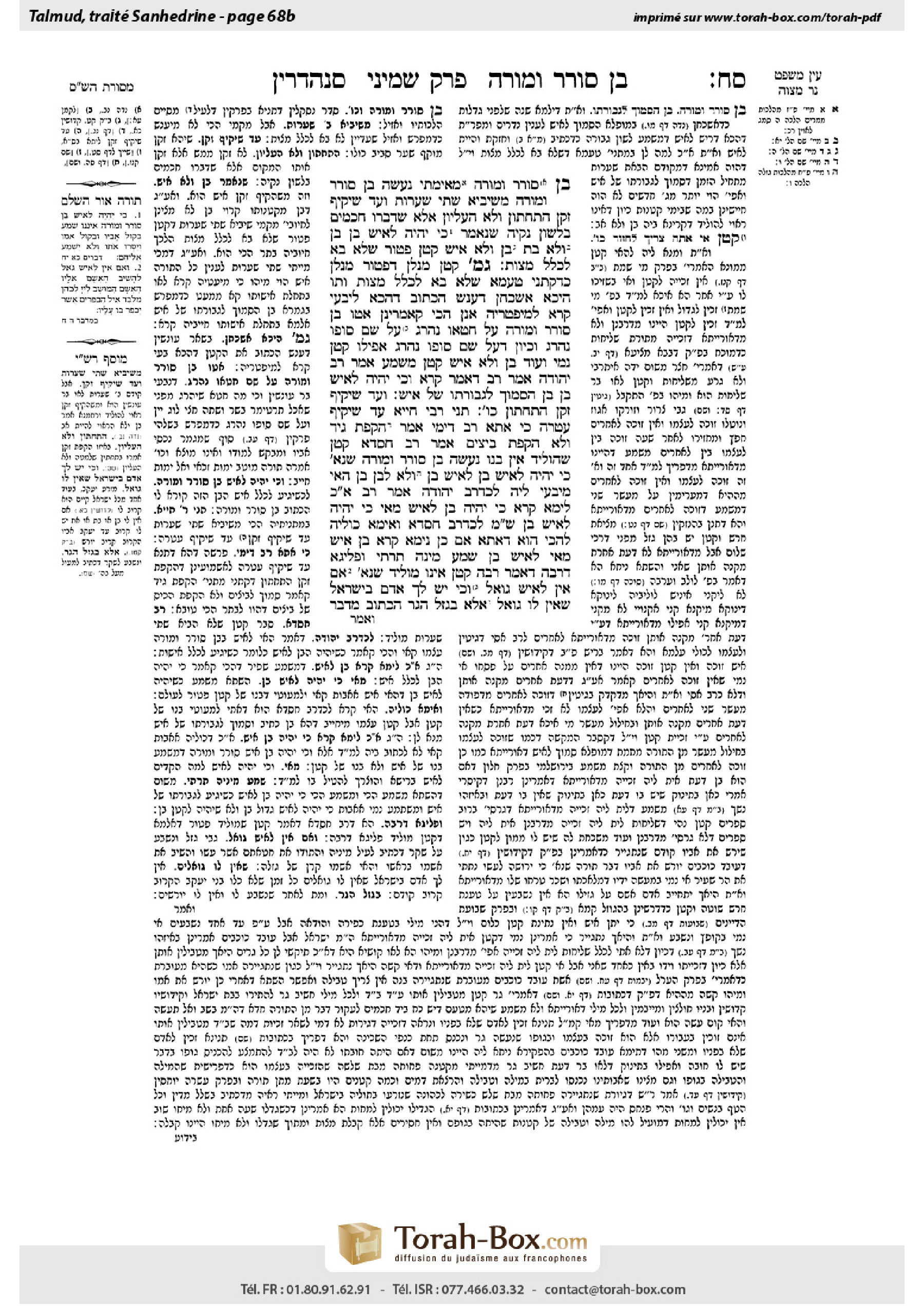
Sanhedrin 68b: Talmud study for Daf Yomi
Daf Yomi is the daily study of one Talmud folio. Explore 37 tractates with scans, Hebrew text, Sefaria English and AI-generated French translations where annotated.
Passage selection and English or AI-generated French translation are available where the scan has annotations. Daf Study is independent of Torah-Box and Sefaria.
Browse Sanhedrin · סנהדרין · All tractatesSanhedrin 68b text and translations
This page of Sanhedrin includes the Aramaic text, an English translation and an AI-generated French translation, alongside the scan above.
סנהדרין ס״ח ב · Aramaic and Hebrew text
מַתְנִי׳ בֵּן סוֹרֵר וּמוֹרֶה, מֵאֵימָתַי נַעֲשֶׂה בֵּן סוֹרֵר וּמוֹרֶה?
מִשֶּׁיָּבִיא שְׁתֵּי שְׂעָרוֹת, וְעַד שֶׁיַּקִּיף זָקָן הַתַּחְתּוֹן וְלֹא הָעֶלְיוֹן, אֶלָּא שֶׁדִּבְּרוּ חֲכָמִים בִּלְשׁוֹן נְקִיָּה. שֶׁנֶּאֱמַר: ״כִּי יִהְיֶה לְאִישׁ בֵּן״ – בֵּן וְלֹא בַּת, בֵּן וְלֹא אִישׁ. קָטָן פָּטוּר, שֶׁלֹּא בָּא לִכְלַל מִצְוֹת.
גְּמָ׳ קָטָן מְנָלַן דְּפָטוּר? מְנָלַן?! כִּדְקָתָנֵי טַעְמָא: שֶׁלֹּא בָּא לִכְלַל מִצְוֹת! וְתוּ, הֵיכָא אַשְׁכְּחַן דְּעָנַשׁ הַכָּתוּב, דְּהָכָא לִיבְעֵי קְרָא לְמִיפְטְרֵיהּ?
אֲנַן הָכִי קָאָמְרִינַן: אַטּוּ בֵּן סוֹרֵר וּמוֹרֶה עַל חֶטְאוֹ נֶהֱרָג? עַל שֵׁם סוֹפוֹ נֶהֱרָג! וְכֵיוָן דְּעַל שֵׁם סוֹפוֹ נֶהֱרָג, אֲפִילּוּ קָטָן נָמֵי? וְעוֹד, ״בֵּן״ וְלֹא אִישׁ – קָטָן מַשְׁמַע!
אָמַר רַב יְהוּדָה אָמַר רַב: דְּאָמַר קְרָא, ״וְכִי יִהְיֶה לְאִישׁ בֵּן״ – בֵּן הַסָּמוּךְ לִגְבוּרָתוֹ שֶׁל אִישׁ.
וְעַד שֶׁיַּקִּיף זָקָן הַתַּחְתּוֹן כּוּ׳. תָּנֵי רַבִּי חִיָּיא: עַד שֶׁיַּקִּיף עֲטָרָה. כִּי אֲתָא רַב דִּימִי אָמַר: הַקָּפַת גִּיד, וְלֹא הַקָּפַת בֵּיצִים.
אָמַר רַב חִסְדָּא: קָטָן שֶׁהוֹלִיד, אֵין בְּנוֹ נַעֲשֶׂה בֵּן סוֹרֵר וּמוֹרֶה, שֶׁנֶּאֱמַר: ״כִּי יִהְיֶה לְאִישׁ בֵּן״ – לְאִישׁ בֵּן, וְלֹא לְבֵן בֵּן. הַאי מִיבְּעֵי לֵיהּ לְכִדְרַב יְהוּדָה אָמַר רַב! אִם כֵּן, לֵימָא קְרָא: ״כִּי יִהְיֶה בֵּן לְאִישׁ״. מַאי ״כִּי יִהְיֶה לְאִישׁ בֵּן״? שְׁמַע מִינַּהּ לְכִדְרַב חִסְדָּא.
וְאֵימָא: כּוּלֵּיהּ לְהָכִי הוּא דַּאֲתָא? אִם כֵּן, נֵימָא קְרָא ״בֶּן אִישׁ״. מַאי ״לְאִישׁ בֵּן״? שְׁמַע מִינַּהּ תַּרְתֵּי.
וּפְלִיגָא דְּרַבָּה, דְּאָמַר רַבָּה: קָטָן אֵינוֹ מוֹלִיד, שֶׁנֶּאֱמַר: ״וְאִם אֵין לָאִישׁ גֹּאֵל״. וְכִי יֵשׁ לְךָ אָדָם בְּיִשְׂרָאֵל שֶׁאֵין לוֹ גּוֹאֵל?
אֶלָּא, בְּגֶזֶל הַגֵּר הַכָּתוּב מְדַבֵּר.
Sanhedrin 68b · English translation
MISHNA: The Torah describes the punishment given to a son who steals money from his parents to eat a gluttonous meal of meat and wine in the company of lowly men. If his parents bring him to court for this act, he is exhorted to desist and is punished with lashes. If he repeats the same misdeed and is again brought to court by his parents within the same three-month period, he is considered a stubborn and rebellious son [ben sorer umoreh]. He is liable to receive the death penalty, which in this case is execution by stoning. From when does a stubborn and rebellious son become liable to receive the death penalty imposed upon a stubborn and rebellious son?
From when he grows two pubic hairs, which are a sign of puberty and from which time he is considered an adult, until he has grown a beard around. The reference here is to the lower beard surrounding his genitals, and not the upper beard, i.e., his facial hair, but the Sages spoke in euphemistic terms. As it is stated: “If a man has a stubborn and rebellious son” (Deuteronomy 21:18), which indicates that the penalty for rebelliousness is imposed upon a son, but not upon a daughter; and upon a son, but not upon a fully grown man. A minor under the age of thirteen is exempt from the penalty imposed upon a stubborn and rebellious son, because he has not yet reached the age of inclusion in mitzvot.
GEMARA: The Gemara inquires about the source of the halakha taught in the mishna: From where do we derive that a minor is exempt from the punishment imposed upon a stubborn and rebellious son? The Gemara comments: This question is puzzling: From where do we derive this halakha? The reason is as is taught in the mishna: Because he has not yet reached the age of inclusion in mitzvot. And furthermore, where do we find that the verse punishes a minor, so that a special verse should be required here in order to exempt him?
The Gemara clarifies: This is what we are saying: Is this to say that a stubborn and rebellious son is killed for a sin that he already committed? But, as will be explained (71b), he is killed for what he will become in the end. The Torah understands that since the boy has already embarked on an evil path, he will continue to be drawn after his natural tendencies and commit many offenses that are more severe. It is therefore preferable that he should be killed now so that he may die in relative innocence, rather than be put to death in the future bearing much more guilt. And since he is executed for what he will become in the end, one might have thought that even a minor as well can be sentenced to the death penalty as a stubborn and rebellious son. And furthermore, the exclusion: “A son,” but not a man, indicates that a minor is in fact included in the halakha, as he is not yet a man.
Rav Yehuda says that Rav says: A minor is exempt from the punishment imposed upon a stubborn and rebellious son, as the verse states: “If a man has a son” (Deuteronomy 21:18), which indicates that the halakha applies to a son who is close to the stage of having the strength of a man, i.e., close to full maturity, but not to a younger boy.
§ The mishna teaches that a boy can be sentenced as a stubborn and rebellious son only until he has grown a lower beard. Rabbi Ḥiyya teaches a baraita that states: Until the hair surrounds the corona. When Rav Dimi came from Eretz Yisrael to Babylonia he said in explanation of Rabbi Ḥiyya’s statement: The reference in the mishna is to hair surrounding the penis and not to hair surrounding the sac holding the testicles, which grows later.
§ Rav Ḥisda says: In the case of a minor who fathered a child, his son cannot become a stubborn and rebellious son, as it is stated: “If a man has a stubborn and rebellious son,” which indicates that the halakha applies only if a man has a son, but not if a son, i.e., one who is not yet a man, has a son. The Gemara asks: How can Rav Ḥisda derive his halakha from this verse? Doesn’t he require this verse to teach us that which Rav Yehuda says that Rav says, namely, that a minor is exempt from the punishment imposed upon a stubborn and rebellious son? The Gemara answers: This verse teaches two halakhot, as, were the intention to teach only the halakha that a minor is exempt, let the verse say: If there be a son to a man. For what reason does the verse introduce a change into the normal word order and state: “If a man has a son”? Conclude from it that the verse serves to teach the ruling of Rav Ḥisda.
The Gemara asks: If so, say that the entire verse comes to teach us this, i.e., what Rav Ḥisda said, and that it does not teach that a minor is not included in the halakha of a stubborn and rebellious son. The Gemara answers: If so, the verse should have stated: If there be the son of a man. What is the meaning of: “If a man has a son”? Conclude two conclusions from it, both that a minor cannot become a stubborn and rebellious son and that if a minor fathered a son, the son cannot become a stubborn and rebellious son.
The Gemara comments: And Rav Ḥisda’s statement disagrees with the opinion of Rabba, as Rabba says in connection with one who returns stolen property after having taken a false oath that he did not steal it: A minor cannot father a child, as it is stated: “But if the man has no relative to whom restitution may be made, let the trespass that is recompensed to the Lord be the priest’s” (Numbers 5:8). And is there any man in the Jewish people who does not have a relative? All members of the Jewish people are related, as they all descend from the patriarch Jacob, and therefore every person has a relative who is fit to inherit from him.
Rather, the verse is speaking of the robbery of a convert, who is treated like a newborn child and considered to have no ties to his natural parents or relatives. If he did not father any children after his conversion, he is a man with no relatives at all, and therefore if he dies, property that had been stolen from him must be returned to a priest.
Sanhedrin 68b · Traduction française (IA)
MICHNA : La Torah décrit la peine infligée à un fils qui vole de l’argent à ses parents pour se livrer à un repas glouton de viande et de vin en compagnie d’hommes de basse condition. Si ses parents le traduisent en justice pour cet acte, il est exhorté à y renoncer et reçoit des coups de fouet. S’il répète la même faute et que ses parents le traduisent de nouveau en justice au cours de la même période de trois mois, il est considéré comme un fils rebelle et réfractaire [ben sorer umoreh]. Il est passible de la peine de mort, qui consiste ici à être lapidé. À partir de quand un fils rebelle et réfractaire devient-il passible de la peine de mort prévue pour un fils rebelle et réfractaire ?
À partir du moment où deux poils pubiens lui poussent, signe de la puberté et âge à partir duquel il est considéré comme adulte, jusqu’à ce qu’il ait une barbe tout autour. Il s’agit ici de la barbe inférieure qui entoure ses organes génitaux, et non de la barbe supérieure, c’est-à-dire des poils du visage ; mais les Sages se sont exprimés par euphémisme. Car il est dit : « Si un homme a un fils rebelle et réfractaire » (Deutéronome 21,18), ce qui indique que la peine pour rébellion s’applique à un fils, mais non à une fille, et à un fils, mais non à un homme pleinement adulte. Un mineur de moins de treize ans est exempt de la peine prévue pour un fils rebelle et réfractaire, car il n’a pas encore atteint l’âge où il est soumis aux mitsvot.
GUEMARA : La Guemara s’interroge sur la source de la halakha enseignée dans la Michna : d’où déduit-on qu’un mineur est exempt de la peine infligée à un fils rebelle et réfractaire ? La Guemara fait remarquer que la question est surprenante : d’où déduit-on cette halakha ? La raison en est celle qui est enseignée dans la Michna : il n’a pas encore atteint l’âge où il est soumis aux mitsvot. De plus, où trouve-t-on qu’un verset punisse un mineur, pour qu’un verset particulier soit nécessaire ici afin de l’en exempter ?
La Guemara précise : Voici ce que nous voulons dire : faut-il comprendre qu’un fils rebelle et réfractaire est mis à mort pour un péché qu’il a déjà commis ? Pourtant, comme cela sera expliqué (71b), il est mis à mort en raison de ce qu’il finira par devenir. La Torah considère que, puisque le garçon s’est déjà engagé sur une mauvaise voie, il continuera à se laisser entraîner par ses tendances naturelles et commettra de nombreuses fautes plus graves. Il vaut donc mieux le mettre à mort dès maintenant, alors qu’il peut mourir relativement innocent, plutôt que de le mettre à mort plus tard, chargé d’une culpabilité bien plus grande. Et puisqu’il est exécuté en raison de ce qu’il finira par devenir, on aurait pu penser qu’un mineur également peut être condamné à mort comme fils rebelle et réfractaire. En outre, l’exclusion « un fils », mais non un homme, indique qu’un mineur est en fait inclus dans cette halakha, puisqu’il n’est pas encore un homme.
Rav Yehouda dit au nom de Rav : Un mineur est exempt de la peine infligée à un fils rebelle et réfractaire, comme le dit le verset : « Si un homme a un fils » (Deutéronome 21,18), ce qui indique que la halakha s’applique à un fils proche d’avoir la force d’un homme, c’est-à-dire proche de la maturité complète, mais non à un garçon plus jeune.
§ La Michna enseigne qu’un garçon ne peut être condamné comme fils rebelle et réfractaire que jusqu’à ce qu’il ait une barbe inférieure. Rabbi Ḥiyya enseigne une baraïta qui dit : jusqu’à ce que les poils entourent le gland. Lorsque Rav Dimi vint d’Eretz Israël en Babylonie, il expliqua les propos de Rabbi Ḥiyya ainsi : la Michna parle des poils qui entourent le pénis, et non de ceux qui entourent le scrotum, lesquels poussent plus tard.
§ Rav Ḥisda dit : Dans le cas d’un mineur qui a engendré un enfant, son fils ne peut pas devenir un fils rebelle et réfractaire, comme il est dit : « Si un homme a un fils rebelle et réfractaire », ce qui indique que cette halakha s’applique uniquement lorsqu’un homme a un fils, mais non lorsqu’un fils, c’est-à-dire quelqu’un qui n’est pas encore un homme, a un fils. La Guemara demande : Comment Rav Ḥisda peut-il déduire sa halakha de ce verset ? N’a-t-il pas besoin de ce verset pour nous enseigner ce que dit Rav Yehouda au nom de Rav, à savoir qu’un mineur est exempt de la peine infligée à un fils rebelle et réfractaire ? La Guemara répond : Ce verset enseigne deux halakhot. En effet, si l’intention était de nous enseigner uniquement qu’un mineur est exempt, le verset aurait dû dire : « S’il y a un fils à un homme ». Pourquoi le verset modifie-t-il l’ordre habituel des mots et dit-il : « Si un homme a un fils » ? Déduis-en que le verset sert à enseigner la décision de Rav Ḥisda.
La Guemara demande : Si tel est le cas, disons que tout le verset vient nous enseigner cela, c’est-à-dire ce qu’a dit Rav Ḥisda, et qu’il n’enseigne pas qu’un mineur n’est pas inclus dans la halakha du fils rebelle et réfractaire. La Guemara répond : Si tel était le cas, le verset aurait dû dire : « S’il y a le fils d’un homme ». Que signifie alors : « Si un homme a un fils » ? Déduis-en deux conclusions : un mineur ne peut pas devenir un fils rebelle et réfractaire, et si un mineur a engendré un fils, celui-ci ne peut pas devenir un fils rebelle et réfractaire.
La Guemara fait remarquer que la déclaration de Rav Ḥisda est en désaccord avec l’opinion de Rabba, car Rabba dit, à propos de quelqu’un qui restitue un bien volé après avoir prêté un faux serment affirmant qu’il ne l’avait pas volé : Un mineur ne peut pas engendrer un enfant, comme il est dit : « Mais si l’homme n’a pas de parent à qui restituer le bien, le bien restitué au Seigneur reviendra au prêtre » (Nombres 5,8). Or existe-t-il un homme parmi le peuple juif qui n’ait pas de parent ? Tous les membres du peuple juif sont apparentés, puisqu’ils descendent tous du patriarche Jacob ; chacun a donc un parent apte à hériter de lui.
En réalité, le verset parle du vol commis au préjudice d’un converti, qui est considéré comme un nouveau-né et comme n’ayant aucun lien avec ses parents naturels ou ses proches. S’il n’a engendré aucun enfant après sa conversion, c’est un homme sans aucun parent ; par conséquent, s’il meurt, les biens qui lui ont été volés doivent être restitués à un prêtre.
Traduction française générée par IA à partir de l’édition anglaise de Sefaria. Vérifie toujours un passage avec le texte source.
Text from Sefaria: William Davidson Edition - Vocalized Aramaic (CC BY NC); William Davidson Edition - English (CC BY NC).