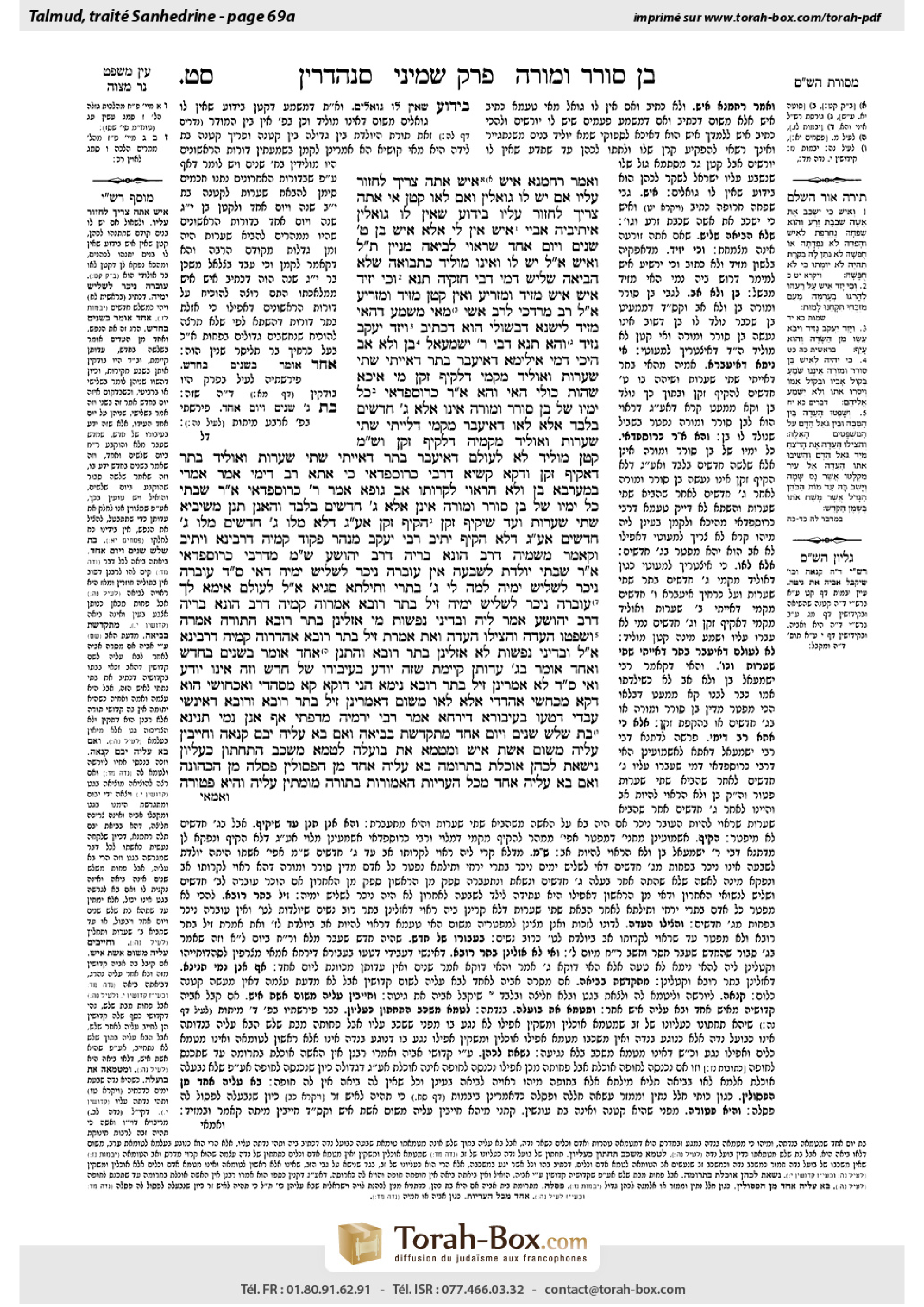
Sanhedrin 69a: Talmud study for Daf Yomi
Daf Yomi is the daily study of one Talmud folio. Explore 37 tractates with scans, Hebrew text, Sefaria English and AI-generated French translations where annotated.
Passage selection and English or AI-generated French translation are available where the scan has annotations. Daf Study is independent of Torah-Box and Sefaria.
Browse Sanhedrin · סנהדרין · All tractatesSanhedrin 69a text and translations
This page of Sanhedrin includes the Aramaic text, an English translation and an AI-generated French translation, alongside the scan above.
סנהדרין ס״ט א · Aramaic and Hebrew text
וְאָמַר רַחֲמָנָא: ״אִישׁ״. אִישׁ – אַתָּה צָרִיךְ לַחֲזוֹר עָלָיו אִם יֵשׁ לוֹ גּוֹאֲלִין וְאִם לָאו. קָטָן – אִי אַתָּה צָרִיךְ לַחֲזוֹר עָלָיו, בְּיָדוּעַ שֶׁאֵין לוֹ גּוֹאֲלִין.
אֵיתִיבֵיהּ אַבָּיֵי: ״אִישׁ״ – אֵין לִי אֶלָּא אִישׁ. בֶּן תֵּשַׁע שָׁנִים וְיוֹם אֶחָד שֶׁרָאוּי לְבִיאָה מִנַּיִין? תַּלְמוּד לוֹמַר: ״וְאִישׁ״.
אֲמַר לֵיהּ: יֵשׁ לוֹ וְאֵינוֹ מוֹלִיד, כִּתְבוּאָה שֶׁלֹּא הֵבִיאָה שְׁלִישׁ דָּמֵי.
דְּבֵי חִזְקִיָּה תָּנָא: ״וְכִי יָזִד אִישׁ״ – אִישׁ מֵזִיד וּמַזְרִיעַ, וְאֵין קָטָן מֵזִיד וּמַזְרִיעַ. אֲמַר לֵיהּ רַב מָרְדֳּכַי לְרַב אָשֵׁי: מַאי מַשְׁמַע דְּהַאי ״מֵזִיד״ לִישָּׁנָא דְּבַשּׁוֹלֵי הוּא? דִּכְתִיב: ״וַיָּזֶד יַעֲקֹב נָזִיד״.
וְהָא תָּנָא דְּבֵי רַבִּי יִשְׁמָעֵאל: ״בֵּן״ – וְלֹא אָב?
הֵיכִי דָמֵי? אִילֵּימָא דְּאִיעַבַּר בָּתַר דְּאַיְיתִי שְׁתֵּי שְׂעָרוֹת, וְאוֹלֵיד מִקַּמֵּי דְּלַקֵּיף זָקָן – מִי אִיכָּא שְׁהוּת כּוּלֵּי הַאי? וְהָא אָמַר רַבִּי כְּרוּסְפָּדַאי: כׇּל יָמָיו שֶׁל בֵּן סוֹרֵר וּמוֹרֶה אֵינוֹ אֶלָּא שְׁלֹשָׁה חֳדָשִׁים בִּלְבַד! אֶלָּא לָאו דְּאִיעַבַּר מִקַּמֵּי דְּלַיְיתֵי שְׁתֵּי שְׂעָרוֹת, וְאוֹלֵיד מִקַּמֵּיהּ דְּלַקֵּיף זָקָן, וּשְׁמַע מִינַּהּ: קָטָן מוֹלֵיד!
לָא, לְעוֹלָם דְּאִיעַבַּר בָּתַר דְּאַיְיתִי שְׁתֵּי שְׂעָרוֹת, וְאוֹלִיד בָּתַר דְּאַקֵּיף זָקָן. וּדְקָא קַשְׁיָא דְּרַבִּי כְּרוּסְפָּדַאי – כִּי אֲתָא רַב דִּימִי אֲמַר: אָמְרִי בְּמַעְרְבָא ״בֵּן״ – וְלֹא הָרָאוּי לִקְרוֹתוֹ אָב.
גּוּפָא, אָמַר רַבִּי כְּרוּסְפָּדַאי אָמַר רַבִּי שַׁבְּתַי: כׇּל יָמָיו שֶׁל בֵּן סוֹרֵר וּמוֹרֶה אֵינָן אֶלָּא שְׁלֹשָׁה חֳדָשִׁים בִּלְבַד. וְהָאֲנַן תְּנַן: מִשֶּׁיָּבִיא שְׁתֵּי שְׂעָרוֹת וְעַד שֶׁיַּקִּיף זָקָן! הִקִּיף זָקָן – אַף עַל גַּב דְּלָא מְלוֹ שְׁלֹשָׁה חֳדָשִׁים. מְלוֹ שְׁלֹשָׁה חֳדָשִׁים – אַף עַל גַּב דְּלֹא הִקִּיף.
יָתֵיב רַבִּי יַעֲקֹב מִנְּהַר פְּקוֹד קַמֵּיהּ דְּרָבִינָא, וְיָתֵיב וְקָאָמַר מִשְּׁמֵיהּ דְּרַב הוּנָא בְּרֵיהּ דְּרַב יְהוֹשֻׁעַ: שְׁמַע מִינַּהּ מִדְּרַבִּי כְּרוּסְפָּדַאי אָמַר רַבִּי שַׁבְּתַי, יוֹלֶדֶת לְשִׁבְעָה אֵין עוּבָּרָהּ נִיכָּר לִשְׁלִישׁ יָמֶיהָ.
דְּאִי סָלְקָא דַעְתָּךְ: עוּבָּרָהּ נִיכָּר לִשְׁלִישׁ יָמֶיהָ, לְמָה לִי שְׁלֹשָׁה? בִּתְרֵי וְתִילְתָּא סַגִּיא!
אֲמַר לֵיהּ: לְעוֹלָם אֵימָא לָךְ, עוּבָּרָהּ נִיכָּר לִשְׁלִישׁ יָמֶיהָ. זִיל בָּתַר רוּבָּא.
אַמְרוּהָ קַמֵּיהּ דְּרַב הוּנָא בְּרֵיהּ דְּרַב יְהוֹשֻׁעַ. אָמַר לֵיהּ: וּבְדִינֵי נְפָשׁוֹת מִי אָזְלִינַן בָּתַר רוּבָּא? הַתּוֹרָה אָמְרָה: ״וְשָׁפְטוּ הָעֵדָה וְהִצִּילוּ הָעֵדָה״, וְאַתְּ אָמְרַתְּ זִיל בָּתַר רוּבָּא?!
אַהְדְּרוּהָ קַמֵּיהּ דְּרָבִינָא. אֲמַר לֵיהּ: וּבְדִינֵי נְפָשׁוֹת לָא אָזְלִינַן בָּתַר רוּבָּא? וְהָתְנַן: אֶחָד אוֹמֵר ״בִּשְׁנַיִם בַּחֹדֶשׁ״ וְאֶחָד אוֹמֵר ״בִּשְׁלֹשָׁה״, עֵדוּתָן קַיֶּימֶת, שֶׁזֶּה יוֹדֵעַ בְּעִיבּוּרוֹ שֶׁל חֹדֶשׁ וְזֶה אֵינוֹ יוֹדֵעַ.
וְאִי סָלְקָא דַּעְתָּךְ לָא אָמְרִינַן זִיל בָּתַר רוּבָּא, נֵימָא: הָנֵי דַּוְקָא קָא מַסְהֲדִי, וְאַכְחוֹשֵׁי הוּא דְּקָא מַכְחֲשִׁי אַהֲדָדֵי! אֶלָּא לָאו מִשּׁוּם דְּאָמְרִינַן זִיל בָּתַר רוּבָּא, וְרוּבָּא דְאִינָשֵׁי עֲבִדִי דְּטָעוּ בְּעִיבּוּרָא דְּיַרְחָא!
אָמַר רַבִּי יִרְמְיָה מִדִּפְתִּי: אַף אֲנַן נָמֵי תְּנֵינָא, בַּת שָׁלֹשׁ שָׁנִים וְיוֹם אֶחָד מִתְקַדֶּשֶׁת בְּבִיאָה, וְאִם בָּא עָלֶיהָ יָבָם – קְנָאָהּ, וְחַיָּיבִין עָלֶיהָ מִשּׁוּם אֵשֶׁת אִישׁ.
וּמְטַמְּאָה אֶת בּוֹעֲלָהּ, לְטַמֵּא מִשְׁכָּב הַתַּחְתּוֹן כְּעֶלְיוֹן. נִישֵּׂאת לַכֹּהֵן – אוֹכֶלֶת בִּתְרוּמָה. בָּא עָלֶיהָ אֶחָד מִן הַפְּסוּלִין – פְּסָלָהּ מִן הַכְּהוּנָּה. וְאִם בָּא עָלֶיהָ אֶחָד מִכׇּל הָעֲרָיוֹת הָאֲמוּרוֹת בְּתוֹרָה – מוּמָתִין עָלֶיהָ, וְהִיא פְּטוּרָה.
Sanhedrin 69a · English translation
And the Merciful One states: “But if the man has no relative,” teaching that it is only in the case of a convert who is a man that you must go around seeking whether or not he has relatives, i.e., children who were born to him after his conversion. But in the case of a convert who is a minor, you do not have to go around searching for relatives; it is known that he has no relative, since a minor cannot father a child.
Abaye raised an objection to Rabba from a baraita discussing a designated maidservant, about whom the verse states: “And if a man lies carnally with a woman who is a maidservant designated to a man, and not fully redeemed, nor freedom given her, inquiry shall be made; they shall not be put to death, because she was not free” (Leviticus 19:20). From the word “man,” I have derived only that this halakha applies to an adult man. But as for a minor aged nine years and one day, who is fit for engaging in intercourse, from where is it derived that he too is subject to this halakha? The verse states: “And if a man.” The extraneous letter vav, meaning “and,” serves to include a minor who is nine years old, as already at that age he can perform complete intercourse.
Rabba said to Abaye: There is no proof from here, as even though a nine-year-old boy has sperm, he cannot father a child. His sperm is like the seed of grain that was cut even though it had not yet reached one-third of its growth. Such seed, even if planted, will not grow.
A Sage of the school of Ḥizkiyya taught: The verse states: “But if a man comes intentionally [yazid] against his neighbor, to slay him with guile, you shall take him from My altar, that he may die” (Exodus 21:14). The use of the term yazid in this context and its juxtaposition to the word “man” teaches that a man can heat [mezid] himself up and produce viable sperm, but a minor cannot heat himself up and produce viable sperm. Therefore, even though a minor can engage in full intercourse with a woman, he cannot father a child. Rav Mordekhai said to Rav Ashi: From where may it be inferred that this word mezid is a term meaning heating up? As it is written in a different verse: “And Jacob cooked [vayyazed] pottage” (Genesis 25:29).
The Gemara asks: But didn’t the school of Rabbi Yishmael teach the following baraita concerning a stubborn and rebellious son: The verse that states: “If a man has a stubborn and rebellious son,” teaches that a son can become a stubborn and rebellious son, but not a father, so that one who has a child cannot be sentenced as a stubborn and rebellious son.
The Gemara asks: What are the circumstances? If we say that his wife conceived after he grew two pubic hairs and the baby was born before he grew a beard around his genitals, is there such a long interval between these two times to allow for carrying the child to term? But doesn’t Rabbi Kruspedai say: The entire time during which it is possible to judge and sentence a stubborn and rebellious son is only three months, the time between the appearance of two pubic hairs and the growth of a beard around the genitals? Consequently, it is impossible for a child to be born to the stubborn and rebellious son during this period. Rather, is it not that his wife conceived before he grew two pubic hairs, and the baby was born before he grew a beard around his genitals? And you can learn from it that a minor can, in fact, father a child.
The Gemara rejects this reasoning: No, actually, you can explain that his wife conceived only after he grew two pubic hairs, and the baby was born after he grew a beard around his genitals. And as for that which is difficult for you based on the statement of Rabbi Kruspedai that the halakha governing a stubborn and rebellious son applies for only three months, it can be explained as follows: When Rav Dimi came from Eretz Yisrael to Babylonia, he said that they say in the West, Eretz Yisrael, that the term “son” teaches that only a son can become a stubborn and rebellious son, but not one who is fit to be called a father. That is to say, the verse does not exclude someone whose child was born during this period, but rather one whose wife conceived during this time, so that he is fit to be called a father.
§ Returning to the matter itself: Rabbi Kruspedai says that Rabbi Shabbtai says: The entire time during which it is possible to judge and sentence a stubborn and rebellious son is only three months. The Gemara asks: But didn’t we learn in the mishna that a boy can be judged as a stubborn and rebellious son from when he grows two pubic hairs until he grows a beard around his genitals? This seems to indicate that his liability depends on his physical maturity, and not on any specific time period. The Gemara answers: If he grew a beard around his genitals, then even if three months have not passed, he can no longer become liable as a stubborn and rebellious son. And if three months passed, then even if he has not grown a beard around his genitals, he is similarly exempt.
Rabbi Ya’akov from Nehar Pekod sat before Ravina and sat and said in the name of Rav Huna, son of Rav Yehoshua: Learn from the statement that Rabbi Kruspedai says that Rabbi Shabbtai says that when a woman gives birth at seven months, her fetus cannot yet be discerned after one-third of her days of pregnancy. In a nine-month pregnancy, the fetus can be discerned after three months, which is one-third of the pregnancy. In the case of a pregnancy that lasts seven months, the fetus cannot be discerned at the end of one-third of the pregnancy, i.e., after two and one-third months, but after three months, as in a standard nine-month pregnancy.
Rabbi Ya’akov explains the inference: As if it enters your mind that when a woman gives birth at seven months, her fetus can already be discerned after one-third of her days of pregnancy, i.e., after two and one-third months, why do I need three months from the time the boy reaches adulthood until the end of the time that he can become liable as a stubborn and rebellious son? A period of two and one-third months should suffice. If he engaged in intercourse with a woman immediately upon reaching adulthood and the intercourse resulted in a seven-month pregnancy, the fetus would be able to be discerned after two and one-third months, and he would be fit to be called a father already from then. From the statement of Rabbi Kruspedai, citing Rabbi Shabbtai, it is clear that the earliest time the fetus can be discerned is after three months of the pregnancy have passed.
Ravina said to Rabbi Ya’akov: Actually, I could say to you that even when a woman gives birth at seven months, her fetus can already be discerned after one-third of her days of pregnancy. But the halakha with regard to a stubborn and rebellious son was not adjusted accordingly because of the principle that one follows the majority. Most women give birth at nine months, and their fetuses are discernible only after three months. Therefore, the fact that one would be fit to be called a father in the case of a seven-month pregnancy is disregarded.
The Sages stated this answer before Rav Huna, son of Rav Yehoshua, whereupon he said to them: But do we blindly follow the majority in cases of capital law and not judge each case on its own merits? Doesn’t the Torah state: “And the congregation shall judge…and the congregation shall deliver” (Numbers 35:24–25), from which it is derived that the court must make every effort to find exculpatory arguments in support of the accused; and yet you say that one follows the majority? If it is possible that already after two and one-third months the stubborn and rebellious son will be fit to be called a father, from that time on he should be exempt from punishment.
The Sages then brought Rav Huna’s analysis back to Ravina and presented it before him. Ravina said to them: And do we not follow the majority in cases of capital law? But didn’t we learn in the mishna (Sanhedrin 40a): If one witness says that the event occurred on the second of the month, and one witness says that the event occurred on the third of the month, this is not regarded as a contradiction and their testimony stands, since it is possible to say that this witness knows of the addition of a day to the previous month, and according to his tally the event occurred on the second of the month, and that witness does not know of the addition of a day to the previous month, and according to his tally the event occurred on the third of the month.
And if it enters your mind that we do not say that one follows the majority in cases of capital law, let us then say that these witnesses are testifying with precision, and that they contradict each other, and therefore the accused should be acquitted. Rather, is it not because we say that one follows the majority, and the majority of people are apt to err with regard to the addition of an extra day to the month?
Rabbi Yirmeya of Difti says: We learn in another mishna (Nidda 44b) as well that one follows the majority even in cases of capital law: A girl who is three years and one day old whose father arranged her betrothal can be betrothed with intercourse, as, despite her age, the legal status of intercourse with her is that of full-fledged intercourse. And in a case where the childless husband of a girl three years and one day old dies, if his brother, the yavam, engages in intercourse with her, he acquires her as his wife. And if a girl of that age is married, a man other than her husband is liable for engaging in intercourse with her due to violation of the prohibition against adultery, as despite her age she is legally considered to be a married woman.
The mishna continues: And if she is impure due to menstruation, she transmits impurity to one who engages in intercourse with her, who then renders all the items designated for lying beneath him impure like the items designated for lying above him. If she marries a priest, she may partake of teruma like any other wife of a priest. If she is unmarried and one of the men who is unfit for the priesthood, e.g., a mamzer or ḥalal, engaged in intercourse with her, he has disqualified her from marrying into the priesthood, and if she is the daughter of a priest, she is disqualified from partaking of teruma. And if one of any of those with whom relations are forbidden, which are enumerated in the Torah, engaged in intercourse with her, e.g., her father or father-in-law, the man is executed by the court for engaging in intercourse with her, and she is exempt because she is a minor.
Sanhedrin 69a · Traduction française (IA)
Et le Tout-Puissant déclare : « Mais si l'homme n'a pas de parent », enseignant qu'il n'est que dans le cas d'un converti qui est un homme qu'il faut se mettre en quête de savoir s'il a des parents ou non, c'est-à-dire des enfants qui lui sont nés après sa conversion. Mais dans le cas d'un converti qui est un mineur, vous n'avez pas à vous mettre en quête de parents ; il est connu qu'il n'a pas de parent, puisque un mineur ne peut pas engendrer d'enfant.
Abaye a soulevé une objection à Rabba à partir d'une baraïta discutant d'une servante désignée, au sujet de laquelle le verset déclare : « Et si un homme couche charnellement avec une femme qui est une servante désignée à un homme, et qui n'est pas entièrement rachetée, ni à qui la liberté n'a été donnée, on fera enquête ; ils ne seront pas mis à mort, parce qu'elle n'était pas libre » (Lévitique 19:20). À partir du mot « homme », j'ai déduit seulement que cette halakha s'applique à un homme adulte. Mais quant à un mineur âgé de neuf ans et un jour, qui est apte à s'engager dans des rapports sexuels, d'où est-il déduit qu'il est lui aussi soumis à cette halakha ? Le verset déclare : « Et si un homme ». La lettre vav superflue, signifiant « et », sert à inclure un mineur qui a neuf ans, car dès cet âge, il peut accomplir des rapports sexuels complets.
Rabba a dit à Abaye : Il n'y a pas de preuve ici, car bien qu'un garçon de neuf ans ait du sperme, il ne peut pas engendrer d'enfant. Son sperme est comme la graine de blé qui a été coupée bien qu'elle n'ait pas encore atteint le tiers de sa croissance. Une telle graine, même si elle est plantée, ne poussera pas.
Un Sage de l'école de Ḥizkiyya a enseigné : Le verset déclare : « Mais si un homme agit intentionnellement [yazid] contre son prochain, pour le tuer avec ruse, tu le prendras de Mon autel, afin qu'il meure » (Exode 21:14). L'usage du terme yazid dans ce contexte et sa juxtaposition avec le mot « homme » enseignent qu'un homme peut s'échauffer [mezid] et produire du sperme viable, mais qu'un mineur ne peut pas s'échauffer et produire du sperme viable. Par conséquent, bien qu'un mineur puisse avoir des rapports sexuels complets avec une femme, il ne peut pas engendrer d'enfant. Rav Mordekhai a dit à Rav Ashi : D'où peut-on inférer que ce mot mezid est un terme signifiant s'échauffer ? Comme il est écrit dans un autre verset : « Et Jacob fit cuire [vayyazed] une bouillie » (Genèse 25:29).
La Guemara demande : Mais l'école de Rabbi Yishmael n'a-t-elle pas enseigné la baraïta suivante concernant le fils rétif et rebelle : Le verset qui déclare : « Si un homme a un fils rétif et rebelle », enseigne qu'un fils peut devenir un fils rétif et rebelle, mais pas un père, de sorte que celui qui a un enfant ne peut pas être condamné comme fils rétif et rebelle.
La Guemara demande : Quelles sont les circonstances ? Si nous disons que sa femme a conçu après qu'il ait poussé deux poils pubiens et que le bébé est né avant qu'il ait poussé une barbe autour de ses organes génitaux, y a-t-il un tel long intervalle entre ces deux moments pour permettre de porter l'enfant à terme ? Mais Rabbi Kruspedai ne dit-il pas : Tout le temps pendant lequel il est possible de juger et de condamner un fils rétif et rebelle n'est que de trois mois, le temps entre l'apparition de deux poils pubiens et la croissance d'une barbe autour des organes génitaux ? Par conséquent, il est impossible qu'un enfant naisse au fils rétif et rebelle pendant cette période. Plutôt, n'est-ce pas que sa femme a conçu avant qu'il ait poussé deux poils pubiens, et que le bébé est né avant qu'il ait poussé une barbe autour de ses organes génitaux ? Et vous pouvez en apprendre qu'un mineur peut, en fait, engendrer un enfant.
La Guemara rejette ce raisonnement : Non, en réalité, on peut expliquer que sa femme a conçu seulement après qu'il ait poussé deux poils pubiens, et que l'enfant est né après qu'il ait poussé une barbe autour de ses organes génitaux. Et quant à ce qui vous pose difficulté, fondé sur l'affirmation de Rabbi Kruspedai selon laquelle la halakha régissant le fils rétif et rebelle ne s'applique que pendant trois mois, cela peut s'expliquer ainsi : Lorsque Rav Dimi est venu d'Eretz Yisrael en Babylone, il a dit qu'on dit à l'Ouest, en Eretz Yisrael, que le terme « fils » enseigne que seul un fils peut devenir un fils rétif et rebelle, mais pas celui qui est apte à être appelé père. Autrement dit, le verset n'exclut pas celui dont l'enfant est né pendant cette période, mais plutôt celui dont la femme a conçu pendant ce temps, de sorte qu'il est apte à être appelé père.
§ Revenant à la question elle-même : Rabbi Kruspedai dit que Rabbi Shabbtai dit : La totalité du temps pendant lequel il est possible de juger et de condamner un fils rétif et rebelle n'est que de trois mois. La Guemara demande : Mais n'avons-nous pas appris dans la Michna qu'un garçon peut être jugé comme fils rétif et rebelle depuis qu'il pousse deux poils pubiens jusqu'à ce qu'il pousse une barbe autour de ses organes génitaux ? Cela semble indiquer que sa responsabilité dépend de sa maturité physique, et non d'une période de temps spécifique. La Guemara répond : S'il a poussé une barbe autour de ses organes génitaux, alors même si trois mois ne se sont pas écoulés, il ne peut plus devenir responsable en tant que fils rétif et rebelle. Et si trois mois se sont écoulés, alors même s'il n'a pas poussé de barbe autour de ses organes génitaux, il est de même exempt.
Rabbi Ya’akov de Nehar Pekod s’assit devant Ravina et, demeurant assis, déclara au nom de Rav Huna, fils de Rav Yehoshua : Tirez-en la leçon de l’affirmation de Rabbi Kruspedai, qui rapporte que Rabbi Shabbtaï dit que lorsqu’une femme accouche au septième mois, son fœtus ne peut pas encore être discerné après le tiers de ses jours de grossesse. Dans une grossesse de neuf mois, le fœtus peut être discerné après trois mois, soit le tiers de la grossesse. Dans le cas d’une grossesse qui dure sept mois, le fœtus ne peut pas être discerné à la fin du tiers de la grossesse, c’est-à-dire après deux mois et un tiers, mais seulement après trois mois, comme dans une grossesse standard de neuf mois.
Rabbi Ya’akov explique le raisonnement : Si l’on pouvait penser que lorsqu’une femme accouche au septième mois, son fœtus est déjà discernable après le tiers de ses jours de grossesse, c’est-à-dire après deux mois et un tiers, pourquoi ai-je besoin de trois mois à partir du moment où le garçon atteint l’âge adulte jusqu’à la fin de la période durant laquelle il peut devenir passible de la peine en tant que fils rétif et rebelle ? Une période de deux mois et un tiers devrait suffire. S’il a eu des rapports avec une femme immédiatement après avoir atteint l’âge adulte et que ces rapports ont entraîné une grossesse de sept mois, le fœtus serait discernable après deux mois et un tiers, et il serait apte à être appelé père dès ce moment. De la déclaration de Rabbi Kruspedai, citant Rabbi Shabbtaï, il est clair que le moment le plus précoce où le fœtus peut être discerné est après trois mois de grossesse.
Ravina dit à Rabbi Ya’akov : En réalité, je pourrais vous dire que même lorsqu’une femme accouche au septième mois, son fœtus est déjà discernable après le tiers de sa durée de grossesse. Mais la halakha concernant le fils rétif et rebelle n’a pas été ajustée en conséquence en raison du principe selon lequel on suit la majorité. La plupart des femmes accouchent au neuvième mois, et leurs fœtus ne sont discernables qu’après trois mois. Par conséquent, le fait qu’un homme serait apte à être appelé père dans le cas d’une grossesse de sept mois est ignoré.
Les Sages ont présenté cette réponse devant Rav Huna, fils de Rav Yehoshua, qui leur a alors dit : Mais suivons-nous aveuglément la majorité dans les cas de droit pénal et ne jugeons-nous pas chaque cas sur ses propres mérites ? La Torah ne déclare-t-elle pas : « Et l’assemblée jugera… et l’assemblée livrera » (Nombres 35:24-25), d’où il est dérivé que le tribunal doit faire tous les efforts possibles pour trouver des arguments d’acquittement en faveur de l’accusé ; et pourtant vous dites que l’on suit la majorité ? S’il est possible que déjà après deux mois et un tiers le fils rétif et rebelle soit apte à être appelé père, il devrait être exempt de punition à partir de ce moment.
Les Sages ont alors rapporté l’analyse de Rav Huna à Ravina et la lui ont présentée. Ravina leur a dit : Et ne suivons-nous pas la majorité dans les cas de droit pénal ? Mais n’avons-nous pas appris dans la Michna (Sanhedrin 40a) : Si un témoin dit que l’événement s’est produit le deuxième jour du mois, et un autre témoin dit que l’événement s’est produit le troisième jour du mois, cela n’est pas considéré comme une contradiction et leur témoignage est valable, car il est possible de dire que ce témoin connaît l’ajout d’un jour au mois précédent, et selon son décompte l’événement s’est produit le deuxième jour du mois, et que l’autre témoin ne connaît pas l’ajout d’un jour au mois précédent, et selon son décompte l’événement s’est produit le troisième jour du mois.
Et si l’on pouvait penser que nous ne disons pas que l’on suit la majorité dans les cas de droit pénal, disons alors que ces témoins témoignent avec précision, et qu’ils se contredisent mutuellement, et par conséquent l’accusé devrait être acquitté. Au contraire, n’est-ce pas parce que nous disons que l’on suit la majorité, et que la majorité des gens est susceptible de se tromper concernant l’ajout d’un jour supplémentaire au mois ?
Rabbi Yirmeya de Difti dit : Nous apprenons dans une autre Michna (Nidda 44b) également que l’on suit la majorité même dans les cas de droit pénal : Une fille âgée de trois ans et un jour dont le père a arrangé ses fiançailles peut être fiancée par des rapports sexuels, car, malgré son âge, le statut juridique des rapports avec elle est celui de rapports pleinement établis. Et dans un cas où le mari sans enfant d’une fille âgée de trois ans et un jour meurt, si son frère, le yavam, a des rapports avec elle, il l’acquiert comme épouse. Et si une fille de cet âge est mariée, un homme autre que son mari est passible de la peine pour avoir eu des rapports avec elle en raison de la violation de l’interdiction de l’adultère, car malgré son âge elle est juridiquement considérée comme une femme mariée.
La Michna continue : Et si elle est impure en raison de ses menstruations, elle transmet l'impureté à celui qui a des rapports avec elle, qui rend alors impurs tous les objets destinés à être placés sous lui, de la même manière que les objets destinés à être placés au-dessus de lui. Si elle épouse un prêtre, elle peut consommer la terouma comme toute autre épouse d'un prêtre. Si elle est célibataire et que l'un des hommes inaptes au sacerdoce, par exemple un mamzer ou un ḥalal, a eu des rapports avec elle, il l'a disqualifiée pour le mariage dans le sacerdoce, et si elle est la fille d'un prêtre, elle est disqualifiée pour consommer la terouma. Et si l'un de ceux avec qui les relations sont interdites, qui sont énumérés dans la Torah écrite, a eu des rapports avec elle, par exemple son père ou son beau-père, l'homme est exécuté par le tribunal pour avoir eu des rapports avec elle, et elle est exemptée parce qu'elle est mineure.
Traduction française générée par IA à partir de l’édition anglaise de Sefaria. Vérifie toujours un passage avec le texte source.
Text from Sefaria: William Davidson Edition - Vocalized Aramaic (CC BY NC); William Davidson Edition - English (CC BY NC).