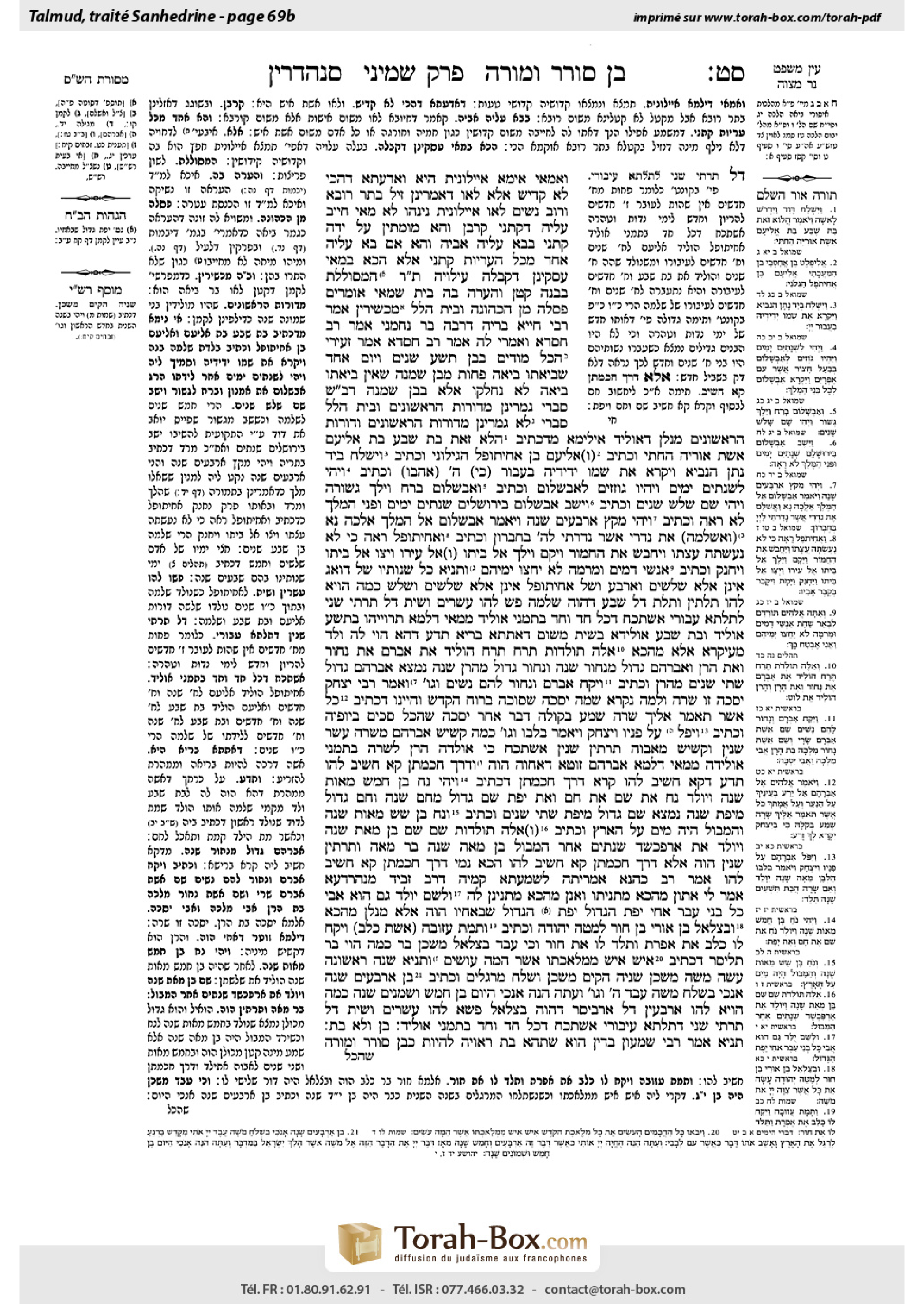
Sanhedrin 69b: Talmud study for Daf Yomi
Daf Yomi is the daily study of one Talmud folio. Explore 37 tractates with scans, Hebrew text, Sefaria English and AI-generated French translations where annotated.
Passage selection and English or AI-generated French translation are available where the scan has annotations. Daf Study is independent of Torah-Box and Sefaria.
Browse Sanhedrin · סנהדרין · All tractatesSanhedrin 69b text and translations
This page of Sanhedrin includes the Aramaic text, an English translation and an AI-generated French translation, alongside the scan above.
סנהדרין ס״ט ב · Aramaic and Hebrew text
אַמַּאי? אֵימָא: אַיְילוֹנִית הִיא, וְאַדַּעְתָּא דְּהָכִי לָא קַדֵּישׁ! אֶלָּא, לָאו דְּאָמְרִינַן: זִיל בָּתַר רוּבָּא, וְרוֹב נָשִׁים לָאו אַיְילוֹנִית נִינְהוּ.
לָא, מַאי ״חַיָּיב עָלֶיהָ״ דְּקָתָנֵי? קׇרְבָּן.
וְהָא ״מוּמָתִין עַל יָדָהּ״ קָתָנֵי? בְּבָא עָלֶיהָ אָבִיהָ.
וְהָא ״אִם בָּא עָלֶיהָ אֶחָד מִכׇּל הָעֲרָיוֹת״ קָתָנֵי? אֶלָּא, הָכָא בְּמַאי עָסְקִינַן: דְּקַבְּלַהּ עִילָּוֵיהּ.
תָּנוּ רַבָּנַן: הַמְסוֹלֶלֶת בִּבְנָהּ קָטָן, וְהֶעֱרָה בָּהּ – בֵּית שַׁמַּאי אוֹמְרִים: פְּסָלָהּ מִן הַכְּהוּנָּה, וּבֵית הִלֵּל מַכְשִׁירִין.
אָמַר רַבִּי חִיָּיא בְּרֵיהּ דְּרַבָּה בַּר נַחְמָנִי: אָמַר רַב חִסְדָּא, וְאָמְרִי לַהּ אָמַר רַב חִסְדָּא אָמַר זְעֵירִי: הַכֹּל מוֹדִים בְּבֶן תֵּשַׁע שָׁנִים וְיוֹם אֶחָד שֶׁבִּיאָתוֹ בִּיאָה, פָּחוֹת מִבֶּן שְׁמֹנֶה שֶׁאֵין בִּיאָתוֹ בִּיאָה. לֹא נֶחְלְקוּ אֶלָּא בְּבֶן שְׁמֹנֶה, דְּבֵית שַׁמַּאי סָבְרִי: גָּמְרִינַן מִדּוֹרוֹת הָרִאשׁוֹנִים, וּבֵית הִלֵּל סָבְרִי: לָא גָּמְרִינַן מִדּוֹרוֹת הָרִאשׁוֹנִים.
וְדוֹרוֹת הָרִאשׁוֹנִים מְנָלַן דְּאוֹלִיד? אִילֵּימָא מִדִּכְתִיב: ״הֲלוֹא זֹאת בַּת שֶׁבַע בַּת אֱלִיעָם אֵשֶׁת אוּרִיָּה הַחִתִּי״, וּכְתִיב: ״אֱלִיעָם בֶּן אֲחִיתֹפֶל הַגִּלֹנִי״, וּכְתִיב: ״וַיִּשְׁלַח בְּיַד נָתָן הַנָּבִיא וַיִּקְרָא אֶת שְׁמוֹ יְדִידְיָהּ בַּעֲבוּר (כִּי) ה׳ (אֲהֵבוֹ)״.
וּכְתִיב: ״וַיְהִי לִשְׁנָתַיִם יָמִים וַיִּהְיוּ גֹזְזִים לְאַבְשָׁלוֹם״, וּכְתִיב: ״וְאַבְשָׁלוֹם בָּרַח וַיֵּלֶךְ גְּשׁוּרָה וַיְהִי שָׁם שָׁלֹשׁ שָׁנִים״.
וּכְתִיב: ״וַיֵּשֶׁב אַבְשָׁלוֹם בִּירוּשָׁלִַים שְׁנָתַיִם יָמִים וּפְנֵי הַמֶּלֶךְ לֹא רָאָה״. וּכְתִיב: ״וַיְהִי מִקֵּץ אַרְבָּעִים שָׁנָה וַיֹּאמֶר אַבְשָׁלוֹם אֶל הַמֶּלֶךְ אֵלְכָה נָּא וַאֲשַׁלְּמָה אֶת נִדְרִי אֲשֶׁר נָדַרְתִּי לַה׳ בְּחֶבְרוֹן״. וּכְתִיב: ״וַאֲחִיתֹפֶל רָאָה כִּי לֹא נֶעֶשְׂתָה עֲצָתוֹ וַיַּחֲבֹשׁ אֶת הַחֲמוֹר וַיָּקׇם וַיֵּלֶךְ אֶל בֵּיתוֹ וְאֶל עִירוֹ וַיְצַו אֶל בֵּיתוֹ וַיֵּחָנַק״.
וּכְתִיב: ״אַנְשֵׁי דָמִים וּמִרְמָה לֹא יֶחֱצוּ יְמֵיהֶם״. וְתַנְיָא: כׇּל שְׁנוֹתָיו שֶׁל דּוֹאֵג אֵינָן אֶלָּא שְׁלֹשִׁים וְאַרְבַּע, וְשֶׁל אֲחִיתֹפֶל אֵינָן אֶלָּא שְׁלֹשִׁים וְשָׁלֹשׁ. כַּמָּה הָוְיָא לְהוּ? תְּלָתִין וּתְלָת. דַּל שְׁבַע דַּהֲוָה שְׁלֹמֹה, פָּשׁ לְהוּ עֶשְׂרִים וְשֵׁית. דַּל תַּרְתֵּי שְׁנֵי לִתְלָתָא עִבּוּרֵי, אִשְׁתְּכַח דְּכֹל חַד וְחַד בְּתַמְנֵי אוֹלֵיד.
מִמַּאי? דִּלְמָא תַּרְוַיְיהוּ בִּתְשַׁע אוֹלֵיד, וּבַת שֶׁבַע אוֹלִידָא בְּשֵׁית, מִשּׁוּם דְּאִיתְּתָא בָּרְיָא. תֵּדַע, דְּהָא הֲוַי לַהּ וָלָד מֵעִיקָּרָא.
אֶלָּא מֵהָכָא: ״אֵלֶּה תּוֹלְדֹת תֶּרַח תֶּרַח הוֹלִיד אֶת אַבְרָם אֶת נָחוֹר וְאֶת הָרָן״. וְאַבְרָהָם גָּדוֹל מִנָּחוֹר שָׁנָה, וְנָחוֹר גָּדוֹל מֵהָרָן שָׁנָה. נִמְצָא אַבְרָהָם גָּדוֹל שְׁתֵּי שָׁנִים מֵהָרָן. וּכְתִיב: ״וַיִּקַּח אַבְרָם וְנָחוֹר לָהֶם נָשִׁים וְגוֹ׳״.
וְאָמַר רַבִּי יִצְחָק: ״יִסְכָּה״ זוֹ שָׂרָה, וְלָמָּה נִקְרָא שְׁמָהּ ״יִסְכָּה״? שֶׁסּוֹכָה בְּרוּחַ הַקֹּדֶשׁ. וְהַיְינוּ דִּכְתִיב: ״כֹּל אֲשֶׁר תֹּאמַר אֵלֶיךָ שָׂרָה שְׁמַע בְּקֹלָהּ״. דָּבָר אַחֵר: ״יִסְכָּה״ – שֶׁהַכֹּל סָכִים בְּיוֹפְיָהּ. וּכְתִיב: ״וַיִּפֹּל [אַבְרָהָם] עַל פָּנָיו וַיִּצְחָק וַיֹּאמֶר בְּלִבּוֹ וְגוֹ׳״. כַּמָּה קַשִּׁישׁ אַבְרָהָם מִשָּׂרָה? עֲשַׂר שְׁנִין. וְקַשִּׁישׁ מֵאֲבוּהּ תַּרְתֵּין שְׁנִין. אִשְׁתְּכַח כִּי אוֹלְדַהּ הָרָן לְשָׂרָה בְּתַמְנֵי אוֹלְדַהּ.
מִמַּאי? דִּלְמָא אַבְרָהָם זוּטָא דַּאֲחוּהּ הֲוָה, וְדֶרֶךְ חׇכְמָתָן קָא חָשֵׁיב לְהוּ.
תֵּדַע דְּקָא חָשֵׁיב לְהוּ קְרָא דֶּרֶךְ חׇכְמָתָן, וּכְתִיב: ״וַיְהִי נֹחַ בֶּן חֲמֵשׁ מֵאוֹת שָׁנָה וַיּוֹלֶד נֹחַ אֶת שֵׁם אֶת חָם וְאֶת יָפֶת״. שֵׁם גָּדוֹל מֵחָם שָׁנָה, וְחָם גָּדוֹל מִיֶּפֶת שָׁנָה. נִמְצָא שֵׁם גָּדוֹל מִיֶּפֶת שְׁתֵּי שָׁנִים. וּכְתִיב: ״וְנֹחַ בֶּן שֵׁשׁ מֵאוֹת שָׁנָה וְהַמַּבּוּל הָיָה מַיִם עַל הָאָרֶץ״. וּכְתִיב: ״(וְאֵלֶּה) תּוֹלְדֹת שֵׁם שֵׁם בֶּן מְאַת שָׁנָה וַיּוֹלֶד אֶת אַרְפַּכְשָׁד שְׁנָתַיִם אַחַר הַמַּבּוּל״. בֶּן מֵאָה שָׁנָה? בַּר מְאָה וְתַרְתֵּין שְׁנִין הֲוָה!
אֶלָּא, דֶּרֶךְ חׇכְמָתָן קָא חָשֵׁיב לְהוּ. הָכָא נָמֵי, דֶּרֶךְ חׇכְמָתָן קָא חָשֵׁיב לְהוּ.
אָמַר רַב כָּהֲנָא: אַמְרִיתַהּ לִשְׁמַעְתָּא קַמֵּיהּ דְּרַב זְבִיד מִנְּהַרְדְּעָא. אָמַר לִי: אַתּוּן מֵהָכָא מַתְנִיתוּ, וַאֲנַן מֵהָכָא מַתְנֵינַן לַהּ: ״וּלְשֵׁם יֻלַּד גַּם הוּא אֲבִי כׇּל בְּנֵי עֵבֶר אֲחִי יֶפֶת הַגָּדוֹל״. יֶפֶת הַגָּדוֹל שֶׁבְּאֶחָיו הֲוָה.
אֶלָּא מְנָלַן? מֵהָכָא: ״וּבְצַלְאֵל בֶּן אוּרִי בֶן חוּר לְמַטֵּה יְהוּדָה״, וּכְתִיב: ״וַתָּמׇת עֲזוּבָה אֵשֶׁת כָּלֵב וַיִּקַּח לוֹ כָלֵב אֶת אֶפְרָת וַתֵּלֶד לוֹ אֶת חוּר״. וְכִי עֲבַד בְּצַלְאֵל מִשְׁכָּן בַּר כַּמָּה הָוֵי? בַּר תְּלֵיסַר, דִּכְתִיב: ״אִישׁ אִישׁ מִמְּלַאכְתּוֹ אֲשֶׁר הֵמָּה עֹשִׂים״. וְתַנְיָא: שָׁנָה רִאשׁוֹנָה עָשָׂה מֹשֶׁה מִשְׁכָּן, שְׁנִיָּה הֵקִים מִשְׁכָּן וְשָׁלַח מְרַגְּלִים.
וּכְתִיב: ״בֶּן אַרְבָּעִים שָׁנָה אָנֹכִי בִּשְׁלֹחַ מֹשֶׁה עֶבֶד ה׳ וְגוֹ׳״, ״וְעַתָּה הִנֵּה אָנֹכִי הַיּוֹם בֶּן חָמֵשׁ וּשְׁמֹנִים שָׁנָה״. כַּמָּה הָוְיָא לְהוּ? אַרְבְּעִין. דַּל אַרְבֵּיסַר דַּהֲוָה בְּצַלְאֵל, פָּשָׁא לְהוּ עֶשְׂרִים וְשֵׁית. דַּל תַּרְתֵּי שְׁנֵי דִּתְלָתָא עִיבּוּרֵי, אִשְׁתְּכַח דְּכֹל חַד וְחַד בְּתַמְנֵי אוֹלֵיד.
בֵּן, וְלֹא בַּת. תַּנְיָא: אָמַר רַבִּי שִׁמְעוֹן: בְּדִין הוּא שֶׁתְּהֵא בַּת רְאוּיָה לִהְיוֹת כְּבֵן סוֹרֵר וּמוֹרֶה,
Sanhedrin 69b · English translation
Rabbi Yirmeya of Difti explains how this mishna demonstrates that one follows the majority even in cases of capital law: Why is a man who engaged in intercourse with a three-year-old girl who was married to another man liable to receive the death penalty? Say that perhaps it will turn out that she is a sexually underdeveloped woman [ailonit] who is incapable of bearing children, and her husband did not betroth her with this understanding; and consequently the marriage is null, as it was entered into in error. Therefore, a man who engaged in intercourse with her should not be liable to receive the death penalty for adultery. Rather, is it not that we say that one follows the majority, and the majority of women are not sexually underdeveloped women, and therefore the assumption is that the betrothal was valid? This is proof that even in cases of capital law one follows the majority.
The Gemara refutes this claim: No; rather, what is the meaning of that which is taught in the mishna: And if she is married, a man other than her husband is liable for engaging in intercourse with her due to violation of the prohibition against intercourse with a married woman? This means that if a man unwittingly engaged in intercourse with a three-year-old girl who was married to another man, he is liable to bring a sin-offering, but there is no liability to receive the death penalty based on a majority.
The Gemara asks: But wasn’t it taught in the mishna: And if one of any of those with whom relations are forbidden, which are enumerated in the Torah, engaged in intercourse with her, the man is executed by the court for engaging in intercourse with her? The Gemara answers: This is referring to a case where her father or some other close relative engaged in intercourse with her, so that the prohibition is incest, rather than adultery.
The Gemara asks: But wasn’t it taught: If one of any of those with whom relations are forbidden engaged in intercourse with her, the man is executed by the court for engaging in intercourse with her? This seems to indicate that the death penalty is imposed for all types of forbidden intercourse with a three-year-old girl, even if the intercourse is forbidden as a result of her being married. The Gemara refutes this claim: Rather, what are we dealing with here? With a case where the husband explicitly accepted her upon himself as his wife even if she turns out to be a sexually undeveloped woman. Therefore, another man who engages in intercourse with her is liable to receive the death penalty even if he is not one of her close relatives.
§ The Sages taught in a baraita: If a woman was acting lewdly with her minor son and he performed the initial stage of intercourse with her, Beit Shammai say that he has thereby disqualified her from marrying into the priesthood. And Beit Hillel deem her fit to marry into the priesthood, because they maintain that the intercourse of a minor is not regarded as intercourse.
Rabbi Ḥiyya, son of Rabba bar Naḥmani, says that Rav Ḥisda says, and some say that Rav Ḥisda says that Ze’eiri says: All, i.e., both Beit Shammai and Beit Hillel, concede with regard to a boy nine years and one day old that his intercourse is regarded as intercourse and disqualifies a woman from marrying into the priesthood as well as results in her liability to receive the death penalty, even though he himself is not liable to receive it. And they also all concede concerning a boy less than eight years old that his intercourse is not regarded as intercourse vis-à-vis these halakhot. They disagree only about a boy who is eight years old, as Beit Shammai maintain that we learn from earlier generations, when people were able to father children at that age, and we apply that reality to the present; and Beit Hillel maintain that we do not learn from earlier generations.
The Gemara asks: And from where do we derive that in earlier generations men fathered children at this age? If we say that we know this from the following calculation: It is written: “Is this not Bathsheba, daughter of Eliam, wife of Uriah the Hittite?” (II Samuel 11:3). And it is also written: “And Eliam, son of Ahithophel the Gilonite” (II Samuel 23:34), which teaches that Bathsheba was the granddaughter of Ahithophel. And it is written with reference to the birth of Solomon: “And he sent by the hand of Nathan the prophet, and he called his name Jedidiah, for the Lord’s sake” (II Samuel 12:25).
And later it is written: “And it came to pass after two years, that Absalom had sheepshearers” (II Samuel 13:23), and at that time Amnon was killed (see II Samuel 13:23–29), this being at least two years after Solomon was born. And afterward it is written: “So Absalom fled, and went to Geshur, and was there three years” (II Samuel 13:38), so that this was five years after Solomon was born.
And it is written: “So Absalom dwelt two years in Jerusalem, and did not see the king’s face” (II Samuel 14:28), bringing the tally to seven years after Solomon was born. And it is written: “And it came to pass after forty years, that Absalom said to the king, I pray you, let me go and pay my vow, which I have vowed to the Lord, in Hebron” (II Samuel 15:7). This was the beginning of Absalom’s rebellion against David. Accordingly, at that time Solomon was at least seven years old. And at some point during the rebellion it is written: “And when Ahithophel saw that his counsel was not followed, he saddled his donkey, and arose, and went to his house, to his city, and put his household in order, and strangled himself and died” (II Samuel 17:23).
And it is written: “Bloody and deceitful men shall not live out half their days” (Psalms 55:24). And in keeping with this verse, it is taught in a baraita: All of Doeg’s years were only thirty-four and Ahithophel’s were only thirty-three. Neither reached the age of thirty-five, half of the normal life span of seventy years. Based on this, one can calculate: How many years did Ahithophel live? Thirty-three. Subtract seven years, Solomon’s age at the time of Ahithophel’s death, which leaves Ahithophel twenty-six years old at the time of Solomon’s birth. Subtract two more years for three pregnancies, one preceding the birth of Eliam the son of Ahithophel, one preceding the birth of Bathsheba, daughter of Eliam, and one preceding the birth of Solomon, son of Bathsheba. It turns out that three generations were born in twenty-four years, and that each and every parent begot a child at the age of eight.
The Gemara refutes this proof: From where do you prove this? Perhaps both Ahithophel and his son Eliam fathered children when they were each nine years old, and Bathsheba gave birth to Solomon when she was six, because a woman is stronger and can conceive at an earlier age. Know that this is true that women conceive at an earlier age, as Bathsheba had already given birth to a child from David before giving birth to Solomon (see II Samuel 11:27). Therefore, no proof can be derived from here.
Rather, it is from here that one can deduce that in earlier generations men fathered children at the age of eight, as it is written: “And these are the generations of Terah; Terah begot Abram, Nahor, and Haran” (Genesis 11:27). And Abraham was at least one year older than Nahor, and Nahor was one year older than Haran, so it turns out that Abraham was two years older than Haran. And it is written: “And Abram and Nahor took wives for themselves; the name of Abram’s wife was Sarai and the name of Nahor’s wife was Milka, daughter of Haran, father of Milka and father of Iscah” (Genesis 11:29).
And Rabbi Yitzḥak says: Iscah is in fact Sarah. And why was she called Iscah? Because she envisioned [shesokha] hidden matters by means of divine inspiration. And this explains what is written: “In all that Sarah has said to you, hearken to her voice” (Genesis 21:12). Alternatively, Sarah was also called Iscah, because all gazed [sokhim] upon her beauty. And it is written: “And Abraham fell upon his face, and laughed, and said in his heart: Shall a child be born to him that is a hundred years old? And shall Sarah, who is ninety years old, give birth?” (Genesis 17:17). How much older was Abraham than Sarah? He was ten years older than her and, as stated above, he was two years older than her father, Haran. It turns out then that when Haran begot Sarah, he begot her at the age of eight.
The Gemara refutes this proof: From where do you prove this? Perhaps Abraham was the youngest of the brothers, and not the oldest among them. The fact that Abraham is listed first is no proof that he was the oldest, as perhaps the verse listed them in the order of their wisdom and therefore Abraham, being the wisest, was mentioned first.
Know that it is true that the verse sometimes lists brothers not according to their birth order, but in the order of their degrees of wisdom, as it is written: “And Noah was five hundred years old; and Noah begot Shem, Ham, and Japheth” (Genesis 5:32). According to this, Shem was at least one year older than Ham, and Ham one year older than Japheth, so it turns out that Shem was two years older than Japheth. And it is written: “And Noah was six hundred years old when the flood of waters was upon the earth” (Genesis 7:6). And it is written: “These are the descendants of Shem; Shem was one hundred years old, and begot Arpachshad two years after the flood” (Genesis 11:10). If Shem was the oldest brother, how could he be only 100 years old? He must have been at least 102 years old, as Noah was 500 years old when his third son was born, and he was 600 years old at the time of the flood.
Rather, the verse listed them in the order of their degrees of wisdom, Shem being the wisest. With regard to his age, Shem was the youngest of the brothers, having been born when Noah was 502 years old. Shem begot his son 100 years later, which was two years after the flood. Here too, then, with regard to the sons of Terah, it can be argued that the verse lists them in the order of their degrees of wisdom.
Rav Kahana says: I stated this discussion before Rav Zevid of Neharde’a. When he heard it, he said to me: You learn that Shem was not Noah’s oldest son from there, and we learn it from here: “And to Shem, the father of all the children of Eber, the brother of Japheth the elder, to him also were children born” (Genesis 10:21). This verse indicates that Japheth, rather than Shem, was the oldest of the brothers.
The Gemara asks: Rather, from where do we derive that in earlier generations men fathered children at the age of eight? From here, as it is written: “And Bezalel, son of Uri, son of Hur, of the tribe of Judah, made all that the Lord commanded Moses” (Exodus 38:22). And it is written: “And Azubah died, and Caleb took for himself Ephrat, who bore him Hur. And Hur begot Uri, and Uri begot Bezalel” (I Chronicles 2:19–20). And when Bezalel made the Tabernacle how old was he? He must have been at least thirteen years old, as it is written: “And all the wise men that carried out all the work of the sanctuary, came every man from his work that they did” (Exodus 36:4), and one who is less than thirteen is not called a man. And it is taught in a baraita: In the first year following the exodus from Egypt Moses made the Tabernacle; in the second year he erected the Tabernacle and sent out the spies.
And it is written that Caleb, Bezalel’s great-grandfather, said to Joshua: “I was forty years old when Moses the servant of the Lord sent me from Kadesh Barnea to spy out the land” (Joshua 14:7). And he added: “And now, behold, I am this day eighty-five years old” (Joshua 14:10). How many years old was Caleb when he was sent off with the spies? He was forty. Subtract fourteen years, as Bezalel was at least fourteen years old when Caleb was sent to spy out the land. This is known because that mission took place a year after the Tabernacle was erected. This leaves twenty-six years. Subtract two more years for three pregnancies, one preceding the birth of Hur, son of Caleb, one preceding the birth of Uri, son of Hur, and one preceding the birth of Bezalel, son of Uri. It turns out that three generations were born in twenty-four years, and that each and every parent begot a child at the age of eight.
§ The mishna teaches that the penalty for rebelliousness is imposed upon a son, but not upon a daughter. It is taught in a baraita: Rabbi Shimon says: It would be reasonable that a daughter should be fit to be treated like a stubborn and rebellious son, and to be punished like him if she sins in the same way as he does.
Sanhedrin 69b · Traduction française (IA)
Le Rabbi Yirmeya de Difti explique comment cette Michna démontre qu'on suit la majorité même dans les cas relevant de la loi capitale : Pourquoi un homme qui a eu des rapports sexuels avec une fille de trois ans mariée à un autre homme est-il passible de la peine de mort ? Peut-être s'agit-il d'une femme dont le développement sexuel est incomplet [ailonit] et qui est incapable de procréer, et son mari ne l'a pas fiancée en ayant cette connaissance ; par conséquent, le mariage est nul, car il a été contracté par erreur. Par conséquent, un homme qui a eu des rapports avec elle ne devrait pas être passible de la peine de mort pour adultère. Au contraire, n'est-ce pas que nous disons qu'on suit la majorité, et que la majorité des femmes ne sont pas des femmes dont le développement sexuel est incomplet, et par conséquent l'hypothèse est que les fiançailles étaient valides ? C'est la preuve que même dans les cas relevant de la loi capitale, on suit la majorité.
La Guemara réfute cette affirmation : Non ; plutôt, quelle est la signification de ce qui est enseigné dans la Michna : Et si elle est mariée, un homme autre que son mari est passible pour avoir eu des rapports avec elle en raison de la violation de l'interdiction de rapports avec une femme mariée ? Cela signifie que si un homme a eu des rapports avec une fille de trois ans mariée à un autre homme sans le savoir, il est tenu d'apporter un sacrifice expiatoire, mais il n'y a pas de responsabilité de recevoir la peine de mort basée sur la majorité.
La Guemara demande : Mais n'est-il pas enseigné dans la Michna : Et si l'un de ceux avec qui les rapports sont interdits, qui sont énumérés dans la Torah, a eu des rapports avec elle, l'homme est exécuté par le tribunal pour avoir eu des rapports avec elle ? La Guemara répond : Cela fait référence à un cas où son père ou un autre proche parent a eu des rapports avec elle, de sorte que l'interdiction est l'inceste, plutôt que l'adultère.
La Guemara demande : Mais n'est-il pas enseigné : Si l'un de ceux avec qui les rapports sont interdits a eu des rapports avec elle, l'homme est exécuté par le tribunal pour avoir eu des rapports avec elle ? Cela semble indiquer que la peine de mort est infligée pour tous les types de rapports interdits avec une fille de trois ans, même si les rapports sont interdits en raison de son mariage. La Guemara réfute cette affirmation : Plutôt, de quoi s'agit-il ici ? D'un cas où le mari l'a explicitement acceptée comme sa femme, même si elle s'avère être une femme dont le développement sexuel est incomplet. Par conséquent, un autre homme qui a des rapports avec elle est passible de la peine de mort, même s'il n'est pas l'un de ses proches parents.
§ Les Sages ont enseigné dans une baraïta : Si une femme se comportait de manière licencieuse avec son fils mineur et qu'il a effectué la première étape des rapports sexuels avec elle, Beit Chammaï disent qu'il l'a ainsi disqualifiée pour se marier dans le sacerdoce. Et Beit Hillel la jugent apte à se marier dans le sacerdoce, car ils soutiennent que les rapports d'un mineur ne sont pas considérés comme des rapports.
Rabbi Ḥiyya, fils de Rabba bar Naḥmani, rapporte que Rav Ḥisda dit, et certains disent que Rav Ḥisda rapporte que Ze’eiri dit : Tous, c’est-à-dire Beit Shammaï et Beit Hillel, conviennent qu’au sujet d’un garçon âgé de neuf ans et un jour, ses rapports sont considérés comme des rapports et disqualifient une femme pour le mariage dans le sacerdoce, ainsi que cela l’expose à la peine de mort, même s’il n’est pas lui-même passible de cette peine. Ils conviennent également tous qu’au sujet d’un garçon de moins de huit ans, ses rapports ne sont pas considérés comme des rapports au regard de ces halakhot. Ils ne sont en désaccord que sur un garçon âgé de huit ans, car Beit Shammaï soutiennent que nous tirons notre enseignement des générations antérieures, lorsque les hommes étaient capables de procréer à cet âge, et que nous appliquons cette réalité au présent ; et Beit Hillel soutiennent que nous ne tirons pas notre enseignement des générations antérieures.
La Guemara demande : Et d’où déduisons-nous que, dans les générations antérieures, les hommes procréaient à cet âge ? Si nous disons que nous le savons par le calcul suivant : Il est écrit : « N’est-ce pas Bathsheba, fille d’Eliam, femme d’Uriah le Hittite ? » (II Samuel 11:3). Et il est aussi écrit : « Et Eliam, fils d’Ahithophel le Gilonite » (II Samuel 23:34), ce qui enseigne que Bathsheba était la petite-fille d’Ahithophel. Et il est écrit à propos de la naissance de Salomon : « Et il envoya par la main de Nathan le prophète, et il appela son nom Jedidiah, pour l’amour de l’Éternel » (II Samuel 12:25).
Et plus tard il est écrit : « Et il arriva, après deux ans, qu’Absalom eut des tondus de moutons » (II Samuel 13:23), et à ce moment Amnon fut tué (voir II Samuel 13:23–29), ce qui était au moins deux ans après la naissance de Salomon. Et ensuite il est écrit : « Alors Absalom s’enfuit, et alla à Gueschur, et y resta trois ans » (II Samuel 13:38), de sorte que cela était cinq ans après la naissance de Salomon.
Et il est écrit : « Alors Absalom demeura deux ans à Jérusalem, et ne vit pas la face du roi » (II Samuel 14:28), portant le total à sept ans après la naissance de Salomon. Et il est écrit : « Et il arriva, après quarante ans, qu'Absalom dit au roi : Je te prie, laisse-moi aller et payer mon vœu, que j'ai fait à l'Éternel, à Hébron » (II Samuel 15:7). C'était le début de la révolte d'Absalom contre David. En conséquence, à ce moment, Salomon avait au moins sept ans. Et à un certain moment pendant la révolte, il est écrit : « Et quand Ahithophel vit que son conseil n'était pas suivi, il sella son âne, et se leva, et alla à sa maison, à sa ville, et mit sa maison en ordre, et se pendit et mourut » (II Samuel 17:23).
Et il est écrit : « Les hommes sanguinaires et trompeurs ne vivront pas la moitié de leurs jours » (Psaumes 55:24). Et conformément à ce verset, il est enseigné dans une baraïta : Toutes les années de Doeg ne furent que trente-quatre, et celles d'Ahithophel ne furent que trente-trois. Aucun des deux n'atteignit l'âge de trente-cinq ans, la moitié de la durée normale de vie de soixante-dix ans. Sur cette base, on peut calculer : Combien d'années Ahithophel a-t-il vécu ? Trente-trois. Soustrayez sept ans, l'âge de Salomon au moment de la mort d'Ahithophel, ce qui laisse Ahithophel âgé de vingt-six ans au moment de la naissance de Salomon. Soustrayez deux années de plus pour trois grossesses, l'une précédant la naissance d'Éliam, fils d'Ahithophel, l'une précédant la naissance de Bathsheba, fille d'Éliam, et l'une précédant la naissance de Salomon, fils de Bathsheba. Il s'avère que trois générations sont nées en vingt-quatre ans, et que chaque parent a engendré un enfant à l'âge de huit ans.
La Guemara réfute cette preuve : D'où prouvez-vous cela ? Peut-être qu'Ahithophel et son fils Éliam ont eu des enfants alors qu'ils avaient chacun neuf ans, et que Bathsheba a donné naissance à Salomon alors qu'elle avait six ans, car une femme est plus forte et peut concevoir à un âge plus précoce. Sachez que c'est vrai que les femmes conçoivent à un âge plus précoce, car Bathsheba avait déjà donné naissance à un enfant de David avant de donner naissance à Salomon (voir II Samuel 11:27). Par conséquent, aucune preuve ne peut être déduite d'ici.
Plutôt, c'est d'ici que l'on peut déduire que dans les générations antérieures, les hommes engendraient des enfants à l'âge de huit ans, comme il est écrit : « Voici les générations de Tharé ; Tharé engendra Abram, Nahor et Haran » (Genèse 11:27). Et Abraham était d'au moins un an plus âgé que Nahor, et Nahor était d'un an plus âgé que Haran, de sorte qu'Abraham était de deux ans plus âgé que Haran. Et il est écrit : « Abram et Nahor prirent des femmes pour eux ; le nom de la femme d'Abram était Saraï, et le nom de la femme de Nahor était Milka, fille de Haran, père de Milka et père d'Iscah » (Genèse 11:29).
Et Rabbi Yitzḥak dit : Iscah est en réalité Sarah. Et pourquoi était-elle appelée Iscah ? Parce qu'elle envisageait [shesokha] des choses cachées par le moyen de l'inspiration divine. Et cela explique ce qui est écrit : « En tout ce que Sarah vous aura dit, écoutez sa voix » (Genèse 21:12). Ou bien, Sarah était aussi appelée Iscah, parce que tous regardaient [sokhim] sa beauté. Et il est écrit : « Et Abraham tomba sur sa face, et rit, et dit en son cœur : Un enfant naîtra-t-il à celui qui est centenaire ? Et Sara, qui est âgée de quatre-vingt-dix ans, enfantera-t-elle ? » (Genèse 17:17). De combien d'années Abraham était-il plus âgé que Sarah ? Il était de dix ans plus âgé qu'elle et, comme indiqué ci-dessus, il était de deux ans plus âgé que son père, Haran. Il s'ensuit donc que lorsque Haran engendra Sarah, il l'engendra à l'âge de huit ans.
La Guemara réfute cette preuve : D'où tirez-vous cette conclusion ? Peut-être qu'Abraham était le plus jeune des frères, et non le plus âgé parmi eux. Le fait qu'Abraham soit cité en premier ne prouve pas qu'il était le plus âgé, car il est possible que le verset les ait énumérés dans l'ordre de leur sagesse, et qu'Abraham, étant le plus sage, ait été mentionné en premier.
Sachez qu'il est vrai que le verset énumère parfois les frères non selon l'ordre de leur naissance, mais selon l'ordre de leur degré de sagesse, comme il est écrit : « Noé était âgé de cinq cents ans ; et Noé engendra Sem, Cham et Japhet » (Genèse 5:32). Selon cela, Sem était d'au moins un an plus âgé que Cham, et Cham d'un an plus âgé que Japhet, de sorte que Sem était de deux ans plus âgé que Japhet. Et il est écrit : « Noé était âgé de six cents ans lorsque le déluge des eaux fut sur la terre » (Genèse 7:6). Et il est écrit : « Voici les descendants de Sem ; Sem était âgé de cent ans, et engendra Arphaxad deux ans après le déluge » (Genèse 11:10). Si Sem était le frère aîné, comment pouvait-il n'avoir que 100 ans ? Il aurait dû avoir au moins 102 ans, car Noé avait 500 ans lorsque son troisième fils est né, et il avait 600 ans au moment du déluge.
Au contraire, le verset les a énumérés dans l'ordre de leur degré de sagesse, Sem étant le plus sage. En ce qui concerne son âge, Sem était le plus jeune des frères, étant né lorsque Noé avait 502 ans. Sem engendra son fils 100 ans plus tard, ce qui était deux ans après le déluge. Ici aussi, donc, en ce qui concerne les fils de Tharé, on peut soutenir que le verset les énumère dans l'ordre de leur degré de sagesse.
Rav Kahana dit : J'ai exposé cette discussion devant Rav Zevid de Neharde'a. En l'entendant, il me dit : Vous apprenez de là que Sem n'était pas le fils aîné de Noé, et nous l'apprenons d'ici : « Et à Sem, père de tous les enfants d'Éber, frère de Japhet l'aîné, à lui aussi des enfants naquirent » (Genèse 10:21). Ce verset indique que Japhet, plutôt que Sem, était le plus âgé des frères.
La Guemara demande : Plutôt, d'où déduisons-nous que dans les générations antérieures, les hommes engendraient des enfants à l'âge de huit ans ? D'ici, comme il est écrit : « Et Betsalel, fils d'Uri, fils de Hur, de la tribu de Juda, fit tout ce que l'Éternel avait commandé à Moïse » (Exode 38:22). Et il est écrit : « Et Azuba mourut, et Caleb prit pour lui Ephrat, qui lui enfanta Hur. Et Hur engendra Uri, et Uri engendra Betsalel » (I Chroniques 2:19–20). Et lorsque Betsalel fit le Tabernacle, quel âge avait-il ? Il devait avoir au moins treize ans, comme il est écrit : « Et tous les hommes sages qui exécutaient toute l'œuvre du sanctuaire, chacun vint de son travail qu'il faisait » (Exode 36:4), et celui qui a moins de treize ans n'est pas appelé un homme. Et il est enseigné dans une baraïta : La première année suivant la sortie d'Égypte, Moïse fit le Tabernacle ; la deuxième année, il dressa le Tabernacle et envoya les espions.
Et il est écrit que Caleb, l’arrière-grand-père de Betsalel, a dit à Josué : « J’avais quarante ans lorsque Moïse, serviteur de l’Éternel, m’envoya de Kadès-Barnea pour explorer le pays » (Josué 14:7). Et il ajouta : « Et voici, aujourd’hui, j’ai quatre-vingt-cinq ans » (Josué 14:10). Quel âge avait Caleb lorsqu’il fut envoyé avec les espions ? Il avait quarante ans. On soustrait quatorze ans, car Betsalel avait au moins quatorze ans lorsque Caleb fut envoyé pour explorer le pays. Cela est connu parce que cette mission eut lieu un an après l’érection du Tabernacle. Il reste vingt-six ans. On soustrait deux ans de plus pour trois grossesses, l’une précédant la naissance de Hur, fils de Caleb, l’une précédant la naissance d’Uri, fils de Hur, et l’une précédant la naissance de Betsalel, fils d’Uri. Il s’avère que trois générations sont nées en vingt-quatre ans, et que chaque parent a engendré un enfant à l’âge de huit ans.
§ La Michna enseigne que la peine pour la rébellion est infligée à un fils, mais non à une fille. Il est enseigné dans une baraïta : Rabbi Chimon dit : Il serait raisonnable qu’une fille soit susceptible d’être traitée comme un fils têtu et rebelle, et d’être punie comme lui si elle pèche de la même manière que lui.
Traduction française générée par IA à partir de l’édition anglaise de Sefaria. Vérifie toujours un passage avec le texte source.
Text from Sefaria: William Davidson Edition - Vocalized Aramaic (CC BY NC); William Davidson Edition - English (CC BY NC).