Sanhedrin 70a: Talmud study for Daf Yomi
Daf Yomi is the daily study of one Talmud folio. Explore 37 tractates with scans, Hebrew text, Sefaria English and AI-generated French translations where annotated.
Passage selection and English or AI-generated French translation are available where the scan has annotations. Daf Study is independent of Torah-Box and Sefaria.
Browse Sanhedrin · סנהדרין · All tractatesSanhedrin 70a text and translations
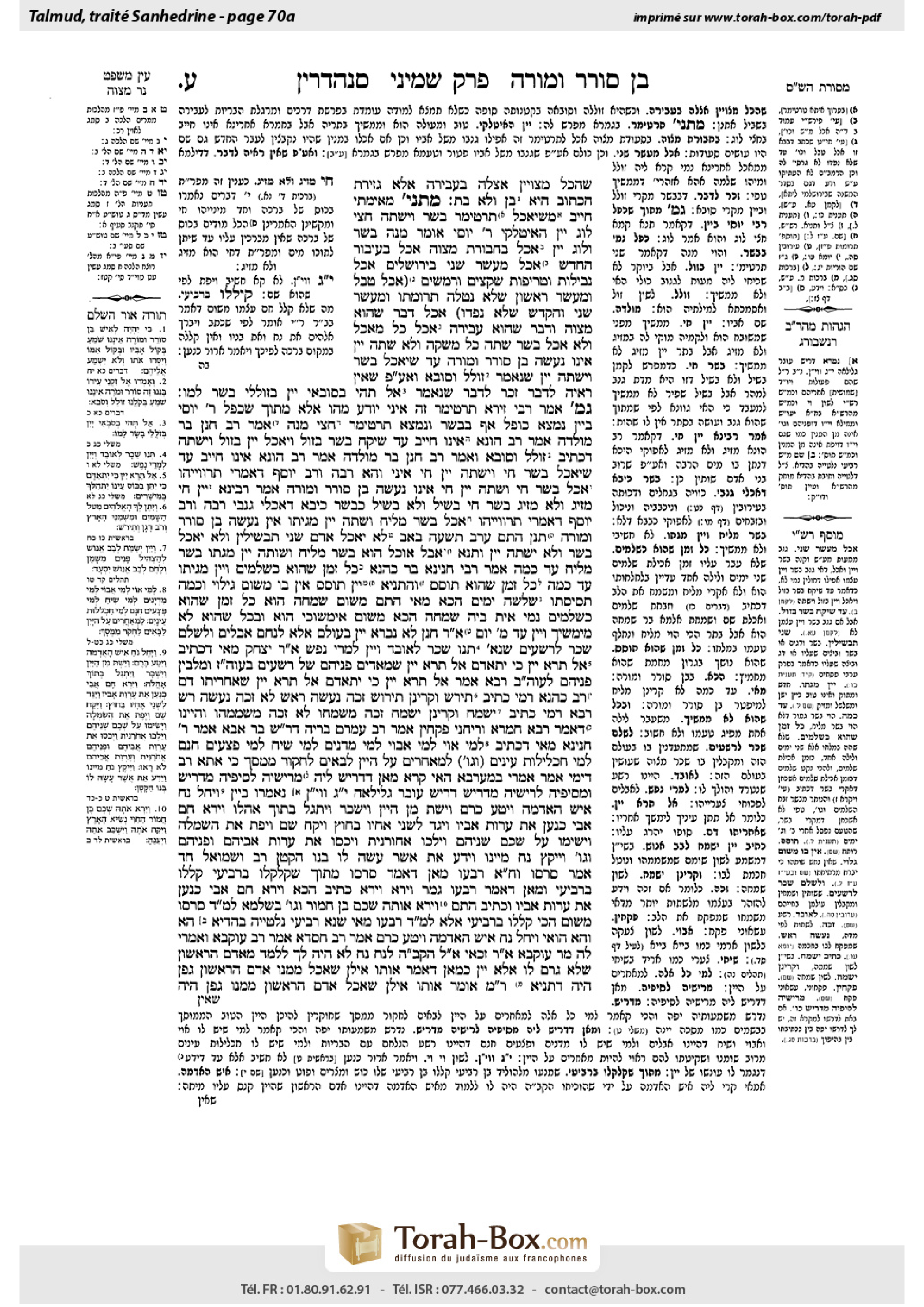
This page of Sanhedrin includes the Aramaic text, an English translation and an AI-generated French translation, alongside the scan above.
סנהדרין ע׳ א · Aramaic and Hebrew text
שֶׁהַכֹּל מְצוּיִין אֶצְלָהּ בַּעֲבֵירָה, אֶלָּא גְּזֵירַת הַכָּתוּב הִיא: ״בֵּן״, וְלֹא בַּת.
מַתְנִי׳ מֵאֵימָתַי חַיָּיב? מִשֶּׁיֹּאכַל תַּרְטֵימָר בָּשָׂר, וְיִשְׁתֶּה חֲצִי לוֹג יַיִן הָאִיטַלְקִי. רַבִּי יוֹסֵי אוֹמֵר: מָנֶה בָּשָׂר, וְלוֹג יַיִן.
אָכַל בַּחֲבוּרַת מִצְוָה, אָכַל בְּעִיבּוּר הַחֹדֶשׁ, אָכַל מַעֲשֵׂר שֵׁנִי בִּירוּשָׁלַיִם, אָכַל נְבֵילוֹת וּטְרֵיפוֹת שְׁקָצִים וּרְמָשִׂים (אָכַל טֶבֶל וּמַעֲשֵׂר רִאשׁוֹן שֶׁלֹּא נִטְּלָה תְּרוּמָתוֹ וּמַעֲשֵׂר שֵׁנִי וְהֶקְדֵּשׁ שֶׁלֹּא נִפְדּוּ).
אָכַל דָּבָר שֶׁהוּא מִצְוָה, וְדָבָר שֶׁהוּא עֲבֵירָה, אָכַל כׇּל מַאֲכָל וְלֹא אָכַל בָּשָׂר, שָׁתָה כׇּל מַשְׁקֶה וְלֹא שָׁתָה יַיִן – אֵינוֹ נַעֲשֶׂה בֵּן סוֹרֵר וּמוֹרֶה עַד שֶׁיֹּאכַל בָּשָׂר וְיִשְׁתֶּה יַיִן, שֶׁנֶּאֱמַר: ״זוֹלֵל וְסֹבֵא״. וְאַף עַל פִּי שֶׁאֵין רְאָיָה לַדָּבָר, זֵכֶר לַדָּבָר שֶׁנֶּאֱמַר: ״אַל תְּהִי בְסֹבְאֵי יָיִן בְּזֹלְלֵי בָשָׂר לָמוֹ״.
גְּמָ׳ אָמַר רַבִּי זֵירָא: תַּרְטֵימָר זֶה אֵינִי יוֹדֵעַ מַהוּ, אֶלָּא מִתּוֹךְ שֶׁכָּפַל רַבִּי יוֹסֵי בְּיַיִן, נִמְצָא כּוֹפֵל אַף בַּבָּשָׂר, וְנִמְצָא תַּרְטֵימָר חֲצִי מָנֶה.
אָמַר רַב חָנָן בַּר מוֹלָדָה אָמַר רַב הוּנָא: אֵינוֹ חַיָּיב עַד שֶׁיִּקַּח בָּשָׂר בְּזוֹל וְיֹאכַל, יַיִן בְּזוֹל וְיִשְׁתֶּה, דִּכְתִיב: ״זוֹלֵל וְסֹבֵא״.
וְאָמַר רַב חָנָן בַּר מוֹלָדָה אָמַר רַב הוּנָא: אֵינוֹ חַיָּיב עַד שֶׁיֹּאכַל בָּשָׂר חַי וְיִשְׁתֶּה יַיִן חַי. אִינִי? וְהָא רַבָּה וְרַב יוֹסֵף דְּאָמְרִי תַּרְוַויְיהוּ: אָכַל בָּשָׂר חַי וְשָׁתָה יַיִן חַי אֵינוֹ נַעֲשֶׂה בֵּן סוֹרֵר וּמוֹרֶה! אָמַר רָבִינָא: יַיִן חַי – מְזִיג וְלָא מְזִיג, בָּשָׂר חַי – בְּשִׁיל וְלָא בְּשִׁיל, כִּבְשַׂר כִּיבָא דְּאָכְלִי גַּנָּבֵי.
רַבָּה וְרַב יוֹסֵף דְּאָמְרִי תַּרְוַויְיהוּ: אָכַל בָּשָׂר מָלִיחַ וְשָׁתָה יַיִן מִגִּיתּוֹ, אֵין נַעֲשֶׂה בֵּן סוֹרֵר וּמוֹרֶה. תְּנַן הָתָם: עֶרֶב תִּשְׁעָה בְּאָב לֹא יֹאכַל אָדָם שְׁנֵי תַבְשִׁילִין, וְלֹא יֹאכַל בָּשָׂר, וְלֹא יִשְׁתֶּה יַיִן. וְתָנָא: אֲבָל אוֹכֵל הוּא בָּשָׂר מָלִיחַ וְשׁוֹתֶה יַיִן מִגִּתּוֹ.
בְּבָשָׂר מָלִיחַ, עַד כַּמָּה? אָמַר רַבִּי חֲנִינָא בַּר כָּהֲנָא: כׇּל זְמַן שֶׁהוּא כִּשְׁלָמִים.
וְיַיִן מִגִּיתּוֹ, עַד כַּמָּה? כׇּל זְמַן שֶׁהוּא תּוֹסֵס. וְהָתַנְיָא: יַיִן תּוֹסֵס אֵין בּוֹ מִשּׁוּם גִּילּוּי. וְכַמָּה תְּסִיסָתוֹ? שְׁלֹשָׁה יָמִים.
הָכָא מַאי? הָתָם מִשּׁוּם שִׂמְחָה הוּא, כׇּל זְמַן שֶׁהוּא כִּשְׁלָמִים נָמֵי אִית בֵּיהּ שִׂמְחָה. הָכָא מִשּׁוּם אִימְּשׁוֹכֵי הוּא, וּבְכָל שֶׁהוּא לָא מִימְּשִׁיךְ. וְיַיִן – עַד אַרְבָּעִים יוֹם.
אָמַר רַב חָנָן: לֹא נִבְרָא יַיִן בָּעוֹלָם אֶלָּא לְנַחֵם אֲבֵלִים, וּלְשַׁלֵּם שָׂכָר לָרְשָׁעִים, שֶׁנֶּאֱמַר: ״תְּנוּ שֵׁכָר לְאוֹבֵד וְיַיִן לְמָרֵי נָפֶשׁ״.
אָמַר רַבִּי יִצְחָק: מַאי דִּכְתִיב ״אַל תֵּרֶא יַיִן כִּי יִתְאַדָּם״? אַל תֵּרֶא יַיִן שֶׁמַּאֲדִים פְּנֵיהֶם שֶׁל רְשָׁעִים בָּעוֹלָם הַזֶּה, וּמַלְבִּין פְּנֵיהֶם לָעוֹלָם הַבָּא. רָבָא אָמַר: ״אַל תֵּרֶא יַיִן כִּי יִתְאַדָּם״ – אַל תֵּרֶא יַיִן שֶׁאַחֲרִיתוֹ דָּם.
רַב כָּהֲנָא רָמֵי: כְּתִיב ״תִּירָשׁ״ וְקָרֵינַן ״תִּירוֹשׁ״. זָכָה – נַעֲשֶׂה רֹאשׁ, לֹא זָכָה – נַעֲשֶׂה רָשׁ.
רָבָא רָמֵי: כְּתִיב ״יְשַׁמַּח״ וְקָרֵינַן ״יְשַׂמַּח״. זָכָה – מְשַׂמְּחוֹ, לֹא זָכָה – מְשַׁמְּמֵהוּ. וְהַיְינוּ דְּאָמַר רָבָא: חַמְרָא וְרֵיחָנֵי פַּקַּחִין.
אָמַר רַב עַמְרָם בְּרֵיהּ דְּרַבִּי שִׁמְעוֹן בַּר אַבָּא, אָמַר רַבִּי חֲנִינָא: מַאי דִּכְתִיב ״לְמִי אוֹי לְמִי אֲבוֹי לְמִי מְדָנִים לְמִי שִׂיחַ לְמִי פְּצָעִים חִנָּם לְמִי חַכְלִלוּת עֵינָיִם (וְגוֹ׳) לַמְאַחֲרִים עַל הַיָּיִן לַבָּאִים לַחְקֹר מִמְסָךְ״? כִּי אֲתָא רַב דִּימִי אֲמַר: אָמְרִי בְּמַעְרְבָא, הַאי קְרָא מַאן דְּדָרֵישׁ לֵיהּ מֵרֵישֵׁיהּ לְסֵיפֵיהּ – מִדְּרִישׁ, וּמִסֵּיפֵיהּ לְרֵישֵׁיהּ – מִדְּרִישׁ.
דָּרֵישׁ עוֹבֵר גָּלִילָאָה: שְׁלֹשׁ עֶשְׂרֵה וָוִין נֶאֱמַר בַּיַּיִן: ״וַיָּחֶל נֹחַ אִישׁ הָאֲדָמָה, וַיִּטַּע כָּרֶם, וַיֵּשְׁתְּ מִן הַיַּיִן, וַיִּשְׁכָּר, וַיִּתְגַּל בְּתוֹךְ אׇהֳלוֹ, וַיַּרְא חָם אֲבִי כְנַעַן אֵת עֶרְוַת אָבִיו, וַיַּגֵּד לִשְׁנֵי אֶחָיו בַּחוּץ, וַיִּקַּח שֵׁם וָיֶפֶת אֶת הַשִּׂמְלָה, וַיָּשִׂימוּ עַל שְׁכֶם שְׁנֵיהֶם, וַיֵּלְכוּ אֲחֹרַנִּית, וַיְכַסּוּ אֵת עֶרְוַת אֲבִיהֶם וּפְנֵיהֶם וְגוֹ׳״, ״וַיִּיקֶץ נֹחַ מִיֵּינוֹ, וַיֵּדַע אֵת אֲשֶׁר עָשָׂה לוֹ בְּנוֹ הַקָּטָן״.
רַב וּשְׁמוּאֵל: חַד אָמַר סֵרְסוֹ, וְחַד אָמַר רְבָעוֹ.
מַאן דְּאָמַר סֵרְסוֹ: מִתּוֹךְ שֶׁקִּלְקְלוֹ בָּרְבִיעִי, קִלְּלוֹ בָּרְבִיעִי. וּמַאן דְּאָמַר רְבָעוֹ: גָּמַר ״וַיַּרְא״ ״וַיַּרְא״. כְּתִיב הָכָא: ״וַיַּרְא חָם אֲבִי כְנַעַן אֵת עֶרְוַת אָבִיו״, וּכְתִיב הָתָם: ״וַיַּרְא אוֹתָהּ שְׁכֶם בֶּן חֲמוֹר וְגוֹ׳״.
בִּשְׁלָמָא לְמַאן דְּאָמַר סֵרְסוֹ, מִשּׁוּם הָכִי קִלְּלוֹ בָּרְבִיעִי. אֶלָּא לְמַאן דְּאָמַר רְבָעוֹ, מַאי שְׁנָא רְבִיעִי? נִלְטְיֵיהּ בְּהֶדְיָא! הָא וְהָא הֲוַאי.
״וַיָּחֶל נֹחַ אִישׁ הָאֲדָמָה וַיִּטַּע כָּרֶם״. אָמַר רַב חִסְדָּא אָמַר רַב עוּקְבָא, וְאָמְרִי לַהּ מָר עוּקְבָא אָמַר רַבִּי זַכַּאי: אָמַר לוֹ הַקָּדוֹשׁ בָּרוּךְ הוּא לְנֹחַ: נֹחַ, לֹא הָיָה לְךָ לִלְמוֹד מֵאָדָם הָרִאשׁוֹן שֶׁלֹּא גָּרַם לוֹ אֶלָּא יַיִן? כְּמַאן דְּאָמַר אוֹתוֹ אִילָן שֶׁאָכַל מִמֶּנּוּ אָדָם הָרִאשׁוֹן – גֶּפֶן הָיָה.
דְּתַנְיָא: רַבִּי מֵאִיר אוֹמֵר, אוֹתוֹ אִילָן שֶׁאָכַל אָדָם הָרִאשׁוֹן מִמֶּנּוּ – גֶּפֶן הָיָה,
Sanhedrin 70a · English translation
The reason is that all are found frequently with her in sin, and in the end she will be a sinner and cause others to sin. But it is a Torah edict that the penalty for rebelliousness is imposed only upon a son, and not upon a daughter.
MISHNA: From when is a stubborn and rebellious son liable? From when he eats a tarteimar of meat and drinks a half-log of Italian wine. Rabbi Yosei says: From when he eats a maneh of meat and drinks a log of wine.
The mishna now lists a series of conditions concerning his eating and drinking. If he ate these items with a group assembled for the performance of a mitzva, or he ate them at a meal celebrating the intercalation of a month, or he ate the items when they had second tithe status, in Jerusalem, he does not become a stubborn and rebellious son because each of these circumstances involves some aspect of a mitzva. If he ate the meat of unslaughtered animal carcasses or animals that had wounds that would have caused them to die within twelve months [tereifot] or repugnant creatures or creeping animals, or he ate untithed produce from which tithes and terumot were not separated, or first tithe from which its teruma was not separated, or second tithe outside Jerusalem or consecrated food that was not redeemed, each of which involves a transgression, he does not become a stubborn and rebellious son.
The mishna summarizes: If he ate an item that involves performing a mitzva or an item that involves committing a transgression, or if he ate any food in the world but did not eat meat, or if he drank any beverage but did not drink wine, he does not become a stubborn and rebellious son, unless he actually eats meat and actually drinks wine, as it is stated: “This son of ours is stubborn and rebellious; he does not listen to our voice; he…is a glutton [zolel] and a drunkard [vesovei]” (Deuteronomy 21:20). One is not called a glutton and a drunkard unless he eats meat and drinks wine. And although there is no explicit proof to the matter that the reference in the Torah is to meat and wine, there is an allusion to the matter in another verse, as it is stated: “Be not among wine drinkers [besovei], among gluttonous eaters [bezolelei] of meat” (Proverbs 23:20).
GEMARA: Rabbi Zeira says: Concerning this tarteimar that is mentioned in the mishna, I do not know what its measure is. But since Rabbi Yosei is found to have doubled the measure of the wine, as the unattributed opinion in the mishna speaks of a half-log whereas Rabbi Yosei requires a log, he presumably is found to have doubled the measure of the meat as well. Therefore, it turns out that a tarteimar is equivalent to one-half of a maneh.
Rav Ḥanan bar Molada says that Rav Huna says: A stubborn and rebellious son is not liable unless he purchases inexpensive [bezol] meat and eats it, and he buys inexpensive wine and drinks it, as it is written: “He is a glutton [zolel] and a drunkard.”
And Rav Ḥanan bar Molada says that Rav Huna says: A stubborn and rebellious son is not liable unless he eats raw meat and drinks undiluted wine. The Gemara raises a difficulty: Is that so? But don’t Rabba and Rav Yosef both say: If he ate raw meat or drank undiluted wine he does not become a stubborn and rebellious son? Ravina said: The two conflicting statements can be reconciled. If he ate totally raw meat or drank totally undiluted wine, he is in fact exempt. The undiluted wine for which he is liable is wine that is diluted but not diluted properly. And the raw meat for which he is liable is meat that is cooked but not cooked properly, like the scorched meat that thieves are wont to eat, due to the hasty manner in which they must prepare their food.
Rabba and Rav Yosef both say: If he ate heavily salted meat or drank wine from his winepress, i.e., wine that has not finished fermenting, he does not become a stubborn and rebellious son. And on a related topic we learned in a mishna elsewhere (Ta’anit 26b): On the eve of the Ninth of Av, a person may not eat two cooked dishes in one meal. And furthermore, he may neither eat meat nor drink wine. And a tanna taught in a baraita: But one may eat heavily salted meat, as it is not considered meat, and one many drink wine from his winepress before it has properly fermented.
The Gemara asks: With regard to salted meat on the eve of the Ninth of Av, how long must this meat remain in salt before it is permitted? Rabbi Ḥanina bar Kahana says: As long as it is like a peace-offering, which could be eaten for two days and one night after it was sacrificed. After this time has passed, it is no longer the type of meat that one may not eat during that meal. Therefore, if it was salted for longer than this, it may be eaten on the eve of the Ninth of Av.
The Gemara inquires further: And with regard to wine from his press before it has properly fermented, until when is wine considered in this category? As long as it is still fermenting. And it is taught in a baraita: Fermenting wine is not subject to the prohibition of exposed liquids, as there is no concern that a snake will leave its venom in that wine. And how long is its initial fermenting period? Three days from the time the grapes were pressed.
The Gemara clarifies: These definitions of salty meat and wine from his winepress were stated with regard to the prohibitions applying on the eve of the Ninth of Av. Here, concerning a stubborn and rebellious son, what is considered salty meat and wine from his press? The Gemara answers: There, with regard to the eve of the Ninth of Av, the prohibition is due to joy; as long as the meat is like a peace-offering, there is still joy. But here, with regard to a stubborn and rebellious son, it is due to the son becoming drawn to it, and if the taste of the meat is flawed only slightly he will not be drawn to it. And with regard to wine, there is no concern that he will be drawn to it until it is forty days old.
§ The Gemara’s discussion turns to wine in general. Rav Ḥanan says: Wine was created in the world only to comfort mourners in their distress, and to reward the wicked in this world so that they will have no reward left in the World-to-Come, as it is stated: “Give strong drink to him that is ready to perish, and wine to the bitter of soul” (Proverbs 31:6). “Him that is ready to perish” is referring to the wicked, who will perish from this world, while “the bitter of soul” denotes mourners.
Rabbi Yitzḥak says: What is the meaning of that which is written: “Look not upon wine when it is red” (Proverbs 23:31)? Look not upon wine that reddens the faces of the wicked in this world when they drink it, and whitens their faces, i.e., embarrasses them, in the World-to-Come. Rava says that this is how the verse should be understood: “Look not upon wine that reddens [yitaddam]” means: Look not upon wine, as it leads to bloodshed [dam], indicating that one who drinks wine will end up committing an act of killing or will be killed because of it.
Rav Kahana raises a contradiction: The verse states: “Therefore, they shall come and sing in the height of Zion, and shall flow to the bounty of the Lord, for wheat, and for wine, and for oil, and for the young of the flock and of the herd” (Jeremiah 31:12). The word for wine is written tirash, without the letter vav, but we read it as tirosh, with the letter vav. The matter can be explained as follows: If one merits and drinks a moderate amount he becomes a leader [rosh], whereas if he does not merit and drinks excessively he becomes poor [rash].
Rava raises a similar contradiction: It is written: “And wine that gladdens the heart of man” (Psalms 104:15). The word for gladdens could be read as yeshamaḥ, meaning that wine makes one crazy, but we read it as yesamaḥ, gladdens the heart. The matter can be explained as follows: If one merits and drinks a moderate amount the wine gladdens him [mesameḥo], whereas if he does not merit and drinks excessively it makes him crazy [meshamemehu]. And that is what Rava meant when he said: Wine and fragrant spices have made me wise; that is to say, the controlled drinking of wine is beneficial to the drinker.
Rav Amram, son of Rabbi Shimon bar Abba, says that Rabbi Ḥanina says: What is the meaning of that which is written: “Who cries, Woe? Who cries, Alas? Who has quarrels? Who has complaints? Who has causeless injuries? Who has redness of eyes? They who tarry long at the wine, they who go to seek mixed wine” (Proverbs 23:29–30)? When Rav Dimi came from Eretz Yisrael to Babylonia, he said that they say in the West, Eretz Yisrael, that one who interprets this verse from the beginning to the end interprets it in a way that has meaning and significance. And also one who interprets it from the end to the beginning interprets it in a meaningful manner. It is possible to interpret these verses from the beginning to the end and say: Woe and alas to one who drinks wine; and it is also possible to interpret them from the end to the beginning: Who drinks wine? He who has quarrels, complaints, and injuries.
A visitor from the Galilee expounded: The conversive vav is stated thirteen times in the passage concerning wine, as it is stated: “And Noah began [vayyaḥel] to be a farmer, and he planted [vayyita] a vineyard, and he drank [vayyesht] of the wine, and was drunk [vayyishkar]; and he was uncovered [vayyitgal] within his tent. And Ham, the father of Canaan, saw [vayyar] the nakedness of his father, and told [vayyagged] his two brothers outside. And Shem and Japheth took [vayyikaḥ] the garment, and laid it [vayyasimu] upon both their shoulders, and went [vayyelekhu] backward, and covered [vaykhassu] the nakedness of their father; and their faces were backward, and they did not see their father’s nakedness. And Noah awoke [vayyiketz] from his wine, and knew [vayyeda] what his younger son had done to him” (Genesis 9:20–24). All thirteen instances of the conversive vav here are followed by the letter yod. Together they form the word vay, meaning woe, and allude to the suffering and misfortune caused by uncontrolled drinking.
Having cited the passage discussing Noah, the Gemara enters into a discussion about what was actually done to him by his younger son, Ham. Rav and Shmuel disagreed: One says that Ham castrated Noah and one says that Ham sodomized him.
The Gemara explains: The one who says that Ham castrated Noah adduces the following proof: Since he injured Noah with respect to the possibility of conceiving a fourth son, which Noah wanted but could no longer have, therefore Noah cursed him by means of Ham’s fourth son. Ham’s sons were Cush, Mizraim, Put, and Canaan (see Genesis 10:6), and of all of these, it was Canaan whom Noah cursed (see Genesis 9:25–28). And the one who says that Ham sodomized Noah learned this from a verbal analogy between the words “and he saw” and “and he saw.” Here it is written: “And Ham, the father of Canaan, saw the nakedness of his father”; and there it is written: “And Shechem, son of Hamor the Hivite, prince of the country, saw her, and he took her, and lay with her, and afflicted her” (Genesis 34:2). This indicates that the term “saw” alludes to sexual intercourse.
The Gemara asks: Granted, according to the one who says that Ham castrated Noah, it is due to that reason that Noah cursed Ham by means of Ham’s fourth son. But according to the one who says that Ham sodomized him, what is different about his fourth son? He should have cursed Ham directly. The Gemara answers: This Sage holds that both this offense and that offense were committed. All agree that Ham castrated Noah, and some say that Ham also sodomized him.
The Gemara continues to analyze the passage relating to Noah. The verse states: “And Noah began to be a farmer, and he planted a vineyard.” In explanation of this matter, Rav Ḥisda says that Rav Ukva says, and some say that Mar Ukva says that Rabbi Zakkai says: The Holy One, Blessed be He, said to Noah: Noah, shouldn’t you have learned from Adam the first man, whose banishment from the Garden of Eden was caused only by wine? The Gemara notes: This is in accordance with the opinion of the one who says that the tree from which Adam the first man ate was a grapevine.
As it is taught in a baraita: Rabbi Meir says: The tree from which Adam the first man ate was a grapevine,
Sanhedrin 70a · Traduction française (IA)
La raison en est que tous sont fréquemment en sa compagnie lorsqu’ils pèchent et qu’à la fin elle deviendra pécheresse et entraînera les autres à pécher. Mais c’est un décret de la Torah que la peine pour rébellion ne s’applique qu’à un fils, et non à une fille.
MICHNA : À partir de quand un fils rebelle et indocile est-il passible de la peine ? À partir du moment où il mange un tarteimar de viande et boit un demi-log de vin italien. Rabbi Yossei dit : À partir du moment où il mange un maneh de viande et boit un log de vin.
La Michna énumère à présent une série de conditions concernant sa nourriture et sa boisson. S’il mange ces aliments avec un groupe réuni pour accomplir une mitsva, ou lors d’un repas célébrant la fixation d’un mois intercalaire, ou s’il les mange alors qu’ils ont le statut de seconde dîme, à Jérusalem, il ne devient pas un fils rebelle et indocile, car chacune de ces circonstances comporte un aspect de mitsva. S’il mange de la viande provenant de carcasses d’animaux qui n’ont pas été abattus rituellement ou d’animaux présentant des lésions qui les auraient fait mourir dans les douze mois [tereifot], ou des créatures répugnantes ou des animaux rampants, ou s’il mange des produits dont les dîmes et les teroumot n’ont pas été prélevées, ou de la première dîme dont la terouma n’a pas été prélevée, ou de la seconde dîme hors de Jérusalem, ou des aliments consacrés qui n’ont pas été rachetés — autant de cas qui impliquent une transgression —, il ne devient pas un fils rebelle et indocile.
La Michna résume : S’il mange un aliment qui implique l’accomplissement d’une mitsva ou un aliment qui implique une transgression, ou s’il mange n’importe quel aliment sans manger de viande, ou s’il boit n’importe quelle boisson sans boire de vin, il ne devient pas un fils rebelle et indocile, à moins qu’il ne mange effectivement de la viande et ne boive effectivement du vin, comme il est dit : « Ce fils qui est à nous est rebelle et indocile ; il n’écoute pas notre voix ; il est […] glouton [zolel] et ivrogne [vesovei] » (Deutéronome 21:20). On n’est qualifié de glouton et d’ivrogne que si l’on mange de la viande et boit du vin. Et bien qu’il n’y ait pas de preuve explicite que la Torah fasse référence à la viande et au vin, un autre verset y fait allusion, comme il est dit : « Ne sois pas parmi les buveurs de vin [besovei], parmi les gloutons [bezolelei] qui mangent de la viande » (Proverbes 23:20).
GUEMARA : Rabbi Zeïra dit : Quant à ce tarteimar mentionné dans la Michna, j’ignore quelle en est la mesure. Mais puisque Rabbi Yossei semble avoir doublé la mesure du vin — car l’opinion anonyme de la Michna parle d’un demi-log, tandis que Rabbi Yossei exige un log —, il semble qu’il ait également doublé la mesure de viande. Il s’ensuit donc qu’un tarteimar équivaut à un demi-maneh.
Rav Ḥanan bar Molada dit au nom de Rav Houna : Un fils rebelle et indocile n’est passible de la peine que s’il achète de la viande à bas prix [bezol] et la mange, et s’il achète du vin à bas prix et le boit, comme il est écrit : « Il est glouton [zolel] et ivrogne. »
Rav Ḥanan bar Molada dit également au nom de Rav Houna : Un fils rebelle et indocile n’est passible de la peine que s’il mange de la viande crue et boit du vin non coupé d’eau. La Guemara soulève une difficulté : Est-ce bien le cas ? Pourtant, Rabba et Rav Yossef disent tous deux que s’il a mangé de la viande crue ou bu du vin non coupé d’eau, il ne devient pas un fils rebelle et indocile. Ravina dit : On peut concilier les deux affirmations contradictoires. S’il a mangé de la viande entièrement crue ou bu du vin entièrement non coupé d’eau, il est effectivement exempt. Le vin pour lequel il est passible de la peine est un vin coupé d’eau, mais pas convenablement. Et la viande pour laquelle il est passible de la peine est une viande cuite, mais pas convenablement, comme la viande brûlée que les voleurs ont l’habitude de manger, en raison de la hâte avec laquelle ils doivent préparer leur nourriture.
Rabba et Rav Yossef disent tous deux : S’il a mangé de la viande fortement salée ou bu du vin de son pressoir, c’est-à-dire du vin dont la fermentation n’est pas achevée, il ne devient pas un fils rebelle et indocile. À ce propos, nous avons appris dans une Michna ailleurs (Ta’anit 26b) : La veille du Neuf Av, on ne peut pas manger deux plats cuits au cours d’un même repas. De plus, on ne peut ni manger de viande ni boire de vin. Et un tanna a enseigné dans une baraïta : On peut toutefois manger de la viande fortement salée, car elle n’est pas considérée comme de la viande, et boire du vin de son pressoir avant qu’il ait correctement fermenté.
La Guemara demande : Concernant la viande salée la veille du Neuf Av, combien de temps doit-elle rester dans le sel avant qu’il soit permis de la manger ? Rabbi Ḥanina bar Kahana dit : Tant qu’elle est comparable à celle d’un sacrifice de paix, qui pouvait être mangée pendant deux jours et une nuit après avoir été offerte. Passé ce délai, elle n’est plus du type de viande qu’il est interdit de manger au cours de ce repas. Par conséquent, si elle a été salée plus longtemps, on peut la manger la veille du Neuf Av.
La Guemara s’enquiert davantage : Et concernant le vin de son pressoir avant qu’il ait correctement fermenté, jusqu’à quand le vin est-il considéré comme appartenant à cette catégorie ? Tant qu’il fermente encore. Et il est enseigné dans une baraïta : Le vin en fermentation n’est pas soumis à l’interdiction des liquides laissés à découvert, car on ne craint pas qu’un serpent y dépose son venin. Et combien de temps dure sa période initiale de fermentation ? Trois jours à compter du pressurage des raisins.
La Guemara précise : Ces définitions de la viande salée et du vin de son pressoir ont été énoncées au sujet des interdictions applicables la veille du Neuf Av. Ici, concernant un fils rebelle et indocile, qu’entend-on par viande salée et vin de son pressoir ? La Guemara répond : Là, à propos de la veille du Neuf Av, l’interdiction est due à la joie ; tant que la viande est comparable à celle d’un sacrifice de paix, elle procure encore de la joie. Mais ici, pour le fils rebelle et indocile, la raison tient au fait que le fils se laisse attirer par ces aliments ; si le goût de la viande est même légèrement altéré, il ne se laissera pas attirer par elle. Quant au vin, on ne craint pas qu’il se laisse attirer par lui avant qu’il ait quarante jours.
§ La discussion de la Guemara se tourne vers le vin en général. Rav Ḥanan dit : Le vin n’a été créé dans le monde que pour réconforter les endeuillés dans leur détresse et récompenser les méchants dans ce monde, afin qu’il ne leur reste aucune récompense dans le Monde futur, comme il est dit : « Donnez de l’alcool à celui qui va périr, et du vin à ceux qui ont l’âme amère » (Proverbes 31:6). « Celui qui va périr » désigne les méchants, qui périront de ce monde, tandis que « ceux qui ont l’âme amère » désigne les endeuillés.
Rabbi Yitsḥak dit : Quel est le sens de ce qui est écrit : « Ne regarde pas le vin lorsqu’il est rouge » (Proverbes 23:31) ? Ne regarde pas le vin qui rougit le visage des méchants dans ce monde lorsqu’ils en boivent, et qui blanchit leur visage, c’est-à-dire les couvre de honte, dans le Monde futur. Rava dit que le verset doit être compris ainsi : « Ne regarde pas le vin qui rougit [yitaddam] » signifie : Ne regarde pas le vin, car il mène à l’effusion de sang [dam], indiquant que celui qui boit du vin finira par commettre un meurtre ou sera tué à cause de cela.
Rav Kahana soulève une contradiction : Le verset dit : « Alors ils viendront et chanteront sur les hauteurs de Sion, ils accourront vers les bienfaits de l’Éternel : le blé, le vin et l’huile, les jeunes des troupeaux de petit et de gros bétail » (Jérémie 31:12). Le mot désignant le vin est écrit tirash, sans la lettre vav, mais se lit tirosh, avec la lettre vav. On peut expliquer la chose ainsi : Si l’on en est digne et que l’on boit avec modération, on devient un chef [rosh] ; mais si l’on n’en est pas digne et que l’on boit avec excès, on devient pauvre [rash].
Rava soulève une contradiction similaire : Il est écrit : « Et le vin qui réjouit le cœur de l’homme » (Psaumes 104:15). Le mot signifiant « réjouit » pourrait se lire yeshamaḥ, c’est-à-dire que le vin rend fou, mais il se lit yesamaḥ, « réjouit le cœur ». On peut expliquer la chose ainsi : Si l’on en est digne et que l’on boit avec modération, le vin nous réjouit [mesameḥo] ; mais si l’on n’en est pas digne et que l’on boit avec excès, il nous rend fous [meshamemehu]. C’est ce que Rava voulait dire lorsqu’il a déclaré : « Le vin et les épices odorantes m’ont rendu sage » ; autrement dit, boire du vin avec modération est bénéfique à celui qui en boit.
Rav Amram, fils de Rabbi Shimon bar Abba, dit au nom de Rabbi Ḥanina : Quel est le sens de ce qui est écrit : « Qui crie : Malheur ? Qui crie : Hélas ? Qui a des querelles ? Qui a des plaintes ? Qui a des blessures sans cause ? Qui a les yeux rouges ? Ceux qui s’attardent longtemps auprès du vin, ceux qui vont chercher du vin mélangé » (Proverbes 23:29–30) ? Lorsque Rav Dimi vint d’Eretz Israël en Babylonie, il dit qu’en Occident, c’est-à-dire en Eretz Israël, on dit que celui qui interprète ce verset du début à la fin lui donne un sens et une portée. De même, celui qui l’interprète de la fin au début lui donne un sens. On peut interpréter ces versets du début à la fin et dire : Malheur et hélas à celui qui boit du vin ; on peut aussi les interpréter de la fin au début : Qui boit du vin ? Celui qui a des querelles, des plaintes et des blessures.
Un visiteur venu de Galilée enseigna : La lettre vav conversive apparaît treize fois dans le passage relatif au vin, comme il est dit : « Noé commença [vayyaḥel] à cultiver la terre, il planta [vayyita] une vigne, il but [vayyesht] du vin et s’enivra [vayyishkar] ; il se découvrit [vayyitgal] au milieu de sa tente. Cham, père de Canaan, vit [vayyar] la nudité de son père et raconta [vayyagged] à ses deux frères, au-dehors. Sem et Japhet prirent [vayyikaḥ] le vêtement, le posèrent [vayyasimu] sur leurs deux épaules, marchèrent [vayyelekhu] à reculons et couvrirent [vaykhassu] la nudité de leur père ; leur visage étant tourné en arrière, ils ne virent pas la nudité de leur père. Noé se réveilla [vayyiketz] de son vin et sut [vayyeda] ce que son plus jeune fils lui avait fait » (Genèse 9:20–24). Dans ces treize occurrences, la lettre vav conversive est suivie de la lettre yod. Ensemble, elles forment le mot vay, qui signifie « malheur », et font allusion aux souffrances et aux malheurs causés par une consommation excessive d’alcool.
Après avoir cité le passage qui parle de Noé, la Guemara entreprend de discuter de ce que son plus jeune fils, Cham, lui a réellement fait. Rav et Shmuel sont en désaccord : selon l’un, Cham a castré Noé ; selon l’autre, Cham lui a fait subir une sodomie.
La Guemara explique : Celui qui affirme que Cham a castré Noé apporte la preuve suivante : Puisqu’il l’a privé de la possibilité d’avoir un quatrième fils, que Noé désirait mais qu’il ne pouvait plus avoir, Noé l’a maudit par l’intermédiaire du quatrième fils de Cham. Les fils de Cham étaient Koush, Mitsraïm, Pout et Canaan (voir Genèse 10:6), et c’est Canaan que Noé maudit parmi eux (voir Genèse 9:25–28). Celui qui affirme que Cham a sodomisé Noé l’a appris d’une analogie verbale entre les expressions « il vit » et « il vit ». Ici, il est écrit : « Cham, père de Canaan, vit la nudité de son père » ; et là, il est écrit : « Shekhem, fils de Ḥamor le Hivite, prince du pays, la vit, la prit, coucha avec elle et lui fit violence » (Genèse 34:2). Cela indique que le terme « vit » fait allusion à un rapport sexuel.
La Guemara demande : Il est compréhensible que, selon celui qui affirme que Cham a castré Noé, ce soit pour cette raison que Noé a maudit Cham par l’intermédiaire de son quatrième fils. Mais, selon celui qui affirme que Cham lui a fait subir une sodomie, qu’est-ce qui distingue son quatrième fils ? Noé aurait dû maudire Cham directement. La Guemara répond : Ce Sage tient que ces deux fautes ont été commises. Tous conviennent que Cham a castré Noé, et certains disent qu’il l’a également sodomisé.
La Guemara poursuit l’analyse du passage relatif à Noé. Le verset dit : « Noé commença à cultiver la terre et planta une vigne. » À propos de cette question, Rav Ḥisda dit au nom de Rav Ukva — et certains disent que Mar Ukva dit au nom de Rabbi Zakkaï — : Le Saint, béni soit-Il, dit à Noé : « Noé, n’aurais-tu pas dû tirer une leçon d’Adam, le premier homme, dont l’expulsion du jardin d’Éden fut causée uniquement par le vin ? » La Guemara note : Cela correspond à l’opinion de celui qui dit que l’arbre dont Adam, le premier homme, a mangé était une vigne.
Comme il est enseigné dans une baraïta : Rabbi Meïr dit : L’arbre dont Adam, le premier homme, a mangé était une vigne,
Traduction française générée par IA à partir de l’édition anglaise de Sefaria. Vérifie toujours un passage avec le texte source.
Text from Sefaria: William Davidson Edition - Vocalized Aramaic (CC BY NC); William Davidson Edition - English (CC BY NC).