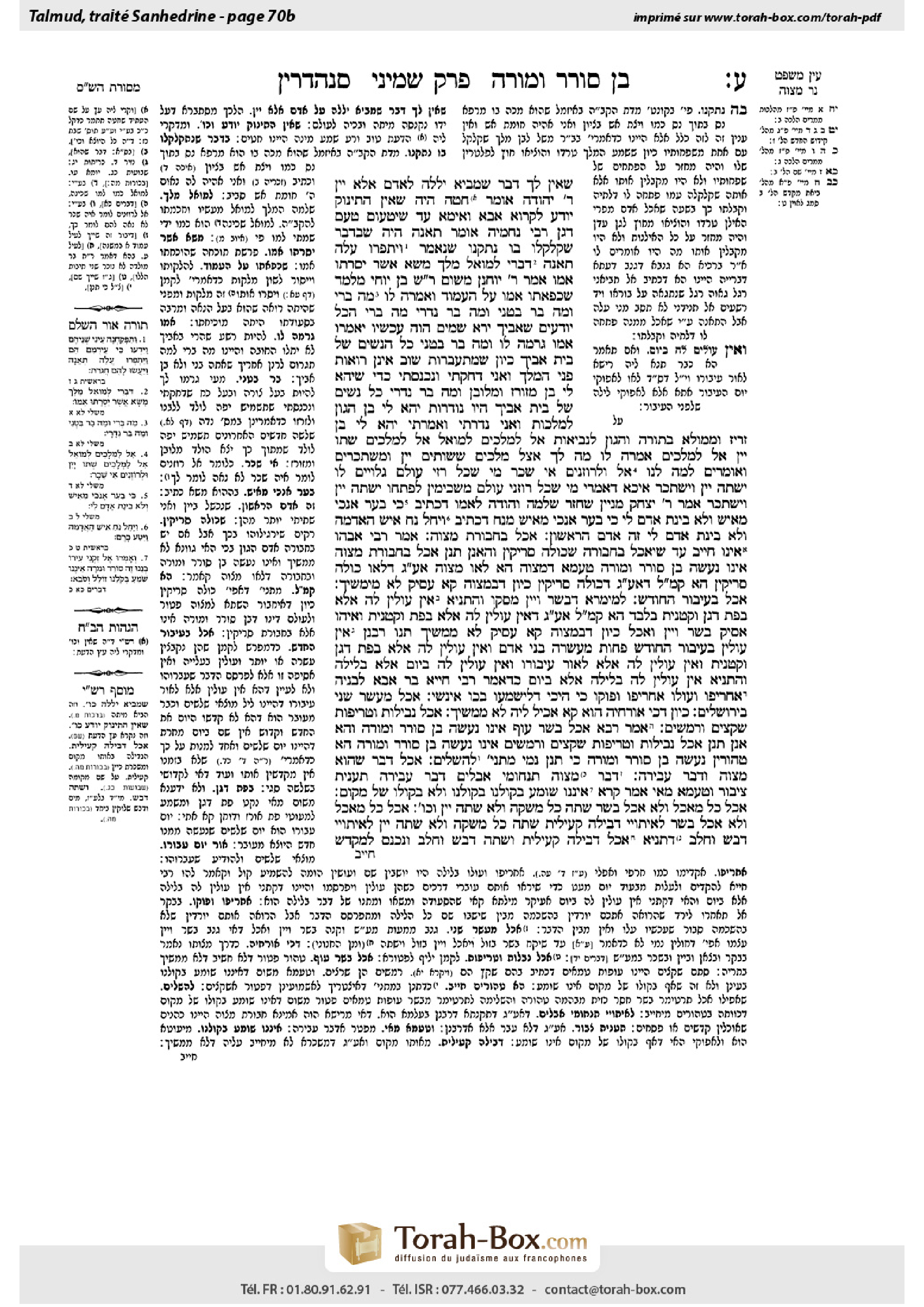
Sanhedrin 70b: Talmud study for Daf Yomi
Daf Yomi is the daily study of one Talmud folio. Explore 37 tractates with scans, Hebrew text, Sefaria English and AI-generated French translations where annotated.
Passage selection and English or AI-generated French translation are available where the scan has annotations. Daf Study is independent of Torah-Box and Sefaria.
Browse Sanhedrin · סנהדרין · All tractatesSanhedrin 70b text and translations
This page of Sanhedrin includes the Aramaic text, an English translation and an AI-generated French translation, alongside the scan above.
סנהדרין ע׳ ב · Aramaic and Hebrew text
שֶׁאֵין לְךָ דָּבָר שֶׁמֵּבִיא יְלָלָה לְאָדָם אֶלָּא יַיִן. רַבִּי יְהוּדָה אוֹמֵר: חִטָּה הָיָה, שֶׁאֵין הַתִּינוֹק יוֹדֵעַ לִקְרוֹא אַבָּא וְאִימָּא עַד שֶׁיִּטְעוֹם טַעַם דָּגָן. רַבִּי נְחֶמְיָה אוֹמֵר: תְּאֵנָה הָיָה, שֶׁבַּדָּבָר שֶׁקִּלְקְלוּ בּוֹ נִתְקְנוּ, שֶׁנֶּאֱמַר: ״וַיִּתְפְּרוּ עֲלֵה תְאֵנָה״.
״דִּבְרֵי לְמוּאֵל מֶלֶךְ מַשָּׂא אֲשֶׁר יִסְּרַתּוּ אִמּוֹ״. אָמַר רַבִּי יוֹחָנָן מִשּׁוּם רַבִּי שִׁמְעוֹן בֶּן יוֹחַי: מְלַמֵּד שֶׁכְּפָאַתּוּ אִמּוֹ עַל הָעַמּוּד וְאָמְרָה לוֹ, ״מַה בְּרִי וּמַה בַּר בִּטְנִי וּמֶה בַּר נְדָרָי״. ״מַה בְּרִי״ – הַכֹּל יוֹדְעִים שֶׁאָבִיךְ יְרֵא שָׁמַיִם הֲוָה, עַכְשָׁיו יֹאמְרוּ אִמּוֹ גָּרְמָה לוֹ.
״וּמַה בַּר בִּטְנִי״ – כׇּל הַנָּשִׁים שֶׁל בֵּית אָבִיךָ, כֵּיוָן שֶׁמִּתְעַבְּרוֹת, שׁוּב אֵינָן רוֹאוֹת פְּנֵי הַמֶּלֶךְ. וַאֲנִי דָּחַקְתִּי וְנִכְנַסְתִּי, כְּדֵי שֶׁיְּהֵא לִי בֵּן מְזוֹרָז וּמְלוּבָּן.
״וּמָה בַּר נְדָרָי״ – כָּל נָשִׁים שֶׁל בֵּית אָבִיךָ הָיוּ נוֹדְרוֹת: ״יְהֵא לִי בֵּן הָגוּן לַמַּלְכוּת״, וַאֲנִי נָדַרְתִּי וְאָמַרְתִּי: ״יְהֵא לִי בֵּן זָרִיז וּמְמוּלָּא בַּתּוֹרָה וְהָגוּן לִנְבִיאוּת״.
״אַל לַמְלָכִים לְמוֹאֵל, אַל לַמְלָכִים שְׁתוֹ יָיִן״. ״אַל לַמְלָכִים״ – אָמְרָה לוֹ: מָה לְךָ אֵצֶל מְלָכִים שֶׁשּׁוֹתִים יַיִן וּמִשְׁתַּכְּרִים וְאוֹמְרִים לָמָּה לָנוּ אֵל? ״וּלְרוֹזְנִים אֵי שֵׁכָר״ – מִי שֶׁכׇּל רָזֵי עוֹלָם גְּלוּיִים לוֹ יִשְׁתֶּה יַיִן וְיִשְׁתַּכֵּר? אִיכָּא דְּאָמְרִי: מִי שֶׁכׇּל רוֹזְנֵי עוֹלָם מַשְׁכִּימִין לְפִתְחוֹ יִשְׁתֶּה יַיִן וְיִשְׁתַּכֵּר?
אָמַר רַבִּי יִצְחָק: מִנַּיִין שֶׁחָזַר שְׁלֹמֹה וְהוֹדָה לְאִמּוֹ? דִּכְתִיב: ״כִּי בַעַר אָנֹכִי מֵאִישׁ וְלֹא בִינַת אָדָם לִי״. ״כִּי בַעַר אָנֹכִי מֵאִישׁ״ – מִנֹּחַ, דִּכְתִיב: ״וַיָּחֶל נֹחַ אִישׁ הָאֲדָמָה״. ״וְלֹא בִינַת אָדָם לִי״ – זֶה אָדָם הָרִאשׁוֹן.
אָכַל בַּחֲבוּרַת מִצְוָה. אָמַר רַבִּי אֲבָהוּ: אֵינוֹ חַיָּיב עַד שֶׁיֹּאכַל בַּחֲבוּרָה שֶׁכּוּלָּהּ סְרִיקִין.
וְהָאֲנַן תְּנַן: אָכַל בַּחֲבוּרַת מִצְוָה – אֵינוֹ נַעֲשֶׂה בֵּן סוֹרֵר וּמוֹרֶה. טַעְמָא דְּמִצְוָה, הָא לָאו מִצְוָה – אַף עַל גַּב דְּלָאו כּוּלָּהּ סְרִיקִין? הָא קָא מַשְׁמַע לַן: דְּאַף עַל גַּב דְּכוּלָּהּ סְרִיקִין, כֵּיוָן דִּבְמִצְוָה קָא עָסֵיק – לָא מִימְּשִׁיךְ.
אָכַל בְּעִיבּוּר הַחוֹדֶשׁ. לְמֵימְרָא דְּבָשָׂר וְיַיִן מַסְּקוּ? וְהָתַנְיָא: אֵין עוֹלִין לָהּ אֶלָּא בְּפַת דָּגָן וְקִטְנִית בִּלְבַד! הָא קָא מַשְׁמַע לַן: אַף עַל גַּב דְּאֵין עוֹלִין לָהּ אֶלָּא בְּפַת וְקִטְנִית, וְאִיהוּ אַסֵּיק בָּשָׂר וְיַיִן וַאֲכַל, כֵּיוָן דִּבְמִצְוָה קָא עָסֵיק – לָא מִמְּשִׁיךְ.
תָּנוּ רַבָּנַן: אֵין עוֹלִין בְּעִיבּוּר הַחוֹדֶשׁ פָּחוֹת מֵעֲשָׂרָה בְּנֵי אָדָם, וְאֵין עוֹלִין לָהּ אֶלָּא בְּפַת דָּגָן וְקִטְנִית, וְאֵין עוֹלִין לָהּ אֶלָּא לְאוֹר עִיבּוּרוֹ, וְאֵין עוֹלִין לָהּ בַּיּוֹם אֶלָּא בַּלַּיְלָה. וְהָתַנְיָא: אֵין עוֹלִין לָהּ בַּלַּיְלָה אֶלָּא בַּיּוֹם! כְּדַאֲמַר רַבִּי חִיָּיא בַּר אַבָּא לִבְנֵיהּ: אַחְרִיפוּ וְעוּלוּ, אַחְרִיפוּ וּפוּקוּ, כִּי הֵיכִי דְּלִישְׁמְעוּ בְּכוּ אִינָשֵׁי.
אָכַל מַעֲשֵׂר שֵׁנִי בִּירוּשָׁלַיִם. כֵּיוָן דְּכִי אוֹרְחֵיהּ הוּא קָא אָכֵיל לֵיהּ, לָא מִמְּשִׁיךְ.
אָכַל נְבֵילוֹת וּטְרֵיפוֹת, שְׁקָצִים וּרְמָשִׂים. אָמַר רָבָא: אָכַל בְּשַׂר עוֹף – אֵינוֹ נַעֲשֶׂה בֵּן סוֹרֵר וּמוֹרֶה.
וְהָא אֲנַן תְּנַן: אָכַל נְבֵילוֹת וּטְרֵיפוֹת, שְׁקָצִים וּרְמָשִׂים – אֵינוֹ נַעֲשֶׂה בֵּן סוֹרֵר וּמוֹרֶה. הָא טְהוֹרִין – נַעֲשֶׂה בֵּן סוֹרֵר וּמוֹרֶה? כִּי תְּנַן נָמֵי מַתְנִיתִין – לְהַשְׁלִים.
אָכַל דָּבָר שֶׁהוּא מִצְוָה, וּדְבַר עֲבֵירָה. דְּבַר מִצְוָה – תַּנְחוּמֵי אֲבֵלִים, דְּבַר עֲבֵירָה – תַּעֲנִית צִיבּוּר.
וְטַעְמָא מַאי? אָמַר קְרָא: ״אֵינֶנּוּ שֹׁמֵעַ בְּקֹלֵנוּ״ – בְּקוֹלֵנוּ, וְלֹא בְּקוֹלוֹ שֶׁל מָקוֹם.
אָכַל כׇּל מַאֲכָל וְלֹא אָכַל בָּשָׂר, שָׁתָה כׇּל מַשְׁקֶה וְלֹא שָׁתָה יַיִן וְכוּ׳. אָכַל כׇּל מַאֲכָל וְלֹא אָכַל בָּשָׂר – לְאֵיתוֹיֵי דְּבֵילָה קְעִילִית. שָׁתָה כׇּל מַשְׁקֶה וְלֹא שָׁתָה יַיִן – לְאֵיתוֹיֵי דְּבַשׁ וְחָלָב.
דְּתַנְיָא: אָכַל דְּבֵילָה קְעִילִית, וְשָׁתָה דְּבַשׁ וְחָלָב, וְנִכְנַס לַמִּקְדָּשׁ –
Sanhedrin 70b · English translation
as, even today, nothing except wine brings wailing and trouble upon a person; most sins are caused by drunkenness. Rabbi Yehuda says: The Tree of Knowledge was the wheat plant. This is proven by the fact that, even today, an infant does not know how to call out to his father or mother until he tastes the taste of grain, and for this reason wheat is called “the Tree of Knowledge.” Rabbi Neḥemya says: The Tree of Knowledge was a fig tree, because it was with the matter with which they sinned that they were rehabilitated, as it is stated: “And they sewed together fig leaves, and made for themselves loincloths” (Genesis 3:7).
§ The Gemara continues its discussion of wine. Referring to the verse that states: “The words of King Lemuel, the burden with which his mother corrected him” (Proverbs 31:1), Rabbi Yoḥanan says in the name of Rabbi Shimon ben Yoḥai: This teaches that when Solomon’s mother Bathsheba saw Solomon engaged in excessive drinking, she bound him to a pillar to have him flogged. And she said to him: “What, my son? And what, son of my womb? And what, son of my vows?” (Proverbs 31:2). She meant: “What, my son?” Everyone knows that your father, David, was a God-fearing man, and now, when they see you sin, they will all say that his mother caused him to drink, i.e., that you engage in these behaviors because you are my son.
“And what, son of my womb?” That is to say: With regard to all of the women of your father’s house, once they conceive they no longer see the face of the king, but I pushed myself in and entered the king’s chamber while I was pregnant, so that I might have a son who is strong and fair-skinned. There are times during a woman’s pregnancy when intercourse is beneficial for the development of the fetus. Bathsheba was telling Solomon: I did my utmost to ensure that you have extra strength and beauty, and now you use that strength and appeal to pursue drink.
“And what, son of my vows?” That is to say: With regard to all of the women of your father’s house, they would take vows while they were pregnant, saying: Let me have a son who is fit to be king. But I, by contrast, took a vow and said: Let me have a son who is diligent and filled with knowledge of the Torah and fit for prophecy.
It is further stated there: “It is not for kings, O Lemoel, it is not for kings to drink wine; nor for princes to say: Where is strong drink?” (Proverbs 31:4). The Gemara provides an explanation of the meaning of each part of this verse. “It is not for kings”: Bathsheba said to her son Solomon: What have you to do with kings who drink wine and become intoxicated and say: Why [lamma] do we need God [El]? The Gemara continues to explain the verse. “Nor for princes [rozenim] to say: Where is strong drink?” This means that one like Solomon, to whom all the secrets [razei] of the world are revealed, should he drink wine and become intoxicated? Alternatively, there are those who say that this part of the verse should be understood as follows: One like Solomon, to whom all the princes of the world rise early to come to his door, should he drink wine and become intoxicated?
Rabbi Yitzḥak says: From where can it be learned that Solomon repented and admitted to his mother that she was justified in her rebukes? As it is written: “For I am more foolish than a man, and have not the understanding of a man” (Proverbs 30:2). This should be understood as follows: “For I am more foolish than a man [ish]”; that is, I am more foolish than Noah, who sinned with wine and is called “a man,” as it is written: “And Noah began to be a farmer [ish ha’adama]” (Genesis 9:20). “And have not the understanding of a man [adam]”; this is a reference to Adam the first man, who also sinned with wine, in accordance with the opinion of Rabbi Meir, who says that the Tree of Knowledge was a grapevine.
§ The mishna teaches that if the son ate and drank the requisite amounts of meat and wine with a group assembled for the performance of a mitzva, he does not become liable as a stubborn and rebellious son. Rabbi Abbahu says: He is not liable unless he eats with a group that is entirely made up of idlers. This seems to indicate that if he eats and drinks in the company of decent people, even if he consumes the required amounts that would otherwise make him liable, he does not become a stubborn and rebellious son.
The Gemara asks: But didn’t we learn in the mishna: If the son ate and drank the requisite amounts of meat and wine with a group assembled for the performance of a mitzva he does not become liable as a stubborn and rebellious son? A precise reading of the mishna indicates that the reason that he does not become liable is that he ate and drank with a group assembled for the performance of a mitzva. But if they were not assembled for the performance of a mitzva he would be liable even if the group is not entirely made up of idlers. The Gemara answers: There is no contradiction between the mishna and the statement of Rabbi Abbahu. In fact, the son is liable only if he eats with a group of whom all are idlers. And the mishna teaches us this: That even if the group is entirely composed of idlers, since they are occupied with a mitzva, there is no concern that he will be drawn to sin.
The mishna teaches that if the son ate and drank the requisite amounts of meat and wine at a meal celebrating the intercalation of the month he does not become liable as a stubborn and rebellious son. The Gemara asks: Is this to say that meat and wine are brought up to the upper chamber where the month is intercalated? But isn’t it taught in a baraita: They ascend to intercalate the month only with a meal consisting of bread made of grain and legumes? The Gemara answers: The mishna teaches us this: Even though they ordinarily ascend to the upper chamber only with bread and legumes, and he brought up meat and wine and ate them, since they are occupied with a mitzva, there is no concern that he will be drawn to sin.
The Sages taught in a baraita: No fewer than ten men ascend to the upper chamber for the intercalation of the month; and they ascend to intercalate the month only with bread made of grain and legumes; and they ascend only on the night of the month’s intercalation; and they ascend not by day, but only at night. The Gemara asks: But isn’t it taught in another baraita: They ascend not at night, but only by day? The Gemara explains: As Rabbi Ḥiyya bar Abba said to his sons: When you come to intercalate the month, ascend early and leave early so that people should hear your comings and goings, and thereby know that you have been addressing this matter. The proper time for this is at daybreak, between night and day.
§ The mishna teaches that if he ate second tithe in Jerusalem he is not liable as a stubborn and rebellious son. The Gemara explains: Since he eats the second tithe in the normal way, i.e., as he is commanded, in Jerusalem, he will not be drawn to sin.
The mishna teaches that if he ate the meat of unslaughtered animal carcasses or tereifot or repugnant creatures or creeping animals, he is not liable as a stubborn and rebellious son. Rava says: If the boy ate the meat of fowl, even if he ate the required amount, he does not become a stubborn and rebellious son.
The Gemara raises a difficulty: But didn’t we learn in the mishna that if the boy ate the meat of unslaughtered animal carcasses or tereifot or repugnant creatures or creeping animals, he does not become a stubborn and rebellious son? A precise reading of the mishna indicates that it is only if he ate the meat of such animals that he is not liable; but if he ate the meat of kosher animals, which includes the meat of fowl, he would become a stubborn and rebellious son, counter to the ruling of Rava. The Gemara resolves this difficulty: When we learned this in the mishna as well, it was in reference to completing the measure of meat. Rava was speaking of the primary consumption of meat.
The mishna teaches that if he ate an item that involves performing a mitzva or an item that involves committing a transgression, he does not become a stubborn and rebellious son. The Gemara explains: This ruling concerning an item that involves performing a mitzva includes mitzvot by rabbinic law, such as comforting mourners. And the ruling concerning an item that involves committing a transgression includes transgressing prohibitions by rabbinic law, such as eating on a communal fast.
The Gemara asks: And what is the reason that eating an item involving a mitzva or a transgression does not render him a stubborn and rebellious son? The Gemara answers: The verse states: “This son of ours is stubborn and rebellious; he will not obey our voices” (Deuteronomy 21:20), which indicates that the halakha applies to a boy who does not obey “our voices,” i.e., the voice of his parents, but not to one who also does not obey the voice of God.
The mishna teaches that if the rebellious boy ate any other food but did not eat meat, or if he drank any beverage but did not drink wine, he is not liable as a stubborn and rebellious son. The Gemara clarifies. That which the mishna teaches: The statement: If he ate any other food but did not eat meat, comes to include pressed figs from the town of Ke’ila, the eating of which is as satisfying as eating meat, but for which one is not liable. And that which the mishna teaches: The statement: If he drank any beverage but did not drink wine, comes to include honey and milk, which, though they can have a slightly intoxicating effect, do not render him liable as a stubborn and rebellious son.
From where is it learned that honey and milk are intoxicating? As it is taught in a baraita: If a priest ate pressed figs from Ke’ila, or drank honey or milk, thereby becoming intoxicated, and he then entered the Temple to perform the Temple service,
Sanhedrin 70b · Traduction française (IA)
car, même aujourd’hui, rien d’autre que le vin n’attire sur une personne lamentations et malheurs ; la plupart des fautes sont causées par l’ivresse. Rabbi Yehouda dit : L’arbre de la connaissance était le blé. La preuve en est qu’aujourd’hui encore, un nourrisson ne sait pas appeler son père ou sa mère avant d’avoir goûté au grain ; c’est pourquoi le blé est appelé « l’arbre de la connaissance ». Rabbi Neḥemya dit : L’arbre de la connaissance était un figuier, car ils furent rétablis au moyen même de ce avec quoi ils avaient péché, comme il est dit : « Ils cousirent des feuilles de figuier et s’en firent des pagnes » (Genèse 3:7).
§ La Guemara poursuit sa discussion sur le vin. À propos du verset : « Paroles du roi Lemouel, l’oracle par lequel sa mère l’instruisit » (Proverbes 31:1), Rabbi Yoḥanan dit au nom de Rabbi Shimon ben Yoḥai : Cela enseigne que, lorsque Bethsabée, la mère de Salomon, le vit boire avec excès, elle l’attacha à un pilier pour le faire fouetter. Elle lui dit : « Que te dire, mon fils ? Que te dire, fils de mes entrailles ? Que te dire, fils de mes vœux ? » (Proverbes 31:2). Elle voulait dire : « Que te dire, mon fils ? » Tout le monde sait que ton père, David, était un homme craignant Dieu ; maintenant, quand ils te verront pécher, ils diront tous que sa mère l’a poussé à boire, c’est-à-dire que tu te comportes ainsi parce que tu es mon fils.
« Que te dire, fils de mes entrailles ? » Autrement dit : parmi toutes les femmes de la maison de ton père, lorsqu’elles conçoivent, elles ne voient plus le visage du roi ; mais moi, j’ai pris l’initiative et je suis entrée dans la chambre du roi alors que j’étais enceinte, afin d’avoir un fils fort et au teint clair. Il y a des moments de la grossesse où les relations conjugales contribuent au développement du fœtus. Bethsabée disait à Salomon : J’ai fait tout mon possible pour que tu aies une force et une beauté exceptionnelles, et maintenant tu te sers de cette force et de cet attrait pour rechercher la boisson.
« Que te dire, fils de mes vœux ? » Autrement dit : parmi toutes les femmes de la maison de ton père, elles faisaient des vœux pendant leur grossesse, disant : « Puissé-je avoir un fils digne d’être roi. » Mais moi, au contraire, j’ai fait un vœu et j’ai dit : « Puissé-je avoir un fils diligent, rempli de connaissance de la Torah et digne de prophétiser. »
Il est également dit à cet endroit : « Ce n’est pas aux rois, Lemouel, ce n’est pas aux rois de boire du vin, ni aux princes de dire : “Où est la boisson forte ?” » (Proverbes 31:4). La Guemara explique le sens de chacune des parties de ce verset. « Ce n’est pas aux rois » : Bethsabée dit à son fils Salomon : Qu’as-tu à faire avec les rois qui boivent du vin, s’enivrent et disent : « Pourquoi [lamma] avons-nous besoin de Dieu [El] ? » La Guemara poursuit l’explication du verset. « Ni aux princes [rozenim] de dire : “Où est la boisson forte ?” » Cela signifie : Un homme tel que Salomon, à qui sont révélés tous les secrets [razei] du monde, doit-il boire du vin et s’enivrer ? D’autres disent que cette partie du verset doit plutôt être comprise ainsi : Un homme tel que Salomon, à la porte duquel tous les princes du monde viennent dès l’aube, doit-il boire du vin et s’enivrer ?
Rabbi Yitsḥak dit : D’où apprend-on que Salomon s’est repenti et a reconnu auprès de sa mère qu’elle avait eu raison de le réprimander ? Car il est écrit : « Car je suis plus stupide qu’un homme et je n’ai pas l’intelligence d’un homme » (Proverbes 30:2). Cela doit se comprendre ainsi : « Car je suis plus stupide qu’un homme [ish] », c’est-à-dire plus stupide que Noé, qui pécha avec le vin et est appelé « un homme », comme il est écrit : « Noé, homme de la terre [ish ha’adama], commença à planter une vigne » (Genèse 9:20). « Et je n’ai pas l’intelligence d’un homme [adam] » : cela fait référence à Adam, le premier homme, qui pécha lui aussi avec le vin, conformément à l’opinion de Rabbi Meïr, selon laquelle l’arbre de la connaissance était une vigne.
§ La Michna enseigne que si le fils a mangé et bu les quantités requises de viande et de vin avec un groupe réuni pour accomplir une mitsva, il n’encourt pas la peine de fils rebelle et réfractaire. Rabbi Abbahou dit : Il n’encourt cette peine que s’il mange avec un groupe composé exclusivement de désœuvrés. Cela semble indiquer que s’il mange et boit en compagnie de gens honorables, même s’il consomme les quantités requises qui, dans d’autres circonstances, le rendraient passible, il ne devient pas un fils rebelle et réfractaire.
La Guemara demande : Mais n’avons-nous pas appris dans la Michna : Si le fils a mangé et bu les quantités requises de viande et de vin avec un groupe réuni pour accomplir une mitsva, il n’encourt pas la peine de fils rebelle et réfractaire ? Une lecture précise de la Michna indique que la raison pour laquelle il n’encourt pas cette peine est qu’il a mangé et bu avec un groupe réuni pour accomplir une mitsva. Mais si le groupe ne s’était pas réuni pour accomplir une mitsva, il en serait passible, même si le groupe n’était pas composé exclusivement de désœuvrés. La Guemara répond : Il n’y a pas de contradiction entre la Michna et la déclaration de Rabbi Abbahou. En réalité, le fils n’est passible que s’il mange avec un groupe dont tous les membres sont des désœuvrés. Et la Michna nous enseigne ceci : même si le groupe est entièrement composé de désœuvrés, puisqu’ils sont occupés à accomplir une mitsva, il n’y a pas lieu de craindre qu’il soit entraîné à pécher.
La Michna enseigne que si le fils a mangé et bu les quantités requises de viande et de vin lors d’un repas célébrant l’intercalation du mois, il n’encourt pas la peine de fils rebelle et réfractaire. La Guemara demande : Cela signifie-t-il qu’on apporte de la viande et du vin dans la salle supérieure où l’on procède à l’intercalation du mois ? Or n’est-il pas enseigné dans une baraïta qu’on monte pour intercaler le mois uniquement avec un repas composé de pain fait de céréales et de légumineuses ? La Guemara répond : La Michna nous enseigne ceci : même si, d’ordinaire, on ne monte dans la salle supérieure qu’avec du pain et des légumineuses, et que lui a apporté de la viande et du vin et les a consommés, puisqu’ils sont occupés à accomplir une mitsva, il n’y a pas lieu de craindre qu’il soit entraîné à pécher.
Les Sages ont enseigné dans une baraïta : Pas moins de dix hommes montent dans la salle supérieure pour l’intercalation du mois ; on ne monte pour intercaler le mois qu’avec du pain fait de céréales et de légumineuses ; on ne monte que la nuit où l’on procède à l’intercalation du mois ; on ne monte pas de jour, mais seulement de nuit. La Guemara demande : Mais n’est-il pas enseigné dans une autre baraïta qu’on ne monte pas de nuit, mais seulement de jour ? La Guemara explique : Comme Rabbi Ḥiyya bar Abba le dit à ses fils : Lorsque vous viendrez procéder à l’intercalation du mois, montez tôt et partez tôt, afin que les gens entendent vos allées et venues et sachent ainsi que vous vous êtes occupés de cette question. Le moment approprié est à l’aube, entre la nuit et le jour.
§ La Michna enseigne que s’il a mangé de la seconde dîme à Jérusalem, il n’encourt pas la peine de fils rebelle et réfractaire. La Guemara explique : Puisqu’il mange la seconde dîme de la manière prescrite, c’est-à-dire à Jérusalem, il ne sera pas entraîné à pécher.
La Michna enseigne que s’il a mangé de la viande de bêtes mortes sans abattage rituel, de bêtes tereifot, d’animaux répugnants ou de reptiles, il n’encourt pas la peine de fils rebelle et réfractaire. Rava dit : Si le garçon a mangé de la viande de volaille, même s’il en a mangé la quantité requise, il ne devient pas un fils rebelle et réfractaire.
La Guemara soulève une difficulté : Mais n’avons-nous pas appris dans la Michna que si le garçon a mangé de la viande de bêtes mortes sans abattage rituel, de bêtes tereifot, d’animaux répugnants ou de reptiles, il ne devient pas un fils rebelle et réfractaire ? Une lecture précise de la Michna indique qu’il n’est pas passible seulement s’il a mangé la viande de tels animaux ; mais s’il a mangé la viande d’animaux cachères, catégorie qui inclut la volaille, il deviendrait un fils rebelle et réfractaire, ce qui contredit la décision de Rava. La Guemara résout cette difficulté : Lorsque nous avons également appris cela dans la Michna, il s’agissait de compléter la quantité requise de viande. Rava parlait de la consommation principale de viande.
La Michna enseigne que s’il a mangé un aliment lié à l’accomplissement d’une mitsva ou un aliment lié à la commission d’une transgression, il ne devient pas un fils rebelle et réfractaire. La Guemara explique : La décision concernant un aliment lié à l’accomplissement d’une mitsva inclut les mitsvot d’origine rabbinique, par exemple réconforter les endeuillés. Et la décision concernant un aliment lié à la commission d’une transgression inclut la violation d’interdits d’origine rabbinique, par exemple manger lors d’un jeûne communautaire.
La Guemara demande : Pour quelle raison le fait de manger un aliment lié à une mitsva ou à une transgression ne fait-il pas de lui un fils rebelle et réfractaire ? La Guemara répond : Le verset dit : « Ce fils qui est à nous est rebelle et réfractaire ; il n’obéit pas à notre voix » (Deutéronome 21:20). Cela indique que cette halakha s’applique à un garçon qui n’obéit pas à « notre voix », c’est-à-dire à celle de ses parents, mais non à celui qui n’obéit pas non plus à la voix de Dieu.
La Michna enseigne que si le garçon rebelle a mangé un autre aliment mais pas de viande, ou s’il a bu une autre boisson mais pas de vin, il n’encourt pas la peine de fils rebelle et réfractaire. La Guemara précise : La formulation de la Michna, « s’il a mangé un autre aliment mais pas de viande », vient inclure les figues pressées de la ville de Ke’ila, dont la consommation rassasie autant que celle de la viande, mais pour lesquelles il n’est pas passible. Et la formulation de la Michna, « s’il a bu une autre boisson mais pas de vin », vient inclure le miel et le lait qui, bien qu’ils puissent avoir un léger effet enivrant, ne le rendent pas passible en tant que fils rebelle et réfractaire.
D’où apprend-on que le miel et le lait sont enivrants ? Comme il est enseigné dans une baraïta : Si un prêtre a mangé des figues pressées de Ke’ila, ou bu du miel ou du lait et s’est ainsi enivré, puis est entré dans le Temple pour y accomplir le service du Temple,
Traduction française générée par IA à partir de l’édition anglaise de Sefaria. Vérifie toujours un passage avec le texte source.
Text from Sefaria: William Davidson Edition - Vocalized Aramaic (CC BY NC); William Davidson Edition - English (CC BY NC).