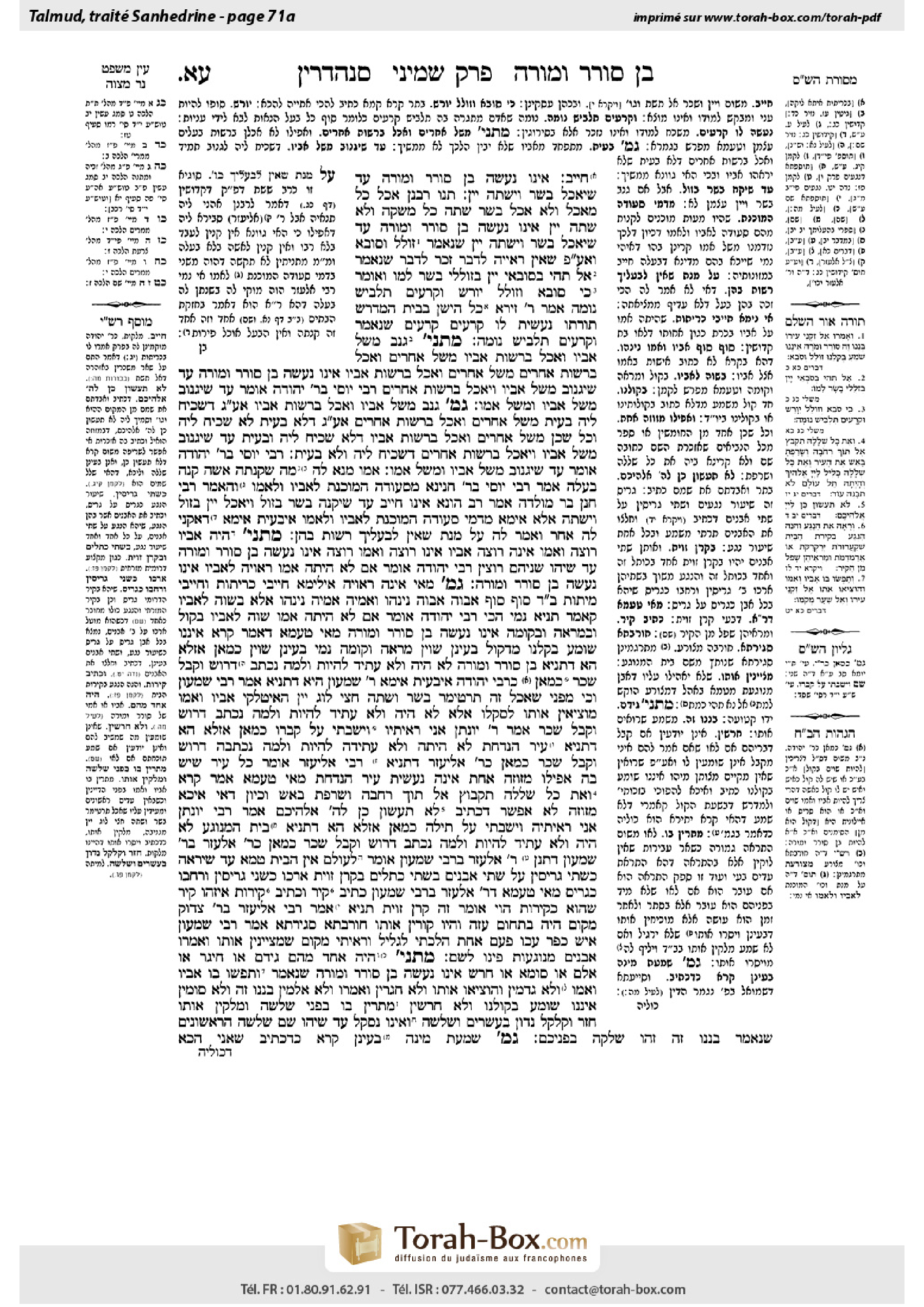
Sanhedrin 71a: Talmud study for Daf Yomi
Daf Yomi is the daily study of one Talmud folio. Explore 37 tractates with scans, Hebrew text, Sefaria English and AI-generated French translations where annotated.
Passage selection and English or AI-generated French translation are available where the scan has annotations. Daf Study is independent of Torah-Box and Sefaria.
Browse Sanhedrin · סנהדרין · All tractatesSanhedrin 71a text and translations
This page of Sanhedrin includes the Aramaic text, an English translation and an AI-generated French translation, alongside the scan above.
סנהדרין ע״א א · Aramaic and Hebrew text
חַיָּיב.
אֵינוֹ נַעֲשֶׂה בֵּן סוֹרֵר וּמוֹרֶה עַד שֶׁיֹּאכַל בָּשָׂר וְיִשְׁתֶּה יַיִן. תָּנוּ רַבָּנַן: אָכַל כׇּל מַאֲכָל וְלֹא אָכַל בָּשָׂר, שָׁתָה כׇּל מַשְׁקֶה וְלֹא שָׁתָה יַיִן – אֵינוֹ נַעֲשֶׂה בֵּן סוֹרֵר וּמוֹרֶה עַד שֶׁיֹּאכַל בָּשָׂר וְיִשְׁתֶּה יַיִן, שֶׁנֶּאֱמַר: ״זוֹלֵל וְסֹבֵא״.
וְאַף עַל פִּי שֶׁאֵין רְאָיָיה לַדָּבָר, זֵכֶר לַדָּבָר שֶׁנֶּאֱמַר: ״אַל תְּהִי בְסֹבְאֵי יָיִן בְּזֹלְלֵי בָשָׂר לָמוֹ״, וְאוֹמֵר: ״כִּי סֹבֵא וְזוֹלֵל יִוָּרֵשׁ וּקְרָעִים תַּלְבִּישׁ נוּמָה״. אָמַר רַבִּי זֵירָא: כׇּל הַיָּשֵׁן בְּבֵית הַמִּדְרָשׁ תּוֹרָתוֹ נַעֲשֵׂית לוֹ קְרָעִים קְרָעִים, שֶׁנֶּאֱמַר: ״וּקְרָעִים תַּלְבִּישׁ נוּמָה״.
מַתְנִי׳ גָּנַב מִשֶּׁל אָבִיו וְאָכַל בִּרְשׁוּת אָבִיו, מִשֶּׁל אֲחֵרִים וְאָכַל בִּרְשׁוּת אֲחֵרִים, מִשֶּׁל אֲחֵרִים וְאָכַל בִּרְשׁוּת אָבִיו – אֵינוֹ נַעֲשֶׂה בֵּן סוֹרֵר וּמוֹרֶה עַד שֶׁיִּגְנוֹב מִשֶּׁל אָבִיו וְיֹאכַל בִּרְשׁוּת אֲחֵרִים. רַבִּי יוֹסֵי בְּרַבִּי יְהוּדָה אוֹמֵר: עַד שֶׁיִּגְנוֹב מִשֶּׁל אָבִיו וּמִשֶּׁל אִמּוֹ.
גְּמָ׳ גָּנַב מִשֶּׁל אָבִיו וְאָכַל בִּרְשׁוּת אָבִיו. אַף עַל גַּב דִּשְׁכִיחַ לֵיהּ, בְּעִית.
מִשֶּׁל אֲחֵרִים וְאָכַל בִּרְשׁוּת אֲחֵרִים. אַף עַל גַּב דְּלָא בְּעִית – לָא שְׁכִיחַ לֵיהּ. וְכׇל שֶׁכֵּן מִשֶּׁל אֲחֵרִים וְאָכַל בִּרְשׁוּת אָבִיו, דְּלָא שְׁכִיחַ לֵיהּ וּבְעִית.
עַד שֶׁיִּגְנוֹב מִשֶּׁל אָבִיו, וְיֹאכַל בִּרְשׁוּת אֲחֵרִים. דִּשְׁכִיחַ לֵיהּ, וְלָא בְּעִית.
רַבִּי יוֹסֵי בְּרַבִּי יְהוּדָה אוֹמֵר: עַד שֶׁיִּגְנוֹב מִשֶּׁל אָבִיו וּמִשֶּׁל אִמּוֹ. אִמּוֹ מְנָא לַהּ? מַה שֶּׁקָּנְתָה אִשָּׁה קָנָה בַּעְלָהּ! אָמַר רַבִּי יוֹסֵי בְּרַבִּי חֲנִינָא: מִסְּעוּדָה הַמּוּכֶנֶת לְאָבִיו וּלְאִמּוֹ.
וְהָאָמַר רַבִּי חָנָן בַּר מוֹלָדָה אָמַר רַב הוּנָא: אֵינוֹ חַיָּיב עַד שֶׁיִּקְנֶה בָּשָׂר בְּזוֹל וְיֹאכַל, יַיִן בְּזוֹל וְיִשְׁתֶּה? אֶלָּא, אֵימָא: מִדְּמֵי סְעוּדָה הַמּוּכֶנֶת לְאָבִיו וּלְאִמּוֹ.
אִיבָּעֵית אֵימָא: דְּאַקְנִי לַהּ אַחֵר, וַאֲמַר לַהּ: ״עַל מְנָת שֶׁאֵין לְבַעְלִיךְ רְשׁוּת בָּהֶן״.
מַתְנִי׳ הָיָה אָבִיו רוֹצֶה וְאִמּוֹ אֵינָהּ רוֹצֶה, אָבִיו אֵינוֹ רוֹצֶה וְאִמּוֹ רוֹצָה – אֵינוֹ נַעֲשֶׂה בֵּן סוֹרֵר וּמוֹרֶה עַד שֶׁיְּהוּ שְׁנֵיהֶם רוֹצִין. רַבִּי יְהוּדָה אוֹמֵר: אִם לֹא הָיְתָה אִמּוֹ רְאוּיָה לְאָבִיו, אֵינוֹ נַעֲשֶׂה בֵּן סוֹרֵר וּמוֹרֶה.
גְּמָ׳ מַאי ״אֵינָהּ רְאוּיָה״? אִילֵּימָא חַיָּיבֵי כָרֵיתוֹת וְחַיָּיבֵי מִיתוֹת בֵּית דִּין, סוֹף סוֹף אֲבוּהּ אֲבוּהּ נִיהוּ, וְאִמֵּיהּ אִמֵּיהּ נִיהִי!
אֶלָּא בְּשָׁוָה לְאָבִיו קָאָמַר. תַּנְיָא נָמֵי הָכִי: רַבִּי יְהוּדָה אוֹמֵר, אִם לֹא הָיְתָה אִמּוֹ שָׁוָה לְאָבִיו בְּקוֹל וּבְמַרְאֶה וּבַקּוֹמָה, אֵינוֹ נַעֲשֶׂה בֵּן סוֹרֵר וּמוֹרֶה. מַאי טַעְמָא? דְּאָמַר קְרָא ״אֵינֶנּוּ שֹׁמֵעַ בְּקֹלֵנוּ״. מִדְּקוֹל בָּעֵינַן שָׁוִין, מַרְאֶה וְקוֹמָה נָמֵי בָּעֵינַן שָׁוִין.
כְּמַאן אָזְלָא הָא דְּתַנְיָא: בֵּן סוֹרֵר וּמוֹרֶה לֹא הָיָה וְלֹא עָתִיד לִהְיוֹת, וְלָמָּה נִכְתַּב? דְּרוֹשׁ וְקַבֵּל שָׂכָר. כְּמַאן? כְּרַבִּי יְהוּדָה.
אִיבָּעֵית אֵימָא: רַבִּי שִׁמְעוֹן הִיא, דְּתַנְיָא, אָמַר רַבִּי שִׁמְעוֹן: וְכִי מִפְּנֵי שֶׁאָכַל זֶה תַּרְטֵימָר בָּשָׂר וְשָׁתָה חֲצִי לוֹג יַיִן הָאִיטַלְקִי, אָבִיו וְאִמּוֹ מוֹצִיאִין אוֹתוֹ לְסׇקְלוֹ? אֶלָּא לֹא הָיָה וְלֹא עָתִיד לִהְיוֹת, וְלָמָּה נִכְתַּב? דְּרוֹשׁ וְקַבֵּל שָׂכָר. אָמַר רַבִּי יוֹנָתָן: אֲנִי רְאִיתִיו וְיָשַׁבְתִּי עַל קִבְרוֹ.
כְּמַאן אָזְלָא הָא דְּתַנְיָא: עִיר הַנִּדַּחַת לֹא הָיְתָה וְלֹא עֲתִידָה לִהְיוֹת, וְלָמָּה נִכְתְּבָה – דְּרוֹשׁ וְקַבֵּל שָׂכָר. כְּמַאן? כְּרַבִּי אֱלִיעֶזֶר, דְּתַנְיָא: רַבִּי אֱלִיעֶזֶר אוֹמֵר, כׇּל עִיר שֶׁיֵּשׁ בָּהּ אֲפִילּוּ מְזוּזָה אַחַת אֵינָהּ נַעֲשֵׂית עִיר הַנִּדַּחַת.
מַאי טַעְמָא? אָמַר קְרָא: ״וְאֶת כׇּל שְׁלָלָהּ תִּקְבֹּץ אֶל תּוֹךְ רְחֹבָהּ וְשָׂרַפְתָּ בָאֵשׁ״. וְכֵיוָן דְּאִי אִיכָּא מְזוּזָה, לָא אֶפְשָׁר, דִּכְתִיב: ״לֹא תַעֲשׂוּן כֵּן לַה׳ אֱלֹהֵיכֶם״. אָמַר רַבִּי יוֹנָתָן: אֲנִי רְאִיתִיהָ וְיָשַׁבְתִּי עַל תִּילָּהּ.
כְּמַאן אָזְלָא הָא דְּתַנְיָא: בַּיִת הַמְנוּגָּע לֹא הָיָה וְלֹא עָתִיד לִהְיוֹת, וְלָמָּה נִכְתַּב – דְּרוֹשׁ וְקַבֵּל שָׂכָר. כְּמַאן? כְּרַבִּי אֶלְעָזָר בְּרַבִּי שִׁמְעוֹן, דִּתְנַן: רַבִּי אֶלְעָזָר בְּרַבִּי שִׁמְעוֹן אוֹמֵר, לְעוֹלָם אֵין הַבַּיִת טָמֵא עַד שֶׁיֵּרָאֶה כִּשְׁתֵּי גְרִיסִין עַל שְׁתֵּי אֲבָנִים בִּשְׁתֵּי כְתָלִים בְּקֶרֶן זָוִית, אׇרְכּוֹ כִּשְׁנֵי גְרִיסִין וְרׇחְבּוֹ כִּגְרִיס.
מַאי טַעְמָא דְּרַבִּי אֶלְעָזָר בְּרַבִּי שִׁמְעוֹן? כְּתִיב ״קִיר״ וּכְתִיב ״קִירֹת״. אֵיזֶהוּ קִיר שֶׁהוּא כְּקִירוֹת? הֱוֵי אוֹמֵר: זֶה קֶרֶן זָוִית.
תַּנְיָא: אָמַר רַבִּי אֱלִיעֶזֶר בְּרַבִּי צָדוֹק, מָקוֹם הָיָה בִּתְחוּם עַזָּה, וְהָיוּ קוֹרִין אוֹתוֹ חוּרְבָּתָא סְגִירְתָּא. אָמַר רַבִּי שִׁמְעוֹן אִישׁ כְּפַר עַכּוֹ: פַּעַם אַחַת הָלַכְתִּי לְגָלִיל וְרָאִיתִי מָקוֹם שֶׁמְּצַיְּינִין אוֹתוֹ, וְאָמְרוּ: אֲבָנִים מְנוּגָּעוֹת פִּינוּ לְשָׁם.
מַתְנִי׳ הָיָה אֶחָד מֵהֶם גִּידֵּם, אוֹ חִיגֵּר, אוֹ אִלֵּם, אוֹ סוֹמֵא, אוֹ חֵרֵשׁ – אֵינוֹ נַעֲשֶׂה בֵּן סוֹרֵר וּמוֹרֶה, שֶׁנֶּאֱמַר: ״וְתָפְשׂוּ בוֹ אָבִיו וְאִמּוֹ״ – וְלֹא גִּדְמִין, ״וְהוֹצִיאוּ אֹתוֹ״ – וְלֹא חִגְּרִין, ״וְאָמְרוּ״ – וְלֹא אִלְּמִין, ״בְּנֵנוּ זֶה״ – וְלֹא סוֹמִין, ״אֵינֶנּוּ שֹׁמֵעַ בְּקֹלֵנוּ״ – וְלֹא חֵרְשִׁין.
מַתְרִין בּוֹ בִּפְנֵי שְׁלֹשָׁה, וּמַלְקִין אוֹתוֹ. חָזַר וְקִלְקֵל – נִדּוֹן בְּעֶשְׂרִים וּשְׁלֹשָׁה, וְאֵינוֹ נִסְקָל עַד שֶׁיְּהוּ שָׁם שְׁלֹשָׁה הָרִאשׁוֹנִים, שֶׁנֶּאֱמַר: ״בְּנֵנוּ זֶה״ – זֶהוּ שֶׁלָּקָה בִּפְנֵיכֶם.
גְּמָ׳ שָׁמְעַתְּ מִינַּהּ: בָּעֵינַן קְרָא כְּדִכְתִיב? שָׁאנֵי הָכָא,
Sanhedrin 71a · English translation
he is liable for entering the Temple while intoxicated.
§ The mishna teaches that the boy does not become a stubborn and rebellious son unless he actually eats meat and drinks wine. The Sages taught in a baraita: If he ate any other food but did not eat meat, or if he drank any other beverage but did not drink wine, he does not become a stubborn and rebellious son unless he actually eats meat and drinks wine, as it is stated: “This son of ours is stubborn and rebellious; he will not obey our voices; he is a glutton and a drunkard.”
And although there is no explicit proof to the matter, there is an allusion to the matter in another verse, as it is stated: “Be not among wine drinkers, among gluttonous eaters of meat” (Proverbs 23:20). And the verse states: “For the drunkard and the glutton shall come to poverty, and drowsiness shall clothe a man with rags” (Proverbs 23:21). That is to say, a person who is a glutton and a drunkard, and sleeps a lot due to his excessive eating and drinking, will end up poor and dressed in rags. Rabbi Zeira expounds the same verse and says: With regard to anyone who sleeps in the study hall, his Torah shall become tattered, as it is stated: “And drowsiness shall clothe a man with rags.”
MISHNA: If he stole that which belonged to his father and ate on his father’s property, or he stole that which belonged to others and ate on the property of others, or he stole that which belonged to others and ate on his father’s property, he does not become a stubborn and rebellious son, unless he steals that which belonged to his father and eats on the property of others. Rabbi Yosei, son of Rabbi Yehuda, says: He does not become a stubborn and rebellious son unless he steals that which belonged to his father and that which belonged to his mother.
GEMARA: The Gemara explains the reasons for the various halakhot taught in the mishna: If he stole that which belonged to his father and ate on his father’s property, even though this is accessible to him and it is easy for him to steal, he is afraid that his father will see him eating what he had stolen, and therefore he will not be drawn after his action to further evil.
If he stole that which belonged to others and ate on the property of others, even though he is not afraid of them, as they neither know him nor watch over him, this theft is not easily accessible to him, as it is performed on someone else’s property, and therefore he will not be drawn to additional sin. And all the more so if he stole that which belonged to others and ate on his father’s property, in which case it is not accessible to him, and he is also afraid of his father.
Therefore, he is not liable unless he steals that which belonged to his father and eats on the property of others, in which case it is easily accessible to him, and he is not afraid, and there is concern that he will be drawn after his action to additional sin.
The mishna teaches that Rabbi Yosei, son of Rabbi Yehuda, says that he is not liable as a stubborn and rebellious son unless he steals that which belonged to his father and that which belonged to his mother. The Gemara asks: With regard to his mother, from where does she have independently owned property that her son can steal? The basis for this question is the halakha that anything that a woman acquires is acquired by her husband. Rabbi Yosei, son of Rabbi Ḥanina, says in answer to this question: The mishna is referring to a case where the boy stole food from a meal that had been prepared for his father and for his mother. In such a case the husband grants his wife ownership of the food that she will eat over the course of her meal.
The Gemara raises a difficulty. But doesn’t Rabbi Ḥanan bar Molada say that Rav Huna says: A stubborn and rebellious son is not liable unless he purchases inexpensive meat and eats it, and he purchases inexpensive wine and drinks it, which indicates that he becomes liable only if he steals money, not if he steals the actual meat and wine? Rather, say that the boy stole from money set aside for a meal that was to be prepared for his father and for his mother.
The Gemara presents another answer to the question posed concerning the opinion of Rabbi Yosei, son of Rabbi Yehuda: If you wish, say instead that another person gave property to the mother and said to her: This shall be yours on the condition that your husband shall have no right to it. In such a case, the woman acquires the property for herself and her husband does not acquire it. Therefore, it is possible for the son to steal from his mother’s property.
MISHNA: If his father wishes to have him punished but his mother does not wish that, or if his father does not wish to have him punished but his mother wishes that, he does not become a stubborn and rebellious son, unless they both wish that he be punished. Rabbi Yehuda says: If his mother was not suited for his father, the two being an inappropriate match, as the Gemara will explain, he does not become a stubborn and rebellious son.
GEMARA: The Gemara asks: What does Rabbi Yehuda mean when he speaks of the mother as being not suited for the father? If we say that due to their union they are among those who are liable to receive karet, in which case the marriage does not take effect, and certainly if the union puts them in the category of those who are liable to receive one of the types of court-imposed death penalty, in which case the marriage also does not take effect, there is a difficulty: Why should it matter if they are not married? Ultimately, his father is still his father and his mother is still his mother, and the verses concerning the stubborn and rebellious son can be fulfilled.
Rather, Rabbi Yehuda is saying that the boy’s mother must be identical to his father in several aspects. The Gemara comments: This is also taught in a baraita: Rabbi Yehuda says: If his mother was not identical to his father in voice, appearance, and height, he does not become a stubborn and rebellious son. The Gemara asks: What is the reason for this? As the verse states: “He will not obey our voices [kolenu]” (Deuteronomy 21:20), which indicates that they both have the same voice. And since we require that they be identical in voice, we also require that they be identical in appearance and height.
The Gemara asks: In accordance with whose opinion is that which is taught in a baraita: There has never been a stubborn and rebellious son and there will never be one in the future, as it is impossible to fulfill all the requirements that must be met in order to apply this halakha. And why, then, was the passage relating to a stubborn and rebellious son written in the Torah? So that you may expound upon new understandings of the Torah and receive reward for your learning, this being an aspect of the Torah that has only theoretical value. In accordance with whose opinion is this? It is in accordance with the opinion of Rabbi Yehuda, who requires that the parents have certain identical characteristics, making it virtually impossible to apply the halakha.
If you wish, say instead that this baraita is in accordance with the opinion of Rabbi Shimon. As it is taught in a baraita that Rabbi Shimon says: And is it simply due to the fact that the boy ate a tarteimar of meat and drank a half-log of Italian wine that his father and his mother shall take him out to stone him? Rather, there has never been a stubborn and rebellious son and there will never be one in the future. And why, then, was the passage relating to a stubborn and rebellious son written in the Torah? So that you may expound upon new understandings of the Torah and receive reward for your learning. Rabbi Yonatan says: This is not so, as I saw one. I was once in a place where a stubborn and rebellious son was condemned to death, and I even sat on his grave after he was executed.
The Gemara raises a similar question: In accordance with whose opinion is that which is taught in a baraita: There has never been an idolatrous city and there will never be one in the future, as it is virtually impossible to fulfill all the requirements that must be met in order to apply this halakha. And why, then, was the passage relating to an idolatrous city written in the Torah? So that you may expound upon new understandings of the Torah and receive reward for your learning. In accordance with whose opinion is this? It is in accordance with the opinion of Rabbi Eliezer, as it is taught in a baraita that Rabbi Eliezer says: Any city that has even one mezuza or any other sacred scroll cannot become an idolatrous city. It is difficult to imagine an entire city without even one mezuza.
The Gemara asks: What is the reason that a city that has even one mezuza cannot become an idolatrous city? The Gemara answers: The verse states: “And you shall gather all the spoil of it into the midst of the open space of the city, and shall burn with fire both the city and the entire plunder taken in it” (Deuteronomy 13:17). And since if there is a mezuza there it is impossible to burn all the contents of the city, as it is written: “And you shall overthrow their altars, and break their pillars, and burn their asherim with fire…This you shall not do so to the Lord your God” (Deuteronomy 12:3–4). It is derived from this verse that it is prohibited to destroy a sacred item such as a mezuza. Therefore, in a city that has even one mezuza, it is impossible to fulfill the halakhot of an idolatrous city, as not all of its contents may be burned. Rabbi Yonatan says: This is not so, as I once saw an idolatrous city that was condemned to destruction, and I even sat on its ruins.
The Gemara asks another similar question: In accordance with whose opinion is that which is taught in a baraita: There has never been a house afflicted with leprosy of the house and there will never be one in the future. And why, then, was the passage relating to leprosy of the house written in the Torah? So that you may expound upon new understandings of the Torah and receive reward for your learning. In accordance with whose opinion is this? It is in accordance with the opinion of Rabbi Elazar, son of Rabbi Shimon, as we learned in a mishna (Nega’im 12:3) that Rabbi Elazar, son of Rabbi Shimon, says: A house never becomes impure with leprosy until a mark about the size of two split beans is seen on two stones in two walls that form a corner between them, the mark being about two split beans in length and about one split bean in width. It is difficult to imagine that such a precise situation will ever occur.
The Gemara asks: What is the reason for the statement of Rabbi Elazar, son of Rabbi Shimon, that a house does not become impure unless it has a mark precisely in the corner? The verse states: “And he shall look at the leprous mark, and, behold, if the leprous mark be in the walls of the house, in greenish or reddish depressions, which in sight are lower than the wall” (Leviticus 14:37). In one part of the verse it is written “wall,” and in another part of the verse it is written “walls.” Which wall is like two walls? You must say this is a corner.
It is taught in a baraita: Rabbi Eliezer, son of Rabbi Tzadok, says: There was a place in the area of Gaza, and it was called the leprous ruin; that is to say, it was the ruin of a house that had been afflicted with leprosy. Apparently, then, leprosy of the house has existed. Rabbi Shimon of the village of Akko said: I once went to the Galilee and I saw a place that was being marked off as an impure place, and they said that stones afflicted with leprosy were cast there. This too indicates that a house afflicted with leprosy has existed.
MISHNA: If one of the parents was without hands, or lame, or mute, or blind, or deaf, their son does not become a stubborn and rebellious son, as it is stated: “Then shall his father and his mother lay hold of him, and bring him out to the elders of his city and to the gate of his place. And they shall say to the elders of his city: This son of ours is stubborn and rebellious; he will not obey our voices; he is a glutton and a drunkard” (Deuteronomy 21:19–20). The Sages derive: “Then shall his father and his mother lay hold of him,” but not people without hands, who cannot do this. “And bring him out,” but not lame people, who cannot walk. “And they shall say,” but not mutes. “This son of ours,” but not blind people, who cannot point to their son and say “this.” “He will not obey our voices,” but not deaf people, who cannot hear whether or not he declined to obey them.
After he is brought before the elders of the city, he is admonished before three people and then they flog him for having stolen. If he sins again, he is judged by a court of twenty-three judges, but he is not stoned unless the first three judges before whom he had been flogged are present there, as it is stated: “This son of ours,” this is the son who was already flogged before you.
GEMARA: The Gemara draws a conclusion from the mishna: You can learn from the mishna that we require that a verse be fulfilled precisely as it is written, in strict conformity with its literal sense, and not in looser or more expansive fashion. The Gemara rejects this suggestion: There is no proof from here. Here it is different,
Sanhedrin 71a · Traduction française (IA)
il est passible pour être entré dans le Temple en état d’ivresse.
§ La Michna enseigne que le garçon ne devient un fils rebelle et indocile que s’il mange effectivement de la viande et boit du vin. Les Sages ont enseigné dans une baraïta : s’il mange un autre aliment sans manger de viande, ou s’il boit une autre boisson sans boire de vin, il ne devient pas un fils rebelle et indocile ; il ne le devient que s’il mange effectivement de la viande et boit du vin, comme il est dit : « Voici notre fils, il est rebelle et indocile ; il n’écoute pas notre voix ; c’est un glouton et un ivrogne. »
Et bien qu’il n’y ait pas de preuve explicite à ce sujet, un autre verset y fait allusion, comme il est dit : « Ne sois pas parmi les buveurs de vin, parmi les gloutons qui mangent de la viande » (Proverbes 23, 20). Le verset dit aussi : « Car le buveur et le glouton tomberont dans la pauvreté, et la somnolence vêtira l’homme de haillons » (Proverbes 23, 21). Cela signifie qu’un homme glouton et ivrogne, qui dort beaucoup à cause de ses excès de nourriture et de boisson, finira pauvre et vêtu de haillons. Rabbi Zeïra interprète le même verset et dit : Quiconque dort dans la maison d’étude verra sa Torah tomber en lambeaux, comme il est dit : « La somnolence vêtira l’homme de haillons. »
MICHNA : S’il a volé un bien appartenant à son père et qu’il a mangé sur le domaine de son père, ou s’il a volé un bien appartenant à autrui et qu’il a mangé sur le domaine d’autrui, ou s’il a volé un bien appartenant à autrui et qu’il a mangé sur le domaine de son père, il ne devient pas un fils rebelle et indocile. Il ne le devient que s’il vole un bien appartenant à son père et mange sur le domaine d’autrui. Rabbi Yossé, fils de Rabbi Yehouda, dit : Il ne devient pas un fils rebelle et indocile tant qu’il n’a pas volé des biens appartenant à son père et à sa mère.
GUEMARA : La Guemara explique les raisons des différentes halakhot enseignées dans la Michna : s’il a volé un bien appartenant à son père et qu’il a mangé sur le domaine de son père, bien que le bien lui soit facilement accessible et qu’il lui soit facile de le voler, il craint que son père ne le voie manger ce qu’il a volé ; il ne se laissera donc pas entraîner par cet acte vers d’autres méfaits.
S’il a volé un bien appartenant à autrui et qu’il a mangé sur le domaine d’autrui, bien qu’il n’ait pas peur de ces personnes, puisqu’elles ne le connaissent pas et ne le surveillent pas, ce vol ne lui est pas facilement accessible, car il a lieu sur le domaine d’autrui ; il ne se laissera donc pas entraîner vers d’autres péchés. À plus forte raison s’il a volé un bien appartenant à autrui et qu’il a mangé sur le domaine de son père, puisque le bien ne lui est pas facilement accessible et qu’il craint aussi son père.
Par conséquent, il n’est passible que s’il vole un bien appartenant à son père et mange sur le domaine d’autrui : le bien lui est alors facilement accessible et il n’a pas peur, de sorte qu’il est à craindre qu’il ne se laisse entraîner par cet acte vers d’autres péchés.
La Michna enseigne que Rabbi Yossé, fils de Rabbi Yehouda, dit qu’il n’est passible en tant que fils rebelle et indocile que s’il vole des biens appartenant à son père et à sa mère. La Guemara demande : En ce qui concerne sa mère, d’où peut-elle tenir des biens en propre que son fils puisse voler ? La question repose sur la halakha selon laquelle tout ce qu’une femme acquiert est acquis par son mari. Rabbi Yossi, fils de Rabbi Ḥanina, répond à cette question : la Michna parle d’un cas où le garçon a volé de la nourriture d’un repas préparé pour son père et sa mère. Dans un tel cas, le mari accorde à sa femme la propriété de la nourriture qu’elle mangera au cours de son repas.
La Guemara soulève une difficulté. Mais Rabbi Ḥanan bar Molada ne dit-il pas que Rav Houna dit : Un fils rebelle et indocile n’est passible que s’il achète de la viande bon marché et la mange, et s’il achète du vin bon marché et le boit ? Cela indique qu’il n’est passible que s’il vole de l’argent, et non la viande et le vin eux-mêmes. Il faut donc plutôt dire que le garçon a volé de l’argent destiné à un repas qui devait être préparé pour son père et sa mère.
La Guemara donne une autre réponse à la question soulevée au sujet de l’opinion de Rabbi Yossé, fils de Rabbi Yehouda : si tu veux, dis plutôt qu’une autre personne a donné des biens à la mère en lui disant : « Cela sera à toi, à condition que ton mari n’y ait aucun droit. » Dans un tel cas, la femme acquiert ces biens pour elle-même et son mari ne les acquiert pas. Il est donc possible que le fils vole des biens appartenant à sa mère.
MICHNA : Si son père souhaite qu’il soit puni mais que sa mère ne le souhaite pas, ou si son père ne souhaite pas qu’il soit puni mais que sa mère le souhaite, il ne devient pas un fils rebelle et indocile ; il ne le devient que si tous deux souhaitent qu’il soit puni. Rabbi Yehouda dit : Si sa mère ne convenait pas à son père, les deux formant une union inappropriée, comme la Guemara l’expliquera, il ne devient pas un fils rebelle et indocile.
GUEMARA : La Guemara demande : Que veut dire Rabbi Yehouda lorsqu’il dit que la mère ne convenait pas au père ? Si nous disons qu’en raison de leur union, ils font partie de ceux qui sont passibles de karet, auquel cas le mariage ne prend pas effet — et, à plus forte raison, si leur union les range parmi ceux qui sont passibles d’une des peines de mort imposées par le tribunal, auquel cas le mariage ne prend pas effet non plus —, cela pose problème : pourquoi importe-t-il qu’ils ne soient pas mariés ? Après tout, son père reste son père et sa mère reste sa mère, et les versets concernant le fils rebelle et indocile peuvent être accomplis.
Mais Rabbi Yehouda veut dire que la mère du garçon doit être identique à son père sous plusieurs aspects. La Guemara fait remarquer que cela aussi est enseigné dans une baraïta : Rabbi Yehouda dit : Si sa mère n’était pas identique à son père par la voix, l’apparence et la taille, il ne devient pas un fils rebelle et indocile. La Guemara demande : Quelle en est la raison ? Le verset dit : « Il n’écoutera pas nos voix [kolenu] » (Deutéronome 21, 20), ce qui indique qu’ils ont tous deux la même voix. Et puisqu’il est exigé qu’ils soient identiques par la voix, il est également exigé qu’ils le soient par l’apparence et la taille.
La Guemara demande : Selon quelle opinion a-t-on enseigné dans une baraïta qu’il n’y a jamais eu de fils rebelle et indocile et qu’il n’y en aura jamais à l’avenir, car il est impossible de réunir toutes les conditions requises pour appliquer cette halakha ? Pourquoi, alors, le passage concernant le fils rebelle et indocile a-t-il été écrit dans la Torah ? Afin que tu interprètes de nouvelles interprétations de la Torah et reçoives une récompense pour ton étude ; ce passage n’a qu’une valeur théorique. Selon quelle opinion cela a-t-il été enseigné ? Selon celle de Rabbi Yehouda, qui exige que les parents possèdent certaines caractéristiques identiques, ce qui rend l’application de la halakha pratiquement impossible.
Si tu veux, dis plutôt que cette baraïta suit l’opinion de Rabbi Shimon. Car il est enseigné dans une baraïta que Rabbi Shimon dit : Est-ce simplement parce que le garçon a mangé un tarteimar de viande et bu un demi-log de vin italien que son père et sa mère doivent le conduire pour le faire lapider ? En réalité, il n’y a jamais eu de fils rebelle et indocile et il n’y en aura jamais à l’avenir. Pourquoi, alors, le passage concernant le fils rebelle et indocile a-t-il été écrit dans la Torah ? Afin que tu interprètes de nouvelles interprétations de la Torah et reçoives une récompense pour ton étude. Rabbi Yonatan dit : Cela n’est pas ainsi, car j’en ai vu un. Je me trouvais un jour en un lieu où un fils rebelle et indocile avait été condamné à mort, et je me suis même assis sur sa tombe après son exécution.
La Guemara soulève une question semblable : selon quelle opinion a-t-on enseigné dans une baraïta qu’il n’y a jamais eu de ville idolâtre et qu’il n’y en aura jamais à l’avenir, car il est pratiquement impossible de réunir toutes les conditions requises pour appliquer cette halakha ? Pourquoi, alors, le passage concernant une ville idolâtre a-t-il été écrit dans la Torah ? Afin que tu interprètes de nouvelles interprétations de la Torah et reçoives une récompense pour ton étude. Selon quelle opinion cela a-t-il été enseigné ? Selon celle de Rabbi Eliezer, car il est enseigné dans une baraïta que Rabbi Eliezer dit : Une ville qui possède ne serait-ce qu’une mezouza ou un autre rouleau sacré ne peut pas devenir une ville idolâtre. Il est difficile d’imaginer une ville entière sans la moindre mezouza.
La Guemara demande : Pourquoi une ville qui possède ne serait-ce qu’une mezouza ne peut-elle pas devenir une ville idolâtre ? La Guemara répond : Le verset dit : « Tu rassembleras tout son butin au milieu de la place de la ville, et tu brûleras au feu la ville et tout son butin » (Deutéronome 13, 17). Or, s’il s’y trouve une mezouza, il est impossible de brûler tout le contenu de la ville, car il est écrit : « Vous renverserez leurs autels, vous briserez leurs stèles et vous brûlerez leurs ashéras au feu… Vous n’agirez pas ainsi envers le Seigneur, votre Dieu » (Deutéronome 12, 3-4). On déduit de ce verset qu’il est interdit de détruire un objet sacré tel qu’une mezouza. Par conséquent, dans une ville qui possède ne serait-ce qu’une mezouza, il est impossible d’appliquer les halakhot de la ville idolâtre, puisque tout son contenu ne peut pas être brûlé. Rabbi Yonatan dit : Cela n’est pas ainsi, car j’ai vu un jour une ville idolâtre condamnée à la destruction, et je me suis même assis sur ses ruines.
La Guemara pose une autre question semblable : selon quelle opinion a-t-on enseigné dans une baraïta qu’il n’y a jamais eu de maison atteinte de lèpre et qu’il n’y en aura jamais à l’avenir ? Pourquoi, alors, le passage concernant la lèpre des maisons a-t-il été écrit dans la Torah ? Afin que tu interprètes de nouvelles interprétations de la Torah et reçoives une récompense pour ton étude. Selon quelle opinion cela a-t-il été enseigné ? Selon celle de Rabbi Elazar, fils de Rabbi Shimon, car nous avons appris dans une Michna (Negaïm 12, 3) que Rabbi Elazar, fils de Rabbi Shimon, dit : Une maison ne devient jamais impure à cause de la lèpre si une marque de la taille d’environ deux fèves fendues n’apparaît pas sur deux pierres situées dans deux murs qui se rejoignent en formant un angle, la marque ayant environ deux fèves fendues de longueur et une fève fendue de largeur. Il est difficile d’imaginer qu’une situation aussi précise se produise un jour.
La Guemara demande : Pour quelle raison Rabbi Elazar, fils de Rabbi Shimon, affirme-t-il qu’une maison ne devient pas impure à moins de porter une marque située précisément dans un angle ? Le verset dit : « Il examinera la plaie de lèpre et, si la plaie de lèpre apparaît sur les murs de la maison, sous forme de dépressions verdâtres ou rougeâtres, qui semblent plus basses que le mur » (Lévitique 14, 37). Dans une partie du verset, le mot « mur » est au singulier, et dans une autre, le mot « murs » est au pluriel. Quel mur équivaut à deux murs ? Il faut dire qu’il s’agit d’un angle.
Il est enseigné dans une baraïta : Rabbi Eliezer, fils de Rabbi Tsadok, dit : Il y avait un lieu dans la région de Gaza qu’on appelait « la ruine lépreuse », c’est-à-dire les ruines d’une maison atteinte de lèpre. Il semble donc que la lèpre des maisons ait existé. Rabbi Shimon du village d’Akko dit : Je suis allé un jour en Galilée et j’ai vu un endroit délimité comme un lieu impur ; on m’a dit que des pierres atteintes de lèpre y avaient été jetées. Cela indique également qu’une maison atteinte de lèpre a existé.
MICHNA : Si l’un des parents n’a pas de mains, est boiteux, muet, aveugle ou sourd, leur fils ne devient pas un fils rebelle et indocile, comme il est dit : « Son père et sa mère le saisiront et le conduiront aux anciens de sa ville, à la porte de son lieu. Ils diront aux anciens de sa ville : “Voici notre fils, il est rebelle et indocile ; il n’écoute pas notre voix ; c’est un glouton et un ivrogne” » (Deutéronome 21, 19-20). Les Sages déduisent : « Son père et sa mère le saisiront », mais pas ceux qui n’ont pas de mains, qui ne peuvent pas le faire. « Et le conduiront », mais pas les boiteux, qui ne peuvent pas marcher. « Ils diront », mais pas les muets. « Voici notre fils », mais pas les aveugles, qui ne peuvent pas désigner leur fils et dire « voici ». « Il n’écoute pas notre voix », mais pas les sourds, qui ne peuvent pas entendre s’il a refusé ou non de leur obéir.
Après qu’il a été conduit devant les anciens de la ville, on l’admoneste devant trois personnes, puis on le fouette pour le vol. S’il pèche de nouveau, il est jugé par un tribunal de vingt-trois juges, mais il n’est lapidé que si les trois premiers juges devant lesquels il a été fouetté sont présents, comme il est dit : « Voici notre fils » ; il s’agit du fils qui a déjà été fouetté devant vous.
GUEMARA : La Guemara tire une conclusion de la Michna : on peut déduire de la Michna qu’on exige qu’un verset soit accompli précisément comme il est écrit, conformément à son sens littéral strict, et non de manière plus souple ou plus large. La Guemara rejette cette suggestion : il n’y a pas de preuve à tirer d’ici. Ici, c’est différent,
Traduction française générée par IA à partir de l’édition anglaise de Sefaria. Vérifie toujours un passage avec le texte source.
Text from Sefaria: William Davidson Edition - Vocalized Aramaic (CC BY NC); William Davidson Edition - English (CC BY NC).