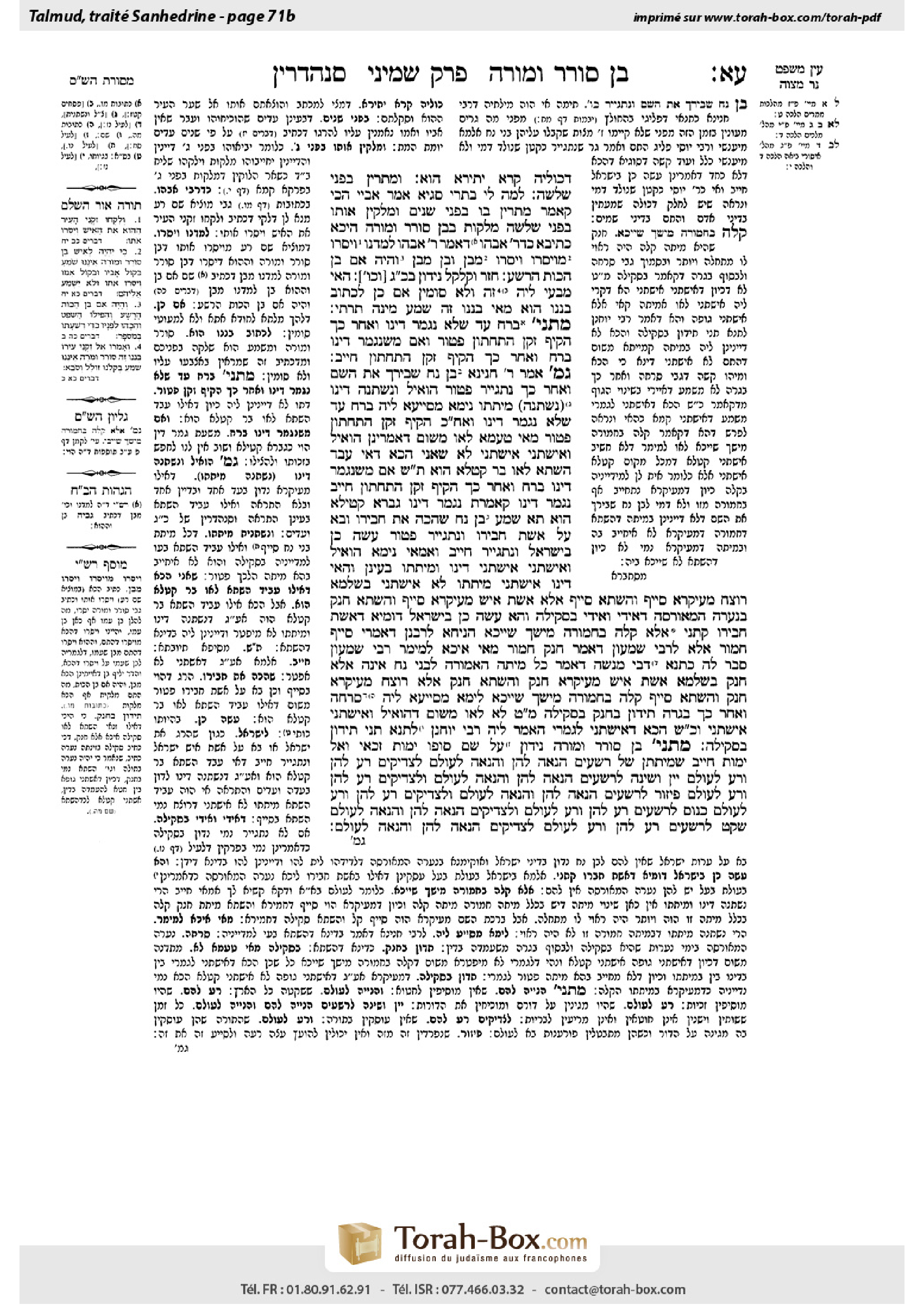
Sanhedrin 71b: Talmud study for Daf Yomi
Daf Yomi is the daily study of one Talmud folio. Explore 37 tractates with scans, Hebrew text, Sefaria English and AI-generated French translations where annotated.
Passage selection and English or AI-generated French translation are available where the scan has annotations. Daf Study is independent of Torah-Box and Sefaria.
Browse Sanhedrin · סנהדרין · All tractatesSanhedrin 71b text and translations
This page of Sanhedrin includes the Aramaic text, an English translation and an AI-generated French translation, alongside the scan above.
סנהדרין ע״א ב · Aramaic and Hebrew text
דְּכוּלֵּיהּ קְרָא יַתִּירָא הוּא.
וּמַתְרִין בִּפְנֵי שְׁלֹשָׁה? לְמָה לִי? בִּתְרֵי סַגְיָא! אָמַר אַבָּיֵי: הָכִי קָאָמַר – מַתְרִין בּוֹ בִּפְנֵי שְׁנַיִם, וּמַלְקִין אוֹתוֹ בִּפְנֵי שְׁלֹשָׁה.
מַלְקוּת בְּבֵן סוֹרֵר וּמוֹרֶה הֵיכָא כְּתִיבָא? כִּדְרַבִּי אֲבָהוּ, דְּאָמַר רַבִּי אֲבָהוּ: לָמַדְנוּ ״וְיִסְּרוּ״ מִ״וְּיִסְּרוּ״, ״וְיִסְּרוּ״ מִ״בֶּן״, וּ״בֶן״ מִ״בִּן״ – ״וְהָיָה אִם בִּן הַכּוֹת הָרָשָׁע״.
חָזַר וְקִלְקֵל, נִידּוֹן בְּעֶשְׂרִים וּשְׁלֹשָׁה [וְכוּ׳]. הַאי מִיבְּעֵי לֵיהּ: ״זֶה״ – וְלֹא סוֹמִין? אִם כֵּן, לִכְתּוֹב ״בְּנֵנוּ הוּא״. מַאי ״בְּנֵנוּ זֶה״? שְׁמַע מִינַּהּ תַּרְתֵּי.
מַתְנִי׳ בָּרַח עַד שֶׁלֹּא נִגְמַר דִּינוֹ, וְאַחַר כָּךְ הִקִּיף זָקָן הַתַּחְתּוֹן – פָּטוּר. וְאִם מִשֶּׁנִּגְמַר דִּינוֹ בָּרַח, וְאַחַר כָּךְ הִקִּיף זָקָן הַתַּחְתּוֹן – חַיָּיב.
גְּמָ׳ אָמַר רַבִּי חֲנִינָא: בֶּן נֹחַ שֶׁבֵּירַךְ אֶת הַשֵּׁם וְאַחַר כָּךְ נִתְגַּיֵּיר – פָּטוּר, הוֹאִיל וְנִשְׁתַּנָּה דִּינוֹ, נִשְׁתַּנֵּית מִיתָתוֹ.
נֵימָא מְסַיְּיעָא לֵיהּ: בָּרַח עַד שֶׁלֹּא נִגְמַר דִּינוֹ, וְאַחַר כָּךְ הִקִּיף זָקָן הַתַּחְתּוֹן – פָּטוּר. מַאי טַעְמָא? לָאו מִשּׁוּם דְּאָמְרִינַן: הוֹאִיל וְאִישְׁתַּנִּי – אִישְׁתַּנִּי?
לָא, שָׁאנֵי הָכָא, דְּאִי עֲבַד הַשְׁתָּא – לָאו בַּר קְטָלָא הוּא.
תָּא שְׁמַע: אִם מִשֶּׁנִּגְמַר דִּינוֹ בָּרַח, וְאַחַר כָּךְ הִקִּיף זָקָן הַתַּחְתּוֹן – חַיָּיב. נִגְמַר דִּינוֹ קָאָמְרַתְּ? נִגְמַר דִּינוֹ גַּבְרָא קְטִילָא הוּא!
תָּא שְׁמַע: בֶּן נֹחַ שֶׁהִכָּה אֶת חֲבֵירוֹ, וּבָא עַל אֵשֶׁת חֲבֵירוֹ, וְנִתְגַּיֵּיר – פָּטוּר. עָשָׂה כֵּן בְּיִשְׂרָאֵל וְנִתְגַּיֵּיר – חַיָּיב. וְאַמַּאי? נֵימָא: הוֹאִיל וְאִישְׁתַּנִּי – אִישְׁתַּנִּי!
דִּינוֹ וּמִיתָתוֹ בָּעֵינַן, וְהַאי – דִּינוֹ אִישְׁתַּנִּי, מִיתָתוֹ לָא אִישְׁתַּנַּי.
בִּשְׁלָמָא רוֹצֵחַ, מֵעִיקָּרָא סַיִיף וְהַשְׁתָּא סַיִיף. אֶלָּא אֵשֶׁת אִישׁ, מֵעִיקָּרָא סַיִיף וְהַשְׁתָּא חֶנֶק?
בְּנַעֲרָה הַמְאוֹרָסָה, דְּאִידֵּי וְאִידֵּי בִּסְקִילָה.
וְהָא ״עָשָׂה כֵּן בְּיִשְׂרָאֵל״, דּוּמְיָא דְּאֵשֶׁת חֲבֵירוֹ קָתָנֵי.
אֶלָּא, קַלָּה בַּחֲמוּרָה מֵישָׁךְ שָׁיְיכָא.
הָנִיחָא לְרַבָּנַן דְּאָמְרִי: ״סַיִיף חָמוּר״, אֶלָּא לְרַבִּי שִׁמְעוֹן דְּאָמַר: ״חֶנֶק חָמוּר״, מַאי אִיכָּא לְמֵימַר?
רַבִּי שִׁמְעוֹן סָבַר לַהּ כְּתַנָּא דְבֵי מְנַשֶּׁה, דְּאָמַר: כׇּל מִיתָה הָאֲמוּרָה לִבְנֵי נֹחַ אֵינָהּ אֶלָּא חֶנֶק.
בִּשְׁלָמָא אֵשֶׁת אִישׁ, מֵעִיקָּרָא חֶנֶק וְהַשְׁתָּא חֶנֶק. אֶלָּא רוֹצֵחַ, מֵעִיקָּרָא חֶנֶק וְהַשְׁתָּא סַיִיף? קַלָּה בַּחֲמוּרָה מֵישָׁךְ שָׁיְיכָא.
לֵימָא מְסַיְּיעָא לֵיהּ: סָרְחָה, וְאַחַר כָּךְ בָּגְרָה – תִּידּוֹן בְּחֶנֶק. בִּסְקִילָה מַאי טַעְמָא לָא? לָאו מִשּׁוּם דְּהוֹאִיל וְאִישְׁתַּנַּי אִישְׁתַּנִּי? וְכׇל שֶׁכֵּן הָכָא דְּאִישְׁתַּנִּי לִגְמָרֵי! הָאָמַר לֵיהּ רַבִּי יוֹחָנָן לְתַנָּא: תְּנִי ״תִּידּוֹן בִּסְקִילָה״.
מַתְנִי׳ בֵּן סוֹרֵר וּמוֹרֶה נִידּוֹן עַל שֵׁם סוֹפוֹ. יָמוּת זַכַּאי וְאַל יָמוּת חַיָּיב, שֶׁמִּיתָתָן שֶׁל רְשָׁעִים – הֲנָאָה לָהֶן וַהֲנָאָה לָעוֹלָם. לַצַּדִּיקִים – רַע לָהֶן וְרַע לָעוֹלָם.
יַיִן וְשֵׁינָה לָרְשָׁעִים – הֲנָאָה לָהֶן וַהֲנָאָה לָעוֹלָם, וְלַצַּדִּיקִים – רַע לָהֶן וְרַע לָעוֹלָם.
פִּיזּוּר לָרְשָׁעִים – הֲנָאָה לָהֶן וַהֲנָאָה לָעוֹלָם. וְלַצַּדִּיקִים – רַע לָהֶן וְרַע לָעוֹלָם. כִּנּוּס לָרְשָׁעִים – רַע לָהֶן וְרַע לָעוֹלָם. וְלַצַּדִּיקִים – הֲנָאָה לָהֶן וַהֲנָאָה לָעוֹלָם. שֶׁקֶט לָרְשָׁעִים – רַע לָהֶן וְרַע לָעוֹלָם. לַצַּדִּיקִים – הֲנָאָה לָהֶן וַהֲנָאָה לָעוֹלָם.
Sanhedrin 71b · English translation
since the entire verse is superfluous. The verse’s description of how the father and mother bring their son out appears to be unnecessary, and therefore each element in the verse limits the halakha in a precise manner. When a verse is not superfluous, it is not strictly interpreted.
§ The mishna teaches that after the rebellious son is brought before the elders of the city, he is admonished before three people. The Gemara asks: Why do I need him to be admonished before three people? Two witnesses should suffice, as in all other matters of halakha. Abaye says: This is what the mishna is saying: He is admonished before two people, who serve as witnesses, and he is flogged before three people, who constitute a court.
The Gemara asks: Where is it written that lashes are administered to a stubborn and rebellious son? There is no explicit mention of lashes in the verse. The Gemara answers: It is as Rabbi Abbahu said in another context, as Rabbi Abbahu says: We learned the meaning of the word “chastise” as stated with regard to a defamer: “And the elders of that city shall take that man and chastise him” (Deuteronomy 22:18), by means of a verbal analogy from the word “chastise” stated with regard to a rebellious son (Deuteronomy 21:18). And the meaning of the word “chastise” in the latter verse is derived from the word “son” that appears in the same verse. And the meaning of the word “son [ben]” with regard to a rebellious son is derived from the similar word “bin” stated with regard to lashes: “Then it shall be if the wicked man deserves [bin] to be flogged” (Deuteronomy 25:2). Consequently, the chastisement mentioned with regard to both a defamer and a rebellious son involves flogging.
The mishna teaches: If he sins again, he is judged by a court of twenty-three judges, which must include the three judges before whom he was brought initially, as it is stated: “This son of ours,” this is the son who was already flogged before you. The Gemara asks: But isn’t that verse needed for the derivation mentioned earlier: “This son of ours,” but not blind people, who cannot point to their son and say “this”? The Gemara answers: If so, that these words serve only to teach that the original judges must also be present, the verse should have written: He is our son, which would indicate: He who was already flogged before you. What is the meaning of: “This son of ours”? Conclude two conclusions from it: That the three original judges must also be present at the second trial, and that the son of blind parents cannot become a stubborn and rebellious son.
MISHNA: If the rebellious son ran away before he was sentenced, and afterward, before he was caught, his lower beard grew around, he is exempt from the death penalty. Once his lower beard grows around his genitals, he can no longer be judged as a stubborn and rebellious son. But if he ran away only after he was sentenced, and afterward, by the time he was caught, his lower beard had already grown around, he is liable to receive the death penalty. Once he is sentenced to death his sentence remains in force.
GEMARA: Rabbi Ḥanina says: If a descendant of Noah blessed, i.e., cursed, the name of God, and afterward he converted to Judaism, he is exempt from punishment, since his trial procedure changed, and the death penalty to which he is subject also changed. A descendant of Noah is tried by a single judge, and he can be sentenced to death on the basis of the testimony of a single witness even without having been forewarned; whereas a Jew is tried by a court of twenty-three and can be executed only on the basis of the testimony of two witnesses, and this only after having been forewarned. A descendant of Noah is killed by the sword for this transgression, whereas a Jew is killed by stoning.
The Gemara asks: Shall we say that the mishna supports him: If the rebellious son ran away before he was sentenced, and afterward, before he was caught, his lower beard grew around, he is exempt from the death penalty? What is the reason for this exemption? Isn’t it because we say: Since his legal status has changed, his liability has also changed?
The Gemara rejects this claim: No, it is different here, with regard to a stubborn and rebellious son, as were he now, after he grew his lower beard, to perform the same actions that render one liable as a rebellious son, he would not be fit for execution, and therefore he is exempt. This is different from a gentile who cursed God’s name and then converted, as even if he cursed God after having converted, he would still be liable to receive the death penalty.
The Gemara suggests: Come and hear a proof from the latter half of the mishna: But if he ran away only after he was sentenced, and afterward, by the time he was caught, his lower beard had already grown around, he is liable to receive the death penalty. This indicates that even though his legal status has changed, he is nevertheless executed. The Gemara rejects this argument: There is no proof from here; you speak of a case where he was already sentenced to death. Once he was already sentenced, he is considered a dead man and his verdict can no longer be changed.
The Gemara suggests: Come and hear another proof from what was stated in a baraita: If a descendant of Noah struck and killed another gentile or engaged in intercourse with the wife of another gentile, and he then converted to Judaism, he is exempt. But if he did this to an Israelite, killing a Jew or engaging in intercourse with the wife of a Jew, and then converted, he is liable. But why should this be so? Let us say that since his legal status changed, his liability changed as well, and therefore he should no longer be subject to the death penalty. The baraita indicates that this rationale is not accepted.
The Gemara refutes this proof: There is no comparison between the cases, because in order to nullify one’s death penalty we require a change both in his trial procedure and in the specific death penalty to which he is subject. But this descendant of Noah, though his trial procedure changed, the death penalty to which he is subject did not change.
The Gemara raises a difficulty: Granted, with regard to the case of a murderer, this answer is understandable, as initially, while he was still a gentile, he was subject to death by the sword, and now that he is a Jew he is still subject to death by the sword. Consequently, there is no change in the punishment to which he is subject. But with regard to the case of one who engaged in intercourse with a married woman, initially when he was still a gentile he was subject to death by the sword, but now that he is a Jew he is subject to death by strangulation. Accordingly, there is a change both in his trial procedure and in the type of capital punishment to which he is subject.
The Gemara answers: The case of a married woman mentioned here involves a man who engaged in intercourse with a betrothed young woman, so that in both this case, where he engaged in intercourse with her when he was still a descendant of Noah, and in that case, where he did so when he was already a Jew, he is subject to death by stoning. Since there was no change in the type of capital punishment to which he is subject, he remains liable and is executed.
The Gemara raises an objection: But the baraita teaches the case where he did this to an Israelite, i.e., engaged in intercourse with the wife of a Jew, similar to the case where he engaged in intercourse with the wife of another gentile. Both cases seem to be addressing identical circumstances, and the unique halakha governing a betrothed young woman exists only for Jews, not for descendants of Noah. Accordingly, the baraita must be discussing the case of a fully married woman.
Rather, the lenient punishment is included in the severe one. If initially, when he was a gentile, he was liable to receive a more severe punishment, and now that he is a Jew he is liable to receive a more lenient punishment, the lenient punishment is included in the severe one, and he remains liable to receive the lenient punishment. By contrast, if the punishment that he is now liable to receive is more severe, he is exempt from all punishment.
The Gemara raises a difficulty: This works out well according to the opinion of the Rabbis, who say that death by the sword is more severe than death by strangulation. Therefore, if a descendant of Noah engaged in intercourse with a married woman, so that he was subject to death by the sword, and then he converted to Judaism, so that his sentence was lightened to death by strangulation, he is still executed. But according to the opinion of Rabbi Shimon, who says that death by strangulation is more severe than death by the sword, what can be said? The convert should now be exempt from all punishment.
The Gemara answers: Rabbi Shimon holds in accordance with the opinion of the tanna of the school of Menashe, who says: Any death mentioned in connection with the descendants of Noah is nothing other than death by strangulation, and not death by the sword. Accordingly, if a descendant of Noah engaged in intercourse with a married woman, and he then converted, his punishment did not become more severe with his conversion; rather, it stayed the same, death by strangulation, and he is still executed.
The Gemara challenges: Granted, with regard to the case of a married woman, this answer is understandable. Initially, when he was still a descendant of Noah, he was subject to death by strangulation, and now, after his conversion, he is subject to death by strangulation. But as for a murderer, initially, when he was still a descendant of Noah, according to the tanna of the school of Menashe he was subject to death by strangulation, but now, after his conversion, he is subject to death by the sword. The Gemara explains: The lenient punishment is included in the severe one, and according to the opinion of Rabbi Shimon, death by strangulation is more severe than death by the sword. Consequently, he is executed.
The Gemara suggests: Shall we say that the following baraita supports Rabbi Ḥanina: If a betrothed young woman sinned by committing adultery, and afterward she reached her majority, at which time she was brought to trial, she is sentenced to death by strangulation like any other betrothed grown woman who commits adultery. What is the reason that she is not sentenced to death by stoning, the punishment imposed upon a betrothed young woman who commits adultery? Is it not that since her legal status changed, her liability changed as well? And all the more so here, in the case of the descendant of Noah who converted, where he changed completely from a gentile to a Jew, his sentence should change. The Gemara rejects this argument: No proof can be derived from here, as doesn’t Rabbi Yoḥanan say to the tanna who taught this baraita before him: Emend your version of the baraita and teach: She is sentenced to death by stoning.
MISHNA: A stubborn and rebellious son is sentenced to death not because of the severity of the transgression that he already committed but on account of his ultimate end, because a boy of his nature will grow up to lead an immoral life, and it is better that he should die while he is still innocent, before causing excessive harm, and not die after he becomes guilty. This is because the death of the wicked is beneficial to them, because they can no longer sin, and it is also beneficial to the world, which is now rid of those who do it harm. Conversely, the death of the righteous is detrimental to them, as they can no longer engage in the performance of mitzvot, and it is also detrimental to the world, as the righteous are now absent from it.
By way of association, the mishna continues: The wine and sleep of the wicked are beneficial to them and beneficial to the world, as when they are sleeping or under the influence of wine, they do not cause harm to others. And, conversely, the wine and sleep of the righteous are detrimental to them and detrimental to the world, as wine and sleep prevent them from engaging in their good deeds.
The dispersal of the wicked, so that they are not found in close proximity to each other, is beneficial to them, as they are less likely to provoke each other to sin, and it is beneficial to the world. The dispersal of the righteous is detrimental to them and detrimental to the world. The assembly of the wicked in one place is detrimental to them and detrimental to the world, while the assembly of the righteous is beneficial to them and beneficial to the world. The tranquility of the wicked is detrimental to them and detrimental to the world, while the tranquility of the righteous is beneficial to them and beneficial to the world.
Sanhedrin 71b · Traduction française (IA)
puisque le verset entier est superflu. La description du verset, selon laquelle le père et la mère conduisent leur fils, semble inutile ; chaque élément du verset restreint donc la halakha de manière précise. Lorsqu’un verset n’est pas superflu, il n’est pas interprété de manière stricte.
§ La Michna enseigne qu’après que le fils rebelle a été conduit devant les anciens de la ville, il est admonesté devant trois personnes. La Guemara demande : Pourquoi faut-il qu’il soit admonesté devant trois personnes ? Deux témoins devraient suffire, comme dans toutes les autres matières de halakha. Abaye dit : Voici ce qu’enseigne la Michna : il est admonesté devant deux personnes, qui servent de témoins, et il reçoit la flagellation devant trois personnes, qui constituent un tribunal.
La Guemara demande : Où est-il écrit qu’un fils indocile et rebelle reçoit la flagellation ? Le verset ne mentionne explicitement aucune flagellation. La Guemara répond : C’est comme l’a dit Rabbi Abbahou dans un autre contexte. Rabbi Abbahou dit en effet : Nous avons établi le sens du mot « châtier », au sujet du diffamateur — « Les anciens de cette ville prendront cet homme et le châtieront » (Deutéronome 22,18) — au moyen d’une analogie verbale avec le mot « châtier » employé au sujet du fils rebelle (Deutéronome 21,18). Le sens du mot « châtier » dans ce dernier verset est déduit du mot « fils », qui figure dans le même verset. Et le sens du mot « fils [ben] » au sujet du fils rebelle est déduit du mot semblable « bin », employé au sujet de la flagellation : « S’il se trouve que le coupable mérite [bin] d’être battu » (Deutéronome 25,2). Par conséquent, le châtiment mentionné au sujet du diffamateur comme du fils rebelle implique la flagellation.
La Michna enseigne : S’il commet de nouveau une faute, il est jugé par un tribunal de vingt-trois juges, parmi lesquels doivent figurer les trois juges devant lesquels il a été conduit initialement, comme il est dit : « Ce fils qui est le nôtre » ; c’est le fils qui a déjà reçu la flagellation devant vous. La Guemara demande : Mais ce verset n’est-il pas nécessaire pour la déduction mentionnée précédemment : « Ce fils qui est le nôtre », mais pas les aveugles, qui ne peuvent désigner leur fils et dire « celui-ci » ? La Guemara répond : Si ces mots servent uniquement à enseigner que les juges initiaux doivent également être présents, le verset aurait dû dire : « Il est notre fils », ce qui aurait indiqué qu’il s’agit de celui qui a déjà reçu la flagellation devant vous. Quel est donc le sens de « Ce fils qui est le nôtre » ? Il faut en tirer deux conclusions : les trois juges initiaux doivent également être présents au second procès, et le fils de parents aveugles ne peut pas devenir un fils indocile et rebelle.
MICHNA : Si le fils rebelle s’est enfui avant d’avoir été condamné et que, par la suite, avant qu’on ne le rattrape, sa pilosité pubienne a fait le tour, il est exempt de la peine de mort. Dès que sa pilosité pubienne a fait le tour de ses organes génitaux, il ne peut plus être jugé comme fils indocile et rebelle. Mais s’il ne s’est enfui qu’après avoir été condamné et que, par la suite, au moment où on le rattrape, sa pilosité pubienne a déjà fait le tour, il est passible de la peine de mort. Une fois condamné à mort, sa sentence reste en vigueur.
GUEMARA : Rabbi Ḥanina dit : Si un descendant de Noé a béni, c’est-à-dire maudit, le nom de Dieu, puis s’est converti au judaïsme, il est exempt de punition, car la procédure de son procès a changé, de même que la peine de mort à laquelle il est soumis. Un descendant de Noé est jugé par un seul juge et peut être condamné à mort sur le témoignage d’un seul témoin, même sans avoir été prévenu ; tandis qu’un Juif est jugé par un tribunal de vingt-trois juges et ne peut être exécuté que sur le témoignage de deux témoins, et seulement après avoir été prévenu. Pour cette transgression, un descendant de Noé est mis à mort par l’épée, tandis qu’un Juif est mis à mort par lapidation.
La Guemara demande : Faut-il dire que la Michna lui donne raison ? Si le fils rebelle s’est enfui avant d’avoir été condamné et que, par la suite, avant qu’on ne le rattrape, sa pilosité pubienne a fait le tour, il est exempt de la peine de mort. Quelle est la raison de cette exemption ? N’est-ce pas parce que nous disons que, puisque son statut juridique a changé, sa responsabilité a également changé ?
La Guemara rejette cette affirmation : Non, le cas du fils indocile et rebelle est différent, car s’il accomplissait maintenant, après que sa pilosité pubienne a fait le tour, les mêmes actes qui rendent un fils rebelle passible de la peine de mort, il ne pourrait pas être exécuté ; il est donc exempt. Cela diffère du cas d’un non-Juif qui a maudit le nom de Dieu puis s’est converti, car même s’il maudissait Dieu après sa conversion, il resterait passible de la peine de mort.
La Guemara propose : Écoute plutôt une preuve tirée de la seconde moitié de la Michna : s’il ne s’est enfui qu’après avoir été condamné et que, par la suite, au moment où on le rattrape, sa pilosité pubienne a déjà fait le tour, il est passible de la peine de mort. Cela indique que, même si son statut juridique a changé, il est néanmoins exécuté. La Guemara rejette cet argument : il n’y a pas de preuve ici ; tu parles d’un cas où il avait déjà été condamné à mort. Une fois condamné, il est considéré comme un mort, et son verdict ne peut plus être modifié.
La Guemara propose : Écoute une autre preuve tirée de ce qui est enseigné dans une baraïta : si un descendant de Noé a frappé et tué un autre non-Juif, ou a eu des relations avec l’épouse d’un autre non-Juif, puis s’est converti au judaïsme, il est exempt. Mais s’il a fait cela à un Israélite — en tuant un Juif ou en ayant des relations avec l’épouse d’un Juif — puis s’est converti, il est passible de la peine de mort. Mais pourquoi en serait-il ainsi ? Ne devrions-nous pas dire que, puisque son statut juridique a changé, sa responsabilité a également changé, et qu’il ne devrait donc plus être passible de la peine de mort ? La baraïta indique que ce raisonnement n’est pas accepté.
La Guemara réfute cette preuve : les cas ne sont pas comparables, car pour annuler la peine de mort d’une personne, il faut que changent à la fois la procédure de son procès et la peine de mort précise à laquelle elle est soumise. Or, pour ce descendant de Noé, bien que la procédure de son procès ait changé, la peine de mort à laquelle il est soumis n’a pas changé.
La Guemara soulève une difficulté : cela se comprend dans le cas d’un meurtrier, car au départ, alors qu’il était encore non-Juif, il était passible de la mort par l’épée, et maintenant qu’il est juif, il reste passible de la mort par l’épée. Par conséquent, la peine à laquelle il est soumis n’a pas changé. Mais dans le cas de celui qui a eu des relations avec une femme mariée, au départ, alors qu’il était encore non-Juif, il était passible de la mort par l’épée, tandis que maintenant qu’il est juif, il est passible de la mort par strangulation. Il y a donc un changement à la fois dans la procédure de son procès et dans le type de peine capitale auquel il est soumis.
La Guemara répond : Le cas de la femme mariée mentionné ici concerne un homme qui a eu des relations avec une jeune fille fiancée ; ainsi, dans les deux cas — lorsqu’il a eu des relations avec elle alors qu’il était encore descendant de Noé et lorsqu’il l’a fait alors qu’il était déjà juif —, il est passible de la mort par lapidation. Puisque le type de peine capitale auquel il est soumis n’a pas changé, il reste passible de la peine et il est exécuté.
La Guemara soulève une objection : Mais la baraïta enseigne le cas où il a fait cela à un Israélite, c’est-à-dire qu’il a eu des relations avec l’épouse d’un Juif, en parallèle avec le cas où il a eu des relations avec l’épouse d’un autre non-Juif. Les deux cas semblent concerner des circonstances identiques, et la halakha particulière relative à une jeune fille fiancée ne concerne que les Juifs, et non les descendants de Noé. Par conséquent, la baraïta doit parler du cas d’une femme pleinement mariée.
Il faut plutôt dire que la peine la moins sévère est incluse dans la peine la plus sévère. Si, au départ, lorsqu’il était non-Juif, il était passible d’une peine plus sévère et que maintenant, devenu juif, il est passible d’une peine moins sévère, la peine moins sévère est incluse dans la peine plus sévère, et il reste passible de la peine moins sévère. En revanche, si la peine à laquelle il est désormais passible est plus sévère, il est exempt de toute peine.
La Guemara soulève une difficulté : cela fonctionne bien selon l’opinion des Rabbins, qui disent que la mort par l’épée est plus sévère que la mort par strangulation. Par conséquent, si un descendant de Noé a eu des relations avec une femme mariée, de sorte qu’il était passible de la mort par l’épée, puis s’est converti au judaïsme, de sorte que sa peine a été allégée et est devenue la mort par strangulation, il est tout de même exécuté. Mais, selon l’opinion de Rabbi Shimon, qui dit que la mort par strangulation est plus sévère que la mort par l’épée, que peut-on dire ? Le converti devrait désormais être exempt de toute peine.
La Guemara répond : Rabbi Shimon se conforme à l’opinion du tanna de l’école de Menashé, qui dit : Toute mise à mort mentionnée à propos des descendants de Noé n’est autre que la mort par strangulation, et non la mort par l’épée. Par conséquent, si un descendant de Noé a eu des relations avec une femme mariée puis s’est converti, sa peine n’est pas devenue plus sévère à la suite de sa conversion ; elle est restée la même — la mort par strangulation — et il est toujours exécuté.
La Guemara objecte : cela se comprend dans le cas d’une femme mariée. Au départ, alors qu’il était encore descendant de Noé, il était passible de la mort par strangulation, et maintenant, après sa conversion, il est passible de la mort par strangulation. Mais dans le cas d’un meurtrier, au départ, lorsqu’il était encore descendant de Noé, il était, selon le tanna de l’école de Menashé, passible de la mort par strangulation ; maintenant, après sa conversion, il est passible de la mort par l’épée. La Guemara explique : la peine moins sévère est incluse dans la peine plus sévère et, selon l’opinion de Rabbi Shimon, la mort par strangulation est plus sévère que la mort par l’épée. Il est donc exécuté.
La Guemara propose : Faut-il dire que la baraïta suivante appuie Rabbi Ḥanina ? Si une jeune fille fiancée a péché en commettant un adultère, puis a atteint sa majorité et est alors conduite en justice, elle est condamnée à la mort par strangulation, comme toute autre femme adulte fiancée qui commet un adultère. Pourquoi n’est-elle pas condamnée à la mort par lapidation, peine imposée à une jeune fille fiancée qui commet un adultère ? N’est-ce pas parce que, puisque son statut juridique a changé, sa responsabilité a également changé ? À plus forte raison ici, dans le cas du descendant de Noé qui s’est converti et dont le statut a complètement changé, passant de non-Juif à Juif, sa peine devrait-elle changer. La Guemara rejette cet argument : aucune preuve ne peut en être tirée, car Rabbi Yoḥanan ne dit-il pas au tanna qui lui enseignait cette baraïta : « Corrige ta version de la baraïta et enseigne : elle est condamnée à la mort par lapidation » ?
MICHNA : Un fils indocile et rebelle est condamné à mort non pas en raison de la gravité de la transgression qu’il a déjà commise, mais en raison de ce qu’il finira par devenir : un garçon de cette nature mènera en grandissant une vie immorale. Mieux vaut qu’il meure alors qu’il est encore innocent, avant de causer des dommages excessifs, plutôt qu’après être devenu coupable. En effet, la mort des méchants leur est bénéfique, puisqu’ils ne peuvent plus pécher, et elle est également bénéfique au monde, qui est désormais débarrassé de ceux qui lui nuisent. À l’inverse, la mort des justes leur est préjudiciable, puisqu’ils ne peuvent plus accomplir de mitsvot, et elle est également préjudiciable au monde, qui en est désormais privé.
Par association d’idées, la Michna poursuit : Le vin et le sommeil des méchants leur sont bénéfiques et bénéficient au monde, car lorsqu’ils dorment ou sont sous l’influence du vin, ils ne nuisent pas aux autres. À l’inverse, le vin et le sommeil des justes leur sont préjudiciables et sont préjudiciables au monde, car le vin et le sommeil les empêchent d’accomplir leurs bonnes actions.
La dispersion des méchants, qui les empêche de se trouver à proximité les uns des autres, leur est bénéfique, car ils sont moins susceptibles de s’entraîner mutuellement à pécher ; elle est également bénéfique au monde. La dispersion des justes leur est préjudiciable et est préjudiciable au monde. Le rassemblement des méchants en un même lieu leur est préjudiciable et est préjudiciable au monde, tandis que le rassemblement des justes leur est bénéfique et est bénéfique au monde. La tranquillité des méchants leur est préjudiciable et est préjudiciable au monde, tandis que la tranquillité des justes leur est bénéfique et est bénéfique au monde.
Traduction française générée par IA à partir de l’édition anglaise de Sefaria. Vérifie toujours un passage avec le texte source.
Text from Sefaria: William Davidson Edition - Vocalized Aramaic (CC BY NC); William Davidson Edition - English (CC BY NC).