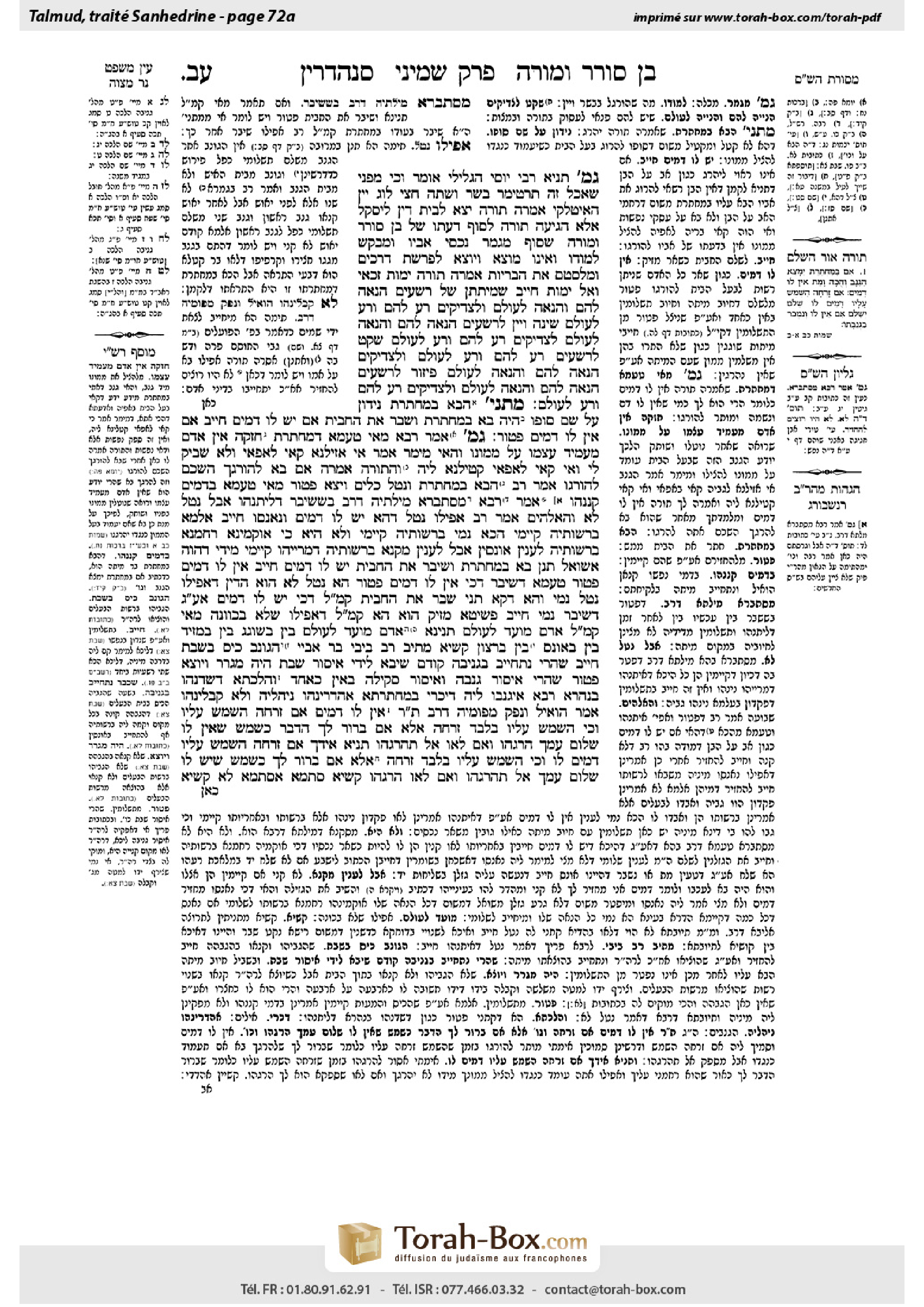
Sanhedrin 72a: Talmud study for Daf Yomi
Daf Yomi is the daily study of one Talmud folio. Explore 37 tractates with scans, Hebrew text, Sefaria English and AI-generated French translations where annotated.
Passage selection and English or AI-generated French translation are available where the scan has annotations. Daf Study is independent of Torah-Box and Sefaria.
Browse Sanhedrin · סנהדרין · All tractatesSanhedrin 72a text and translations
This page of Sanhedrin includes the Aramaic text, an English translation and an AI-generated French translation, alongside the scan above.
סנהדרין ע״ב א · Aramaic and Hebrew text
גְּמָ׳ תַּנְיָא, רַבִּי יוֹסֵי הַגְּלִילִי אוֹמֵר: וְכִי מִפְּנֵי שֶׁאָכַל זֶה תַּרְטֵימָר בָּשָׂר וְשָׁתָה חֲצִי לוֹג יַיִן הָאִיטַלְקִי אָמְרָה תּוֹרָה יֵצֵא לְבֵית דִּין לִיסָּקֵל? אֶלָּא הִגִּיעָה תּוֹרָה לְסוֹף דַּעְתּוֹ שֶׁל בֵּן סוֹרֵר וּמוֹרֶה, שֶׁסּוֹף מְגַמֵּר נִכְסֵי אָבִיו וּמְבַקֵּשׁ לִמּוּדוֹ וְאֵינוֹ מוֹצֵא, וְיוֹצֵא לְפָרָשַׁת דְּרָכִים וּמְלַסְטֵם אֶת הַבְּרִיּוֹת.
אָמְרָה תּוֹרָה: יָמוּת זַכַּאי וְאַל יָמוּת חַיָּיב, שֶׁמִּיתָתָן שֶׁל רְשָׁעִים – הֲנָאָה לָהֶם וַהֲנָאָה לָעוֹלָם, וְלַצַּדִּיקִים – רַע לָהֶם וְרַע לָעוֹלָם. שֵׁינָה וְיַיִן לָרְשָׁעִים – הֲנָאָה לָהֶם וַהֲנָאָה לָעוֹלָם, לַצַּדִּיקִים – רַע לָהֶם וְרַע לָעוֹלָם. שֶׁקֶט לָרְשָׁעִים – רַע לָהֶם וְרַע לָעוֹלָם, וְלַצַּדִּיקִים – הֲנָאָה לָהֶם וַהֲנָאָה לָעוֹלָם. פִּיזּוּר לָרְשָׁעִים – הֲנָאָה לָהֶם וַהֲנָאָה לָעוֹלָם, וְלַצַּדִּיקִים – רַע לָהֶם וְרַע לָעוֹלָם.
מַתְנִי׳ הַבָּא בַּמַּחְתֶּרֶת נִידּוֹן עַל שֵׁם סוֹפוֹ. הָיָה בָּא בַּמַּחְתֶּרֶת וְשָׁבַר אֶת הֶחָבִית, אִם יֵשׁ לוֹ דָּמִים – חַיָּיב, אִם אֵין לוֹ דָּמִים – פָּטוּר.
גְּמָ׳ אָמַר רָבָא: מַאי טַעְמָא דְּמַחְתֶּרֶת? חֲזָקָה אֵין אָדָם מַעֲמִיד עַצְמוֹ עַל מָמוֹנוֹ, וְהַאי מֵימָר אָמַר: אִי אָזֵילְנָא, קָאֵי לְאַפַּאי וְלָא שָׁבֵיק לִי, וְאִי קָאֵי לְאַפַּאי – קָטֵילְנָא לֵיהּ. וְהַתּוֹרָה אָמְרָה: אִם בָּא לְהוֹרְגְּךָ – הַשְׁכֵּם לְהוֹרְגוֹ.
אָמַר רַב: הַבָּא בַּמַּחְתֶּרֶת וְנָטַל כֵּלִים וְיָצָא – פָּטוּר. מַאי טַעְמָא? בְּדָמִים קְנָנְהוּ. אָמַר רָבָא: מִסְתַּבְּרָא מִילְּתֵיהּ דְּרַב בְּשֶׁשִּׁיבֵּר, דְּלֵיתַנְהוּ, אֲבָל נָטַל – לָא.
וְהָאֱלֹהִים! אָמַר רַב: אֲפִילּוּ נָטַל – דְּהָא יֵשׁ לוֹ דָּמִים וְנֶאֶנְסוּ, חַיָּיב. אַלְמָא בִּרְשׁוּתֵיהּ קָיְימִי. הָכָא נָמֵי, בִּרְשׁוּתֵיהּ קָיְימִי.
וְלָא הִיא, כִּי אוֹקְמִינְהוּ רַחֲמָנָא בִּרְשׁוּתֵיהּ לְעִנְיַן אֳנָסִין, אֲבָל לְעִנְיַן מִקְנָא – בִּרְשׁוּתֵיהּ דְּמָרַיְיהוּ קָיְימִי, מִידֵּי דְּהָוֵה אַשּׁוֹאֵל.
תְּנַן: בָּא בַּמַּחְתֶּרֶת וְשִׁיבֵּר אֶת הֶחָבִית, יֵשׁ לוֹ דָּמִים – חַיָּיב, אֵין לוֹ דָּמִים – פָּטוּר. טַעְמָא דְּשִׁיבֵּר, דְּכִי אֵין לוֹ דָּמִים פָּטוּר. הָא נָטַל – לָא.
הוּא הַדִּין דַּאֲפִילּוּ נָטַל נָמֵי, וְהָא דְּקָא תָנֵי ״שָׁבַר אֶת הֶחָבִית״, קָא מַשְׁמַע לַן דְּכִי יֵשׁ לוֹ דָּמִים, אַף עַל גַּב דְּשִׁיבֵּר נָמֵי – חַיָּיב.
פְּשִׁיטָא, מַזִּיק הוּא! הָא קָא מַשְׁמַע לַן דַּאֲפִילּוּ שֶׁלֹּא בְּכַוָּונָה. מַאי קָא מַשְׁמַע לַן? אָדָם מוּעָד לְעוֹלָם? תְּנֵינָא: אָדָם מוּעָד לְעוֹלָם, בֵּין בְּשׁוֹגֵג בֵּין בְּמֵזִיד, בֵּין בְּאוֹנֶס בֵּין בְּרָצוֹן! קַשְׁיָא.
מֵתִיב רַב בִּיבִי בַּר אַבָּיֵי: הַגּוֹנֵב כִּיס בְּשַׁבָּת – חַיָּיב, שֶׁהֲרֵי נִתְחַיֵּיב בִּגְנֵיבָה קוֹדֶם שֶׁיָּבֹא לִידֵי אִיסּוּר שַׁבָּת.
הָיָה מְגָרֵר וְיוֹצֵא – פָּטוּר, שֶׁהֲרֵי אִיסּוּר גְּנֵבָה וְאִיסּוּר סְקִילָה בָּאִין כְּאֶחָד.
וְהִלְכְתָא: דִּשְׁדָנְהוּ בְּנַהֲרָא.
רָבָא אִיגְּנַבוּ לֵיהּ דִּיכְרֵי בְּמַחְתַּרְתָּא. אַהְדְּרִינְהוּ נִיהֲלֵיהּ, וְלָא קַבְּלִינְהוּ. אָמַר: הוֹאִיל וּנְפַק מִפּוּמֵּיהּ דְּרַב.
תָּנוּ רַבָּנַן: ״אֵין לוֹ דָּמִים. אִם זָרְחָה הַשֶּׁמֶשׁ עָלָיו״. וְכִי הַשֶּׁמֶשׁ עָלָיו בִּלְבַד זָרְחָה? אֶלָּא, אִם בָּרוּר לְךָ הַדָּבָר כַּשֶּׁמֶשׁ שֶׁאֵין לוֹ שָׁלוֹם עִמְּךָ – הׇרְגֵהוּ, וְאִם לָאו – אַל תַּהְרְגֵהוּ.
תַּנְיָא אִידַּךְ: ״אִם זָרְחָה הַשֶּׁמֶשׁ עָלָיו דָּמִים לוֹ״. וְכִי הַשֶּׁמֶשׁ עָלָיו בִּלְבַד זָרְחָה? אֶלָּא, אִם בָּרוּר לְךָ כַּשֶּׁמֶשׁ שֶׁיֵּשׁ לוֹ שָׁלוֹם עִמְּךָ – אַל תַּהַרְגֵהוּ, וְאִם לָאו – הׇרְגֵהוּ. קַשְׁיָא סְתָמָא אַסְּתָמָא!
לָא קַשְׁיָא,
Sanhedrin 72a · English translation
GEMARA: It is taught in a baraita that further elaborates upon the words of the mishna: Rabbi Yosei HaGelili says: Is it simply due to the fact that the boy ate a tarteimar of meat and drank a half-log of Italian wine that the Torah states that he shall be taken out to court to be stoned? Rather, the Torah penetrated the ultimate mind-set of the stubborn and rebellious son and the inevitable results of his actions, and it is understood that he will continue on this path, and in the end he will squander his father’s property, and then, seeking the pleasures to which he had become accustomed but not finding them, he will go out to the crossroads and rob people.
The Torah said that it is better that he should die now when he is still innocent, and he should not die later when he is guilty. This is because the death of the wicked is beneficial to them and also beneficial to the world, while the death of the righteous is detrimental to them and detrimental to the world. The sleep and wine of the wicked is beneficial to them and beneficial to the world, while that of the righteous is detrimental to them and detrimental to the world. The tranquility of the wicked is detrimental to them and detrimental to the world, while the tranquility of the righteous is beneficial to them and beneficial to the world. The dispersal of the wicked is beneficial to them and beneficial to the world, while the dispersal of the righteous is detrimental to them and detrimental to the world.
MISHNA: A burglar who is found breaking into a house may be killed by the owner of the house with impunity (see Exodus 22:1). He too is sentenced on account of his ultimate end, as it is presumed that if the owner of the house would resist the burglar, the burglar would kill the owner of the house. If the burglar was breaking into a house, and in the course of doing so he broke a barrel, if there is blood-guiltiness for killing him, i.e., if the homeowner would be liable for killing him, the burglar is liable to pay for the value of the barrel. An example of this is if a father broke into his son’s house, in which case it is presumed that even if the son resists his father, his father would never kill him, and therefore the son may not kill his father, and if he does so he is liable. If there is no blood-guiltiness for killing him, i.e., if the homeowner would be exempt from punishment for killing him, the burglar is exempt from paying for the barrel.
GEMARA: Rava says: What is the reason for this halakha concerning a burglar who breaks into a house? He explains: There is a presumption that a person does not restrain himself when faced with losing his money, and therefore this burglar must have said to himself: If I go in and the owner sees me, he will rise against me and not allow me to steal from him, and if he rises against me, I will kill him. And the Torah stated a principle: If someone comes to kill you, rise and kill him first.
Rav says: If a burglar broke into a house and took certain vessels, and he then left and was caught only afterward, he is exempt from the obligation to pay restitution for the vessels. What is the reason? He acquired the vessels with his blood. When he broke into the house, he risked his life, as the owner could have killed him. This grave risk that he took exempts him from any other more lenient punishments that could otherwise have been imposed upon him, including the obligation to pay restitution. Rava says: Rav’s statement is reasonable in a case where he broke the vessels in the course of robbing, so that they no longer exist, and the issue is only whether he has to pay for them. But if he took the vessels and they are still extant, Rav’s ruling does not apply.
The Gemara comments: But by God! Rav states his ruling even with regard to a case where the burglar took the vessels and they are still extant. That is to say, Rav himself does not distinguish between the two cases, as in a case where there is blood-guiltiness for killing him, e.g., in a case where a father came to steal from his son, if an accident occurred to the vessels, the burglar is liable to pay for them. Apparently, the vessels are established in the burglar’s possession, and he must pay for any damage that occurs to them. Here also, then, where there is no blood-guiltiness, the vessels are established as being in the burglar’s possession and they are his.
Rava explains: But this is not so, i.e., there is no proof from that case that can be applied to this one. One can claim that when the Merciful One established the vessels in the burglar’s possession, that was only concerning accidents, so he should be liable to pay for any damage that occurs to them. But as for ownership, they remain in the possession of their owner, just as it is in the case of a borrower. Even though a borrower is liable to pay for all the accidental damage caused to the item he borrowed, nevertheless the borrowed item does not become his property.
The Gemara raises an objection against Rav: We learned in the mishna that if the burglar was breaking into a house, and in the course of doing so he broke a barrel, if there is blood-guiltiness for killing him, the burglar is liable to pay the value of the barrel. If there is no blood-guiltiness for killing him, he is exempt from paying for the barrel. A precise reading of the mishna indicates that the reason he is exempt is that he broke the barrel, so where there is no blood-guiltiness for killing him, he is exempt from paying for it. But if he took the barrel, he would not be exempt; rather, he would be liable, counter to the ruling of Rav.
The Gemara explains: The same is true, i.e., that the burglar would be exempt, even if he took the barrel. And that which was taught in the mishna: He broke the barrel, serves to teach us that when there is blood-guiltiness for killing him, then even though he broke the barrel and it is no longer extant, he is also liable to pay for it.
The Gemara raises an objection: Isn’t it obvious that he is liable? This burglar is like any other person who causes damage and is liable to pay for it. The Gemara answers: This mishna teaches us that he is liable even if he broke the barrel unintentionally. The Gemara objects once again: What is the mishna teaching us with this ruling? Does it teach that the legal status of a person is always that of one forewarned, and therefore he is liable even for unintentional damage? But we already learn this in a baraita: The legal status of a person is always that of one forewarned, whether the damage was done unintentionally or intentionally, whether by unavoidable accident or whether it was done willingly. The Gemara comments: Indeed, this presents a difficulty for Rav.
Rav Beivai bar Abaye raises an objection to the ruling of Rava from a baraita: One who steals a purse on Shabbat and takes it out into a public domain is liable to pay for what he stole even though he also desecrated Shabbat, which is a transgression for which one is executed by stoning. Ordinarily, one who is liable to receive two punishments for the same offense is administered only the more severe punishment and exempt from the other one. Here, however, he is liable to pay for the purse and is executed, because he was already liable to pay for the theft as soon as he lifted the purse, and this took place before he came to violate the prohibition of performing prohibited labor on Shabbat by carrying the purse into the public domain.
The baraita continues: If he did not lift the purse, but rather was dragging it on the ground and exiting the private domain, he is exempt from paying for what he stole, as in this case, since he did not lift the purse, he would become liable to pay for the stolen item only when he drags it out of its owner’s property into the public domain. Accordingly, the prohibition of theft and the prohibition of performing prohibited labor on Shabbat, which is punishable with death by stoning, are violated simultaneously, and one who is liable to receive the death penalty is exempt from monetary liability that he incurred with the selfsame act. This poses a difficulty to Rava, who ruled that if the stolen item is extant the burglar must return it, whereas this baraita indicates that if one commits a transgression for which he is liable to receive the death penalty, he is exempt from all payments.
The Gemara answers: And the halakha is that the baraita must be understood as referring to a case where the burglar threw the purse into a river. Since the purse is no longer extant, he is exempt from having to pay for it even though he caused the damage intentionally. But if the purse is extant, he is in fact required to return it.
It is related that rams were once stolen from Rava by burglars who broke into his house. The burglars came to return the animals to him, but Rava did not accept them. Rava said: Since a ruling issued from Rav’s mouth that a burglar who may be killed acquires the items he stole, I no longer agree to take them.
§ Apropos a burglar who breaks into a house, the Sages taught in a baraita: The verses state: “If a burglar is found breaking in, and is smitten and dies, there shall not be blood shed on his account. If the sun is risen upon him, there shall be blood shed on his account” (Exodus 22:1–2). A question may be raised: But did the sun rise only upon him? Rather, these words must be understood in a metaphoric sense: If the matter is as clear to you as the sun that the burglar is not coming to you in peace, but rather his intention is to kill you, arise and kill him first. But if you are not sure about his intentions, do not kill him.
It is taught in another baraita: The verse states: “If the sun is risen upon him, there shall be blood shed on his account.” A question may be raised: But did the sun rise only upon him? Rather, these words must be understood as follows: If the matter is as clear to you as the sun that the burglar is coming to you in peace, do not kill him. But if you are not sure about his intentions, arise and kill him. The Gemara notes a difficulty: The halakha in the undetermined case as stated in the first baraita contradicts the halakha in the undetermined case as stated in the second baraita. The first baraita indicates that if the homeowner is unsure about the burglar’s intentions, he is prohibited from killing the burglar, whereas the second baraita indicates that in such a case, he is permitted to kill the burglar.
The Gemara answers: This is not difficult.
Sanhedrin 72a · Traduction française (IA)
GUEMARA : Il est enseigné dans une baraïta qui développe davantage les propos de la Michna : Rabbi Yossei HaGelili dit : Est-ce simplement parce que le garçon a mangé un tarteimar de viande et bu un demi-log de vin italien que la Torah dit qu’il doit être conduit au tribunal pour y être lapidé ? La Torah a plutôt pénétré les dispositions ultimes du fils rebelle et réfractaire et prévu les conséquences inéluctables de ses actes. On comprend qu’il poursuivra dans cette voie et qu’il finira par dilapider les biens de son père ; alors, en quête des plaisirs auxquels il s’était habitué, mais sans parvenir à les satisfaire, il ira aux carrefours et dépouillera les gens.
La Torah a dit qu’il vaut mieux qu’il meure maintenant, alors qu’il est encore innocent, plutôt que plus tard, alors qu’il sera coupable. Car la mort des méchants leur est bénéfique et bénéficie aussi au monde, tandis que la mort des justes leur est préjudiciable et nuit aussi au monde. Le sommeil et le vin des méchants leur sont bénéfiques et bénéficient aussi au monde, tandis que ceux des justes leur sont préjudiciables et nuisent aussi au monde. La tranquillité des méchants leur est préjudiciable et nuit aussi au monde, tandis que la tranquillité des justes leur est bénéfique et bénéficie aussi au monde. La dispersion des méchants leur est bénéfique et bénéficie aussi au monde, tandis que la dispersion des justes leur est préjudiciable et nuit aussi au monde.
MICHNA : Un voleur surpris en train de s’introduire par effraction dans une maison peut être tué impunément par le propriétaire (voir Exode 22,1). Lui aussi est jugé en fonction de son issue ultime, car on présume que si le propriétaire s’opposait au voleur, celui-ci le tuerait. Si le voleur s’introduisait dans une maison et cassait un tonneau au cours de l’effraction, s’il y a culpabilité de sang à le tuer, c’est-à-dire si le propriétaire serait passible de sanction pour l’avoir tué, le voleur doit payer la valeur du tonneau. C’est le cas, par exemple, si un père s’introduit dans la maison de son fils : on présume que même si le fils s’opposait à son père, celui-ci ne le tuerait jamais. Le fils n’a donc pas le droit de tuer son père et, s’il le fait, il est passible de sanction. S’il n’y a pas culpabilité de sang à le tuer, c’est-à-dire si le propriétaire serait exempt de sanction pour l’avoir tué, le voleur est exempt de payer le tonneau.
GUEMARA : Rava dit : Quelle est la raison de cette halakha concernant un voleur qui s’introduit par effraction dans une maison ? Il explique : On présume qu’une personne ne se maîtrise pas lorsqu’elle risque de perdre son argent. Ce voleur a donc dû se dire : « Si j’entre et que le propriétaire me voit, il se dressera contre moi et ne me laissera pas le voler ; et s’il se dresse contre moi, je le tuerai. » Or la Torah a énoncé un principe : si quelqu’un vient pour te tuer, lève-toi et tue-le le premier.
Rav dit : Si un voleur s’est introduit par effraction dans une maison et a emporté des objets, puis est reparti et n’a été capturé que plus tard, il est exempt de l’obligation de payer les objets. Pour quelle raison ? Il les a acquis au prix de son sang. En s’introduisant dans la maison, il a risqué sa vie, car le propriétaire aurait pu le tuer. Le grave risque qu’il a pris l’exempte de toute autre peine, plus légère, qui aurait pu lui être infligée, y compris l’obligation de payer les objets. Rava dit : La déclaration de Rav est logique dans le cas où le voleur a cassé les objets au cours du vol, de sorte qu’ils n’existent plus, et où la seule question est de savoir s’il doit les payer. Mais s’il les a emportés et qu’ils existent encore, la décision de Rav ne s’applique pas.
La Guemara fait remarquer : Mais, par Dieu ! Rav énonce sa décision même dans le cas où le voleur a emporté les objets et qu’ils existent encore. Autrement dit, Rav lui-même ne distingue pas entre les deux cas. En effet, lorsqu’il y a culpabilité de sang à le tuer, par exemple si un père est venu voler chez son fils, si les objets subissent un dommage accidentel, le voleur doit les payer. Apparemment, les objets sont considérés comme étant en la possession du voleur, et il doit payer tout dommage qui leur survient. Ici aussi, donc, lorsqu’il n’y a pas culpabilité de sang, les objets sont considérés comme étant en la possession du voleur et lui appartiennent.
Rava explique : Mais il n’en est pas ainsi, c’est-à-dire que ce cas ne constitue pas une preuve applicable à celui-ci. On peut soutenir que lorsque le Miséricordieux a considéré les objets comme étant en la possession du voleur, ce n’était que pour les dommages accidentels, afin que celui-ci soit tenu de payer tout dommage qui leur surviendrait. Quant à leur propriété, ils restent en possession de leur propriétaire, comme dans le cas d’un emprunteur. Même si un emprunteur est tenu de payer tous les dommages accidentels causés à l’objet qu’il a emprunté, cet objet ne devient pas pour autant sa propriété.
La Guemara objecte à Rav : Nous avons appris dans la Michna que si le voleur s’introduisait par effraction dans une maison et cassait un tonneau au cours de l’effraction, s’il y a culpabilité de sang à le tuer, il doit payer la valeur du tonneau. S’il n’y a pas culpabilité de sang à le tuer, il est exempt de payer le tonneau. Une lecture attentive de la Michna indique que la raison de son exemption est qu’il a cassé le tonneau ; ainsi, lorsqu’il n’y a pas culpabilité de sang à le tuer, il est exempt de le payer. Mais s’il avait emporté le tonneau, il ne serait pas exempt ; au contraire, il serait tenu de le payer, ce qui contredit la décision de Rav.
La Guemara explique : Il en va de même, c’est-à-dire que le voleur serait exempt, même s’il avait emporté le tonneau. La précision de la Michna, « il a cassé le tonneau », vient nous enseigner que lorsqu’il y a culpabilité de sang à le tuer, même s’il a cassé le tonneau et qu’il n’existe plus, il doit aussi le payer.
La Guemara objecte : N’est-il pas évident qu’il doit payer ? Ce voleur est comme toute autre personne qui cause un dommage et doit le réparer. La Guemara répond : Cette Michna nous enseigne qu’il doit payer même s’il a cassé le tonneau involontairement. La Guemara objecte de nouveau : Que nous enseigne la Michna par cette décision ? Enseigne-t-elle que le statut juridique d’une personne est toujours celui d’une personne avertie, et qu’elle est donc responsable même d’un dommage involontaire ? Or nous l’apprenons déjà dans une baraïta : le statut juridique d’une personne est toujours celui d’une personne avertie, que le dommage ait été causé involontairement ou intentionnellement, par accident ou volontairement. La Guemara fait remarquer : En effet, cela pose une difficulté à Rav.
Rav Beivaï bar Abaye objecte à la décision de Rava en citant une baraïta : Celui qui vole une bourse pendant Chabbat et la transporte dans le domaine public doit payer ce qu’il a volé, bien qu’il ait aussi profané Chabbat, transgression passible de lapidation. En règle générale, celui qui encourt deux peines pour une même infraction ne reçoit que la peine la plus grave et est exempt de l’autre. Ici, toutefois, il doit payer la bourse et est exécuté, car il était déjà tenu de payer pour le vol dès qu’il avait soulevé la bourse, avant de transgresser l’interdiction d’effectuer un travail interdit pendant Chabbat en la transportant dans le domaine public.
La baraïta poursuit : S’il n’a pas soulevé la bourse, mais l’a traînée par terre en sortant du domaine privé, il est exempt de payer ce qu’il a volé. En effet, puisqu’il n’a pas soulevé la bourse, il ne devient tenu de payer l’objet volé qu’au moment où il le traîne hors de la propriété de son propriétaire pour le faire entrer dans le domaine public. L’interdiction du vol et celle d’effectuer un travail interdit pendant Chabbat, passible de la peine de mort par lapidation, sont donc transgressées simultanément ; celui qui encourt la peine de mort est exempt de toute responsabilité financière découlant de ce même acte. Cela soulève une difficulté à l’encontre de Rava, qui a décidé que si l’objet volé existe encore, le voleur doit le restituer, alors que cette baraïta indique que celui qui commet une transgression passible de la peine de mort est exempt de tout paiement.
La Guemara répond : La halakha est que la baraïta doit être comprise comme se rapportant à un cas où le voleur a jeté la bourse dans un fleuve. Puisque la bourse n’existe plus, il est exempt de devoir la payer, même s’il a causé le dommage intentionnellement. Mais si la bourse existe encore, il est effectivement tenu de la restituer.
Il est rapporté qu’un jour, des béliers furent volés à Rava par des voleurs qui s’étaient introduits par effraction chez lui. Les voleurs vinrent lui rendre les animaux, mais Rava ne les accepta pas. Rava dit : « Puisqu’une décision émanant de Rav a établi qu’un voleur qu’on peut tuer acquiert les objets qu’il a volés, je n’accepte plus de les reprendre. »
§ À propos d’un voleur qui s’introduit par effraction dans une maison, les Sages ont enseigné dans une baraïta : Les versets disent : « Si un voleur est surpris en train de s’introduire par effraction et qu’il est frappé et meurt, il n’y aura pas de sang versé à son sujet. Si le soleil s’est levé sur lui, il y aura du sang versé à son sujet » (Exode 22,1–2). On peut poser la question : Mais le soleil ne s’est-il levé que sur lui ? Ces mots doivent plutôt être compris au sens métaphorique : si la situation est aussi claire pour toi que le soleil, à savoir que le voleur ne vient pas en paix, mais a l’intention de te tuer, lève-toi et tue-le le premier. Mais si tu n’es pas certain de ses intentions, ne le tue pas.
Il est enseigné dans une autre baraïta : Le verset dit : « Si le soleil s’est levé sur lui, il y aura du sang versé à son sujet. » On peut poser la question : Mais le soleil ne s’est-il levé que sur lui ? Ces mots doivent plutôt être compris ainsi : si la situation est aussi claire pour toi que le soleil, à savoir que le voleur vient en paix, ne le tue pas. Mais si tu n’es pas certain de ses intentions, lève-toi et tue-le. La Guemara relève une difficulté : la halakha du cas où les intentions sont indéterminées, telle qu’énoncée dans la première baraïta, contredit celle du cas où elles sont indéterminées, telle qu’énoncée dans la seconde baraïta. La première baraïta indique que si le propriétaire n’est pas certain des intentions du voleur, il lui est interdit de le tuer, tandis que la seconde indique que dans un tel cas, il lui est permis de le tuer.
La Guemara répond : Il n’y a pas de difficulté.
Traduction française générée par IA à partir de l’édition anglaise de Sefaria. Vérifie toujours un passage avec le texte source.
Text from Sefaria: William Davidson Edition - Vocalized Aramaic (CC BY NC); William Davidson Edition - English (CC BY NC).