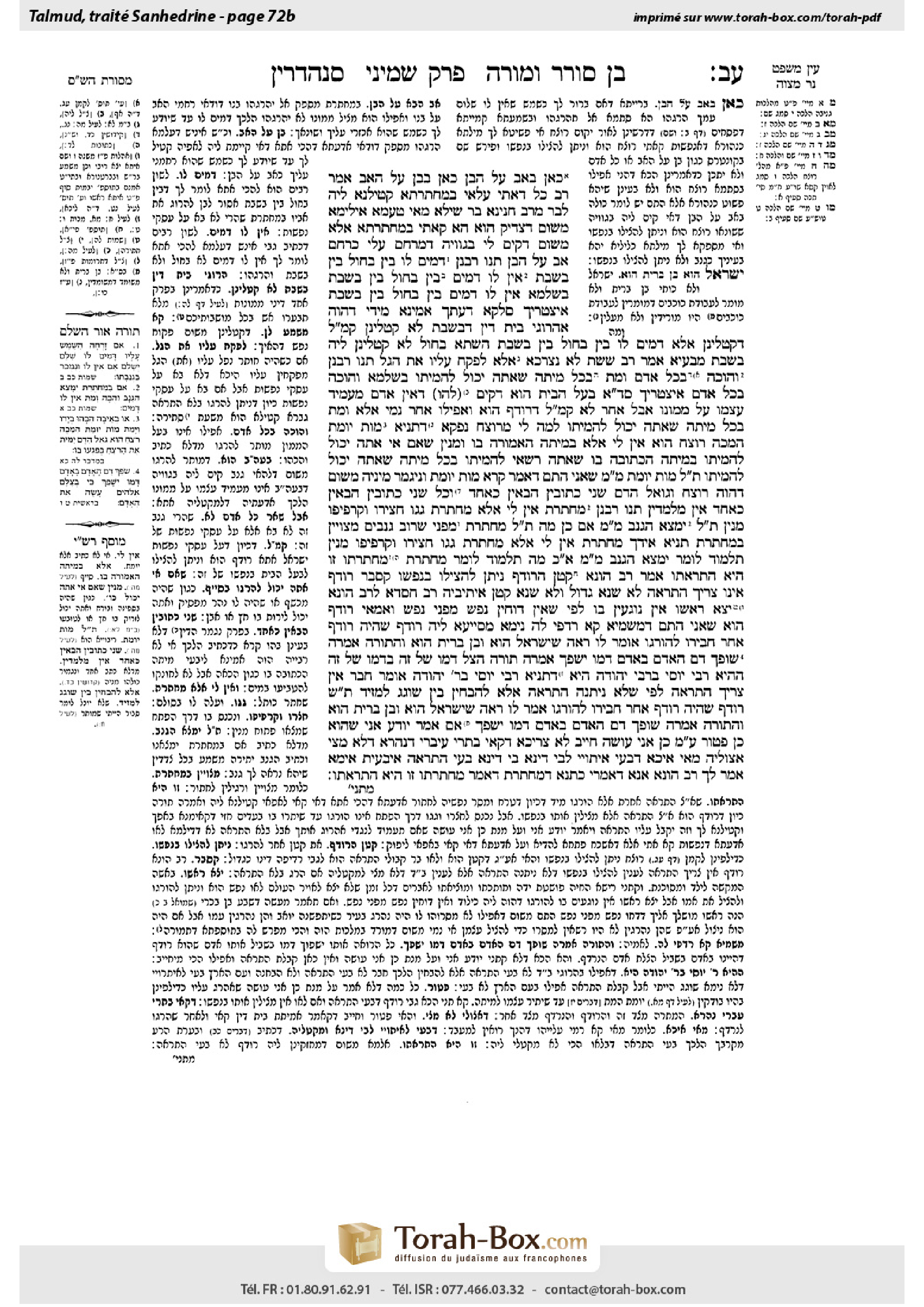
Sanhedrin 72b: Talmud study for Daf Yomi
Daf Yomi is the daily study of one Talmud folio. Explore 37 tractates with scans, Hebrew text, Sefaria English and AI-generated French translations where annotated.
Passage selection and English or AI-generated French translation are available where the scan has annotations. Daf Study is independent of Torah-Box and Sefaria.
Browse Sanhedrin · סנהדרין · All tractatesSanhedrin 72b text and translations
This page of Sanhedrin includes the Aramaic text, an English translation and an AI-generated French translation, alongside the scan above.
סנהדרין ע״ב ב · Aramaic and Hebrew text
כָּאן – בְּאָב עַל הַבֵּן, כָּאן – בְּבֵן עַל הָאָב.
אָמַר רַב: כֹּל דְּאָתֵי עֲלַאי בְּמַחְתַּרְתָּא – קָטֵילְנָא לֵיהּ, לְבַר מֵרַב חֲנִינָא בַּר שֵׁילָא. מַאי טַעְמָא? אִילֵּימָא מִשּׁוּם דְּצַדִּיק הוּא – הָא קָאָתֵי בְּמַחְתַּרְתָּא! אֶלָּא מִשּׁוּם דְּקִים לִי בְּגַוֵּויהּ דִּמְרַחֵם עָלַי כְּרַחֵם אָב עַל הַבֵּן.
תָּנוּ רַבָּנַן: ״דָּמִים לוֹ״ – בֵּין בַּחוֹל בֵּין בַּשַּׁבָּת, ״אֵין לוֹ דָּמִים״ – בֵּין בַּחוֹל בֵּין בַּשַּׁבָּת.
בִּשְׁלָמָא ״אֵין לוֹ דָּמִים״ בֵּין בַּחוֹל בֵּין בַּשַּׁבָּת אִיצְטְרִיךְ, סָלְקָא דַּעְתָּךְ אָמֵינָא: מִידֵּי דְּהָוֵה אַהֲרוּגֵי בֵּית דִּין, דִּבְשַׁבָּת לָא קָטְלִינַן. קָא מַשְׁמַע לַן דְּקָטְלִינַן. אֶלָּא ״דָּמִים לוֹ״ בֵּין בַּחוֹל בֵּין בַּשַּׁבָּת? הַשְׁתָּא בַּחוֹל לָא קָטְלִינַן לֵיהּ, בַּשַּׁבָּת מִבַּעְיָא?
אָמַר רַב שֵׁשֶׁת: לָא נִצְרְכָא אֶלָּא לְפַקֵּחַ עָלָיו אֶת הַגַּל.
תָּנוּ רַבָּנַן: ״וְהֻכָּה״ – בְּכׇל אָדָם, ״וָמֵת״ – בְּכׇל מִיתָה שֶׁאַתָּה יָכוֹל לַהֲמִיתוֹ. בִּשְׁלָמָא ״וְהֻכָּה״ בְּכׇל אָדָם אִיצְטְרִיךְ, סָלְקָא דַּעְתָּךְ אָמֵינָא: בַּעַל הַבַּיִת הוּא דְּקִים לֵהּוֹ, דְּאֵין אָדָם מַעֲמִיד עַצְמוֹ עַל מָמוֹנוֹ, אֲבָל אַחֵר – לָא.
קָא מַשְׁמַע לַן, דְּרוֹדֵף הוּא, וַאֲפִילּוּ אַחֵר נָמֵי. אֶלָּא ״וָמֵת״ בְּכׇל מִיתָה שֶׁאַתָּה יָכוֹל לַהֲמִיתוֹ, לְמָה לִי?
מֵרוֹצֵחַ נָפְקָא, דְּתַנְיָא: ״מוֹת יוּמַת הַמַּכֶּה רֹצֵחַ הוּא״ – אֵין לִי אֶלָּא בְּמִיתָה הָאֲמוּרָה בּוֹ. וּמִנַּיִן שֶׁאִם אִי אַתָּה יָכוֹל לַהֲמִיתוֹ בְּמִיתָה הַכְּתוּבָה בּוֹ, שֶׁאַתָּה רַשַּׁאי לַהֲמִיתוֹ בְּכׇל מִיתָה שֶׁאַתָּה יָכוֹל לַהֲמִיתוֹ? תַּלְמוּד לוֹמַר: ״מוֹת יוּמַת״ – מִכׇּל מָקוֹם.
שָׁאנֵי הָתָם, דְּאָמַר קְרָא: ״מוֹת יוּמַת״.
וְנִיגְמַר מִינֵּיהּ? מִשּׁוּם דְּהָוֵה רוֹצֵחַ וְגוֹאֵל הַדָּם שְׁנֵי כְתוּבִין הַבָּאִין כְּאֶחָד, וְכׇל שְׁנֵי כְתוּבִין הַבָּאִין כְּאֶחָד אֵין מְלַמְּדִין.
תָּנוּ רַבָּנַן: ״מַחְתֶּרֶת״ – אֵין לִי אֶלָּא מַחְתֶּרֶת. גַּגּוֹ, חֲצֵירוֹ וְקַרְפֵּיפוֹ מִנַּיִן? תַּלְמוּד לוֹמַר: ״יִמָּצֵא הַגַּנָּב״ – מִכׇּל מָקוֹם. אִם כֵּן, מָה תַּלְמוּד לוֹמַר ״מַחְתֶּרֶת״? מִפְּנֵי שֶׁרוֹב גַּנָּבִים מְצוּיִין בַּמַּחְתֶּרֶת.
תַּנְיָא אִידַּךְ: ״מַחְתֶּרֶת״ – אֵין לִי אֶלָּא מַחְתֶּרֶת. גַּגּוֹ, חֲצֵירוֹ וְקַרְפֵּיפוֹ מִנַּיִן? תַּלְמוּד לוֹמַר: ״יִמָּצֵא הַגַּנָּב״ – מִכׇּל מָקוֹם. אִם כֵּן, מָה תַּלְמוּד לוֹמַר ״מַחְתֶּרֶת״? מַחְתַּרְתּוֹ זוֹ הִיא הַתְרָאָתוֹ.
אָמַר רַב הוּנָא: קָטָן הָרוֹדֵף, נִיתָּן לְהַצִּילוֹ בְּנַפְשׁוֹ. קָסָבַר, רוֹדֵף אֵינוֹ צָרִיךְ הַתְרָאָה, לָא שְׁנָא גָּדוֹל וְלָא שְׁנָא קָטָן.
אֵיתִיבֵיהּ רַב חִסְדָּא לְרַב הוּנָא: יָצָא רֹאשׁוֹ – אֵין נוֹגְעִין בּוֹ, לְפִי שֶׁאֵין דּוֹחִין נֶפֶשׁ מִפְּנֵי נֶפֶשׁ. וְאַמַּאי? רוֹדֵף הוּא! שָׁאנֵי הָתָם, דְּמִשְּׁמַיָּא קָא רָדְפִי לַהּ.
נֵימָא מְסַיַּיע לֵיהּ: רוֹדֵף שֶׁהָיָה רוֹדֵף אַחַר חֲבֵירוֹ לְהוֹרְגוֹ, אוֹמְרִין לוֹ: רְאֵה שֶׁיִּשְׂרָאֵל הוּא וּבֶן בְּרִית הוּא, וְהַתּוֹרָה אָמְרָה ״שֹׁפֵךְ דַּם הָאָדָם בָּאָדָם דָּמוֹ יִשָּׁפֵךְ״. אָמְרָה תּוֹרָה: הַצֵּל דָּמוֹ שֶׁל זֶה בְּדָמוֹ שֶׁל זֶה.
הָהִיא רַבִּי יוֹסֵי בְּרַבִּי יְהוּדָה הִיא, דְּתַנְיָא: רַבִּי יוֹסֵי בְּרַבִּי יְהוּדָה אוֹמֵר, חָבֵר אֵין צָרִיךְ הַתְרָאָה, לְפִי שֶׁלֹּא נִיתְּנָה הַתְרָאָה אֶלָּא לְהַבְחִין בֵּין שׁוֹגֵג לְמֵזִיד.
תָּא שְׁמַע: רוֹדֵף שֶׁהָיָה רוֹדֵף אַחַר חֲבֵירוֹ לְהוֹרְגוֹ, אֹמְרִין לוֹ: רְאֵה שֶׁיִּשְׂרָאֵל הוּא וּבֶן בְּרִית הוּא, וְהַתּוֹרָה אָמְרָה ״שֹׁפֵךְ דַּם הָאָדָם בָּאָדָם דָּמוֹ יִשָּׁפֵךְ״. אִם אָמַר: יוֹדֵעַ אֲנִי שֶׁהוּא כֵּן – פָּטוּר. עַל מְנָת כֵּן אֲנִי עוֹשֶׂה – חַיָּיב.
לָא צְרִיכָא, דְּקָאֵי בִּתְרֵי עִיבְרֵי דְנַהְרָא, דְּלָא מָצֵי אַצּוֹלֵיה. מַאי אִיכָּא? דְּבָעֵי אֵיתוֹיֵי לְבֵי דִינָא. בֵּי דִינָא בָּעֵי הַתְרָאָה.
אִיבָּעֵית אֵימָא: אָמַר לְךָ רַב הוּנָא, אֲנָא דַּאֲמַרִי כְּתַנָּא דְּמַחְתֶּרֶת, דְּאָמַר: מַחְתַּרְתּוֹ זוֹ הִיא הַתְרָאָתוֹ.
Sanhedrin 72b · English translation
Here, where the baraita teaches that if one is unsure about the burglar’s intentions it is prohibited for him to kill him, it is referring to a father who comes to rob his son. A father has great compassion for his son, and therefore it may be presumed that he will not kill his son if he resists. Accordingly, the son is prohibited from killing his father unless he knows for certain that his father has the intention of killing him. There, where the baraita teaches that if one is unsure about the burglar’s intentions it is permitted for him to kill him, it is referring to a son who comes to rob his father. Since a son has less compassion for his father, it may be presumed that he would be ready to kill his father if he resists. Therefore, the father is permitted to kill his son unless he knows for certain that his son would never kill him.
Rav says: With regard to anyone who breaks into my house, I would kill him, as I would presume that he is ready to kill me, except for Rav Ḥanina bar Sheila, whom I would not kill. The Gemara asks: What is the reason that Rav excludes Rabbi Ḥanina bar Sheila? If we say that Rav trusts him because he is a righteous person, this is difficult, as the case is one where he broke into his house, which indicates that he is not a righteous person. Rather, it is because he would say: I am certain that he would have mercy upon me just like a father would have mercy on a son.
§ The Sages taught in a baraita: “If the sun is risen upon him, there shall be blood shed on his account” (Exodus 22:2), both during the week and on Shabbat. “If a burglar is found breaking in…there shall not be blood shed on his account” (Exodus 22:1), both during the week and on Shabbat.
The Gemara clarifies this baraita: Granted that with regard to “there shall not be blood shed on his account,” it was necessary to say that this applies both during the week and on Shabbat, as it might enter your mind to say that this is just as it is in the case of those who are executed by the court, who are not executed on Shabbat. Therefore, the baraita teaches us that the burglar may be slain in self-defense even on Shabbat. But with regard to “there shall be blood shed on his account,” the statement that this applies both during the week and on Shabbat is puzzling. Now, if on a weekday he may not be slain, is it necessary to say that he may not be slain on Shabbat?
Rav Sheshet says: This ruling is necessary only to teach that if a building collapsed on the burglar on Shabbat, one is obligated to clear the pile of stones from on top of him and perform any action necessary to rescue him, even if it involves the desecration of Shabbat; one does not say that while he is not permitted to actively kill him, he is also not obligated to save him.
§ Concerning the verse that states: “If a burglar is found breaking in, and is smitten and dies, there shall not be blood shed on his account” (Exodus 22:1), the Sages taught a baraita: “And is smitten,” by any person who strikes him; “and dies,” by any means of death by which you can put him to death. The Gemara clarifies this baraita: Granted, with regard to the words “and is smitten,” it was necessary to say that he may be struck by any person, as it might enter your mind to say that it is only the owner of the house whom the burglar is certain will resist him, because there is a presumption that a person does not restrain himself when faced with losing his money, and therefore it is only the homeowner’s life that is in danger from the burglar. But as for another person, the burglar is not sure that he will try to stop him, and therefore that other person may not kill him, since the burglar did not come with the intention of killing him.
Therefore, the baraita teaches us that this burglar is considered a pursuer, and he is subject to the same halakha as anyone who pursues another in order to kill him, namely, that anyone may kill the pursuer in order to rescue the one being pursued. Therefore, even another person is permitted to kill the burglar in order to save the homeowner. But that which the baraita teaches, that the words “and dies” teach that he may be slain by any means of death by which you can put him to death, why do I need this?
The Gemara clarifies the difficulty: This can be derived from the halakha governing a murderer, as it is taught in a baraita: The verse with regard to a murderer states: “He that smote him shall be put to death, for he is a murderer” (Numbers 35:21). I have derived only that the murderer is put to death with the mode of execution stated concerning him, namely, killing by decapitation. From where do I derive that if you cannot put him to death with the mode of execution written concerning him, e.g., if he is escaping, that you can put him to death with any mode of execution with which you can put him to death? The verse states: “He that smote him shall be put to death [mot yumat],” the doubled verb teaching that he is put to death in any case, by any mode of execution. Why not derive the halakha of a burglar from the halakha of a murderer?
The Gemara rejects this reasoning: There it is different, as the verse explicitly states: “Mot yumat,” which serves to include all modes of execution.
The Gemara asks: But why not learn from it a principle that can be applied to all people who may be put to death? The Gemara rejects this reasoning: This case does not serve as a source for a principle, because the halakhot of a murderer and of a blood redeemer, i.e., a relative of one who was killed who is allowed to kill his relative’s killer (see Makkot 11b), are two verses that come as one, and two verses that come as one do not teach a principle. In other words, if a halakha is stated with regard to two specific cases in the Torah, the halakha is understood to apply only to those cases. Had the halakha applied to all other relevant cases as well, it would not have been necessary for the Torah to teach it twice. Therefore, the baraita had to teach us that this halakha also applies to a burglar who breaks into a person’s house.
§ The Sages taught in a baraita: From the words: “If a burglar is found breaking in” (Exodus 22:1), I have derived only that this halakha applies to a burglar who came breaking in through a wall. But from where do I derive that the same halakha applies if he was found on his roof, in his yard, or in the enclosed area behind his house? Therefore, the verse states: “If a burglar is found,” which teaches that the halakha applies in any case. If that is so, what is the meaning when the verse states: “Breaking in”? Because the Torah speaks of a common case, and most thieves are found breaking in.
It is taught in another baraita: From the words: “If a burglar is found breaking in,” I have derived only that this halakha applies to a burglar who came breaking in through a wall. But from where do I derive that the same halakha applies if he was found on his roof, in his yard, or in the enclosed area behind his house? Therefore, the verse states: “If a burglar is found,” which teaches that the halakha applies in any case. If that is so, what is the meaning when the verse states: “Breaking in”? This teaches that his breaking in is his forewarning. If a burglar is found breaking into a house, the owner need not formally forewarn him before killing him. If he is found elsewhere, such a forewarning is necessary.
§ Rav Huna says: If a minor was pursuing another person in order to kill him, the pursued party may be saved with the pursuer’s life. That is to say, one is permitted to save the pursued party by killing the minor who is pursuing him, and one does not say that since the minor lacks halakhic competence, he is not subject to punishment. The Gemara explains: Rav Huna maintains that a pursuer, in general, does not require forewarning, and there is no difference with regard to this matter between an adult and a minor. The essence of the matter is rescuing the pursued party from death, and therefore the pursuer’s liability to receive the death penalty is irrelevant.
Rav Ḥisda raised an objection to Rav Huna from a baraita: If a woman was giving birth and her life was being endangered by the fetus, the life of the fetus may be sacrificed in order to save the mother. But once his head has emerged during the birthing process, he may not be harmed in order to save the mother, because one life may not be pushed aside to save another life. If one is permitted to save the pursued party by killing the minor who is pursuing him, why is this so? The fetus is a pursuer who is endangering his mother’s life. The Gemara answers: This is not difficult, as it is different there, with regard to the woman giving birth, since she is being pursued by Heaven. Since the fetus is not acting of his own volition and endangering his mother of his own will, his life may not be taken in order to save his mother.
The Gemara suggests: Let us say that a baraita supports the ruling of Rav Huna, who said that a pursuer does not require a forewarning: If a pursuer was pursuing another person in order to kill him, a third party says to the pursuer: See that he whom you are pursuing to kill is a Jew, and a loyal member of the covenant, and the Torah stated: “Whoever sheds the blood of man, by man shall his blood be shed” (Genesis 9:6). The Torah stated: Save the blood of this person who is being pursued with the blood of that person who is pursuing him. The fact that there is no indication here that the pursuer must say that he heard the forewarning suggests that forewarning is not required, as stated by Rav Huna.
The Gemara rejects this suggestion: Perhaps this baraita was taught in accordance with the opinion of Rabbi Yosei, son of Rabbi Yehuda. As it is taught in a baraita: Rabbi Yosei, son of Rabbi Yehuda, says: A ḥaver, who is thoroughly knowledgeable in halakha, does not need to be issued a forewarning by witnesses in order to become liable to be punished, because forewarning is given only to distinguish between unintentional sin and intentional sin, and a ḥaver is certainly aware of the halakha. The same may be said about a pursuer: Since his malice is clear, he does not require a forewarning; his sin is obviously intentional. Those who disagree with Rabbi Yosei, son of Rabbi Yehuda, and say that even a ḥaver needs to be issued a forewarning would say that a pursuer must be forewarned as well.
The Gemara suggests: Come and hear a proof that a pursuer must be forewarned, and therefore one may not save a pursued party by killing a minor who is pursuing him, from a baraita: If a pursuer was pursuing another person in order to kill him, and a third party said to him: See that he whom you are pursuing to kill is a Jew, and a loyal member of the covenant, and the Torah stated: “Whoever sheds the blood of man, by man shall his blood be shed” (Genesis 9:6), in this case, if the pursuer said: I know this to be so, he is exempt from being killed, but if he said: I am doing it on this condition, i.e., knowing that I am liable to be killed for this, he is liable to be slain. This indicates that even a pursuer must be issued a forewarning.
The Gemara rejects this proof: This forewarning is not necessary except in a case where the pursuer and the person issuing the warning are standing on two opposite sides of a river, so that the latter cannot save the party being pursued by killing the pursuer. What is there for him to do? Unable to save the pursued party, he wants at least to bring the pursuer to court, so that he will be convicted and have the death penalty administered to him. But in order to administer punishment, the court requires that the offender receive proper forewarning. It is for this reason that the baraita speaks of forewarning, but a pursuer may be killed by a bystander even without having been forewarned.
If you wish, say instead that Rav Huna could have said to you: I stated my opinion that it is permitted to kill a minor pursuer in accordance with the tanna who spoke of the issue of a burglar who breaks into a house. As this tanna says that his breaking in is his forewarning, that is, a burglar who breaks into a house needs no further forewarning. Here, too, anyone who is pursuing another in order to kill him does not require forewarning since his pursuit is his forewarning.
Sanhedrin 72b · Traduction française (IA)
Ici, là où la baraïta enseigne que, si l’on ignore les intentions du cambrioleur, il est interdit de le tuer, il s’agit d’un père qui vient voler son fils. Un père éprouve une grande compassion pour son fils ; on peut donc présumer qu’il ne le tuera pas si celui-ci résiste. Par conséquent, le fils n’a pas le droit de tuer son père, à moins de savoir avec certitude que celui-ci a l’intention de le tuer. Là, là où la baraïta enseigne que, si l’on ignore les intentions du cambrioleur, il est permis de le tuer, il s’agit d’un fils qui vient voler son père. Comme un fils éprouve moins de compassion pour son père, on peut présumer qu’il serait prêt à le tuer si celui-ci résistait. Le père est donc autorisé à tuer son fils, à moins de savoir avec certitude que celui-ci ne le tuerait jamais.
Rav dit : Quiconque s’introduit par effraction chez moi, je le tuerais, car je présumerais qu’il est prêt à me tuer, à l’exception de Rav Ḥanina bar Sheila, que je ne tuerais pas. La Guemara demande : Pourquoi Rav fait-il une exception pour Rabbi Ḥanina bar Sheila ? Si l’on dit que Rav lui fait confiance parce que c’est un homme juste, cela pose difficulté, car il s’agit d’un cas où celui-ci s’est introduit par effraction chez lui, ce qui indique qu’il n’est pas un homme juste. C’est plutôt parce qu’il se dirait : « Je suis certain qu’il aurait pitié de moi, comme un père a pitié de son fils. »
§ Les Sages ont enseigné dans une baraïta : « Si le soleil s’est levé sur lui, il y aura du sang versé à cause de lui » (Exode 22, 2), aussi bien en semaine que le Chabbat. « Si un cambrioleur est trouvé en train de forcer l’entrée… il n’y aura pas de sang versé à cause de lui » (Exode 22, 1), aussi bien en semaine que le Chabbat.
La Guemara précise cette baraïta : certes, pour ce qui est de « il n’y aura pas de sang versé à cause de lui », il fallait dire que cela s’applique aussi bien en semaine que le Chabbat, car on aurait pu penser que la règle est la même que pour ceux qui sont exécutés par le tribunal, qui ne sont pas exécutés le Chabbat. La baraïta nous enseigne donc que le cambrioleur peut être tué en état de légitime défense, même le Chabbat. Mais pour ce qui est de « il y aura du sang versé à cause de lui », il est étonnant d’affirmer que cela s’applique aussi bien en semaine que le Chabbat. En semaine, s’il ne peut pas être tué, faut-il préciser qu’il ne peut pas l’être le Chabbat ?
Rav Sheshet dit : cette décision n’est nécessaire que pour enseigner que, si un bâtiment s’effondre sur le cambrioleur le Chabbat, on est tenu de déblayer les pierres qui le recouvrent et d’accomplir toute action nécessaire pour le sauver, même si cela entraîne la profanation du Chabbat. On ne dit pas que, puisqu’il n’est pas permis de le tuer activement, on n’est pas non plus tenu de le sauver.
§ Au sujet du verset qui dit : « Si un cambrioleur est trouvé en train de forcer l’entrée, qu’il soit frappé et meure, il n’y aura pas de sang versé à cause de lui » (Exode 22, 1), les Sages ont enseigné dans une baraïta : « Qu’il soit frappé », par toute personne qui le frappe ; « et meure », par tout moyen de mise à mort par lequel on peut le mettre à mort. La Guemara précise cette baraïta : certes, pour ce qui est des mots « qu’il soit frappé », il fallait dire qu’il peut être frappé par toute personne, car on aurait pu penser que seul le propriétaire de la maison, dont le cambrioleur est certain qu’il lui résistera — puisqu’on présume qu’une personne ne se contient pas lorsqu’elle risque de perdre son argent —, est en danger de mort à cause du cambrioleur. Quant à une autre personne, le cambrioleur n’est pas certain qu’elle essaiera de l’arrêter ; cette autre personne ne pourrait donc pas le tuer, puisque le cambrioleur n’était pas venu avec l’intention de la tuer.
La baraïta nous enseigne donc que ce cambrioleur est considéré comme un poursuivant et qu’il relève de la même halakha que quiconque poursuit autrui dans l’intention de le tuer : toute personne peut tuer le poursuivant afin de sauver celui qui est poursuivi. Par conséquent, même une autre personne est autorisée à tuer le cambrioleur pour sauver le propriétaire de la maison. Mais pourquoi ai-je besoin de ce que la baraïta enseigne, à savoir que les mots « et meure » apprennent qu’il peut être tué par tout moyen de mise à mort permettant de le mettre à mort ?
La Guemara précise la difficulté : cela peut être déduit de la halakha relative au meurtrier, comme l’enseigne une baraïta : au sujet du meurtrier, le verset dit : « Celui qui l’a frappé sera mis à mort, car c’est un meurtrier » (Nombres 35, 21). J’ai seulement déduit que le meurtrier est mis à mort selon le mode d’exécution indiqué à son sujet, à savoir la décapitation. D’où déduis-je que, si l’on ne peut pas le mettre à mort selon le mode d’exécution écrit à son sujet, par exemple s’il s’enfuit, on peut le mettre à mort par tout moyen permettant de le mettre à mort ? Le verset dit : « Celui qui l’a frappé sera mis à mort [mot yumat] » ; le verbe répété enseigne qu’il est mis à mort dans tous les cas, quel que soit le mode d’exécution. Pourquoi ne pas déduire la halakha concernant le cambrioleur de celle du meurtrier ?
La Guemara rejette ce raisonnement : là, c’est différent, car le verset dit explicitement « mot yumat », ce qui inclut tous les modes d’exécution.
La Guemara demande : mais pourquoi ne pas en déduire un principe applicable à tous ceux qui peuvent être mis à mort ? La Guemara rejette ce raisonnement : ce cas ne peut pas servir de fondement à un principe, car les halakhot du meurtrier et du vengeur du sang, c’est-à-dire un parent de la victime qui est autorisé à tuer celui qui l’a tuée (voir Makot 11b), font l’objet de deux versets qui viennent enseigner la même chose ; or, deux versets qui viennent enseigner la même chose ne permettent pas de déduire un principe. Autrement dit, si une halakha est énoncée dans la Torah pour deux cas particuliers, on comprend qu’elle ne s’applique qu’à ces cas. Si cette halakha s’appliquait également à tous les autres cas pertinents, la Torah n’aurait pas eu besoin de l’enseigner deux fois. La baraïta devait donc nous enseigner que cette halakha s’applique aussi au cambrioleur qui s’introduit dans la maison d’une personne.
§ Les Sages ont enseigné dans une baraïta : des mots « Si un cambrioleur est trouvé en train de forcer l’entrée » (Exode 22, 1), j’ai seulement déduit que cette halakha s’applique au cambrioleur qui s’est introduit en passant par un mur. Mais d’où déduis-je que la même halakha s’applique s’il a été trouvé sur son toit, dans sa cour ou dans l’espace clos derrière sa maison ? Le verset dit donc : « Si un cambrioleur est trouvé », ce qui enseigne que la halakha s’applique dans tous les cas. Si tel est le cas, que signifie alors l’expression « en train de forcer l’entrée » ? La Torah parle d’un cas courant, car la plupart des voleurs sont trouvés en train de forcer l’entrée.
Il est enseigné dans une autre baraïta : des mots « Si un cambrioleur est trouvé en train de forcer l’entrée », j’ai seulement déduit que cette halakha s’applique au cambrioleur qui s’est introduit en passant par un mur. Mais d’où déduis-je que la même halakha s’applique s’il a été trouvé sur son toit, dans sa cour ou dans l’espace clos derrière sa maison ? Le verset dit donc : « Si un cambrioleur est trouvé », ce qui enseigne que la halakha s’applique dans tous les cas. Si tel est le cas, que signifie alors l’expression « en train de forcer l’entrée » ? Cela enseigne que l’effraction tient lieu d’avertissement préalable. Si un cambrioleur est trouvé en train de s’introduire dans une maison, le propriétaire n’a pas besoin de lui adresser un avertissement formel avant de le tuer. S’il est trouvé ailleurs, un tel avertissement est nécessaire.
§ Rav Huna dit : si un mineur poursuit une autre personne dans l’intention de la tuer, la personne poursuivie peut être sauvée, même si cela implique la mort du poursuivant. Autrement dit, il est permis de sauver la personne poursuivie en tuant le mineur qui la poursuit, et l’on ne dit pas que, puisque le mineur n’a pas la capacité juridique selon la halakha, il n’est pas passible de sanction. La Guemara explique : Rav Huna estime qu’en général, un poursuivant n’a pas besoin d’un avertissement préalable, et qu’à cet égard il n’y a pas de différence entre un adulte et un mineur. L’essentiel est de sauver la personne poursuivie de la mort ; par conséquent, le fait que le poursuivant soit passible de la peine capitale n’entre pas en ligne de compte.
Rav Ḥisda objecte à Rav Huna en citant une baraïta : si une femme accouche et que le fœtus met sa vie en danger, on peut sacrifier la vie du fœtus pour sauver la mère. Mais, une fois que sa tête est sortie au cours de l’accouchement, on ne peut pas lui faire de mal pour sauver la mère, car on ne peut pas écarter une vie pour en sauver une autre. S’il est permis de sauver la personne poursuivie en tuant le mineur qui la poursuit, pourquoi en est-il ainsi ? Le fœtus est un poursuivant qui met en danger la vie de sa mère. La Guemara répond : il n’y a pas de difficulté, car le cas de la femme qui accouche est différent : elle est poursuivie par le Ciel. Puisque le fœtus n’agit pas de son propre gré et ne met pas sa mère en danger de sa propre volonté, sa vie ne peut pas être prise pour sauver sa mère.
La Guemara propose : disons qu’une baraïta appuie la décision de Rav Huna, selon laquelle un poursuivant n’a pas besoin d’un avertissement préalable. Une baraïta enseigne : si un poursuivant pourchasse une autre personne dans l’intention de la tuer, un tiers lui dit : « Regarde : celui que tu poursuis pour le tuer est un Juif, un membre fidèle de l’Alliance, et la Torah a déclaré : “Quiconque verse le sang de l’homme, par l’homme son sang sera versé” (Genèse 9, 6). La Torah a déclaré : sauvez le sang de cette personne qui est poursuivie par le sang de cette personne qui la poursuit. » Le fait que rien n’indique ici que le poursuivant doit dire qu’il a entendu l’avertissement laisse entendre qu’un avertissement n’est pas requis, comme l’affirme Rav Huna.
La Guemara rejette cette proposition : peut-être cette baraïta a-t-elle été enseignée conformément à l’opinion de Rabbi Yosei, fils de Rabbi Yehuda. En effet, il est enseigné dans une baraïta que Rabbi Yosei, fils de Rabbi Yehuda, dit : un ḥaver, qui connaît parfaitement la halakha, n’a pas besoin que des témoins lui adressent un avertissement préalable pour être passible d’une sanction, car l’avertissement n’est donné que pour distinguer la faute involontaire de la faute intentionnelle, et un ḥaver connaît certainement la halakha. On peut dire la même chose d’un poursuivant : puisque sa malveillance est manifeste, il n’a pas besoin d’un avertissement préalable ; son acte est évidemment intentionnel. Ceux qui ne sont pas d’accord avec Rabbi Yosei, fils de Rabbi Yehuda, et qui disent qu’un ḥaver doit lui aussi recevoir un avertissement préalable, diraient également qu’un poursuivant doit être averti.
La Guemara propose : viens entendre une preuve qu’un poursuivant doit être averti et que, par conséquent, on ne peut pas sauver une personne poursuivie en tuant le mineur qui la poursuit, d’après une baraïta : si un poursuivant pourchasse une autre personne dans l’intention de la tuer et qu’un tiers lui dit : « Regarde : celui que tu poursuis pour le tuer est un Juif, un membre fidèle de l’Alliance, et la Torah a déclaré : “Quiconque verse le sang de l’homme, par l’homme son sang sera versé” (Genèse 9, 6) », dans ce cas, si le poursuivant dit : « Je sais que c’est le cas », il est exempt de la peine de mort ; mais s’il dit : « Je le fais à cette condition », c’est-à-dire en sachant que je suis passible de la peine de mort pour cela, il est passible d’être mis à mort. Cela indique que même un poursuivant doit recevoir un avertissement préalable.
La Guemara rejette cette preuve : cet avertissement préalable n’est nécessaire que dans un cas où le poursuivant et la personne qui l’avertit se trouvent sur deux rives opposées d’un fleuve, si bien que cette dernière ne peut pas sauver la personne poursuivie en tuant le poursuivant. Que peut-elle faire alors ? Incapable de sauver la personne poursuivie, elle veut au moins faire comparaître le poursuivant devant le tribunal, afin qu’il soit condamné et que la peine de mort lui soit appliquée. Or, pour infliger une peine, le tribunal exige que le coupable ait reçu un avertissement préalable en bonne et due forme. C’est pour cette raison que la baraïta parle d’un avertissement préalable ; mais un passant peut tuer un poursuivant sans l’avoir averti au préalable.
Si tu le souhaites, on peut plutôt dire que Rav Huna aurait pu te répondre : « J’ai énoncé mon avis selon lequel il est permis de tuer un poursuivant mineur conformément au tanna qui traite du cambrioleur qui s’introduit dans une maison. Ce tanna dit que l’effraction tient lieu d’avertissement préalable, c’est-à-dire qu’un cambrioleur qui s’introduit dans une maison n’a pas besoin d’autre avertissement. De même, quiconque poursuit une autre personne dans l’intention de la tuer n’a pas besoin d’un avertissement préalable, car sa poursuite tient lieu d’avertissement. »
Traduction française générée par IA à partir de l’édition anglaise de Sefaria. Vérifie toujours un passage avec le texte source.
Text from Sefaria: William Davidson Edition - Vocalized Aramaic (CC BY NC); William Davidson Edition - English (CC BY NC).