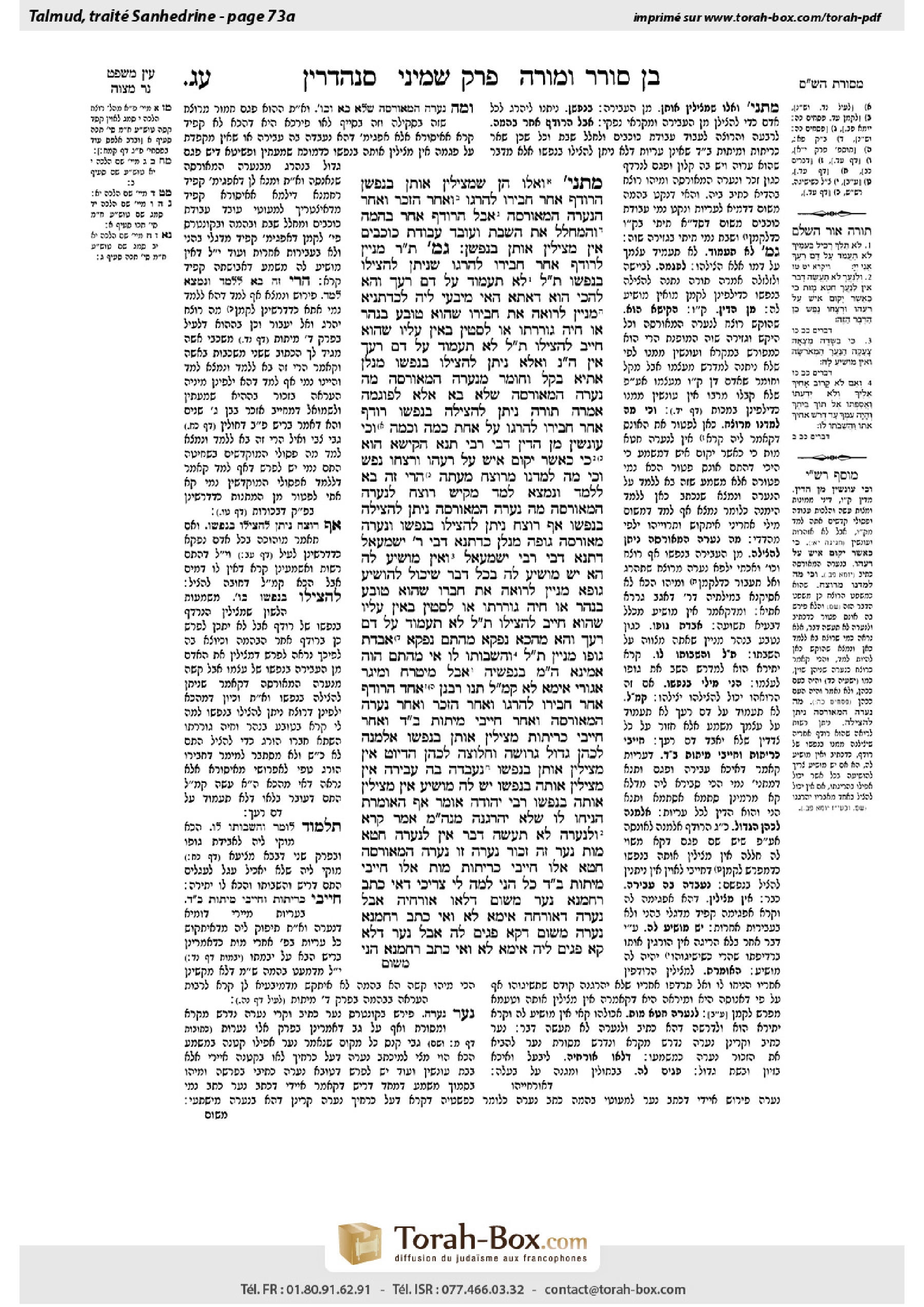
Sanhedrin 73a: Talmud study for Daf Yomi
Daf Yomi is the daily study of one Talmud folio. Explore 37 tractates with scans, Hebrew text, Sefaria English and AI-generated French translations where annotated.
Passage selection and English or AI-generated French translation are available where the scan has annotations. Daf Study is independent of Torah-Box and Sefaria.
Browse Sanhedrin · סנהדרין · All tractatesSanhedrin 73a text and translations
This page of Sanhedrin includes the Aramaic text, an English translation and an AI-generated French translation, alongside the scan above.
סנהדרין ע״ג א · Aramaic and Hebrew text
מַתְנִי׳ וְאֵלּוּ הֵן שֶׁמַּצִּילִין אוֹתָן בְּנַפְשָׁן: הָרוֹדֵף אַחַר חֲבֵירוֹ לְהׇרְגוֹ, וְאַחַר הַזָּכָר, וְאַחַר הַנַּעֲרָה הַמְאוֹרָסָה. אֲבָל הָרוֹדֵף אַחַר בְּהֵמָה, וְהַמְחַלֵּל אֶת הַשַּׁבָּת, וְעוֹבֵד עֲבוֹדָה זָרָה – אֵין מַצִּילִין אוֹתָן בְּנַפְשָׁן.
גְּמָ׳ תָּנוּ רַבָּנַן: מִנַּיִין לְרוֹדֵף אַחַר חֲבֵירוֹ לְהׇרְגוֹ שֶׁנִּיתָּן לְהַצִּילוֹ בְּנַפְשׁוֹ? תַּלְמוּד לוֹמַר: ״לֹא תַעֲמֹד עַל דַּם רֵעֶךָ״. וְהָא לְהָכִי הוּא דַּאֲתָא? הַאי מִיבְּעֵי לֵיהּ לְכִדְתַנְיָא: מִנַּיִין לָרוֹאֶה אֶת חֲבֵירוֹ שֶׁהוּא טוֹבֵעַ בַּנָּהָר, אוֹ חַיָּה גּוֹרַרְתּוֹ, אוֹ לִסְטִין בָּאִין עָלָיו, שֶׁהוּא חַיָּיב לְהַצִּילוֹ? תַּלְמוּד לוֹמַר: ״לֹא תַעֲמֹד עַל דַּם רֵעֶךָ״. אִין, הָכִי נָמֵי.
וְאֶלָּא, נִיתָּן לְהַצִּילוֹ בְּנַפְשׁוֹ מְנָלַן? אָתְיָא בְּקַל וָחוֹמֶר מִנַּעֲרָה הַמְאוֹרָסָה: מָה נַעֲרָה הַמְאוֹרָסָה שֶׁלֹּא בָּא אֶלָּא לְפוֹגְמָהּ, אָמְרָה תּוֹרָה נִיתָּן לְהַצִּילָהּ בְּנַפְשׁוֹ, רוֹדֵף אַחַר חֲבֵירוֹ לְהׇרְגוֹ – עַל אַחַת כַּמָּה וְכַמָּה.
וְכִי עוֹנְשִׁין מִן הַדִּין? דְּבֵי רַבִּי תָּנָא, הֶקֵּישָׁא הוּא: ״כִּי כַּאֲשֶׁר יָקוּם אִישׁ עַל רֵעֵהוּ וּרְצָחוֹ נֶפֶשׁ״. וְכִי מָה לָמַדְנוּ מֵרוֹצֵחַ?
מֵעַתָּה הֲרֵי זֶה בָּא לְלַמֵּד וְנִמְצָא לָמֵד. מַקִּישׁ רוֹצֵחַ לְנַעֲרָה הַמְאוֹרָסָה: מָה נַעֲרָה הַמְאוֹרָסָה נִיתָּן לְהַצִּילָהּ בְּנַפְשׁוֹ, אַף רוֹצֵחַ נִיתָּן לְהַצִּילוֹ בְּנַפְשׁוֹ.
וְנַעֲרָה מְאוֹרָסָה גּוּפַהּ מְנָלַן? כִּדְתָנָא דְּבֵי רַבִּי יִשְׁמָעֵאל, דְּתָנָא דְּבֵי רַבִּי יִשְׁמָעֵאל: ״וְאֵין מוֹשִׁיעַ לָהּ״ – הָא יֵשׁ מוֹשִׁיעַ לָהּ, בְּכׇל דָּבָר שֶׁיָּכוֹל לְהוֹשִׁיעַ.
גּוּפָא: מִנַּיִן לָרוֹאֶה אֶת חֲבֵרוֹ שֶׁהוּא טוֹבֵעַ בַּנָּהָר, אוֹ חַיָּה גּוֹרַרְתּוֹ, אוֹ לִסְטִין בָּאִין עָלָיו, שֶׁהוּא חַיָּיב לְהַצִּילוֹ? תַּלְמוּד לוֹמַר: ״לֹא תַעֲמֹד עַל דַּם רֵעֶךָ״. וְהָא מֵהָכָא נָפְקָא? מֵהָתָם נָפְקָא! אֲבֵדַת גּוּפוֹ מִנַּיִין? תַּלְמוּד לוֹמַר: ״וַהֲשֵׁבֹתוֹ לוֹ״.
אִי מֵהָתָם, הֲוָה אָמֵינָא: הָנֵי מִילֵּי בְּנַפְשֵׁיהּ, אֲבָל מִיטְרַח וּמֵיגַר אָגוֹרֵי – אֵימָא לָא. קָא מַשְׁמַע לַן.
תָּנוּ רַבָּנַן: אֶחָד הָרוֹדֵף אַחַר חֲבֵירוֹ לְהׇרְגוֹ, וְאַחַר הַזָּכָר, וְאַחַר נַעֲרָה הַמְאוֹרָסָה, וְאַחַר חַיָּיבֵי מִיתוֹת בֵּית דִּין, וְאַחַר חַיָּיבֵי כָרֵיתוֹת – מַצִּילִין אוֹתָן בְּנַפְשׁוֹ. אַלְמָנָה לְכֹהֵן גָּדוֹל, גְּרוּשָׁה וַחֲלוּצָה לְכֹהֵן הֶדְיוֹט – אֵין מַצִּילִין אוֹתָן בְּנַפְשׁוֹ.
נֶעֶבְדָה בָּהּ עֲבֵירָה – אֵין מַצִּילִין אוֹתָהּ בְּנַפְשׁוֹ. יֵשׁ לָהּ מוֹשִׁיעַ – אֵין מַצִּילִין אוֹתָהּ בְּנַפְשׁוֹ. רַבִּי יְהוּדָה אוֹמֵר: אַף הָאוֹמֶרֶת ״הַנִּיחוּ לוֹ״ שֶׁלֹּא יַהַרְגֶנָּה.
מְנָא הָנֵי מִילֵּי? אָמַר קְרָא: ״וְלַנַּעֲרָה לֹא תַעֲשֶׂה דָבָר אֵין לַנַּעֲרָה חֵטְא מָוֶת״. ״נַעַר״ – זֶה זְכוּר, ״נַעֲרָה״ – זוֹ נַעֲרָה הַמְאוֹרָסָה, ״חֵטְא״ – אֵלּוּ חַיָּיבֵי כָרֵיתוֹת, ״מָוֶת״ – אֵלּוּ חַיָּיבֵי מִיתוֹת בֵּית דִּין.
כֹּל הָנֵי לְמָה לִי? צְרִיכִי, דְּאִי כְּתַב רַחֲמָנָא ״נַעַר״ – מִשּׁוּם דְּלָאו אוֹרְחֵיהּ, אֲבָל נַעֲרָה דְּאוֹרְחַהּ – אֵימָא לָא.
וְאִי כְּתַב רַחֲמָנָא ״נַעֲרָה״, מִשּׁוּם דְּקָא פָגֵים לַהּ, אֲבָל נַעַר דְּלָא קָא פָגֵים לֵיהּ – אֵימָא לָא.
וְאִי כְּתַב רַחֲמָנָא הָנֵי,
Sanhedrin 73a · English translation
MISHNA: And these are the ones who are saved from transgressing even at the cost of their lives; that is to say, these people may be killed so that they do not perform a transgression: One who pursues another to kill him, or pursues a male to sodomize him, or pursues a betrothed young woman to rape her. But with regard to one who pursues an animal to sodomize it, or one who seeks to desecrate Shabbat, or one who is going to engage in idol worship, they are not saved at the cost of their lives. Rather, they are forewarned not to transgress, and if they proceed to transgress after having been forewarned, they are brought to trial, and if they are found guilty, they are executed.
GEMARA: The Sages taught in a baraita: From where is it derived that with regard to one who pursues another in order to kill him, the pursued party may be saved at the cost of the pursuer’s life? The verse states: “You shall not stand idly by the blood of another” (Leviticus 19:16); rather, you must save him from death. The Gemara asks: But does this verse really come to teach us this? This verse is required for that which is taught in a baraita: From where is it derived that one who sees another drowning in a river, or being dragged away by a wild animal, or being attacked by bandits [listin], is obligated to save him? The Torah states: “You shall not stand idly by the blood of another.” The Gemara answers: Yes, it is indeed so that this verse relates to the obligation to save one whose life is in danger.
The Gemara asks again: But from where do we derive that one may be saved at the cost of the pursuer’s life? The Gemara answers: It is derived by means of an a fortiori inference from the halakha governing a betrothed young woman who was assaulted by a rapist: If in the case of a betrothed young woman, whom the rapist comes only to degrade, i.e., the result of the rape will be that her status is lowered, the Torah said that she may be saved even at the cost of the rapist’s life, then in the case of one who pursues another person to kill him, all the more so should one say that he may be saved even at the cost of the pursuer’s life.
The Gemara asks: But does the court administer punishment based on an a fortiori inference? The Gemara answers: A Sage of the school of Rabbi Yehuda HaNasi taught: This halakha is also derived from an analogy based on a juxtaposition. How so? With regard to the rape of a betrothed young woman it is written: “But you shall do nothing to the young woman; the young woman has committed no sin worthy of death; for as when a man rises against his neighbor, and slays him, so too with this matter” (Deuteronomy 22:26). But why would the verse mention murder in this context? But what do we learn here from a murderer?
Now, the mention of murder came in order to teach a halakha about the betrothed young woman, and it turns out that, in addition, it derives a halakha from that case. The Torah juxtaposes the case of a murderer to the case of a betrothed young woman to indicate that just as in the case of a betrothed young woman one may save her at the cost of the rapist’s life, so too, in the case of a murderer, one may save the potential victim at the cost of the murderer’s life.
The Gemara asks: And with regard to the betrothed young woman herself, from where do we derive that she may be saved at the cost of the rapist’s life? The Gemara explains: As it was taught in the school of Rabbi Yishmael: The verse states: “For he found her in the field, and the betrothed young woman cried out, and there was none to save her” (Deuteronomy 22:27). But if there was someone to save her, he must do so by any means that can save her, even by killing the potential rapist.
Concerning the matter itself, it is taught in a baraita: From where is it derived that one who sees another drowning in a river, or being dragged away by a wild animal, or being attacked by bandits, is obligated to save him? The verse states: “You shall not stand idly by the blood of another” (Leviticus 19:16). The Gemara asks about this derivation: But is this really derived from here? It is derived from there, i.e., from a different verse, as it is taught: The Torah teaches that one must return lost property to its rightful owner. But from where is it derived that one must help his neighbor who may suffer the loss of his body or his health? The verse states: “And you shall restore it [vahashevato] to him [lo]” (Deuteronomy 22:2), which can also be read as: And you shall restore him [vehashevato] to him, i.e., saving his body. Consequently, there should be no need for the additional verse: “You shall not stand idly by the blood of another.”
The Gemara answers: If this halakha were derived only from there, I would say that this matter applies only to saving the person in danger by himself, i.e., that he himself must come to his neighbor’s rescue if he can, as is the halakha with regard to returning a lost item. But to trouble himself and hire workers for this purpose, one might say that he is not obligated, just as he is not obligated to hire workers to recover another’s lost item. Therefore, the verse “Do not stand by the blood of another” teaches us that he must even hire workers, and he transgresses a prohibition if he does not do so.
§ The Sages taught yet another baraita on the topic of a pursuer: One who pursues another to kill him; or pursues a male to sodomize him; or pursues a betrothed young woman to rape her; or pursues a woman who is forbidden to him by a prohibition, the violation of which renders him liable to receive a court-imposed death penalty; or pursues a woman who is forbidden to him by a prohibition, the violation of which renders him liable to receive karet, all these people are to be saved at the cost of the life of the transgressor. But with regard to a widow who is being pursued by a High Priest, or a divorcée, or a woman who has performed ḥalitza [ḥalutza] who is being pursued by an ordinary priest, they are not saved at the cost of the rapist’s life, because these unions are subject only to a mere prohibition.
Furthermore, if a sin had already been committed with the betrothed young woman, she is not saved at the cost of the rapist’s life. In addition, if there is one to save her, i.e., if there is another way to save the betrothed young woman that does not involve killing the rapist, she is not saved at the cost of his life. Rabbi Yehuda says: Also, if the betrothed young woman says to those who come to rescue her: Let the rapist be, she is saying this so that he should not kill her, and therefore the rapist is not killed.
The Gemara asks: From where are these matters derived? The Gemara answers: The verse states: “But you shall do nothing to the young woman [na’ara]; the young woman has committed no sin worthy of death” (Deuteronomy 22:26). The word is read as young woman, “na’ara,” but it is written as young man, na’ar. Na’ar, as it is written, this is an allusion to sodomy. “Na’ara,” as it is read, this is a betrothed young woman. “Sin”; these are women who are forbidden to him by a prohibition the violation of which renders him liable to receive karet. “Death”; these are women who are forbidden to him by a prohibition the violation of which renders him liable to receive a court-imposed death penalty.
The Gemara asks: Why do I need all these different cases? Why does it not suffice to offer one example from which all the others can be derived? The Gemara answers: These cases are all necessary, as had the Merciful One written only na’ar to teach the halakha with regard to sodomy, one might say that this victim alone is saved at the cost of his attacker’s life, because it is not his way to engage in intercourse with a man, and so he would suffer excessive embarrassment and pain were he not saved. But a young woman, whose natural way is to engage in intercourse with a man, one might say that her attacker may not be killed.
And had the Merciful One written only “na’ara” to teach the halakha concerning a betrothed young woman, one might say that she alone is saved at the cost of her attacker’s life, because he degrades her by taking her virginity, and she will be cheapened in the eyes of her betrothed. But a young man, who is not similarly degraded, one might say that his attacker may not be killed.
And had the Merciful One written both of these,
Sanhedrin 73a · Traduction française (IA)
MICHNA : Voici ceux qu’on doit sauver de la transgression, même au prix de leur vie ; autrement dit, ces personnes peuvent être tuées afin qu’elles ne commettent pas de transgression : celui qui poursuit quelqu’un pour le tuer, celui qui poursuit un homme pour le sodomiser, ou celui qui poursuit une jeune femme fiancée pour la violer. En revanche, celui qui poursuit un animal pour le sodomiser, celui qui cherche à profaner le Chabbat ou celui qui s’apprête à pratiquer l’idolâtrie ne sont pas sauvés au prix de leur vie. On les avertit plutôt de ne pas transgresser ; s’ils transgressent malgré l’avertissement, ils sont jugés et, s’ils sont reconnus coupables, exécutés.
GUEMARA : Les Sages ont enseigné dans une baraïta : D’où déduit-on que, lorsqu’un homme en poursuit un autre pour le tuer, on peut sauver la victime au prix de la vie du poursuivant ? Le verset dit : « Tu ne resteras pas indifférent au sang de ton prochain » (Lévitique 19:16) ; tu dois au contraire le sauver de la mort. La Guemara demande : Mais ce verset vient-il vraiment nous enseigner cela ? Il est nécessaire pour ce qui est enseigné dans une baraïta : D’où déduit-on que celui qui voit quelqu’un se noyer dans une rivière, être entraîné par un animal sauvage ou être attaqué par des brigands [listin] a l’obligation de le sauver ? La Torah dit : « Tu ne resteras pas indifférent au sang de ton prochain. » La Guemara répond : Oui, ce verset concerne bien l’obligation de sauver une personne dont la vie est en danger.
La Guemara demande encore : Mais d’où déduit-on qu’on peut sauver une personne au prix de la vie du poursuivant ? La Guemara répond : On le déduit par un raisonnement a fortiori de la halakha concernant une jeune femme fiancée agressée par un violeur. Si, dans le cas d’une jeune femme fiancée, que le violeur ne cherche qu’à dégrader — c’est-à-dire que le viol abaissera son statut —, la Torah a dit qu’on peut la sauver même au prix de la vie du violeur, alors, dans le cas de celui qui poursuit quelqu’un pour le tuer, à plus forte raison peut-on sauver sa victime au prix de la vie du poursuivant.
La Guemara demande : Mais le tribunal inflige-t-il une peine sur la base d’un raisonnement a fortiori ? La Guemara répond : Un Sage de l’école de Rabbi Yehouda HaNassi a enseigné que cette halakha se déduit également d’une analogie fondée sur le rapprochement de versets. Comment cela ? Au sujet du viol d’une jeune femme fiancée, il est écrit : « Mais tu ne feras rien à la jeune femme ; la jeune femme n’a commis aucun péché passible de mort ; car c’est comme lorsqu’un homme se dresse contre son prochain et le tue : il en va de même dans cette affaire » (Deutéronome 22:26). Mais pourquoi le verset mentionne-t-il le meurtre dans ce contexte ? Que déduit-on ici du meurtrier ?
La mention du meurtre a donc été introduite pour enseigner une halakha concernant la jeune femme fiancée ; il s’avère qu’en outre, on déduit une halakha de ce cas. La Torah rapproche le cas du meurtrier de celui de la jeune femme fiancée pour indiquer que, de même que dans le cas de la jeune femme fiancée on peut la sauver au prix de la vie du violeur, de même, dans le cas d’un meurtrier, on peut sauver la victime potentielle au prix de la vie du meurtrier.
La Guemara demande : Et pour la jeune femme fiancée elle-même, d’où déduit-on qu’on peut la sauver au prix de la vie du violeur ? La Guemara explique : Comme cela a été enseigné dans l’école de Rabbi Yishmaël : le verset dit : « Car il l’a trouvée dans les champs, et la jeune femme fiancée a crié, mais personne n’était là pour la sauver » (Deutéronome 22:27). Or, s’il y avait quelqu’un pour la sauver, il devait le faire par tout moyen susceptible de la sauver, même en tuant le violeur potentiel.
À propos de la question elle-même, une baraïta enseigne : D’où déduit-on que celui qui voit quelqu’un se noyer dans une rivière, être entraîné par un animal sauvage ou être attaqué par des brigands a l’obligation de le sauver ? Le verset dit : « Tu ne resteras pas indifférent au sang de ton prochain » (Lévitique 19:16). La Guemara s’interroge sur cette déduction : Mais cela se déduit-il vraiment de ce verset ? Cela se déduit plutôt de l’autre verset, comme il est enseigné : la Torah enseigne qu’on doit restituer un objet perdu à son propriétaire légitime. Mais d’où déduit-on qu’on doit aider son prochain lorsque celui-ci risque de subir une atteinte corporelle ou une atteinte à sa santé ? Le verset dit : « Et tu le lui rendras [vahashevato] [lo] » (Deutéronome 22:2), ce qui peut aussi se lire : « Et tu le rétabliras [vehashevato] auprès de lui », c’est-à-dire en rétablissant son corps. Par conséquent, le verset supplémentaire « Tu ne resteras pas indifférent au sang de ton prochain » ne devrait pas être nécessaire.
La Guemara répond : Si cette halakha se déduisait uniquement de cet autre verset, je dirais qu’elle s’applique seulement au sauvetage de la personne en danger par elle-même, c’est-à-dire qu’elle doit elle-même porter secours à son prochain si elle le peut, comme c’est le cas pour la restitution d’un objet perdu. Mais on pourrait dire qu’elle n’est pas obligée de se donner du mal et d’engager des travailleurs à cette fin, tout comme elle n’est pas obligée d’engager des travailleurs pour récupérer l’objet perdu d’autrui. Le verset « Tu ne resteras pas indifférent au sang de ton prochain » nous enseigne donc qu’elle doit même engager des travailleurs et que, si elle ne le fait pas, elle transgresse un interdit.
§ Les Sages ont encore enseigné une baraïta sur le thème du poursuivant : celui qui poursuit quelqu’un pour le tuer, celui qui poursuit un homme pour le sodomiser, celui qui poursuit une jeune femme fiancée pour la violer, celui qui poursuit une femme qui lui est interdite par un interdit dont la transgression le rend passible de la peine de mort prononcée par un tribunal, ou celui qui poursuit une femme qui lui est interdite par un interdit dont la transgression le rend passible de karet : tous ceux-là doivent être sauvés au prix de la vie du transgresseur. En revanche, on ne sauve pas au prix de la vie du poursuivant une veuve poursuivie par un grand prêtre, une divorcée ou une femme ayant accompli la ḥalitza [ḥalutza] poursuivie par un prêtre ordinaire, car ces unions ne sont soumises qu’à un simple interdit.
En outre, si le viol de la jeune femme fiancée a déjà été commis, on ne la sauve pas au prix de la vie du violeur. De plus, s’il existe un moyen de la sauver autrement, c’est-à-dire un autre moyen de sauver la jeune femme fiancée qui n’implique pas de tuer le violeur, on ne la sauve pas au prix de sa vie. Rabbi Yehouda dit : De même, si la jeune femme fiancée dit à ceux qui viennent la secourir : « Laissez le violeur », elle dit cela pour qu’il ne la tue pas ; le violeur n’est donc pas tué.
La Guemara demande : D’où déduit-on ces règles ? La Guemara répond : Le verset dit : « Mais tu ne feras rien à la jeune femme [na’ara] ; la jeune femme n’a commis aucun péché passible de mort » (Deutéronome 22:26). Le mot se lit « jeune femme », na’ara, mais s’écrit « jeune homme », na’ar. Na’ar, tel qu’il est écrit, fait allusion à la sodomie. Na’ara, tel qu’il se lit, désigne une jeune femme fiancée. « Péché » désigne les femmes qui lui sont interdites par un interdit dont la transgression le rend passible de karet. « Mort » désigne les femmes qui lui sont interdites par un interdit dont la transgression le rend passible de la peine de mort prononcée par un tribunal.
La Guemara demande : Pourquoi ces différents cas sont-ils tous nécessaires ? Pourquoi ne suffit-il pas de donner un seul exemple dont tous les autres pourraient être déduits ? La Guemara répond : Tous ces cas sont nécessaires. En effet, si le Miséricordieux n’avait écrit que na’ar pour enseigner la halakha concernant la sodomie, on aurait pu dire que seule cette victime doit être sauvée au prix de la vie de son agresseur, car il n’est pas dans sa nature d’avoir des rapports avec un homme et, s’il n’était pas sauvé, il subirait une humiliation et une douleur excessives. Mais on aurait pu dire qu’on ne peut pas tuer l’agresseur d’une jeune femme, pour qui les rapports avec un homme sont naturels.
Et si le Miséricordieux n’avait écrit que « na’ara » pour enseigner la halakha concernant une jeune femme fiancée, on aurait pu dire qu’elle seule doit être sauvée au prix de la vie de son agresseur, car celui-ci la dégrade en lui prenant sa virginité, et elle perdra de sa valeur aux yeux de son fiancé. Mais on aurait pu dire qu’on ne peut pas tuer l’agresseur d’un jeune homme, qui n’est pas dégradé de la même manière.
Et si le Miséricordieux avait écrit ces deux cas,
Traduction française générée par IA à partir de l’édition anglaise de Sefaria. Vérifie toujours un passage avec le texte source.
Text from Sefaria: William Davidson Edition - Vocalized Aramaic (CC BY NC); William Davidson Edition - English (CC BY NC).