Sanhedrin 74a: Talmud study for Daf Yomi
Daf Yomi is the daily study of one Talmud folio. Explore 37 tractates with scans, Hebrew text, Sefaria English and AI-generated French translations where annotated.
Passage selection and English or AI-generated French translation are available where the scan has annotations. Daf Study is independent of Torah-Box and Sefaria.
Browse Sanhedrin · סנהדרין · All tractatesSanhedrin 74a text and translations
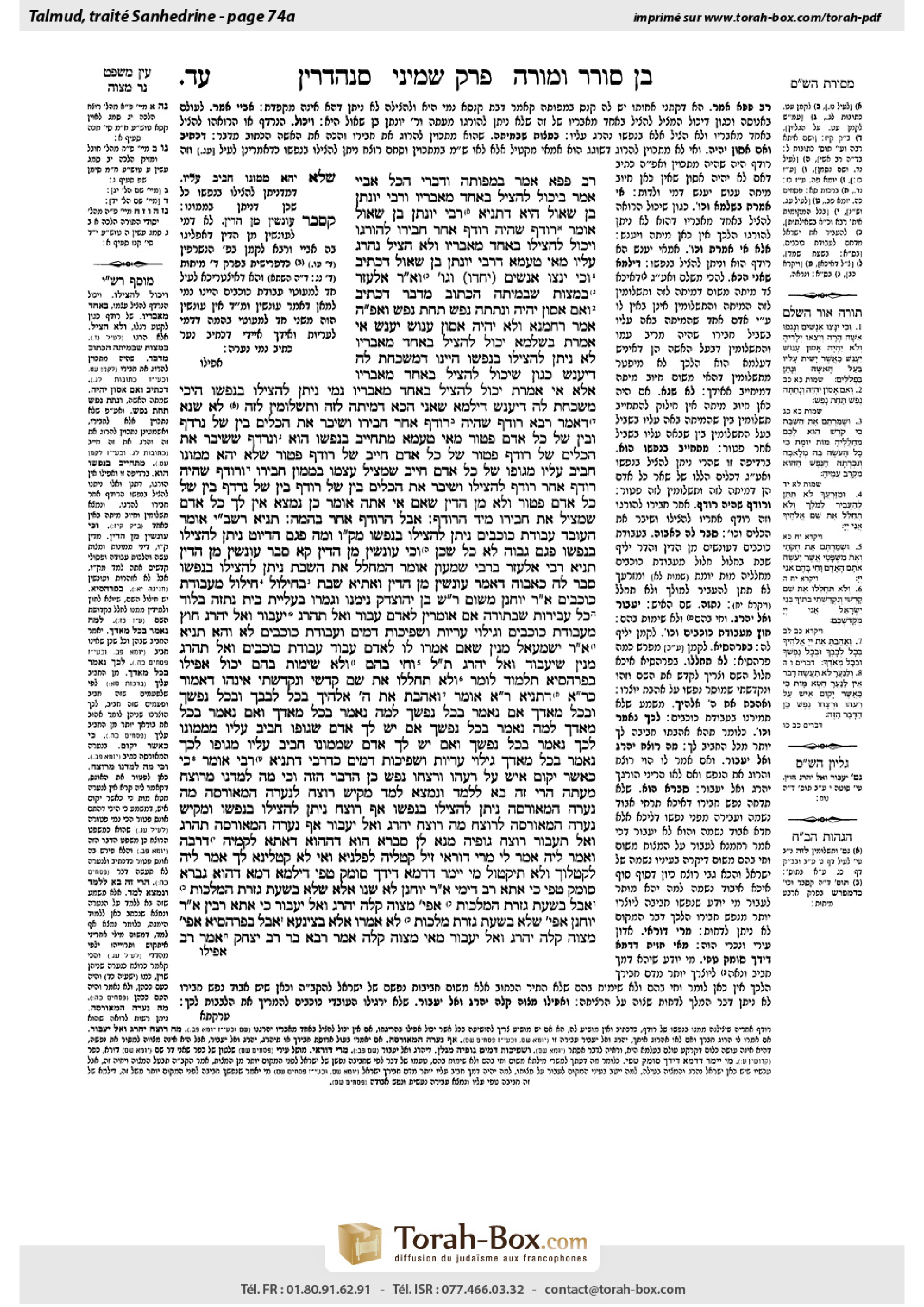
This page of Sanhedrin includes the Aramaic text, an English translation and an AI-generated French translation, alongside the scan above.
סנהדרין ע״ד א · Aramaic and Hebrew text
רַב פָּפָּא אָמַר: בִּמְפוּתָּה, וְדִבְרֵי הַכֹּל.
אַבָּיֵי אָמַר: בְּיָכוֹל לְהַצִּיל בְּאֶחָד מֵאֵבָרָיו, וְרַבִּי יוֹנָתָן בֶּן שָׁאוּל הִיא. דְּתַנְיָא: רַבִּי יוֹנָתָן בֶּן שָׁאוּל אוֹמֵר, רוֹדֵף שֶׁהָיָה רוֹדֵף אַחַר חֲבֵירוֹ לְהוֹרְגוֹ, וְיָכוֹל לְהַצִּילוֹ בְּאֶחָד מֵאֵבָרָיו וְלֹא הִצִּיל – נֶהֱרָג עָלָיו.
מַאי טַעְמָא דְּרַבִּי יוֹנָתָן בֶּן שָׁאוּל? דִּכְתִיב: ״וְכִי יִנָּצוּ אֲנָשִׁים (יַחְדָּו) וְגוֹ׳״. וְאָמַר רַבִּי אֶלְעָזָר: בְּמַצּוּת שֶׁבְּמִיתָה הַכָּתוּב מְדַבַּר, דִּכְתִיב: ״וְאִם אָסוֹן יִהְיֶה וְנָתַתָּה נֶפֶשׁ תַּחַת נָפֶשׁ״. וַאֲפִילּוּ הָכִי אָמַר רַחֲמָנָא: ״וְלֹא יִהְיֶה אָסוֹן עָנוֹשׁ יֵעָנֵשׁ״.
אִי אָמְרַתְּ בִּשְׁלָמָא: יָכוֹל לְהַצִּיל בְּאֶחָד מֵאֵבָרָיו, לֹא נִיתָּן לְהַצִּילוֹ בְּנַפְשׁוֹ – הַיְינוּ דְּמַשְׁכַּחַתְּ לַהּ דְּיֵעָנֵשׁ, כְּגוֹן שֶׁיָּכוֹל לְהַצִּיל בְּאֶחָד מֵאֵבָרָיו.
אֶלָּא, אִי אָמְרַתְּ: יָכוֹל לְהַצִּיל בְּאֶחָד מֵאֵבָרָיו נָמֵי נִיתָּן לְהַצִּילוֹ בְּנַפְשׁוֹ, הֵיכִי מַשְׁכַּחַתְּ לַהּ דְּיֵעָנֵשׁ?
דִּילְמָא שָׁאנֵי הָכָא, דְּמִיתָה לָזֶה וְתַשְׁלוּמִין לָזֶה.
לָא שְׁנָא, דְּאָמַר רָבָא: רוֹדֵף שֶׁהָיָה רוֹדֵף אַחַר חֲבֵירוֹ, וְשִׁיבֵּר אֶת הַכֵּלִים – בֵּין שֶׁל נִרְדׇּף וּבֵין שֶׁל כׇּל אָדָם – פָּטוּר. מַאי טַעְמָא? מִתְחַיֵּיב בְּנַפְשׁוֹ הוּא.
וְנִרְדׇּף שֶׁשִּׁיבֵּר אֶת הַכֵּלִים שֶׁל רוֹדֵף – פָּטוּר, שֶׁל כׇּל אָדָם – חַיָּיב. שֶׁל רוֹדֵף פָּטוּר, שֶׁלֹּא יְהֵא מָמוֹנוֹ חָבִיב עָלָיו מִגּוּפוֹ. שֶׁל כׇּל אָדָם חַיָּיב, שֶׁמַּצִּיל עַצְמוֹ בְּמָמוֹן חֲבֵירוֹ.
וְרוֹדֵף שֶׁהָיָה רוֹדֵף אַחַר רוֹדֵף לְהַצִּילוֹ, וְשִׁיבֵּר אֶת הַכֵּלִים – בֵּין שֶׁל רוֹדֵף, בֵּין שֶׁל נִרְדׇּף, בֵּין שֶׁל כׇּל אָדָם – פָּטוּר. וְלֹא מִן הַדִּין, שֶׁאִם אִי אַתָּה אוֹמֵר כֵּן, נִמְצָא אֵין לָךְ כׇּל אָדָם שֶׁמַּצִּיל אֶת חֲבֵירוֹ מִיַּד הָרוֹדֵף.
אֲבָל הָרוֹדֵף אַחַר בְּהֵמָה. תַּנְיָא, רַבִּי שִׁמְעוֹן בֶּן יוֹחַי אוֹמֵר: הָעוֹבֵד עֲבוֹדָה זָרָה נִיתָּן לְהַצִּילוֹ בְּנַפְשׁוֹ, מִקַּל וָחוֹמֶר. וּמָה פְּגַם הֶדְיוֹט נִיתָּן לְהַצִּילוֹ בְּנַפְשׁוֹ, פְּגַם גָּבוֹהַּ לֹא כׇּל שֶׁכֵּן? וְכִי עוֹנְשִׁין מִן הַדִּין?! קָא סָבַר: עוֹנְשִׁין מִן הַדִּין.
תַּנְיָא, רַבִּי אֶלְעָזָר בְּרַבִּי שִׁמְעוֹן אוֹמֵר: הַמְחַלֵּל אֶת הַשַּׁבָּת נִיתָּן לְהַצִּילוֹ בְּנַפְשׁוֹ. סָבַר לַהּ כַּאֲבוּהּ, דְּאָמַר: עוֹנְשִׁין מִן הַדִּין. וְאָתְיָא שַׁבָּת בְּ״חִילּוּל״ ״חִילּוּל״ מֵעֲבוֹדָה זָרָה.
אָמַר רַבִּי יוֹחָנָן מִשּׁוּם רַבִּי שִׁמְעוֹן בֶּן יְהוֹצָדָק: נִימְנוּ וְגָמְרוּ בַּעֲלִיַּת בֵּית נַתְּזָה בְּלוֹד, כׇּל עֲבֵירוֹת שֶׁבַּתּוֹרָה אִם אוֹמְרִין לָאָדָם ״עֲבוֹר וְאַל תֵּהָרֵג״ – יַעֲבוֹר וְאַל יֵהָרֵג, חוּץ מֵעֲבוֹדָה זָרָה וְגִילּוּי עֲרָיוֹת וּשְׁפִיכוּת דָּמִים.
וַעֲבוֹדָה זָרָה לָא? וְהָא תַּנְיָא: אָמַר רַבִּי יִשְׁמָעֵאל, מִנַּיִן שֶׁאִם אָמְרוּ לוֹ לָאָדָם ״עֲבוֹד עֲבוֹדָה זָרָה וְאַל תֵּהָרֵג״, מִנַּיִן שֶׁיַּעֲבוֹד וְאַל יֵהָרֵג? תַּלְמוּד לוֹמַר ״וָחַי בָּהֶם״ – וְלֹא שֶׁיָּמוּת בָּהֶם.
יָכוֹל אֲפִילּוּ בְּפַרְהֶסְיָא? תַּלְמוּד לוֹמַר: ״וְלֹא תְחַלְּלוּ אֶת שֵׁם קׇדְשִׁי וְנִקְדַּשְׁתִּי״.
אִינְהוּ דַּאֲמוּר כְּרַבִּי אֱלִיעֶזֶר, דְּתַנְיָא: רַבִּי אֱלִיעֶזֶר אוֹמֵר: ״וְאָהַבְתָּ אֵת ה׳ אֱלֹהֶיךָ בְּכׇל לְבָבְךָ וּבְכׇל נַפְשְׁךָ וּבְכׇל מְאֹדֶךָ״. אִם נֶאֱמַר ״בְּכׇל נַפְשְׁךָ״, לָמָּה נֶאֱמַר ״בְּכׇל מְאֹדֶךָ״? וְאִם נֶאֱמַר ״בְּכׇל מְאֹדֶךָ״, לָמָּה נֶאֱמַר ״בְּכׇל נַפְשְׁךָ״?
אִם יֵשׁ לְךָ אָדָם שֶׁגּוּפוֹ חָבִיב עָלָיו מִמָּמוֹנוֹ, לְכָךְ נֶאֱמַר ״בְּכׇל נַפְשְׁךָ״. וְאִם יֵשׁ לָךְ אָדָם שֶׁמָּמוֹנוֹ חָבִיב עָלָיו מִגּוּפוֹ, לְכָךְ נֶאֱמַר ״בְּכׇל מְאֹדֶךָ״.
גִּילּוּי עֲרָיוֹת וּשְׁפִיכוּת דָּמִים, כִּדְרַבִּי. דְּתַנְיָא, רַבִּי אוֹמֵר: ״כִּי כַּאֲשֶׁר יָקוּם אִישׁ עַל רֵעֵהוּ וּרְצָחוֹ נֶפֶשׁ כֵּן הַדָּבָר הַזֶּה״. וְכִי מָה לָמַדְנוּ מֵרוֹצֵחַ?
מֵעַתָּה, הֲרֵי זֶה בָּא לְלַמֵּד וְנִמְצָא לָמֵד. מַקִּישׁ רוֹצֵחַ לְנַעֲרָה הַמְאוֹרָסָה: מָה נַעֲרָה הַמְאוֹרָסָה – נִיתָּן לְהַצִּילוֹ בְּנַפְשׁוֹ, אַף רוֹצֵחַ – נִיתָּן לְהַצִּילוֹ בְּנַפְשׁוֹ.
וּמַקִּישׁ נַעֲרָה הַמְאוֹרָסָה לְרוֹצֵחַ: מָה רוֹצֵחַ יֵהָרֵג וְאַל יַעֲבוֹר, אַף נַעֲרָה הַמְאוֹרָסָה תֵּהָרֵג וְאַל תַּעֲבוֹר.
רוֹצֵחַ גּוּפֵיהּ מְנָא לַן? סְבָרָא הוּא, דְּהָהוּא דַּאֲתָא לְקַמֵּיהּ דְּרַבָּה וַאֲמַר לֵיהּ: אֲמַר לִי מָרֵי דּוּרַאי ״זִיל קַטְלֵיהּ לִפְלָנְיָא, וְאִי לָא קָטֵילְנָא לָךְ״. אֲמַר לֵיהּ: לִקְטְלוּךָ וְלָא תִּיקְטוֹל. מִי יֵימַר דִּדְמָא דִּידָךְ סוּמָּק טְפֵי? דִּילְמָא דְּמָא דְּהוּא גַּבְרָא סוּמָּק טְפֵי.
כִּי אֲתָא רַב דִּימִי, אָמַר רַבִּי יוֹחָנָן: לֹא שָׁנוּ אֶלָּא שֶׁלֹּא בִּשְׁעַת הַשְּׁמָד, אֲבָל בִּשְׁעַת הַשְּׁמָד, אֲפִילּוּ מִצְוָה קַלָּה – יֵהָרֵג וְאַל יַעֲבוֹר.
כִּי אֲתָא רָבִין אָמַר רַבִּי יוֹחָנָן: אֲפִילּוּ שֶׁלֹּא בִּשְׁעַת הַשְּׁמָד, לֹא אָמְרוּ אֶלָּא בְּצִינְעָא, אֲבָל בְּפַרְהֶסְיָא אֲפִילּוּ מִצְוָה קַלָּה – יֵהָרֵג וְאַל יַעֲבוֹר.
מַאי מִצְוָה קַלָּה? אָמַר רָבָא בַּר רַב יִצְחָק אָמַר רַב:
Sanhedrin 74a · English translation
Rav Pappa says: The ruling of the mishna, which lists his sister among those for whom he must pay a fine, is stated with regard to a young woman who was seduced, and in the case of seduction all agree that the woman is not saved at the cost of the seducer’s life, as the intercourse was consensual.
Abaye says: The ruling of the mishna is stated with regard to a young woman who was raped in a case where one was able to save her by injuring the pursuer in one of his limbs, so that it was not necessary to kill him in order to achieve her rescue, and it is in accordance with the opinion of Rabbi Yonatan ben Shaul. As it is taught in a baraita: Rabbi Yonatan ben Shaul says: If a pursuer was pursuing another to kill him, and one was able to save the pursued party without killing the pursuer, but instead by injuring him in one of his limbs, but he did not save him in this manner and rather chose to kill him, he is executed on his account as a murderer.
The Gemara explains: What is the reason of Rabbi Yonatan ben Shaul? As it is written: “If men strive and strike a woman with child, so that her fruit departs, and yet no further harm ensues, he shall be punished, according to the demands that the woman’s husband makes on him; and he shall pay it as the judges determine” (Exodus 21:22). And concerning this Rabbi Elazar says: The verse is speaking of striving to kill, where each man was trying to kill the other. The proof is that it is written: “But if any harm ensues, then you shall give life for life” (Exodus 21:23), and if there was no intention to kill, why should he be executed? And even so, the Merciful One states: “And yet no further harm ensues, he shall be punished,” teaching that he must pay the monetary value of the fetus to the woman’s husband.
Granted, if you say that in a case where one is able to save the pursued party by injuring the pursuer in one of his limbs, he may not save the pursued party at the cost of the pursuer’s life, and if he killed the pursuer rather than injure him he is liable to receive the death penalty, that is how you find the possibility that the one who ultimately struck the woman would be punished. This would be in a case where it was possible to save the man under attack, i.e., one of the men who were fighting, by injuring the pursuer, i.e., the other man, who ultimately struck the woman, in one of his limbs. In this case, the one who ultimately struck the woman was not subject to being killed. Therefore, he is subject to pay a fine.
But if you say that even if one is able to save the pursued party by injuring the pursuer in one of his limbs, he can also save him at the cost of the pursuer’s life, how can you find the possibility that the one who ultimately struck the woman would be punished? When he was going to strike the other man, he was at risk of being killed, as anybody could have killed him at that time, and the halakha is that anybody who commits an act warranting death exempts himself from any monetary obligation ensuing from that act.
The Gemara tries to refute this reasoning: Perhaps it is different here because his two liabilities are not on account of the same person; rather, his liability to be put to death is on account of this person, the man with whom he fought, while his liability to give payment is on account of that person, the woman he ultimately struck. Consequently, he is liable to receive both punishments.
The Gemara rejects this distinction: There is no difference. As Rava says: If a pursuer was pursuing another to kill him, and during the course of the chase the pursuer broke vessels belonging either to the person being pursued or to anyone else, he is exempt from paying for the broken vessels. What is the reason for this? The reason is that he is liable to be killed, since everyone is entitled to kill him in order to save the victim’s life, and one who commits an act rendering himself liable to be killed is exempt from any monetary obligation arising from that act, even if the payment were to be made to a person not connected to the act for which he is liable to be killed.
Rava continues: And if the pursued party broke vessels while fleeing from the pursuer, if those vessels belonged to the pursuer, the pursued party is exempt. But if they belonged to anyone else, he is liable to pay for them. The Gemara explains: If the vessels belonged to the pursuer, he is exempt. The reason for this is so that the pursuer’s property should not be more precious to the pursuer than his own body. Were the one being pursued to cause the pursuer bodily harm, he would be exempt; all the more so when the pursued one breaks the pursuer’s vessels. And if the vessels belonged to anyone else, he is liable, as he saved himself at the expense of another’s property, and that other person should not have to suffer a loss on his account.
Rava continues: But if one pursuer was pursuing another pursuer in order to save him, i.e., if he was trying to save the person being pursued by killing the pursuer, and while doing so he broke vessels belonging either to the pursuer or to the one being pursued, or to anyone else, he is exempt from paying for them. The Gemara comments: This is not by strict law, as if one who saves himself at another’s expense is liable to pay for the damage, certainly one who saves another at the expense of a third party should bear similar liability. Rather, it is an ordinance instituted by the Sages. This is because if you do not say that he is exempt, it will be found that no person will save another from a pursuer, as everyone will be afraid of becoming liable to pay for damage caused in the course of saving the pursued party.
§ The mishna teaches: But with regard to one who pursues an animal to sodomize it, or one who seeks to desecrate Shabbat, or one who is going to engage in idol worship, they are not saved at the cost of their lives. It is taught in a baraita: Rabbi Shimon ben Yoḥai says: One who seeks to worship idols may be saved from transgressing at the cost of his life. This is derived through an a fortiori inference: If to avoid the degradation of an ordinary person, such as in the case of a rapist who degrades his victim, he can be saved even at the cost of his life, all the more so is it not clear that one may kill the transgressor to avoid the degrading of the honor of God through the worship of idols? The Gemara asks: But does the court administer punishment based on an a fortiori inference? The Gemara answers: Rabbi Shimon ben Yoḥai maintains that the court administers punishment based on an a fortiori inference.
It is taught in a baraita: Rabbi Elazar, son of Rabbi Shimon, says: One who seeks to desecrate Shabbat may be saved from transgressing even at the cost of his life. The Gemara explains that Rabbi Elazar holds in accordance with the opinion of his father, Rabbi Shimon, who says: The court administers punishment based on an a fortiori inference, and the halakha with regard to one who desecrates Shabbat is derived from the halakha with regard to idol worship by way of a verbal analogy between the word “desecration” mentioned in the context of Shabbat and the word “desecration” mentioned in the context of idol worship.
§ The Gemara now considers which prohibitions are permitted in times of mortal danger. Rabbi Yoḥanan says in the name of Rabbi Shimon ben Yehotzadak: The Sages who discussed this issue counted the votes of those assembled and concluded in the upper story of the house of Nitza in the city of Lod: With regard to all other transgressions in the Torah, if a person is told: Transgress this prohibition and you will not be killed, he may transgress that prohibition and not be killed, because the preserving of his own life overrides all of the Torah’s prohibitions. This is the halakha concerning all prohibitions except for those of idol worship, forbidden sexual relations, and bloodshed. Concerning those prohibitions, one must allow himself to be killed rather than transgress them.
The Gemara asks: And should one not transgress the prohibition of idol worship to save his life? But isn’t it taught in a baraita: Rabbi Yishmael said: From where is it derived that if a person is told: Worship idols and you will not be killed, from where is it derived that he should worship the idol and not be killed? The verse states: “You shall keep My statutes and My judgments, which a person shall do, and he shall live by them” (Leviticus 18:5), thereby teaching that the mitzvot were given to provide life, but they were not given so that one will die due to their observance.
The baraita continues: One might have thought that it is permitted to worship the idol in this circumstance even in public, i.e., in the presence of many people. Therefore, the verse states: “Neither shall you profane My holy name; but I will be hallowed among the children of Israel: I am the Lord Who sanctifies you” (Leviticus 22:32). Evidently, one is not required to allow himself to be killed so as not to transgress the prohibition of idol worship when in private; but in public he must allow himself to be killed rather than transgress.
The Gemara answers: Those in the upper story of the house of Nitza stated their opinion in accordance with the opinion of Rabbi Eliezer. As it is taught in a baraita that Rabbi Eliezer says: It is stated: “And you shall love the Lord your God with all your heart, with all your soul, and with all your might” (Deuteronomy 6:5). If it is stated: “With all your soul,” why is it also stated: “With all your might,” which indicates with all your material possessions? And if it is stated: “With all your might,” why is it also stated: “With all your soul”? One of these clauses seems to be superfluous.
Rather, this serves to teach that if you have a person whose body is more precious to him than his property, it is therefore stated: “With all your soul.” That person must be willing to sacrifice even his life to sanctify God’s name. And if you have a person whose property is more precious to him than his body, it is therefore stated: “With all your might.” That person must even be prepared to sacrifice all his property for the love of God. According to the opinion of Rabbi Eliezer, one must allow himself to be killed rather than worship an idol.
From where is it derived that one must allow himself to be killed rather than transgress the prohibition of forbidden sexual relations and the prohibition of bloodshed? This is in accordance with the opinion of Rabbi Yehuda HaNasi. As it is taught in a baraita: Rabbi Yehuda HaNasi says: With regard to the rape of a betrothed young woman it is written: “But you shall do nothing to the young woman; the young woman has committed no sin worthy of death; for as when a man rises against his neighbor, and slays him, so too with this matter” (Deuteronomy 22:26). But why would the verse mention murder in this context? But what do we learn here from a murderer?
Now, the mention of murder came in order to teach a halakha about the betrothed young woman, and it turns out that, in addition, it derives a halakha from that case. The Torah juxtaposes the case of a murderer to the case of a betrothed young woman to indicate that just as in the case of a betrothed young woman one may save her at the cost of the rapist’s life, so too, in the case of a murderer, one may save the potential victim at the cost of the murderer’s life.
And conversely, the Torah juxtaposes a betrothed young woman to a murderer to indicate that just as with regard to a potential murderer, the halakha is that if one was ordered to murder another, he must be killed and not transgress the prohibition of bloodshed, so too, with regard to a betrothed young woman, if she is faced with rape, she must be killed and not transgress the prohibition of forbidden sexual relations.
The Gemara asks: From where do we derive this halakha with regard to a murderer himself, that one must allow himself to be killed rather than commit murder? The Gemara answers: It is based on logical reasoning that one life is not preferable to another, and therefore there is no need for a verse to teach this halakha. The Gemara relates an incident to demonstrate this: As when a certain person came before Rabba and said to him: The lord of my place, a local official, said to me: Go kill so-and-so, and if not I will kill you, what shall I do? Rabba said to him: It is preferable that he should kill you and you should not kill. Who is to say that your blood is redder than his, that your life is worth more than the one he wants you to kill? Perhaps that man’s blood is redder. This logical reasoning is the basis for the halakha that one may not save his own life by killing another.
§ When Rav Dimi came from Eretz Yisrael to Babylonia, he said that Rabbi Yoḥanan said: The Sages taught that one is permitted to transgress prohibitions in the face of mortal danger only when it is not a time of religious persecution. But in a time of religious persecution, when the gentile authorities are trying to force Jews to violate their religion, even if they issued a decree about a minor mitzva, one must be killed and not transgress.
When Ravin came from Eretz Yisrael to Babylonia, he said that Rabbi Yoḥanan said: Even when it is not a time of religious persecution, the Sages said that one is permitted to transgress a prohibition in the face of mortal danger only when he was ordered to do so in private. But if he was ordered to commit a transgression in public, even if they threaten him with death if he does not transgress a minor mitzva, he must be killed and not transgress.
The Gemara asks: What is a minor mitzva for this purpose? Rava bar Yitzḥak says that Rav says:
Sanhedrin 74a · Traduction française (IA)
Rav Pappa dit : La règle de la Michna, qui inclut sa sœur parmi celles pour lesquelles il doit payer une amende, concerne une jeune femme qui a été séduite. Dans le cas d’une séduction, tous conviennent que la femme n’est pas sauvée au prix de la vie du séducteur, puisque le rapport sexuel était consenti.
Abaye dit : La règle de la Michna concerne une jeune femme qui a été violée, dans un cas où l’on pouvait la sauver en blessant l’un des membres de son agresseur, de sorte qu’il n’était pas nécessaire de le tuer pour la secourir ; cette règle suit l’opinion de Rabbi Yonatan ben Shaul. En effet, il est enseigné dans une baraïta : Rabbi Yonatan ben Shaul dit : Si un poursuivant en poursuivait un autre pour le tuer, et que l’on pouvait sauver la personne poursuivie sans tuer le poursuivant, mais en le blessant à l’un de ses membres, et que l’on ne la sauvait pas ainsi, préférant tuer le poursuivant, on est exécuté comme meurtrier pour l’avoir tué.
La Guemara explique : Quelle est la raison de Rabbi Yonatan ben Shaul ? Il est écrit : « Si des hommes se querellent et frappent une femme enceinte, de sorte que son fruit sorte, mais qu’il n’en résulte aucun autre dommage, il sera condamné à une amende selon ce que le mari de la femme lui réclamera, et il paiera selon la décision des juges » (Exode 21:22). À ce sujet, Rabbi Elazar dit : Le verset parle d’hommes qui se battent avec l’intention de tuer, chacun cherchant à tuer l’autre. La preuve en est qu’il est écrit : « Mais s’il en résulte un dommage, tu donneras vie pour vie » (Exode 21:23). S’il n’avait pas eu l’intention de tuer, pourquoi serait-il exécuté ? Pourtant, le Miséricordieux dit : « Mais qu’il n’en résulte aucun autre dommage, il sera condamné à une amende », enseignant qu’il doit payer au mari de la femme la valeur monétaire du fœtus.
Certes, si l’on dit que, lorsqu’on peut sauver la personne poursuivie en blessant l’un des membres du poursuivant, on ne peut pas la sauver au prix de la vie du poursuivant, et que celui qui tue le poursuivant au lieu de le blesser est passible de la peine de mort, on peut comprendre pourquoi celui qui a finalement frappé la femme serait puni. Ce serait dans un cas où il était possible de sauver l’homme attaqué — c’est-à-dire l’un des hommes qui se battaient — en blessant l’un des membres du poursuivant — c’est-à-dire l’autre homme, celui qui a finalement frappé la femme. Dans ce cas, celui qui a finalement frappé la femme n’était pas passible de mort. Il est donc passible de payer une amende.
Mais si l’on dit que, même lorsqu’on peut sauver la personne poursuivie en blessant l’un des membres du poursuivant, on peut aussi la sauver au prix de la vie du poursuivant, comment comprendre que celui qui a finalement frappé la femme serait puni ? Au moment où il allait frapper l’autre homme, il risquait d’être tué, car n’importe qui aurait alors pu le tuer. Or, selon la halakha, quiconque commet un acte passible de la peine de mort est dispensé de toute obligation pécuniaire découlant de cet acte.
La Guemara tente de réfuter ce raisonnement : Peut-être la situation est-elle différente ici, car ses deux responsabilités ne concernent pas la même personne : il est passible de mort à l’égard de cet homme, celui avec lequel il s’est battu, tandis qu’il doit payer à cette autre personne, la femme qu’il a finalement frappée. Il est donc passible des deux peines.
La Guemara rejette cette distinction : il n’y a pas de différence. En effet, Rava dit : Si un poursuivant en poursuivait un autre pour le tuer et que, pendant la poursuite, il brisait des objets appartenant soit à la personne poursuivie, soit à n’importe qui d’autre, il est dispensé de payer les objets brisés. Pourquoi ? Parce qu’il est passible de mort, puisque chacun a le droit de le tuer pour sauver la vie de la victime ; or celui qui commet un acte qui le rend passible de mort est dispensé de toute obligation pécuniaire découlant de cet acte, même si le paiement devait être versé à une personne sans lien avec l’acte qui le rend passible de mort.
Rava poursuit : Si la personne poursuivie brise des objets en fuyant son poursuivant, elle est dispensée de les payer s’ils appartiennent au poursuivant. Mais s’ils appartiennent à quelqu’un d’autre, elle est tenue de les payer. La Guemara explique : si les objets appartiennent au poursuivant, la personne poursuivie est dispensée de les payer, afin que les biens du poursuivant ne lui soient pas plus précieux que son propre corps. Si la personne poursuivie causait un dommage corporel au poursuivant, elle serait dispensée de payer ; à plus forte raison lorsqu’elle brise les objets du poursuivant. En revanche, si les objets appartiennent à quelqu’un d’autre, elle est tenue de les payer, puisqu’elle s’est sauvée aux dépens des biens d’autrui, et cet autre ne doit pas subir de perte à cause d’elle.
Rava poursuit : Mais si un poursuivant en poursuivait un autre afin de le sauver — c’est-à-dire s’il cherchait à sauver la personne poursuivie en tuant le poursuivant — et que, ce faisant, il brisait des objets appartenant soit au poursuivant, soit à la personne poursuivie, soit à quelqu’un d’autre, il est dispensé de les payer. La Guemara fait remarquer : cette dispense ne relève pas du droit strict, car si celui qui se sauve aux dépens d’autrui est tenu de payer les dommages, à plus forte raison celui qui sauve autrui aux dépens d’un tiers devrait-il être tenu de la même obligation. Il s’agit plutôt d’une ordonnance instituée par les Sages. En effet, si on ne le dispensait pas de payer, personne ne sauverait autrui d’un poursuivant, chacun craignant d’être tenu de payer les dommages causés en secourant la personne poursuivie.
§ La Michna enseigne : Mais celui qui poursuit un animal pour le sodomiser, celui qui cherche à profaner le Chabbat ou celui qui va pratiquer l’idolâtrie ne sont pas sauvés au prix de leur vie. Il est enseigné dans une baraïta : Rabbi Shimon ben Yoḥai dit : Celui qui cherche à pratiquer l’idolâtrie peut être empêché de transgresser, même au prix de sa vie. Cela se déduit a fortiori : si, pour éviter l’humiliation d’une personne ordinaire — comme dans le cas d’un violeur qui humilie sa victime —, on peut sauver celle-ci même au prix de la vie du violeur, n’est-il pas d’autant plus évident qu’on peut tuer le transgresseur pour éviter que l’honneur de Dieu soit déshonoré par la pratique de l’idolâtrie ? La Guemara demande : Mais le tribunal prononce-t-il des peines sur la base d’une déduction a fortiori ? La Guemara répond : Rabbi Shimon ben Yoḥai estime que le tribunal prononce des peines sur la base d’une déduction a fortiori.
Il est enseigné dans une baraïta : Rabbi Elazar, fils de Rabbi Shimon, dit : Celui qui cherche à profaner le Chabbat peut être empêché de transgresser, même au prix de sa vie. La Guemara explique que Rabbi Elazar suit l’opinion de son père, Rabbi Shimon, selon laquelle le tribunal prononce des peines sur la base d’une déduction a fortiori ; la halakha concernant celui qui profane le Chabbat est déduite de celle relative à l’idolâtrie au moyen d’une analogie verbale entre le mot « profanation », employé à propos du Chabbat, et le mot « profanation », employé à propos de l’idolâtrie.
§ La Guemara examine maintenant quelles interdictions peuvent être transgressées en cas de danger mortel. Rabbi Yoḥanan dit au nom de Rabbi Shimon ben Yehotzadak : Les Sages qui débattirent de cette question procédèrent à un vote parmi les personnes réunies et conclurent, à l’étage supérieur de la maison de Nitza, dans la ville de Lod : Pour toutes les autres transgressions de la Torah, si l’on dit à une personne : « Transgresse cette interdiction et tu ne seras pas tué », elle peut transgresser cette interdiction afin de ne pas être tuée, car la préservation de sa propre vie l’emporte sur toutes les interdictions de la Torah. Cette halakha s’applique à toutes les interdictions, à l’exception de l’idolâtrie, des relations sexuelles interdites et du meurtre. Pour ces interdictions, on doit accepter d’être tué plutôt que de les transgresser.
La Guemara demande : Ne devrait-on pas transgresser l’interdiction de l’idolâtrie pour sauver sa vie ? N’est-il pas enseigné dans une baraïta : Rabbi Yishmael dit : D’où sait-on que, si l’on dit à une personne : « Pratique l’idolâtrie et tu ne seras pas tué », elle doit pratiquer l’idolâtrie afin de ne pas être tuée ? Le verset dit : « Vous observerez Mes lois et Mes règles, que l’homme mettra en pratique et par lesquelles il vivra » (Lévitique 18:5). Cela enseigne que les mitsvot ont été données pour qu’on vive grâce à elles, et non pour qu’on meure en les observant.
La baraïta poursuit : On aurait pu penser qu’il est permis de pratiquer l’idolâtrie dans cette situation, même en public, c’est-à-dire en présence de nombreuses personnes. Le verset dit donc : « Vous ne profanerez pas Mon saint nom, mais Je serai sanctifié au milieu des enfants d’Israël ; Je suis le Seigneur qui vous sanctifie » (Lévitique 22:32). Il en ressort qu’en privé, on n’est pas tenu d’accepter d’être tué plutôt que de transgresser l’interdiction de l’idolâtrie ; mais en public, on doit accepter d’être tué plutôt que de la transgresser.
La Guemara répond : Ceux qui se trouvaient à l’étage supérieur de la maison de Nitza formulèrent leur opinion conformément à celle de Rabbi Eliezer. En effet, il est enseigné dans une baraïta que Rabbi Eliezer dit : Il est écrit : « Tu aimeras le Seigneur ton Dieu de tout ton cœur, de toute ton âme et de toute ta force » (Deutéronome 6:5). S’il est écrit « de toute ton âme », pourquoi est-il également écrit « de toute ta force », ce qui signifie avec tous tes biens ? Et s’il est écrit « de toute ta force », pourquoi est-il également écrit « de toute ton âme » ? L’une de ces expressions semble superflue.
Cela sert plutôt à enseigner que, si une personne tient davantage à son corps qu’à ses biens, l’expression « de toute ton âme » est énoncée pour indiquer qu’elle doit être prête à sacrifier même sa vie afin de sanctifier le nom de Dieu. Et si une personne tient davantage à ses biens qu’à son corps, l’expression « de toute ta force » est énoncée pour indiquer qu’elle doit même être prête à sacrifier tous ses biens par amour pour Dieu. Selon l’opinion de Rabbi Eliezer, on doit accepter d’être tué plutôt que de pratiquer l’idolâtrie.
D’où sait-on qu’on doit accepter d’être tué plutôt que de transgresser l’interdiction des relations sexuelles interdites et celle du meurtre ? Cela suit l’opinion de Rabbi Yehuda HaNasi. En effet, il est enseigné dans une baraïta : Rabbi Yehuda HaNasi dit : À propos du viol d’une jeune femme fiancée, il est écrit : « Mais tu ne feras rien à la jeune femme ; la jeune femme n’a commis aucun péché digne de mort, car il en va de cette affaire comme lorsqu’un homme se dresse contre son prochain et le tue » (Deutéronome 22:26). Mais pourquoi le verset mentionne-t-il le meurtre dans ce contexte ? Que nous apprend ici le cas d’un meurtrier ?
Or, la mention du meurtre vise à enseigner une halakha concernant la jeune femme fiancée ; mais on en déduit également une halakha à partir de ce cas. La Torah rapproche le cas du meurtrier de celui de la jeune femme fiancée pour indiquer que, de même que dans le cas de la jeune femme fiancée, on peut la sauver au prix de la vie du violeur, de même, dans le cas d’un meurtrier, on peut sauver la victime potentielle au prix de la vie du meurtrier.
Inversement, la Torah rapproche le cas de la jeune femme fiancée de celui du meurtrier pour indiquer que, de même que, lorsqu’une personne est sommée de tuer quelqu’un, la halakha veut qu’elle soit tuée plutôt que de transgresser l’interdiction du meurtre, de même, lorsqu’une jeune femme fiancée est confrontée à un viol, elle doit être tuée plutôt que de transgresser l’interdiction des relations sexuelles interdites.
La Guemara demande : D’où déduit-on cette halakha concernant le meurtrier lui-même, à savoir qu’on doit accepter d’être tué plutôt que de commettre un meurtre ? La Guemara répond : Cela repose sur le raisonnement logique selon lequel une vie n’a pas plus de valeur qu’une autre ; il n’est donc pas nécessaire qu’un verset enseigne cette halakha. La Guemara rapporte un incident pour l’illustrer : Un homme vint un jour devant Rabba et lui dit : « Le gouverneur de ma localité m’a dit : “Va tuer untel, sinon je te tuerai.” Que dois-je faire ? » Rabba lui répondit : « Mieux vaut qu’il te tue et que tu ne tues pas. Qui te dit que ton sang est plus rouge que le sien, que ta vie vaut plus que celle de l’homme qu’il veut que tu tues ? Peut-être le sang de cet homme est-il plus rouge. » C’est ce raisonnement logique qui fonde la halakha selon laquelle on ne peut pas sauver sa propre vie en tuant quelqu’un d’autre.
§ Lorsque Rav Dimi arriva d’Eretz Yisrael en Babylonie, il rapporta que Rabbi Yoḥanan avait dit : Les Sages ont enseigné qu’il est permis de transgresser des interdictions face à un danger mortel seulement lorsqu’il ne s’agit pas d’une période de persécution religieuse. Mais en période de persécution religieuse, lorsque les autorités non juives cherchent à contraindre les Juifs à transgresser leur religion, même si elles ont décrété une mesure concernant une mitsva mineure, on doit être tué plutôt que de transgresser.
Lorsque Ravin arriva d’Eretz Yisrael en Babylonie, il rapporta que Rabbi Yoḥanan avait dit : Même en dehors d’une période de persécution religieuse, les Sages ont dit qu’il est permis de transgresser une interdiction face à un danger mortel seulement si l’ordre de la transgresser a été donné en privé. Mais si l’on a reçu l’ordre de commettre une transgression en public, même si l’on menace de le tuer s’il ne transgresse pas une mitsva mineure, il doit être tué plutôt que de transgresser.
La Guemara demande : Qu’est-ce qu’une mitsva mineure dans ce contexte ? Rava bar Yitzḥak dit au nom de Rav :
Traduction française générée par IA à partir de l’édition anglaise de Sefaria. Vérifie toujours un passage avec le texte source.
Text from Sefaria: William Davidson Edition - Vocalized Aramaic (CC BY NC); William Davidson Edition - English (CC BY NC).