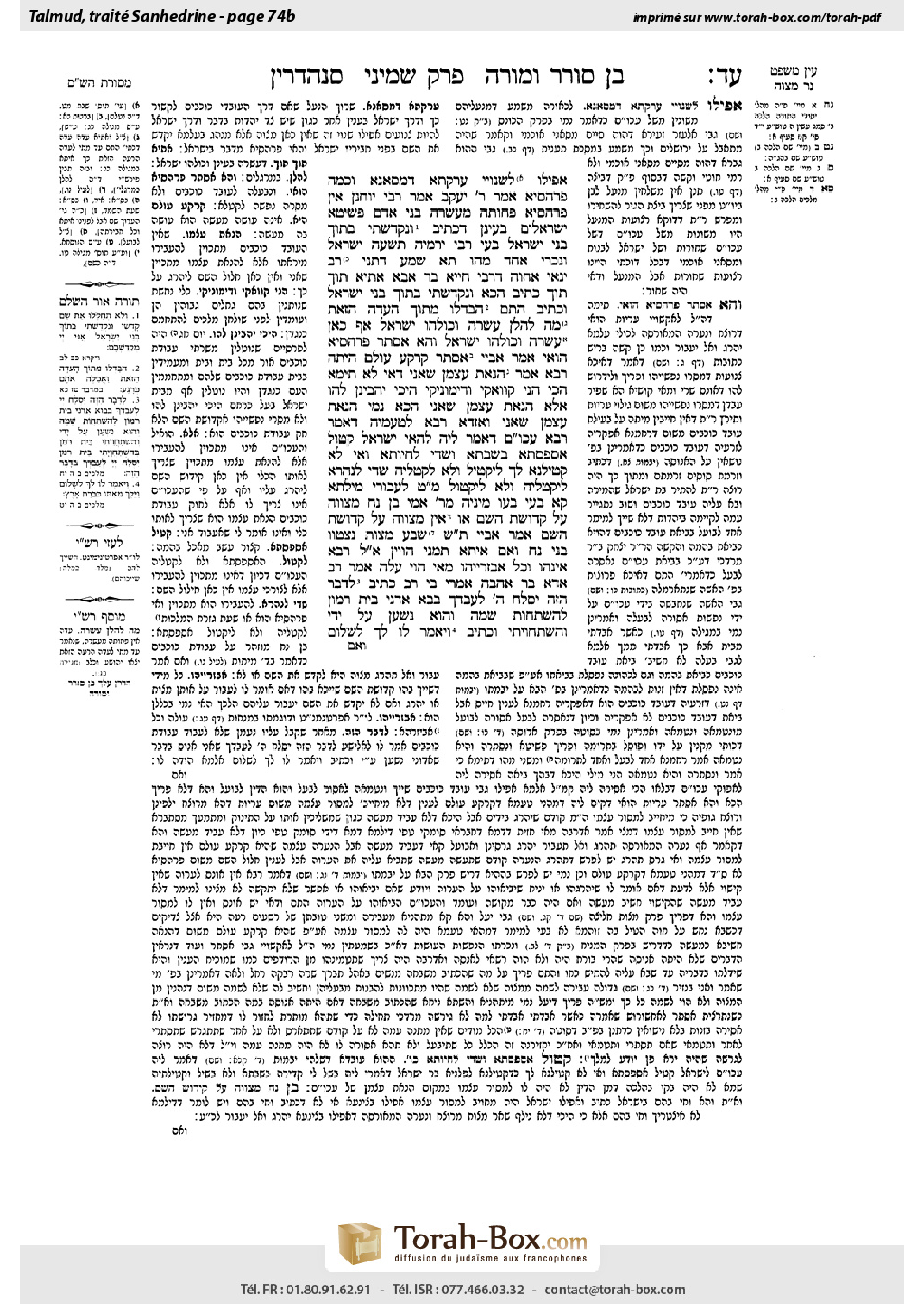
Sanhedrin 74b: Talmud study for Daf Yomi
Daf Yomi is the daily study of one Talmud folio. Explore 37 tractates with scans, Hebrew text, Sefaria English and AI-generated French translations where annotated.
Passage selection and English or AI-generated French translation are available where the scan has annotations. Daf Study is independent of Torah-Box and Sefaria.
Browse Sanhedrin · סנהדרין · All tractatesSanhedrin 74b text and translations
This page of Sanhedrin includes the Aramaic text, an English translation and an AI-generated French translation, alongside the scan above.
סנהדרין ע״ד ב · Aramaic and Hebrew text
אֲפִילּוּ לְשַׁנּוֹיֵי עַרְקְתָא דִּמְסָאנָא.
וְכַמָּה פַּרְהֶסְיָא? אָמַר רַבִּי יַעֲקֹב אָמַר רַבִּי יוֹחָנָן: אֵין פַּרְהֶסְיָא פְּחוּתָה מֵעֲשָׂרָה בְּנֵי אָדָם. פְּשִׁיטָא, יִשְׂרְאֵלִים בָּעֵינַן, דִּכְתִיב: ״וְנִקְדַּשְׁתִּי בְּתוֹךְ בְּנֵי יִשְׂרָאֵל״. בָּעֵי רַבִּי יִרְמְיָה: תִּשְׁעָה יִשְׂרָאֵל וְגוֹי אֶחָד, מַהוּ?
תָּא שְׁמַע, דְּתָנֵי רַב יַנַּאי אֲחוּהּ דְּרַבִּי חִיָּיא בַּר אַבָּא: אָתְיָא ״תּוֹךְ״ ״תּוֹךְ״ – כְּתִיב הָכָא: ״וְנִקְדַּשְׁתִּי בְּתוֹךְ בְּנֵי יִשְׂרָאֵל״, וּכְתִיב הָתָם: ״הִבָּדְלוּ מִתּוֹךְ הָעֵדָה הַזֹּאת״. מָה לְהַלָּן עֲשָׂרָה וְכוּלְּהוּ יִשְׂרָאֵל, אַף כָּאן עֲשָׂרָה וְכוּלְּהוּ יִשְׂרָאֵל.
וְהָא אֶסְתֵּר פַּרְהֶסְיָא הֲוַאי? אָמַר אַבָּיֵי: אֶסְתֵּר קַרְקַע עוֹלָם הָיְתָה.
רָבָא אָמַר: הֲנָאַת עַצְמָן שָׁאנֵי.
דְּאִי לָא תֵּימָא הָכִי, הָנֵי קְוָואקֵי וְדֵימוֹנִיקֵי הֵיכִי יָהֲבִינַן לְהוּ? אֶלָּא הֲנָאַת עַצְמָן שָׁאנֵי. הָכָא נָמֵי, הֲנָאַת עַצְמָן שָׁאנֵי.
וְאַזְדָּא רָבָא לְטַעְמֵיהּ, דְּאָמַר רָבָא: גּוֹי דְּאָמַר לֵיהּ לְהַאי יִשְׂרָאֵל, ״קְטוֹל אַסְפַּסְתָּא בְּשַׁבְּתָא וּשְׁדִי לְחֵיוָתָא, וְאִי לָא קָטֵילְנָא לָךְ״ – לִיקְטוֹל וְלָא לִקְטְלֵיהּ. ״שְׁדִי לְנַהְרָא״ – לִיקְטְלֵיהּ וְלָא לִיקְטוֹל. מַאי טַעְמָא? לְעַבּוֹרֵי מִילְּתָא קָא בָּעֵי.
בְּעוֹ מִינֵּיהּ מֵרַבִּי אַמֵּי: בֵּן נֹחַ מְצוֶּּוה עַל קְדוּשַּׁת הַשֵּׁם, אוֹ אֵין מְצוֶּּוה עַל קְדוּשַּׁת הַשֵּׁם?
אָמַר אַבָּיֵי, תָּא שְׁמַע: שֶׁבַע מִצְוֹת נִצְטַוּוּ בְּנֵי נֹחַ. וְאִם אִיתָא, תַּמְנֵי הָוְיָין! אֲמַר לֵיהּ רָבָא: אִינְהוּ וְכֹל אַבְזְרַיְיהוּ.
מַאי הָוֵי עֲלַהּ? אָמַר רַב אַדָּא בַּר אַהֲבָה: אָמְרִי בֵּי רַב, כְּתִיב: ״לַדָּבָר הַזֶּה יִסְלַח ה׳ לְעַבְדֶּךָ בְּבוֹא אֲדֹנִי בֵית רִמּוֹן לְהִשְׁתַּחֲוֹת שָׁמָּה וְהוּא נִשְׁעָן עַל יָדִי וְהִשְׁתַּחֲוֵיתִי״, וּכְתִיב: ״וַיֹּאמֶר לוֹ לֵךְ לְשָׁלוֹם״.
Sanhedrin 74b · English translation
Even to change the strap of a sandal. There was a Jewish custom with regard to sandal straps. If the gentile authorities were to decree that Jews must change their practice and wear sandal straps like those worn by the gentiles, one would be obligated to give up his life rather than veer from the accepted custom.
The Gemara asks: And the presence of how many people is required so that it should be deemed a public act? Rabbi Ya’akov says that Rabbi Yoḥanan says: An action is not considered a public act if it is performed in the presence of fewer than ten people. The Gemara clarifies this point: It is obvious that we require that these ten people be Jews, as it is written in the verse from which we derive the requirement of ten for the sanctification of God’s name: “And I shall be sanctified among the children of Israel” (Leviticus 22:32). Rabbi Yirmeya asks: What is the halakha if there were nine Jews and one gentile present?
The Gemara answers: Come and hear an answer from what Rav Yannai, the brother of Rabbi Ḥiyya bar Abba, teaches in a baraita: This is derived by means of a verbal analogy between the word “among” written with regard to the sanctification of God’s name, and the word “among” written with regard to Korah and his assembly. Here, with regard to the sanctification of God’s name, it is written: “And I shall be sanctified among the children of Israel,” and there, with regard to Korah, it is written: “Separate yourselves from among this congregation” (Numbers 16:21). The meaning of the word “congregation” written with regard to Korah is derived by means of a verbal analogy to the word “congregation” written with regard to the spies sent out by Moses to scout the land: “How long shall I bear with this evil congregation” (Numbers 14:27). Just as there, the congregation of spies numbered ten, and all were Jews, so too here, concerning the sanctification of God, there must be ten, all of them being Jews.
The Gemara raises a difficulty: But wasn’t the incident involving Esther, i.e., her cohabitation with Ahasuerus, a public sin? Why then did Esther not surrender her life rather than engage in intercourse? The Gemara answers: Abaye says: Esther was merely like natural ground, i.e., she was a passive participant. The obligation to surrender one’s life rather than engage in forbidden sexual intercourse applies only to a man who transgresses the prohibition in an active manner. A woman who is passive and merely submits is not required to give up her life so that she not sin.
Rava says that there is another justification for Esther’s behavior: When gentiles order the transgression of a prohibition not in order to persecute the Jews or to make them abandon their religion, but for their own personal pleasure, it is different. In such a situation there is no obligation to sacrifice one’s life, even when the sin is committed in public.
Rava explains: As if you do not say so, then how do we give them coal shovels [kevakei vedimonikei]? The Persian priests would take coal shovels from every house, fill them with coals, and use them to heat their temples on their festival days. Although this involved assisting idol worship in public, Jews would not sacrifice their lives in order not to do so. Rather, the reason they cooperated is certainly that a measure enacted for the gentiles’ personal pleasure is different. Here too, concerning Esther, Ahasuerus engaged in intercourse with her for his personal pleasure, and a measure enacted for a gentile’s personal pleasure is different, and there is no obligation to sacrifice one’s life to avoid it.
The Gemara comments: And Rava follows his own line of reasoning, as Rava says: If a gentile said to a certain Jew: Cut grass [aspasta] on Shabbat and throw it before the cattle, and if you do not do this I will kill you, he should cut the grass and not be killed. But if the gentile said to him: Cut the grass and throw it into the river, he should be killed and not cut the grass. What is the reason for the latter ruling? Because it is clear that the gentile is not seeking his own personal pleasure, but rather he wants to force the Jew to violate his religion.
§ The Sages raised a dilemma before Rabbi Ami: Is a descendant of Noah, who is commanded to refrain from idol worship, also commanded about the sanctification of God’s name, or is he not commanded about the sanctification of God’s name?
Abaye says: Come and hear an answer to this question from a baraita in which it was taught: Descendants of Noah were commanded to observe seven mitzvot: To establish courts of law, to refrain from cursing God, idol worship, adultery, bloodshed, robbery, and from eating the limb of a living animal. And if it is so that they are commanded about the sanctification of God’s name, then there would be eight mitzvot in which they are commanded. Rava said to him: There is no proof from here, as when the baraita speaks of seven mitzvot it means the seven mitzvot themselves with all their associated [avzaraihu] obligations. The mitzva to sanctify God’s name can be understood as a detail of the prohibition of idolatry.
The Gemara asks: What halakhic conclusion was reached about this matter? Rav Adda bar Ahava says that they say in the school of Rav: It is written that Naaman, commander of the army of the king of Aram, said to the prophet Elisha: “For this matter may the Lord pardon your servant, that when my master goes into the house of Rimmon to bow down there and he leans on my hand, and I bow myself down in the house of Rimmon” (II Kings 5:18). That is, he was forced to bow down before an idol out of fear of his master, the king of Aram. And it is written in the following verse: “And he said to him: Go in peace,” indicating that Elisha did not criticize him for acting in this manner.
Sanhedrin 74b · Traduction française (IA)
Même pour changer la lanière d’une sandale. Les Juifs avaient une coutume concernant les lanières de sandales. Si les autorités non juives décrétaient que les Juifs devaient modifier leur pratique et porter des lanières comme celles des non-Juifs, il aurait fallu donner sa vie plutôt que de s’écarter de la coutume admise.
La Guemara demande : Combien de personnes doivent être présentes pour que l’acte soit considéré comme public ? Rabbi Ya’akov dit au nom de Rabbi Yoḥanan : Un acte n’est pas considéré comme public s’il est accompli en présence de moins de dix personnes. La Guemara précise : Il est évident que ces dix personnes doivent être juives, comme l’indique le verset dont nous déduisons l’exigence de dix personnes pour la sanctification du nom de Dieu : « Je serai sanctifié au milieu des enfants d’Israël » (Lévitique 22:32). Rabbi Yirmeya demande : Quelle est la halakha si neuf Juifs et un non-Juif étaient présents ?
La Guemara répond : Viens entendre la réponse de ce qu’enseigne Rav Yannai, le frère de Rabbi Ḥiyya bar Abba, dans une baraïta : Cela se déduit par une analogie verbale entre le mot « au milieu », écrit à propos de la sanctification du nom de Dieu, et le mot « au milieu », écrit à propos de Koré et de son assemblée. Ici, à propos de la sanctification du nom de Dieu, il est écrit : « Je serai sanctifié au milieu des enfants d’Israël » ; et là, à propos de Koré, il est écrit : « Séparez-vous du milieu de cette assemblée » (Nombres 16:21). Le sens du mot « assemblée », écrit à propos de Koré, se déduit par une analogie verbale avec le mot « assemblée », écrit à propos des explorateurs envoyés par Moïse pour reconnaître le pays : « Jusqu’à quand supporterai-je cette assemblée perverse ? » (Nombres 14:27). De même que là, l’assemblée des explorateurs comptait dix personnes, toutes juives, de même ici, pour la sanctification de Dieu, il faut dix personnes, toutes juives.
La Guemara soulève une difficulté : Mais l’épisode d’Esther, c’est-à-dire ses relations avec Assuérus, n’était-il pas un péché public ? Pourquoi Esther n’a-t-elle donc pas préféré mourir plutôt que d’avoir des relations sexuelles ? La Guemara répond : Abayé dit qu’Esther était comme un sol naturel, c’est-à-dire qu’elle était passive. L’obligation de donner sa vie plutôt que d’avoir des relations sexuelles interdites ne s’applique qu’à un homme qui transgresse l’interdit de manière active. Une femme passive, qui se soumet simplement, n’est pas tenue de donner sa vie pour ne pas pécher.
Rava donne une autre justification au comportement d’Esther : lorsque les non-Juifs ordonnent la transgression d’un interdit, non pour persécuter les Juifs ni pour les pousser à abandonner leur religion, mais pour leur propre plaisir, le cas est différent. Dans une telle situation, il n’y a pas d’obligation de donner sa vie, même si le péché est commis publiquement.
Rava explique : En effet, si tu ne dis pas cela, comment leur remettons-nous des pelles à braises [kevakei vedimonikei] ? Les prêtres perses prenaient des pelles à braises dans chaque maison, les remplissaient de braises et s’en servaient pour chauffer leurs temples les jours de fête. Bien que cela impliquât de contribuer au culte idolâtre en public, les Juifs ne donnaient pas leur vie pour éviter de le faire. La raison de leur coopération est donc certainement que le cas d’une mesure prise pour le plaisir personnel des non-Juifs est différent. De même ici, concernant Esther, Assuérus avait des relations avec elle pour son plaisir personnel ; le cas d’une mesure prise pour le plaisir personnel d’un non-Juif est différent, et il n’y a pas d’obligation de donner sa vie pour l’éviter.
La Guemara fait remarquer que Rava suit son propre raisonnement, car Rava dit : Si un non-Juif dit à un Juif : « Coupe de l’herbe [aspasta] pendant Chabbat et jette-la devant le bétail », en ajoutant que s’il ne le fait pas, il le tuera, le Juif doit couper l’herbe plutôt que d’être tué. Mais si le non-Juif lui dit : « Coupe l’herbe et jette-la dans le fleuve », le Juif doit être tué plutôt que de couper l’herbe. Pour quelle raison cette dernière décision ? Parce qu’il est clair que le non-Juif ne cherche pas son propre plaisir, mais veut contraindre le Juif à transgresser sa religion.
§ Les Sages posèrent une question à Rabbi Ami : Un descendant de Noé, à qui il est ordonné de s’abstenir de l’idolâtrie, est-il également tenu de sanctifier le nom de Dieu, ou ne l’est-il pas ?
Abayé dit : Viens entendre la réponse à cette question dans une baraïta où il est enseigné que les descendants de Noé reçurent l’ordre d’observer sept mitsvot : établir des tribunaux, s’abstenir de maudire Dieu, de pratiquer l’idolâtrie, de commettre l’adultère, de verser le sang, de voler et de manger le membre d’un animal vivant. Et s’ils étaient également tenus de sanctifier le nom de Dieu, ils auraient donc huit mitsvot à observer. Rava lui dit : Il n’y a pas de preuve à tirer de là, car lorsque la baraïta parle de sept mitsvot, elle entend les sept mitsvot elles-mêmes, avec toutes les obligations qui leur sont associées [avzaraihu]. La mitsva de sanctifier le nom de Dieu peut être comprise comme un aspect de l’interdit de l’idolâtrie.
La Guemara demande : Quelle conclusion halakhique a-t-on tirée sur cette question ? Rav Adda bar Ahava dit que l’on enseigne à l’école de Rav : Il est écrit que Naaman, chef de l’armée du roi d’Aram, dit au prophète Élisée : « Que l’Éternel pardonne à ton serviteur en cette circonstance : lorsque mon maître entrera dans la maison de Rimmon pour s’y prosterner et qu’il s’appuiera sur mon bras, je me prosternerai moi aussi dans la maison de Rimmon » (II Rois 5:18). Autrement dit, il était contraint de se prosterner devant une idole par crainte de son maître, le roi d’Aram. Et il est écrit dans le verset suivant : « Il lui dit : Va en paix », ce qui indique qu’Élisée ne lui reprocha pas d’avoir agi ainsi.
Traduction française générée par IA à partir de l’édition anglaise de Sefaria. Vérifie toujours un passage avec le texte source.
Text from Sefaria: William Davidson Edition - Vocalized Aramaic (CC BY NC); William Davidson Edition - English (CC BY NC).