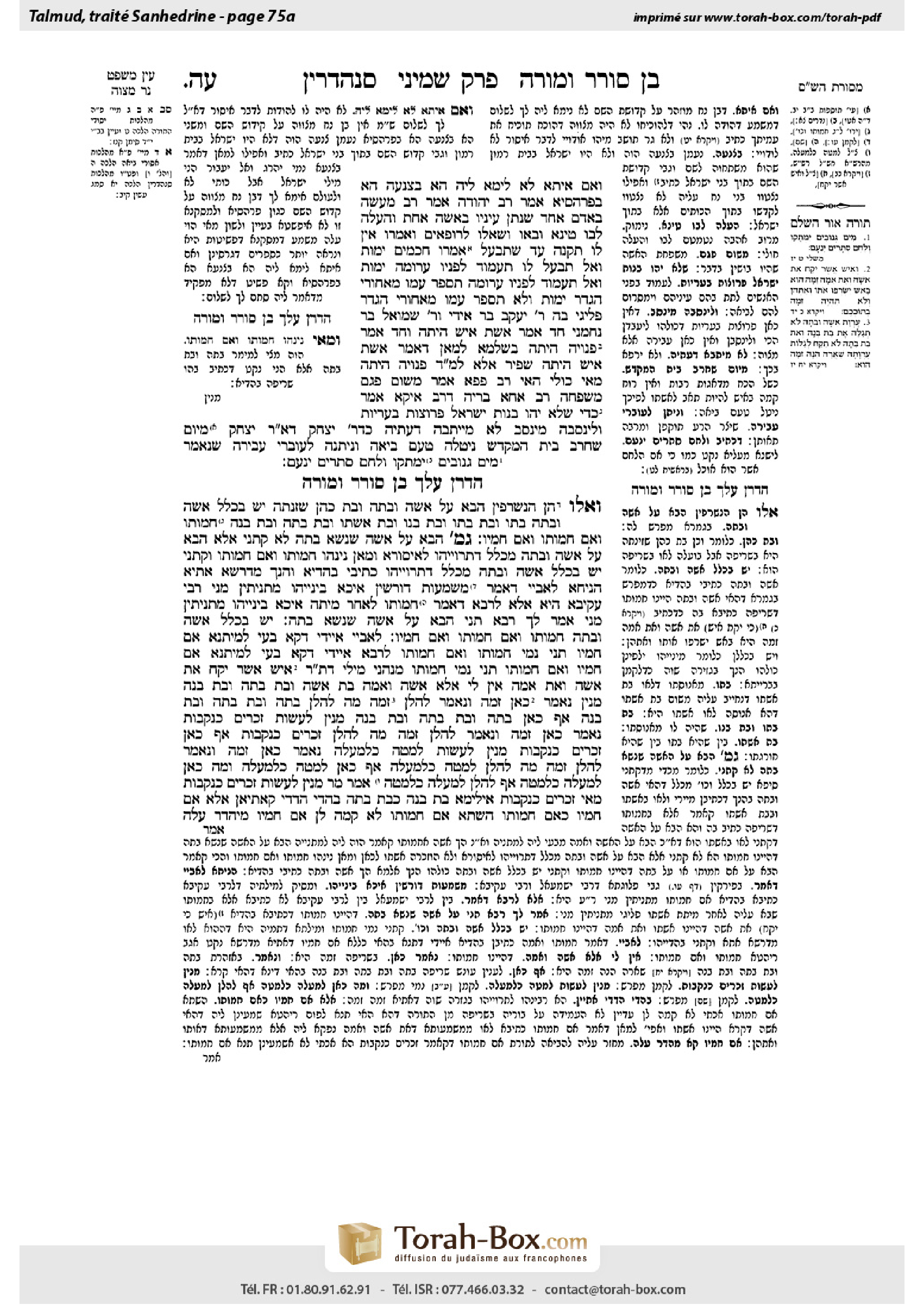
Sanhedrin 75a: Talmud study for Daf Yomi
Daf Yomi is the daily study of one Talmud folio. Explore 37 tractates with scans, Hebrew text, Sefaria English and AI-generated French translations where annotated.
Passage selection and English or AI-generated French translation are available where the scan has annotations. Daf Study is independent of Torah-Box and Sefaria.
Browse Sanhedrin · סנהדרין · All tractatesSanhedrin 75a text and translations
This page of Sanhedrin includes the Aramaic text, an English translation and an AI-generated French translation, alongside the scan above.
סנהדרין ע״ה א · Aramaic and Hebrew text
וְאִם אִיתָא, לָא לֵימָא לֵיהּ? הָא בְּצִנְעָה, הָא בְּפַרְהֶסְיָא.
אָמַר רַב יְהוּדָה אָמַר רַב: מַעֲשֶׂה בְּאָדָם אֶחָד שֶׁנָּתַן עֵינָיו בְּאִשָּׁה אַחַת, וְהֶעֱלָה לִבּוֹ טִינָא. וּבָאוּ וְשָׁאֲלוּ לָרוֹפְאִים, וְאָמְרוּ: אֵין לוֹ תַּקָּנָה עַד שֶׁתִּבָּעֵל. אָמְרוּ חֲכָמִים: יָמוּת וְאַל תִּבָּעֵל לוֹ. תַּעֲמוֹד לְפָנָיו עֲרוּמָּה: יָמוּת וְאַל תַּעֲמוֹד לְפָנָיו עֲרוּמָּה. תְּסַפֵּר עִמּוֹ מֵאֲחוֹרֵי הַגָּדֵר: יָמוּת וְלֹא תְּסַפֵּר עִמּוֹ מֵאֲחוֹרֵי הַגָּדֵר.
פְּלִיגִי בַּהּ רַבִּי יַעֲקֹב בַּר אִידֵּי וְרַבִּי שְׁמוּאֵל בַּר נַחְמָנִי: חַד אָמַר: אֵשֶׁת אִישׁ הָיְתָה, וְחַד אָמַר: פְּנוּיָה הָיְתָה. בִּשְׁלָמָא לְמַאן דְּאָמַר אֵשֶׁת אִישׁ הָיְתָה – שַׁפִּיר, אֶלָּא לְמַאן דְּאָמַר פְּנוּיָה הָיְתָה – מַאי כּוּלֵּי הַאי?
רַב פָּפָּא אָמַר: מִשּׁוּם פְּגַם מִשְׁפָּחָה. רַב אַחָא בְּרֵיהּ דְּרַב אִיקָא אָמַר: כְּדֵי שֶׁלֹּא יְהוּ בְּנוֹת יִשְׂרָאֵל פְּרוּצוֹת בַּעֲרָיוֹת.
וְלִינְסְבַהּ מִינְסָב? לָא מְיַיתְּבָה דַּעְתֵּיהּ, כִּדְרַבִּי יִצְחָק. דְּאָמַר רַבִּי יִצְחָק: מִיּוֹם שֶׁחָרַב בֵּית הַמִּקְדָּשׁ, נִיטְּלָה טַעַם בִּיאָה וְנִיתְּנָה לְעוֹבְרֵי עֲבֵירָה, שֶׁנֶּאֱמַר ״מַיִם גְּנוּבִים יִמְתָּקוּ וְלֶחֶם סְתָרִים יִנְעָם״.
הֲדַרַן עֲלָךְ בֵּן סוֹרֵר וּמוֹרֶה.
מַתְנִי׳ וְאֵלּוּ הֵן הַנִּשְׂרָפִין: הַבָּא עַל אִשָּׁה וּבִתָּהּ, וּבַת כֹּהֵן שֶׁזִּנְּתָה.
יֵשׁ בִּכְלַל אִשָּׁה וּבִתָּהּ: בִּתּוֹ, וּבַת בִּתּוֹ, וּבַת בְּנוֹ, וּבַת אִשְׁתּוֹ, וּבַת בִּתָּהּ, וּבַת בְּנָהּ, חֲמוֹתוֹ, וְאֵם חֲמוֹתוֹ, וְאֵם חָמִיו.
גְּמָ׳ הַבָּא עַל אִשָּׁה שֶׁנָּשָׂא בִּתָּהּ – לָא קָתָנֵי, אֶלָּא הַבָּא עַל אִשָּׁה וּבִתָּהּ. מִכְּלָל דְּתַרְוַיְיהוּ לְאִיסּוּרָא, וּמַאן נִינְהוּ? חֲמוֹתוֹ וְאֵם חֲמוֹתוֹ.
וְקָתָנֵי: ״יֵשׁ בִּכְלַל אִשָּׁה וּבִתָּהּ״, מִכְּלָל דְּתַרְוַיְיהוּ כְּתִיבִי בְּהֶדְיָא, וְהָנָךְ מִדְּרָשָׁא אָתְיָא.
הָנִיחָא לְאַבָּיֵי, דְּאָמַר: מַשְׁמָעוּת דּוֹרְשִׁין אִיכָּא בֵּינַיְיהוּ. מַתְנִיתִין מַנִּי? רַבִּי עֲקִיבָא הִיא.
אֶלָּא לְרָבָא דְּאָמַר: חֲמוֹתוֹ לְאַחַר מִיתָה אִיכָּא בֵּינַיְיהוּ, מַתְנִיתִין מַנִּי? אָמַר לָךְ רָבָא: תְּנִי ״הַבָּא עַל אִשָּׁה שֶׁנָּשָׂא בִּתָּהּ״.
יֵשׁ בִּכְלַל אִשָּׁה וּבִתָּהּ: חֲמוֹתוֹ, וְאֵם חֲמוֹתוֹ, וְאֵם חָמִיו. לְאַבָּיֵי, אַיְּידֵי דְּקָא בָּעֵי לְמִיתְנֵא אֵם חָמִיו, תָּנֵי נָמֵי חֲמוֹתוֹ וְאֵם חֲמוֹתוֹ.
לְרָבָא, אַיְּידֵי דְּקָא בָּעֵי לְמִיתְנֵא אֵם חָמִיו וְאֵם חֲמוֹתוֹ, תָּנֵי נָמֵי חֲמוֹתוֹ.
מְנָהָנֵי מִילֵּי? דְּתָנוּ רַבָּנַן: ״אִישׁ אֲשֶׁר יִקַּח אֶת אִשָּׁה וְאֶת אִמָּהּ״ – אֵין לִי אֶלָּא אִשָּׁה וְאִמָּהּ. בַּת אִשָּׁה, וּבַת בִּתָּהּ, וּבַת בְּנָהּ מִנַּיִן?
נֶאֱמַר כָּאן ״זִמָּה״, וְנֶאֱמַר לְהַלָּן ״זִמָּה״. מָה לְהַלָּן – בִּתָּהּ וּבַת בִּתָּהּ וּבַת בְּנָהּ, אַף כָּאן – בִּתָּהּ וּבַת בִּתָּהּ וּבַת בְּנָהּ.
מִנַּיִן לַעֲשׂוֹת זְכָרִים כִּנְקֵבוֹת? נֶאֱמַר כָּאן ״זִמָּה״, וְנֶאֱמַר לְהַלָּן ״זִמָּה״. מָה לְהַלָּן זְכָרִים כִּנְקֵבוֹת, אַף כָּאן זְכָרִים כִּנְקֵבוֹת.
מִנַּיִן לַעֲשׂוֹת לְמַטָּה כִּלְמַעְלָה? נֶאֱמַר כָּאן ״זִמָּה״, וְנֶאֱמַר לְהַלָּן ״זִמָּה״. מָה לְהַלָּן לְמַטָּה כִּלְמַעְלָה, אַף כָּאן לְמַטָּה כִּלְמַעְלָה. וּמָה כָּאן לְמַעְלָה כִּלְמַטָּה, אַף לְהַלָּן לְמַעְלָה כִּלְמַטָּה.
אָמַר מָר: מִנַּיִן לַעֲשׂוֹת זְכָרִים כִּנְקֵבוֹת. מַאי ״זְכָרִים כִּנְקֵבוֹת״? אִילֵּימָא בַּת בְּנָהּ כְּבַת בִּתָּהּ? בַּהֲדֵי הֲדָדֵי קָאָתְיָאן!
אֶלָּא, אֵם חָמִיו כְּאֵם חֲמוֹתוֹ. הַשְׁתָּא, אֵם חֲמוֹתוֹ לָא קָמָה לַן, אֵם חָמִיו מִיהְדָּר עֲלַהּ?
Sanhedrin 75a · English translation
And if it is so that a descendant of Noah is commanded about the sanctification of God’s name, he should not have said to him: “Go in peace.” The Gemara answers: This situation, where Elisha permitted Naaman’s conduct, happened in private. When Naaman bowed down in the house of Rimmon, he did not do so in the presence of ten Jews. Whereas that question that was raised is whether or not a descendant of Noah must sanctify God’s name in public, in the presence of ten Jews. Consequently, the question remains without a solution.
§ Apropos the discussion of the obligation to allow oneself to be killed rather than engage in forbidden sexual intercourse, the Gemara notes that Rav Yehuda says that Rav says: There was an incident involving a certain man who set his eyes upon a certain woman and passion rose in his heart, to the point that he became deathly ill. And they came and asked doctors what was to be done with him. And the doctors said: He will have no cure until she engages in sexual intercourse with him. The Sages said: Let him die, and she may not engage in sexual intercourse with him. The doctors said: She should at least stand naked before him. The Sages said: Let him die, and she may not stand naked before him. The doctors suggested: The woman should at least converse with him behind a fence in a secluded area, so that he should derive a small amount of pleasure from the encounter. The Sages insisted: Let him die, and she may not converse with him behind a fence.
The Gemara comments: Rabbi Ya’akov bar Idi and Rabbi Shmuel bar Naḥmani disagree about this issue. One of them says: The woman in question was a married woman, and the other one says: She was unmarried. The Gemara tries to clarify the issue: Granted, according to the one who says that she was a married woman, the matter is properly understood. Since the case involved a severely prohibited forbidden relationship, the Sages did not allow any activity hinting at intimacy. But according to the one who says that she was unmarried, what is the reason for all this opposition? Why did the Sages say that the man must be allowed to die, rather than have the woman do as was requested?
Rav Pappa says: This is due to the potential family flaw, i.e., harm to the family name, as it is not permitted to bring disgrace to the entire family in order to save the lovesick man. Rav Aḥa, son of Rav Ika, says: This is so that the daughters of Israel should not be promiscuous with regard to forbidden sexual relations. Were they to listen to the doctors’ recommendations, Jewish women might lose moral restraint.
The Gemara asks: But if the woman was unmarried, let the man marry her. The Gemara answers: His mind would not have been eased by marriage, in accordance with the statement of Rabbi Yitzḥak. As Rabbi Yitzḥak says: Since the day the Temple was destroyed, sexual pleasure was taken away from those who engage in permitted intercourse and given to transgressors, as it is stated: “Stolen waters are sweet, and bread eaten in secret is pleasant” (Proverbs 9:17). Therefore, the man could have been cured only by engaging in illicit sexual interaction.
MISHNA: And these are the transgressors who are burned in the implementation of the court-imposed death penalty: One who engaged in intercourse with a woman and her daughter, and one who is the daughter of a priest and who committed adultery.
Included in the category of the prohibition of engaging in intercourse with a woman and her daughter and the resulting execution by burning, there are: His daughter, and the daughter of his daughter, and the daughter of his son. Likewise, the following are also included in this category: Intercourse with the daughter of his wife, even though she is not his daughter, and the daughter of her daughter, and the daughter of her son, as well as intercourse with his mother-in-law, and the mother of his mother-in-law, and the mother of his father-in-law. The prohibition and punishment apply both in cases where a man marries a woman and then engages in intercourse with her daughter, and in cases where a man marries a woman and then engages in intercourse with her mother.
GEMARA: The tanna does not teach the case of one who engaged in intercourse with a woman whose daughter he previously married. Rather, the tanna teaches the case of one who engaged in intercourse with a woman and her daughter. By inference, one may conclude that both the woman and her daughter are mentioned in the mishna for the purpose of establishing that there is a prohibition of intercourse with either of them, and when he engages in intercourse with the first of them he is liable to be executed. And who are these women? The reference is to his mother-in-law and the mother of his mother-in-law.
And the tanna teaches: Additional women are included in the category of the prohibition of and the punishment for engaging in intercourse with a woman and her daughter. By inference, one may conclude that with regard to both his mother-in-law and the mother of his mother-in-law, the prohibition and punishment are written explicitly in the Torah, and with regard to those additional women enumerated in the mishna, the prohibition and punishment are derived by means of interpretation.
The Gemara comments: This works out well according to Abaye, who says that with regard to the dispute between Rabbi Yishmael and Rabbi Akiva cited later in the Gemara (76b), the difference between their opinions is only concerning the interpretation of the meaning of the verse, but there is no practical difference between their opinions. According to Abaye, whose opinion is expressed in the mishna? It is the opinion of Rabbi Akiva. Abaye explains that Rabbi Akiva maintains that the prohibition of engaging in intercourse with the mother of one’s mother-in-law is stated explicitly in the Torah.
But according to Rava, who says that the difference between their opinions is with regard to the prohibition of engaging in intercourse with one’s mother-in-law after the death of his wife, whose opinion is expressed in the mishna? The opinion of the tanna of the mishna corresponds neither to the opinion of Rabbi Akiva nor to the opinion of Rabbi Yishmael, as they both maintain that the prohibition of engaging in intercourse with the mother of one’s mother-in-law is not stated explicitly in the Torah. The Gemara answers: Rava could say to you: Emend the mishna and teach: One who engaged in intercourse with a woman whose daughter he previously married.
The mishna teaches: Included in the category of the prohibition of engaging in intercourse with a woman and her daughter and the resulting execution by burning, there are: His mother-in-law, and the mother of his mother-in-law, and the mother of his father-in-law. The Gemara comments: Abaye holds that everyone agrees that the prohibition of engaging in intercourse with one’s mother-in-law is stated explicitly in the Torah, and the tanna enumerates his mother-in-law together with relatives concerning whom the prohibition is derived by means of interpretation. Therefore, according to Abaye, since the tanna seeks to teach that the mother of his father-in-law is included in the prohibition, he teaches the halakha of his mother-in-law and the mother of his mother-in-law as well, despite the fact the prohibition of engaging in intercourse with one’s mother-in-law is stated explicitly in the Torah.
By contrast, Rava holds that the woman and her daughter mentioned in the first clause of the mishna are his wife and his mother-in-law. Therefore, according to Rava, since the tanna seeks to teach that the mother of his father-in-law and the mother of his mother-in-law are included in the prohibition, he teaches the halakha of his mother-in-law in the latter clause as well, despite the fact that it is stated explicitly in the Torah.
§ The mishna enumerates several women with whom intercourse is forbidden who are included in the prohibition of engaging in intercourse with a woman and her daughter, which is punished by execution by burning. The Gemara asks: From where are these matters derived? They are derived as the Sages taught: “And if a man takes a woman and her mother, it is lewdness; they shall be burned with fire both him and them, and there shall be no lewdness among you” (Leviticus 20:14). I have derived only that this punishment applies to one who engages in intercourse with a woman and with her mother. From where is it derived that one who engages in intercourse with the daughter of the woman married to him, or with the daughter of her daughter, or with the daughter of her son, is also liable to be executed by burning?
The baraita continues: Lewdness is stated here, with regard to the punishment: “There shall be no lewdness among you” (Leviticus 20:14), and lewdness is stated there, with regard to the prohibition: “You shall not uncover the nakedness of a woman and her daughter; you shall not take her son’s daughter, or her daughter’s daughter, to uncover her nakedness; they are near kinswomen, it is lewdness” (Leviticus 18:17). It is derived by means of a verbal analogy that just as there the prohibition applies to the woman’s daughter, and the daughter of her daughter, and the daughter of her son, so too here, the punishment of burning applies to one who engages in intercourse with the woman’s daughter, and to the daughter of her daughter, and to the daughter of her son.
The baraita continues: From where is it derived to render the status of males like that of females with regard to this punishment? Lewdness is stated here and lewdness is stated there. Just as there, the Torah renders the status of males like that of female relatives, so too here, the Torah renders the status of males like that of females.
From where is it derived to render the status of relatives below like the status of relatives above? Lewdness is stated here and lewdness is stated there. Just as there, the Torah renders the status of relatives below like that of relatives above, so too here, the Torah renders the status of relatives below like that of relatives above. And just as here, the Torah renders the status of relatives above like that of relatives below, so too there, the Torah renders the status of relatives above like that of relatives below.
The Gemara proceeds to elaborate on the derivations cited in the baraita. The Master says: From where is it derived to render the status of males like that of females? The Gemara asks: What is the meaning of: The status of males like that of females? If we say that it means that one who engages in intercourse with the daughter of the son of his wife is executed by burning like one who engages in intercourse with the daughter of her daughter, the status of the daughter of her son and the daughter of her daughter are derived together in the first clause of the baraita, as both are written explicitly in the prohibition.
Rather, this clause in the baraita means that one who engages in intercourse with the mother of his father-in-law is executed by burning like one who engages in intercourse with the mother of his mother-in-law. The Gemara asks: Now, we have not yet established the halakha of one who engages in intercourse with the mother of his mother-in-law, and the baraita is seeking to derive the halakha of one who engages in intercourse with the mother of his father-in-law from the halakha of the mother of his mother-in-law?
Sanhedrin 75a · Traduction française (IA)
Et s'il en est ainsi qu'un descendant de Noé est tenu par le commandement de la sanctification du Nom de Dieu, il n'aurait pas dû lui dire : « Va en paix ». La Guemara répond : Cette situation, où Élisée a permis la conduite de Naaman, s'est produite en privé. Lorsque Naaman s'est prosterné dans la maison de Rimmon, il ne l'a pas fait en présence de dix Juifs. Or, la question posée porte sur le fait de savoir si un descendant de Noé doit sanctifier le Nom de Dieu en public, en présence de dix Juifs. Par conséquent, la question reste sans solution.
§ À propos de la discussion sur l'obligation de se laisser tuer plutôt que de s'adonner à des relations sexuelles interdites, la Guemara note que Rav Yehouda dit que Rav dit : Il y a eu un incident impliquant un certain homme qui a posé ses yeux sur une certaine femme et la passion s'est emparée de son cœur, au point qu'il est devenu gravement malade. Et ils sont venus demander aux médecins ce qu'il fallait faire pour lui. Et les médecins ont dit : Il n'aura aucun remède jusqu'à ce qu'elle ait des relations sexuelles avec lui. Les Sages ont dit : Qu'il meure, et qu'elle n'ait pas de relations sexuelles avec lui. Les médecins ont dit : Elle devrait au moins se tenir nue devant lui. Les Sages ont dit : Qu'il meure, et qu'elle ne se tienne pas nue devant lui. Les médecins ont suggéré : La femme devrait au moins converser avec lui derrière une clôture dans un endroit isolé, afin qu'il puisse tirer un petit plaisir de la rencontre. Les Sages ont insisté : Qu'il meure, et qu'elle ne converse pas avec lui derrière une clôture.
La Guemara commente : Rabbi Ya’akov bar Idi et Rabbi Chmouel bar Naḥmani sont en désaccord sur cette question. L’un d’eux affirme que la femme en question était mariée, tandis que l’autre soutient qu’elle était célibataire. La Guemara tente de clarifier la question : Certes, selon celui qui dit qu’elle était mariée, la situation est bien comprise. Puisque l’affaire impliquait une relation sexuellement interdite de manière grave, les Sages n’ont pas permis toute activité suggérant l’intimité. Mais selon celui qui dit qu’elle était célibataire, quelle est la raison de toute cette opposition ? Pourquoi les Sages ont-ils dit que l’homme doit être laissé mourir, plutôt que de laisser la femme faire ce qui était demandé ?
Rav Pappa dit : Cela est dû au défaut potentiel de la lignée, c’est-à-dire au préjudice porté au nom de la famille, car il n’est pas permis de porter atteinte à l’honneur de toute la famille pour sauver l’homme amoureux. Rav Aḥa, fils de Rav Ika, dit : C’est afin que les filles d’Israël ne se livrent pas à la promiscuité en matière de relations sexuelles interdites. S’elles écoutaient les recommandations des médecins, les femmes juives pourraient perdre leur retenue morale.
La Guemara demande : Mais si la femme était célibataire, que l’homme l’épouse. La Guemara répond : Son esprit n’aurait pas été apaisé par le mariage, conformément à l’énoncé de Rabbi Yitsḥak. Car Rabbi Yitsḥak dit : Depuis le jour où le Temple a été détruit, le plaisir sexuel a été retiré à ceux qui s’adonnent à des relations permises et donné aux transgresseurs, comme il est écrit : « Les eaux volées sont douces, et le pain mangé en secret est agréable » (Proverbes 9:17). Par conséquent, l’homme n’aurait pu être guéri qu’en s’adonnant à une interaction sexuelle illicite.
MICHNA : Voici les transgresseurs qui sont brûlés dans l'exécution de la peine de mort imposée par le tribunal : celui qui a eu des relations avec une femme et sa fille, et la fille d'un prêtre qui a commis l'adultère.
Sont inclus dans la catégorie de l'interdiction d'avoir des relations avec une femme et sa fille, et de l'exécution par le feu qui en résulte : sa fille, la fille de sa fille, et la fille de son fils. De même, les cas suivants sont également inclus dans cette catégorie : les relations avec la fille de sa femme, bien qu'elle ne soit pas sa fille, la fille de sa fille, et la fille de son fils, ainsi que les relations avec sa belle-mère, la mère de sa belle-mère, et la mère de son beau-père. L'interdiction et la punition s'appliquent tant dans les cas où un homme épouse une femme puis a des relations avec sa fille, que dans les cas où un homme épouse une femme puis a des relations avec sa mère.
GUEMARA : Le tanna n'enseigne pas le cas de celui qui a eu des relations avec une femme dont il avait auparavant épousé la fille. Plutôt, le tanna enseigne le cas de celui qui a eu des relations avec une femme et sa fille. Par inférence, on peut conclure que tant la femme que sa fille sont mentionnées dans la Michna dans le but d'établir qu'il y a une interdiction de relations avec l'une ou l'autre, et lorsqu'il a des relations avec la première d'entre elles, il est passible de la peine de mort. Et qui sont ces femmes ? Il s'agit de sa belle-mère et de la mère de sa belle-mère.
Et le tanna enseigne : D'autres femmes sont incluses dans la catégorie de l'interdiction et de la punition pour avoir des relations avec une femme et sa fille. Par inférence, on peut conclure que, en ce qui concerne tant sa belle-mère que la mère de sa belle-mère, l'interdiction et la punition sont écrites explicitement dans la Torah, et en ce qui concerne ces femmes supplémentaires énumérées dans la Michna, l'interdiction et la punition sont dérivées par le moyen de l'interprétation.
La Guemara commente : Cela fonctionne bien selon Abaye, qui dit que, en ce qui concerne le désaccord entre Rabbi Yichmael et Rabbi Akiva cité plus tard dans la Guemara (76b), la différence entre leurs opinions ne concerne que l'interprétation du sens du verset, mais il n'y a pas de différence pratique entre leurs opinions. Selon Abaye, dont l'opinion est exprimée dans la Michna ? C'est l'opinion de Rabbi Akiva. Abaye explique que Rabbi Akiva soutient que l'interdiction d'avoir des relations avec la mère de sa belle-mère est énoncée explicitement dans la Torah.
Mais selon Rava, qui affirme que la différence entre leurs avis concerne l'interdiction d'avoir des relations sexuelles avec sa belle-mère après le décès de son épouse, à l'avis de qui correspond la Michna ? L'avis du tanna de la Michna ne correspond ni à l'avis de Rabbi Akiva ni à celui de Rabbi Yishmael, car tous deux soutiennent que l'interdiction d'avoir des relations sexuelles avec la mère de sa belle-mère n'est pas explicitement énoncée dans la Torah. La Guemara répond : Rava pourrait vous dire : Corrigez la Michna et enseignez : Celui qui a eu des relations sexuelles avec une femme dont il avait auparavant épousé la fille.
La Michna enseigne : Inclus dans la catégorie de l'interdiction d'avoir des relations sexuelles avec une femme et sa fille, et de l'exécution par le bûcher qui en résulte, figurent : Sa belle-mère, la mère de sa belle-mère, et la mère de son beau-père. La Guemara commente : Abaye soutient que tout le monde est d'accord pour dire que l'interdiction d'avoir des relations sexuelles avec sa belle-mère est explicitement énoncée dans la Torah, et le tanna énumère sa belle-mère avec des parents pour lesquels l'interdiction est dérivée par interprétation. Par conséquent, selon Abaye, puisque le tanna cherche à enseigner que la mère de son beau-père est incluse dans l'interdiction, il enseigne également la halakha concernant sa belle-mère et la mère de sa belle-mère, bien que l'interdiction d'avoir des relations sexuelles avec sa belle-mère soit explicitement énoncée dans la Torah.
En revanche, Rava soutient que la femme et sa fille mentionnées dans la première clause de la Michna sont son épouse et sa belle-mère. Par conséquent, selon Rava, puisque le tanna cherche à enseigner que la mère de son beau-père et la mère de sa belle-mère sont incluses dans l'interdiction, il enseigne la halakha concernant sa belle-mère dans la clause suivante également, bien que celle-ci soit explicitement énoncée dans la Torah.
§ La Michna énumère plusieurs femmes avec qui les relations sexuelles sont interdites et qui sont incluses dans l'interdiction d'avoir des relations sexuelles avec une femme et sa fille, punie par l'exécution par le bûcher. La Guemara demande : D'où ces règles sont-elles dérivées ? Elles sont dérivées ainsi que l'ont enseigné les Sages : « Et si un homme prend une femme et sa mère, c'est une impureté ; ils seront brûlés par le feu, lui et elles, et il n'y aura pas d'impureté parmi vous » (Lévitique 20:14). J'ai seulement dérivé que cette punition s'applique à celui qui a des relations sexuelles avec une femme et avec sa mère. D'où est-il dérivé que celui qui a des relations sexuelles avec la fille de la femme qu'il a épousée, ou avec la fille de sa fille, ou avec la fille de son fils, est également passible d'exécution par le bûcher ?
La baraïta continue : L'impureté est énoncée ici, concernant la punition : « Il n'y aura pas d'impureté parmi vous » (Lévitique 20:14), et l'impureté est énoncée là, concernant l'interdiction : « Tu ne découvriras pas la nudité d'une femme et de sa fille ; tu ne prendras pas la fille de son fils, ni la fille de sa fille, pour découvrir sa nudité ; elles sont ses proches parentes, c'est une impureté » (Lévitique 18:17). Il est dérivé par analogie verbale que de même que là, l'interdiction s'applique à la fille de la femme, à la fille de sa fille, et à la fille de son fils, de même ici, la punition par le bûcher s'applique à celui qui a des relations sexuelles avec la fille de la femme, avec la fille de sa fille, et avec la fille de son fils.
La baraïta continue : D'où est-il dérivé d'assimiler le statut des hommes à celui des femmes concernant cette punition ? L'impureté est énoncée ici et l'impureté est énoncée là. De même que là, la Torah assimile le statut des hommes à celui des parentes femmes, de même ici, la Torah assimile le statut des hommes à celui des femmes.
D'où est-il dérivé d'assimiler le statut des parents inférieurs à celui des parents supérieurs ? L'impureté est énoncée ici et l'impureté est énoncée là. De même que là, la Torah assimile le statut des parents inférieurs à celui des parents supérieurs, de même ici, la Torah assimile le statut des parents inférieurs à celui des parents supérieurs. Et de même que ici, la Torah assimile le statut des parents supérieurs à celui des parents inférieurs, de même là, la Torah assimile le statut des parents supérieurs à celui des parents inférieurs.
La Guemara procède à l'élaboration des dérivations citées dans la baraïta. Le Maître dit : D'où est-il dérivé d'assimiler le statut des hommes à celui des femmes ? La Guemara demande : Quelle est la signification de : Le statut des hommes comme celui des femmes ? Si nous disons que cela signifie que celui qui a des relations sexuelles avec la fille du fils de son épouse est exécuté par le bûcher comme celui qui a des relations sexuelles avec la fille de sa fille, le statut de la fille de son fils et de la fille de sa fille sont dérivés ensemble dans la première clause de la baraïta, car les deux sont explicitement écrites dans l'interdiction.
Plutôt, cette clause dans la baraïta signifie que celui qui a des relations sexuelles avec la mère de son beau-père est exécuté par le bûcher comme celui qui a des relations sexuelles avec la mère de sa belle-mère. La Guemara demande : Or, nous n'avons pas encore établi la halakha de celui qui a des relations sexuelles avec la mère de sa belle-mère, et la baraïta cherche à dériver la halakha de celui qui a des relations sexuelles avec la mère de son beau-père à partir de la halakha de la mère de sa belle-mère ?
Traduction française générée par IA à partir de l’édition anglaise de Sefaria. Vérifie toujours un passage avec le texte source.
Text from Sefaria: William Davidson Edition - Vocalized Aramaic (CC BY NC); William Davidson Edition - English (CC BY NC).