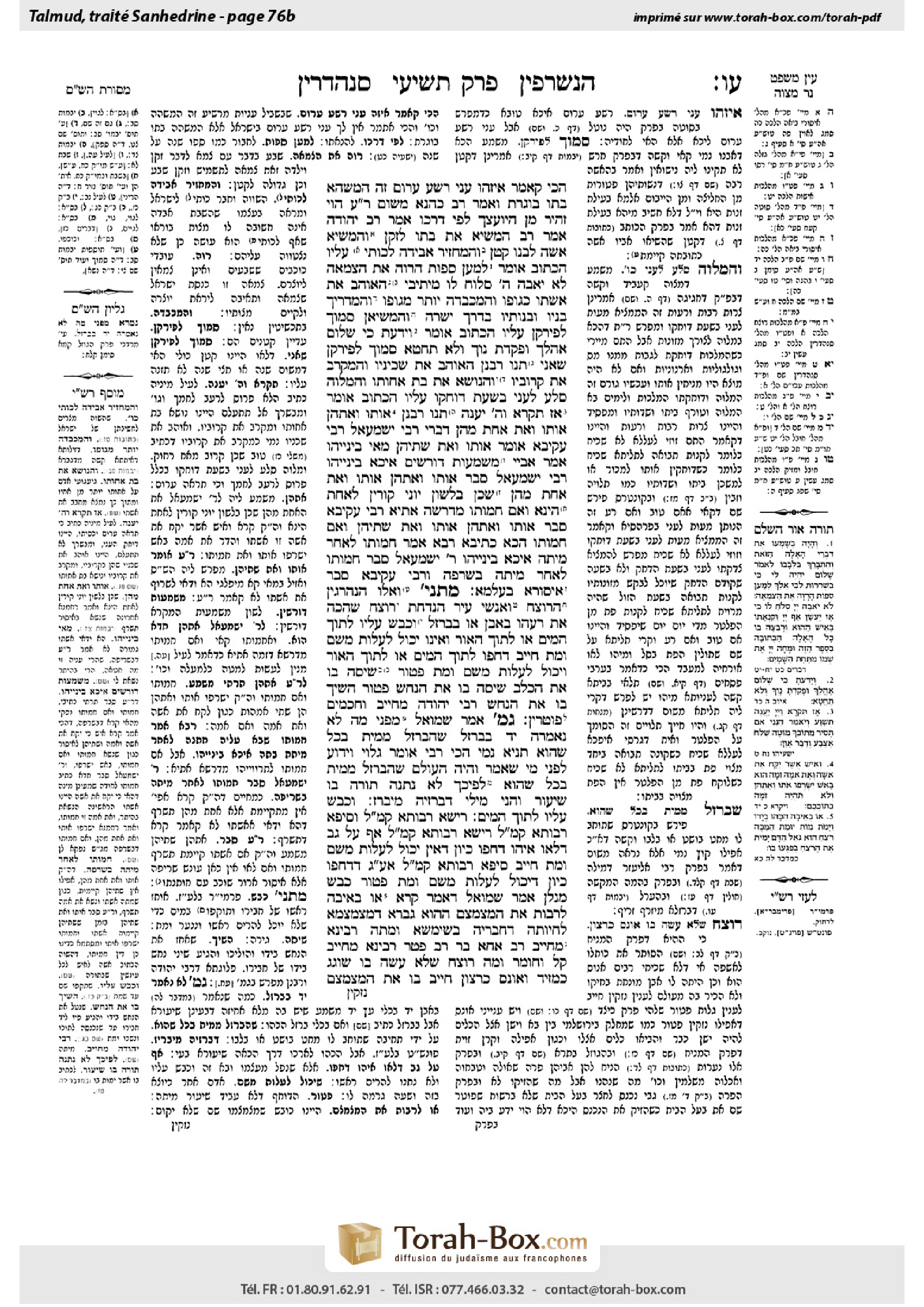
Sanhedrin 76b: Talmud study for Daf Yomi
Daf Yomi is the daily study of one Talmud folio. Explore 37 tractates with scans, Hebrew text, Sefaria English and AI-generated French translations where annotated.
Passage selection and English or AI-generated French translation are available where the scan has annotations. Daf Study is independent of Torah-Box and Sefaria.
Browse Sanhedrin · סנהדרין · All tractatesSanhedrin 76b text and translations
This page of Sanhedrin includes the Aramaic text, an English translation and an AI-generated French translation, alongside the scan above.
סנהדרין ע״ו ב · Aramaic and Hebrew text
הָכִי קָאָמַר: אֵיזֶהוּ עָנִי רָשָׁע עָרוּם? זֶה הַמַּשְׁהֶא בִּתּוֹ בּוֹגֶרֶת. וְאָמַר רַב כָּהֲנָא מִשּׁוּם רַבִּי עֲקִיבָא: הֱוֵי זָהִיר מִן הַיּוֹעֶצְךָ לְפִי דַּרְכּוֹ.
אָמַר רַב יְהוּדָה אָמַר רַב: הַמַּשִּׂיא אֶת בִּתּוֹ לְזָקֵן, וְהַמַּשִּׂיא אִשָּׁה לִבְנוֹ קָטָן, וְהַמַּחְזִיר אֲבֵידָה לְנׇכְרִי – עָלָיו הַכָּתוּב אוֹמֵר: ״לְמַעַן סְפוֹת הָרָוָה אֶת הַצְּמֵאָה. לֹא יֹאבֶה ה׳ סְלֹחַ לוֹ״.
מֵיתִיבִי: הָאוֹהֵב אֶת אִשְׁתּוֹ כְּגוּפוֹ, וְהַמְכַבְּדָהּ יוֹתֵר מִגּוּפוֹ, וְהַמַּדְרִיךְ בָּנָיו וּבְנוֹתָיו בְּדֶרֶךְ יְשָׁרָה, וְהַמַּשִּׂיאָן סָמוּךְ לְפִירְקָן – עָלָיו הַכָּתוּב אוֹמֵר: ״וְיָדַעְתָּ כִּי שָׁלוֹם אׇהֳלֶךָ וּפָקַדְתָּ נָוְךָ וְלֹא תֶחֱטָא״. סָמוּךְ לְפִירְקָן – שָׁאנֵי.
תָּנוּ רַבָּנַן: הָאוֹהֵב אֶת שְׁכֵינָיו, וְהַמְקָרֵב אֶת קְרוֹבָיו, וְהַנּוֹשֵׂא אֶת בַּת אֲחוֹתוֹ, וְהַמַּלְוֶה סֶלַע לְעָנִי בִּשְׁעַת דּוֹחְקוֹ – עָלָיו הַכָּתוּב אוֹמֵר: ״אָז תִּקְרָא וַה׳ יַעֲנֶה״.
תָּנוּ רַבָּנַן: ״אֹתוֹ וְאֶתְהֶן״ – אוֹתוֹ וְאֶת אַחַת מֵהֶן, דִּבְרֵי רַבִּי יִשְׁמָעֵאל. רַבִּי עֲקִיבָא אוֹמֵר: אוֹתוֹ וְאֶת שְׁתֵּיהֶן.
מַאי בֵּינַיְיהוּ? אָמַר אַבָּיֵי: מַשְׁמָעוּת דּוֹרְשִׁים אִיכָּא בֵּינַיְיהוּ.
רַבִּי יִשְׁמָעֵאל סָבַר: ״אֹתוֹ וְאֶתְהֶן״ – אוֹתוֹ וְאֶת אַחַת מֵהֶן, שֶׁכֵּן בְּלָשׁוֹן יְוָנִי קוֹרִין לְאַחַת ״הִינָא״. וְאֵם חֲמוֹתוֹ – מִדְּרָשָׁא אָתְיָא. רַבִּי עֲקִיבָא סָבַר: ״אֹתוֹ וְאֶתְהֶן״ – אוֹתוֹ וְאֶת שְׁתֵּיהֶן, וְאֵם חֲמוֹתוֹ הָכָא כְּתִיבָא.
רָבָא אָמַר: חֲמוֹתוֹ לְאַחַר מִיתָה אִיכָּא בֵּינַיְיהוּ. רַבִּי יִשְׁמָעֵאל סָבַר: חֲמוֹתוֹ לְאַחַר מִיתָה בִּשְׂרֵפָה, וְרַבִּי עֲקִיבָא סָבַר: אִיסּוּרָא בְּעָלְמָא.
מַתְנִי׳ וְאֵלּוּ הַנֶּהֱרָגִין: הָרוֹצֵחַ, וְאַנְשֵׁי עִיר הַנִּדַּחַת.
רוֹצֵחַ שֶׁהִכָּה אֵת רֵעֵהוּ בְּאֶבֶן אוֹ בְּבַרְזֶל, וְכָבַשׁ עָלָיו לְתוֹךְ הַמַּיִם אוֹ לְתוֹךְ הָאוּר, וְאֵינוֹ יָכוֹל לַעֲלוֹת מִשָּׁם וָמֵת – חַיָּיב.
דְּחָפוֹ לְתוֹךְ הַמַּיִם אוֹ לְתוֹךְ הָאוּר, וְיָכוֹל לַעֲלוֹת מִשָּׁם וָמֵת – פָּטוּר. שִׁיסָּה בּוֹ אֶת הַכֶּלֶב, שִׁיסָּה בּוֹ אֶת הַנָּחָשׁ – פָּטוּר. הִשִּׁיךְ בּוֹ אֶת הַנָּחָשׁ: רַבִּי יְהוּדָה מְחַיֵּיב, וַחֲכָמִים פּוֹטְרִין.
גְּמָ׳ אָמַר שְׁמוּאֵל: מִפְּנֵי מָה לֹא נֶאֶמְרָה ״יָד״ בַּבַּרְזֶל? שֶׁהַבַּרְזֶל מֵמִית בְּכׇל שֶׁהוּא.
תַּנְיָא נָמֵי הָכִי: רַבִּי אוֹמֵר, גָּלוּי וְיָדוּעַ לִפְנֵי מִי שֶׁאָמַר וְהָיָה הָעוֹלָם שֶׁהַבַּרְזֶל מֵמִית בְּכׇל שֶׁהוּא, לְפִיכָךְ לֹא נָתְנָה תּוֹרָה בּוֹ שִׁיעוּר. וְהָנֵי מִילֵּי דְּבַרְזֵיהּ מִיבְרָז.
וְכָבַשׁ עָלָיו לְתוֹךְ הַמַּיִם. רֵישָׁא רְבוּתָא קָא מַשְׁמַע לַן, וְסֵיפָא רְבוּתָא קָא מַשְׁמַע לַן. רֵישָׁא רְבוּתָא קָא מַשְׁמַע לַן: אַף עַל גַּב דְּלָאו אִיהוּ דְּחָפוֹ, כֵּיוָן דְּאֵין יָכוֹל לַעֲלוֹת מִשָּׁם וָמֵת – חַיָּיב. סֵיפָא רְבוּתָא קָא מַשְׁמַע לַן: אַף עַל גַּב דִּדְחָפוֹ, כֵּיוָן דְּיָכוֹל לַעֲלוֹת מִשָּׁם וָמֵת – פָּטוּר.
כָּבַשׁ – מְנָלַן? אָמַר שְׁמוּאֵל: דְּאָמַר קְרָא ״אוֹ בְאֵיבָה״, לְרַבּוֹת אֶת הַמְצַמְצֵם.
הָהוּא גַּבְרָא דְּצַמְצְמַהּ לְחֵיוְתָא דְּחַבְרֵיהּ בְּשִׁימְשָׁא, וּמִתָה. רָבִינָא מְחַיֵּיב, רַב אַחָא בַּר רַב פָּטַר.
רָבִינָא מְחַיֵּיב, קַל וָחוֹמֶר: וּמָה רוֹצֵחַ שֶׁלֹּא עָשָׂה בּוֹ שׁוֹגֵג כְּמֵזִיד וְאוֹנֶס כְּרָצוֹן, חִיֵּיב בּוֹ אֶת הַמְצַמְצֵם.
Sanhedrin 76b · English translation
This is what Rav Kahana is saying: Who is a pauper who, due to his poverty, becomes a conniving, wicked person? This is one who delays the marriage of his daughter who is a grown woman. And Rav Kahana says in the name of Rabbi Akiva: Beware of one who advises you according to his own interests, as he is likely motivated by personal gain.
Rav Yehuda says that Rav says: One who marries his daughter to an old man, and one who takes a wife for his minor son, and one who returns a lost item to a gentile are all individuals who are the cause of sin. Marriage to an old man or a minor leaves the woman unsatisfied and is apt to lead to licentiousness. One who returns lost property to gentiles adds to the property that they stole from Jews. With regard to each of them the verse states: “Lest there should be among you a man or a woman…whose heart turns away this day from the Lord…saying: I will have peace, even though I walk in the stubbornness of my heart, that the quenched shall be added to the thirsty. The Lord will not be willing to pardon him” (Deuteronomy 29:17-19).
The Gemara raises an objection to one element of the ruling of Rav from a baraita: One who loves his wife as he loves himself, and who esteems her by giving her clothing and jewelry more than he esteems himself, and one who instructs his sons and daughters to follow an upright path, and who marries them to appropriate spouses adjacent to their reaching puberty, ensures that his home will be devoid of quarrel and sin. Concerning him the verse states: “And you shall know that your tent is in peace; and you shall visit your habitation and shall miss nothing” (Job 5:24). The baraita indicates that it is a mitzva to marry one’s children to appropriate spouses while they are young, contrary to the statement of Rav that one who takes a wife for his minor son causes sin. The Gemara replies: Adjacent to their reaching puberty is different from marrying her to a minor, as there is no concern that his daughter will sin during the brief period until her husband reaches puberty.
The Sages taught: One who loves his neighbors, and one who brings his relatives close, and one who marries the daughter of his sister, an example of a woman that he knows and likes before taking her as his wife, and one who lends a sela to a poor man at his time of need, when he has no alternative source of funds, with regard to each of them the verse states: “Break your bread for the hungry, and the poor that are cast out bring to your house; when you see the naked, you shall clothe him, and hide not yourself from your own flesh…then shall you call, and the Lord will answer; you shall cry, and He will say: Here I am” (Isaiah 58:7–9).
§ The Sages taught with regard to the verse: “And if a man takes a woman and her mother, it is lewdness; they shall be burned with fire both him and them, and there shall be no lewdness among you” (Leviticus 20:14). What is the meaning of “both him and them”? It means him and one of them, as one woman is his wife. He is liable for engaging in intercourse with the other woman; this is the statement of Rabbi Yishmael. Rabbi Akiva says: It means him and the two of them.
The Gemara asks: What is the difference between them? Clearly Rabbi Akiva does not hold that his wife is punished when he engages in intercourse with her relative. Abaye says: The difference between Rabbi Akiva and Rabbi Yishmael is with regard to the interpretation of the meaning of the verse.
Rabbi Yishmael holds that the term “both him and them [et’hen]” means him and one of them, as in the Greek language one calls the number one heina. The prohibition in the verse is with regard to one who engages in intercourse with the mother of his wife. And the prohibition of engaging in intercourse with the mother of his mother-in-law is derived through an interpretation of the verses and is not written explicitly in the Torah. Rabbi Akiva holds that the term “both him and them” means him and both of them; the prohibition in the verse is with regard to one who engages in intercourse with his mother-in-law, and the prohibition for engaging in intercourse with the mother of his mother-in-law is also written here explicitly.
Rava says: Rabbi Yishmael and Rabbi Akiva agree that the prohibition with regard to the mother of his mother-in-law is derived through interpretation, and the difference between them is with regard to one who engages in intercourse with his mother-in-law after the death of his wife. Rabbi Yishmael holds that one who engages in intercourse with his mother-in-law after the death of his wife is executed by burning. The verse indicates: Both him and one of them, meaning that he is liable to be executed by burning even if only one of the pair of his wife and mother-in-law is alive, i.e., when his wife is deceased and he engages in intercourse with his mother-in-law. And Rabbi Akiva maintains that in that case, one violates a mere prohibition and is not liable to be executed.
MISHNA: And these are the transgressors who are killed by decapitation in the implementation of the court-imposed death penalty: The murderer; and the residents of an idolatrous city, all of whom engaged in idol worship.
The mishna elaborates: In the case of a murderer who struck another with a stone or with iron, or held him in the water or in the fire, and the victim could not extricate himself from there and he died, the murderer is liable to be executed.
If one pushed another into the water or into the fire and that person could have extricated himself from there but failed to do so, and he died, the one who pushed him is exempt from punishment by a court, as he caused the death but did not actually kill the victim. For the same reason, if one set a dog against another and the dog killed him, or if one set a snake against another and the snake killed him, the one who set the dog or the snake is exempt from punishment. If he imbedded the snake’s fangs into another and caused the snake to bite him and kill him, Rabbi Yehuda deems him liable to be executed, as he is a murderer, and the Rabbis exempt him, as they maintain that he indirectly caused the individual’s death.
GEMARA: The verses state with regard to a murderer: “And if he struck him with a stone in hand, by which a man may die…or if he struck him with an instrument of wood in hand, by which a man may die, and he died, he is a murderer; the murderer shall be put to death” (Numbers 35:17-18). The term “in hand” indicates that one is liable for murder only if he utilized a stone or a wooden instrument that was of at least a certain measure. Shmuel says: For what reason was the term “in hand” not stated with regard to the iron instrument, as it is written: “But if he struck him with an instrument of iron, so that he died” (Numbers 35:16)? The reason is that an iron instrument of any size kills.
This is also taught in a baraita. Rabbi Yehuda HaNasi says: It is revealed and known before He Who spoke and the world came into being that an iron instrument of any size kills. Therefore, the Torah did not provide a measure for it. The Gemara comments: And this statement applies only when the murderer stabbed him with the iron instrument. But in a case where the murderer struck another with an iron instrument, he is liable only if the instrument was at least a certain measure capable of causing death.
§ The mishna teaches: Or held him in the water and that other person died, the murderer is liable. The Gemara comments: The first clause of the mishna teaches us a novel element, and the latter clause of the mishna teaches us a novel element. The first clause teaches us a novel element: Even though it was not he who pushed the individual into the water, since he held the victim and the victim could not extricate himself from there and he died, the one who held him in the water is liable to be executed. The latter clause teaches us a novel element: Even though he pushed the individual into the water, since the victim could have extricated himself from there but failed to do so and he died, the one who pushed him is exempt from punishment.
The Gemara asks: From where do we derive that one who held another in the water is liable to be executed? Shmuel says: It is derived from a verse, as the verse states: “Or in enmity he struck him with his hand and he died, the assailant shall be put to death; he is a murderer” (Numbers 35:21). The phrase “or in enmity” serves to include one who confines another in a place where he cannot survive.
There was a certain man who confined the animal of another in a place in the sun and it died from exposure to the sun. Ravina deemed the man liable to recompense the owner as though his action caused the death of the animal. Rav Aḥa bar Rav deemed him exempt from recompensing the owner, as it was not his action that caused the death of the animal.
The Gemara elaborates: Ravina deemed him liable to recompense the owner, and he derived it by means of an a fortiori inference: Just as with regard to a murderer, where the Torah did not render the legal status of one who kills unwittingly, who is exiled, like that of one who kills intentionally, who is executed, and did not render the status of one who kills due to circumstances beyond his control, who is exempt from punishment, like that of one who kills with intent, who is liable, nevertheless the Torah rendered one who confines another in a place where he cannot survive liable to be executed, even though he did not perform an action;
Sanhedrin 76b · Traduction française (IA)
Voici ce que dit Rav Kahana : Qui est le pauvre qui, du fait de sa pauvreté, devient rusé et méchant ? C’est celui qui retarde le mariage de sa fille devenue adulte. Rav Kahana dit aussi au nom de Rabbi Akiva : Méfie-toi de celui qui te conseille selon ses propres intérêts, car il est probablement motivé par son profit personnel.
Rav Yehouda dit au nom de Rav : Celui qui donne sa fille en mariage à un vieillard, celui qui prend une épouse pour son fils mineur et celui qui restitue un objet perdu à un non-Juif sont tous des individus qui causent le péché. Le mariage avec un vieillard ou un mineur laisse la femme insatisfaite et risque de la conduire à la débauche. Celui qui restitue un objet perdu à des non-Juifs accroît les biens qu’ils ont volés aux Juifs. À propos de chacun d’eux, le verset dit : « Qu’il n’y ait parmi vous ni homme ni femme… dont le cœur se détourne aujourd’hui de l’Éternel… en disant : Je serai en paix, même si je marche selon l’obstination de mon cœur, de sorte que l’arrosé soit ajouté à l’assoiffé. L’Éternel ne consentira pas à lui pardonner » (Deutéronome 29, 17-19).
La Guemara soulève une objection à l’un des éléments de la décision de Rav, à partir d’une baraïta : Celui qui aime son épouse comme lui-même, qui l’estime en lui donnant des vêtements et des bijoux plus qu’il ne s’en accorde à lui-même, qui enseigne à ses fils et à ses filles à suivre une voie droite et les marie à des conjoints convenables à l’approche de leur puberté, assure la paix dans son foyer et le préserve du péché. À son sujet, le verset dit : « Tu sauras que ta tente est en paix ; tu visiteras ta demeure et tu ne manqueras de rien » (Job 5, 24). La baraïta indique que c’est une mitsva de marier ses enfants à des conjoints convenables alors qu’ils sont jeunes, contrairement à la déclaration de Rav selon laquelle celui qui prend une épouse pour son fils mineur cause le péché. La Guemara répond : Les marier à l’approche de la puberté, c’est différent du fait de marier sa fille à un mineur, car il n’y a pas lieu de craindre que sa fille pèche pendant le bref laps de temps qui précède la puberté de son mari.
Les Sages ont enseigné : Celui qui aime ses voisins, celui qui rapproche ses proches, celui qui épouse la fille de sa sœur — exemple d’une femme qu’il connaît et qu’il apprécie avant de la prendre pour épouse — et celui qui prête un sela à un pauvre au moment où il en a besoin, lorsqu’il n’a aucune autre source de fonds, à propos de chacun d’eux, le verset dit : « Partage ton pain avec l’affamé, et fais entrer chez toi les pauvres sans abri ; quand tu vois un homme nu, couvre-le, et ne te détourne pas de ton semblable… alors tu appelleras, et l’Éternel répondra ; tu crieras, et Il dira : Me voici » (Isaïe 58, 7-9).
§ Les Sages ont enseigné à propos du verset : « Si un homme prend une femme et sa mère, c’est une dépravation ; ils seront brûlés au feu, lui et elles, afin qu’il n’y ait pas de dépravation parmi vous » (Lévitique 20, 14). Que signifie « lui et elles » ? Cela signifie lui et l’une d’elles, puisque l’une des femmes est son épouse. Il est passible d’une peine pour avoir eu des relations avec l’autre femme ; telle est la déclaration de Rabbi Yichmaël. Rabbi Akiva dit : Cela signifie lui et les deux femmes.
La Guemara demande : Quelle est la différence entre eux ? Il est évident que Rabbi Akiva ne considère pas que son épouse soit punie lorsqu’il a des relations avec une parente de celle-ci. Abayé dit : La différence entre Rabbi Akiva et Rabbi Yichmaël concerne l’interprétation du verset.
Rabbi Yichmaël considère que l’expression « lui et elles [et’hen] » signifie lui et l’une d’elles, car en grec, le nombre un se dit heina. L’interdiction du verset concerne celui qui a des relations avec la mère de son épouse. L’interdiction d’avoir des relations avec la mère de sa belle-mère se déduit par l’interprétation des versets et n’est pas explicitement écrite dans la Torah. Rabbi Akiva considère que l’expression « lui et elles » signifie lui et les deux femmes ; l’interdiction du verset concerne celui qui a des relations avec sa belle-mère, et l’interdiction d’avoir des relations avec la mère de sa belle-mère est également explicitement écrite ici.
Rava dit : Rabbi Yichmaël et Rabbi Akiva conviennent que l’interdiction concernant la mère de sa belle-mère se déduit par interprétation ; leur désaccord porte sur celui qui a des relations avec sa belle-mère après la mort de son épouse. Rabbi Yichmaël considère que celui qui a des relations avec sa belle-mère après la mort de son épouse est exécuté par le feu. Le verset indique « lui et l’une d’elles », ce qui signifie qu’il est passible d’être exécuté par le feu même si une seule des deux, son épouse ou sa belle-mère, est en vie, c’est-à-dire lorsque son épouse est morte et qu’il a des relations avec sa belle-mère. Rabbi Akiva, quant à lui, maintient que dans ce cas, il ne transgresse qu’une simple interdiction et n’est pas passible d’exécution.
MICHNA : Voici les transgresseurs qui sont mis à mort par décapitation dans le cadre de la peine capitale prononcée par le tribunal : le meurtrier et les habitants d’une ville idolâtre, qui ont tous pratiqué le culte des idoles.
La Michna précise : Dans le cas d’un meurtrier qui a frappé quelqu’un avec une pierre ou un objet en fer, ou qui l’a maintenu dans l’eau ou dans le feu, et que la victime n’a pas pu s’en extraire et est morte, le meurtrier est passible d’exécution.
Si quelqu’un a poussé une autre personne dans l’eau ou dans le feu, et que celle-ci aurait pu s’en extraire mais ne l’a pas fait et est morte, celui qui l’a poussée est exempt de peine devant le tribunal, car il a causé sa mort sans avoir tué lui-même la victime. Pour la même raison, si quelqu’un a lancé un chien contre une autre personne et que le chien l’a tuée, ou s’il a lancé un serpent contre elle et que le serpent l’a tuée, celui qui a lancé le chien ou le serpent est exempt de peine. S’il a enfoncé les crochets du serpent dans une autre personne et l’a ainsi amenée à la mordre et à la tuer, Rabbi Yehouda le déclare passible d’exécution, car c’est un meurtrier, tandis que les Sages l’en exemptent, puisqu’ils considèrent qu’il a causé indirectement la mort de cette personne.
GUEMARA : Les versets disent au sujet d’un meurtrier : « S’il l’a frappé avec une pierre à la main, qui peut causer la mort d’un homme… ou s’il l’a frappé avec un instrument de bois à la main, qui peut causer la mort d’un homme, et qu’il est mort, c’est un meurtrier ; le meurtrier sera mis à mort » (Nombres 35, 17-18). L’expression « à la main » indique qu’on n’est passible du meurtre que si l’on a utilisé une pierre ou un instrument de bois d’une certaine dimension au moins. Chmouel dit : Pour quelle raison l’expression « à la main » n’est-elle pas employée à propos de l’instrument de fer, comme il est écrit : « Mais s’il l’a frappé avec un instrument de fer et qu’il est mort » (Nombres 35, 16) ? C’est parce qu’un instrument de fer de n’importe quelle taille peut tuer.
Cela est également enseigné dans une baraïta. Rabbi Yehouda ha-Nassi dit : Il est révélé et connu devant Celui qui a parlé et le monde est venu à l’existence qu’un instrument de fer de n’importe quelle taille peut tuer. La Torah ne lui a donc pas attribué de mesure. La Guemara commente : Cette déclaration ne s’applique que lorsque le meurtrier l’a transpercé avec l’instrument de fer. Mais si le meurtrier a frappé quelqu’un avec un instrument de fer, il n’est passible que si l’instrument avait au moins une certaine dimension, capable de provoquer la mort.
§ La Michna enseigne : Ou s’il l’a maintenu dans l’eau et que cette personne est morte, le meurtrier est passible. La Guemara commente : La première partie de la Michna nous enseigne un élément nouveau, et la dernière partie de la Michna nous en enseigne un autre. La première partie nous enseigne que, même si ce n’est pas lui qui a poussé la personne dans l’eau, puisqu’il a maintenu la victime et que celle-ci n’a pas pu s’en extraire et est morte, celui qui l’a maintenue dans l’eau est passible d’exécution. La dernière partie nous enseigne que, même s’il a poussé la personne dans l’eau, puisque la victime aurait pu s’en extraire mais ne l’a pas fait et est morte, celui qui l’a poussée est exempt de peine.
La Guemara demande : D’où déduit-on que celui qui a maintenu une autre personne dans l’eau est passible d’exécution ? Chmouel dit : Cela se déduit d’un verset, car le verset dit : « Ou, par inimitié, il l’a frappé de sa main et il est mort ; l’agresseur sera mis à mort, car c’est un meurtrier » (Nombres 35, 21). L’expression « ou, par inimitié » inclut celui qui enferme une autre personne dans un endroit où elle ne peut survivre.
Un homme enferma l’animal d’un autre dans un endroit exposé au soleil, et l’animal mourut sous l’effet du soleil. Ravina jugea l’homme tenu d’indemniser le propriétaire, comme si son acte avait causé la mort de l’animal. Rav Aḥa bar Rav le jugea exempt d’indemniser le propriétaire, car ce n’était pas son acte qui avait causé la mort de l’animal.
La Guemara précise : Ravina jugea l’homme tenu d’indemniser le propriétaire et le déduisit au moyen d’un raisonnement a fortiori : de même qu’en matière de meurtre, la Torah n’a pas assimilé celui qui tue involontairement, qui est exilé, à celui qui tue intentionnellement, qui est exécuté ; elle n’a pas non plus assimilé celui qui tue en raison de circonstances indépendantes de sa volonté, qui est exempt de peine, à celui qui tue intentionnellement, qui est passible. Pourtant, la Torah a rendu passible d’exécution celui qui enferme une autre personne dans un endroit où elle ne peut survivre, même s’il n’a accompli aucune action ;
Traduction française générée par IA à partir de l’édition anglaise de Sefaria. Vérifie toujours un passage avec le texte source.
Text from Sefaria: William Davidson Edition - Vocalized Aramaic (CC BY NC); William Davidson Edition - English (CC BY NC).