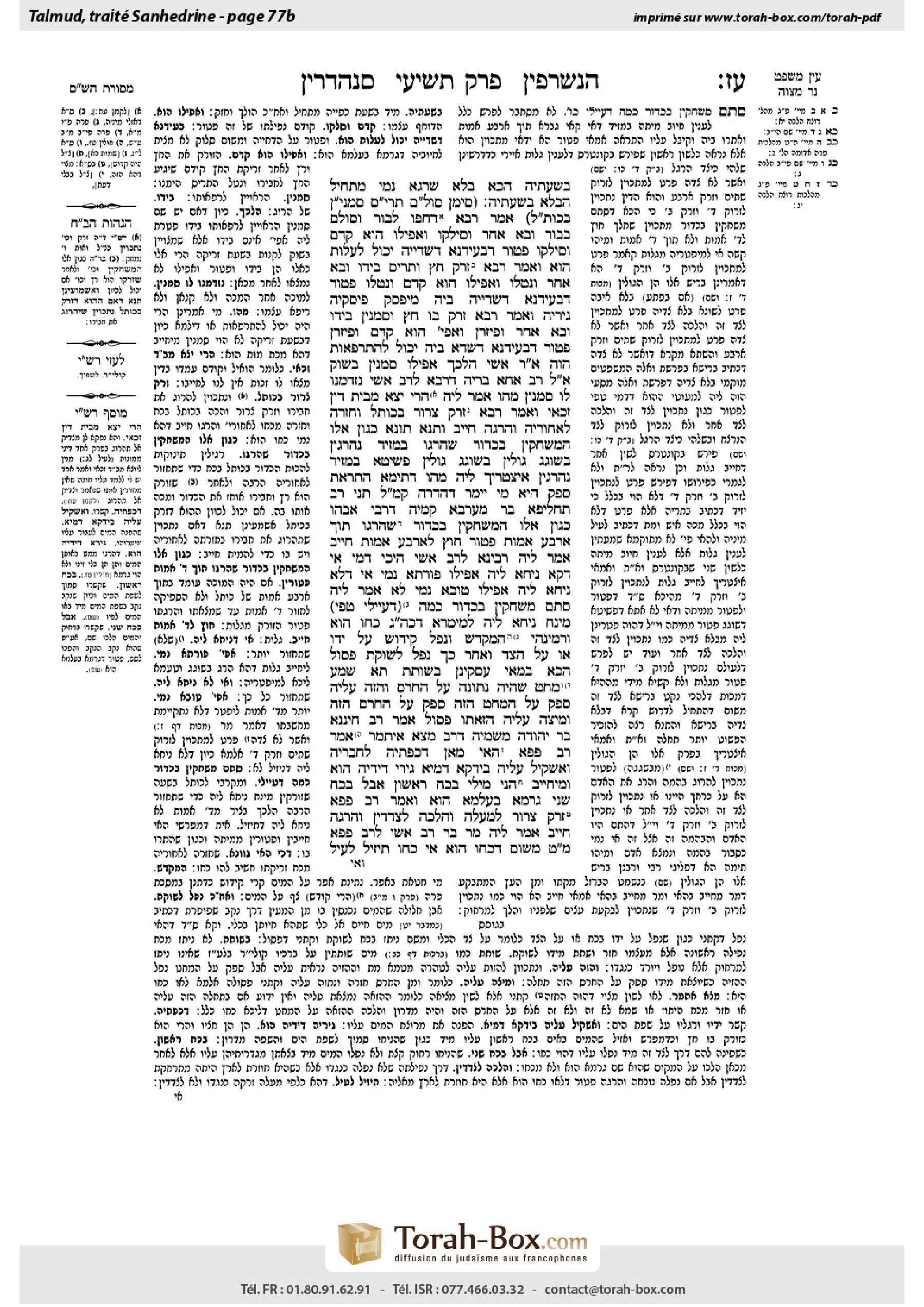
Sanhedrin 77b: Talmud study for Daf Yomi
Daf Yomi is the daily study of one Talmud folio. Explore 37 tractates with scans, Hebrew text, Sefaria English and AI-generated French translations where annotated.
Passage selection and English or AI-generated French translation are available where the scan has annotations. Daf Study is independent of Torah-Box and Sefaria.
Browse Sanhedrin · סנהדרין · All tractatesSanhedrin 77b text and translations
This page of Sanhedrin includes the Aramaic text, an English translation and an AI-generated French translation, alongside the scan above.
סנהדרין ע״ז ב · Aramaic and Hebrew text
בְּשַׁעְתֵּיהּ. הָכָא, בְּלָא שְׁרָגָא נָמֵי מַתְחֵיל הַבְלָא בְּשַׁעְתֵּיהּ.
(סִימָן: סוּלָּם, תְּרִיס, סַמָּנִין, בַּכּוֹתֶל).
אָמַר רָבָא: דְּחָפוֹ לְבוֹר, וְסוּלָּם בַּבּוֹר, וּבָא אַחֵר וְסִילְּקוֹ, וַאֲפִילּוּ הוּא קָדַם וְסִילְּקוֹ – פָּטוּר, דִּבְעִידָּנָא דְּשַׁדְיֵיהּ יָכוֹל לַעֲלוֹת הוּא.
וְאָמַר רָבָא: זָרַק חֵץ, וּתְרִיס בְּיָדוֹ, וּבָא אַחֵר וּנְטָלוֹ, וַאֲפִילּוּ הוּא קָדַם וּנְטָלוֹ – פָּטוּר, דִּבְעִידָּנָא דְּשַׁדְיֵיהּ בֵּיהּ מִיפְסָק פְּסִיקִי גִּירֵיהּ.
וְאָמַר רָבָא: זָרַק בּוֹ חֵץ, וְסַמָּנִין בְּיָדוֹ, וּבָא אַחֵר וּפִיזְּרָן, וַאֲפִילּוּ הוּא קָדַם וּפִיזְּרָן – פָּטוּר, דִּבְעִידָּנָא דִּשְׁדָא בֵּיהּ יָכוֹל לְהִתְרַפְּאוֹת הֲוָה.
אָמַר רַב אָשֵׁי: הִלְכָּךְ, אֲפִילּוּ סַמָּנִין בַּשּׁוּק. אֲמַר לֵיהּ רַב אַחָא בְּרֵיהּ דְּרָבָא לְרַב אָשֵׁי: נִזְדַּמְּנוּ לוֹ סַמָּנִין, מַהוּ? אֲמַר לֵיהּ: הֲרֵי יָצָא מִבֵּית דִּין זַכַּאי.
וְאָמַר רָבָא: זָרַק צְרוֹר בַּכּוֹתֶל, וְחָזְרָה לַאֲחוֹרֶיהָ וְהָרְגָה – חַיָּיב. וְתַנָּא תּוּנָא: כְּגוֹן אֵלּוּ הַמְשַׂחֲקִין בְּכַדּוּר שֶׁהָרְגוּ, בְּמֵזִיד – נֶהֱרָגִין, בְּשׁוֹגֵג – גּוֹלִין.
בְּשׁוֹגֵג גּוֹלִין, פְּשִׁיטָא! בְּמֵזִיד נֶהֱרָגִין אִיצְטְרִיךְ לֵיהּ. מַהוּ דְּתֵימָא: הַתְרָאַת סָפֵק הִיא, מִי יֵימַר דְּהָדְרָה? קָא מַשְׁמַע לַן.
תָּנֵי רַב תַּחְלִיפָא בַּר מַעְרְבָא קַמֵּיהּ דְּרַבִּי אֲבָהוּ: כְּגוֹן אֵלּוּ הַמְשַׂחֲקִין בְּכַדּוּר שֶׁהָרְגוּ, תּוֹךְ אַרְבַּע אַמּוֹת – פָּטוּר, חוּץ לְאַרְבַּע אַמּוֹת – חַיָּיב.
אֲמַר לֵיהּ רָבִינָא לְרַב אָשֵׁי: הֵיכִי דָמֵי? אִי דְּקָא נִיחָא לֵיהּ, אֲפִילּוּ פּוּרְתָּא נָמֵי. אִי דְּלָא נִיחָא לֵיהּ, אֲפִילּוּ טוּבָא נָמֵי לָא. אֲמַר לֵיהּ: סְתָם מְשַׂחֲקִין בְּכַדּוּר, כַּמָּה דְּעָיְילִי טְפֵי – מֵינָח נִיחָא לֵיהּ.
לְמֵימְרָא דִּכְהַאי גַּוְונָא כֹּחוֹ הוּא? וּרְמִינְהוּ: הַמְקַדֵּשׁ, וְנָפַל קִידּוּשׁ עַל יָדוֹ אוֹ עַל הַצַּד, וְאַחַר כָּךְ נָפַל לְשׁוֹקֶת – פָּסוּל.
הָכָא בְּמַאי עָסְקִינַן? בְּשׁוֹתֵת.
תָּא שְׁמַע: מַחַט שֶׁהָיָה נְתוּנָה עַל הַחֶרֶס, וְהִזָּה עָלֶיהָ – סָפֵק עַל הַמַּחַט הִזָּה, סָפֵק עַל הַחֶרֶס הִזָּה וּמִיצָּה עָלֶיהָ – הַזָּאָתוֹ פָּסוּל.
אָמַר רַב חִינָּנָא בַּר יְהוּדָה מִשְּׁמֵיהּ דְּרַב: ״מָצָא״ אִיתְּמַר.
אָמַר רַב פָּפָּא: הַאי מַאן דְּכַפְתֵיהּ לְחַבְרֵיהּ, וְאַשְׁקֵיל עֲלֵיהּ בִּידְקָא דְמַיָּא – גִּירֵי דִידֵיהּ הוּא, וּמִיחַיַּיב. הָנֵי מִילֵּי בְּכֹחַ רִאשׁוֹן, אֲבָל בְּכֹחַ שֵׁנִי – גְּרָמָא בְּעָלְמָא הוּא.
וְאָמַר רַב פָּפָּא: זָרַק צְרוֹר לְמַעְלָה וְהָלְכָה לִצְדָדִין וְהָרְגָה – חַיָּיב. אֲמַר לֵיהּ מָר בַּר רַב אָשֵׁי לְרַב פָּפָּא: מַאי טַעְמָא? מִשּׁוּם דְּכֹחוֹ הוּא? אִי כֹּחוֹ – תֵּיזִיל לְעֵיל,
Sanhedrin 77b · English translation
at the time of the perpetrator’s action, as the room is sufficiently large to enable the individual to breathe. Here, in the case where one overturns a vat upon another, even without a kindled lamp the atmosphere begins to cause suffocation at the time of the perpetrator’s actions. Therefore, the two cases are not comparable, and it is Rava who exempts the one who overturned a vat upon another.
§ The Gemara cited a mnemonic for the halakhot that follow with regard to causing the death of another: Ladder, shield, herbs, in a wall.
Rava says: In a case where one pushed another into the pit and there was a ladder in the pit that would enable him to emerge from it, and another individual came and removed the ladder, or even if the perpetrator himself removed the ladder before the one whom he pushed could emerge, causing him to die of starvation, the perpetrator is exempt from execution. The reason is that at the time that he cast him into the pit, the victim was able to ascend and emerge from the pit. Pushing him into the pit did not cause his death, and the removal of the ladder merely prevented the victim from emerging, but was not an action that directly caused his death.
And Rava says: In the case of one who shot an arrow at another, and there was a shield [teris] in the victim’s hand, if another individual came and took the shield from him, or even if the one who shot the arrow took the shield before the arrow reached the victim, the attacker is exempt from execution. The reason is that at the time that he shot the arrow at the victim, his arrows were blocked from the one being attacked by the shield, and they could not harm him. The victim’s death was caused indirectly, by removal of the shield.
And Rava says: In the case of one who shot an arrow at another and the victim had herbs in his possession capable of healing the wound from the arrow before it became fatal, if another individual came and scattered the herbs, or even if the one who shot the arrow scattered them before the victim could heal his wound with the herbs, the attacker is exempt from execution. The reason is that at the time that he shot the arrow at him, the victim was able to be cured. The arrow caused injury, but the victim died due to the unavailability of a cure.
Rav Ashi says: It is established that one who shoots an arrow at another is exempt when herbs that could facilitate his recovery are available; therefore, even if there are herbs available in the marketplace, the attacker is exempt from execution, as in that case, too, the herbs are available. Rav Aḥa, son of Rava, said to Rav Ashi: If the herbs were not available in the marketplace, and herbs capable of healing the wound happened to enter into the victim’s possession, yet he neglected to use them and died, what is the halakha? Rav Ashi said to Rav Aḥa: He emerged from the court innocent. As long as there was a possibility that the victim could heal his wound with the herbs, the one who shot the arrow is not a murderer; rather, he is merely one who caused death indirectly.
§ And Rava says: In the case of one who threw a stone with the intent to kill another, and the stone caromed off the wall and rebounded back and killed a different individual, the attacker is liable. And the tanna taught a similar halakha in a baraita: In a case where those who were playing with a ball killed another by hitting him with the rebounding ball, if they did so intentionally, they are executed by beheading; if they did so unwittingly, they are exiled.
The Gemara asks: If they did so unwittingly, they are exiled; isn’t this obvious? All unwitting murderers are exiled. The Gemara answers: The novel element in this baraita is not that the unwit-ting murderer is exiled; rather, it was necessary for the tanna to teach that if they did so intentionally, they are executed. This halakha needed to be taught lest you say that they cannot be executed because the death penalty requires certain forewarning, i.e., forewarning of an action that will certainly lead to the death penalty, and in this case the forewarning is uncertain, as who is to say that the ball will rebound and cause death? Therefore, the tanna teaches us that those who play ball are trained in throwing it and the ball will certainly rebound; therefore, there is no uncertainty.
Rav Taḥlifa, from the West, Eretz Yisrael, taught this baraita before Rabbi Abbahu: In a case where those who were playing with a ball killed an individual by hitting him with the ball, if the ball struck the individual within four cubits of the one who threw the ball, he is exempt from being exiled, as it was certainly not his intent to throw the ball so short a distance; beyond four cubits, he is liable to be exiled.
Ravina said to Rav Ashi, questioning this halakha: What are the circumstances? If he was amenable to having the ball travel a short distance, then he should be liable even for a throw less than four cubits. And if he was not amenable to having the ball travel the distance that it traveled, but he wanted it to travel farther, then he should not be liable even for a throw greater than four cubits. In what case is the measure of four cubits significant? Rabbi Abbahu said to him: With regard to ordinary people who play with a ball, the farther they enter and approach the wall, the more amenable they are to the result, as the ball caroms off the wall and rebounds farther. Therefore, presumably their intent was that the ball would travel a distance greater than four cubits.
The Gemara questions the principle underlying this halakha. Is that to say that in a case like this, when an item caroms off the wall, the action is considered the result of his force? And the Gemara raises a contradiction from a mishna (Para 6:1): In the case of one who sanctifies the waters of purification by placing the ashes of the red heifer into the water, in order to sprinkle on one impure with impurity imparted by a corpse, and the sacred ashes fell on his hand or on the side of the vessel and only thereafter it fell into the water in the trough, the purification waters are unfit, since there is a requirement that the ashes must be placed in the water by the force of his action. Likewise, when an item caroms off a wall, the action is not generated by the force of his action; therefore, he should not be liable.
The Gemara answers: With what are we dealing here? We are dealing with a case where the ashes trickle from his hand or from the sides of the vessel into the water, a slow movement that is not generated by the force of his action. This is in contrast to the case where he throws a ball off the wall.
The Gemara suggests: Come and hear proof that only an action that one generates directly is considered the force of his action, as it is taught in a mishna (Para 12:2): Concerning a needle that was impure with impurity imparted by a corpse and was placed on an earthenware shard, and one sprinkled water of purification; if there is uncertainty whether he actually sprinkled the purification water on the needle or whether he sprinkled it on the earthenware shard and the water inadvertently sprayed upon the needle, his sprinkling is unfit. Apparently, an action performed indirectly is not considered to have been generated by his force.
Rav Ḥinnana bar Yehuda said in the name of Rav: Emend the mishna: Sprayed [mitza] was not stated in the mishna; found [matza] was stated. That is, it was found that the needle was wet, and it is not clear whether it was wet from purification water sprinkled directly upon it or from water that dripped from the earthenware onto the needle. This case is not comparable to the case of one who throws a ball off a wall.
Rav Pappa says: With regard to this one who bound another and diverted a flow of water upon him and he died, the water is tantamount to his arrows that were effective in committing the murder, and he is liable. And this matter applies only in a case where he killed the other individual by primary force, as the individual was near to him and was directly drowned by the water. But if the individual was further away and was killed by secondary force after the water flowed on its own, it is not his action; rather, it is merely an indirect action, and he is exempt.
And Rav Pappa says: In a case where one threw a stone upward and it went to the side, and killed an individual, he is liable. Mar, son of Rav Ashi, said to Rav Pappa: What is the reason that you say he is liable? Is it due to the fact that the result is generated by the force of his action? That cannot be, as if it is generated by the force of his action, the stone should go directly upward where he threw it, and not to the side.
Sanhedrin 77b · Traduction française (IA)
au moment de l’acte de l’auteur, puisque la pièce est suffisamment grande pour permettre à l’individu de respirer. Ici, dans le cas où quelqu’un renverse une cuve sur une autre personne, même sans lampe allumée, l’air commence à provoquer l’asphyxie au moment de l’acte de l’auteur. Les deux cas ne sont donc pas comparables, et c’est Rava qui exonère celui qui a renversé une cuve sur une autre personne.
§ La Guemara a cité un moyen mnémotechnique pour les halakhot qui suivent concernant le fait de causer la mort d’autrui : échelle, bouclier, herbes, contre un mur.
Rava dit : dans le cas où quelqu’un pousse une autre personne dans une fosse où se trouve une échelle qui lui permettrait d’en sortir, puis qu’un autre individu vient retirer l’échelle — ou même si l’auteur lui-même la retire avant que la personne qu’il a poussée puisse en sortir — et que celle-ci meurt de faim, l’auteur est exempté de la peine capitale. En effet, au moment où il l’a jetée dans la fosse, la victime pouvait remonter et en sortir. Le fait de la pousser dans la fosse n’a pas causé sa mort ; le retrait de l’échelle l’a seulement empêchée d’en sortir, mais n’a pas directement causé sa mort.
Et Rava dit : dans le cas où quelqu’un tire une flèche sur une autre personne et que la victime tient un bouclier [teris], si un autre individu vient le lui enlever — ou même si le tireur lui-même retire le bouclier avant que la flèche n’atteigne la victime — l’assaillant est exempté de la peine capitale. En effet, au moment où il a tiré sur la victime, le bouclier faisait obstacle à ses flèches et les empêchait de lui nuire. La mort de la victime a été causée indirectement, par le retrait du bouclier.
Et Rava dit : dans le cas où quelqu’un tire une flèche sur une autre personne et que la victime possède des herbes capables de guérir la blessure causée par la flèche avant qu’elle ne devienne mortelle, si un autre individu vient disperser les herbes — ou même si le tireur les disperse avant que la victime puisse s’en servir pour guérir sa blessure — l’assaillant est exempté de la peine capitale. En effet, au moment où il lui a tiré dessus, la victime pouvait être guérie. La flèche l’a blessée, mais elle est morte faute de remède.
Rav Ashi dit : il est établi que celui qui tire une flèche sur une autre personne est exempté lorsque des herbes pouvant favoriser son rétablissement sont disponibles ; par conséquent, même si des herbes sont disponibles au marché, l’assaillant est exempté de la peine capitale, car, dans ce cas aussi, les herbes sont disponibles. Rav Aḥa, fils de Rava, dit à Rav Ashi : si les herbes n’étaient pas disponibles au marché et que des herbes capables de guérir la blessure venaient par hasard en possession de la victime, mais que celle-ci néglige de les utiliser et meurt, quelle est la halakha ? Rav Ashi dit à Rav Aḥa : il est sorti du tribunal acquitté. Tant qu’il était possible que la victime guérisse sa blessure grâce aux herbes, celui qui a tiré la flèche n’est pas un meurtrier ; il a seulement causé la mort indirectement.
§ Et Rava dit : dans le cas où quelqu’un lance une pierre avec l’intention de tuer une autre personne, mais que la pierre rebondit contre un mur et tue une autre personne, l’assaillant est passible. Et le tanna enseigne une halakha semblable dans une baraïta : si des personnes qui jouaient à la balle en tuent une autre en la frappant avec la balle qui a rebondi, elles sont décapitées si elles l’ont fait intentionnellement ; si elles l’ont fait involontairement, elles sont exilées.
La Guemara demande : si elles l’ont fait involontairement, elles sont exilées ; cela n’est-il pas évident ? Tous les meurtriers involontaires sont exilés. La Guemara répond : l’élément nouveau de cette baraïta n’est pas que le meurtrier involontaire soit exilé ; le tanna devait plutôt enseigner qu’elles sont exécutées si elles l’ont fait intentionnellement. Il fallait enseigner cette halakha, de peur que tu ne dises qu’elles ne peuvent pas être exécutées, car la peine capitale exige un avertissement certain, c’est-à-dire un avertissement portant sur un acte qui conduira certainement à la peine capitale, alors qu’ici l’avertissement est incertain : qui peut dire que la balle rebondira et causera la mort ? Le tanna nous enseigne donc que ceux qui jouent à la balle sont entraînés à la lancer et que la balle rebondira certainement ; il n’y a donc aucune incertitude.
Rav Taḥlifa, de l’Ouest, c’est-à-dire de la Terre d’Israël, enseigna cette baraïta devant Rabbi Abbahu : si des personnes qui jouaient à la balle tuent un individu en le frappant avec la balle, si celle-ci l’atteint à moins de quatre coudées de celui qui l’a lancée, ce dernier est exempté de l’exil, car il n’avait certainement pas l’intention de lancer la balle sur une si courte distance ; au-delà de quatre coudées, il est passible de l’exil.
Ravina dit à Rav Ashi, contestant cette halakha : dans quelles circonstances ? S’il acceptait que la balle parcoure une courte distance, alors il devrait être passible même pour un lancer de moins de quatre coudées. Et s’il n’acceptait pas qu’elle parcoure la distance qu’elle a parcourue, mais voulait qu’elle aille plus loin, alors il ne devrait pas être passible même pour un lancer de plus de quatre coudées. Dans quel cas la mesure de quatre coudées a-t-elle une importance ? Rabbi Abbahu lui dit : chez les gens ordinaires qui jouent à la balle, plus ils s’avancent et s’approchent du mur, plus ils acceptent le résultat, car la balle rebondit contre le mur et repart plus loin. On présume donc qu’ils avaient l’intention que la balle parcoure une distance supérieure à quatre coudées.
La Guemara met en question le principe qui sous-tend cette halakha. Faut-il donc dire que, dans un cas comme celui-ci, lorsqu’un objet rebondit contre un mur, l’action est considérée comme le résultat de sa force ? La Guemara soulève une contradiction à partir d’une Michna (Para 6:1) : dans le cas de celui qui sanctifie les eaux de purification en plaçant les cendres de la vache rousse dans l’eau, afin d’en asperger une personne impure de l’impureté transmise par un cadavre, si les cendres consacrées tombent sur sa main ou sur le côté du récipient et ne tombent qu’ensuite dans l’eau du bassin, les eaux de purification sont invalides, puisqu’il est requis que les cendres soient placées dans l’eau par la force de son action. De même, lorsqu’un objet rebondit contre un mur, l’action n’est pas produite par la force de son action ; il ne devrait donc pas être passible.
La Guemara répond : de quel cas s’agit-il ici ? D’un cas où les cendres s’écoulent lentement de sa main ou des côtés du récipient jusque dans l’eau, mouvement qui n’est pas produit par la force de son action. Cela diffère du cas où il lance une balle contre le mur.
La Guemara propose : viens entendre une preuve que seule une action que l’on produit directement est considérée comme résultant de la force de son action, ainsi qu’il est enseigné dans une Michna (Para 12:2) : au sujet d’une aiguille impure de l’impureté transmise par un cadavre, placée sur un tesson de poterie, et sur laquelle on a aspergé de l’eau de purification, s’il est incertain qu’il ait effectivement aspergé l’aiguille d’eau de purification ou qu’il ait aspergé le tesson et que l’eau ait atteint l’aiguille par éclaboussure, son aspersion est invalide. Il apparaît donc qu’une action accomplie indirectement n’est pas considérée comme ayant été produite par sa force.
Rav Ḥinnana bar Yehuda dit au nom de Rav : corrige la Michna : on n’y a pas dit « a éclaboussé » [mitza], mais « a trouvé » [matza]. Autrement dit, on a trouvé l’aiguille mouillée, sans savoir si elle l’était à cause de l’eau de purification directement aspergée dessus ou de l’eau qui avait coulé du tesson sur l’aiguille. Ce cas n’est pas comparable à celui de quelqu’un qui lance une balle contre un mur.
Rav Pappa dit : dans le cas de celui qui a ligoté une autre personne, a détourné vers elle un courant d’eau et l’a ainsi fait mourir, l’eau équivaut à ses flèches, qui ont effectivement causé le meurtre, et il est passible. Cela ne s’applique que dans le cas où il a tué l’autre individu par une force primaire, car celui-ci était près de lui et a été directement noyé par l’eau. Mais si l’individu était plus éloigné et a été tué par une force secondaire, après que l’eau s’est écoulée d’elle-même, ce n’est pas son action ; c’est seulement une action indirecte, et il est exempté.
Et Rav Pappa dit : dans le cas où quelqu’un lance une pierre vers le haut, mais qu’elle part de côté et tue un individu, il est passible. Mar, fils de Rav Ashi, dit à Rav Pappa : pourquoi dis-tu qu’il est passible ? Est-ce parce que le résultat est produit par la force de son action ? Cela ne peut pas être le cas, car si le résultat est produit par la force de son action, la pierre devrait aller directement vers le haut, là où il l’a lancée, et non de côté.
Traduction française générée par IA à partir de l’édition anglaise de Sefaria. Vérifie toujours un passage avec le texte source.
Text from Sefaria: William Davidson Edition - Vocalized Aramaic (CC BY NC); William Davidson Edition - English (CC BY NC).